Hubbry Logo
EmbolomeriEmbolomeriMain
Open search
Embolomeri
Community hub
Embolomeri
logo
8 pages, 0 posts
0 subscribers
Be the first to start a discussion here.
Embolomeri
Embolomeri
from Wikipedia

Embolomeres
Temporal range: Mississippian - Wuchiapingian
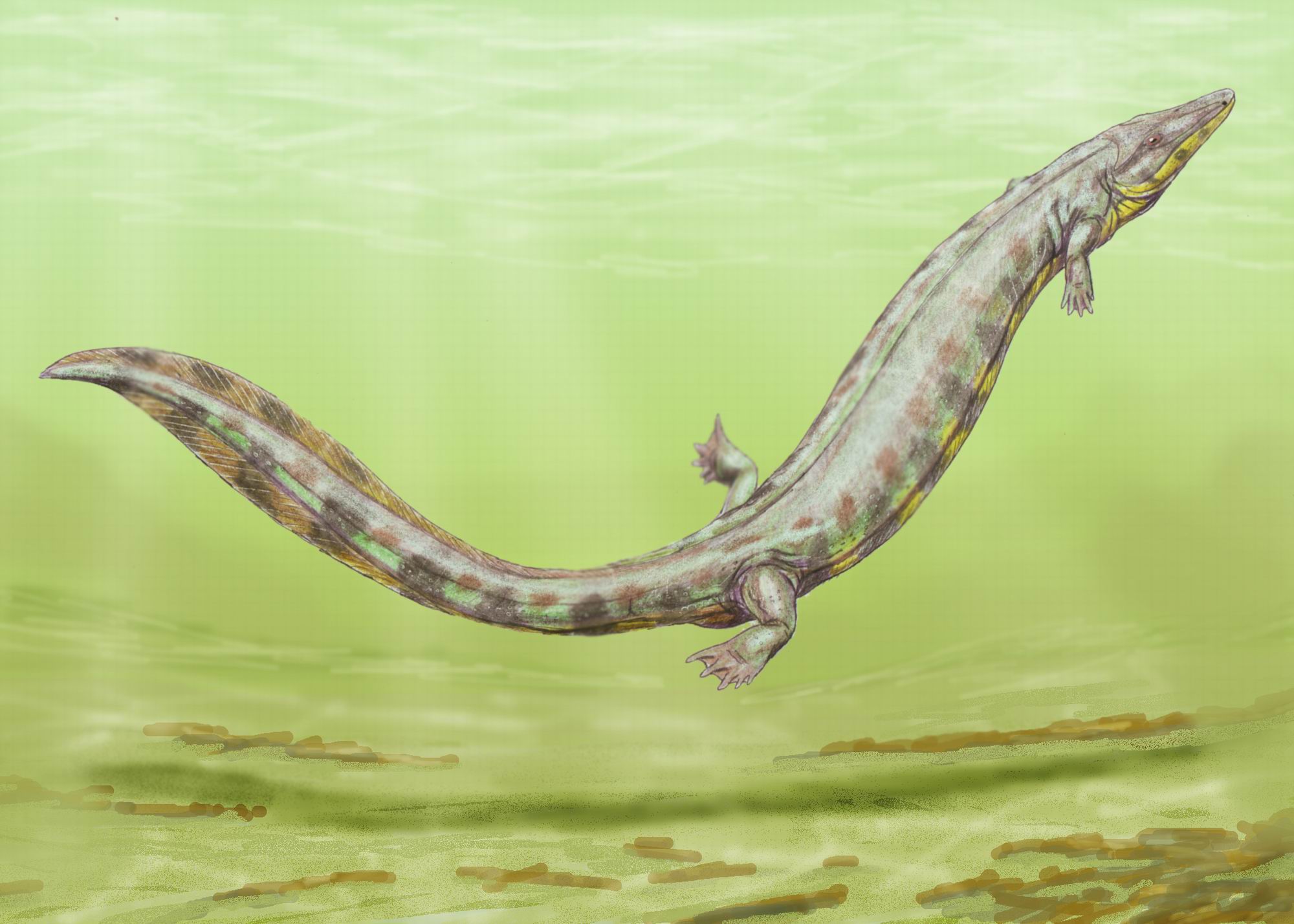
Restoration of Archeria from the Lower Permian of Texas.
Scientific classification Edit this classification
Kingdom: Animalia
Phylum: Chordata
Clade: Stegocephali
Order: Embolomeri
Cope, 1885
Genera

See text.

Embolomeri is an order of tetrapods or stem-tetrapods, possibly members of Reptiliomorpha. Embolomeres first evolved in the Early Carboniferous (Mississippian) Period and were the largest and most successful predatory tetrapods of the Late Carboniferous (Pennsylvanian) Period. They were specialized semiaquatic predators with long bodies for eel-like undulatory swimming. Embolomeres are characterized by their vertebral centra, which are formed by two cylindrical segments, the pleurocentrum at the rear and intercentrum at the front. These segments are equal in size. Most other tetrapods have pleurocentra and intercentra which are drastically different in size and shape.[1]

Embolomeres were among the earliest large carnivorous tetrapods, with members such as the crocodilian-like Proterogyrinus appearing in the Visean stage of the Carboniferous. They declined in diversity during the Permian period, though at least one representative (Archeria) was common in the Early Permian.[2] Embolomeres went extinct shortly before the end of the Permian.[3]

Classification

[edit]
Vertebrae from several different tetrapods, with those of "Cricotus" (Archeria) in A-C, showing the large, cylindrical intercentra (I) and pleurocentra (P)

The order Embolomeri was first named by Edward Drinker Cope in 1884 during his revision of "batrachian" (amphibian) evolution. Embolomeri was differentiated from several other newly named amphibian orders, such as "Rachitomi", by the presence of intercentra and pleurocentra of the same size and shape, that being large cylinders. At the time, embolomere fossils were uncommon, so Cope could only identify "cricotids" such as Cricotus as possessing embolomerous vertebrae.[4] The genus name "Cricotus" is dubious, as it has been used by Cope to refer to embolomere fossils spanning anywhere between mid-Pennsylvanian deposits of Illinois and the Permian red beds of Texas. Most paleontologists now refer the red bed "Cricotus" specimens to the genus Archeria.[2]

Michel Laurin (1998) formally defined Embolomeri as "the last common ancestor of Proterogyrinus and Archeria and all of its descendants."[5] This definition excludes Eoherpeton, which is almost always considered a close ally of the group. Some authors place Silvanerpeton or chroniosuchians as close relatives as well, though they are generally agreed to lie outside Embolomeri proper.[6][7][8][9]

The poorly defined group Anthracosauria is sometimes considered synonymous with Embolomeri, and the group's namesake, Anthracosaurus, is an embolomere. However, other authors use the term "Anthracosauria" in reference to a broader group which includes embolomeres in combination with various other reptile-like amphibians (reptiliomorphs). Reptiliomorphs are all tetrapods more closely related to living reptiles and synapsids (mammals and their ancestors), rather than living amphibians. Despite this, reptiliomorphs likely had amphibian-like biological traits, such as water-based reproduction.

Many studies conducted since the 1990s have also placed the group Lepospondyli as closer to amniotes than embolomeres were. Lepospondyls are a particularly unusual group of tetrapods, with some members (i.e. brachystelechids) very similar to lissamphibians and others (i.e. tuditanids) very similar to amniotes. If lepospondyls are both close relatives of amniotes and the ancestors of modern amphibians, then that means that crown-Tetrapoda (descendants of the common ancestor to all living tetrapods) is a much more restricted group than previously assumed. In this situation, various traditional orders of Tetrapoda such as Embolomeri and Temnospondyli actually would qualify as stem-tetrapods due to having evolved prior to the split between modern amphibians and amniotes.[10]

However, most authors consider temnospondyls to be the ancestors of modern amphibians. This would suggest that embolomeres are likely reptiliomorphs (closer to reptiles) and within the clade Tetrapoda.[11] However, even this classification is not stable, as some analyses have found embolomeres to be more basal than temnospondyls.[12]

Below is a cladogram from Ruta et al. (2003):[11]

Tetrapoda

Genera

[edit]
List of genera
Name Age Location Notes Images
Anthracosaurus Pennsylvanian (Westphalian A-B) United Kingdom ( Scotland, England), United States ( Ohio) A large and widespread embolomere with a small number of oversized fangs compared to other members of the group. The namesake of Anthracosauria.
Archeria Early Permian United States ( Texas) A common, late-surviving member of the group, sometimes considered a species of Cricotus
Aversor Early Permian (Ufimian) Russia Supposedly the latest surviving eogyrinid, but very poorly known
Calligenethlon Pennsylvanian (Bashkirian) Canada ( Nova Scotia) The largest named tetrapod preserved inside lycopod tree stumps in the Joggins Fossil Cliffs
Cricotus Pennsylvanian United States ( Illinois) Responsible for the identification of Embolomeri as a unique order of tetrapods, although its history is convoluted and its taxonomic validity is questionable
Carbonoherpeton Pennsylvanian (Westphalian D) Canada ( Nova Scotia) A lightly-built member of the group with characteristics of both archeriids and eogyrinids
Diplovertebron Pennsylvanian (Moscovian) Czech Republic A small member of the group sometimes confused with Gephyrostegus
Eobaphetes Pennsylvanian United States ( Kansas) A possible relative of Anthracosaurus, originally named "Erpetosuchus" until it was determined that the name was preoccupied by a Triassic reptile. Probably from Kansas, though its exact origin remains a mystery.
Eoherpeton Mississippian-Pennsylvanian (Visean-Bashkirian) United Kingdom ( Scotland) One of the oldest and most basal members of the group (if it even counts as part of it), with vertebrae that were not fully embolomerous
Leptophractus Pennsylvanian (Westphalian D) United States ( Ohio) Known from a skull found at the Linton Diamond Mine
Neopteroplax Pennsylvanian United States ( Ohio) One of the largest Carboniferous limbed vertebrates known from North America
Palaeoherpeton Pennsylvanian (Westphalian A-B) United Kingdom ( Scotland) An eogyrinid known as Palaeogyrinus from 1926 to 1970, until it was determined that this name was occupied by a genus of beetles

Papposaurus

Mississippian-Pennsylvanian (Namurian) United Kingdom ( Scotland) Known from a femur, may have been a relative of Proterogyrinus
Pholiderpeton Pennsylvanian (Westphalian A-B) United Kingdom ( England, Scotland) An eogyrinid with two species: the older type species Pholiderpeton scutigerum and the younger species Pholiderpeton attheyi (also known as Eogyrinus). P. attheyi has the largest and best-preserved skull out of all UK embolomeres.
Proterogyrinus Mississippian (Serpukhovian) United States ( West Virginia), United Kingdom ( Scotland) An early member of the group possessing robust limbs but lacking certain adaptations of later members of the group
Pteroplax Pennsylvanian (Westphalian B) United Kingdom ( England) Poorly known despite being among the first embolomeres to be described
Seroherpeton Late Permian (Wuchiapingian) China The youngest known embolomere by a significant margin
Spondylerpeton Pennsylvanian United States ( Illinois) A close relative of Cricotus known from vertebrae found at the Mazon Creek fossil beds

References

[edit]
Revisions and contributorsEdit on WikipediaRead on Wikipedia
from Grokipedia
Embolomeri is an extinct of large-bodied, predatory tetrapods that lived from the Early to the Late Permian, characterized primarily by their distinctive embolomerous vertebrae consisting of disc-shaped intercentra and pleurocentra of roughly equal size that together form a bipartite centrum pierced by a notochordal canal. Traditionally classified within as stem-group , recent phylogenetic analyses place embolomeres as stem-tetrapods basal to crown tetrapods, distinguished from more derived groups like chroniosuchians by features such as a strongly developed descending on the pterygoid's quadrate ramus and plesiomorphic traits including caudal fin rays. These crocodile-like animals were adapted to humid tropical environments as apex predators in aquatic and semi-aquatic habitats, with body lengths reaching up to several meters in larger species; their vertebrae show followed by periosteal bone formation, featuring a thickened cortex of compact lamellar bone externally and spongy bone internally. Embolomeri first appeared in the Mississippian subperiod of the around 339–336 million years ago, dominating Permo-Carboniferous tetrapod faunas as moderately sized to large aquatic hunters, though they declined by the late Permian amid climatic shifts toward aridification. Notable genera include Proterogyrinus, known from well-ossified skulls and vertebrae with high calcified cartilage content; Archeria, featuring a deep with a prominent surangular crest and chisel-shaped teeth; Pholiderpeton, an archetypal large predator; ; and the recently described Seroherpeton yangquanensis, the youngest known species from the (~255 Ma) of , indicating late-surviving dispersal into refugia. Smaller forms, such as those from the Desmoinesian coal mines of , exhibit blunt, parallel-sided teeth (up to 55 per dentary) and compact vertebral structures, suggesting niche diversity within the group from apex predators to more generalized feeders.

Description

Anatomy and morphology

Embolomeri possessed a distinctive vertebral column characterized by embolomerous centra, in which the pleurocentra and intercentra were roughly equal in size and both contributed substantially to spinal support. The pleurocentra were cylindrical and deeply amphicoelous, often fused to the neural arch and pierced by a , while the intercentra formed disc-like or crescentic elements also centrally perforated by the . This dual-ossification pattern provided robust, multipartite vertebrae adapted for the mechanical demands of a lifestyle, with initiating from cartilage precursors followed by periosteal bone deposition to form dense, supportive structures. The overall of embolomeres was long and slender, resembling an in proportions but with a crocodile-like build overall, facilitating lateral undulation for in aquatic environments. Elongated neural and haemal spines, particularly along the tail, enhanced propulsion and supported a deep caudal fin, contributing to efficient . Their were deep and narrow, featuring large temporal fenestrae for muscle attachment and robust jaws suited for predatory behavior. The dermal roofing bones exhibited irregular sculpture and systems indicative of aquatic sensory adaptations, with a kinetic line separating the skull table from the cheek region in some taxa. Limbs in embolomeri were well-developed yet relatively short compared to the elongated trunk, with forelimbs and hindlimbs supporting propulsion through paddling motions. These features, combined with their position as reptiliomorphs or stem-tetrapods, highlight a body plan transitional between fully aquatic and terrestrial forms.

Size and adaptations

Embolomeres exhibited a range of body sizes, with most genera attaining lengths of 1 to 3 meters, though larger species such as Eogyrinus attheyi (now classified as Pholiderpeton attheyi) could reach up to 3.5 meters based on skeletal reconstructions from multiple specimens. Smaller forms, like those in the genus Proterogyrinus, were more modestly proportioned, reflecting adaptations suited to predatory roles in aquatic environments. Key adaptations for their semiaquatic lifestyles included an elongated trunk supported by a high number of presacral vertebrae—such as the 32 observed in Proterogyrinus—paired with reduced limb girdles that minimized drag during movement. This configuration, combined with a flexible vertebral column featuring persistent sutures between the pleurocentrum and intercentrum, enabled efficient undulatory motion akin to that of modern eels, optimizing propulsion through water. While primarily aquatic, embolomeres possessed strong tail musculature that provided primary thrust for , as inferred from the robust caudal vertebrae and elongated in preserved skeletons. On land, they were capable of limited locomotion via a sprawling , supported by stouter limbs relative to more terrestrial relatives, though their body plan prioritized aquatic efficiency over extended terrestrial travel. Sensory adaptations for underwater hunting are evident in skull morphology, including large orbits suggestive of well-developed eyes for low-light aquatic conditions and the presence of sulci in several genera, such as Proterogyrinus and Pholiderpeton, which would have detected water movements from prey. These features underscore their role as specialized predators in swampy, riverine habitats.

Evolutionary history

Origins and timeline

Embolomeri originated in the Early during the Mississippian subperiod, with the earliest known fossils appearing in the Late Mississippian around 330 million years ago (Ma). These initial forms, such as Proterogyrinus scheelei from deposits in and , represent an from amphibian-like s that had survived the Devonian-Carboniferous transition. This emergence followed , a ~20-million-year interval of sparse tetrapod fossils from approximately 360 to 340 Ma, during which embolomeri rapidly diversified to occupy predatory niches in aquatic and semi-aquatic habitats left by less specialized early tetrapods. The group reached its peak diversity in the Late Carboniferous Pennsylvanian subperiod, spanning roughly 330 to 300 Ma, particularly during the Bashkirian and Moscovian stages (~323–307 Ma). At this time, embolomeri dominated as large predators in extensive swampy floodplains and deltaic environments that characterized the period's coal-forming wetlands, adapting to exploit abundant and prey. Their success is evidenced by multiple genera co-occurring in assemblages across Euramerica, marking a high point in predator evolution before the rise of more terrestrial forms. Embolomeri persisted into the Permian but with diminishing diversity, maintaining a presence in the early stage (~300–290 Ma) through genera like Archeria and Aversor in North American and European localities. The group's decline coincided with environmental shifts toward drier conditions and competition from emerging lineages. The youngest confirmed fossils extend this timeline to the late Permian subperiod, with Seroherpeton yangquanensis from China's Sunjiagou Formation dated to approximately 255 Ma in the Wuchiapingian stage, representing a population far south of their typical range.

Distribution and extinction

Embolomere fossils are primarily known from sites across Euramerica, the paleocontinent comprising Laurentia and northern Gondwana during the late Paleozoic, with a late-surviving occurrence in eastern Asia. In Europe, significant discoveries come from Scotland, including the East Kirkton Quarry in the Bathgate Group (Visean, Early Carboniferous), which has yielded articulated specimens of genera such as Proterogyrinus and Palaeoherpeton, and from northern England, where taxa like Anthracosaurus, Pholiderpeton, and Pteroplax occur in Coal Measures deposits (Westphalian, Late Carboniferous). In North America, key localities include the Linton site in Ohio (Middle Pennsylvanian, Westphalian B), preserving rare cranial elements, and the Mazon Creek biota in Illinois (Late Carboniferous), with disarticulated remains associated with exceptional soft-tissue preservation in ironstone concretions. Additional U.S. sites encompass West Virginia (Upper Mississippian) and Texas, where Permian red beds of the Clear Fork Group (early Cisuralian) contain the genus Archeria. Isolated finds extend to Nova Scotia, Canada (Point Edward locality, Mississippian), and the Nýřany Basin in the Czech Republic (Late Carboniferous), representing peripheral European occurrences. The youngest record is from the Sunjiagou Formation in North China (Lopingian, Late Permian), with Seroherpeton yangquanensis indicating dispersal into refugia. These fossils consistently occur in depositional environments indicative of warm, humid tropical settings during the , particularly coal swamp forests and deltaic systems that supported extensive ecosystems. Such habitats, characterized by lush vegetation and standing water, aligned with the lifestyle of embolomeres, enabling their role as apex predators in shallow aquatic niches. The prevalence in these settings reflects the wetter global climate of the period, driven by high atmospheric CO₂ levels and proximity to the paleoequator. Embolomeres declined sharply in the Permian amid aridification and competition from more terrestrial lineages, becoming extinct by the Late Permian around 255 million years ago. Their last confirmed occurrences are in the Archerian faunas of the Wichita Group in , represented by Archeria crassidisca (early ), and the relict Seroherpeton yangquanensis from the Sunjiagou Formation in (). Their extinction is attributed to the gradual aridification of equatorial Euramerica, which reduced the extent of swampy habitats essential for their survival, as documented in paleoclimatic models of the Permo-Carboniferous transition. This drying trend coincided with the waning of late glaciation cycles, leading to warmer, more seasonal conditions and widespread habitat loss in tropical wetlands.

Taxonomy

Classification history

The order Embolomeri was named by in 1885 as a suborder of batrachians (amphibians), based on the characteristic embolomerous vertebrae—composed of paired, disc-like pleurocentra and intercentra—observed in fossils from , such as those from the Mazon Creek shales. emphasized these bipartite centra as a key diagnostic feature, distinguishing them from other labyrinthodont amphibians known at the time. In the mid-20th century, embolomeres were reclassified within the broader group by Alfred Sherwood Romer, who in works such as his 1966 textbook Vertebrate Paleontology positioned them as reptiliomorphs transitional between and , based on shared skeletal features like robust limbs and aquatic adaptations suggestive of a stem-reptilian affinity. This shift reflected growing recognition of their potential role in amniote origins, moving away from purely amphibian interpretations. Romer's framework grouped embolomeres with other forms like , highlighting their predatory, crocodile-like morphology as indicative of early reptiliomorph diversification. A formal phylogenetic definition for Embolomeri as a was provided by Michel Laurin in 1998, designating it as the most inclusive group containing Proterogyrinus scheelei Romer, 1952, and Archeria combsii Romer, 1955, thereby anchoring the taxon to specific exemplar genera and aligning it with modern cladistic methods. Subsequent phylogenetic studies in the late 20th and early 21st centuries have consistently placed embolomeres as stem-amniotes or within , resolving longstanding debates on whether their embolomerous vertebrae represented a primitive condition (as initially thought in amphibian-centric classifications) or a derived specialization linked to aquatic lifestyles in early amniote relatives. This repositioning underscores their evolutionary significance in bridging temnospondyl-like amphibians and true amniotes.

Phylogenetic relationships

Recent phylogenetic analyses, including a 2023 study using computed on the of Archeria crassidisca, position Embolomeri as stem-group tetrapods rather than on the stem. This placement is supported by cladistic analyses incorporating cranial and postcranial characters, which recover Embolomeri crownward of more basal stem-tetrapods such as aïstopods and colosteids. Historical definitions by Cope (1868) and subsequent revisions emphasized their reptiliomorph affinities based on vertebral morphology, but modern phylogenies refine this to exclude direct ancestry. The of Embolomeri is well-supported in recent studies, defined by synapomorphies including embolomerous (bipartite) vertebral composed of distinct pleurocentra and intercentra, an elongated aquatic with robust neural and haemal spines, and specialized palatal featuring a strongly developed descending flange on the quadrate ramus of the pterygoid. Additional cranial features reinforcing this include the presence of a tabular horn, absence of the post-temporal fossa, and a large Meckelian in the , alongside neurocranial traits such as a persistent notochordal remnant and anteroventrally projecting saccular fossae in the basioccipital. These characters distinguish Embolomeri from temnospondyls and lepospondyls, highlighting their unique evolutionary trajectory within the stem. Phylogenetic relationships among Embolomeri and other reptiliomorphs vary across analyses, with some recovering them as the to Chroniosuchia, forming a basal within . In broader trees, Embolomeri appear near or , though support for these exact sister relationships is moderate due to character conflicts in early matrices. Post-2020 studies, incorporating new tomographic data from genera like Archeria and Seroherpeton, affirm while excluding traditional members such as Anthracosaurus and Calligenethlon, which nest basal to the core embolomere clade (e.g., Proterogyrinus, Archeria, Pholiderpeton). This revision underscores ongoing debates about generic inclusions, driven by parsimony analyses showing 199–225 steps for optimal trees with low bootstrap values at deep nodes.

Known genera

Major Carboniferous genera

Pholiderpeton (including the junior synonym Eogyrinus), from the Westphalian coal measures of and , represents one of the largest and best-preserved embolomeres of the . P. attheyi (formerly Eogyrinus attheyi) reached lengths of up to approximately 4.5 meters, with near-complete skeletons revealing robust limbs adapted for both aquatic propulsion and limited terrestrial support, strong humeri and femora indicating greater mobility than in more derived forms, and embolomerous vertebrae featuring paired pleurocentra and intercentra for flexibility in environments. P. scutigerum, recovered from the Westphalian A coal measures of , attains lengths of about 2 meters and is notable for its exceptionally preserved skeleton, including a detailed with a long, narrow rostrum, large orbits, and marginal featuring sharp, recurved teeth pointing to a piscivorous diet reliant on predation in shallow waters. Embolomerous vertebrae with high neural spines and a flexible enhance its undulatory , while reduced limb girdles reflect primary aquatic specialization. As the oldest complete embolomere from British strata, Pholiderpeton provides critical insights into otic evolution and adaptations for underwater hearing in early tetrapods, highlighting early predatory adaptations and dominance in swampy habitats. Proterogyrinus scheelei, an early embolomere from the Upper Mississippian (late Visean) of , measures approximately 3 meters in length and exemplifies primitive traits bridging aquatic and terrestrial locomotion. Known from a well-ossified partial including the and postcrania, it features a crocodile-like with a broad and conical teeth suited for grasping prey, alongside well-developed limbs with moderate digit counts for versatile movement. The absence of an ossified braincase roof and restricted limb excursion range suggest a lifestyle with balanced capabilities on land, marking it as one of the earliest large carnivorous tetrapods in North American deposits. Its discovery underscores the rapid diversification of embolomeres in early floodplains. Pteroplax cornuta and russelli, both from the British Westphalian coal measures, are embolomeres around 3 meters long, known primarily from fragmentary remains that emphasize vertebral innovations. Pteroplax, represented by isolated tables and axial elements, displays embolomerous vertebrae similar to those of larger relatives like Pholiderpeton, with short transverse processes and robust centra supporting a laterally compressed body for agile swimming. , with better-preserved cranial material from Scottish sites, features a deep with fang-like marginal teeth and specialized pleurocentra-intercentra pairings that enhance spinal stability during predation. These genera illustrate vertebral specialization for efficiency, contributing to understanding mid-Carboniferous embolomere niche partitioning despite incomplete fossils. Minor genera such as Spondylerpeton spinatum from the Middle Pennsylvanian Mazon Creek locality in add to early diversity through fragmentary postcrania, including embolomerous vertebrae that reveal compact, disc-like centra adapted for flexibility in smaller-bodied forms. Palaeoherpeton foresti, from Scottish Pennsylvanian deposits, is known from type specimens preserving skull roofing bones and vertebrae, highlighting subtle variations in postorbital shape and neural arch morphology that inform phylogenetic branching within embolomeres. These taxa, though less complete, demonstrate the breadth of embolomere morphologies and their role in filling predatory roles across Euramerican swamps.

Permian genera

Embolomeri were scarce in the Permian compared to their dominance, with only three genera documented from this period, reflecting a decline in diversity among these predators. These include two from the early Permian () and one from the late Permian (), spanning , , and . The early Permian representatives, Archeria and Aversor, are known from relatively complete cranial material, while the late Permian Seroherpeton is based on fragmentary palatal elements but represents the youngest known embolomere. Archeria crassidisca, from the Early Permian of and , , is the best-preserved Permian embolomere and one of the most common tetrapod fossils from these deposits. This medium-sized aquatic predator reached lengths of approximately 1–1.5 meters, characterized by an elongated body, robust skull with large fangs, and a solidly ossified braincase featuring a well-developed otic notch. Its shows advanced features such as a broad parasphenoid and prominent basipterygoid processes, supporting its position within a including Proterogyrinus and Pholiderpeton. Archeria likely inhabited freshwater environments, preying on and smaller vertebrates, and its strongly developed descending on the pterygoid ramus indicates adaptations for aquatic feeding. Aversor dmitrievi, described from an incomplete found in the Kungurian (early Permian) Inta Formation of northern , represents the easternmost early Permian embolomere. This genus is tentatively classified within the eogyrinid subfamily of Embolomeri, suggesting similarities to more derived aquatic forms with a streamlined and prominent for grasping prey. Limited restricts detailed morphological , but its palatal structure, including fang pairs on the ectopterygoid, aligns with embolomere patterns, and it may have reached sizes comparable to Archeria. Aversor provides evidence of embolomere dispersal into high-latitude regions during the early Permian. The late Permian Seroherpeton yangquanensis, from the Wuchiapingian Sunjiagou Formation in Province, , is the sole embolomere known from the and the only one from the North China Block. Known from partial palatal fragments including denticle shagreens on the pterygoid and two pairs of large ectopterygoid tusks, it exhibits a cylindrical pterygoid shaft and a descending on the quadrate ramus, features shared with Archeria and Proterogyrinus. Phylogenetically, Seroherpeton forms a to Proterogyrinus, Archeria, and Pholiderpeton, indicating persistence of basal embolomere traits into the late Permian despite global faunal turnover. This discovery, dated to approximately 255 million years ago, extends the temporal range of Embolomeri by about 15 million years and highlights their adaptability in isolated continental blocks.

References

Add your contribution
Related Hubs
User Avatar
No comments yet.