


Community hub
Recent from talks
Contribute something
Nothing was collected or created yet.
Scottish Rite
View on Wikipedia
| Part of a series on |
| Freemasonry |
|---|
 |
The Ancient and Accepted Scottish Rite of Freemasonry is a rite within the broader context of Freemasonry. It is the most widely practiced Rite in the world.[1][2][3] In some parts of the world, and in the Droit Humain, it is a concordant body and oversees all degrees from the 1st to 33rd degrees, while in other areas it is deemed an appendant body with a Supreme Council that oversees the 4th to 33rd degrees.
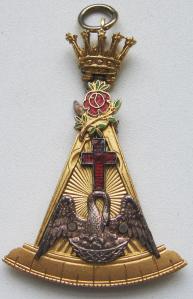
It is most commonly referred to as the Scottish Rite. Sometimes, as in England and Australia, it is called the Rose Croix,[4][5] though this is just one of its degrees, and is not to be confused with other Masonic related Rosicrucian societies such as the Societas Rosicruciana in Anglia. Its name may vary slightly in various jurisdictions and constitutions. For example, the English and Irish Constitutions[6] omit the word Scottish.[7][8]
Master Masons from other rites may, in some countries, join the Scottish Rite's upper degrees starting from the 4th degree due to its popularity.[9][10] This Rite builds upon the ethical teachings and philosophy offered in the Craft (or Blue) Lodge through dramatic presentations of its individual degrees. The term "Blue Lodge" refers to the first three degrees of Masonry, regardless of the Rite being practiced. In the Scottish Rite system, the first three degrees are considered Blue Lodge degrees rather than "Red Lodge".[11]

History
[edit]Scots Master Degree
[edit]There are records of lodges conferring the degree of "Scots Master" or "Scotch Master" as early as 1733.[12][13][14] A lodge at the Devil (Tavern), Temple Bar in London is the earliest such lodge on record.[15] Other lodges include a lodge at Bath in 1735, and the French lodge, St. George de l'Observance No. 49 at Covent Garden in 1736. The references to these few occasions indicate that these were special meetings held for the purpose of performing unusual ceremonies, probably by visiting Freemasons.[16]: 5 The Copiale cipher, dating from the 1740s to 1760s says, "The rank of a Scottish master is an entirely new invention..."[17][18]
Myth of Jacobite origins
[edit]French writers Jean-Marie Ragon (1781–1862) and Emmanuel Rebold, in their Masonic histories, first claimed that the high degrees were created and practiced in Lodge Canongate Kilwinning[19] at Edinburgh, which is entirely false.[20]
Estienne Morin
[edit]A French trader, by the name of Estienne Morin, had been involved in high-degree Masonry in Bordeaux since 1744 and, in 1747, founded an "Écossais" lodge (Scottish Lodge) in the city of Le Cap Français, on the north coast of the French colony of Saint-Domingue, now Haiti. Over the next decade, high-degree Freemasonry was carried by French men to other cities in the Western hemisphere. The high-degree lodge at Bordeaux warranted or recognized seven Écossais lodges there.
In Paris in the year 1761, a patent was issued to Estienne Morin, dated 27 August, creating him "Grand Inspector for all parts of the New World". This Patent was signed by officials of the Grand Lodge at Paris and appears to have originally granted him power over the craft lodges only, and not over the high, or "Écossais", degree lodges. Later copies of this Patent appear to have been embellished, probably by Morin, to improve his position over the high-degree lodges in the West Indies.[16]: 31–45
Morin returned to the West Indies in 1762 or 1763, to Saint-Domingue. Based on his new Patent, he assumed powers to constitute lodges of all degrees, spreading the high degrees throughout the West Indies and North America. Morin stayed in Saint-Domingue until 1766, when he moved to Jamaica. At Kingston, Jamaica, in 1770, Morin created a "Grand Chapter" of his new Rite, the Grand Council of Jamaica. Morin died in 1771 and was buried in Kingston.[21]: 16
Rite of 25 Degrees
[edit]Early writers long believed that a "Rite of Perfection" consisting of 25 degrees, itself the predecessor of the Scottish Rite, had been formed in Paris by a high-degree council calling itself "The Council of Emperors of the East and West". The title "Rite of Perfection" first appeared in the Preface to the "Grand Constitutions of 1786", the authority for which is now known to be faulty.[16]: 75–84 The highest degree in this rite was the "Sublime Prince of the Royal Secret".
It is now generally accepted that this Rite of twenty-five degrees was compiled by Estienne Morin and is more properly called "The Rite of the Royal Secret", or "Morin's Rite".[16]: 37
However, it was known as "The Order of Prince of the Royal Secret" by the founders of the Scottish Rite, who mentioned it in their "Circular throughout the two Hemispheres"[22] or "Manifesto", issued on December 4, 1802.[23]
Henry Andrew Francken and his manuscripts
[edit]Henry Andrew Francken, a naturalized French subject born as Hendrick Andriese Franken of Dutch origin, was most important in assisting Morin in spreading the degrees in the New World. Morin appointed him Deputy Grand Inspector General (DGIG) as one of his first acts after returning to the West Indies. Francken worked closely with Morin and, in 1771, produced a manuscript book giving the rituals for the 15th through the 25th degrees. Francken produced at least four such manuscripts. In addition to the 1771 manuscript, there is a second which can be dated to 1783; a third manuscript, of uncertain date, written in Francken's handwriting, with the rituals 4–25°, which was found in the archives of the Provincial Grand Lodge of Lancashire in Liverpool in approximately 1984; and a fourth, again of uncertain date, with rituals 4–24°, which was known to have been given by H. J. Whymper to the District Grand Lodge of the Punjab and rediscovered about 2010.[24] Additionally, there is a French manuscript dating from 1790 to 1800 which contains the 25 degrees of the Order of the Royal Secret with additional detail, as well as three other Hauts Grades rituals; its literary structure suggests it is derived from a common source as the Francken Manuscripts.[25]
Scottish Perfection Lodges
[edit]A Loge de Parfaits d' Écosse was formed on 12 April 1764 at New Orleans, becoming the first high-degree lodge on the North American continent. Its life, however, was short, as the Treaty of Paris (1763) ceded New Orleans to Spain, and the Catholic Spanish crown had been historically hostile to Freemasonry. Documented Masonic activity ceased for a time. It did not return to New Orleans until the late 1790s, when French refugees from the revolution in Saint-Domingue settled in the city.[21]: 16
Francken traveled to New York in 1767 where he granted a Patent, dated 26 December 1767, for the formation of a Lodge of Perfection at Albany, which was called "Ineffable Lodge of Perfection". This marked the first time the Degrees of Perfection (the 4th through the 14th) were conferred in one of the Thirteen British colonies in North America. This Patent, and the early minutes of the Lodge, are extant and are in the archives of Supreme Council, Northern Jurisdiction.[21]: 16 The minutes of Ineffable Lodge of Perfection reveal that it ceased activity on December 5, 1774. It was revived by Giles Fonda Yates about 1820 or 1821, and came under authority of the Supreme Council, Southern Jurisdiction until 1827. That year it was transferred to the Supreme Council, Northern Jurisdiction.
While in New York City, Francken also communicated the degrees to Moses Michael Hays, a Jewish businessman, and appointed him as a Deputy Inspector General. In 1781, Hays made eight Deputy Inspectors General, four of whom were later important in the establishment of Scottish Rite Freemasonry in South Carolina:
- Isaac Da Costa Sr., D.I.G. for South Carolina;
- Abraham Forst, D.I.G. for Virginia;
- Joseph M. Myers, D.I.G. for Maryland;
- Barend M. Spitzer, D.I.G. for Georgia.
Da Costa returned to Charleston, South Carolina, where he established the "Sublime Grand Lodge of Perfection" in February 1783. After Da Costa's death in November 1783, Hays appointed Myers as Da Costa's successor. Joined by Forst and Spitzer, Myers created additional high-degree bodies in Charleston.[21]: 16–17
Physician Hyman Isaac Long from the island of Jamaica, who settled in New York City, went to Charleston in 1796 to appoint eight French men; he had received his authority through Spitzer. These men had arrived as refugees from Saint-Domingue, where the slave revolution was underway that would establish Haiti as an independent republic in 1804. They organized a Consistory of the 25th Degree, or "Princes of the Royal Secret," which Masonic historian Brigadier ACF Jackson says became the first Supreme Council of the Scottish Rite.[16]: 66–68 According to Fox, by 1801, the Charleston bodies were the only extant bodies of the Rite in North America.[21]: 16–17
Birth of the Scottish Rite – 1801
[edit]Although most of the thirty-three degrees of the Scottish Rite existed in parts of previous degree systems,[26] the Scottish Rite did not come into being until the formation of the Mother Supreme Council at Charleston, South Carolina, in May 1801 at Shepheard's Tavern at the corner of Broad and Church Streets (the tavern had been the location of the founding of Freemasonry in South Carolina in 1754). The Founding Fathers of the Scottish Rite who attended became known as "The Eleven Gentlemen of Charleston" and included, John Mitchell, first Grand Commander of the Supreme Council, Frederick Dalcho, Alexandre Francois Auguste de Grasse, Jean-Baptiste Marie de La Hogue, Thomas Bartholemew Bowen, Abraham Alexander, Emanuel de la Motta, Isaac Auld, Israel de Lieben, Moses Clava Levy, James Moultrie and Isaac Da Costa.
Da Costa in particular had been commissioned to establish Morin's Rite of the Royal Secret in other countries; he formed the constituent bodies of the Rite in South Carolina in 1783, which in 1801, became the Supreme Council of the Ancient and Accepted Scottish Rite, Southern Jurisdiction. All regular Scottish Rite bodies today derive their heritage from this body. Subsequently, other Supreme Councils were formed in Saint-Domingue (now Haiti) in 1802, in France in 1804, in Italy in 1805, and in Spain in 1811.[27]
On May 1, 1813, an officer from the Supreme Council at Charleston initiated several New York Masons into the Thirty-third Degree and organized a Supreme Council for the "Northern Masonic District and Jurisdiction". On May 21, 1814, this Supreme Council reopened and proceeded to "nominate, elect, appoint, install and proclaim in due, legal and ample form" the elected officers "as forming the second Grand and Supreme Council...". Finally, the charter of this organization (written January 7, 1815) added, “We think the Ratification ought to be dated 21st day May 5815."[28]
Officially, the Supreme Council, 33°, N.M.J. dates itself from May 15, 1867. This was the date of the "Union of 1867", when it merged with the competing Cerneau "Supreme Council" in New York. The current Ancient and Accepted Scottish Rite, Northern Masonic Jurisdiction of the United States, was thus formed.[29]
Albert Pike
[edit]
Born in Boston, Massachusetts on December 29, 1809, Albert Pike is asserted within the Southern Jurisdiction as the man most responsible for the growth and success of the Scottish Rite from an obscure Masonic Rite in the mid-19th century to the international fraternity that it became. Pike received the 4th through the 32nd Degrees in March 1853[30][31] from Albert Mackey, in Charleston, South Carolina, and was appointed Deputy Inspector for Arkansas that same year.
In 1857 Pike completed his first revision of the 4°-32° ritual and printed 100 copies. This revision, which Mackey dubbed the "Magnum Opus", was never adopted by the Supreme Council. According to Arturo de Hoyos, 33°, the Scottish Rite's Grand Historian, the Magnum Opus became the basis for future ritual revisions.[32]
In March 1858, Pike was elected a member of the Supreme Council for the Southern Jurisdiction of the United States, and in January 1859 he became its Grand Commander. The American Civil War interrupted his work on the Scottish Rite rituals. Around 1870, he, and the Supreme Council, moved to Washington, DC. In 1884 his revision of the rituals was complete.
Scottish Rite Grand Archivist and Grand Historian de Hoyos[33] created the following chart of Pike's ritual revisions:
| Degrees | When Revised |
|---|---|
| 1–3° | 1872 |
| 4–14° | 1861, 1870, 1883 |
| 15–16° | 1861, 1870, 1882 |
| 17–18° | 1861, 1870 |
| 19–30° | 1867, 1879, 1883 |
| 31–32° | 1867, 1879, 1883 |
| 33° | 1857, 1867, 1868, 1880
(manuscripts only) |
Pike also wrote lectures about all the degrees, which were published in 1871 under the title Morals and Dogma of the Ancient and Accepted Scottish Rite of Freemasonry.[34]
General organization and degree structure
[edit]The Ancient and Accepted Scottish Rite is a rite comprising 33 degrees. The first three degrees are administered by "blue lodges" or "symbolic lodges." They are called "Blue degree" and not "Red degrees". The Scottish rite is by far the most practiced rite worldwide. The next thirty degrees (from the 4th to the 33rd), the high or side degrees - a further development and complement to the first three - are administered by the "Supreme Councils of the 33rd and final degree of the Ancient and Accepted Scottish Rite."[35] However, the name can slightly vary depending on the jurisdictions.
There is no international governing body aside from Le Droit Humain, which is an international order; all of the other Supreme Councils in each country are sovereign unto themselves in their own jurisdictions.[36]

The thirty-three degrees of the Scottish Rite are conferred by several controlling bodies. The first of these is the Craft Blue Lodge, which confers the Entered Apprentice, Fellowcraft, and Master Mason degrees. Craft Blue lodges operate under the authority of national (or in the US, state) Grand Lodges, not the Supreme Council.
The highest degree is that of Master Mason. That is why the degrees with a number higher than the third must be considered as “side” degrees, (even when called High degrees), they are seen as degrees of instruction or improvement, and not as “higher” degrees, that is, implying a particular power that a Master Mason could claim to be above the others.[37][38] The hierarchical structure of Freemasonry can be likened to a three-tiered edifice, with the third tier, the Master Mason, being the highest. Attaining this level grants a Freemason access to the corridors of the third tier, where he can delve deeper into his Masonic education and broaden his understanding of the craft. They represent a lateral movement in Masonic education rather than an upward movement and are degrees of instruction rather than rank.[39]
Degree progression in the Scottish Rite
[edit]Inspired by the Solomonic Tradition and centered on the construction of the Temple of Jerusalem, the Scottish Rite closely combines the criterion of duration, as characteristic of the initiatory process, with the criterion of construction, which commits the adept to the path laid out by the Rite. Building oneself in the AASR system is seen as a long process which is accomplished on the path of truth, justice and wisdom.
This long and lengthy process to obtain the degrees can be found within the foundational documents of the AASR, the Constitution and Regulation of 1762,[40] that is present on the altar of every Lodge in the Southern Jurisdiction. The foundational document proscribes the following minimum time allowed to receive the degrees: "All these degrees, into which one can only be initiated in a mysterious number of months, to arrive at each degree in due succession, make the number, in all, of 81 months. [41]
Thus, almost seven years was the minimum allowed time to obtain the 25 degrees, in the foundational document of the AASR.
The process cannot be a solitary, silent quest for self-fulfillment; the collective project must always prevail over individual pretensions in the AASR system.[42]
The Motto of the Scottish Rite: Ordo ab Chao
[edit]This motto is probably found for the first time in the patent of February 1, 1802 issued by the brother, Alexandre, Auguste comte De Grasse, marquis de Tilly.[42]
The motto "ordo ab chao" implies the action of a principle of order, the chaos from which each of us comes symbolizing the suffering and disarray of the human spirit that precedes the path to a spiritual life of peace and brotherhood.
It is explained as denoting the mission as Masons is to bring order out of chaos. It becomes a source of hope for those in darkness, who aspire to the Light.
The Craft Degrees of the Ancient and Accepted Scottish Rite
[edit]The Ancient and Accepted Scottish Rite is a full Masonic Rite and has its own distinctive versions of the Craft or Blue Lodge rituals which includes the Entered Apprentice, Fellow Craft, and Master Mason degrees. It is the most practiced Rite in the world thus most Master Masons are made thought the Scottish Rite system with the exception of the United States of America where most Lodges do not work the first three degrees in the Scottish Rite but rather join after the attainment of the third degree in their own systems.
However, some U.S. Lodges do practice the Ancient and Accepted Scottish Rite blue degrees, and, in recent years, they have grown in number.[43][44][11][45][46][47] There are 11 lodges in New Orleans (Historically all located in the district 16 they recently approved a new one district 20),[48][49][50] 16 in New York City[51] as well as Washington DC, Hawaii[52] and California,[53] that work in the Scottish Rite Craft degrees.
The Ancient and Accepted Scottish Rite blue degrees are more common in Europe, Asia, Africa and Latin-American jurisdictions. All lodges in the International Order of Freemasonry for Men & Women, Le Droit Humain, work "seamlessly from the first to the thirty-third degree and practice only the Ancient and Accepted Scottish Rite. These two characteristics define it as an Order and not as an Obedience".[54] Most lodges under the jurisdiction of the Grande Loge de France use these degrees,[55] as do a few of the lodges under the jurisdiction of the Grande Loge Nationale Française. It is also a dominant ritual, out of the other rituals in use, in the Grand Lodge of Spain. There are two Lodges in Australia that practice the AASR Craft degrees, The Zetland Lodge of Australia No. 9 and Lodge France 1021, both of which are under the United Grand Lodge of New South Wales and the Australian Capital Territory.[56]
An hypothesis from Masonic historian Alain Bernheim, Belgian Masonic scholar Pierre Noël hypothesized in a 2002 paper that the Ancient and Accepted Scottish Rite Craft degrees might be derived from a French translation of the Masonic exposé Three Distinct Knocks, issued in London in 1760. But this theory is heavily debated among Masonic Scholars. [57]
Degree names
[edit]In 2000, the Southern Jurisdiction in the United States completed a revision of its ritual scripts. The current ritual is based upon Pike's, but with some differences. Generally, the current titles of the degrees and their arrangement in the Southern Jurisdiction remains substantially unchanged since the time of Pike.
In 2004, the Northern Jurisdiction in the United States rewrote and reorganized its degrees.[58] Further changes have occurred in 2006.[59] During those two revisions, the names of 21 out of the 33 degrees were changed.
The list of degrees for the Supreme Councils of Australia, England and Wales, and most other jurisdictions largely agrees with that of the Southern Jurisdiction of the U.S. However, the list of degrees for the Northern Jurisdiction of the United States is now somewhat different and is given in the table below. The list of degrees of the Supreme Council of Canada reflects a mixture of the two, with some unique titles as well:
| Degree | Southern Jurisdiction[60] | Northern Jurisdiction[61] | France and Canada[62] | England and Wales[63] | Le Droit Humain[64] |
|---|---|---|---|---|---|
| 1° | Entered Apprentice | ||||
| 2° | Fellow-Craft | Companion / Fellow-Craft [65][66] | Fellow-Craft[67] | ||
| 3° | Master Mason | ||||
| 4° | Secret Master | Builder [68] | Secret Master | ||
| 5° | Perfect Master | ||||
| 6° | Intimate Secretary | Master of the Brazen Serpent | Intimate Secretary | ||
| 7° | Provost and Judge | ||||
| 8° | Intendant of the Building | Intendant of the Buildings | |||
| 9° | Elu of the Nine | Master of the Temple | Elect of the Nine | Elect of Nine | |
| 10° | Elu of the Fifteen | Master Elect[69] | Elect of the Fifteen | Elect of Fifteen | |
| 11° | Elu of the Twelve | Sublime Master Elected | Elect of the Twelve | Sublime Elect | |
| 12° | Master Architect | Master of Mercy | Grand Master Architect | ||
| 13° | Royal Arch of Solomon | Master of the Ninth Arch | Royal Arch of Solomon | Ancient Master of the Royal Arch of Enoch[70] | Royal Arch of Enoch |
| 14° | Perfect Elu | Grand Elect Mason | Grand Elect Perfect and Sublime Mason | Grand Elect Perfect and Sublime Master | Scotch Knight of
Perfection |
| 15° | Knight of the East, or Knight of the Sword, or Knight of the Eagle |
Knight of the East[71] | Knight of the East, or Knight of the Sword |
Knight of the Sword, or Knight of the East |
Knight of the Sword
or the East |
| 16° | Prince of Jerusalem | ||||
| 17° | Knight of the East and West | ||||
| 18° | Knight Rose Croix | Knight of the Rose Croix of H.R.D.M.[72] | Knight Rose Croix | Sovereign Prince Rose Croix, or Knight of the Pelican and Eagle |
Sovereign Prince of Rose
Croix of H.R.D.M. |
| 19° | Grand Pontiff | Brother of the Trail | Grand Pontiff | Grand Pontiff or
Sublime Scottish Knight | |
| 20° | Master of the Symbolic Lodge | Master ad Vitam | Venerable Grand Master | Sovereign Prince or
Master ad Vitam | |
| 21° | Noachite, or Prussian Knight |
Patriarch Noachite | Noachite or
Prussian Knight | ||
| 22° | Knight of the Royal Axe, or Prince of Libanus |
Prince of Libanus | Prince of the Lebanon, or
Knight of the Royal Axe | ||
| 23° | Chief of the Tabernacle | Knight of Valor | Chief of the Tabernacle | ||
| 24° | Prince of the Tabernacle | Brother of the Forest | Prince of the Tabernacle | ||
| 25° | Knight of the Brazen Serpent | Master of Achievement | Knight of the Brazen Serpent | ||
| 26° | Prince of Mercy, or Scottish Trinitarian |
Friend and Brother Eternal[73] | Prince of Mercy | ||
| 27° | Knight of the Sun, or Prince Adept |
Knight of Jerusalem | Commander of the Temple | Sovereign Commander
of the Temple | |
| 28° | Knight Commander of the Temple | Knight of the Sun | Knight of the Sun or
Prince Adept | ||
| 29° | Scottish Knight of Saint Andrew | Knight of Saint Andrew | Grand Scottish Knight of
St. Andrew | ||
| 30° | Knight Kadosh, or Knight of the White and Black Eagle |
Grand Inspector | Knight Kadosh | Grand Elected Knight Kadosh, or Knight of the White and Black Eagle |
Grand Elect Knight K.H. |
| 31° | Inspector Inquisitor | My Brother's Keeper[74] | Inspector Inquisitor Commander | Grand Inspector Inquisitor Commander | |
| 32° | Master of the Royal Secret | Sublime Prince of the Royal Secret | |||
| 33° | Inspector General | Sovereign Grand Inspector General | |||
Exceptions, specificities, and disagreements
[edit]In many jurisdictions, there are also specificities, generally minor but sometimes more significant. These mainly concern which degrees are actually practiced, with other degrees being transmitted through "communication," following the common 18th-century practice, meaning that the ritual for the degree is not actually performed. Today, in some jurisdictions, it is common to have only the 4th, 9th, 12th, 13th and 14th performed by the Lodge of perfection (Green degrees),17th and 18th performed by the Chapters (Red degrees), 22nd, 26th, 28th and 30th on the Areopagus or (Black degrees) and the 31st, 32nd, 33rd degrees on a Consistory (White degree) level. Although some valleys or jurisdictions confers many more, while some other jurisdictions confer all of the degrees insisting on communicating none.
Moreover, the U.S. and Canadian system progresses much more rapidly than in other countries, allowing one to reach the 32nd degree in a relatively short span, whereas in Europe and South America, such progression requires diligent practice over more than two decades. For this reason, several European and South American jurisdictions do not automatically recognize the high degrees received by their members during their stay in the United States and will sometime bar U.S. 32nd degree members from attending their meetings.
The Ancient and Accepted Scottish Rite by country
[edit]General practices
[edit]In most parts of the world the Scottish Rite is practiced as a full Rite, starting with the Blue Lodge degrees, under the jurisdiction of a Grand Lodge, then becomes an invitation only body for "upper" degrees divided in groups; the candidate must then wait a period of time after being made a Master Mason of three to five years depending on the jurisdiction (sometimes must be past-master), then may be honored with an invitation to the Green Lodges (4th–14th); if the brother shows diligence and hard work he may then become invited to the Red Lodges (15th–18th) and receive the degree; again after hard work and dedication he may be invited to the Black Lodges (19th–30th) and receive the degrees, then be invited to the White Lodges (31st–33rd). This process takes an average of 25 years to accomplish if the brother is invited to every group and only a very small fraction can make it all the way to 33rd degree. It is worth noting that in the United States of America, the Scottish Rite process is a lot different than the rest of the world and tend to be a lot faster (only a few days or weeks), and the Master Mason can petition to receive the upper degrees,[75] although a new observant movement is developing, and the idea of forming an "observant Valley" that would take more time and be more selective is being explored to curb falling membership numbers.[76][77]
The Droit Humain does not make a jurisdictional distinction between Blue degrees to upper degrees and holds an international jurisdiction over its Scottish Rite system.
Scottish Rite Masonic Calendar
[edit]The Scottish Rite Masonic calendar celebrates the creation of the world (Anno Mundi), 3760/3761 years before the beginning of the Common Era (C.E.) and is based upon the older, Hebraic (Hebrew) calendar, which begins the civil year in September rather than the Gregorian calendar which begins the new year in January (current date +3760), thus after September of the current year, add 1 year more (date +3760 +1), as by example displayed in 'The book of the Ancient and Accepted Scottish Rite of Freemasonry' (revised and enlarged edition, 1899, chapter: Hebrew Calendar, page 612), written by Charles T. Mcclenachan, 33°, Grand Master General of Ceremonies of the Supreme Council, Northern Masonic Jurisdiction, U.S.A.[78]
Europe
[edit]Austria
[edit]Growth and challenge in the 19th century
[edit]In the aftermath of the ratification of Scottish Rite bodies, the Rite experienced steady growth in Austria during the late 1700s and early 1800s. However, anti-Masonic sentiments arose in the mid-19th century, as occurred in other European countries, constraining Masonic activity. The Catholic Church exerted political pressure on Masonic organizations, associating the Scottish Rite with anti-religious conspiracy theories.[79] In 1894, these pressures resulted in the Emperor Franz Joseph officially suspending all Masonic lodges in Austria, forcing the Scottish Rite underground until 1918.[80]
Resilience and reemergence in the 20th century
[edit]After the fall of the Austro-Hungarian Empire, the Scottish Rite swiftly reestablished itself under the new Republic of German-Austria. Bick (2016) explains how the Scottish Rite provided a philosophical beacon during volatile social circumstances in the interwar period in Vienna and Austria in the early 20th century. Moreover, the Scottish Rite upheld ideals of religious unity, morality, and service as Austria rebuilt.[81]
While antisemitism and nationalism eventually permeated Austria in World War II, the Scottish Rite lodges centered humanism. After the war, the Supreme Council based in Vienna continued operating, despite Communist pressures in Eastern bloc countries.[82] From the post-war period until present day, the Scottish Rite persevered as a bastion of moral enlightenment in Austria even given wider sociocultural trends.
The Austrian Scottish Rite in the 21st century
[edit]Presently, the Scottish Rite tradition remains intact in Austria with approximately 3,000 Freemasons participating in lodges across the country.[83] The Supreme Council serves as an international representation of the Scottish Rite by upholding universal values articulated across 33 degrees of initiation. Through moral education and philanthropy, Austrian Scottish Rite bodies perpetuate esoteric knowledge to endorse peace, community improvement, and individual actualization.
Current situation
[edit]Austria contends with persistent fragmentation within its Freemasonry landscape, hindering a revival of a tradition that once flourished. In Scandinavia, a distinct Masonic tradition prevails, setting it apart from the broader Scottish Rite family.[84]
France
[edit]History
[edit]When Comte de Grasse-Tilly returned to France in 1804, he worked to establish the Ancient and Accepted Scottish Rite there. He founded the first Supreme Council in France[85] that same year.
The Grand Orient of France signed a treaty of union in December 1804 with the Supreme Council of the 33rd Degree in France; the treaty declared that "the Grand Orient united to itself"[86] the Supreme Council in France. This accord was applied until 1814. Thanks to this treaty, the Grand Orient of France took ownership, as it were, of the Scottish Rite.
From 1805 to 1814, the Grand Orient of France administered the first 18 degrees of the Rite, leaving the Supreme Council of France to administer the last 15. In 1815, five of the leaders of the Supreme Council founded the Suprême Conseil des Rites within the Grand Orient of France. The original Supreme Council of France fell dormant from 1815 to 1821.[87]
The Suprême Conseil des Isles d'Amérique (founded in 1802 by Grasse-Tilly and revived around 1810 by his father-in-law Delahogue, who had also returned from the United States) breathed new life into the Supreme Council for the 33rd Degree in France. They merged into a single organization: the Supreme Council of France. This developed as an independent and sovereign Masonic power. It created symbolic lodges (those composed of the first three degrees, which otherwise would be federated around a Grand Lodge or a Grand Orient).
The Suprême Conseil de France [fr] (emerging from the Supreme Council of 1804 and restored in 1821 by the Supreme Council of the Isles d'Amérique founded in 1802 in Saint-Domingue, the modern Haiti) In 1894, the Supreme Council of France created the Grand Lodge of France. It became fully independent in 1904, when the Supreme Council of France ceased chartering new lodges.[88] The Supreme Council of France still considers itself the overseer of all 33 degrees of the Rite. Relations between the two structures remain close, as shown by their organizing two joint meetings a year.
France has two additional Supreme Councils:
- The Suprême Conseil Grand Collège du Rite écossais ancien accepté (emerging from the Supreme Council on 1804 and constituted in 1815), affiliated with the Grand Orient de France.
- The Suprême Conseil pour la France (emerging from the Supreme Council of the Netherlands, constituted in 1965), affiliated with the Grande Loge Nationale Française. In 1964, the Sovereign Grand Commander Charles Riandey, along with 400 to 500 members,[89] left the jurisdiction of the Supreme Council of France and joined the Grande Loge Nationale Française. Because of his resignation and withdrawal of hundreds of members, there was no longer a Supreme Council of France. Riandey then reinitiated the 33 degrees of the rite in Amsterdam.[90] With the support of the Supreme Council of the Southern Jurisdiction of the United States, he founded a new Supreme Council in France, called the Suprême Conseil pour la France.
The distinction between the symbolic degrees (1st-3rd) and the high/side degrees (4th-33rd) has not always been as clearly defined as it is today, especially in France, where symbolic lodges practice the Ancient and Accepted Scottish Rite from the first degree onward. Nowadays, some of the rituals for certain high degrees still make reference to "prerogatives" dating back to their origins, predating the establishment of the Ancient and Accepted Scottish Rite.
In 2004, a noteworthy milestone was achieved when the AASR officially commemorated its establishment in France, marked by the founding of the Supreme Council under the leadership of de Grasse-Tilly. This momentous occasion marked the beginning of a developmental trajectory intricately linked with the activities of Masonic obediences in the country, resulting in a richly diverse and multifaceted network.
The year 2015 witnessed a pivotal commemoration, namely the AASR's historic alignment with the Grand Orient de France (GODF) in 1815. This event provided historians with a valuable opportunity to engage in a comprehensive and scholarly examination of the AASR's evolution in France, tracing its roots back to 1804. International symposiums, notably hosted by the Supreme Council and the Grand College of the REAA-GODF in cities such as Lyon and Paris, featured distinguished speakers who represented both the Southern Jurisdiction and the Supreme Council for France. These symposia were conceived with the overarching objective of transcending partisan debates and fostering a platform for erudite discourse within the Masonic community.
Beyond France, this distinctive pattern is observed in Belgium, the Netherlands, Luxembourg, and Switzerland, where the AASR demonstrates relative vitality, albeit in proportionate terms.
Practices
[edit]In France and Belgium, depending on the jurisdictions, the degrees typically practiced and initiated include the 4th, 9th, 12th, 13th, 14th, 15th, 17th, 18th, 22nd, 26th, 28th, 30th, 31st, 32nd, and 33rd degrees. In some Belgian jurisdictions, initiation into the 5th and 29th degrees are also conducted. Differences in the number of degrees practiced exist from one jurisdiction and country to another. Generally, French jurisdictions practice fewer Areopagus degrees than Belgian jurisdictions and prioritize capitular degrees.
In present-day the Ancient and Accepted Scottish Rite has been growing rapidly in France, which prompted some changes to make it more difficult to be invited, in 2023, the G.N.L.F. changed the requirement from three years as a Master Mason to being a Past-Master to be invited into the Scottish Rite's upper degrees (4th onwards).
Ireland
[edit]The Ancient and Accepted Rite for Ireland was established in Ireland in 1824 by the Southern Jurisdiction of the USA,[91] following dramatic American expansion.[7] Its Supreme Council operates from the Freemasons' Hall in Dublin,[7] which also serves as the headquarters for the Grand Lodge of Ireland. In Ireland, membership of the Ancient and Accepted Rite is strictly by invitation only.[7] Canvassing for, or requesting, membership results in automatic disqualification.
A number of prominent Irish freemasons have served as Sovereign and Commander of the Supreme Council of the Ancient and Accepted Rite for Ireland, including Sir Charles Cameron[92] and Gerald FitzGibbon.[93]
Italy
[edit]The Scottish Rite in Italy dates to 1805.[94]
Romania
[edit]The Ancient and Accepted Scottish Rite was established in Romania in 1881, a year after the National Grand Lodge of Romania was founded. On 27 December 1922, the Supreme Council of Scottish Rite of Romania, received the recognition of the Supreme Council of France in 1922, and recognition from the Supreme Council, Southern Jurisdiction of the United States in 1925.
Between 1948 and 1989 all of Romanian Freemasonry, including the Ancient and Accepted Scottish Rite of Romania, was banned by the Communist regime.
The Supreme Council of the Ancient and Accepted Scottish Rite of Romania was reconsecrated in 1993.[95]
United Kingdom
[edit]
In England and Wales, whose Supreme Council was warranted by that of the Northern Masonic Jurisdiction of the USA (in 1845),[96] the Rite is known colloquially as the "Rose Croix" although this is just one of the degrees. More formally, it is known as "The Ancient and Accepted Rite for England and Wales and its Districts and Chapters Overseas". In England and Wales, the adjective "Scottish" is generally left out, although in continental European jurisdictions, they retain the "Écossais".

There are 25,000 members of the Supreme Council out of the 160,000 members of the United Grand Lodge of England.[97] England and Wales are divided into Districts, which administer the Rose Croix Chapters within their District. There are also some eighteen Districts overseas, as well as some 'unattached' Chapters in a further nine countries. All candidates for membership must have been Master masons for at least six months.[98]
Many degrees are conferred in name only, and degrees beyond the 18° are conferred only by the Supreme Council itself. In England and Wales, the candidate is perfected in the 18th degree with the preceding degrees awarded in name only. Continuing to the 30th degree is restricted to those who have served in the chair of the Chapter. Degrees beyond the 30th are conferred only upon a very small number of individuals.
In Scotland, the 18th and 30th degree are practised. A minimum of a two-year interval is required before continuing to the 30th degree, again with the intervening degrees awarded by name only. Elevation beyond that is by invitation only, and numbers are severely restricted.[99]
The Ancient and Accepted Scottish Rite is also practiced from the 1st to the 33rd degree by the British Federation of Le Droit Humain,[100] and from the 1st to the 3rd degree by the all-male lodge The White Swan, No. 1348, of the Grande Loge de France in London, as well as by the mixed lodge Marco Polo of the Gran Loggia d'Italia.
North America
[edit]Canada
[edit]In Canada, the Supreme Council is called "Supreme Council 33° Ancient and Accepted Scottish Rite of Freemasonry of Canada" and was warranted in 1874 by that of England and Wales. Canada's Supreme Council office is located at 4 Queen Street South in Hamilton, Ontario. There are 45 local units or "Valleys" across Canada.[101]
United States
[edit]
In the United States of America there are five Supreme Councils: the Supreme Council, Southern Jurisdiction, in Washington, D.C., the Supreme Council, Northern Masonic Jurisdiction in Lexington, Massachusetts, the Supreme Council of Louisiana, United Supreme Council, Prince Hall Affiliation, Northern Jurisdiction, located in Philadelphia, and the United Supreme Council, Prince Hall Affiliation, Southern Jurisdiction, located in Memphis, Tennessee.[102]
They each have particular characteristics and degree structure that make them different. In the United States, members of the various Scottish Rite bodies can be elected to receive the 33° by their respective Supreme Council[103] which is conferred on members who have made major contributions to society or to Masonry in general. Only four of the Supreme Councils are seen as regular or legitimate freemasonry. The Supreme Council of Louisiana is branch of Freemasonry known as "Cerneauism," which refers to its founder Joseph Cerneau, and is considered irregular by the other four Supreme Councils.[104] The two United Supreme Council, Prince Hall Affiliation, were not seen as regular by the other two Supreme Councils for almost two centuries. This began to change in the mid-1900s and was officially ratified on September 7, 2022 with the Statement of Unity signed by all four Sovereign Grand Commanders.[105]
Supreme Council, Southern Jurisdiction
[edit]
Based in Washington, D.C., the Southern Jurisdiction (often referred to as the "Mother Supreme Council of the World")[106] was founded in Charleston, South Carolina, in 1801. It oversees the Ancient and Accepted Scottish Rite in 35 states, which are referred to as Orients, which are divided into regions called Valleys, each containing individual bodies.[107][108][109]
In the Southern Jurisdiction of the United States, the Supreme Council consists of no more than 33 members, called Active members, and is presided over by a Sovereign Grand Commander, and since 2019, Illustrious Brother James D. Cole, 33°.[110] Other members of the Supreme Council are called "Sovereign Grand Inspectors General" (S.G.I.G.), and each is the head of the AASR bodies in his respective Orient (or state). Other heads of the various Orients who are not members of the Supreme Council are called "Deputies of the Supreme Council." The Supreme Council of the Southern Jurisdiction meets every odd year during the month of August at the House of the Temple, Ancient and Accepted Scottish Rite of Freemasonry Southern Jurisdiction Headquarters, in Washington, D.C. During this conference, the Valley of Washington D.C. confers the 33° for those elected to receive it or others of the degree who desire to watch it. There are closed meetings between the Grand Commander and the S.G.I.G.s, and many members of the fraternity from all over the world attend the open ceremony on the 5th of 6 council meeting days.
United Supreme Council, Prince Hall Affiliation, Southern Jurisdiction
[edit]
Based in Memphis, Tennessee, the United Supreme Council, Prince Hall Affiliation, Southern Jurisdiction, oversees the states in the bottom half of the United States. African Americans were barred from the Southern and Northern Jurisdictions of the Scottish Rite and so formed their own organizations. Originally, there were five Supreme Councils, but they merged into two official United Supreme Councils in 1881.[111] Currently, nine men serve as elected officers of the United Supreme Council with Illustrious Brother Corey D. Hawkins, Sr., 33°, serving as Sovereign Grand Commander.[112]
Northern Jurisdiction
[edit]
The Lexington, Massachusetts-based Northern Masonic Jurisdiction, formed in 1813, and inactive from 1832 to 1845,[113] oversees the bodies in fifteen states: Connecticut, Delaware, Illinois, Indiana, Maine, Massachusetts, Michigan, New Jersey, New Hampshire, New York, Ohio, Pennsylvania, Rhode Island, Wisconsin and Vermont. The Northern Jurisdiction is only divided into Valleys, not Orients.[114] Each Valley has up to four Scottish Rite bodies, and each body confers a set of degrees.
In the Northern Jurisdiction, the Supreme Council consists of no more than 66 members, led by the Sovereign Grand Commander, currently Ill. Walter F. Wheeler, 33°, who was elected to the position in 2023.[115] Those who are elected to membership on the Supreme Council are then designated "Active." In the Northern Jurisdiction all recipients of the 33rd Degree are honorary members of the Supreme Council, and all members are referred to as a "Sovereign Grand Inspectors General." The head of the Rite in each State of the Northern Jurisdiction is called a "Deputy of the Supreme Council." Thus, the highest-ranking Scottish Rite officer in Ohio, is titled, "Deputy for Ohio", and so forth for each state. Additionally, each Deputy has one or more "Actives" to assist him in the administration of the state. Active members of the Supreme Council who have served faithfully for ten years, or reach the age of 75, may be designated "Active, Emeritus". The Northern Jurisdiction Supreme Council meets yearly, in the even years by an executive session, and in the odd years, with the full membership invited. The 33rd Degree is conferred on the odd years at the Annual Meeting.
In the Northern Jurisdiction, there is a 46-month requirement for eligibility to receive the 33rd degree, and while there is a Meritorious Service Award (as well as a Distinguished Service Award), they are not required intermediate steps towards the 33°.
United Supreme Council, Prince Hall Affiliation, Northern Jurisdiction
[edit]
Based in Philadelphia, the United Supreme Council, Prince Hall Affiliation, Northern Jurisdiction, oversees the states in the top half of the United States. In the 1800s and early 1900s, African Americans were barred from the Southern and Northern Jurisdictions of the Scottish Rite and so formed their own organizations. Originally, there were five Supreme Councils, but they merged into two official United Supreme Councils in 1881.[111] Currently, there are seven elected officers of the United Supreme Council with Illustrious Brother, Melvin J. Blazemore, 33°, serving as Sovereign Grand Commander.[116]
Supreme Council of Louisiana
[edit]
The Supreme Council of Louisiana was founded in New Orleans in 1839 in the aftermath of the Morgan Affair. During this time, the Northern Jurisdiction consisted of John James Joseph Gourgas and Giles Fonda Yates who were "effectively a Supreme Council of two people."[117] Likewise, the Grand Commander of the Southern Jurisdiction, Moses Holbrook longed to "relinquish his responsibilities as Sovereign Grand Commander"[118] moving to the rural frontier of Florida to serve as a doctor.
It was during this period that the Supreme Council of Louisiana emerged, which claimed its authority via "Cerneauism"[119] – a type of Scottish Rite Masonry[120] without ties to the either the Northern or Southern Jurisdictions.[121] After the Civil War, the Grand Orient of France recognized the Supreme Council of Louisiana.[122]

New Orleans educator and Civil Rights activist George Longe was the head of this council for nearly five decades, from 1938 to 1985. Under his watch the Supreme Council of Louisiana tripled in size and expanded to other states.[123] His papers are held at the Amistad Research Center of Tulane University.[123] As of 2023, the Most Powerful Sovereign Grand Commander of the Supreme Council of Louisiana is Ill. Bro. Eddie L. Gabriel Sr. 33°.[124]
Criticism of the American System
[edit]Traditionally, in most international jurisdictions, the Scottish Rite degrees are conferred gradually over many years, with candidates being individually invited to progress based on their demonstrated understanding and mastery of each degree's teachings.[125][126][127] The original constitutions of the Scottish Rite, which formed the basis for both the Northern and Southern Jurisdictions in the United States, prescribed a minimum interval between degrees and required approximately 81 months (seven years) to complete the original 25 degrees.[128] However, many U.S. jurisdictions now confer degrees from the 4th to the 32nd in concentrated one or two-day sessions.[129][130][126][131][132][133][134] Some international jurisdictions reportedly decline to recognize American Scottish Rite Masons in their upper bodies, citing concerns about adequate mastery of the degree material.[135][136][131][137][138]
In response to these criticisms and as an attempt to save the U.S. Scottish Rite from disappearing, some American Scottish Rite Masons have advocated for a return to more traditional, observant practices aligned with international standards.[139]
See also
[edit]- Esotericism
- Grand College of Rites – A U.S. appendant body dedicated to preserving disused Masonic rituals and the rites of defunct Masonic societies.
- High Masonic degrees
- List of Masonic Rites
- Masonic bodies – An explanation of groups attached to "Blue Lodge" Freemasonry
- Rite of Memphis-Misraim – A European Masonic order dating from the 19th century, including degrees based on the three Blue Lodge and thirty-three Scottish Rite degrees, as well as additional esoteric degrees.
- Rite of Baldwyn – A rite of seven degrees, practised only in Bristol, UK.
- Societas Rosicruciana in Anglia - An esoteric masonic society (known as the SRICF in the US).
- York Rite – Another masonic rite or concordant body.
References
[edit]- ^ Ancient and Accepted Scottish Rite of Freemasonry
- ^ "Our Rite – Orient of Utah".
- ^ "The Scottish Rite". Scottish Rite Orient of Georgia.
- ^ "The Supreme Council". sc33.org.uk. Archived from the original on 29 September 2017. Retrieved 28 April 2018.
- ^ "The Ancient and Accepted Rite". Archived from the original on 2023-05-29. Retrieved 2023-05-29.
- ^ "Ancient and Accepted Rite for Ireland | Grand Lodge of Ireland". Retrieved 2024-01-26.
- ^ a b c d Grand Lodge Of Ireland. "Ancient and Accepted Rite for Ireland". Retrieved 14 November 2023.
- ^ "Introduction". The Supreme Council 33. Retrieved January 19, 2024.
- ^ "How to Join – Scottish Rite of Freemasonry, S.J., U.S.A." Scottish Rite of Freemasonry, S.J., U.S.A. Archived from the original on 2017-07-03. Retrieved 2017-06-12.
- ^ "Become a member". Scottish Rite Omaha. Archived from the original on 2016-08-30. Retrieved 2017-06-12.
- ^ a b "Some Lodges Are Different".
- ^ "Our Valley – Scottish Rite Temple, A.&A.S.R." wilmingtonaasr.ipower.com. Archived from the original on 2018-04-28. Retrieved 2017-06-14.
- ^ "About Scottish Rite". aasrcalgary.ca. Archived from the original on 2017-12-23. Retrieved 2017-06-14.
- ^ Boston, Scottish Rite. "Scottish Rite Boston". scottishriteboston.org. Archived from the original on 2017-03-02. Retrieved 2017-06-14.
- ^ "History of the Rite | Scottish Rite of Freemasonry, S.J., U.S.A." Retrieved 2024-06-08.
- ^ a b c d e Jackson, Alexander Cosby Fishburn (1987). Rose Croix: A History of the Ancient & Accepted Rite for England and Wales (Revised (Original 1980) ed.). London: Lewis Masonic. ISBN 0853181519.
- ^ Megyesi, Beáta. "Copiale cipher. Translation from German (August 2011)" (PDF). Uppsala University. Archived (PDF) from the original on 16 January 2013. Retrieved 2 November 2013.
- ^ "The Copiale Cipher: An Early German Masonic Ritual Unveiled | Scottish Rite of Freemasonry, S.J., U.S.A." Retrieved 2025-07-01.
- ^ Tailby, S.R.; Young, Hugh (1944). "A BRIEF HISTORY OF LODGE MOTHER KILWINNING No. 0". Archived from the original on 2006-11-26. Retrieved 2007-03-30.
- ^ Coil, Henry W. (1961) Article: "Stuart Masonry", pp. 634–637. Coil's Masonic Encyclopedia (rev. ed. 1996). Richmond, Va: Macoy Publ. Co. Inc.
- ^ a b c d e Fox, William L. (1997). Lodge of the Double-Headed Eagle: Two centuries of Scottish Rite Freemasonry in America's Southern Jurisdiction. Univ. of Arkansas Press.
- ^ "Dalcho Circular Creating the Supreme Council". scscottishrite.org. Archived from the original on 4 March 2016. Retrieved 30 June 2018.
- ^ de Hoyos, Arturo, Scottish Rite Ritual, Monitor and Guide 2d ed. (Washington, D.C.: Supreme Council, 33°, S.J., 2009), pp. 937, 938.
- ^ Morris, S. Brent (2015). "Henry Andrew Francken & His Masonic Manuscripts" (PDF). Heredom. 23: 107–114. Retrieved 30 June 2018.
- ^ de Hoyos, Arturo; Bernheim, Alain (Introduction) (2014). Freemasonry's Royal Secret: The Jamaican Francken Manuscript of the High Degrees. Washington, DC: Scottish Rite Research Center. p. viii. ISBN 978-0-9837738-6-3.
- ^ de Hoyos, Arturo, "Development of the Scottish Rite Rituals", in Scottish Rite Ritual, Monitor and Guide 2d ed. (Washington, D.C.: Supreme Council, 33°, S.J., 2009), pp. 109–118.
- ^ Coil, Henry W. (1996) [1961]. "Scottish Rite Masonry". Coil's Masonic Encyclopedia. Macoy Publishing and Masonic Supply Co., Inc. p. 614.
- ^ de Hoyos, Arturo (2010). "A Brief History of Freemasonry and the Origins of the Scottish Rite". The Scottish Rite Ritual Monitor and Guide (PDF) (3rd ed.). Washington, D.C.: Supreme Council, 33°, Southern Jurisdiction. p. 109. ISBN 978-0-9708749-3-1. Archived (PDF) from the original on 2015-11-23.
- ^ de Hoyos, Arturo, "The Union of 1867", in Heredom (Washington, D.C.: Scottish Rite Research Society, 1995), vol. 5:7–45.
- ^ "The Royal Arch". knightstemplar.org. Archived from the original on 2018-04-28. Retrieved 2017-06-13.
- ^ "Scottish Rite of Orange County | What Is The Scottish Rite?". ocscottishrite.org. 20 September 2011. Archived from the original on 2017-08-21. Retrieved 2017-06-13.
- ^ de Hoyos, Arturo, Scottish Rite Ritual, Monitor and Guide 2d ed. (Washington, D.C.: Supreme Council, 33°, S.J., 2009), p. 114.
- ^ de Hoyos, Arturo, Scottish Rite Ritual, Monitor and Guide 2d ed. (Washington, D.C.: Supreme Council, 33°, S.J., 2009), p. 115.
- ^ Coil, Henry W. (1961). Article: "Pike, Albert" pp. 472–475. "Coil's Masonic Encyclopedia" (rev. ed. 1995) Richmond, Va: Macoy Publ. Co. Inc.
- ^ "Scottish Rite, NMJ". Scottish Rite, NMJ. Archived from the original on 2017-08-21. Retrieved 2017-06-14.
- ^ "Home - ORDRE MAÇONNIQUE MIXTE INTERNATIONAL LE DROIT HUMAIN". ORDRE MAÇONNIQUE MIXTE INTERNATIONAL LE DROIT HUMAIN.
- ^ "Masonic Rites and Degrees Explained – Why the Scottish has 33 and the normal only 3 degrees?". DocumentaryTube. 2016-05-30. Archived from the original on 2017-06-02. Retrieved 2017-06-13.
- ^ "Scottish Rite Degrees". toledoaasr.com. Archived from the original on 2017-04-18. Retrieved 2017-06-13.
- ^ Scottish Rite, Northern Masonic Jurisdiction website: Frequently asked questions Archived 2015-06-23 at the Wayback Machine – "Are Scottish Rite degrees higher than those of a Master Mason?"
- ^ "The constitutions and regulations of 1762". 1872.
- ^ "The constitutions and regulations of 1762". 1872.
- ^ a b "3112-1 : Spécificité du Rite Écossais Ancien et Accepté".
- ^ "How do I Charter a Scottish Rite Craft Lodge?". YouTube. 13 February 2023.
- ^ "In Long Beach, a New Bilingual Masonic Lodge". 13 June 2023.
- ^ "Archimedes Lodge".
- ^ "Proceedings of the grand lodge of the state of Louisiana" (PDF). library.la-mason.com.
- ^ "Proceedings of the grand lodge of the state of Louisiana" (PDF). Archived from the original (PDF) on 2022-07-03.
- ^ "16th Masonic District of Louisiana - Scottish Rite Craft Lodges". ladistrict16.azurewebsites.net.
- ^ "Grand Lodge Masonic Membership Manager".
- ^ Germania Lodge ASR Degrees "The Lodge works in the Scottish Rite Symbolic ritual – one of only ten Lodges under the jurisdiction of the Grand Lodge of Louisiana which work in this historic ritual. The ten Scottish Rite Lodges comprise the 16th District of the Grand Lodge of Louisiana."
- ^ "TENTH MANHATTAN". district-26-ny.ourlodgepage.com.
- ^ "The Official Website of the Honolulu Scottish Rite | Hawaii Freemasonry".
- ^ "Grand Lodge of the State of Louisiana". la-mason.com.
- ^ "Rites, Lodges and Obediences". Ordre Maçonnique Mixte International le Droit Humain. Retrieved 2022-03-02.
- ^ "Grande Loge de France". Archived from the original on 2005-02-11.
- ^ Unknown[permanent dead link]
- ^ Bernheim, Alain (4 October 2003). "MASONIC AUTHORS – The bad, the good and the ugly". Pietre-Stones Review of Freemasonry. Retrieved 19 June 2018.
- ^ Freemasons for Dummies, Christopher Hodapp, ISBN 0-7645-9796-5, Hungry Minds Inc, U.S., 2005. pp. 224–225
- ^ The Northern Light Magazine, November 2006; p. 6 "Ritual Changes."
- ^ A Bridge to Light, by Rex R. Hutchens; publ. 1995; 2nd Ed., 4th Printing, 2001; by The Supreme Council, 33°, Ancient & Accepted Scottish Rite of Freemasonry, So. Jurisdiction, U.S.A.; see also de Hoyos, Arturo, "Structure of the Scottish Rite" in Scottish Rite Ritual, Monitor and Guide 2d ed. (Washington, D.C.: Supreme Council, 33°, S.J., 2009), pp. 119–26.
- ^ Freemasons for Dummies, Christopher Hodapp, ISBN 0-7645-9796-5, Hungry Minds Inc, U.S., 2005. pp. 226–227
- ^ Kirk White (15 June 2011). "DEGREES OF THE ANCIENT AND ACCEPTED SCOTTISH RITE OF FREEMASONRY OF CANADA (Excerpts from the Statutes and Regulations of the Supreme Council 33° of the Ancient and Accepted Scottish Rite of Freemasonry of Canada)". Archived from the original on 7 June 2011.
- ^ Keith B. Jackson, Beyond the Craft, 6th Edition, Lewis Masonic 2012 (ISBN 978-0853184058), p. 31.
- ^ International Order of Freemasonry For Men and Women, LE DROIT HUMAIN, British Federation, Approved by the Supreme Council (2020). General Regulations British Federation 2020. p. 4.
{{cite book}}: CS1 maint: multiple names: authors list (link) - ^ "Déclaration - SCPLF-REAA".
- ^ "Suprême Conseil National de France". www.scndf.fr.
- ^ "Fundamentals - ORDRE MAÇONNIQUE MIXTE INTERNATIONAL LE DROIT HUMAIN". Ordre Maçonnique Mixte International le Droit Humain.
- ^ "Scottish Rite, NMJ | Lodge of Perfection Degrees". Scottish Rite, NMJ. Archived from the original on 2021-12-11. Retrieved 2021-12-11.
- ^ Formerly "Master Elect of Fifteen." The Northern Light Magazine, November 2006
- ^ Cited by this title in the 18th Degree Certificates issued by the Supreme Council of the 33th Degree of the Ancient and Accepted Rite for England and Wales and its Districts and Chapters Overseas
- ^ "Scottish Rite, NMJ | Council of Prices of Jerusalem Degrees |…". Scottish Rite, NMJ. Archived from the original on 2022-03-19. Retrieved 2022-03-19.
- ^ "Scottish Rite, NMJ | Chapter of Rose Croix Degrees | Scottish Rite,…". Scottish Rite, NMJ. Archived from the original on 2021-11-02. Retrieved 2022-03-19.
- ^ Formerly "Prince of Mercy." The Northern Light Magazine, November 2006
- ^ "Scottish Rite, NMJ | Consistory Degrees". Scottish Rite, NMJ. Archived from the original on 2021-12-11. Retrieved 2022-03-19.
- ^ "How to Join/Membership Qualifications | Scottish Rite of Freemasonry, S.J., U.S.A."
- ^ "Quality/Quantity".
- ^ "Eight Steps to Excellence: The Observant Lodge". 9 January 2017.
- ^ "Masonic Calendars".
- ^ Hoyos, M. (2015). "Fear and Suspicion: Catholic Condemnation of Freemasonry in 19th Century Vienna". Modern Austrian Studies. 22 (4): 209–230.
- ^ Heindl, L.; Hoffmann, S. (2010). "The Scottish Rite in Austria". Transactions of Quator Coronati Lodge. 23: 11–25.
- ^ Lorenz, E.A. (2004). "Modernity, Nationalism and the Austrian Scottish Rite". Austrian History Yearbook. 36 (3): 239–269.
- ^ Denslow, H. (1958). "History of Scottish Rite Masonry in Post-War Austria". Ars Quator Coronatorum. 48: 23–32.
- ^ Lescak, M. (2008). "Contemporary Scottish Rite Freemasonry in Austria: A Modern Incarnation of Old Traditions". Bruckner University Yearbook: 10–19.
- ^ Morris, B.; Radice, M. (2009). "Scottish Rite Masonry: A Reputation Reconstituted". Journal of Masonic Societies and Education. 5 (2): 177–201.
- ^ Pierre Mollier, "Naissance et essor du Rite écossais ancien et accepté en France : 1804–1826", in 1804–2004 Deux siècles de Rite Ecossais Ancien Accepté en France, Dervy, 2004, pp. 70–113.
- ^ In the original: Le Grand Orient unit à lui.
- ^ The only known evidence of activity by this Supreme Council in this period is a rent receipt. Source: CG.
- ^ (Revue "Points de vue initiatiques" 1980, p. 17)
- ^ (Daniel Ligou et al. 2000, pp. 185–188)
- ^ (Riandey 1989, p. 169)
- ^ Crowe, Irish Master Masons' Handbook, 85
- ^ McClenachan, Scottish Rite, 668 (reference obtained from Anne Marie D'Arcy, 'Joyce and the Two-Headed Octopus of Judeó-Maçonerrie' [2013] The Review of English Studies Vol. 64, No. 267, pp. 857-877, at p.870)
- ^ Anne Marie D'Arcy, 'Joyce and the Two-Headed Octopus of Judeó-Maçonerrie' [2013] The Review of English Studies Vol. 64, No. 267, pp. 857-877, at p.870
- ^ "History". Rito Scozzese Antico ed Accettato. Retrieved 2025-07-01.
- ^ "Supreme Council of 33rd and Last Degree of the Ancient and Accepted Scottish Rite of Romania – SCAASR". scaasr.ro. 16 September 2016. Archived from the original on 19 December 2017. Retrieved 28 April 2018.
- ^ "Property Market in the South East – Bedsfordshire Property Times". beds-freemasonry.org.uk. Archived from the original on 22 August 2017. Retrieved 28 April 2018.
- ^ "The Supreme Council". www.sc33.org.uk.
- ^ "The Supreme Council – Who Can Join". sc33.org.uk. Archived from the original on 17 September 2017. Retrieved 28 April 2018.
- ^ "Supreme Council for the Ancient and Accepted Scottish Rite". supremecouncilforscotland.org. Archived from the original on 15 March 2018. Retrieved 28 April 2018.
- ^ "Fundamentals". Ordre Maçonnique Mixte International le Droit Humain. Retrieved 2013-10-18.
- ^ "Welcome! – Ancient and Accepted Scottish Rite of Freemasonry of Canada". Ancient and Accepted Scottish Rite of Freemasonry of Canada. Archived from the original on 1 October 2017. Retrieved 28 April 2018.
- ^ "Scottish Rite, NMJ". Scottish Rite, NMJ. Archived from the original on 2017-04-05. Retrieved 2017-06-13.
- ^ "The Scottish Rite Caps – Scottish Rite of Freemasonry". tulsasr.org. Archived from the original on 2016-01-13. Retrieved 2017-06-14.
- ^ Baynard, Samuel Harrison, Jr. (1938). History of the Supreme Council, 33° : Ancient Accepted Scottish Rite of Freemasonry, Northern Masonic Jurisdiction of the United States of America and its antecedents. Boston, Mass.: Supreme Council, Northern Masonic Jurisdiction.
{{cite book}}: CS1 maint: multiple names: authors list (link) - ^ "Supreme Councils". thephylaxis.org. Retrieved 2025-08-14.
- ^ adminSCAASR (2016-09-16). "Supreme Council Mother of the World". SCAASR. Retrieved 2022-12-29.
- ^ Bremerton Valley of the Scottish Rite Archived 2006-05-04 at the Wayback Machine "Illustrious Brother James N. Reid, Jr., 33°, IGH, Personal Representative of the S.G.I.G. in the Orient of Washington"
- ^ Jacksonville Valley of the Scottish Rite Archived 2006-06-15 at the Wayback Machine " The Mission of Scottish Rite Freemasonry in the Orient of Florida"
- ^ "Allegiance". Valley of Tampa. Archived from the original on 2007-09-20. Retrieved 2007-07-31.
The Bodies of the Ancient and Accepted Scottish Rite of Freemasonry, sitting in the Valley of Tampa, Orient of Florida acknowledge and yield allegiance to the SUPREME COUNCIL (Mother Council of the World) of Inspectors General. Knights of Solomon of the Thirty-third and last degree of the Ancient and Accepted Scottish Rite of Freemasonry for the jurisdiction of the United States of America, whose seat is at the Grand Orient of Charleston, in the State of South Carolina, now sitting at Washington. D.C....
- ^ "Leadership & Committees".
- ^ a b Walkes, Joseph A., Jr. (1998). History of The United Supreme Council Ancient Accepted Scottish Rite of Freemasonry, Prince Hall Affiliation, Northern Jurisdiction, U.S.A., Inc. 1881-1998 (1st ed.). Philadelphia, Pa.: United Supreme Council Ancient Accepted Scottish Rite of Freemasonry, Prince Hall Affiliation, Northern Jurisdiction, U.S.A., Inc.
{{cite book}}: CS1 maint: multiple names: authors list (link) - ^ "Elected Officers". www.aasrphasj.org. Retrieved 2025-08-14.
- ^ "Proceedings ... 1781-1862". HathiTrust. hdl:2027/mdp.39015070515542. Retrieved 2024-02-17.
- ^ "Valleys of the Northern Masonic Jurisdiction". scottishritenmj.org. Archived from the original on 19 October 2016. Retrieved 28 April 2018.
- ^ "Scottish Rite, NMJ | The Supreme Council of the Scottish Rite,…". Scottish Rite, NMJ. Retrieved 2023-09-05.
- ^ "Elected Officers | The Supreme Council". Retrieved 2025-08-14.
- ^ "Digital Collections Highlight: Killian H. Van Rensselaer's 1845 Petition". Scottish Rite Masonic Museum & Library Blog. Retrieved 2023-08-08.
- ^ "Scottish Rite Masonic Museum & Library Blog". Scottish Rite Masonic Museum & Library Blog. Retrieved 2023-08-08.
- ^ "Scottish Rite Masonic Museum & Library Blog". Scottish Rite Masonic Museum & Library Blog. Retrieved 2022-12-29.
- ^ "Cerneauism and American Freemasonry". scottishritestore.org. Archived from the original on 2022-12-29. Retrieved 2022-12-29.
- ^ A modern, scholarly work on the topic has been completed by Arturo de Hoyos and S. Brent Morris, Cerneaiusm and American Masonry (Washington, D.C.: Scottish Rite Research Society, 2019)
- ^ Foulhouze, James (March 2012). Historical Inquiry Into the Origins of the Ancient and Accepted Scottish Rite. Cornerstone Book Publishers. ISBN 978-1-61342-026-3.
- ^ a b "George Longe papers, 1849-1971 | Amistad Research Center". amistadresearchcenter.tulane.edu. Archived from the original on 2022-12-29. Retrieved 2022-12-29.
- ^ Ballard, E.C. (3 July 2015). "Michael Poll and The Supreme Council of Louisiana". The Hedge Mason. Retrieved 3 February 2021.
- ^ "Les 33 degrés du Rite Ecossais ancien et accepte" [The 33 degrees of the Ancient and Accepted Scottish Rite] (PDF) (in French). Archived from the original (PDF) on 2024-12-04.
- ^ a b Revauger, Cécile (November 5, 2015). "Pour mieux comprendre la franc-maçonnerie américaine". La Chaîne d'Union. 72 (2): 10–11. doi:10.3917/cdu.072.0010 – via shs.cairn.info.
- ^ "The Pike Report: The Ancient and Accepted Scottish Rite in Spain during the Six Revolutionary Years and the Bourbon Restoration (1868-1882)" (PDF). dialnet.unirioja.es.
- ^ "The constitutions and regulations of 1762". 1872.
- ^ "What is required for membership in 32nd Degree Freemasonry™?".
- ^ Unknown[permanent dead link]
- ^ a b "Ritual roots of the Ancient and Accepted Scottish Rite in the Novohispanic and Mexican Masonic traditions from the 19th to the 21st centuries" (PDF). Archived from the original (PDF) on 2024-06-15.
- ^ "Become a Member | The Scottish Rite".
- ^ "Frequently Asked Questions - valley-of-danville". www.aasrdanville.org.
- ^ "Albert Pike. Américain sudiste et réformateur du REAA". Éditions Cépaduès.
- ^ "3094-I : Le Rite Ancien et Accepté". www.ledifice.net.
- ^ "Le régime écossais rectifié, ce rite maçonnique hérité d'un autre siècle". Le Figaro. August 17, 2021.
- ^ Keghel, Alain de (November 5, 2016). "L'expansion mondiale du R. E. A. A, fruit d'une plasticité singulière". La Chaîne d'Union. 75 (1): 52–65. doi:10.3917/cdu.075.0052 – via shs.cairn.info.
- ^ "Les Cahiers Villard de Honnecourt" [The Villard de Honnecourt Notebooks] (PDF) (in French). Archived (PDF) from the original on 2017-12-15. Retrieved 2024-10-28.
- ^ "Quality/Quantity | Scottish Rite of Freemasonry, S.J., U.S.A."
External links
[edit]
- Supreme Council 33°, Ancient and Accepted Scottish Rite, Southern Jurisdiction, US
- Supreme Council 33°, Ancient Accepted Scottish Rite, Northern Masonic Jurisdiction
- United Supreme Council, 33°, Ancient and Accepted Scottish Rite of Freemasonry, Prince Hall Affiliation, Southern Jurisdiction, U.S.
- United Supreme Council, Ancient and Accepted Scottish Rite of Freemasonry, Prince Hall Affiliation, Northern Jurisdiction, USA
- Supreme Council 33° for England and Wales
- The Supreme Council for Scotland of the A&ASR
- Ancient and Accepted Scottish Rite of Freemasonry of Canada
- Ancient and Accepted Scottish Rite of Romania
- Supreme Council of the Ancient & Accepted Scottish Rite for Australia
- Scottish Rite Founding Fathers
- Supreme Council of the Ancient and Accepted Scottish Rite for Russia
- Ancient and Accepted Scottish Rite of Freemasonry historical marker
- Learning Centres for Children in Canada


