Hubbry Logo
EusparassusEusparassusMain
Open search
Eusparassus
Community hub
Eusparassus
logo
8 pages, 0 posts
0 subscribers
Be the first to start a discussion here.
Eusparassus
Eusparassus
from Wikipedia

Eusparassus
Temporal range: Palaeogene– Present
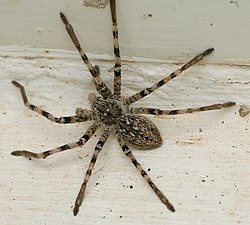
Eusparassus dufouri
female E. jaegeri
Scientific classification Edit this classification
Kingdom: Animalia
Phylum: Arthropoda
Subphylum: Chelicerata
Class: Arachnida
Order: Araneae
Infraorder: Araneomorphae
Family: Sparassidae
Genus: Eusparassus
Simon, 1903[1]
Type species
E. dufouri
Simon, 1932
Species

33, see text

Eusparassus is a genus of huntsman spiders, known as the stone huntsman spiders,[2] it was first described by Eugène Louis Simon in 1903.[3]

Description

[edit]

They are medium to large huntsman spiders, their bodies measuring from 10mm to 30mm. Their eyes are arranged in two rows, the anterior one being slightly recurved, while the posterior ones are relatively straight. They are pale gray to dark brown spiders, with a uniform coloration in their body. Some may have a clearly patterned body with banded legs.[4]

Identification

[edit]

They can be identified by the presence of two pairs of tibial spines on the legs and distinguished from the Olios genus by the palpal bulb morphology.[2]

Habitat

[edit]

They are commonly found in arid and semiarid deserts of Africa and most parts of Eurasia where they inhabit stony habitats and build retreats in crevices. They are one of the most visible arachnid predators in their habitats. They can be found in very high elevations from 3,000 to 4,000m above sea level.[2]

Webs

[edit]

They make silken papery webs, which are usually found in crevices or the underside of flat stones. This webs are used as protection during molts, or as a retreat during the day. Females of this species lay their egg sacs inside the retreats.[2]

Species

[edit]

As of September 2025, this genus includes 33 species, found in Africa, Asia, Europe, and Peru:[1]

References

[edit]
[edit]
Revisions and contributorsEdit on WikipediaRead on Wikipedia
from Grokipedia
Eusparassus is a of huntsman spiders in the family Sparassidae, consisting of 37 valid species as of November 2025 that are medium to large in size and recognized as stone huntsman spiders. First described by Eugène Simon in 1903, with E. dufouri (Simon, 1932), the is characterized by features such as denticles on the cheliceral furrow and distinctive ventral markings on the opisthosoma. These spiders are primarily distributed across arid and semi-arid regions of , (including the ), the , (extending to and ), and in , where they inhabit deserts, rocky terrains, and wadis. Ecologically, Eusparassus species function as apex predators, relying on keen eyesight for diurnal hunting and often camouflaging against stone surfaces to ambush prey. Taxonomically, the genus has undergone significant revisions, with Eurasian species consolidated into 13 valid taxa in 2012 and African-Arabian species reorganized into 27 species across six morphological groups in 2013, including transfers from the genus Olios and descriptions of new species; subsequent changes, such as additional transfers, have resulted in the current total of 37 . Notable species include E. dufouri (endemic to and ), E. walckenaeri (widespread in the Mediterranean), and E. laevatus (found in Ethiopian deserts). Recent molecular studies support the of Eusparassus within Sparassidae, highlighting its evolutionary adaptations to xeric environments.

Taxonomy and Systematics

Etymology and Classification History

The genus name Eusparassus derives from the Greek prefix "eu-" (true or good) and "sparassus," alluding to the Sparassidae family to which it belongs; it was coined by Eugène Simon in 1903 as a substitute for the preoccupied name Sparassus Walckenaer, 1805, which Simon considered a junior synonym of Olios Walckenaer, 1837. Simon established the genus in his Histoire naturelle des araignées, initially designating E. argelasius (a nomen novum for the misidentified Micrommata argelasia Latreille, 1818) as the type species; this was later corrected in 1932 to E. dufouri Simon, 1932, a species distributed in the Western Mediterranean Basin, including parts of North Africa. Prior to the , classification of Eusparassus was unstable, with many being synonymized or transferred to Olios due to overlapping traits, though distinctions emerged based on male palpal morphology, such as the structure of the and conductor. A major advancement came in 2012 with the taxonomic revision of Eurasian by Moradmand and , which validated 13 , redescribed the , and introduced new taxa like E. mesopotamicus Moradmand & , 2012, emphasizing diagnostic genital characters. The African and Arabian received focused attention in 2013 through Moradmand's revision, which redescribed ten existing species, described seven new ones, transferred others (e.g., E. concolor Caporiacco, 1939 to Olios), proposed six species groups, and analyzed zoogeographic patterns, accounting for over 15 species in those regions. These works clarified the genus's boundaries and resolved long-standing nomenclatural issues, including conservation of the name Eusparassus against competing synonyms.

Phylogenetic Position and Revisions

Eusparassus is placed within the family Sparassidae, specifically in the subfamily Eusparassinae, based on morphological characteristics such as and genital structures. Cladistic analyses indicate close relationships with genera like Olios in certain clades, though the exact remains unresolved in broader phylogenies. A 2012 taxonomic revision of Eurasian species recognized 13 valid , primarily using genital morphology for delimitation and redescription of the E. dufouri. This study incorporated distributional data to resolve ambiguities in type localities and established synonymies such as E. nanjiangensis under E. potanini. In 2013, a comprehensive revision of African and Arabian species addressed 17 taxa, describing seven new and integrating zoogeographic patterns to define six groups, including the walckenaeri and dufouri groups. Notable synonymies included E. rufobrunneus under E. vestigator and Olios furcatus under E. tuckeri, emphasizing the role of cheliceral bristles and leg spination in diagnosis. Molecular evidence from a 2014 multilocus phylogeny strongly supports the of Eusparassus, encompassing subclades like the dufouri-, walckenaeri-, and doriae-groups, using markers such as COI, 16S, H3, and 28S rDNA. However, the subfamily Eusparassinae is not monophyletic, with Eusparassus forming a distinct Eurasian-African lineage separate from related genera like Pseudomicrommata. Divergence time estimates place the origin of Eusparassus around 70 million years ago, aligning with adaptations to arid environments in the to . A 2022 study employed ecological niche modeling to assess distributions of species in the dufouri and walckenaeri clades, revealing niche conservatism and geographic divergence as drivers of speciation, with high model accuracy (AUC > 0.97) under current and future climate scenarios. This supports the monophyly of these clades and highlights potential habitat expansions for E. arabicus and E. walckenaeri amid climate change.

Physical Characteristics

Morphology and Anatomy

Eusparassus spiders, belonging to the family Sparassidae, possess a distinctly flattened body structure that facilitates movement through narrow crevices and under stones in arid environments. The cephalothorax (prosoma) is slightly longer than wide, measuring approximately 6–13 mm in length, while the abdomen (opisthosoma) is ovoid and similarly compressed, contributing to an overall body length of 10–30 mm. This dorsoventral flattening is a key adaptation in huntsman spiders for terrestrial navigation. They feature eight eyes arranged in two nearly straight rows, with the anterior row slightly recurved; the anterior median eyes (AME) are subequal to or larger than the anterior lateral eyes (ALE), providing a field of vision suited to ground-level hunting. The legs of Eusparassus are notably long and robust, arranged in a laterigrade orientation where the joints are rotated such that the legs extend sideways from the body, resembling a crab's posture and enabling rapid, sideways scuttling. The typical is 2413, with II the longest, followed by IV and I (often subequal), and III; spination patterns include three spines on the dorsal surface of femora I–III (two on IV) and variable ventral spines on other segments. A diagnostic trait for the within the Eusparassinae is the presence of exactly two pairs (four spines total) of ventral tibial spines on legs I–IV, distinguishing it from related genera that have three pairs. Sexual dimorphism is evident in the genitalia, which serve as primary diagnostic structures. In males, the palpal bulb of the pedipalp exhibits a characteristic U-shaped configuration formed by a parallel embolus and tegulum, with the embolus originating proximally at the 6 o'clock position and curving variably—often slender and sickle-shaped—across species; a small hyaline conductor and retrolateral tibial apophysis are also present. Females possess an epigyne with two prominent triangular lateral lobes flanking a median septum, which ranges from soft and flexible to heavily sclerotized depending on the species. The chelicerae are robust and forward-projecting, with the basal segment bearing 1–4 thick bristles; the cheliceral furrow may bear denticles; and the fangs featuring two anterior teeth and 3–6 posterior teeth along the retromargin, adaptations for piercing and injecting venom into prey; the shorter pedipalps aid in grasping and manipulating captured items.

Size, Coloration, and Variation

Species of the genus Eusparassus are medium to large huntsman spiders, with adult body lengths typically ranging from 10 to 30 mm. Leg spans can reach up to 140 mm in larger species such as E. xerxes. For example, E. dufouri exhibits body lengths of 9.9–17.5 mm, while E. walckenaeri measures 13.4–25.3 mm. Coloration in Eusparassus varies from pale gray to dark brown, with some species displaying uniform body coloration and others featuring distinct patterns. The dorsal opisthosoma often bears chevron-like patterns, and legs may show banding, as seen in E. walckenaeri with its dark brown to cream prosoma and distinctly banded legs. Ventral markings on the opisthosoma are typically V-shaped or vase-like, such as the olive-brown E. dufouri with a prominent V-shaped ventral pattern. In E. jaegeri, dark brown coloration accompanies variable patterning on the body. Sexual dimorphism is evident, with females generally larger than males; for instance, in E. walckenaeri, females reach 16.9–25.3 mm compared to 13.4–20.6 mm in males. Intraspecific variation includes differences in coloration among females, as observed in E. laevatus from the , where preserved specimens show fading but retain darker markings. Juveniles tend to be paler than adults, though specific growth patterns contribute to overall size variation within populations.

Identification and Diagnosis

Key Diagnostic Features

Eusparassus spiders are primarily identified at the genus level through a combination of leg spination, palpal structures, eye arrangement, and leg proportions, which provide reliable field and laboratory diagnostic tools. These traits are consistent across species and reflect adaptations typical of stone-dwelling huntsman spiders in arid environments. A key feature is the leg spination, particularly the ventral surface of the tibiae on legs I and II, which bears two pairs of spines (typically two proximal and two distal), differing from the three pairs found in some related Sparassidae genera. The overall spination pattern for tibiae I–IV is 2024, contributing to their agile predatory locomotion. The leg formula is characteristically 2413, with leg II the longest, followed by IV, I, and III, supporting their cryptic, flattened posture on rocky surfaces. Dense scopulae on the tarsi and metatarsi enhance adhesion to smooth stones and vertical substrates, a trait emphasized in genus-level descriptions. Spiders in this genus typically range from 10–30 mm in body length, though this varies slightly by species. The consists of two recurved rows: the anterior row slightly recurved with anterior median eyes (AME) subequal to or larger than anterior lateral eyes (ALE), and the posterior row straight, forming a consistent dyad arrangement that aids in nocturnal vision for ambush hunting. Male palpal morphology is diagnostic, featuring a cymbium with a retrolateral process and a bulb where the and tegulum form a U-shaped structure, with the originating at approximately the 6:30 o'clock position and a strong, straight distal retrolateral tibial apophysis (dRTA) paired with a small ventral RTA (vRTA). In females, the displays two large, triangular lateral lobes parallel along the median and diverging posteriorly, while the internal genitalia show specifically coiled and fertilization ducts, visible upon for confirmation.

Distinction from Similar Genera

Eusparassus can be distinguished from the closely related Olios primarily through differences in palpal and structures. In Eusparassus, males possess a bifurcated tibial apophysis consisting of a strong, straight dorsal retrolateral tibial apophysis (dRTA) and a small ventral retrolateral tibial apophysis (vRTA), whereas Olios lacks this bifurcation and features a simpler palpal conductor without the small, structure that partially covers the embolus tip in Eusparassus. Additionally, Olios species typically exhibit more than seven bristles on the distal end of the cheliceral basal segment, compared to one to four in Eusparassus, and their are often more flattened, aiding in bark or foliage navigation. Compared to Pseudopoda, Eusparassus shows less leg flattening, with limbs that are not adapted for the extreme dorsoventral compression seen in Pseudopoda, which facilitates movement on flat surfaces like tree bark in tropical forests. The in Eusparassus forms a characteristic U-shaped structure with the tegulum, often directing retrolateralo-distad at the tip, in contrast to the more strongly curved of Pseudopoda. Distributionally, Pseudopoda is confined to tropical , while Eusparassus occupies arid regions across and . Distinctions from Holconia, an Australian endemic, include variations in eye arrangement and cheliceral dentition. The anterior eye row in Eusparassus is slightly recurved with the anterior median eyes (AME) subequal to or larger than the anterior lateral eyes (ALE), differing from the straighter anterior row and slightly procurved posterior row in Holconia. in Eusparassus bear two promarginal teeth and three to six retromarginal teeth, sometimes with denticles, whereas Holconia has three promarginal and two retromarginal teeth without noted denticles. Palpal differences further separate them, with Eusparassus featuring a bifurcated tibial apophysis and a conductor, unlike the prominent tegular apophysis and two-process tibial apophysis in Holconia. In the field, Eusparassus species are typically found in stony deserts and semi-arid rocky s, often under flat stones, which contrasts with the preferences of Olios and Pseudopoda for foliage or bark in more vegetated areas, and Holconia for forests, woodlands, and grasslands. These habitat distinctions aid in avoiding misidentification during surveys.

Habitat and Distribution

Preferred Habitats and Microhabitats

Eusparassus species primarily inhabit arid and semiarid environments, including deserts, steppes, and rocky slopes across their range. These spiders are adapted to xeric and subxeric regions, where they occupy stony habitats that provide suitable conditions for survival in low-precipitation areas. They tolerate a wide elevational range from to approximately 4,000 meters, including highland areas in mountain systems such as the in and the in . Within these landscapes, Eusparassus individuals select specific microhabitats that aid in and moisture conservation, such as crevices in rocks and under large flat stones. These sites allow the spiders to construct silken retreats for , , and daytime hiding, helping to buffer against extreme diurnal fluctuations and in conditions. By utilizing these protected niches, the spiders maintain physiological stability in environments characterized by high heat and low humidity. As apex predators, Eusparassus play a key role in food webs, primarily targeting and occasionally small vertebrates, thereby exerting top-down control on prey populations. Their predatory activities contribute to regulating insect abundances in these ecosystems, supporting overall community dynamics. To cope with intense solar radiation and heat, Eusparassus exhibit behavioral adaptations including sheltering in retreats during the day and peaking in activity at and dawn, aligning with cooler crepuscular periods for .

Global Geographic Range

The genus Eusparassus exhibits a broad but primarily distribution, spanning the Afrotropical and Palearctic realms with extensions into the Indomalayan region. Native ranges encompass North and , (particularly the and Mediterranean basin), the , , and parts of including and . This pattern reflects adaptation to arid and semi-arid environments across these biogeographic zones, with the genus absent from the , , and beyond its core areas. In , which hosts the majority of species diversity, Eusparassus is widespread from the region (e.g., , , ) through (e.g., , , ) to (e.g., , , ). Arabian Peninsula taxa, such as E. arabicus and E. xerxes, bridge Afrotropical and Palearctic distributions, extending into the and . Eurasian populations are concentrated in the western Palearctic, including (E. dufouri in and ) and the (E. walckenaeri from to ), while Central Asian species like E. potanini reach as far northeast as . Indomalayan elements include several species in and (E. maynardi, E. pontii), highlighting connectivity along ancient arid corridors. There is a single historical record of E. shefteli from , but this species is considered misplaced in the genus. No introduced populations are widespread, though E. dufouri has been recorded as established in the , likely via human-mediated transport. Overall, the genus's range underscores its resilience in xeric habitats, with species distributions often aligned with post-Eocene climatic shifts favoring across and .

Behavior and Ecology

Predatory Strategies and Diet

Eusparassus species are predators that primarily employ active pursuit and tactics on the ground to capture prey, relying on their rather than webs. These spiders detect potential prey through motion, using their remarkable speed to close distances rapidly during chases. Their diet is predominantly insectivorous, focusing on arthropods such as beetles, , and , though they opportunistically consume small vertebrates like when encountered. For instance, E. walckenaeri has been observed subduing and feeding on geckos (Mediodactylus orientalis) through physical restraint and injection, demonstrating their ability to tackle prey larger than themselves. Opportunistic has been observed in huntsman spiders (Sparassidae), potentially as a means to supplement during prey scarcity. Sensory adaptations enhance their hunting efficiency, with principal eyes providing excellent motion detection for visual prey location at short ranges. Chemoreceptors on their legs allow tracking of chemical cues from prey, aiding in navigation to hidden or escaping targets. Foraging activity is largely nocturnal or crepuscular, aligning with the behavior of many prey species in desert ecosystems, and exhibits seasonal peaks corresponding to increased insect abundance during warmer months.

Reproduction, Life Cycle, and Development

Mating in Eusparassus species occurs through rituals typical of solitary huntsman spiders, where males approach females cautiously to reduce the risk of aggression, with being rare. Females emit pheromones to attract males, and may involve leg waving and mutual tactile interactions to signal non-threatening intent. Following successful , females store and later oviposit without further male involvement. Females construct plastered egg sacs attached to substrates such as rocks or bark, containing 50 to 200 eggs encased in white papery silk. These sacs are often placed in protected retreats under stones, within simple silk-lined structures, and guarded by the female, who remains protective and may refuse food during this period. Maternal care is transient, lasting until the eggs hatch into pre-larval spiderlings after approximately 3-4 weeks of incubation. The female continues to defend the newly emerged young for a short time, providing protection from predators and parasites. The life cycle of Eusparassus spans 1-2 years, beginning with development followed by multiple juvenile . Spiderlings emerge from the sac and undergo several molts, typically reaching adulthood after about 10 in most Sparassidae, though solitary species like those in Eusparassus begin foraging independently by the second or third . Juveniles disperse from the maternal retreat shortly after hatching, relying on reserves initially before small prey. Breeding is seasonal in temperate regions, peaking in spring and summer as observed in E. walckenaeri populations in during August. In tropical or arid habitats within the genus's range, reproduction may occur year-round, aligned with favorable conditions. Sexual dimorphism in size, with females larger than males, influences mating dynamics, as males must navigate the female's greater predatory capacity during courtship.

Web Use and Retreat Construction

Eusparassus species do not construct capture webs such as orb-webs, instead producing tubular or papery silk retreats primarily for shelter in natural refuges like rock crevices or under stones. These retreats consist of silk sheets bonded to the substrate, forming enclosed spaces that blend with the surrounding environment. The silk used is typically dry and papery, providing camouflage against the rocky substrates where the spiders reside. Females of Eusparassus actively spin these retreats during molting periods and while guarding eggs, creating sealed enclosures within larger structures under flat stones or in crevices. Males utilize more temporary hides, often simpler linings in similar locations, without the extensive seen in females. involves the applying directly to the substrate surface, resulting in a , adherent chamber that can be abandoned after use. These retreats serve as daytime refuges, protecting the spiders from extreme heat and in arid habitats. They also function as secure molting chambers, allowing safe away from predators, and as enclosures for egg sacs, where females deposit and guard them until hatching. The design minimizes exposure, with egg sacs often plastered or suspended by additional lines within the retreat for added stability.

Diversity

Overview of Species Count and Endemism

The genus Eusparassus currently comprises 37 accepted , as documented in the as of November 2025. This represents a significant increase from approximately 20 recognized around 2010, driven by major taxonomic revisions that clarified synonymies and described new taxa. Ongoing taxonomic updates, including splits and new descriptions, continue to refine the genus's diversity. Endemism patterns within Eusparassus vary regionally, with high levels in where 15 are distributed, many restricted to specific or Mediterranean habitats. In contrast, hosts 3 , such as E. dufouri and E. walckenaeri, which exhibit broader distributions across the Mediterranean basin. Formal conservation assessments for Eusparassus are limited, with most considered by the IUCN. Ecological niche modeling for Western Palearctic indicates potential vulnerability to climate change impacts, including habitat shifts and increased aridity by 2050–2070, particularly for environmentally specialized taxa with limited dispersal abilities. No in the are known to be extinct.

Regional Species Distributions and Notable Taxa

The genus Eusparassus exhibits a primarily distribution, with the highest species diversity in and , reflecting adaptations to diverse arid and semi-arid landscapes across these regions. African species account for a significant portion of the genus's diversity, with 15 taxa recognized, many confined to specific subregions within the continent and adjacent Arabian areas. For instance, E. walckenaeri is widespread across , including the Sahara Desert and extending into northeastern regions like and . In contrast, E. jaegeri represents a southern African endemic, known only from and , where it inhabits rocky terrains. Eurasian species number 16 (3 in and 13 in ), spanning from through the to Central and . Key examples include E. mesopotamicus, restricted to the region of and , and E. dufouri, found in the of southwestern . Outside the , the genus includes a single Neotropical representative, E. shefteli, endemic to the Andean highlands of . Among notable taxa, E. arabicus stands out for its specialized adaptations, such as on sandy substrates, and is confined to the in countries like and the . Recent taxonomic additions continue to refine the understanding of regional in these distributions.

References

Add your contribution
Related Hubs
User Avatar
No comments yet.