Hubbry Logo
EvaniidaeEvaniidaeMain
Open search
Evaniidae
Community hub
Evaniidae
logo
8 pages, 0 posts
0 subscribers
Be the first to start a discussion here.
Evaniidae
Evaniidae
from Wikipedia

Evaniidae
Temporal range: Barremian–Present
Evania appendigaster
Scientific classification Edit this classification
Kingdom: Animalia
Phylum: Arthropoda
Class: Insecta
Order: Hymenoptera
Superfamily: Evanioidea
Family: Evaniidae
Latreille, 1802
Diversity
Around 20 living genera
Synonyms
  • Andreneliidae (but see text)
  • Cretevaniidae

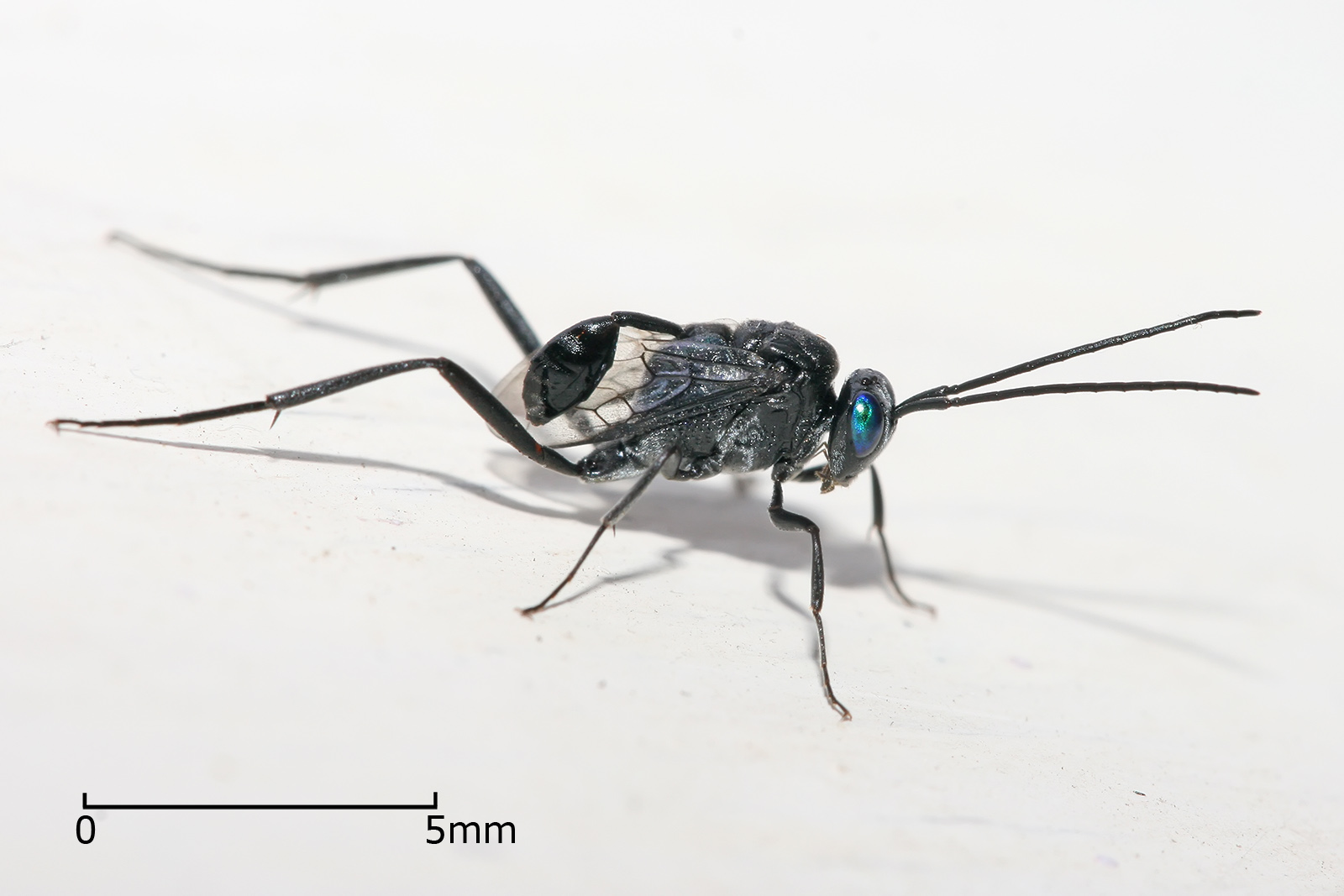
Evaniidae is a family of parasitoid wasps also known as ensign wasps, nightshade wasps, hatchet wasps, or cockroach egg parasitoid wasps. They number around 20 extant genera containing over 400 described species, and are found all over the world except in the polar regions.[1] The larvae of these solitary wasps are parasitoids that feed on cockroaches and develop inside the egg-cases, or oothecae, of their hosts.[2]

Description

[edit]

Evaniidae have the metasoma attached very high above the hind coxae on the propodeum, and the metasoma itself is quite small, with a long, one-segmented, tube-like petiole, and compressed laterally over most of its length (segments 2–8). The ovipositor is short and thin. When active, these wasps jerk the metasoma up and down constantly, as referenced in their common names. The mesosoma is high, short, and heavily sclerotized, with a ridged and pitted surface. The head is largely immovable and attaches to the mesosoma on a short neck; with usually 13-segmented antennae that do not differ between males and females.[1]

Apomorphies of ensign wasp wings and their venation are:[1]

  • deeply separated jugal lobes in fore- and hindwings
  • loss of cross-veins on the distal forewing (though this is hard to determine in some)
  • hindwings retain only medial, cubital, and part of the costal vein; all others have been lost

Ecology

[edit]

As far as is known, ensign wasp larvae are parasitoids on the eggs of cockroaches.[2] However, good host data are only known for a fraction of this family, about 4% as of 2008, thus more unusual life history strategies likely exist. Host specificity and coevolution with roach lineages seem to have played a significant role in the evolution of some ensign wasp lineages. Others are less discriminating in their host choice, and will attack almost any ootheca (egg case) of a particular size.[1]

Illustration of Evania appendigaster (lower right) and its pupa (upper right) as parasitoids of the American cockroach (Periplaneta americana)

The female wasp lays an egg inside the roach ootheca, and the wasp larva hatches quickly and consumes the roach eggs. A single egg is laid per ootheca, into a host egg in some Evaniidae, and between the eggs in others. Some are able to oviposit even when the female cockroach still carries the fresh ootheca around, while other ensign wasps will only attack oothecae that are completed and have been dropped by the mother roach. The wasps seem to be able to determine if an ootheca is already used to host a larva, and refrain from depositing eggs in such cases; alternatively, the larvae might be cannibalistic, with the first to hatch in an ootheca eating any wasp eggs subsequently deposited.[1]

Two Evaniidae species, Evania appendigaster and Prosevania fuscipes, have achieved an essentially worldwide distribution nowadays, having been introduced along with various Blattidae species of genera Blatta and Periplaneta. While they do feed on insects that are considered pests, they rarely attain population sizes sufficient to act as effective biocontrol agents. As cockroaches are typically more abundant in and around human settlements, Evaniidae are a regular sight in such habitat where many other wasps are absent, and are frequently encountered in buildings looking for prey. The adults drink nectar from flowers and neither they nor the larvae are dangerous or harmful to humans.[1]

Systematics and taxonomy

[edit]

Before 1939, the Evaniidae were a "wastebin taxon" for any parasitoid wasp with unusual morphology. Among these were the more apomorphic and less diverse (but about equally speciose) taxa now placed in the Aulacidae and Gasteruptiidae, which together with ensign wasps make up the superfamily Evanioidea. These were formerly a part of the paraphyletic "Parasitica", ranked as an infraorder. But the parasitoid wasp lineages are not more closely related among themselves than they are related to non-parasitoid wasps, thus the "Parasitica" are an obsolete group.[3]

Rather, the Evanioidea seem to be close relatives of the Megalyroidea, Trigonaloidea, and particularly the Ceraphronoidea. These four superfamilies seem to make up a clade, which could be considered one of several infraorders to replace the superseded "Parasitica".[4]

Living genera

[edit]

The living ensign wasp genera can be divided into one larger and four smaller groups, which might be considered subfamilies. Some genera are hard to place in these, though; they probably represent minor lineages of a more basal position. The groups, with genera sorted according to the presumed relationship, are:[1]

Notes

[edit]
  1. ^ "1908" is lapsus in Deans (2008)

Fossil record

[edit]
Ensign wasp in amber

Ensign wasps likely originated over 150 million years ago. Overall, they are successful organisms, existing since the time dinosaurs roamed the Earth with little change in morphology and, presumably, ecology. The fossil record, in particular from fossil amber, is quite comprehensive, with about 10 genera and twice as many species known from the Late Jurassic up to a few million years ago. The primitive Mesozoic genera Andrenelia, Botsvania, and Praevania are only tentatively identified as Evaniidae at present; the first was once separated as family Andreneliidae.[1]

Evaniidae seem to have undergone significant evolutionary radiation in the Cretaceous; these taxa were separated as Cretevaniidae, but seem to be a subfamily if anything. The main lineages of extant ensign wasps probably were well separated by the mid-Paleogene. Few Evaniidae have been found in deposits dating from the Paleogene, however, and the ancestry of the living genera consequently remains not well documented. Eoevania and Protoparevania seem to be closer to the living lineages than earlier fossils.[1]

Ensign wasp genera known only from fossils are:[1]

References

[edit]
[edit]
Revisions and contributorsEdit on WikipediaRead on Wikipedia
from Grokipedia
Evaniidae is a family of small wasps in the superfamily Evanioidea within the order , characterized by their distinctive raised, flag-like metasoma () that gives them the common name "ensign wasps" or "hatchet wasps," and they are specialized predators of eggs (). Comprising over 500 described species across about 21 genera, Evaniidae exhibit a nearly , occurring worldwide in tropical, subtropical, and temperate regions but absent from polar areas. Their biology centers on endoparasitism, with females using their to lay a single inside a (egg case), where the hatches, consumes the host eggs, and pupates within the case before the emerges through a characteristic jagged hole. Adults are typically 3–10 mm long, slender, and black or dark-colored, with wings that may fold transversely in some species; they are non-aggressive toward humans, lack stings, and feed on or honeydew. Evaniidae play a notable ecological role as natural biological control agents against pests, with species like achieving up to 29% rates in some populations and showing potential for augmented releases in pest management programs. The family originated in the around 134–141 million years ago, with most modern genera diversifying near the Cretaceous-Paleogene boundary, reflecting a long co-evolutionary history with their blattodean hosts.

Morphology

Physical characteristics

Evaniidae, commonly known as ensign wasps, exhibit a distinctive characterized by a short and stout mesosoma with the metasoma attached high on the propodeum via a curved, tubular petiole, giving the appearance of a raised flag or ensign. This laterally compressed metasoma is small and oval-shaped, typically measuring less than half the length of the mesosoma, and is carried upright at an angle. Body size varies across the family but generally ranges from 3 to 10 mm in length, with some species like reaching up to 11 mm. The antennae are geniculate, featuring an enlarged scape that is notably long—often 4-5 times as long as wide—and typically consist of 13 segments in both sexes (scape, pedicel, and 11 flagellomeres), though in antennal morphology, such as sensillar patches on female flagellomeres, is common in some genera. Coloration is predominantly black or dark brown, but varies by species and genus; for example, Evania species are entirely black, while others like those in Evaniella may show ferruginous markings, and certain taxa exhibit metallic blue-green or iridescent hues on the body or eyes. Wings are (clear) or lightly infuscated (tinged brown), with reduced venation that includes an open radial cell and deeply separated jugal lobes in both fore- and hindwings, representing key apomorphies of the family. Forewing venation often forms 6-7 closed cells, though some genera like Hyptia show further simplification with only one enclosed cell. The legs are relatively long and slender, facilitating rapid movement across surfaces, including the textured exteriors of oothecae where females search for oviposition sites.

Diagnostic features

Evaniidae are distinguished from other hymenopteran families by their unique combination of morphological traits, particularly the highly modified metasoma and variable wing venation, which facilitate identification in taxonomic keys. The family exhibits extreme heterogeneity in forewing venation, a condition unique among , where patterns range from relatively complete configurations with multiple closed cells to highly reduced forms lacking submarginal cells or featuring only spectral (non-tubular) veins; for instance, some genera retain tubular veins defining a single submarginal cell, while others show complete loss of crossveins in the distal forewing. This variability contrasts with the more uniform venation in related families like Aulacidae and Gasteruptiidae, aiding differentiation within Evanioidea. The metasoma is petiolate and dorsally flattened, arising high on the propodeum well above the hind coxae, with the first tergite (petiolar segment) fused to the propodeum, forming a distinct, often curved tubular petiole that separates the small, compressed gaster from the robust mesosoma. This configuration results in a flag-like appearance when the metasoma is raised, a synapomorphy for the . The ovipositor is short and stout, typically not extending beyond the metasoma apex and remaining mostly hidden within the gaster; it is adapted for piercing the tough of oothecae to deposit eggs internally. The head features large compound eyes that dominate the lateral profile and three ocelli arranged in a triangular formation, providing enhanced for host location. The clypeus is broad and distinct, bearing a transverse carina that delineates its lower margin and separates it from the face, a trait consistent across genera and useful for distinguishing evaniids from superficially similar ichneumonoids. Variations within the family include elongation of the petiolate metasoma in certain lineages; for example, in species of the genus Hyptia, the petiole can be notably long and thin, sometimes approaching or exceeding the combined length of the head and mesosoma, enhancing the ensign-like posture. These traits collectively enable precise identification, with body sizes typically ranging from 3–10 mm and coloration often black or metallic, though varying by species.

Distribution and habitat

Global range

The family Evaniidae displays a predominantly distribution, with approximately 21 extant genera and around 500 described , and is absent from polar regions. This biogeographic pattern reflects their association with hosts in warm climates, though some have expanded beyond native ranges through human-mediated dispersal. The Neotropical region serves as a major hotspot of diversity and for Evaniidae, hosting genera such as Decevania, which is restricted to this area and includes multiple species adapted to local ecosystems. The Afrotropical and Oriental regions also exhibit substantial diversity, with numerous genera and species recorded across these zones, contributing to the family's overall tropical concentration. Patterns of are pronounced in these areas, where many genera are regionally confined, contrasting with more widespread taxa. A notable cosmopolitan species, Evania appendigaster, has achieved near-global distribution through human transport, particularly in urban environments where it exploits synanthropic populations. This wasp, likely of Oriental origin, has established introduced populations in since the late 19th century and in , where it continues to expand via synanthropic pathways. Recent discoveries underscore ongoing expansions and in the Oriental region, including a new of Brachygaster described from in 2025, highlighting the area's untapped diversity. Such findings, combined with records of synanthropic in temperate zones, illustrate the dynamic nature of Evaniidae amid global connectivity.

Habitat preferences

Evaniidae wasps exhibit a strong preference for warm and environments, thriving primarily in tropical and subtropical climates where temperatures range from 25–30°C and relative levels approach 87%. These conditions support their survival and , as lower (e.g., 38% RH) significantly reduces without supplemental resources like sugar solutions. The family is abundant in tropical regions, with many showing cosmopolitan distributions facilitated by their association with synanthropic hosts. In urban settings, Evaniidae are frequently synanthropic, occurring in buildings, warehouses, and other human-modified structures harboring infestations, where they exploit oothecae hidden in crevices and sheltered areas. Beyond urban environments, they inhabit natural microhabitats such as floors, holes, wood piles, and palm bracts, often aggregating near cockroach egg cases concealed under bark or in soil. Their presence is limited in arid zones due to the family's reliance on moist conditions, though they extend into temperate areas via human-mediated dispersal. Evaniidae occupy a broad altitudinal range, from near up to approximately 1,750 m in mountainous regions, aligning with their global distribution patterns excluding polar areas. influence has amplified their prevalence through global and , which inadvertently transports them alongside hosts to new locales, enhancing urban .

Biology and ecology

Life cycle

Evaniidae exhibit holometabolous development, characterized by distinct , larval, pupal, and stages. Females oviposit a single , occasionally more, directly into the of a host using their short , where it hatches into a solitary that functions as an internal predator, consuming all the host eggs within the capsule. This larval feeding strategy ensures the wasp offspring obtains all necessary nutrients from the enclosed host eggs, typically numbering 12–16 per . The undergoes three s, each marked by morphological adaptations for feeding and growth inside the confined . The first is transparent and elongated, approximately 2 mm long, with pointed mandibles that pierce the wall to access and consume 1–2 host eggs initially. The second is ovoid and more robust, reaching about 4.6 mm, featuring strengthened tridentate mandibles suited for shredding remaining eggs and exhibiting cannibalistic behavior if multiple wasp eggs are present. The third (final) is plump and fills the , measuring around 7.7 mm, with minimal additional feeding as it prepares for pupation, relying on stored nutrients. Following the larval period, the mature remains within the without spinning a cocoon, entering a prepupal stage before pupation. The is exarate, initially whitish and darkening over time, with development occurring entirely inside the host capsule under stable environmental conditions such as 70% and a 14:10 light-dark photoperiod. Pupation duration varies but aligns with overall generation times influenced by . The emerges by chewing a small, jagged exit hole, approximately 5 mm in diameter, using its mandibles. The complete generation time from to spans 20–40 days, contingent on , with a lower developmental threshold around 13°C and a requirement of approximately 585 day-degrees. Optimal development occurs at 25–30°C, yielding faster cycles and higher survival rates, while extremes below 17°C or above 35°C prevent emergence; at 30°C, the cycle completes in about 34 days. In tropical regions, Evaniidae are multivoltine, producing multiple generations annually due to favorable warmth. Reproduction is predominantly sexual and biparental, with arrhenotokous —where unfertilized eggs develop into males—occurring rarely. Females are typically larger than males, reflecting common in the family, and both sexes exhibit similar patterns modulated by and .

Parasitism and hosts

Evaniidae are obligate parasitoids that target the oothecae (egg cases) of in the order , with larvae developing as solitary egg predators inside these structures. Only about 4% of the more than 400 described species in the family have documented hosts, which are primarily from the families and . During oviposition, the female wasp uses her short to penetrate the tough outer wall of the and deposit a single , typically between or within the host eggs, in a manner that avoids detection by the female . This solitary oviposition strategy limits the number of offspring per host to one, aligning with the larval development observed in the life cycle. Upon hatching, the single consumes the entire contents of the , devouring the 12-16 eggs across three instars before pupating within the empty case. Superparasitism is rare, as females rely on chemical cues from previously parasitized to avoid laying additional eggs in occupied hosts. A well-documented host association is that of with the (Periplaneta americana), a peridomestic pest in the family , where the wasp targets the oothecae containing 14-16 eggs. Despite this specificity, E. appendigaster shows limited efficacy as a biocontrol agent against populations, with natural rates typically below 10% due to factors such as host density and oothecal availability. Recent has highlighted behavioral adaptations in host selection, such as a 2017 study demonstrating that E. appendigaster exhibits a strong oviposition preference for freshly laid (1-day-old) oothecae of P. americana, which are most vulnerable to host , resulting in higher rates (up to 45%) and shorter handling times compared to older oothecae. This preference prioritizes oothecae with optimal conditions for progeny fitness, even at the risk of reduced survival from .

Taxonomy and systematics

Phylogenetic relationships

Evaniidae belongs to the superfamily Evanioidea within the suborder of , representing one of the basal lineages in the apocritan phylogeny. The superfamily Evanioidea is positioned near the base of , with its stem divergence from the symphytan family Orussidae estimated at approximately 175–221 million years ago based on multi-gene analyses incorporating fossil calibrations. Within broader phylogenies, Evanioidea has been recovered as sister to a clade comprising Stephanoidea and the remaining in some molecular and morphological studies, highlighting its primitive position among parasitoid wasps. In analyses of Evanioidea, Evaniidae is often placed as sister to a clade formed by Aulacidae and Gasteruptiidae, though relationships vary across datasets; for instance, morphological and molecular evidence supports this grouping in parsimony-based reconstructions, while Bayesian approaches sometimes suggest alternative arrangements with extinct families. The family Evaniidae exhibits strong monophyly, corroborated by molecular markers such as 16S rDNA, COI, and 28S rDNA, which resolve internal branches with high posterior probabilities in concatenated multi-gene phylogenies. Within Evanioidea, Evaniidae and the extinct Praeaulacidae (often considered paraphyletic) form part of the crown group diversification, emerging in the Early Cretaceous alongside other evanioid lineages. Key apomorphies uniting Evaniidae with other Evanioidea include the elevated attachment of the metasoma to the propodeum and distinctive wing venation patterns, such as reduced crossveins, which are shared with fossils and underscore the family's evolutionary stability. A comprehensive phylogeny published in using expanded molecular sampling resolved finer-scale relationships within Evaniidae, confirming its and divergence patterns without altering higher-level placements. Subsequent studies incorporating tip-dating and fossilized birth-death models, up to , have refined divergence estimates but introduced no major revisions to the core phylogenetic framework for extant Evanioidea post-2020.

Classification and genera

Evaniidae is classified without recognition of subfamilies, encompassing approximately 20 extant genera and over 450 described worldwide, with significant undescribed diversity particularly in tropical regions. The genera are informally grouped into species complexes based on morphological and phylogenetic similarities, such as the Evania group, which includes the cosmopolitan genus Evania (with its single species E. appendigaster) and Evaniella, and the Hyptia group, comprising Hyptia and Brachygaster. Other key genera include the Neotropical Prosevania and the Afrotropical Szepligetiella. A comprehensive list of extant genera includes: Acanthinevania (now synonymous with Szepligetiella), Afrevania, Alobevania, Brachevania, Brachygaster, Decevania, Evania, Evaniella, Evaniscus, Hyptia, Micrevania, Papatuka (synonymous with Zeuxevania), Parevania (synonymous with Zeuxevania), Prosevania, Rothevania, Semaeomyia, Szepligetiella, Thaumatevania, Trissevania, Vernevania, and Zeuxevania. Historical taxonomic challenges, including wastebasket genera with accumulated synonymies, have been largely resolved through recent phylogenetic analyses; for instance, a 2019 multi-gene study supported the synonymy of Parevania and Papatuka under Zeuxevania (transferring over 30 species) and Acanthinevania under Szepligetiella (transferring about 20 species). Earlier revisions in described three new genera (Decevania, Rothevania, Vernevania) from the and Neotropics, while a 2005 catalog provided the foundational species-level synopsis.

Fossil record

Known fossil taxa

The fossil record of Evaniidae encompasses approximately 13 extinct genera and more than 50 described species, documenting the family's history from the to the . The oldest known fossils date to the (late , approximately 130 Ma), with several genera documented from this period. A notable radiation occurred during the , particularly in formations. In the of (), several genera such as Mesevania and Lebanevania have been documented, showcasing diverse forewing venation patterns characteristic of the family. Praevania, known from a single species Praevania sculpturata in the Early Cretaceous Dzun-Bain Formation of , represents another early example with elongated petioles and reduced metasoma. Mid-Cretaceous Kachin amber from has yielded numerous well-preserved specimens, including recent discoveries such as Sorellevania rara (2023), highlighting the family's morphological diversity in tropical environments. Additional 2023 finds from this amber include new evanioid wasps, expanding knowledge of Cretaceous diversity. Cenozoic fossils are primarily known from deposits, providing exceptional preservation of fine structures like antennae and wing veins. Eocene Baltic contains Hyptia-like forms, such as Hyptia hennigi, which display modified compound eyes unique among and closely resemble extant Neotropical . In Miocene , three new ensign wasps were documented in 2020 (Evaniella setifera, Evaniella dominicana, Semaeomyia hispaniola), underscoring the family's persistence in the Neotropics and revealing parallels to modern genera in metasomal shape. Oligocene–Miocene Mexican amber preserves Hyptia deansi, the sole of its , with intact and venation details affirming its placement near living Hyptia. Amber preservation dominates the fossil record, enabling detailed observations of wing venation, such as the configuration of the submarginal cells and radial sector, which are key diagnostic traits for distinguishing extinct genera from extant ones. Compression fossils from Cretaceous sediments provide complementary evidence but often lack the resolution of amber inclusions.

Evolutionary insights

The superfamily Evanioidea, which includes Evaniidae, likely originated in the Late Triassic to Early Jurassic (approximately 200–170 Ma), with diversification in the Middle to Late Jurassic (around 160–150 Ma), based on molecular and fossil-calibrated phylogenies. The crown group of Evaniidae radiated primarily during the Early Cretaceous (approximately 140–130 Ma), coinciding with the diversification of their primary hosts, the Blattodea (cockroaches). This temporal alignment suggests co-speciation dynamics, as ensign wasps have remained specialized egg predators of cockroaches without evidence of major host shifts following the Cretaceous-Paleogene boundary. Fossilized birth-death models indicate a peak in Evanioidea diversification during the , followed by a decline after the mid-Cretaceous, potentially linked to competition from rising and environmental changes at the Cretaceous-Paleogene transition. Most extant evaniid genera diverged near the K-T boundary around 66 Ma, reflecting a post-extinction recovery that stabilized the family's modern diversity. Biogeographically, Evaniidae exhibit a Laurasian origin, with early fossils from regions such as (Early Cretaceous) and (mid-Cretaceous), followed by dispersal into Gondwanan landmasses, as evidenced by extant species in and . Amber deposits, particularly from Kachin in northern , preserve tropical assemblages that highlight the persistence of evaniid lineages in warm, humid environments through the , with ongoing discoveries as of 2025 providing further insights. Despite these advances, significant gaps remain in understanding the ancestry of modern evaniid genera, with molecular phylogenies providing insufficient resolution for deep generic relationships due to limited sampling and conflicting morphological signals. The sparse fossil record further obscures transitions to the , though ongoing discoveries in hold promise for clarifying these evolutionary patterns.

References

Add your contribution
Related Hubs
User Avatar
No comments yet.