Hubbry Logo
Arrhenatherum elatiusArrhenatherum elatiusMain
Open search
Arrhenatherum elatius
Community hub
Arrhenatherum elatius
logo
8 pages, 0 posts
0 subscribers
Be the first to start a discussion here.
Arrhenatherum elatius
from Wikipedia

Arrhenatherum elatius
Scientific classification Edit this classification
Kingdom: Plantae
Clade: Tracheophytes
Clade: Angiosperms
Clade: Monocots
Clade: Commelinids
Order: Poales
Family: Poaceae
Subfamily: Pooideae
Genus: Arrhenatherum
Species:
A. elatius
Binomial name
Arrhenatherum elatius
(L.) P.Beauv. ex J.Presl & C.Presl, 1819

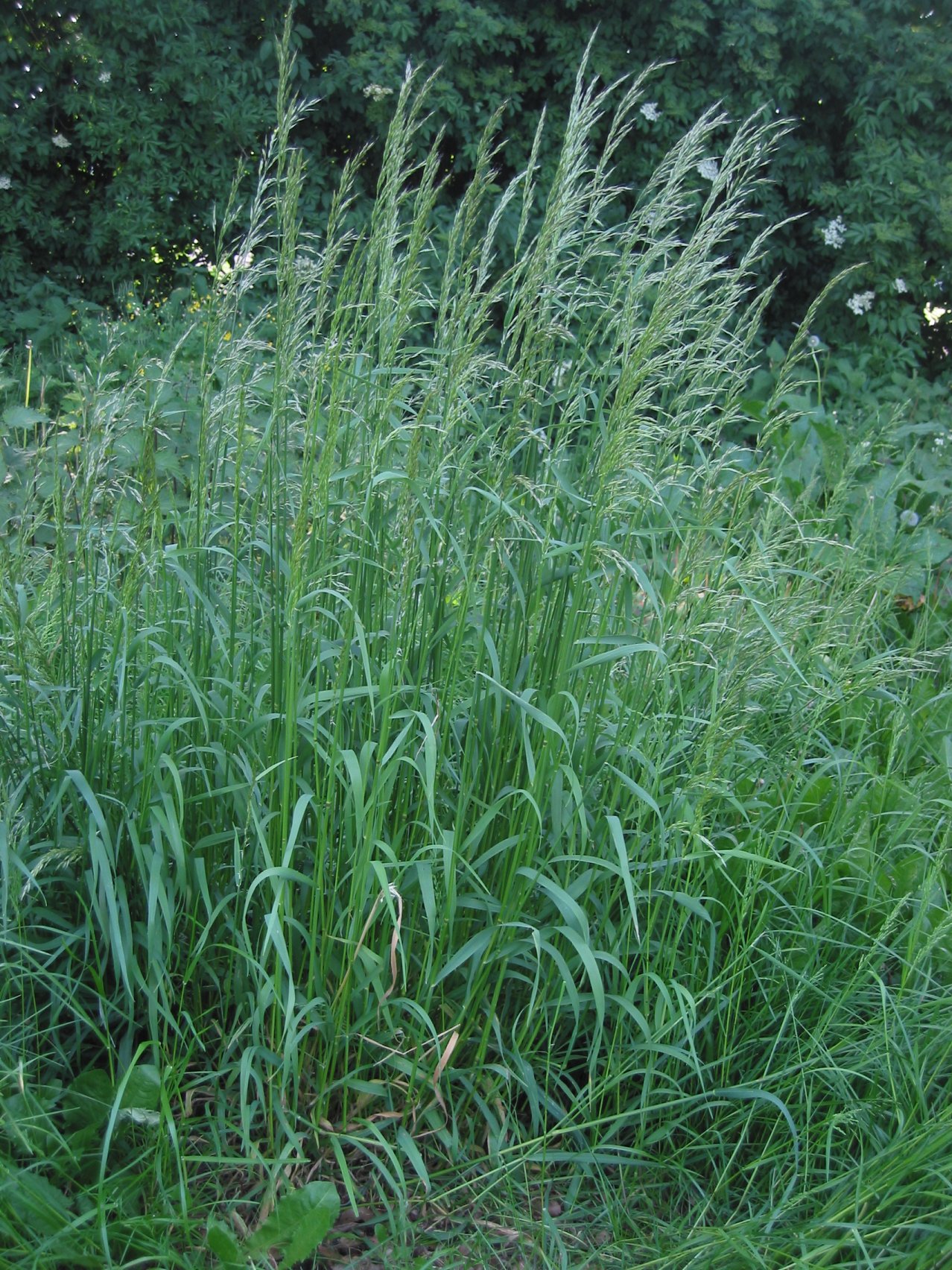
Arrhenatherum elatius is a species of flowering plant in the grass family Poaceae, commonly known as false oat-grass,[1] and also bulbous oat grass (subsp. bulbosum),[2] tall oat-grass, tall meadow oat, onion couch and tuber oat-grass. It is native throughout Europe (including Iceland), and also western and southwestern Asia (south to Jordan and Iran), and northwestern Africa (Morocco to Tunisia).[3] This tufted grass[1] is sometimes used as an ornamental grass[citation needed] and is sometimes marketed as "cat grass".[citation needed]

Outside of its native range it can be found elsewhere as an introduced species.[3] It is found especially in prairies, at the side of roads and in uncultivated fields. The bulbous subspecies can be a weed of arable land. It is palatable grass for livestock and is used both as forage (pasture) and fodder (hay and silage).

Description

[edit]

This coarse grass can grow to 1.80 m (6 ft) tall.[4] The leaves are 4–10 mm (0–0 in) wide, bright green, broad, slightly hairy, and rough. The ligule is 1–3 mm (0–0 in) long and smooth edged.[4] The panicle is up to 30 cm (12 in), and the bunched spikelets have projecting and angled awns up to 17 mm (1 in) long, green or purplish. The panicles often remain into winter.[5] The spikelets are oblong or gaping. It flowers from June to September. The roots are yellow.[6]

Four subspecies are currently accepted by Kew's Plants of the World:[3]

  • Arrhenatherum elatius subsp. elatius, the typical (nominate) subspecies.
  • Arrhenatherum elatius subsp. bulbosum (syn. Arrhenatherum tuberosum), onion couch or tuber oat-grass, distinguished by the presence of corms at the base of the stem, by which it propagates. It occurs in vegetated shingle and arable land.[7]: 1065 
  • Arrhenatherum elatius subsp. cypricola (Cyprus, endemic).
  • Arrhenatherum elatius subsp. sardoum (western Mediterranean region).

Habitat

[edit]

Arrhenatherum elatius is a principal species in two UK National Vegetation Classification habitat communities: the very widespread MG1 (Arrhenatherum elatius grassland) and the much rarer MG2 (Arrhenatherum elatius - Filipendula ulmaria tall-herb grassland). This means that it can be found with species such as Dactylis glomerata (also known as cock's-foot and orchard grass), and Filipendula ulmaria (also known as meadow-sweet).

It is found on road verges, along hedges and riverbanks.

It can colonise and stabilise limestone scree, bare calcareous cliffs, maritime shingle and coastal dunes.

References

[edit]
[edit]
Revisions and contributorsEdit on WikipediaRead on Wikipedia
from Grokipedia
Arrhenatherum elatius, commonly known as tall oat grass or false oat-grass, is a perennial tufted grass in the family , native to , , and temperate . It features erect stems typically 50–180 cm tall, often with a bulbous or rhizomatous base in some , flat leaves 5–32 cm long and 1–10 mm wide, and an open 10–30 cm long bearing spikelets 6–11 mm in length. Two main are recognized: the typical A. elatius subsp. elatius and the bulbous A. elatius subsp. bulbosum, which differs in having enlarged basal internodes. Widely naturalized in , , , and other regions since its introduction as a in the early , A. elatius thrives in a variety of habitats including meadows, grasslands, roadsides, forest edges, and disturbed areas at elevations from to over 3,000 meters. It prefers well-drained, medium- to fine-textured with neutral to slightly acidic and adequate moisture (annual precipitation ≥400 mm), tolerating partial shade and a range of soil types but avoiding heavy shade or waterlogged conditions. In its introduced ranges, such as the and , it is often found in anthropogenic settings like fields and along streams, where it can form dense stands. Ecologically, A. elatius is a cool-season grass that provides valuable for and due to its high production and , though it is sensitive to heavy and may decline under overuse. It is used in revegetation projects for and pasture improvement because of its inexpensive seed and adaptability, but it is also considered invasive in some areas, outcompeting in grasslands and meadows. Additionally, its can contribute to seasonal allergies in sensitive individuals.

Taxonomy and nomenclature

Etymology and synonyms

The genus name Arrhenatherum derives from the Greek words arrhen () and ather or atheras (awn), alluding to the awned staminate () floret in the . The species elatius comes from the Latin elatus, meaning tall or lofty, reflecting the plant's robust, upright growth habit. Originally described by as Avena elatior in (1753), the species was later transferred to the genus Arrhenatherum by Jan Svatopluk Presl and Karel Bořivoj Presl in Reliquiae Haenkeanae (1819), establishing the current binomial Arrhenatherum elatius. This reclassification separated it from the oat genus due to distinct and floret characteristics. Accepted synonyms include Avena elatior L. (the ), Arrhenatherum avenaceum P. Beauv. (illegitimate), and Arrhenatherum biaristatum (Peterm.) Peterm.

Classification and subspecies

Arrhenatherum elatius belongs to the kingdom Plantae, phylum Tracheophyta, class , order , family , subfamily , tribe Aveneae, and genus Arrhenatherum. Subspecies recognition varies by taxonomic authority, with commonly two to five accepted; these include A. e. subsp. elatius, the typical form distributed widely across Europe; subsp. bulbosum, with a bulbous base and primarily Mediterranean distribution; subsp. cypricola, endemic to Cyprus; subsp. sardoum, confined to the western Mediterranean region, particularly Sardinia; and subsp. baeticum, native to the western Mediterranean. Subsp. elatius features glabrous nodes and basal internodes 2–4 mm thick, occurring commonly in temperate grasslands. In contrast, subsp. bulbosum is distinguished by densely hairy nodes and swollen basal internodes 5–10 mm thick, enabling vegetative propagation via corms, especially in disturbed Mediterranean habitats. Subsp. sardoum represents a diploid form lacking corms, adapted to open Mediterranean environments, while subsp. cypricola is a rare variant with limited documentation beyond its Cypriot endemism. Subsp. baeticum is a perennial form in western Mediterranean habitats, with morphological details less extensively described. Phylogenetic analyses position the genus Arrhenatherum within subtribe Aveninae of Aveneae, forming a with and other genera such as Helictotrichon and Pseudarrhenatherum, based on molecular data from nuclear and markers. This relationship highlights shared evolutionary history in the cool-season grasses, with A. elatius serving as an outgroup in studies of diversification.

Description

Vegetative morphology

Arrhenatherum elatius is a , cespitose bunchgrass that forms dense tussocks up to 50–180 cm in height. It exhibits a tufted growth form, with erect, smooth, and robust culms that are typically glabrous. The culms feature nodes that are glabrous or sparsely pubescent, and basal internodes may be bulbous or tuberous in certain subspecies. Short rhizomes are produced in some forms, aiding in the development of tussock-forming clumps. Leaves are flat, 4–15 mm wide and 10–40 cm long, with a rough upper surface, prominent midrib, and slightly hairy sheaths at the base. Ligules are membranous, 1–3 mm long, often with fine hairs. The is fibrous and extensive, supporting the habit and tussock formation; in varieties like subsp. bulbosum, short swollen tubers may develop. variations include differences in basal culm structure, such as bulbous bases in subsp. bulbosum.

Inflorescence and reproduction

The of Arrhenatherum elatius is an open, branched , typically 15–30 cm long and 1–10 cm wide, often green to purplish in color and borne terminally on erect culms that can reach 50–180 cm in height. The consists of about ten nodes from which clusters of 4–6 pedicels emerge, bearing the ; these are laterally compressed, purplish, and measure 7–11 mm in length, usually containing two florets—one fertile and one sterile or staminate. Each features unequal glumes that are keeled and acute, with the lemmas slightly pubescent, 7–10 mm long, and bearing bent, twisted awns up to 17 mm long attached below the midpoint or in the upper half. Flowering typically occurs from June to September in temperate regions, with anthers 3.6–6 mm long and three per flower, facilitating release. A. elatius is primarily wind-pollinated (anemophilous) and genetically tetraploid, exhibiting self-fertility that allows alongside potential cross-pollination, leading to high seed set and viability. Reproduction in A. elatius occurs mainly through , which are non-dormant with high rates (up to 150,000–189,000 per pound) and dispersed primarily by , though also by and attachment to animals via the awned spikelets. Vegetative propagation may supplement through short rhizomes that form tussocks in the nominate A. elatius subsp. elatius (where present), while subsp. bulbosum spreads more aggressively via swollen, tuberous rhizomes or corms under moist conditions.

Distribution and habitat

Native range

Arrhenatherum elatius is native to , where it occurs widely across the continent, spanning from in the north to the Mediterranean regions in the south, and from the Atlantic coasts to the eastern steppes. Its distribution in Europe includes countries such as the , , , , , and , often in temperate grasslands and ecosystems. The species is also native to western and southwestern , with key occurrences in , the region (including Georgia, , and ), and extending to parts of and . In northwestern , A. elatius is found in and , primarily in coastal and mountainous areas. Historical records document the presence of A. elatius in ancient European grasslands, with archaeobotanical evidence of its tubers from Neolithic sites in northern Germany and other central European locations, indicating early human interaction or natural occurrence in prehistoric landscapes. By the Middle Ages, macroremains in sediments confirm its role in hay meadows across Central Europe. The plant is particularly associated with temperate Eurasian steppes, where it contributes to the biodiversity of mesic perennial grasslands in transitional zones between forests and arid plains.

Introduced ranges

Arrhenatherum elatius has been introduced to several regions outside its native range, primarily through seed trade and agricultural practices as a and grass. In , it was first introduced from in the early , with records dating to 1807, and has since become naturalized across much of the continent. It is now widespread in the northeastern and , as well as the , where it commonly occurs in prairies, fields, meadows, and disturbed areas. The species is considered non-native and potentially invasive in these regions, often forming dense stands that alter local grasslands. In and , A. elatius was introduced similarly for agricultural purposes and has established populations in temperate grasslands and lands. It is regarded as a in some systems, though its invasiveness varies by location. In parts of , including the northwest and regions such as , the species has been introduced and naturalized in similar habitats, often via contaminated seed or forage imports. The subspecies A. elatius ssp. bulbosum, known for its bulbous basal internodes, is particularly noted as a troublesome in arable lands within introduced ranges, where can spread its vegetative propagules. This subspecies contributes to the species' persistence in cultivated fields across and other introduced areas.

Ecology

Habitat preferences

Arrhenatherum elatius thrives in moist, fertile soils that are well-aerated and moderately deep, with a preference for neutral to conditions. It tolerates a range of 5.0 to 8.0, though optimal growth occurs between 6.0 and 7.5, allowing it to adapt to both slightly acidic and alkaline environments while favoring base-rich substrates. The plant performs best in soils of high to moderate but can establish in lower sites under suitable . This species is commonly associated with full sun to partial shade, where it exhibits robust growth in open conditions but can tolerate shaded and edges. It frequently occurs in rough grasslands, road verges, hedges, riverbanks, , and coastal dunes, often in disturbed or semi-natural settings with low to moderate pressure. In the , A. elatius is a key component of National Vegetation Classification communities, particularly MG1 (Arrhenatherum-dominated grassland) and MG2 (Arrhenatherum elatius-Filipendula ulmaria tall-herb grassland), which characterize mesotrophic grasslands on neutral to base-rich soils. As a cool-season perennial bunchgrass, A. elatius exhibits active growth in spring and autumn, with rapid development following winter and potential summer under extreme heat or conditions. This pattern enables it to persist in temperate climates with variable moisture, entering when soils dry out during prolonged dry periods.

Biological interactions and invasiveness

Arrhenatherum elatius provides valuable for herbivores, including and wild grazers, due to its nutritious foliage, though it is less palatable than some . The plant hosts minor pests such as , which feed on its leaves and can affect growth under stress conditions like , but overall pest pressure remains low compared to more susceptible grasses. It is tolerant of occasional defoliation, quickly resprouting after cutting, but is sensitive to heavy or continuous and may decline under overuse while maintaining tussock structure. In introduced regions, A. elatius engages in intense competition with native grasses, forming dense, tall stands that suppress shorter species through shading and resource dominance. These invasions alter soil nutrient dynamics, particularly by accelerating mineralization rates—>30 kg ha⁻¹ in summer at invaded sites—which favors its own growth but disadvantages natives adapted to nutrient-poor conditions. , particularly western prairies and meadows, it displaces native bunchgrasses like Danthonia californica and Festuca roemeri, transforming open habitats into sod-like structures and impacting associated wildlife, such as host plants for endangered . As a dominant species in some grasslands, A. elatius can stabilize ecosystems under moderate disturbance but generally reduces plant diversity in invaded sites by outcompeting forbs and low-growing perennials, leading to lower richness. of its invasiveness in the focuses on repeated mowing, ideally in at 15 cm height, which significantly reduces cover and flowering over several years and promotes native recovery, or annual applications like , though the plant's resprouting ability requires ongoing efforts.

Uses and cultivation

Agricultural and forage applications

Arrhenatherum elatius is valued as a palatable crop suitable for hay and production, particularly in temperate regions where it provides reliable feed for . It thrives in cool, moist climates with at least 16 inches of annual , yielding substantial on moderately fertile, well-drained soils. The nutritional profile of A. elatius features moderate crude protein content, typically around 7-8% of , with good digestibility estimated at approximately 61% digestible , making it a suitable option for diets despite lower protein compared to . Its palatability supports effective utilization in mixed pastures, though fiber levels increase with maturity, affecting overall feed quality. Cultivation involves spring sowing at rates of 5-8 pounds of pure live per acre, planted at a depth of ¼ inch in a firm to promote establishment. Harvesting is optimal at the boot stage to maximize digestibility and protein content, with the performing best under cutting management rather than heavy due to its bunchgrass growth habit. Historically, A. elatius has been used in for production since the , with macroremains indicating its role in early hay meadows for feed.

Ornamental and other uses

Arrhenatherum elatius is valued in ornamental , particularly its subspecies A. elatius subsp. bulbosum and cultivars like 'Variegatum', which feature striking variegated foliage with green and white stripes that provide textural contrast in garden designs. This clumping perennial grass forms low mounds up to 1.5 feet tall and 2 feet wide, making it suitable for borders, containers, ground covers, and edging in shade gardens or woodland settings. Its soft, arching foliage and summer-blooming panicles, which emerge as loose, oat-like inflorescences, add movement and subtle interest without overwhelming smaller spaces. The plant's tolerance for dry, poor soils and deer resistance further enhance its appeal for low-maintenance landscapes. Beyond landscaping, young shoots of A. elatius are palatable and marketed as "cat grass" for indoor pet use, providing a safe, nutrient-rich option to satisfy feline instincts. In traditional herbalism, the grass has minor applications as a and to aid , though such uses lack modern clinical validation. For environmental management, A. elatius serves in , particularly on slopes, riverbanks, and depleted lands, where its fibrous stabilize during revegetation efforts. Additionally, demonstrates its potential in , as the grass accumulates such as cobalt, , lead, , , and from contaminated substrates, especially when chelators like EDTA enhance uptake—reaching concentrations up to 2.5% lead in dry matter under experimental conditions. This capability positions it as a candidate for phytostabilization in metal-polluted sites, though practical implementation requires further field trials.

References

Add your contribution
Related Hubs
User Avatar
No comments yet.