


Community hub
Recent from talks
Contribute something
Nothing was collected or created yet.
Ferrari 553
View on Wikipedia | |||||||||
| Category | Formula One | ||||||||
|---|---|---|---|---|---|---|---|---|---|
| Constructor | Ferrari | ||||||||
| Predecessor | 500 | ||||||||
| Successor | 625/D50 | ||||||||
| Technical specifications[1] | |||||||||
| Chassis | Single-seater, tubular frame | ||||||||
| Axle track | Front: 1,278 mm (50.3 in) Rear: 1,250 mm (49 in) | ||||||||
| Wheelbase | 2,160 mm (85 in) | ||||||||
| Engine | Lampredi 1,984.86 cc (121.1 cu in) (1953) 2,497.56 cc (152.4 cu in) (1954) L4 naturally aspirated, front engine, longitudinally mounted | ||||||||
| Transmission | Ferrari 4-speed manual | ||||||||
| Weight | 590 kg (1,300 lb) | ||||||||
| Fuel | Shell | ||||||||
| Tyres | Pirelli | ||||||||
| Competition history | |||||||||
| Notable entrants | Scuderia Ferrari | ||||||||
| Notable drivers |  Giuseppe Farina Giuseppe Farina  Mike Hawthorn Mike Hawthorn Jose Froilan Gonzalez Jose Froilan Gonzalez | ||||||||
| Debut | 1953 Italian Grand Prix | ||||||||
| |||||||||
| Constructors' Championships | 0 | ||||||||
| Drivers' Championships | 0 | ||||||||
The Ferrari 553 was a racing car produced by Ferrari which raced in 1953 (when the World Championship was run to F2 regulations) as a Formula Two car and in 1954 as a Formula One car.
553 F1
[edit]The 1953 553 F2 car was raced in the 1953 World Drivers' Championship by Umberto Maglioli and Piero Carini. It was first raced at Monza in the 1953 Italian Grand Prix on September 13, 1953.[2] In 1954 the Ferrari 553 F1 car replaced it when the World Championship returned to F1 specifications.
The car competed in six World Championship Grands Prix over the two seasons, making ten individual entries. Its only points finishing position was a win for Mike Hawthorn at the 1954 Spanish Grand Prix.
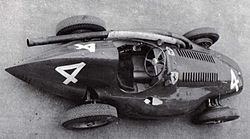
The engine was a Lampredi inline-four, producing 260 PS (191 kW; 256 hp) at 7200 rpm, from 2497.56 cc of total capacity. Because of the distinctive rounded bodywork and air-intake it was nicknamed Squalo, meaning Shark in Italian.[3]
555 F1
[edit]In 1955, Ferrari updated their existing 553 F1 car. New helical springs were used for the front suspension, instead of the transverse leaf-springs. The rear saw the replacement of a lower leaf-spring to an upper one. It also received a five-speed gearbox instead of a four-speed. It used the same capacity as before and the power output also remained the same.
Because of the extended, rounded bodywork it was further nicknamed as a Supersqualo (Super shark). The car was first used at the Bordeaux GP on 24 April 1955. In 1956, Peter Collins was still using the 555 F1, whilst the rest of the Scuderia drove the Lancia-Ferrari D50.[4]
Technical data
[edit]| Technical data[5] | 553 Squalo | 555 Super Squalo |
|---|---|---|
| Engine: | Front mounted 4-cylinder in-line engine | |
| displacement: | 2498 cm³ | |
| Bore x stroke: | 100 x 79.5 mm | |
| Compression: | 13.0:1 | 11.9:1 |
| Max power at rpm: | 260 hp at 7 200 rpm | |
| Valve control: | Double Overhead Camshafts, 2 valves per cylinder | |
| Carburetor: | 2 Weber 50 DCOA/3 | |
| Gearbox: | 4-speed manual, transaxle | 5-speed manual, transaxle |
| suspension front: | Double cross links, transverse leaf spring | Double cross links, coil springs |
| suspension rear: | De Dion axle, double longitudinal links, transverse leaf spring | |
| Brakes: | Hydraulic drum brakes | |
| Chassis & body: | Fackverks frame with aluminum body | |
| wheelbase: | 216 cm | |
| Dry weight: | 590 kg | |
| Top speed: | 280 km/h | |
Gallery
[edit]-
 Ferrari 553 "Squalo", 2.5-litre I4 Lampredi engine
 -
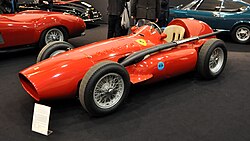 A Ferrari 555 Super Squalo
 -
 A Ferrari 555 at the Museo Ferrari
,_Bj._1954.jpg)

.jpg)
Formula One World Championship results
[edit](key)
| Year | Entrant | Chassis | Engine | Tyres | Driver | 1 | 2 | 3 | 4 | 5 | 6 | 7 | 8 | 9 | |
|---|---|---|---|---|---|---|---|---|---|---|---|---|---|---|---|
| 1953 | Scuderia Ferrari | 553 | Ferrari 553 2.0 L4 | P | ARG | 500 | NED | BEL | FRA | GBR | GER | SUI | ITA | ||
| Umberto Maglioli | 8 | ||||||||||||||
| Piero Carini | Ret | ||||||||||||||
| 1954 | Scuderia Ferrari | 553 | Ferrari 554 2.5 L4 | P | ARG | 500 | BEL | FRA | GBR | GER | SUI | ITA | ESP | ||
| Giuseppe Farina | Ret | WD | |||||||||||||
| José Froilán González | Ret | Ret | Ret | ||||||||||||
| Mike Hawthorn | Ret | 1 | |||||||||||||
| Umberto Maglioli | 7 | ||||||||||||||
| Robert Manzon | DNS | ||||||||||||||
| Maurice Trintignant | Ret | ||||||||||||||
| 1955 | Scuderia Ferrari | 555 | Ferrari 555 2.5 L4 | E | ARG | MON | 500 | BEL | NED | GBR | ITA | ||||
| Harry Schell | Ret | ||||||||||||||
| Paul Frère | 82 | 4 | |||||||||||||
| Piero Taruffi | 82 | DNS | |||||||||||||
| Giuseppe Farina | 3 | ||||||||||||||
| Maurice Trintignant | 6 | Ret | 8 | ||||||||||||
| Eugenio Castellotti | 5 | 3 | |||||||||||||
| Mike Hawthorn | 7 | Ret | |||||||||||||
| Umberto Maglioli | 6 | ||||||||||||||
| 1956 | Scuderia Ferrari | 555 | Ferrari 555 2.5 L4 Ferrari DS50 2.5 V8 |
E | ARG | MON | 500 | BEL | FRA | GBR | GER | ITA | |||
| Peter Collins | Ret | ||||||||||||||
| Olivier Gendebien | 5 | ||||||||||||||
References
[edit]- ^ a b "Ferrari 553". Stats F1. Retrieved 16 April 2016.
- ^ "Ferrari 553 F2". formula1.ferrari.com. Archived from the original on 20 April 2017. Retrieved 16 February 2023.
- ^ "Ferrari 553 F1". formula1.ferrari.com. Archived from the original on 13 November 2017. Retrieved 16 February 2023.
- ^ "Ferrari 555 F1". formula1.ferrari.com. Archived from the original on 22 September 2019. Retrieved 16 February 2023.
- ^ "ferrari.com". Archived from the original on 2012-05-24. Retrieved 2009-07-25.
- ^ Small, Steve (1994). The Guinness Complete Grand Prix Who's Who. Guinness. pp. 94, 136, 161, 179, 239 and 244. ISBN 0851127029.
- ^ "Ferrari 555". StatsF1. Retrieved 16 February 2023.
External links
[edit]


 | This Formula One–related article is a stub. You can help Wikipedia by adding missing information. |
Ferrari 553
View on GrokipediaDevelopment and Design
Origins and Design Process
The Ferrari 553 project originated in 1952-1953 under the direction of chief engineer Aurelio Lampredi, as a successor to the successful Ferrari 500 F2 tailored to meet the 1953 World Drivers' Championship regulations, which adhered to Formula 2 specifications.[3] This initiative followed the success of the preceding Ferrari 500 F2 and was driven by the need to maintain competitiveness in an era dominated by 2.0-liter engines, while strategically positioning the design for adaptability to upcoming changes.[6] Lampredi's approach emphasized forward-thinking engineering, evolving the chassis and powertrain from established F2 precedents to create a versatile platform.[7] The 2.0-liter engine formula profoundly shaped the 553's conception, prioritizing compact, efficient power delivery suitable for F2 racing, yet with scalability in mind for the 1954 Formula 1 regulations that would mandate a 2.5-liter limit.[3] Design work was finalized in early 1953, allowing construction of the initial chassis to begin by mid-year, enabling rapid progression toward production prototypes.[6] Central to Lampredi's contributions was the continuation of the inline-four engine configuration from the 500 F2, which provided superior weight distribution—placing the power unit lower and more centrally—and greater operational reliability under racing stresses.[3] Prototypes of the 553 underwent essential shakedown testing at the Monza Autodromo in the lead-up to their debut, validating the integration of the new chassis and drivetrain components in real-world conditions.[8] These tests confirmed the design's stability and handling potential, paving the way for its competition entry. The F2-oriented 553 would subsequently form the basis for the 553 F1 variant, adapted to the expanded displacement rules.[7]Key Innovations and Nickname
The Ferrari 553 featured distinctive aerodynamic shaping characterized by rounded, shark-like bodywork that enhanced airflow over the chassis, necessitated by the need to enclose the inline-four engine and accommodate twin side-mounted fuel tanks. This design, crafted by engineer Aurelio Lampredi, widened the body considerably compared to prior models, creating a bulbous profile with a streamlined nose and horizontal upper bodywork that blended seamlessly into the oval radiator inlet for reduced drag.[3][1] Its suspension setup retained transverse leaf springs at the front as a carryover from earlier Ferrari designs, but refinements including Houdaille hydraulic shock absorbers and an anti-roll bar improved handling precision and stability on varied circuits. The inline-four engine's placement, combined with the repositioned fuel tanks straddling the front and rear wheels, aimed for balanced weight distribution, mitigating the rear-heavy bias of predecessors and promoting more neutral cornering dynamics.[3][2] The 553 also advanced Ferrari's power-to-weight ratio over the 500 F2, particularly in its Formula One variant, where the enlarged 2.5-liter Lampredi engine delivered higher output relative to its 590 kg curb weight without compromising the marque's renowned reliability.[9][3] The car's aggressive, finned rear and pointed, streamlined nose evoked the form of a shark, earning it the Italian nickname "Squalo" from journalists observing its debut testing and initial races in 1953.[10][3][1]Variants
553 F2
The Ferrari 553 F2 was developed as Ferrari's entry for the 1953 Formula 2 season, adhering to the 2.0-liter displacement regulations that governed the World Championship that year. Designed under the leadership of Aurelio Lampredi, it represented a shift toward a new inline-four engine architecture, continuing the inline-four engine architecture developed by Lampredi in prior models like the 500 F2 to improve reliability and power delivery in the competitive F2 landscape. The car's distinctive rounded bodywork, earning it the nickname "Squalo" (shark), was intended to optimize airflow around the chassis while maintaining a compact profile suitable for the era's tight circuits.[3][11] At the heart of the 553 F2 was a 1,997.11 cc inline-four engine, also penned by Lampredi, featuring a short-stroke design for higher revving and better responsiveness. This unit, equipped with twin overhead camshafts and fed by dual Weber carburetors, delivered 180 horsepower at 7,200 rpm, providing a balance of power and durability for endurance-focused F2 racing. The engine's aluminum block and head construction contributed to a lighter overall weight, aiding the car's handling despite its modest output compared to some rivals.[11][3][12] The chassis employed a tubular steel frame, a staple of Ferrari's engineering at the time, which offered a dry weight of around 590 kg including fluids for enhanced agility on twisty tracks. Suspension was conventional for the period, with independent front wishbones, a transverse leaf spring, and Houdaille hydraulic dampers at the rear, paired with drum brakes all around. Power was transmitted via a four-speed manual gearbox with reverse, ensuring straightforward operation for the demanding F2 events.[12][2] The 553 F2 made its competitive debut at the 1953 Italian Grand Prix at Monza on September 13, entered by Scuderia Ferrari and driven by Umberto Maglioli and Piero Carini. Maglioli qualified 11th but advanced to finish 8th after 80 laps, while Carini retired on lap 42 due to engine failure, highlighting early teething issues with the new powerplant. This outing marked Ferrari's initial foray with the 553 in championship competition, though it served more as a developmental platform than a outright contender.[13][14] Only two chassis of the 553 F2 were constructed, limiting its deployment primarily to non-championship Formula 2 races throughout 1953, where it gathered valuable data for future iterations. Despite its innovative engine, the car struggled with outright pace against established rivals like the Gordini T16, often hampered by reliability woes and suboptimal power-to-weight ratios that prevented podium finishes in its limited appearances. This version's 2.0-liter configuration was later upscaled to 2.5 liters for Formula 1 adaptation in 1954.[11][13]553 F1
The Ferrari 553 F1 represented an evolution of the original 553 model to comply with the new 2.5-liter Formula 1 regulations introduced in 1954, featuring an enlarged engine derived from Aurelio Lampredi's design philosophy. The powerplant was a 2,497.56 cc inline-four with dual overhead camshafts driven by gears, producing 260 hp at 7,200 rpm through two Weber 50 DCOA/3 carburetors and dry-sump lubrication.[10][2] This upgrade aimed to provide higher output while maintaining the compact architecture of the predecessor, though it introduced challenges in balancing power with durability. The 553 F1 made its racing debut at the Syracuse Grand Prix on April 11, 1954, serving as an alternative to the parallel-developed 625 model amid ongoing refinements to the larger-displacement program. Initial outings revealed teething issues with reliability, including engine overheating and inconsistent handling, which limited its early competitiveness and prompted further development work.[10][15] These problems were gradually addressed during the season, allowing sporadic deployment.[16] The chassis retained a similar tubular steel frame to the F2 version but incorporated reinforcements to handle elevated speeds and stresses, achieving a top speed of approximately 280 km/h with a dry weight of 590 kg and a 4-speed transmission.[2] Three chassis were produced, with two initially for the F2 variant and adaptations for F1.[17] Consequently, the 553 F1 was raced alongside older 625 examples to cover factory entries while development delays persisted on the newer platform.[18] In Scuderia Ferrari's lineup, it was assigned to Mike Hawthorn and José Froilán González, among others including Giuseppe Farina, Piero Taruffi, Maurice Trintignant, and Umberto Maglioli, who piloted it in select Grands Prix.[19]555 F1
The Ferrari 555 F1 represented a 1955 evolution of the 553 F1, serving as a transitional model until the introduction of the 801 F1 in 1957, with its use extending into the 1956 season. Built on updated versions of the 553's multi-tubular spaceframe chassis, four units were produced to refine the predecessor design while addressing handling and reliability issues.[20][21] Key mechanical updates included the adoption of helical coil springs in the front suspension, replacing the transverse leaf-spring setup for enhanced ride quality and improved handling over uneven circuits. The transmission was upgraded to a five-speed gearbox with reverse, supplanting the four-speed unit to provide better gear ratios for competitive performance. These modifications aimed to boost agility without overhauling the core architecture, allowing Ferrari to respond swiftly to rivals like Mercedes-Benz in the 2.5-liter Formula One era.[21][22][23] The 555 F1 retained the 2.5-liter inline-four engine designed by Aurelio Lampredi with a compression ratio of 13:1, delivering 260 horsepower at 7,200 rpm. This contributed to the model's aggressive character, earning it the nickname "Supersqualo" or "Super Shark," an escalation of the original 553's "Squalo" moniker inspired by its predatory bodywork. The car made its debut at the non-championship Bordeaux Grand Prix on April 24, 1955, marking Ferrari's push for refinement in the face of intensifying competition.[21][24][20]Racing History
1953 Season
The 1953 Formula One World Championship comprised eight rounds contested under Formula Two regulations, with Scuderia Ferrari deploying the newly developed 553 F2 alongside the established and dominant 500 model to maintain competitiveness. The 553, powered by a 2.0-liter inline-four engine, represented an experimental evolution aimed at preparing for the impending shift to 2.5-liter Formula One rules in 1954. Ferrari's strategy emphasized gathering real-world data from the 553 as a development platform, prioritizing reliability insights over immediate championship contention, while the 500 secured the drivers' title for Alberto Ascari and multiple victories.[15] The 553 F2 made its competitive debut at the Italian Grand Prix at Monza on September 13, 1953, as part of a six-car Ferrari assault that included both models and a mix of grand prix aces and sports car specialists. Umberto Maglioli qualified 11th and finished 8th, five laps behind winner Juan Manuel Fangio's Maserati after 80 laps, while teammate Piero Carini retired on lap 42 due to engine failure. These results highlighted the 553's potential in qualifying but exposed its limitations in race endurance, with no points scored under the era's top-five scoring system.[15][25] Reliability issues, including engine overheating and insufficient power compared to rivals like the Maserati A6GCM, restricted the 553 to this single World Championship appearance in 1953, underscoring its role as a testbed rather than a frontline contender. Non-championship Italian Formula Two events saw limited further deployment of the 553, where it achieved modest improvements in handling data but no major podiums, reinforcing Ferrari's focus on iterative refinements for the upcoming season.[15][7]1954 Season
The 1954 Formula One World Championship comprised nine rounds, reverting to 2.5-litre engine regulations after three years of Formula Two specifications. The Ferrari 553 F1 debuted in the non-championship Syracuse Grand Prix on 11 April, where Giuseppe Farina claimed victory in one of the new short-stroke models, demonstrating early promise despite [José Froilán González](/page/José Froilán González) retiring from the other 553 entry due to mechanical issues. This introduction complemented the team's existing 625 cars, allowing Ferrari to field a mix of chassis throughout the season as they adapted to the new formula.[10][26] The 553 saw entries in six World Championship Grands Prix starting mid-season, primarily at Belgian, French, British, Swiss, Italian, and Spanish events. Its standout achievement was Mike Hawthorn's victory at the season finale, the Spanish Grand Prix at Pedralbes, where he started from third on the grid and led the final stages after leaders retired, securing eight points for the model in its only points-scoring finish. Hawthorn also earned a podium with second place at the British Grand Prix at Silverstone, crossing the line over a minute behind teammate González, who won the race in a complementary 625 chassis. At the Belgian Grand Prix, Hawthorn and González shared a fourth-place finish after handing over during the race, marking Ferrari's best non-podium result with the 553.[27][28] Mike Hawthorn's performances highlighted the 553's potential, with finishes of fourth in Belgium, second in Britain, and first in Spain contributing to his third-place standing in the Drivers' Championship. José Froilán González played a key support role, assisting in the shared Belgian result and providing strategic depth to the team amid Mercedes-Benz dominance. The car's reliability saw notable improvements over the 1953 season's developmental woes, with fewer retirements—such as engine failures in France and gearbox issues in Italy—enabling consistent contention and bolstering Ferrari's challenge for overall honors.[19] In non-championship events, the 553 built further momentum with strong performances, including Farina's Syracuse triumph, underscoring the model's growing competitiveness ahead of the 555 evolution.[29]1955-1956 Season
The Ferrari 555 Supersqualo entered the 1955 Formula One World Championship mid-season amid Mercedes-Benz's overwhelming dominance, which saw Juan Manuel Fangio and Stirling Moss secure five victories across the seven-round calendar. Debuting at the Monaco Grand Prix on May 22, the car struggled immediately, with Piero Taruffi handing over to Paul Frère for a shared 8th-place finish and Harry Schell retiring due to engine failure.[30] The tragic death of Alberto Ascari on May 26 during a private test session at Monza in a sports car severely impacted team morale, occurring just days after Monaco and contributing to Lancia's withdrawal from racing, which ultimately benefited Ferrari by providing access to the D50 chassis later in the year.[31] Subsequent outings highlighted the 555's potential but also its reliability woes, particularly with the gearbox. At the Belgian Grand Prix, Giuseppe Farina delivered the model's strongest championship result with 3rd place, supported by Paul Frère's 4th and Maurice Trintignant's 6th, marking Ferrari's only podium of the season for the 555.[32] In the Dutch Grand Prix at Zandvoort, Mike Hawthorn claimed 4th position ahead of Eugenio Castellotti's 5th, though Trintignant retired early from gearbox failure.[33] The British Grand Prix saw Ferrari revert to the Lancia-Ferrari D50, where Hawthorn achieved 2nd, but the 555 was absent. The Italian Grand Prix at Monza provided another podium for the 555, with Castellotti finishing 3rd—Ferrari's home race highlight—while Umberto Maglioli took 6th and Trintignant 8th; Hawthorn, however, retired due to recurring gearbox issues.[34] These results, including two podiums and several points finishes, underscored the 555's competitiveness against Mercedes but were hampered by mechanical gremlins and the German marque's superior engineering. The driver lineup for the 555 included Farina, Trintignant, Castellotti, Hawthorn, Frère, Taruffi, Schell, and Maglioli, reflecting Ferrari's depth amid the post-Ascari transition.[35] In 1956, the 555 saw minimal championship use, appearing only at the season-opening Argentine Grand Prix, where Peter Collins retired following an accident and Olivier Gendebien scored a 5th-place finish using a modified V8 engine setup.[36] No further entries occurred at Monaco or Indianapolis, as Ferrari quickly phased out the 555 mid-season in favor of the proven Lancia-Ferrari D50, which propelled the team to greater success. Across both seasons, the 555 contested approximately 13 entries in total, positioning it as a critical but short-lived bridge to Ferrari's V8 engine era and the D50's championship-winning configuration.[35]Technical Specifications
Engine and Drivetrain
The Ferrari 553 featured a Lampredi-designed Type 553 inline-four engine, constructed with a light alloy block and head, two valves per cylinder, and twin overhead camshafts driven by gears.[2] This naturally aspirated unit was front-mounted and longitudinally positioned, emphasizing reliability and power delivery for mid-1950s Formula racing.[37] In its Formula 2 configuration, the engine displaced 1,997.11 cc with a bore and stroke of 93 mm × 73.5 mm, producing 180 hp at 7,200 rpm and a compression ratio of 13:1, fed by a single Weber carburetor.[12] For the Formula 1 variant, the displacement increased to 2,497.56 cc via a larger bore of 100 mm × 79.5 mm, yielding 260 hp at 7,200 rpm with the same 13:1 compression ratio, now utilizing dual Weber 50 DCOA carburetors for improved fueling.[10] The evolved 555 F1 retained the 2,497.56 cc displacement but boosted output to approximately 260 hp through refined dual-carburetor tuning and minor internal enhancements.[24] The drivetrain across 553 variants employed rear-wheel drive with a de Dion rear axle for better handling stability, paired with a four-speed manual transmission plus reverse in the F2 and 553 F1 models.[2] The 555 F1 upgraded to a five-speed manual transmission to handle the increased power and support higher speeds.[38] Fuel tanks held 160 liters for the 553 F2 and F1 variants and 180 liters for the 555 F1, integrated into the chassis for balanced weight distribution.[12][38]Chassis and Aerodynamics
The Ferrari 553 series utilized a multi-tubular steel spaceframe chassis, which provided structural integrity while minimizing weight for enhanced handling in Formula 2 and Formula 1 applications.[2] This construction featured an oval-section tapering toward the rear, with the frame widened to improve airflow around the engine bay.[3] The wheelbase measured 2,160 mm, complemented by front and rear tracks of 1,278 mm and 1,250 mm, respectively, promoting balanced stability during high-speed cornering.[2] Suspension on the 553 variants consisted of independent front setup with double wishbones, a transverse lower leaf spring, an anti-roll bar, and Houdaille hydraulic lever dampers, delivering responsive steering and roadholding.[2] At the rear, a de Dion live axle with twin radius arms, transverse lower leaf spring, and similar dampers managed power delivery while maintaining wheel alignment under load.[2] The 555 F1 evolution introduced helical coil springs at the front for improved compliance over bumps, retaining the de Dion rear but with revised geometry for better traction.[38] Aerodynamically, the 553 and 555 models featured a lightweight aluminum single-seater body with integrated side fuel tanks and bulbous flanks, reducing turbulence and drag to support top speeds approaching 270 km/h.[22] The overall kerb weight across variants was 590 kg (with water and oil), with dimensions of 3,988 mm in length, 1,427 mm in width, and 1,020 mm in height, optimizing the center of gravity for agile performance.[2] Braking was handled by hydraulic drum brakes at all four wheels, employing separate master cylinders for the front and rear axles to ensure precise and fade-resistant stopping power under racing conditions.[2]Legacy and Results
Overall Achievements
The Ferrari 553 series represented a pivotal bridge in Ferrari's Formula One evolution, transitioning from the successful Formula Two-based dominance of the early 1950s to the more powerful V8 configurations that defined the late decade. Introduced initially as a 2-liter Formula Two car for the 1953 World Championship—run under F2 regulations—the 553 was adapted to 2.5-liter Formula One specifications for 1954, showcasing Aurelio Lampredi's innovative approach to chassis and engine integration amid growing competition from Mercedes-Benz and Maserati.[39] In World Championship competition from 1953 to 1954, the 553 family recorded 10 entries across six Grands Prix, with its sole victory coming at the 1954 Spanish Grand Prix, where Mike Hawthorn claimed first place after 80 laps at the Pedralbes circuit—his debut Formula One win that bolstered his reputation and paved the way for his 1958 Drivers' Championship title with Ferrari.[19][27] Overall achievements extended to non-championship events, yielding several podium finishes, including González's win at the 1954 International Trophy at Silverstone, highlighting the car's competitive edge in varied conditions despite reliability challenges.[5] The 553's legacy endures through its technical innovations, such as Ferrari's inaugural spaceframe chassis, which improved rigidity and weight distribution, informing Lampredi's subsequent designs before his departure in 1955; elements of its inline-four architecture influenced broader engine development trends at Ferrari, contributing to the resilient engineering ethos seen in later models. Only three chassis were built, with some later modified for sports car or saloon racing applications.[39] Nicknamed "Squalo" (Italian for shark) for its predatory bodywork and aggressive snout, the car symbolizes 1950s Italian automotive resilience, with preserved chassis and components featured in collections like the Ferrari Museum in Maranello and subject to ongoing restorations in the 2020s that underscore its historical value.[10][40]Formula One World Championship Results
The Ferrari 553 competed in the Formula One World Championship across the 1953 and 1954 seasons, entering a total of 10 cars in six Grands Prix, all under the Scuderia Ferrari team. It secured one victory, no pole positions, one fastest lap, and a total of 8 points, with its best result being Mike Hawthorn's win at the 1954 Spanish Grand Prix.[19]| Year | Grand Prix | Driver | Team | Grid | Finish | Status |
|---|---|---|---|---|---|---|
| 1953 | Italy | Umberto Maglioli | Scuderia Ferrari | 18 | 8 | Running |
| 1953 | Italy | Piero Carini | Scuderia Ferrari | 20 | Ret | Engine |
| 1954 | Belgium | Giuseppe Farina | Scuderia Ferrari | 3 | Ret | Ignition |
| 1954 | Belgium | José-Froilán González | Scuderia Ferrari | 2 | Ret | Oil line |
| 1954 | France | José-Froilán González | Scuderia Ferrari | 4 | Ret | Engine |
| 1954 | France | Mike Hawthorn | Scuderia Ferrari | 8 | Ret | Engine |
| 1954 | Switzerland | Umberto Maglioli | Scuderia Ferrari | 11 | 7 | Running |
| 1954 | Switzerland | Robert Manzon | Scuderia Ferrari | DNS | Ret | Accident |
| 1954 | Italy | José-Froilán González | Scuderia Ferrari | 5 | Ret | Gearbox |
| 1954 | Spain | Mike Hawthorn | Scuderia Ferrari | 3 | 1 | Running (8 pts) |