


Community hub
Recent from talks
Contribute something
Nothing was collected or created yet.
Filoli
View on Wikipedia
Filoli, also known as the Bourn-Roth Estate, is a country house set in 16 acres (6.5 ha) of formal gardens surrounded by a 654-acre (265 ha) estate, located in Woodside, California, about 25 miles (40 km) south of San Francisco, at the southern end of Crystal Springs Reservoir, on the eastern slope of the Santa Cruz Mountains.[3][4] Now owned by the private, nonprofit National Trust for Historic Preservation, Filoli is open to the public.[4] The site is both a California Historical Landmark and listed on the National Register of Historic Places.[1][2]
Key Information


History
[edit]Bourn family
[edit]Filoli was built between 1915 and 1917 for William Bowers Bourn II, owner of one of California's richest gold mines and president of Spring Valley Water Company, which supplied San Francisco's water,[5] and his wife, Agnes Moody Bourn. They wanted a country estate nearer to their home in San Francisco.[6] The principal designer, San Francisco architect Willis Polk, used a free Georgian style that incorporated the tiled roofs characteristic of California.[7] Polk had previously designed Bourn's houses in Grass Valley and on Webster Street in San Francisco.[8] Polk's friend, artist and designer Bruce Porter, was commissioned to collaborate with the Bourns in planning the gardens, which were laid out between 1917 and 1922. The horticulturist who designed the plantings and fixed the original color schemes was Isabella Worn; she supervised the garden's maintenance for 35 years.[6]
Filoli served as one of the Bourns' residences from 1917 to 1936. The name of the estate is an acronym formed by combining the first two letters from the key words of William Bourn's credo: "Fight for a just cause; Love your fellow man; Live a good life."[4][9]
Bourn's Spring Valley Water Company owned Crystal Springs Reservoir and the surrounding area. Bourn called the Crystal Springs Reservoirs "Spring Valley Lakes" for his company. The original Spring Valley was between Mason and Taylor Streets, and Washington and Broadway Streets in San Francisco, where the water company started. When the company went south for more water, the Spring Valley name was carried south too.[10]
Bourn also owned Muckross House in Ireland and is reputed to have used Muckross as a model for Filoli.
Roth family and National Trust for Historic Preservation
[edit]Following the deaths of William and Agnes Bourn in 1936, the estate was sold the following year to Mr. William P. Roth and Mrs. Lurline Matson Roth, heiress to the Matson Navigation Company. The Roth family built Filoli's botanic collections of camellias, rhododendrons and azaleas, notably in the Woodland Garden, and added the serene swimming pool and the screened-in teahouse.[11] In 1975, Mrs. Roth donated the estate in its entirety to the National Trust for Historic Preservation, with an endowment that helps support annual operating expenses.[12][13]
In 2023, Filoli hosted the first meeting on U.S. soil in several years between U.S. President Joe Biden and General Secretary of the Chinese Communist Party Xi Jinping on the sidelines of the 2023 APEC summit in San Francisco.[4] The two world leaders met at Filoli on November 15, 2023, during Xi's visit to California.[4] Although Filoli had been popular for many years with Asian tourists visiting the San Francisco Bay Area (due to its gardens and its prominent appearance in the opening credits of the television series Dynasty), the extensive press coverage of the Xi-Biden meeting led to a surge of interest among both Chinese and Chinese American tourists.[14]
Management
[edit]The estate operates as Filoli Center, a private, non-profit organization with its own Board of Governors, staff, and volunteers. As of 2022, Filoli was drawing about 400,000 visitors per year.[4] In 2024, Filoli saw almost 490,000 visitors, and drew $22.3 million in revenue.[15]
House
[edit]The house is 54,256 square feet (5,040.5 m2) in size, and has a total of 56 rooms.[4] This includes a ballroom, a reception room, a dining room, cozier family rooms, and servants quarters. While the home was empty when it reached the National Trust, much of the original furniture and art has been donated, to help recreate the original appearance of the home.[16] This is an ongoing effort; in 2022 the gentleman's lounge was restructured to include new period-typical additions to the room and add a re-creation of the original wallpaper.[17]
Library
[edit]Filoli houses two libraries with resources related to the families and the estate: the Friends Library Collection and the Sterling Library Collection. The Friends Library is a circulation library that holds 1,500 books, 125 videos, lectures, or oral histories, and several copies of movies filmed on the estate. The Sterling Library is a research library with 1,800 books and 40 journals. Both libraries are only open to Filoli members or to researchers.[18]
Gardens
[edit]-
 Reflecting pool and former carriage house.
 -
 The Chartres Garden
 -
 The Sunken Garden


The 16 acres (6.5 ha) of gardens are structured as a series of formally enclosed spaces framed by brick walls and clipped hedges, which open one from another, providing long axial views, in which profuse naturalized plantings of hardy and annual plants contrast with lawns, brick and gravel paths, formal reflecting pools, framed in walls and clipped hedging in box, holly, laurel, and yew (illustration, right) and punctuated by massive terracotta pots and many narrowly columnar Irish yews, originally grown on the estate from cuttings. Filoli is an outstanding example of the Anglo-American gardening style reintroducing Italian formality, that was pioneered at the end of the nineteenth century by Edwin Lutyens and Gertrude Jekyll in British gardens and exemplified in the U.S. by designs of Charles A. Platt and Beatrix Farrand.[19]
The gardens extend southeast of the house running up an easy slope. The sunken garden is the first of four main rooms; the rectangular pool at its center that houses hardy and tropical water lilies is flanked by twin panels of lawn and two olive trees, within the hedge of clipped Japanese yew. The walled garden consists of a series of enclosures, including the stained glass window design outlined in clipped box.
After it was acquired by the National Trust for Historic Preservation in 1975, Filoli has been open for public tours. Attractions include self-guided tours, guided tours, and nature hikes.
The formal gardens include several areas, including the Wedding Place, named for Berenice Roth's wedding location in 1941. Lurline and Berenice both had their wedding receptions at Filoli, but Berenice's wedding is the only one that has ever taken place at Filoli when it was a private home. The largest gardens are working gardens for the production of cut flowers for the mansion and for the growing of some vegetables.
Orchard
[edit]Filoli Gentlemen's Orchard was started by Bourn family in the early 20th century, however the Roth family did not maintain the orchard and by the 1970s it was in poor condition.[20] In 1997, the California Rare Fruit Growers began donating rare plants to restore the orchard.[20] Many of the current 650+ trees in the orchard are lost varieties of fruit and include: 275 varieties of apple trees, 59 pear varieties, 42 peach varieties, 6 medlar, and many more.[20][21]
Ecology and conservation
[edit]
Laguna Creek, locally known as "Orchard Creek", flows northwest from its origin on the western slope of Edgewood County Park to Upper Crystal Springs Reservoir where its waters eventually join San Mateo Creek, and descend to San Francisco Bay.[22] In November 1769, Laguna Creek was the route of the Portolà expedition as they descended from their discovery of San Francisco Bay on Sweeney Ridge down San Andreas Creek to Laguna Creek and then southeast down the San Francisquito Creek watershed to El Palo Alto. After crossing to the west side of Cañada Road, Laguna Creek is joined on the left (heading downstream) by the South Fork Laguna Creek, then after crossing under the main entrance road to Filoli it is joined by locally named Fault Creek, then Spring Creek (possibly named by Bourn for his Spring Valley Water Company), then on the right by an unnamed creek, then by waters from the Hetch Hetchy Aqueduct and Pulgas Water Temple just before entering Upper Crystal Springs Reservoir. Historically, the San Mateo Creek watershed hosted runs of anadromous salmonids, including coho salmon (Oncorhynchus kisutch) and steelhead trout (coastal rainbow trout) (Oncorhynchus mykiss irideus) coming up from the Bay. In 1877, Laguna Grande, a natural lake on Laguna Creek, was dammed with an earthen causeway[23] (now crossed by Highway 92) blocking further salmonid migration up into Laguna Creek and its tributaries on Filoli. Stream resident rainbow trout (Oncorhynchus mykiss), continue to run up the creeks of Filoli from the reservoir to spawn.[24]
San Mateo County historian Frank Stanger cited sizeable groves of redwoods (Sequoia sempervirens) in the Laguna Creek watershed. In the area around Filoli he described two historic lumber mills. The historic "Smith Mill" on Fault Creek was destroyed by fire in 1854. Pinckney's mill in "the largest gulch", which would be Spring Creek, was built in 1855 and later purchased by S. L. Mastic. Although information on these mills is limited, they support the idea that "the area was thoroughly logged".[25] A large redwood tree remains on Laguna Creek just below the lower Filoli parking lot and on the main entrance road.
Lamchin Interpretive Center and Trails
[edit]There are two nature trails behind the formal gardens at Filoli, the California Trail and the Spring Creek Trail.
California Trail (former Estate Trail)
[edit]In 2017, Filoli added The Estate Trail, a one mile loop which gives visitors the opportunity to walk through the outer nature preserve of Filoli. In 2024 it was renamed The California Trail. This trail passes through the horse pasture, a field of native plants, the former horse barn, and a bridge over Fault Creek and the San Andreas Fault, which cuts through the property.[26] This trail leads to a former barn that was turned into the Sally MacBride Nature Center, but was renamed the Lamchin Interpretive Center in collaboration with the Ramaytush Ohlone.[27][28]
Spring Creek Trail
[edit]Behind the Lamchin Interpretive Center the new Spring Creek Trail opened in June 2024.[28] This half-mile trail climbs 125 feet and includes a new bridge over Spring Creek, leading to a man-made flume and pond where Bourn stored water for his gardens.[29]
Film location
[edit]Filoli has served as the set for many Hollywood films.[4][30] Most famously, it is the mansion seen from the air in the opening credits of the television series Dynasty.[4] The mansion's plush interiors were also featured in the first episodes of the series but were subsequently replicated on sound stages at the Fox Studios, Century City. However the entire mansion served as the setting for the 2006 CBS Television special Dynasty Reunion: Catfights & Caviar in which cast members reunited to discuss their memories of the series. It was the first time many of the cast members had been to the actual estate.
Among the many striking mature trees on the grounds are a row of immense Italian Stone Pines and scattered native Coast Live Oaks over 250 years in age, the latter of which are the backdrop for Warren Beatty's outdoor scenes in Heaven Can Wait.[citation needed]
Filoli was featured in Bob Vila's A&E Network production Guide to Historic Homes of America[31] as well as in a November 1996 segment of A&E's America's Castles: Garden Estates, the latter being shown continuously at the visitor center.[32]
The house also served as the Stanhope residence in the 1997 film George of the Jungle, and was featured in The Game in the same year.
The house was used in the 2005 film adaptation of the musical Rent, for the engagement party scene for Idina Menzel and Tracie Thoms character's Maureen Johnson and Joanne Jefferson, notably their immediate breakup song Take Me Or Leave Me.
Gallery
[edit]-
 Reception Room
 -
 Kitchen
 -
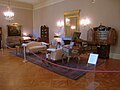 Drawing Room
 -
 Library
 -
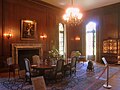 Dining Room
 -
 Ballroom


See also
[edit]
References
[edit]- ^ a b "National Register Information System". National Register of Historic Places. National Park Service. July 9, 2010.
- ^ a b "Filoli". Office of Historic Preservation, California State Parks. Retrieved October 14, 2012.
- ^ "Filoli Mansion and Gardens". Geographic Names Information System. United States Geological Survey, United States Department of the Interior.
- ^ a b c d e f g h i Rogers, Katie; Sanger, David E. (November 16, 2023). "Biden and Xi Meet at a Backdrop for Hollywood and Tech-Titan Weddings". The New York Times. p. A10. Retrieved January 14, 2024.
- ^ McDermott, Jeanne (March 1984), "Filoli", Horticulture, pp. 28–35
- ^ a b McDermott 1984:30.
- ^ Papoulias, Alexander (April 28, 2008), "'Country Elegance' in Woodside", Palo Alto Online, archived from the original on May 17, 2011, retrieved April 30, 2008
- ^ Weinstein, Dave (January 3, 2009). "Architect had designs on San Francisco". SFGate. Retrieved May 4, 2020.
- ^ DeVere, Julia Bly (2017). Filoli: Family Home; Historic Garden; Living Museum. Bloomsbury Publishing. pp. 11–13. ISBN 978-1-78442-155-7.
- ^ Erwin G. Gudde; William Bright (2004). California Place Names: The Origin and Etymology of Current Geographical Names. University of California Press. p. 372. ISBN 978-0-520-24217-3. Retrieved March 20, 2012.
- ^ McDermott 1984:31.
- ^ Purvis, Andrew (May 2019). "Filoli: Garden of a Golden Age". Smithsonian Magazine. Retrieved January 6, 2025.
- ^ Seehaus, Karen (March 9, 2005), "Spring Fling: Ring in spring at one of the Bay Area's own historic treasures", The Wave Magazine, vol. 05, no. 5, San Jose, California, p. 30, archived from the original on September 27, 2007, retrieved July 18, 2007
- ^ Li, Han (December 6, 2023). "Joe Biden and Xi Jinping's APEC Visit Becomes a Selling Point at This Bay Area Garden". The San Francisco Standard. Retrieved January 14, 2024.
- ^ "Home". Filoli Annual Report. Retrieved December 13, 2025.
- ^ "The House | Filoli". September 3, 2020. Retrieved April 5, 2022.
- ^ "Gentlemen's Lounge Restoration | Filoli". March 19, 2022. Retrieved April 5, 2022.
- ^ "About Library | Filoli Historic House & Garden". collections.filoli.org. Retrieved April 5, 2022.
- ^ McDermott 1984.
- ^ a b c Chapman, Robin (January 18, 2017). "Silicon Valley Orchardists 2.0". Edible Silicon Valley. Retrieved June 13, 2019.
- ^ Lee, Christine (2018). "From apples to oranges". Palo Alto Weekly. Retrieved June 13, 2019.
He volunteers at the Filoli estate in Woodside, maintaining its orchard of more than 650 fruit trees
- ^ Alan Hynding (1982). From Frontier to Suburb, The Story of the San Francisco Peninsula. Belmont, California: Star Publishing Company. p. 15. ISBN 978-0-89863-056-5.
- ^ Ferol Egan (1998). Last bonanza kings: the Bourns of San Francisco. University of Nevada Press. p. 167. ISBN 978-0-87417-319-2. Retrieved March 20, 2012.
- ^ Christopher Wingate Lanman (2013). Beyond the Back Gate: Filoli's Wild Garden. Los Altos, California: Christopher W. Lanman. p. 84. ISBN 978-0-615-81816-0. Retrieved January 11, 2014.[self-published source?]
- ^ Frank M. Stanger (1967). Sawmills in the Redwoods: Logging on the San Francisco Peninsula, 1849–1967. San Mateo County Historical Association. pp. 56–51.
- ^ "The Estate | Filoli". September 3, 2020. Retrieved April 5, 2022.
- ^ "Explore Native Plants and the San Andreas Fault on Filoli's Estate Trail | National Trust for Historic Preservation". savingplaces.org. Retrieved April 5, 2022.
- ^ a b Angela Swartz (June 14, 2024). "New exhibition honors Ramaytush Ohlone peoples". The Almanac. Retrieved June 10, 2025.
- ^ Elaine Larsen (February 25, 2000). "Hiking Filoli". Retrieved June 10, 2025.
- ^ It was the mansion featured in Heaven Can Wait and The Game. The garden was used as a set in George of the Jungle, The Joy Luck Club, and The Wedding Planner.
- ^ Bob Vila (1996). "Guide to Historic Homes of America". A&E Network. Archived from the original on November 2, 2010. Retrieved August 6, 2007.
- ^ America's Castles "Garden Estates" was filmed at Filoli from April 14 to 18, 1996. It was first aired on A&E November 24, 1996, Sunday, at 10 p.m. EST. The show featured three homes — Filoli in Woodside, California; Bellingrath Home and Gardens in Mobile, Alabama; and Maymont in Richmond, Virginia. America's Castles was produced by S. Alex Alexander at Cinetel Productions.
Further reading
[edit]- Lanman, CW. "Beyond the Back Gate - Filoli's "Wild Garden"". December, 2013, pp.84. 978-0-615-81816-0. Available online or hard copy.
- DeVere, JB. "Filoli: Family Home; Historic Garden; Living Museum". January, 2017, pp. 120. 978-1784421540. Shire Publications, London, England.
- Steinfeld, CC. "The Bourn Dynasty: The Empire Mine's Golden Era 1869-1929". March, 2015, pp. 144. 978-1577332954. Blue Dolphin Publishing, Inc., Grass Valley, California.
External links
[edit]
- Official website
- Beyond the Back Gate: Filoli's "Wild Garden", a seven-minute film documentary discussing the nature preserve surrounding Filoli
- Stackpole, Peter (photographer) (August 18, 1947). "The Peninsula: It is the playground of San Francisco Society". LIFE. Vol. 23, no. 7. pp. 85–93. ISSN 0024-3019. Retrieved March 29, 2015. Features photographs of Filoli during William P. Roth's ownership.
Filoli
View on GrokipediaHistory
Bourn Family Acquisition and Vision
In 1914, William Bowers Bourn II, a San Francisco mining magnate and president of the Spring Valley Water Company, began assembling the property that would become Filoli by purchasing 709 acres of former Rancho Cañada de Raymundo land in Woodside, California, for $89,000—equivalent to roughly $2.3 million in 2020 dollars.[6][7] This acquisition occurred amid a post-1906 San Francisco earthquake exodus of affluent residents to the Peninsula, where Bourn sought a secure, expansive retreat away from urban vulnerabilities.[6] Bourn, heir to the Empire Mine—one of California's most productive gold operations—and his wife Agnes Moody Bourn, whom he had married in 1881, envisioned Filoli as a self-sustaining country estate integrating residential grandeur, formal gardens, orchards, and livestock facilities to achieve operational independence from city supplies.[3] Their goal emphasized a harmonious blend of opulent living and practical agriculture, drawing on Bourn's business acumen in resource management and the couple's European-inspired tastes for estate design.[8] The estate's name, Filoli, originated from Bourn's personal creed—"Fi(ght) for a just cause; Lo(ve) your fellow man; Li(ve) a good life"—symbolizing a philosophy of purposeful struggle, interpersonal devotion, and virtuous existence that underpinned the project's aspirational ethos.[9][6] This vision positioned Filoli not merely as a residence but as a model of resilient, self-reliant rural splendor amid California's early 20th-century economic boom.[3]Construction and Early Operations
Construction of the Filoli mansion commenced in 1915 and was completed in 1917, directed by William Bowers Bourn II and his wife Agnes Moody Bourn as a Georgian Revival-style country residence.[10] Renowned San Francisco architect Willis Polk oversaw the design, with the project spanning three years and incurring costs of $425,000—equivalent to approximately $10 million in contemporary terms—while exceeding the original budget.[10] The structure was engineered for durability and grandeur, incorporating reinforced concrete and steel framing to withstand seismic activity, reflecting lessons from the 1906 San Francisco earthquake that had destroyed the Bourns' prior city home.[11] The Bourns, aged in their late 50s at the outset, envisioned Filoli as a self-sustaining estate overlooking the Spring Valley Reservoir, where William Bourn served as president of the Spring Valley Water Company from 1908 onward, leveraging his influence over regional water resources.[3] [11] The name "Filoli" originated from Bourn's personal motto, drawing the first two letters from "Fi(ght)," "Lo(ve)," and "Li(ve)."[6] In its early years of operation through the 1920s and into the 1930s, Filoli functioned primarily as a private family retreat and venue for elite social gatherings, hosting dinner parties, concerts, and receptions amid the developing gardens and grounds.[10] The estate supported limited agricultural pursuits aligned with its self-sufficiency goals, including the initiation of a gentlemen's orchard for fruit production, though the primary focus remained residential and recreational use by the Bourns and their staff.[4] William Bourn resided there until his death on July 5, 1936, after which Agnes continued stewardship briefly before her passing later that year.[7]Roth Family Stewardship
Following the deaths of William Bowers Bourn II and his wife Agnes in 1936, Filoli was purchased that year by William P. Roth and Lurline Matson Roth as a fully furnished second home.[3][4] Lurline, the daughter of Matson Navigation Company founder Captain William Matson, and William, who later served as president of the company, raised their three children partly at the estate while maintaining its operations as a country retreat supported by a peak staff of 35, encompassing butlers, maids, cooks, chauffeurs, and gardeners.[3][4][11] The Roths preserved the estate's self-sustaining character established by the Bourns, with Lurline taking a keen interest in the gardens by collaborating with the original designer, Bruce Porter, to enhance their aesthetic and botanical diversity.[4] Under her direction, collections of camellias, rhododendrons, and other specimen plants were expanded, building on the foundational plantings to enrich the formal and thematic areas.[12][4] The family incorporated personal furnishings and decorative elements into the house over nearly four decades, adapting interiors to their tastes without altering the core Georgian Revival architecture.[13] William Roth's death in 1963 prompted Lurline to relocate to a smaller residence, after which she donated the mansion, formal gardens, and 16 acres of grounds to the National Trust for Historic Preservation in 1975, ensuring long-term public access and preservation.[4][1] She expressed that "Filoli is too beautiful to be private," reflecting a commitment to stewardship that prioritized the estate's enduring legacy over private retention.[4] The donation included provisions for ongoing maintenance, transitioning the property from family ownership to nonprofit operation while retaining much of its original collections and features.[1]Transition to Nonprofit Ownership
In 1975, following the death of her husband William Matson Roth, Lurline Roth donated the core 125-acre Filoli estate—including the mansion, formal gardens, and related structures—to the National Trust for Historic Preservation to ensure its long-term preservation and public accessibility.[3][12] Roth expressed her motivation succinctly: "I have always felt that such a place should be shared."[14] This transfer marked the end of private family ownership, which had begun with the Bourn family's construction in 1915 and continued under the Roths since their 1937 acquisition.[3] The donation included an endowment to support ongoing operational expenses, reflecting Roth's commitment to the estate's sustainability beyond her lifetime.[12] Upon receipt, the National Trust opened Filoli to the public that same year, establishing it as a 501(c)(3) nonprofit organization dedicated to historic preservation, education, and horticultural demonstration.[1] The Filoli Center, as the operating entity, functions with an independent board of governors, professional staff, and volunteers, while remaining affiliated with the National Trust.[1] Subsequent expansions bolstered the nonprofit's footprint; in the years following the initial gift, the organization acquired an additional 528 acres from remaining Roth family holdings, enhancing conservation efforts and public programming.[6] This transition preserved Filoli's architectural and landscape integrity against potential private development pressures, aligning with broader mid-20th-century trends in philanthropic transfers of Gilded Age estates to public stewardship.[14]Architectural and Interior Features
Mansion Design and Layout
The Filoli mansion exemplifies Georgian Revival architecture, characterized by symmetrical facades, classical proportions, and hipped roofs adapted with red clay tiles to suit California's climate. Designed by San Francisco architect Willis Polk, the structure draws on 18th-century English precedents while incorporating practical regional elements, such as reinforced foundations to withstand seismic activity.[5][10] Construction began in 1915 and concluded in 1917 after three years of labor by over 100 workers, exceeding the initial budget to reach a total cost of $425,000 (equivalent to approximately $8.5 million in 2020 dollars). The resulting building spans 54,256 square feet and encompasses 56 rooms, including 10 principal bedrooms, 15 bathrooms, 17 fireplaces, and 14 staff bedrooms. Materials emphasized durability and elegance, with white stucco exterior walls, marble interiors in key areas, and oak paneling throughout formal spaces.[5][10] The layout organizes the mansion around a central transverse hall, forming a U-shaped plan that encloses a front courtyard for privacy and approach. The main block prioritizes separation between public entertaining zones and private family quarters: grand reception areas like the ballroom and dining room occupy the eastern wing for hosting debut balls and formal dinners, while the western side includes more intimate spaces such as the study and family room. A dedicated south wing houses staff facilities, featuring a cavernous kitchen with a 17-foot-high coved ceiling for preparing up to nine daily meals, a butler's pantry equipped with a walk-in safe, electric call board, and dumbwaiter, and quarters for live-in personnel to ensure efficient service without intruding on family areas. This functional division reflects the Bourn family's vision of a self-contained country retreat blending opulence with operational realism.[5][10][15] Upper levels extend this arrangement with bedrooms accessed via a grand staircase from the entrance hall, while the basement level supports utilities and storage, connected by service corridors to minimize disruption. The design's emphasis on axial symmetry and enfilade room sequences—where doorways align to create visual corridors—enhances the sense of scale and formality typical of Georgian estates, yet the inclusion of modern conveniences like central heating and plumbing marked it as forward-thinking for its era.[5][10]Key Interior Spaces
The Filoli mansion encompasses 56 rooms across approximately 54,256 square feet, featuring 17 fireplaces and 15 bathrooms, with interiors emphasizing grand entertaining spaces alongside functional family and staff areas.[5] Designed in Georgian Revival style by architect Willis Polk, the first-floor public rooms include the central Reception Room, Drawing Room, Dining Room, and expansive Ballroom, while the south staff wing contains the kitchen and butler's pantry.[5] These spaces reflect the Bourn family's vision for hosting large social gatherings, later adapted by the Roths for more intimate use.[10] The Reception Room, positioned at the heart of the mansion, facilitated concerts and debutante balls during the early 20th century.[5] It connects to barrel-vaulted hallways and served as a primary entry point for guests, embodying the estate's social ambitions. The adjacent Drawing Room, intended for post-dinner withdrawal and ladies' entertaining, showcases ornate woodwork and period furnishings consistent with the home's eclectic interior scheme.[16] The formal Dining Room, with its walnut-paneled walls and massive variegated marble fireplace, hosted elegant dinner parties for up to dozens of guests.[16] [5] Nearby, the Library offers a more subdued atmosphere with built-in bookcases and artwork, providing a retreat for reading and quieter pursuits. The Ballroom, one of the largest rooms at around 2,200 square feet, includes high ceilings, gold leaf accents, and a built-in stage, accommodating dances, performances, and events like 1960s debutante balls.[10] In the staff wing, the Kitchen features a 17-foot-high coved ceiling to aid cooling and supported preparation of up to nine daily meals for residents and servants.[5] The adjoining Butler's Pantry functions as an operational core, equipped with a walk-in safe for silverware, an electric call board, and a dumbwaiter for efficient service. William Bourn's Study, later repurposed as a Roth family room, contrasts the grandeur with its personal, cozy design.[10] These interiors, restored post-donation to the National Trust for Historic Preservation in 1975, incorporate original and period-appropriate elements to preserve historical authenticity.[2]Gardens and Grounds
Formal Garden Design
The formal gardens at Filoli adopt an English Renaissance style, organized into distinct "garden rooms" defined by axial paths, clipped hedges, and symmetrical terraces that extend from the mansion along two primary southeast axes.[17] [18] Landscape architect Bruce Porter shaped the structural framework, while horticulturist Isabella Worn selected plant palettes for texture and color, with development commencing alongside mansion construction in 1915.[19] [17] Head gardener Louis Mariconi implemented and maintained the designs from 1915 to 1965.[19] Prominent features include yew-lined avenues formed by 250 Irish yews imported from Muckross Abbey, Ireland, culminating in a yew theatre at the garden's elevated terminus.[19] [17] The Sunken Garden, established in 1919, centers on a reflective pool encircled by geometric parterres of seasonal flowers and Irish yew-hedged pathways, exemplifying the era's emphasis on enclosed, introspective spaces.[18] [20] The Walled Garden occupies one acre within 10-foot brick enclosures, segmented into ornamental quadrants by hedges and featuring espaliered crabapple and cherry trees amid formal beds.[19] Additional structured areas encompass the Bowling Green, a level lawn for leisure, and the Rose Garden showcasing hybrid tea varieties.[17] The Chartres Garden's beds mirror the branching motifs of the 12th-century Tree of Jesse stained glass at Chartres Cathedral, integrating symbolic geometry into the layout.[21] Annual plantings exceed 75,000 spring bulbs, including daffodils and tulips, to sustain vivid, structured displays.[19]
Productive and Thematic Areas
The productive areas of Filoli's gardens emphasize self-sufficiency and agricultural heritage, reflecting the estate's original design as a working gentleman's farm established in the early 20th century. The Garden Orchard, spanning approximately 10 acres and featuring around 600 fruit trees, includes varieties such as apples, pears, persimmons, and espaliered specimens of rare and antique fruits, with blossoms appearing in spring in shades of purple, white, and pink.[22][23][24] These trees contribute to ongoing production of items like fruit butters, hard cider, and honey, maintaining the site's tradition of utilizing harvests for estate products.[25] The Vegetable Garden, renovated in 2022 to enhance accessibility with raised beds, a berry cage, and an outdoor classroom, cultivates crops including tomatoes, peppers, cabbage, kale, and herbs such as oregano, thyme, and rosemary.[26] Harvests support public programs, Clock Tower Shop offerings, and donations to local food banks, underscoring practical utility.[26] Adjacent working gardens to the south feature rows of additional fruits, vegetables, and flowers, integrated with paths through the Daffodil Meadow for both productivity and visitor access.[19] Thematic elements within these productive zones highlight educational and cultural dimensions, such as the Fruitful Garden in the formal area, which displays edible and medicinal plants alongside pollinator attractors like asters, sunflowers, and poppies.[27] Specific plantings include passion fruit, eggplants, beans, rainbow chard, beets, and herbs like golden pineapple sage and fennel, blending century-old food production methods with contemporary displays and interpretive signage.[27] The Vegetable Garden incorporates themes of Bay Area immigrant food cultures through partner plots and holds USDA People's Garden designation for promoting sustainable food systems and pollinator habitats, with youth programs teaching gardening basics.[26] These features extend the estate's historical self-sustaining ethos into modern conservation and community engagement.[25][17]Natural Landscape Integration
Filoli's estate encompasses 654 acres, with formal gardens occupying only 16 acres, while over 600 acres remain as conserved natural lands featuring native coast redwoods (Sequoia sempervirens), oak woodlands, and riparian zones along Laguna Creek.[28] This vast undeveloped expanse serves as a buffer and transitional zone, allowing the manicured gardens to blend into the wilder, indigenous landscape characteristic of the San Francisco Peninsula's foothill ecology.[17] The original site selection by William Bowers Bourn II in 1915 prioritized a sheltered valley with existing mature trees and a perennial creek, ensuring the mansion and gardens harmonized with rather than dominated the topography.[29] Landscape architect Bruce Porter, collaborating with horticulturist Isabella Worn, incorporated subtle grading and native plantings to maintain natural contours, such as oak savannas and redwood groves that frame the formal areas without abrupt boundaries.[19] This integration reflects early 20th-century estate design principles that valued picturesque naturalism alongside cultivated formality, with pathways like the Estate Trail highlighting geological features including proximity to the San Andreas Fault and endemic flora such as manzanita and ceanothus.[30] Contemporary conservation efforts further enhance this synergy through native plant restoration, reduced water use via drought-tolerant species, and trail networks that promote biodiversity while minimizing intrusion into sensitive habitats.[28]Management and Operations
Governance Structure
Filoli operates as a 501(c)(3) nonprofit organization, governed by a Board of Directors responsible for strategic oversight, policy-setting, and fiduciary duties to ensure the preservation and public access to the historic estate.[31][32] The board consists of approximately 24 to 29 regional members selected for their commitment to Filoli's mission of connecting history with community engagement, with recruitment emphasizing diversity, equity, and inclusion.[31][33] Board officers include a Chair, Vice Chair, Secretary, Treasurer, and Past Chair, who lead executive functions such as governance committees focused on property management, finance, and initiatives like the DEAI Task Force.[32] As of 2025, David Wessel serves as Board Chair, an architectural conservator with over 30 years of experience, supported by Vice Chair Sydney Si Ning Leung, Secretary Pulin Sanghvi, and Treasurer Melissa Lopez.[32] The board collaborates with non-board committee members to advance strategic priorities, including conservation and programming.[34] Day-to-day operations are managed by a professional executive team led by President and CEO Kara Newport, who has held the position since 2016 and reports directly to the board.[35][31] Key executives include Chief Operations Officer Alex Fernandez, overseeing site and horticulture, and Chief Financial Officer Roopa Gottimukkala, handling fiscal management with nonprofit expertise.[35] This structure separates governance from operations, with the board providing high-level direction while staff executes preservation, visitor services, and educational programs.[31]Financial and Staffing Models
Filoli, a 501(c)(3) nonprofit organization, derives the majority of its funding from earned revenue generated through program activities, including admissions, educational programs, and event rentals, which accounted for $9,742,070 of its $16,693,293 total revenues in fiscal year 2023.[36] Membership dues provided an additional $2,706,551, reflecting a record 22,598 member households by December 2023, while contributions and grants contributed $1,529,450.[36][37] Net retail sales from the gift shop added $1,482,955, supplemented by income from a beneficial trust ($631,141) and other sources ($601,126).[36] This model emphasizes self-sustainability, with earned income historically comprising about 88% of the annual budget prior to recent expansions in philanthropy.[38]| Revenue Source (2023) | Amount |
|---|---|
| Program revenues (admissions, events, education) | $9,742,070[36] |
| Memberships | $2,706,551[36] |
| Contributions and grants | $1,529,450[36] |
| Net gift shop sales | $1,482,955[36] |
| Beneficial trust and other income | $1,232,267[36] |
Visitor and Event Programming
Filoli operates as a public historic site open daily from 10:00 a.m. to 5:00 p.m., with trails closing one hour earlier to facilitate guest return; extended hours apply to select special events.[43] General admission tickets, required for entry, grant access to the historic house museum, 16 acres of formal gardens, and natural lands including hiking trails; reservations are recommended in advance via the official website.[43] Free parking is provided with ticket purchase, and accessibility accommodations are available, including reduced or free admission for qualifying programs such as Museums for All for SNAP EBT cardholders.[43] Groups of 15 or more qualify for discounted admission packages tailored for educational or tour groups.[44] Self-guided exploration forms the core of visitor programming, allowing access to the Georgian Revival mansion's interiors—such as the ballroom, drawing room, and library—and the expansive gardens without mandatory tours.[45] Optional guided tours, led by Filoli staff, offer specialized experiences like 90-minute behind-the-scenes collections tours for an additional $40 on top of general admission, focusing on artifacts and history; these are not required for standard house or garden visits.[45] A complimentary Visitor Guide, available upon arrival or for pre-order pickup, provides maps, historical context, and bloom highlights to enhance navigation and educational value.[46] Membership programs grant free daytime admission for primary holders and guests, along with discounts on shops, cafes, and events, supporting ongoing operations through annual dues starting at basic levels.[47] Event programming encompasses both public seasonal offerings and private rentals to diversify revenue and engagement. Public events include immersive experiences such as Holidays at Filoli, featuring decorated interiors and gardens with daytime admission tickets around $75 (including exclusive tours for premium options), and Nightfall, a Halloween-themed nighttime event blending history and mystery.[48] [49] Summer programming extends garden hours on select evenings for extended visits, while themed teas and wine tastings occur periodically; tickets are sold separately from general admission and often sell out.[50] Private event rentals cater to weddings, corporate gatherings, and celebrations, utilizing venues like the Ballroom (up to 120 seated), House Courtyard (220 seated), and Redwood Grove.[51] Wedding packages range from elopements starting at $4,000 for 10 guests in the gardens to full buyouts at $75,000 for exclusive evening use of the house and gardens accommodating larger parties, including on-site coordination and setup allowances.[52] These rentals, managed through dedicated event staff, emphasize the site's historic ambiance while adhering to preservation guidelines.[53]Ecology and Conservation
Site Ecosystems
Filoli's site encompasses approximately 654 acres, of which over 600 acres constitute preserved natural lands featuring six distinct ecosystems characteristic of the California coastal range.[54] These ecosystems include oak-madrone forests dominated by coast live oak (Quercus agrifolia) and Pacific madrone (Arbutus menziesii), redwood groves with coast redwood (Sequoia sempervirens), chaparral shrublands, riparian zones along streams, oak woodlands, and open meadows.[25] [54] The diversity arises from the site's varied topography, elevation, and soil types, including serpentine outcrops that support unique endemic flora.[54] These habitats support a range of native wildlife, including mule deer (Odocoileus hemionus), wild turkeys (Meleagris gallopavo), and numerous bird species such as acorn woodpeckers (Melanerpes formicivorus) and band-tailed pigeons (Patagioenas fasciata).[54] Riparian corridors along Laguna Creek provide critical wetland functions, fostering amphibians, insects, and pollinators essential to the broader food web.[55] Chaparral areas, adapted to periodic fires, host drought-tolerant species like manzanita (Arctostaphylos spp.) and chamise (Adenostoma fasciculatum), contributing to soil stabilization and watershed health.[25] Conservation practices emphasize biodiversity enhancement through indigenous land stewardship, invasive species removal, and habitat restoration, conserving these lands since the estate's public opening in 1975 under nonprofit management.[28] Over 650 acres remain undeveloped, with trails providing non-invasive access while minimizing human impact on ecological processes.[43] This approach aligns with regional efforts to protect Peninsula watersheds, where Filoli's ecosystems serve as refugia amid surrounding urbanization.[2]Preservation Initiatives
Filoli's preservation initiatives emphasize ecological stewardship across its 654-acre estate, with a focus on conserving natural lands and enhancing biodiversity. The organization has conserved over 600 acres as Natural Lands, dedicated to promoting indigenous stewardship practices in collaboration with Ohlone groups and fostering habitat diversity through targeted ecosystem redevelopment.[28][56] These efforts include habitat restoration, invasive species management, and forest health programs, overseen by horticultural leadership to maintain resilience in redwood-dominated woodlands and riparian zones.[57] Sustainable resource management underpins these initiatives, incorporating organic fertilizers, limited pesticide use, and drip irrigation systems to minimize environmental impact while preserving garden and landscape features.[28] Nearly half of annual display beds have been converted to perennials and drought-tolerant native plants, reducing water consumption and supporting pollinator habitats.[28] Waste reduction strategies involve onsite composting of green waste and adoption of compostable foodware, diverting materials from landfills.[28] Energy conservation aligns with broader carbon footprint goals, achieved through a transition to 100% greenhouse gas-free electricity, replacement of gas furnaces and boilers with electric alternatives, and use of all-electric landscape equipment alongside LED lighting for operations.[28] The 2024-2028 Strategic Plan prioritizes a dedicated conservation program for ecosystem redevelopment, alongside a Master Plan that expands public access to trails and natural spaces while protecting resources through resilient design and adaptive horticultural practices.[56] These measures build on 2021 implementations of new conservation protocols, integrating preservation of historic elements with modern ecological needs.[58]Trails and Educational Access
Filoli maintains two primary hiking trails within its 654-acre natural lands, accessible to visitors with general admission tickets and weather permitting. The one-mile California Trail loops through cultivated fields, oak woodlands, and areas highlighting native plants and geology, including proximity to the San Andreas Fault.[59][30] The Spring Creek Trail, a 0.5-mile loop opened to the public in June 2024, follows a creek bed and historic flume amid redwood and madrone trees, emphasizing water history and ecosystem dynamics.[60][61] These trails integrate six distinct ecosystems and support self-guided exploration of Filoli's biodiversity.[62] Educational access via trails is facilitated through structured programs targeting youth and schools, particularly underserved groups in San Mateo and Santa Clara counties. Self-guided school field trips, available Monday through Friday, include nature hikes focused on plant identification, wildlife education, and ecosystem observation, with student fees at $24 and chaperones at $30–$35.[63][64] The June 2024 opening of the Indigenous-led Lamchin Interpretive Center along the trails expands programming for families and school groups, offering exhibits on local ecology, history, and cultural narratives to foster environmental stewardship.[65] Youth initiatives such as Adventures in Nature provide hands-on learning for preschoolers and teens, complemented by service learning opportunities in horticulture and volunteering.[64][66] Docent training and guided hikes cover advanced topics including nutrient cycling, natural communities, and evolutionary biology, ensuring interpretive depth for public and private groups.[67] These efforts prioritize free or subsidized access for socioeconomic need, funding pre-K and high school programs to inspire future conservationists.[68]