Hubbry Logo
Hacky sackHacky sackMain
Open search
Hacky sack
Community hub
Hacky sack
logo
8 pages, 0 posts
0 subscribers
Be the first to start a discussion here.
Hacky sack
Hacky sack
from Wikipedia
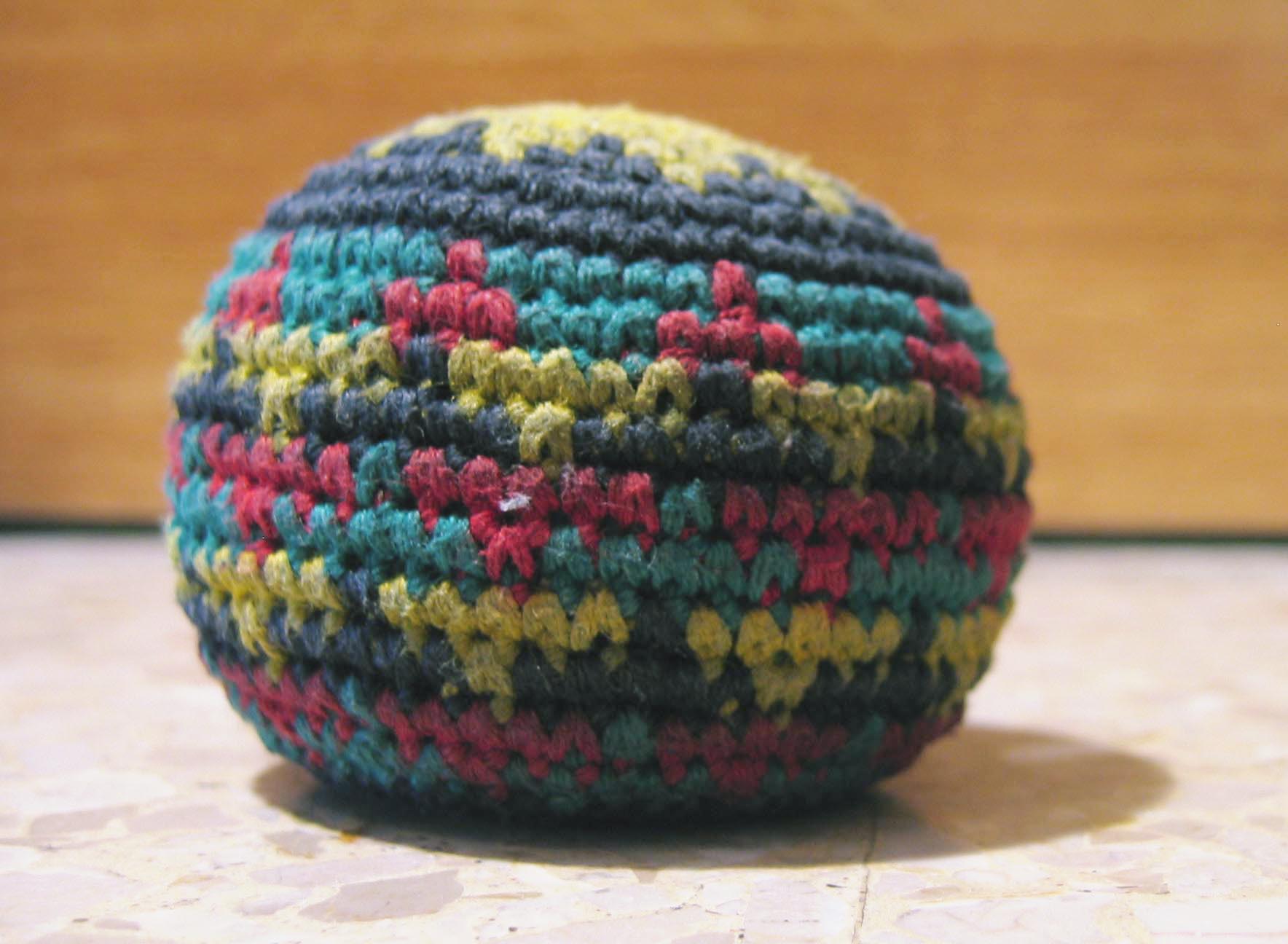
A crocheted footbag

A footbag is a small, round bag usually filled with plastic pellets or sand, which is kicked into the air as part of a competitive game or as a display of dexterity. "Hacky Sack" is the name of a brand of footbag popular in the 1970s (currently owned by Wham-O), which has since become a generic trademark.[1]

The most common game of footbag consists of two or more players standing in a circle and trying to keep the sack off the ground for as long as possible.

History

[edit]

Footbag-like activities have existed for many years. The game is similar to the Japanese game of kemari, and some South East Asian games, such as chinlone, sepak takraw and sipa. The same principle is applied in association football–playing countries in activities of freestyle football and keepie uppie. It is also similar to traditional Asian games of kicking the shuttlecock, known as jianzi, chapteh, đá cầu, and jegichagi.

The current Western incarnation of the sport was invented in 1972 by Mike Marshall and John Stalberger of Oregon City, Oregon, US[2] with their "Hacky Sack" product, the trademark rights to which are now owned by Wham-O. Although Marshall died in 1975, Stalberger continued the business.[3] It gained national popularity in the early 1980s,[4][5][6][7][8][9] and Stalberger sold the trademark to Wham-O in 1983.

Equipment

[edit]

For circle kicking, it is very common to use a crocheted footbag, which is usually filled with plastic beads. Casually, footbags are often differentiated as normal (indicating a plastic-pellet filling), or as "dirt bags" or "sand hacks" (indicating a sand filling).

In the freestyle footbag discipline, a 32-panel bag is the generally accepted standard (the number of panels on commercially available bags can range from 2 to 120 panels). Stitchers generally use Plastic Poly Pellets, sand, BB's, steel shot, lead shot, seed bead, or tungsten shot as filler. Most professional stitchers use a custom combination of different fillers to make the bag play better. Bags usually weigh between 40 and 65 grams, depending on the type of filler and amount of filler used. Thirty-two-panel bags do not stall as easily as a "dirt bag" or "sand hack", but set truer from the foot, allowing for more complex tricks. Professional footbags are usually made out of the fabrics ultrasuede light, facile, or amaretta (a sub-brand of Clarino artificial leather[10]). While these bags can last a long time with proper care, they are quite fragile relative to their more common crocheted cousins.

The footbag net discipline uses a distinct bag, characterized by a harder outer surface than other footbags. These bags are not suitable for freestyle, and vice versa.

There are also several novelty products available, including glow in the dark, chain mail, and even flame retardant bags that can be set on fire and played with. The fire footbag has been banned in South Australia.[11]

Shoes

[edit]
A popular variation of Footbag Lacing, as used by some footbag freestyle players

Most advanced freestylers wear various styles and brands of tennis shoes, the most popular being the Adidas Rod Laver tennis shoe.[12]

Several shoe modifications are common in freestyle footbag. In order to make toe stalling easier, many players use special lacing patterns that pull apart the sides of the shoe near the toe area, creating a broad, rimmed platform. Modified lacing is augmented by cutting away the stitching that joins the row of eyelets to the toe. The area that is created by completing these modifications is called a toe box.

Shoes can be further modified for freestyle footbag by removing layers of fabric from the inside, outside, and toe surfaces.[13] These modifications are advantageous because they allow players to more accurately feel the bag on their foot.

Games

[edit]

Circle kicking

[edit]
Video of four players circle kicking

Circle kicking is the most common game played with a footbag, and is often what people mean when they use the term "hacky sack". Players stand in a circle and keep the bag moving around the circle, with the goal of keeping the bag from touching the ground. There are a variety of terms used by different groups of players to note when the footbag has been touched by every member of the circle.

The game starts when one player picks up the sack and tosses it to the chest of another player, who allows it to fall to their feet so they can kick it, and play begins. Play continues until the sack falls to the ground, then a player picks up the sack and the game resumes. The object of the game is to keep the sack off the ground for as long as possible. If every player gets a touch to the sack before it hits the ground, it is called a 'hack'. If every player gets two touches before the sack hits the ground, it is called a 'double-hack' and so on and so forth.[14][15]

Freestyle footbag

[edit]
World champion Jan Weber performing a freestyle move

Freestyle footbag is a sport in which the object is to perform tricks with the bag. The ending position of the footbag on one trick becomes the starting position of the footbag on the next trick. Tricks are created by combining different components between contacts with the bag (contacts can be either stalls or kicks, though stalls are more frequent). Components include spins, dexterities (using a leg to circle or cross the footbag's path in mid-air), jumps, and ducks (letting the footbag pass a few inches above the neck). Contacts are usually on the inside of the foot behind the opposite support leg (Clipper Stall) or on the toe, however, many inventive possibilities remain and are used to create an endless list of tricks. A partial list of freestyle footbag tricks can be found at the official Footbag WorldWide Information Service.[16]

Various styles have developed as the sport has become more popular. Players can choreograph routines to music, alone or in pairs, executing difficult moves in sync with the music—the result is something like a cross between rhythmic gymnastics and figure skating.[17]

There is an annual footbag world championships held each year. The current freestyle world champion in singles category is Jan Weber, of Czech Republic.[18]

Footbag net

[edit]

In footbag net, players (either playing individually or with a partner) volley a footbag back and forth over a five-foot-high net. This game combines elements of tennis, badminton, and volleyball. The court dimensions and layout are similar to those of badminton; the scoring is similar to the old scoring system in volleyball (a player must be serving to score); and serves must be diagonal, as in tennis. Footbag net games can be played to 11 or 15 points, although the winners must win by at least two points. Rallies in footbag net look a lot like volleyball (e.g., bump, set, and spike), with players spiking from an inverted position in mid-air (over the net) and opponents often digging very fast spikes into bumps or sets. Play in footbag net is very similar to Sepak Takraw. However, in footbag net, it is an "upper-body foul" if the footbag touches any part of a player's body above the shin.

Hacky attack

[edit]
Hacky Attack playing field

Hacky Attack is a particular footbag discipline, played by two teams made up of two players each. It is practiced on a field, generally of sand, formed by a rectangle of 10 x 15 meters. One of the two players, the pitcher, tries to hit the opposing pitcher with the ball (footbag), who instead tries to avoid being hit. The other player, the catcher, has instead the task of picking up the ball and passing it to his thrower. When a pitcher is hit, he switches positions with his teammate. The first team to reach 15 points (the point is scored each time the opposing pitcher is hit) wins the game.

Hit the man

[edit]

This particular discipline, practiced mainly in Northern Italy, was founded in 2009 by some university students and consists in hitting the opponent with precise and spectacular shots, on the street or in public places. In this game, footbag is commonly called Street Ball, due to its ability to play in the crowd.

Other

[edit]
The most successful footbag doubles team, multiple world champions and innovators Martin Sladek and Tomas Tucek
Eric Wulff executing a Roll spike at the 2008 Green Cup, San Francisco
Basse
An old Norwegian foot bag game reminiscent of bag ball, where a player defends their circle. Usually, there are five to six players - where everyone plays against everyone. The aim of the game is for a player to defend their own field while attempting to land the Basse inside the field of an opponent. There are World Cup rules, Series Games, and Cup Games.[citation needed]
Buce
A game in which players in a team must juggle the footbag across a field to the opponent's half and score a goal, by kicking the footbag into a small, cylindrical container, usually a bin or pot plant.[19] The sport was invented in Australia in 2007[20] and is played there with two annual national competitions.
Hack Slap
A game played with 4, 6, 8 or more people and the object is to keep the 'footbag' in the air by any means necessary, excluding hands. When someone fails to keep the footbag in the air, hit it with an upward trajectory, or the 'footbag' fails to make it to an opponents square, they are eliminated.[citation needed]
Footbag Golf
[21] A game in which a player must kick the bag towards a designated target (18 inches in diameter and 18 inches off the ground) while navigating the course. A course is usually made up of 9 or 18 holes, and the distance between the tee and target varies from hole to hole. The game can include any number of players. A player begins a hole by teeing off from a six foot by six foot box by tossing the bag in the air and kicking it with the intention of getting the footbag as close to the target as possible. Where the footbag lands and comes to a complete stop is called the lie. After all players have teed off, the player furthest from the target marks the lie and tosses the bag for another kick. All kicks must be made behind the lie and a player cannot move past the lie until the kick is completed. Once all the players have successfully kicked their bags into the target, they may move on to the next hole.
Horse
A game that can be played with any number of players and is a great way to improve one's freestyle. One of the players performs any freestyle move they choose, then passes it on to the next player who then attempts to perform the same move. If the player performs the move correctly then that they perform a different move of their choice and then pass it on. If they fail to do the move then they get a letter "H" (if they miss again on the next round they get an "O") and passes it on to the next player who chooses a new trick. Once a player spells the word "Horse" they are out.[citation needed]
Kick Back
A game at which a player can kick the footbag against the backstop of a handball court, alone or with others. It needs a very firm footbag to bounce back. A simple score can be kept or not.[citation needed]
Killer
A game similar to War. The hacky sack is kicked around and after a certain number of kicks, a player can kick the sack at another player, trying to peg them. If the hacky sack hits them they are out unless they can hack the sack back in to the circle before it hits the ground. Self-serving, tossing the sack to yourself, is often banned in this game and if done the round is stopped and the rule breaker is pegged, thrown, with the sack.[citation needed]
Knockout
A game that can be played with any number of players, in which players are eliminated by failure to hit the hack. The hack is passed around randomly to any player, and the goal is to keep it going indefinitely; if the hack lands on the ground near another player who could have hit it (within 2 feet of him/her), that player is eliminated for the failure. If the hack lands drastically out of range of any player, then the player who kicked it out of bounds is eliminated. Some groups can apply a more strict rule where, when the hack drops, any player who lifts their foot off the ground in an attempt to kick it is eliminated.[citation needed]
Number Catch
A game where any number of players (best played with 3 or 4) have to alternate turns hitting the footbag as many times as possible and must catch it for the points to count if the bag is dropped the player must subtract the points from their score. This game may be played to a certain score or a certain time to get as many points as possible.[citation needed]
Numbers
A game in which players form a circle and the person who starts kicks the hack once. Then the second person kicks it twice and so on and so forth. If the hack touches the ground before the player achieves their number, the player gets one chance to start where they left off. If the player does not achieve their number, they pass the footbag on to the next player, and if they achieve that number the previous player is out.[citation needed]
Shark
A game where two or more players can play. The goal is to hit the sack a previously set number of times before a player catches it and says: "shark." When the person says "shark" the other players must stay where they are, and the "shark" has the ability to throw it at any player. If a player is hit, the player is out or has a point that goes against their score. Last player standing wins. When a player says "shark", the others players can move only one foot once to reposition themself. It is common to use that one move to dodge the sack.[citation needed]
War
A game for any number of players. The footbag is served and after a predetermined number (usually 3) of kicks (whether by one person, or collectively as a group) everyone tries to catch it. The person who catches the footbag throws it at one of the other players who try to either dodge or catch it. If the footbag hits someone they are out, but if they catch it the person who threw it is out. The game can be played with any number of outs. Also known by the names "Pelt", "Three Balls of Fire", "Three Hit Kill", "Three Hack Wack", "Applesauce", "Red Dot", and "God".[citation needed]
Burn
A game played with 2 or more players. After the sack is hit 3 times between 2 people one can kick the hack at another player yelling out "burn". Once this is done the hacky carries one point with it as it hits another player that point is added to them unless they can hit it with their foot canceling out the burn, or recalling "burn" adding yet another point to the hack in an attempt to hit someone else with 2 burns and so one. You can add as many burns as you would like before hitting another player or the ground. Either one resets the burns attached to the sack. The person with the lowest burn count at the end of the game wins. Other rules are no self serving the hack at the beginning of the game, you must serve to another player or you get 1 burn point. If you use your hands during game play you also get 1 burn point. Getting hit in the face during a burn attempt counts for 2 points to the player who gets hit. If the hacky sack goes through the legs of a player with their legs in the shape of a 4 in an attempt to hit the hack and someone yells "4 hole" before it hits the ground this is 1 burn point. If the hack goes through someones legs who is just standing there and someone yells "5 hole" 1 point is added to that player. This game is also often played with the rule that once you get to 4 burns you have to walk around the circle and get punch by each opponent with a face hit being an automatic walk.

Rules

[edit]

There are a lot of variations of hacky sack therefore there are no standardized rules to govern each version. There are however unwritten rules; for example in circle kicking, players should only serve the ball to players standing next to them rather than serving to themselves. If a player also drops the ball, he is responsible for retrieving it. To complete the circle and get a hack, the ball should pass through all the players without touching the ground. One circle is called a hack, double circle is called double hack and so forth.[22] In the footbag net, only two kicks are allowed per side for singles and three kicks per side for doubles.

See also

[edit]

References

[edit]
Revisions and contributorsEdit on WikipediaRead on Wikipedia
from Grokipedia
Hacky Sack, also known as footbag, is a casual, non-competitive in which players use primarily their feet and to keep a small, beanbag-like object—typically a crocheted or sewn pouch filled with plastic pellets, sand, or dried peas—airborne for as long as possible, without using hands or arms. The game originated in , in the summer of 1972, when athlete John Stalberger and friend Mike Marshall created a handmade beanbag to play a kicking game, initially as a form of rehabilitation for Stalberger after an . The modern footbag evolved from rudimentary square prototypes filled with rice or glass beads into more durable, round designs by 1974, with the first two-panel version produced that year. Commercial production began scaling in , and a U.S. for the footbag was granted in 1979 (U.S. Patent 4151994). In 1983, Inc. acquired the rights for $1.5 million, transforming Hacky Sack into a global phenomenon with over 25 million units sold worldwide since then. Typically played in a circle by two or more participants, the core objective is cooperative: players pass the footbag to one another while performing tricks like stalls, kicks, or spins, with no self-serves allowed to start a round and no penalties for drops, emphasizing goodwill and community over competition. Variants include freestyle routines for individual displays and footbag net (invented in 1978), a competitive doubles game over a net similar to or . Associated with and movements since the 1970s, Hacky Sack gained widespread popularity in the 1980s among college students, at rock concerts, and during peace events, fostering themes of unity and non-violence. The World Footbag Association, founded in 1983, continues to organize events and promote the sport internationally. In May 2025, partnered with PlayMonster to relaunch the Hacky Sack with new designs and features for a 2026 release.

History

Ancient Precursors

The ancient Chinese game of jianzi, a variant of the earlier cuju, involved players kicking a shuttlecock-like object filled with feathers or weighted with coins without using their hands, with origins tracing back to approximately 200 BCE during the Han dynasty. Evolving from cuju—a ball-kicking activity used in military training to build soldiers' agility, coordination, and teamwork—jianzi was documented in ancient texts and artifacts as a means to maintain troop fitness and morale. Archaeological evidence, such as manuscripts unearthed from the Mawangdui tombs (dating to the early Western Han dynasty, circa 2nd century BCE) and sculptural depictions on bronze mirrors and woodblock prints, illustrates its practice across social classes, including in festivals like the Hanshi and Qingming, where it symbolized harmony between heaven and earth through its circular motion. In Chinese society, jianzi served not only recreational purposes but also reinforced military discipline and cultural unity, often integrated into imperial celebrations and courtly routines. In , developed around the 7th century CE, introduced from during the Asuka and early Nara periods, as a non-competitive pastime where participants stood in a circle to keep a deerskin ball aloft using only their feet, emphasizing grace and cooperation over . The earliest textual evidence appears in the (compiled 720 CE), recording a ball game in 644 CE at Hokoji Temple in Nara involving Prince Naka no Oe, potentially linked to diplomatic or reformative events like the Taika Reforms. Historical records from the onward, including the Honcho Gatsuryo (701 CE), describe its formalization on a square field marked by four sacred trees (shihon-kakari), with play occurring on auspicious dates like the fifth day of the fifth month. held profound cultural significance in aristocratic and circles, akin to and ceremonies, as a ritual of harmony (wa) performed at shrines such as Kamomioya-jinja during New Year's observances; its preservation today stems from an 1903 edict by establishing dedicated societies. Chinlone, a traditional Burmese game with ancient roots in , features teams collaboratively passing a woven ball through intricate kicks, originating potentially as early as the Pyu kingdom period (200 BCE–900 CE). Performed in circles during Buddhist festivals and ceremonies, chinlone integrates rhythmic movements inspired by traditional and , accompanied by music to evoke unity and communal joy, historically male-dominated but increasingly inclusive. Its cultural role underscores 's heritage of cooperative play, symbolizing social harmony and physical artistry in both village gatherings and national events. Unlike modern Hacky Sack, which employs a dense, weighted footbag for freestyle tricks, these precursors utilized lighter implements—feathered shuttlecocks in , soft deerskin balls in , and airy rattan spheres in —prioritizing ritual performance, group synchronization, and ceremonial elegance over individual casual or competitive kicking.

Modern Invention and Popularization

The modern incarnation of Hacky Sack, known as footbag, originated in 1972 when Mike Marshall and John Stalberger created a simple kicking game in , using a handmade square beanbag filled with to aid Stalberger's rehabilitation. The duo refined their prototype over the following year, transitioning to sewn fabric footbags that allowed for better control and durability, drawing crowds as they demonstrated the activity in local settings. In 1977, Stalberger co-founded the National Hacky Sack Association (NHSA) with Ted Huff and others to organize the sport formally, which sponsored early footbag tournaments in the late 1970s. In 1983, Stalberger sold the Hacky Sack trademark and manufacturing rights to , which introduced mass-produced round, sand-filled versions that standardized the equipment and fueled a boom in popularity during the , particularly among counterculture groups such as followers who incorporated it into scenes. This commercialization led to widespread adoption on high school and college campuses, where it became a staple of casual , with the NHSA evolving into the World Footbag Association by 1984 to oversee growing competitive events, including the inaugural World Footbag Championships in 1980. The 1990s saw further popularization through music festivals, gatherings, and media exposure, transforming Hacky Sack from a niche pursuit into a recognized global activity, with over 25 million units sold worldwide by . Post-2000, its spread accelerated via communities and organizations like the International Footbag Players' Association (formed in 2000), fostering online tutorials, forums, and international tournaments that sustained and expanded its player base. In 2022, marked the 50th anniversary of the invention with special recognitions, highlighting its enduring legacy as a accessible, skill-building pastime.

Equipment

The Footbag

The footbag, the core object in Hacky Sack, is a small, round beanbag designed for kicking and manipulation with the feet. Typically measuring 2 to 2.5 inches (about 5 to 6 cm) in diameter and weighing 40 to 65 grams, it features an outer shell made from materials such as crocheted , , or synthetic fabrics like or , filled with plastic pellets, sand, or seeds to provide the necessary weight and texture for control during play. Variations in footbag design cater to different playing styles. Dirtbag-style footbags, developed for casual and outdoor play since the late , are durable with sand fills that make them heavier and less bouncy, ideal for beginners learning basic control. Freestyle footbags, often constructed with 32 panels of soft or similar synthetics, emphasize smoothness for stalls and intricate tricks, offering predictable flight and cushioning. Net footbags, built with harder vinyl shells and heavier weights, are engineered for volley-based games, providing resilience against impacts and all-weather durability. Manufacturing of footbags originated in the early 1970s with handmade prototypes by inventors John Stalberger and Mike Marshall, using simple materials like leather discs filled with rice, buttons, or rocks, evolving to round shapes with internal stitching by 1973. Hand-stitched two-panel leather models were produced in starting in 1974, with production expanding to in 1977, before acquired North American rights in 1983, shifting to factory production with standardized plastic pellet fills for consistency. The choice of weight and fill material significantly influences bounce and control, with lighter pellet-filled designs favoring precision kicks and heavier sand versions aiding stalls. Safety features in modern footbags include non-toxic fills like pellets or to prevent hazards from organic materials that could sprout or degrade, such as early rice fills. Metal pellets, like BBs, are sometimes used in advanced models for added weight but are avoided in standard designs due to risks of from punctures or impacts. Softer synthetic shells are recommended for beginners to enhance control and reduce strain.

Footwear and Accessories

In footbag sports, including freestyle and net variants, footwear selection emphasizes shoes that provide a flat, grippy surface for precise control and stalls. For freestyle play, the Vintage has been a longstanding preference since the due to its flat toe and instep, which facilitate toe stalls and smooth contacts, though modern reissues are heavier with a gum outsole. More recently, as of 2025, the Quantum shoes by Freedom Footbags represent a current option specifically designed for freestyle footbag, featuring lightweight soles and enhanced kicking areas. Net players favor the Nike Air Cross-Trainer (TW model) or similar cross-trainers for their solid, flat insteps, outsides, and firm, slightly rounded toes, paired with soles offering good traction on various surfaces. Other historical options include early choices like Nike Court and Avenger models or , evolving through the -1990s to Kaepa K-165 and K-120 with double lacing, and the early 1990s LeCoq Sportif Super Ashe; in 2005, the Planet Footbag Millennium emerged as the first shoe designed specifically for freestyle, though production later ceased. Players often modify shoes to optimize performance, particularly for freestyle where a larger "landing deck" enhances control. Common alterations include unique lacing techniques on models like the , such as skipping the first two eyelets to open the and create side walls for better stalls, or the Kenny Shults method that crosses laces through specific holes to form slip-on loafers with lowered walls. More extensive mods involve cutting or sanding the for a barefoot-like feel, as pioneered by players like Genz in the early 1990s, or adding glued/stitched pads and flat paddle adapters for increased friction; net players may sew strips from mountain-bike tires onto soles for superior grip. Modifications require ensuring a proper fit beforehand, as altered shoes cannot typically be returned. Beyond footwear, footbag enthusiasts use practical accessories to support play and storage. Carry bags, such as the synthetic / models from World Footbag, hold up to three regulation footbags and facilitate portability during sessions or travel. For footbag net, complete sets include nets, posts, springs, nails, snap hooks, and dedicated carry bags, along with boundary lines to define the court. This gear has evolved alongside the sport, shifting from casual 1970s setups with everyday items to specialized equipment in competitive scenes by the 1980s.

Core Gameplay

Fundamental Rules

Hacky Sack, or footbag, adheres to core prohibitions that distinguish it from hand-based sports, mandating no use of hands or arms to contact the footbag in any variant. This rule is universally enforced across competitive disciplines, where such contact constitutes a foul, ensuring the emphasis remains on lower body skill and coordination. In strict play, particularly in net and consecutive kick events, body contact above the —such as with the or head—is also disqualified to maintain focus on precise footwork, though freestyle allows limited upper body use for delays and rolls. Allowed contacts are primarily with the feet and knees, promoting and balance while preventing unfair advantages from larger body surfaces. Etiquette in Hacky Sack prioritizes and continuous flow, especially in social settings. Players must pass the footbag to others rather than self-serving, a prohibition explicitly outlined in freestyle rules to encourage interaction, and extended to casual circle play where solo initiation disrupts the group dynamic. Apologies for misses are discouraged to preserve momentum and positivity, as interrupting the game with verbal regrets hinders the communal spirit. A "stall" technique, involving controlled balancing on the foot or before passing, is encouraged to allow receivers preparation time without excessive delay, fostering smoother exchanges. Scoring basics revolve around sustaining play, with the overarching objective to achieve the maximum number of consecutive contacts without the footbag dropping to the ground. In circle kicking, a casual format applied across skill levels, a "hack" denotes a successful cycle where the footbag completes one full rotation among all participants, building toward longer sequences that test endurance and precision. Adaptations accommodate varying expertise: beginners often receive allowances like hand retrievals or relaxed body contact rules in informal sessions, while competitive enforcement strictly applies prohibitions and classifications by age, gender, and ability to ensure fair play. Safety guidelines emphasize selecting open, uncrowded spaces to minimize collision risks, aligning with the sport's sportsmanship principles that prohibit actions endangering others.

Circle Kicking

Circle kicking, also known as the circle hack or consecutive kicking, is the foundational casual group in hacky sack, emphasizing play to maintain the footbag airborne without using hands or arms. Typically involving three or more players standing in a close , approximately 4 to 6 feet in , the setup allows for easy passing between participants on a flat surface like grass or pavement, with no formal boundaries required. The primary objective is to pass the footbag around the using legal kicks—such as inside-of-the-foot (instep), outside, or strikes—while adhering to the no-hands rule derived from soccer principles, where only feet and knees may contact the bag. Gameplay begins with one player serving the footbag by hand to an adjacent participant, after which all subsequent contacts must be with allowable body parts to propel it to the next player in sequence, usually clockwise or counterclockwise. Players often perform one or more kicks before passing to keep momentum, aiming to complete full circuits without drops; if the footbag touches the ground, the run ends, and the group restarts from zero. Progress is tracked by "hacks," where one hack represents a complete cycle with each player contacting the footbag once, a double hack requires two contacts per player per cycle, and so on, fostering a sense of collective achievement as runs build. Common variations include progressive counting games like "Numbers," where the first player kicks once, the second twice, and so forth until a drop resets the sequence, or "One-Up Five-Down," escalating to five contacts per player before descending. While competitive formats exist with timed rallies or scored points, casual circle kicking prioritizes personal bests over formal scoring, with no nets or opponents involved. Some informal house rules introduce leniency, such as a "" save allowing a hand catch to prevent a drop but imposing a penalty like skipping the next player's turn or an extra kick requirement. Beginners often achieve brief runs of a few cycles due to coordination challenges, whereas skilled groups can sustain extended sequences, enhancing the game's replayability. Originating as the core activity when hacky sack was invented in the early 1970s by John Stalberger and Mike Marshall in , circle kicking served as the basis for the sport's initial spread through informal group sessions, predating organized competitions or specialized variants. By the mid-1970s, it had become a staple among communities, including at music festivals and parks, where it promoted camaraderie and non-competitive bonding among players of varying skill levels. Today, it remains a social staple at outdoor gatherings, building and lighthearted interaction without the need for equipment beyond the footbag itself.

Freestyle Footbag

Freestyle footbag is a performance-oriented within the , where players execute intricate chains of stalls, kicks, and flips without using their hands, aiming to maintain continuous control of the footbag to avoid drops. The primary objective is to demonstrate skill through solo, doubles, or group routines that are judged based on difficulty, creativity, execution, variety, and overall flow. These routines often incorporate choreographed sequences set to music, emphasizing artistic expression alongside technical proficiency, and are a staple in competitive settings. Players typically use specialized freestyle footbags, which feature smooth, stitched-panel constructions—often with 32 panels—for and predictable flight paths during tricks, distinguishing them from crocheted varieties better suited for or other . Competitions commonly feature time-limited routines, such as one-minute performances in events like shred-30 or full choreographed sets, where participants perform in pools and advance based on scoring. Skill progression begins with basic stalls, such as the delay where the footbag is balanced on the foot's side, and advances to complex like the quantum (a body wrap involving a spin and legover) or (a leg-entangling dexterity move that transitions the bag around the body). The competitive history of freestyle footbag traces back to the 1980s, when it evolved from casual kicking games into formalized events under organizations like the International Footbag Players' Association (IFPA), with world championships highlighting routines as a core category since the inaugural tournaments around 1980. Routines are scored using systems that evaluate execution (clean performance without errors), variety (diverse moves), and flow (seamless transitions), often on a scale up to 42 points or through subjective Olympic-style judging from 0 to 6. As of the 2025 IFPA World Footbag Championships in , , Mathieu Gauthier holds the title in individual routines, underscoring the event's global prestige and the discipline's ongoing technical evolution.

Specialized Games

Footbag Net

Footbag net is a competitive sport that combines elements of and soccer, where players use only their feet to volley a footbag over a , emphasizing precision, agility, and strategic placement. Developed as a structured alternative to casual footbag play, it requires teams to maintain rallies through controlled kicks while avoiding faults, fostering both individual skill and cooperative play in team formats. The game promotes fast-paced action with , blocks, and digs, typically using a denser footbag for better control during volleys. The court setup mirrors a in layout, measuring 20 feet wide by 44 feet long, divided by a 5-foot-high net into two equal 22-foot-deep halves, with the net positioned at the center and stanchions placed outside the boundaries to avoid interference. The playing surface is preferably flat grass, free of obstacles, though indoor variants use taped floors; boundary lines are 2 inches wide, and the footbag is considered in-bounds if it touches them. Matches accommodate 1 to 2 players per side—singles (1v1) or doubles (2v2)—with doubles allowing up to 3 alternating kicks per side to build rallies, while singles limit teams to 2 kicks; a specialized, harder footbag (per IFPA standards) ensures consistent flight and durability for competitive play. Core rules prohibit any contact above the , hand use, or body parts other than the feet, with faults including net touches by the footbag (except on serve), consecutive kicks by the same player, or out-of-bounds landings, resulting in a point for the opposing team. Serving begins from behind a service line (10 feet from the ), diagonally into the opponent's quadrant, with let serves ( clips landing in) permitting a retry; scoring systems vary by format—classic scoring awards points only on serve to 15 (win by 2), rally scoring grants points per rally to 21, and uses shorter games to 4 points within sets—typically in best-of-3 matches, with side changes after each game for fairness. Games emphasize foot-only contact to volley the footbag, penalizing ground contacts or delays, and can lead to forfeits under IFPA oversight. Strategy in footbag net revolves around precise placement to exploit opponent weaknesses, with offensive plays like powerful spikes (downward kicks from above the net) and deceptive lobs, countered by defensive blocks (upward deflections) and digs (low saves near the ground). In doubles and triples, teamwork is essential, involving rotations for coverage, communication for set-ups, and alternating kicks to sustain longer rallies; players often employ sole kicks for control, inside-of-foot sweeps for angles, and outside pushes for speed, adapting to indoor (smoother surfaces) or outdoor (wind-influenced) conditions. Success demands soccer-like footwork, tennis-style positioning, and volleyball-inspired timing, prioritizing rally length over power to wear down opponents. Footbag net originated in 1978 as a competitive evolution of casual footbag kicking, invented by John Stalberger following his earlier knee rehabilitation through the sport, initially played over an 8-foot net with a five-kick limit per side before rule adjustments lowered the net to 5 feet and emphasized spiking for faster play. Organized as a formal sport in the 1980s through clubs like the Footbag Pioneer Club, it gained structure via the International Footbag Sports Association (now IFPA), with international tournaments emerging in the 1990s, including annual World Footbag Championships that feature net divisions and attract competitors from , , and beyond.

Other Variants

Beyond the core forms of circle kicking and footbag net, several niche variants of footbag have emerged, often adapting the sport's no-hands rule—prohibiting use of hands or arms except for initial tosses—to create unique challenges emphasizing teamwork, precision, or humor. Footbag Golf, invented in August 1982 in Portland, Oregon, by John Stalberger, transforms the footbag into a golf-like pursuit where players navigate a course of tees, fairways, and greens to reach a central target hole using the fewest kicks possible. Courses typically feature 9 or 18 holes, with each hole's par score determined by distance and obstacles; players begin each kick with a hand toss to launch the footbag airborne before contacting it with the foot, and the stance must be within 12 inches behind the previous landing spot. Scoring counts every kick, with penalties added for out-of-bounds lies (one stroke) or illegal tosses (disqualification from the hole); the lowest total strokes wins, promoting strategic placement over power while accommodating diverse skill levels through its low-cost setup on parks or fields. Etiquette emphasizes safety, such as yielding to faster groups and avoiding environmental damage, making it a social, accessible activity for all ages. Buce, developed in early 2007 in by a group of sports enthusiasts evolving freestyle footbag routines, is a high-energy for 4 to 20 players divided evenly, played on a rectangular field with two bins as goals spaced 15 meters apart. The objective is to score by kicking the footbag into the opponent's bin while keeping it airborne using any body part except hands or arms; a direct entry ("buce") awards 2 points, while touching the bin's exterior or landing nearby scores 1 point, with doubles for long-range shots originating outside a 3.6-meter double-point line. involves rapid passes and incidental contact (like shoulder bumps) is allowed, but fouls such as entering the 1.8-meter no-go around the bin or dangerous plays result in possession turnover via penalty serves; serves start from the hand to the body and cannot directly score, resetting on ground contacts or out-of-bounds. This variant's fast pace and acrobatic jumps foster aggressive exchanges, with games typically lasting until a reaches a set point total, and it has seen organized leagues since 2008. Since 2020, app-integrated challenges have blended digital tracking with physical play, such as the Skill Addicts app, which guides users through progressive footbag tricks and competitive routines via video tutorials and skill-sharing features. Hybrid sports like Hack or Die (released 2021), a video game incorporating footbag kicking mechanics for obstacle navigation and combos, inspire real-world adaptations by simulating high-stakes aerial control.

Techniques

Basic Kicks

Basic kicks form the foundation of footbag play, enabling beginners to maintain control and keep the footbag airborne through simple, repetitive contacts. These techniques emphasize precision over power, using parts of the foot or to direct the footbag with minimal force. Mastery of basic kicks typically begins with solo practice, progressing from simple drops to sustained sequences, and is essential for transitioning to group play like circle kicking. The inside kick utilizes the inner laces or instep of the foot for controlled contact, making it ideal for passing in casual circle games. To execute, a player tosses the footbag slightly forward, twists the about 45 degrees toward the kicking , and strikes the footbag with a loose ankle snap, aiming for mid-thigh height. This technique promotes accuracy due to the larger surface area of the instep, allowing beginners to achieve 20-50 consecutive kicks with practice on both feet. In contrast, the outside kick employs the outer edge of the foot for directional adjustments, often used to redirect the footbag during play. The player tosses the footbag to the side, twists the hips away from the kicking leg, and contacts it with the outstep, directing it upward to . This requires more balance as the surface is narrower, but it helps in varying trajectories; common practice involves alternating sides to build symmetry. The toe kick serves as an entry-level stall and reset, contacting the top of the toe box to pop the footbag straight up. Players drop the footbag at arm's length in front, snap the ankle loosely without excessive force, and aim for vertical lift to facilitate catching or further kicks. It is particularly suitable for beginners due to its simplicity, mimicking soccer motions, though over-kicking can cause unwanted spin. For temporary halts, the knee stall involves bouncing the footbag on the top of the , providing a reset without using the feet. The player kicks the footbag to height, raises the leg to meet it at a 90-degree angle, and cushions the impact by lowering the slightly to hold it for about one second before resetting. This non-foot contact is forgiving for novices, allowing recovery from errant kicks. Learning progression starts with the drop-kick method: dropping the footbag from hand height and contacting it immediately upon descent, gradually advancing to tosses and multi-kick chains without hand intervention. Beginners should set goals like 5-10 consecutive contacts per session, focusing on the weaker foot first, and incorporate stalls to extend rallies. Common errors include over-kicking, which sends the footbag too high or erratically, and inconsistent contact points, often remedied by relaxing the ankle and using short, controlled motions. Biomechanically, effective basic kicks rely on proper foot positioning—perpendicular to the ground for stalls, angled parallel to the ceiling for side kicks—and balanced body posture, with the standing leg slightly bent to absorb impact and the torso twisted for reach. Keeping the kicking leg relaxed prevents tension that leads to bounces, while maintaining a low center of gravity enhances stability for beginners. These fundamentals apply directly to circle kicking, where controlled inside and outside kicks facilitate smooth passes among players.

Advanced Maneuvers

Advanced maneuvers in freestyle footbag elevate the sport beyond basic kicks, requiring precise control, body awareness, and creativity to execute complex sequences that captivate audiences in competitions. These techniques build on foundational stalls and kicks by incorporating elements like , , and multi-hit interactions, often judged for their and difficulty in such as the World Footbag Championships. Key examples include the "diving" maneuver, where the footbag passes over the back of the neck before being ducked under and kicked on the same side, demanding exceptional timing to avoid dropping the bag. The "string" refers to extended multi-hit sequences, such as a ripwalk involving two dexterities (clipper to outside pick-up inside to outside pick-up out to clipper), with the maximum recorded reaching five dexterities in tricks like sailing near-mofly or nemesis swirl. The "mirage" creates an illusion of the footbag vanishing through rapid leg circling during its upward trajectory, as seen in the mixer trick, and can be combined with paradox variations for added complexity. Combo building involves linking these elements into fluid routines, such as chaining an inside kick to an outside stall, knee stall, and diving sequence, while maintaining momentum through controlled timing and body pivots to sustain the footbag's flight path. Players focus on dexterity speed and unusual surfaces to weave these into choreographed performances set to music, emphasizing flow over mere execution. Training for these maneuvers often employs slow-motion to isolate components like leg intersections, paired with video to refine form and identify errors in sequencing. Difficulty is rated using the ADD (Additional Degrees of Difficulty) system from footbag communities, which categorizes adds into delay, dexterity, unusual surface, body (including jumps and ), and cross-body elements; for instance, a five-add trick like a fearless combo signifies elite skill. Innovations in advanced maneuvers stem from player-created moves shared online since the early , evolving through community forums and groups like the Freestyle Footbaggers community, which has facilitated global exchange of techniques such as (a 360-degree dexterity from a clipper stall). These user-generated contributions play a central role in freestyle competitions, where routines are scored on creativity and total adds, driving the sport's uncommercialized, self-organized growth.

Cultural and Competitive Aspects

Hacky Sack developed strong ties to the hippie counterculture, where it was frequently played in parking lots at concerts as a communal, improvisational activity among fans. Although invented in 1972, the game borrowed hippie elements like barefoot play, enhancing its appeal in relaxed, settings. By the 1990s, it had become a staple at music festivals and jam band gatherings, such as , symbolizing the era's laid-back, youthful vibe. This association positioned Hacky Sack as the "athletic equivalent to listening to the ," fostering a sense of shared, non-competitive leisure. In popular media, Hacky Sack has appeared in films and television, reinforcing its image as a quirky, countercultural pastime. A memorable scene in the 1999 teen comedy features performing an extended hacky sack routine, capturing the game's freestyle flair and contributing to its nostalgic 1990s appeal. On , references include characters playing hackie-sack in episodes like "D'oh-in' in the Wind" (Season 10, 1998), where it underscores themes of hippie revival and casual bonding. These portrayals, alongside its links to jam bands, have embedded Hacky Sack in depictions of alternative . The global Hacky Sack community thrives through dedicated online platforms and informal street play, emphasizing accessibility and social connection. Footbag.org, a central non-commercial resource for the since the late , provides information, forums, and references that unite players worldwide. Urban street play is prevalent in parks and public spaces, such as Dolores Park in , where groups gather spontaneously on sunny days. The activity's low barrier to entry promotes inclusivity across ages, encouraging participation from children to adults in diverse settings without formal equipment or rules. Modern trends have revitalized Hacky Sack via , particularly challenges that emerged post-2010, where users share tricks, daily routines, and competitive sequences under hashtags like #hackysackchallenge. These viral formats, including freestyle tutorials and group Olympics-style games, have broadened its reach to new generations. Additionally, it is recognized as a low-impact exercise that enhances flexibility, , , and coordination while minimizing joint stress, making it suitable for casual fitness routines.

Tournaments and Organizations

The International Footbag Players' Association (IFPA), established in the late 1990s as a volunteer-run, non-profit , serves as the primary for footbag sports worldwide, focusing on standardizing rules, sanctioning events, and promoting amateur competition. The IFPA publishes the Official Rules of Footbag Sports and oversees the International Footbag Committee to ensure consistent formats across disciplines like freestyle and net. Earlier organizations laid the groundwork, including the National Hacky Sack Association (NHSA), founded in 1977 by John Stalberger and Ted Huff to organize initial tournaments, and the World Footbag Association (WFA), established in 1983 by Bruce Guettich and Greg Cortopassi to expand the sport internationally through events and publications. Major tournaments include the annual IFPA World Footbag Championships, which began in 1980 as a national event in , , and evolved into an international by the mid-1980s, attracting participants from multiple countries. Held each summer, the championships feature categories such as freestyle (individual and team routines), footbag net (volleyball-style play), and footbag (a precision course-based game), with events spanning qualifying rounds, preliminary competitions, and finals judged on technique, creativity, and endurance. Recent events include the 2024 championships in Montréal, , and the 2025 championships in , . The U.S. Open Footbag Championships, launched in 1981 in , represent another premier event, emphasizing high-level freestyle and net play with cash prizes up to $1,500 for top finishers and contributing to global rankings maintained by the IFPA. By the 2020s, footbag competitions had grown to include over 200 clubs across more than 35 countries, with the World Championships drawing athletes from Europe, North America, Asia, and beyond, fostering international rankings and cultural exchange. Notable freestyle champions, such as Jan Weber of the Czech Republic, who secured multiple world titles from 2005 to 2011, highlight the sport's technical evolution. Post-2000, footbag faced declining participation amid shifting youth interests and reduced mainstream visibility, with casual play peaking in the 1980s and 1990s before tournament attendance stabilized at smaller scales. To counter this, the IFPA and affiliated groups have initiated youth outreach programs, including free memberships, online tutorials, and school integrations, aiming to revive interest through accessible entry points and global online events like the 2020 virtual championships.

References

Add your contribution
Related Hubs
User Avatar
No comments yet.