


Community hub
Recent from talks
Contribute something
Nothing was collected or created yet.
Fossegrim
View on Wikipedia

Fossegrim, also known simply as the grim (Norwegian) or Strömkarlen (Swedish), is a water spirit or troll in Scandinavian folklore. He is often depicted as a handsome, nude man playing the fiddle in streams and waterfalls. Fossegrim has been associated with a mill spirit (kvernknurr) and is related to the water spirit (nokken) and is sometimes also called näcken in Sweden.[1][2][3][4]
Description
[edit]Fossegrim is described as an exceptionally talented fiddler: the sounds of forest, wind and water play over his fiddle strings. Fossegrims can be induced to teach the skill. The Swedish strömkarl's lay is said to have eleven variations, the final one being reserved for the night spirits because when it is played, "tables and benches, cup and can, gray-beards and grandmothers, blind and lame, even babes in the cradle" will begin to dance.[5]
Fossegrim is said to be willing to teach away his skills in exchange for a food offering made on a Thursday evening and in secrecy: a white he-goat thrown with head turned away into a waterfall that flows northwards,[3][6] or smoked mutton (fenalår). If there is not enough meat on the bone, he will only teach the supplicant how to tune the fiddle. If the offering is satisfactory, he will take the pupil's right hand and draw the fingers along the strings until they all bleed, after which he will be able to play so well that "the trees shall dance and torrents in their fall stand still".[3][6]
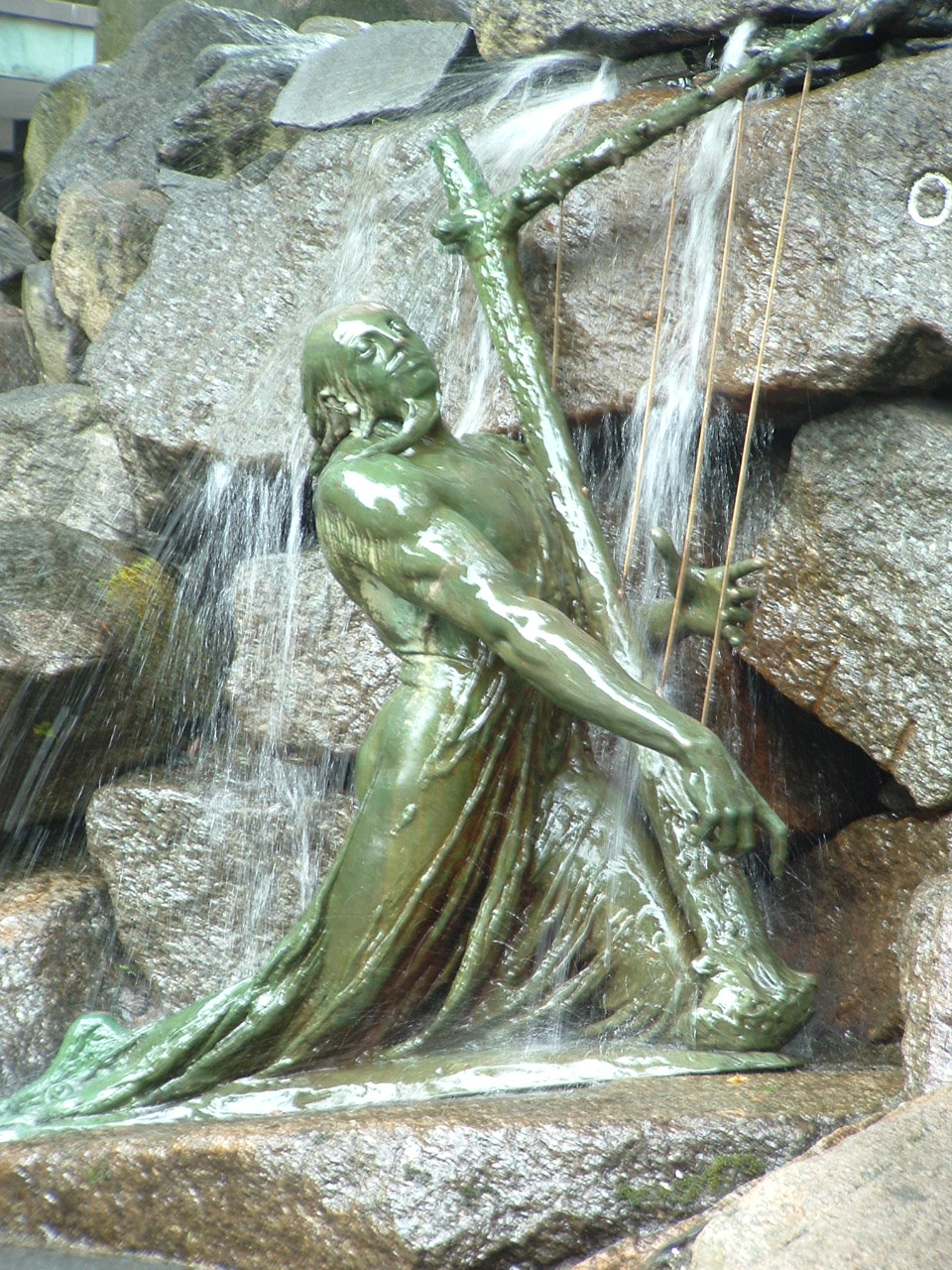
Jacob Grimm cites a variant in 18th-century Chorographia Bahusiensis by Johan Ödman (1682-1749) according to which the Strömkarlen must be offered redemption or he will merely break his instrument and weep bitterly.[6] Famous fiddlers who were rumored to have learnt from the Fossegrim include Torgeir Augundsson (1801–1872) known as Myllarguten and Ole Bull (1810–1880) whose statue in the centre of Bergen depicts a fossegrim playing his harp under the falling water.[7]
In popular culture
[edit]- Dungeons & Dragons introduced the fossegrim, under the name "fossergrim", as a monster in Deities & Demigods (1980).
- Fossegrim is featured in the video game Dark Age of Camelot (2001).
- The Norwegian metal band Kvelertak has a song called "Fossegrim" (2010).
- Fossegrim (Näcken) is featured in the video game Unforgiving: A Northern Hymn (2017).
- Fossegrim is featured in the digital card game Mythgard (2019) as a rare minion in the Norden faction.
- Fossegrim is featured in the video game Röki (2020) in Fossegrim's Cavern.
- Grims are a class of frog-like enemies featured in the video game God of War: Ragnarok (2022).
- Fossegrim is encountered by the protagonist in the video game Bramble: The Mountain King (2023).
- The band Bobtown has a song titled "Fosse Grim" on their album A History of Ghosts (2014), based on the legend. [8]
- Fossegrim is the inspiration for a character named "Fossegrimen" in the video game Old School RuneScape.
References
[edit]- ^
Shipley, Neil (July 9, 2024). "Swedish Monsters: Näcken". Watching the Swedes. Retrieved September 27, 2025.
The name Näcken doesn't come from the word 'näck' meaning naked in Swedish, as one might think. It comes from the Nordic word 'nykr' which meant 'sea monster' or 'hippopotamus'.
- ^ "The Neck". Nightbringer.se. Archived from the original on 2023-08-07. Retrieved September 28, 2025.
- ^ a b c Benjamin Thorpe, Northern Mythology: comprising the principal popular traditions and superstitions of Scandinavia, north Germany, and the Netherlands, 3 vols. London: Lumley, 1851–52, OCLC 656592812, Volume 2 Scandinavian Popular Traditions and Superstitions, p. 23.
- ^ Eugen Mogk, Mythologie, Grundriß der germanischen Philologie 1, Strasbourg: Trübner, 1891, OCLC 162976637, p. 1028 (in German) equated them, but Reimund Kvideland and Henning Sehmsdorf, Scandinavian Folk Belief and Legend, Nordic Series 15, Minneapolis: University of Minnesota, 1988, ISBN 9780816615032, p. 248, distinguish the "mill sprite" as a mischievous creature who punishes grinding on Christian holy days.
- ^ Jacob Grimm, Teutonic Mythology, 4th ed. tr. James Stallybrass, Volume 2, London: Bell, 1883, OCLC 457311367, pp. 492–93.
- ^ a b c Jacob Grimm, Teutonic Mythology, p. 493.
- ^ Jan Sverre Knudsen. "Torgeir Augundsson (Myllarguten)". Norsk biografisk leksikon. Retrieved June 1, 2019.
- ^ YouTube of Fosse Grim
Fossegrim
View on GrokipediaEtymology and Names
Linguistic Origins
The term "Fossegrim" derives from Old Norse elements, combining foss (or fors), meaning "waterfall," with grímr, related to gríma ("mask"), denoting a disguised or spectral being such as a spirit or troll associated with hidden, otherworldly presences.[4][5][6] This nomenclature connects to the broader Old Norse concept of nykr, a term for a water demon or "river horse," often depicted as a shape-shifting aquatic entity resembling a grey horse that lures victims into watery depths, forming the foundation for modern Scandinavian water spirit terminology.[7][8][6] Over time, linguistic and folkloric evolution transformed these brook horse (nykr-like) myths—rooted in pre-Christian warnings of perilous waters—into post-medieval depictions of personified fiddler spirits, as seen in Norwegian traditions where the entity teaches music near cascades, reflecting a shift from malevolent demon to enigmatic mentor.[6][7]Regional Variations
In Norwegian folklore, the Fossegrim is the primary name for the water spirit associated with waterfalls and streams, often shortened to simply Grim in local traditions. This figure is sometimes linked to the kvernknurr, a mill spirit inhabiting watermills along streams, where it embodies similar aquatic guardianship but with a focus on milling mechanisms rather than music. In Swedish variants, the equivalent spirit is known as Strömkarlen, meaning "stream man," a water sprite dwelling in flowing waters and emphasizing seductive melodies to draw humans near. Closely related is the Näcken, another water sprite in Swedish lore that shares the Fossegrim's musical prowess but often appears more malevolent, luring victims into deeper perils. Danish traditions feature the Nøkken as a parallel water spirit, typically shape-shifting and tied to lakes and rivers, with shared traits of enchantment through sound yet a stronger emphasis on danger over instruction. Broader Germanic influences reinforce these as interconnected nixie-like beings, where the musical motif distinguishes Scandinavian versions from more uniformly perilous continental counterparts.Description and Characteristics
Physical Appearance
In Norwegian folklore, the Fossegrim is most frequently portrayed as a handsome, nude young man seated upon rocks adjacent to waterfalls or streams, typically depicted with a Hardanger fiddle in hand.[1] [9] This elegant, lithe figure embodies an alluring, masculine form with glinting eyes and long, thin fingers suited to masterful fiddling.[2] Alternative depictions present the Fossegrim as a more grotesque entity, resembling a green-skinned goblin or troll-like being with gaunt features, mangy locks, and elongated limbs that evoke a wild, otherworldly menace.[2] These variations highlight the creature's shapeshifting nature within Scandinavian traditions, where its form shifts to reflect both seductive and intimidating aspects.[1] [9] Artistic representations from 19th-century folklore collections often emphasize ethereal qualities, such as long, flowing hair, tying the Fossegrim to its aquatic habitats.[1] These visual motifs, drawn from oral tales compiled in works like those referencing Scandinavian superstitions, underscore the spirit's mystical connection to natural waterways without altering its core humanoid silhouette.[10]Habitat and Behavior
The Fossegrim primarily inhabits cascading waterfalls, rivers, streams, and the rushing waters near watermills in the rural landscapes of Norway and broader Scandinavia.[9] These locations, often remote and tied to the natural hydrology of fjords and valleys, provide the Fossegrim with secluded watery domains where it remains closely connected to the elemental forces of flowing water.[9] In folklore, the Fossegrim plays haunting melodies on the fiddle that blend with the ambient sounds of rushing water, attracting or enchanting nearby humans without typically initiating direct contact.[1] [9] Typically portrayed as a nude male figure resembling a human, the Fossegrim maintains a watchful demeanor in these settings.[9] Unlike malevolent water spirits such as the nøkk, which actively lure and drown victims in lakes and rivers, the Fossegrim is depicted as more neutral or conditionally benevolent, rarely engaging in harm unless provoked and instead embodying a harmonious, observational role in the natural world.[9] This distinction highlights its integration into rural Scandinavian ecosystems as a guardian-like entity rather than a destructive force.[9]Folklore and Legends
The Musician Spirit
The Fossegrim, a male water spirit central to Norwegian folklore, is renowned for its exceptional mastery of the fiddle, often identified as the Hardanger fiddle (hardingfele) in traditional accounts. This supernatural musician inhabits waterfalls and rivers, where it performs on calm evenings, drawing listeners with its skillful playing. In Scandinavian traditions, the Fossegrim's music is described as enchanted, capable of evoking profound responses from nature itself, such as compelling trees to dance and temporarily halting the flow of waterfalls.[11] Rooted in 18th- and 19th-century oral narratives collected across Norway and Sweden, the Fossegrim embodies the mystical intersection of music and the natural world, with its fiddle tunes said to resonate with the rhythms of streams and winds. These tales, preserved in folklore compilations, highlight the spirit's role as an unparalleled virtuoso whose performances transcend human capability, enchanting audiences and altering the environment in ways that blur the boundary between the supernatural and the tangible.[12] Unlike more malevolent fiddling spirits such as the Nøkken, which uses music primarily to lure victims to drowning, the Fossegrim is distinguished by its affinity for teaching and creative expression, though it may impart lessons only to those who provide suitable offerings like a kid goat at a waterfall. This characterization underscores its position as a benevolent yet elusive figure in Nordic oral traditions, emphasizing musical inspiration over peril.[12][11]Bargains and Teachings
In Scandinavian folklore, humans seeking to acquire exceptional musical proficiency from the Fossegrim must perform a specific ritual involving offerings presented on Thursday evenings near waterfalls, as these sites are the spirit's primary habitats.[13][1] The most commonly described offering is a white he-goat, which is thrown into the waterfall with the offerer's head turned away to avoid direct gaze upon the spirit; alternative offerings include a black lamb sacrificed in a similar manner.[14][1] These acts symbolize a pact with the supernatural realm, emphasizing the Fossegrim's demand for substantial tribute in exchange for imparting otherworldly knowledge of fiddle-playing.[13] The outcome of the bargain hinges on the quality and completeness of the sacrifice. A plump or fully intact offering—such as a fat he-goat or juicy lamb leg—grants complete mastery, with the Fossegrim physically guiding the learner's hand across the strings until blood flows from the fingertips, enabling the production of enchanting melodies that can compel trees to dance and waterfalls to pause.[14][1] Conversely, an insufficient tribute, like a lean or scrawny animal, limits instruction to mere tuning of the instrument, denying the deeper virtuosity.[13][1] Improper execution, such as glancing at the spirit during the offering or failing to fully submerge the sacrifice, may result in rejection or partial knowledge, underscoring the ritual's precision as a test of devotion.[1] Central to these supernatural pacts is a strict rule of secrecy: the encounter and lessons must remain concealed from others, as revelation invites the Fossegrim's wrath, potentially causing the acquired skills to diminish or triggering vengeful acts like incessant, humiliating apparitions.[1] This prohibition reflects broader folklore warnings about the fragility of gifts from water spirits, where divulgence breaches the implicit covenant and invites supernatural retribution.[13]Associated Tales
One prominent legend associated with the Fossegrim recounts a youth's attempt to gain mastery over the fiddle through the spirit's tutelage. Eager to learn, the youth sacrificed a white goat by throwing it into a northward-flowing waterfall on a Thursday evening, as required by tradition. However, the offering proved too lean, and in response, the Fossegrim only instructed him in tuning the instrument, denying the full revelation of enchanting melodies that could make trees dance and cattle caper. This tale, recorded in early 19th-century Norwegian folklore collections, serves as a moral caution against inadequate respect or stinginess in dealings with supernatural beings, underscoring that half-hearted offerings yield limited rewards.[15] Folklore also links the Fossegrim to the virtuosic talents of historical Norwegian fiddlers, suggesting they acquired their skills through clandestine encounters with the spirit. Torgeir Augundsson (1801–1872), better known as Myllarguten, was rumored to have learned his unparalleled hardingfele technique from the Fossegrim near a Telemark waterfall, though he reportedly dismissed such notions when queried by geologist Theodor Kjerulf during their 1847 meeting. Similarly, the celebrated violinist Ole Bull (1810–1880) was said to have drawn inspiration from the spirit's music, a belief immortalized in Stephan Sinding's 1893 statue in Bergen's Ole Bulls Plass, where a Fossegrim plays a harp beneath cascading water, symbolizing the fusion of folk tradition and artistic genius. These anecdotes highlight the Fossegrim's role in elevating humble musicians to legendary status while weaving moral threads about humility and the perils of denying one's supernatural patrons.[6] Additional 19th-century accounts from Norwegian folklore compilations emphasize the spirit's capricious interactions with humans, often imparting lessons on greed, propriety, and coexistence with nature. In a tale from Nissedal, a miller working late one evening witnessed a massive buck with horns scraping the ceiling enter his mill, only for it to vanish into a nearby stone; locals identified the creature as the Fossegrim in disguise, a manifestation warning against disrupting watery domains without due caution. Another anecdote from Sandaker-Fossen describes a miller plagued by the related Qvernknurren (a mill-haunting variant of the Fossegrim) that halted his machinery; by boiling pitch and hurling it into the spirit's gaping maw when it appeared to demand tribute, the miller banished it forever, illustrating the consequences of unchecked mischief and the value of bold, respectful countermeasures. These stories, drawn from Andreas Faye's 1844 collection Norske Folke-Sagn, reinforce themes of balance—greed invites calamity, while measured respect ensures harmony with the hidden world of waterfalls and mills.[15]Cultural Impact
Influence on Traditional Music
The legend of the Fossegrim has profoundly influenced the techniques and aesthetics of the Hardanger fiddle, a traditional Norwegian string instrument central to Scandinavian folk music. In folklore, the Fossegrim is depicted as a masterful fiddler whose playing evokes the sounds of cascading water, rustling wind, and flowing rivers, inspiring compositions that incorporate droning sympathetic strings to mimic these natural elements. This sonic imitation is evident in traditional slåtter (dance tunes), where the instrument's resonant overtones create an ethereal, watery quality, reflecting the spirit's habitat in waterfalls and streams.[16][17][18] Within rural Norwegian communities, the Fossegrim features prominently in oral histories attributing supernatural origins to exceptional fiddlers' talents. Tales recount virtuosos like Myllarguten (Tale Ognedalen), who legendarily learned intricate bowing and fingering techniques from the spirit in exchange for offerings, such as a goat sacrificed at a waterfall. These narratives, passed down through generations, credit the Fossegrim with granting otherworldly skill, often involving rigorous, almost painful instruction that transforms ordinary players into masters capable of making listeners dance uncontrollably or compelling nature itself to respond. Such stories underscore the mystical dimension of folk music transmission in pre-industrial Norway.[16][17][18] The Fossegrim's legacy was revitalized during the 19th-century Norwegian national romantic movement, where folklorists and musicians integrated such legends into efforts to preserve and elevate traditional music as symbols of national identity. Collectors like Ole Bull and Edvard Grieg drew on Fossegrim motifs to bridge folklore with emerging concert traditions, fostering revivals that linked rural fiddle playing to broader cultural heritage. This period saw the documentation and performance of Hardanger fiddle repertoires in gatherings that evolved into modern festivals, ensuring the spirit's association with virtuosic, nature-inspired music endured amid urbanization.[19]In Literature and Arts
The Fossegrim features prominently in 19th-century Norwegian folklore collections, including Peter Christen Asbjørnsen and Jørgen Moe's Norske folkeeventyr (Norwegian Folk Tales), first compiled in the 1840s and expanded in editions through 1871, where it is portrayed as a seductive water spirit who rewards aspiring musicians with supernatural skill in exchange for offerings.[20] These tales emphasize the spirit's dual nature as both alluring and perilous, drawing from oral traditions to preserve rural legends of enchantment by waterfalls. In visual arts, the Fossegrim inspired illustrations in folklore books, notably Theodor Kittelsen's pen-and-ink drawing Fossegrimen (1892) from his collection Troldskab (Troll Magic), portraying the spirit as a nude, ethereal figure playing the fiddle amid misty cascades, capturing its mystical allure and connection to nature.[3] Kittelsen's Neo-Romantic style, blending realism with fantasy, influenced subsequent depictions, emphasizing the Fossegrim's graceful, almost seductive form to evoke Norway's wild landscapes. This motif extended to Romantic-era paintings, such as Gustav Wentzel's Fossegrimen ved Rjukanfossen (c. 1900), which romanticizes the spirit as a harmonious embodiment of Norway's natural beauty, with swirling waters and dynamic brushstrokes symbolizing rhythmic music. Norwegian artists like Nils Bergslien also incorporated the figure in works evoking national folklore, reinforcing its role as a cultural icon of artistic inspiration. Early 20th-century Norwegian poetry and stories further romanticized the Fossegrim as a symbol of natural harmony, portraying it in lyrical narratives that blend folklore with modernist sensibilities to celebrate the spirit's enchanting fiddle as a metaphor for untamed wilderness and creative transcendence.[21] Authors drew on its legendary musical talents to explore themes of isolation and beauty in works echoing Romantic ideals, often set against Norway's fjords and falls. The Fossegrim's portrayal in these mediums occasionally referenced its influence on traditional music, underscoring the spirit's enduring role in evoking sonic landscapes.[9]Modern Depictions
Video Games and Media
In the role-playing game Dungeons & Dragons, the Fossegrim—rendered as "fossergrim"—debuted in the 1980 supplement Deities & Demigods as a solitary fey creature mystically tied to waterfalls.[22] These beings are portrayed with enchanting musical talents, using fiddles or similar instruments to lure victims through spells like charming songs or sleep-inducing melodies, as detailed in subsequent editions such as the 5th Edition System Reference Document.[23] The massively multiplayer online role-playing game Dark Age of Camelot, released in 2001, includes Fossegrim as a level 29–33 humanoid enemy in the Norse-inspired Midgard realm, appearing in zones like Yggdra Forest and Uppland where players encounter them as quest-related foes or territorial figures near watery areas.[24] In the 2023 horror-adventure game Bramble: The Mountain King, the protagonist Olle confronts Näcken, a violin-wielding water spirit directly drawing from Fossegrim folklore as a variant, who serves as a boss enemy haunting a forest lake and relentlessly pursuing the boy in a chase sequence culminating in a waterfall fall.[25] This depiction emphasizes the creature's role as a seductive yet deadly guardian of aquatic domains, blending Scandinavian myth with dark fantasy pursuit mechanics. The Fossegrim also appears in digital media like YouTube animations and short films that adapt its legends, focusing on horror-fantasy tones through eerie musical lures and perilous encounters. For instance, the 2023 animated short "Fossegrim - The Mysterious Water Spirit of Nordic Folklore" portrays the spirit as a haunting fiddler dwelling in misty waters, granting skills to supplicants while implying fatal risks for the unworthy.[26] Similar retellings, such as "The Mysterious Water Spirit of Nordic Folklore - Fossegrim," use stylized animation to evoke the creature's dual nature as both masterful musician and ominous waterfall dweller.[27]Contemporary Interpretations
In contemporary neo-folk movements, the Fossegrim is invoked as a symbol of musical inspiration during performances and festivals centered on the Hardanger fiddle, Norway's traditional instrument associated with the spirit's legendary fiddle-playing. Groups like Fossegrimen, a Scandinavian folk ensemble, incorporate the Fossegrim's lore into their repertoire, performing at cultural events, dances, and fairs to revive and celebrate Norwegian folk traditions.[28] These revivals emphasize the spirit's role in transmitting ancient melodies, drawing on events such as the annual Førde International Folk Music Festival, where Hardanger fiddle music echoes the Fossegrim's enchanting tunes amid modern audiences.[29] Academic analyses in 21st-century mythology studies often examine the Fossegrim as a remnant of pre-Christian pagan beliefs, debating its syncretic evolution under Christian influences during Scandinavia's conversion period. Scholars highlight how the spirit's pagan origins as a water deity tied to natural forces persisted in folklore collected by 19th-century compilers like Peter Christen Asbjørnsen, but were reframed in Christian contexts to caution against supernatural pacts, blending animistic reverence with moral warnings. For instance, in explorations of European supernatural beliefs, the Fossegrim is positioned alongside other water spirits like the Nøkken, illustrating how pagan elemental worship adapted to Christian demonology without fully losing its ties to musical and natural harmony.[30] Tourism in Norway actively markets waterfall sites with Fossegrim lore to integrate myth into eco-cultural heritage experiences, attracting visitors to scenic locations where the spirit is said to dwell. Prominent examples include Kjosfossen near Flåm, accessible via the Flåmsbana Railway, where interpretive signage and local guides recount tales of offerings to the Fossegrim for fiddle lessons, enhancing hikes with immersive storytelling.[31] Similarly, Låtefossen in the Hardangervidda region features the legend in promotional materials, portraying the twin falls as a gateway to Norway's mythical past while promoting sustainable nature tourism.[31] A statue of the Fossegrim in Bergen further symbolizes this blend, commemorating violinist Ole Bull and linking folklore to cultural identity in visitor narratives.[32]References
- https://en.wiktionary.org/wiki/nykr