Hubbry Logo
Sea serpentSea serpentMain
Open search
Sea serpent
Community hub
Sea serpent
logo
8 pages, 0 posts
0 subscribers
Be the first to start a discussion here.
Sea serpent
Sea serpent
from Wikipedia
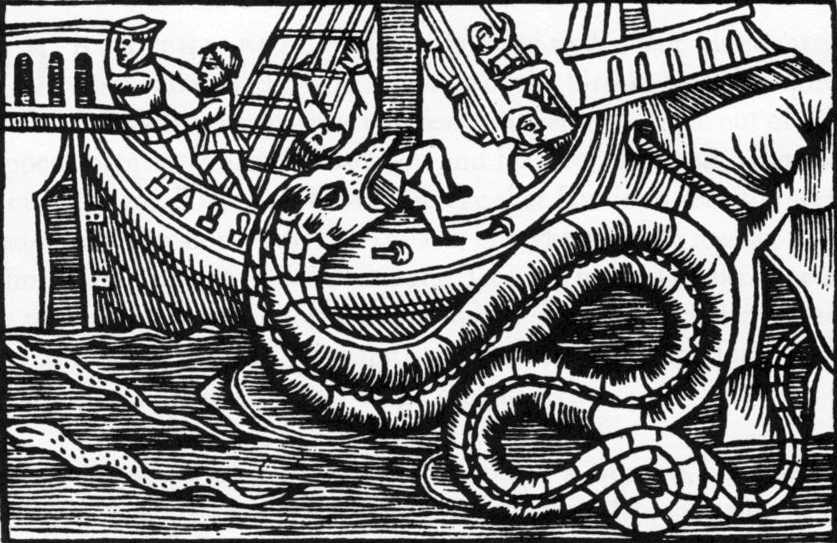
A sea serpent.
―From Magnus, Olaus (1555). History of the Northern Peoples.
Mosaic of a cetus sea serpent of Greek mythology

A sea serpent is a type of sea monster described in various mythologies[1] and religious texts. Famous sea serpents includes: the Mesopotamian Tiamat, Ugaritic Yam and Tannin, Judaic Leviathan and Rahab, ancient Greek Cetus, Echidna, Hydra and Scylla, Vedic Vritra and Surasa, and the Norse Jörmungandr, etc.

Mythology

[edit]

Mediterranean and Western Asia

[edit]

The Drachenkampf mytheme, the chief god in the role of the hero slaying a sea serpent, is widespread both in the ancient Near East and in Indo-European mythology, e.g. Lotan and Hadad, Leviathan and Yahweh, Tiamat and Marduk (see also Labbu, Bašmu, Mušḫuššu), Illuyanka and Tarhunt, Yammu and Baal in the Baal Cycle etc. The Hebrew Bible also has mythological descriptions of large sea creatures as part of creation under Yahweh's command, such as the Tanninim mentioned in Book of Genesis 1:21 and the "great serpent" of Amos 9:3. In the Aeneid, a pair of sea serpents killed Laocoön and his sons when Laocoön argued against bringing the Trojan Horse into Troy. Claudius Aelianus in his work On the Nature of Animals mentions a giant sea centipede, which has a tail that is similar to a crayfish and which moves using numerous feet on each side of its body.[2] Guillaume Rondelet mentions a similar imaginary creature called centipede cetacean in his work L'histoire entière des poissons.[3]

Germanic Scandinavia

[edit]

In Nordic mythology, Jörmungandr (or Midgarðsormr) was a sea serpent or worm so long that it encircled the entire world, Midgard.[4] Sea serpents also appear frequently in later Scandinavian folklore, particularly in that of Norway, such as an account that in 1028 AD, Saint Olaf killed a sea serpent in Valldal in Norway, throwing its body onto the mountain Syltefjellet. Marks on the mountain are associated with the legend.[5][6]

Natural history

[edit]

An apparent eye-witness account is given by Aristotle in his work Historia Animalium on natural history. Strabo makes reference to an eyewitness account of a dead sea creature sighted by Poseidonius on the coast of the northern Levant. He reports the following: "As for the plains, the first, beginning at the sea, is called Macras, or Macra-Plain. Here, as reported by Poseidonius, was seen the fallen dragon, the corpse of which was about a plethrum [30 m or 100 feet] in length, and so bulky that horsemen standing by it on either side could not see one another, and its jaws were large enough to admit a man on horseback, and each flake of its horny scales exceeded an oblong shield in length."[7] The creature was seen sometime between 130 and 51 BC.

Norway, 16th century

[edit]

Swedish ecclesiastic and writer Olaus Magnus included illustrations of sea serpents and other various marine monsters on his illustrated map, the Carta marina. In his 1555 work History of the Northern Peoples, Olaus gives the following description of a Norwegian sea serpent:

Those who sail up along the coast of Norway to trade or to fish, all tell the remarkable story of how a serpent of fearsome size, from 200 feet [60 m] to 400 feet [120 m] long, and 20 feet [6 m] wide, resides in rifts and caves outside Bergen. On bright summer nights this serpent leaves the caves to eat calves, lambs and pigs, or it fares out to the sea and feeds on sea nettles, crabs and similar marine animals. It has ell-long hair hanging from its neck, sharp black scales and flaming red eyes. It attacks vessels, grabs and swallows people, as it lifts itself up like a column from the water.[8][9]

Norwegian Bishop Erik Pontoppidan (1698–1764) did not disbelieve the existence of sea serpents themselves, but doubted they would prey on ships and feed on humans,[10] being more cautious-minded in that respect than Archbishop Olaus (of Uppsala). Nevertheless, a number of reports were made by sailors at the time that sea serpents would destroy ships by wrapping the ship in coils of their body and pulling it underwater. Sailors threatened by a sea serpent were said to have thrown large objects such as paddles or shovels overboard in the path of the serpent, hoping that the serpent would take the object and leave without destroying the ship.[11]

Greenland in 1734

[edit]
Hans Egede's expedition, 1734
Sea serpent seen by Egede, drawn by Bing and reproduced by Henry Lee.
Sea serpent reported by Hans Egede, Bishop of Greenland, in 1734.
―After a sketch by Bing. Reproduced in Lee (1883).[12]
Another reproduction
"The Great Sea Serpent (according to Hans Egede)".
―Engraving c. 1843, signed by artist James Hope Stewart.[13]

Rev. Hans Egede,[a] a Dano-Norwegian clergyman who was an early explorer and surveyor of Greenland, gave an 18th-century description of a sea serpent witnessed by his party. In his journal he wrote:[14][15]

On the 6th of July, 1734, there appeared a very large and frightful sea monster, which raised itself so high out of the water that its head reached above our main-top (top of the mainmast). It had a long, sharp snout, and spouted water like a whale; and very broad flappers. The body seemed to be covered with scales, and the skin was uneven and wrinkled, and the lower part was formed like a snake. After some time the creature plunged backwards into the water, and then turned its tail up above the surface, a whole ship-length from the head. The following evening we had very bad weather" ―translated in Henry Lee (1883).[15]

A giant squid as true identity of Hans Egede's sea-serpent of 1734.

Egede also wrote on the same sea-monster sighting in his book, noting that the beast was spotted at the 64th degree of latitude, and was as thick[16] or "bulky as the Ship, and three or four times as long".[17][18] Egede himself did not supply a sketch in this otherwise well-illustrated book, but the missionary named Bing who was his comrade drew a sketch, which is reproduced in Henry Lee's work.[12]

Bing further described this creature as having reddish eyes, almost burning with fire. This convinced Bishop Pontoppidan that this was different from the type of sea serpent seen by others. From Bing's drawing, Pontoppidan estimated the creature to be considerably shorter than the length of a cable rope, or 100 fathoms (200 m (220 yd)) attested by multiple witnesses, and the pair of fins which were attached "below the waist (Danish: liv)" in Pontoppidan's view, was another unusual feature.[19]

Lee proposed a rational explanation that this sea-serpent was a misapprehended sighting of what was actually the exposed head and one tentacle of a giant squid (Cf. figure above left).[20]

New York exhibition in 1845

[edit]

In 1845, a 35 m (115 ft) long skeleton claimed as belonging to an extinct sea serpent was put on a show in the New York City by Albert C. Koch. The claim was debunked by Prof. Jeffries Wyman, an anatomist who went to see the skeleton for himself. Wyman declared that the skull of the animal had to be mammalian in origin, and that the skeleton was composed of bones of several different animals, including an extinct species of whale.[21]

Portuguese waters, 1848

[edit]
"Supposed Appearance of the Great Sea-Serpent, From H.M.S. Plumper, Sketched by an Officer on Board", Illustrated London News, 14 April 1849

On 6 August 1848 Captain McQuhae of HMS Daedalus and several of his officers and crew (en route to St Helena) saw a sea serpent which was subsequently reported (and debated) in The Times. The vessel sighted what they named as an enormous serpent between the Cape of Good Hope and St Helena. The serpent was witnessed to have been swimming with 1.2 m (4 feet) of its head above the water and they believed that there was another 18 m (60 feet) of the creature in the sea. Captain McQuahoe also said that "[The creature] passed rapidly, but so close under our lee quarter, that had it been a man of my acquaintance I should have easily have recognized his features with the naked eye." According to seven members of the crew, it remained in view for around twenty minutes. Another officer wrote that the creature was more of a lizard than a serpent. Evolutionary biologist Gary J. Galbreath contends that what the crew of Daedalus saw was a sei whale.[22]

A report was published in the Illustrated London News on 14 April 1849 of a sighting of a sea serpent off the Portuguese coast by HMS Plumper.

On the morning of the 31st December, 1848, in lat. 41° 13'N., and long. 12° 31'W., being nearly due west of Oporto, I saw a long black creature with a sharp head, moving slowly, I should think about two knots [3.7 km/h; 2.3 mph] ... its back was about twenty feet [6 m] if not more above water; and its head, as near as I could judge, from six to eight [1.8 to 2.4 m] ...There was something on its back that appeared like a mane, and, as it moved through the water, kept washing about; but before I could examine it more closely, it was too far astern

— "A Naval Officer"[23]

"A giant snake appeared at once from the water - and the largest cetacean a boa constrictor way wrapped twice. (I note such a physeter It can grow to 20-30 meters long!) It lasted for about 15 minutes the deadly struggle, the sea was just foaming and crashing waves around us, finally the back of the whale stood out Out of the water, he sank head first into the deep where the snake must have killed him. A cold shiver ran through us a cet at the sight of his final struggle; so writhing poor in the monster's double ring, like a little bird between the claws of a falcon. View of the two rings, the snake. It could have been 160-170 feet long and 7-8 feet thick."[11]

Natural explanations

[edit]

R.L. France proposed in a 2016 paper for the International Journal of Maritime History that a significant number of sea serpent sightings, including nineteenth century accounts of serpents attacking whales, were due to the misidentification of whales entangled in fishing gear and maritime debris.[24]

In a 2023 article for Fate, Karl Brandt suggested well-known sea serpent sightings could be explained by harpooned sperm whales held fast to their hunters’ overturned rowboats. The boats would accumulate debris at the surface which could stretch for hundreds of yards while appearing to be propelled through the water by unknown means. The theory was supported by the majority of sightings in Norwegian fjords occurring ‘during the summer months of June to August when the whales are most-plentiful’.[25]

Due to their size, elongated bodies, and undulating swimming pattern, Giant oarfish are also presumed to be responsible for some sea serpent sightings.[26]

[edit]

In media

[edit]

See also

[edit]

Explanatory notes

[edit]

References

[edit]
[edit]
Revisions and contributorsEdit on WikipediaRead on Wikipedia
from Grokipedia
A sea serpent is a legendary marine creature depicted in global folklore and historical accounts as an enormous, elongated, snake-like beast inhabiting the deep oceans, often portrayed with a horse-like head, humps along its back, and the ability to coil or undulate through water at high speeds. These mythical entities have been reported in sightings dating back to antiquity, with prominent examples in Scandinavian mythology—such as Olaus Magnus's 16th-century description of the "Great Norway Serpent" or Sea Orm, a terrifying monster said to threaten ships—and in 19th-century New England waters, where the Gloucester Sea Serpent was sighted multiple times between 1817 and 1886, described as 30–100 feet long with a head resembling a snake or horse. In broader cultural contexts, sea serpents appear in ancient Greek literature as unnamed serpentine threats to sailors and in Indigenous North American traditions as water spirits like the horned Gitaskog of Lake Champlain. Modern scholarly analysis attributes most sightings to misidentifications of real animals, including the oarfish (Regalecus glesne), a ribbon-like deep-sea fish reaching up to 36 feet that washes ashore and evokes serpent imagery, or entangled whales and giant squids in combat; statistical studies of reports confirm patterns aligning with such natural phenomena rather than unknown species. Despite cryptozoological interest in undiscovered "super-otters" or primitive seals as candidates, no empirical evidence supports the existence of true sea serpents, positioning them as enduring symbols of human fascination with the sea's mysteries.

Overview

Definition and characteristics

A sea serpent is defined as a legendary marine cryptid, typically portrayed as an enormous, elongated creature resembling a giant snake inhabiting the oceans. The term "sea serpent" entered English usage in the mid-17th century, with its earliest documented appearance in 1646 in the writings of Sir Thomas Browne. Earlier Latin nomenclature, such as "serpens marinus," described similar monstrous sea creatures, as recorded by Norwegian bishop Erik Pontoppidan in his 1752 Natural History of Norway, where he referred to the "Soe Ormen, the Sea-Snake, Serpens Marinus Magnus" as a terrifying oceanic phenomenon. Common characteristics in historical accounts include a serpentine body estimated at 3 to 30 (10 to ) in length, often with a horse-like or snake-like head raised above the surface. Visibility above typically manifests as humps, coils, or arches along the back, with skin described as either scaly or smooth and dark in color. The creature is frequently reported to exhibit rapid undulating movement, propelling itself in a sinuous, wave-like fashion through the , while generally avoiding close proximity to boats but occasionally displaying aggression by rearing up or coiling threateningly. Variations in descriptions highlight typological differences, particularly in 19th-century scholarly analyses. Dutch zoologist A.C. Oudemans, in his 1892 treatise The Great Sea-Serpent, cataloged hundreds of reports and distinguished between "many-humped" types—featuring multiple dorsal arches and slower, more deliberate locomotion—and "single-humped" variants, noted for their streamlined form and swift, agile swimming. These classifications underscore the diversity in eyewitness portrayals, ranging from ponderous, multi-arched forms to more elusive, singularly arched swimmers.

Historical significance

Sea serpent legends profoundly shaped maritime exploration by instilling both fear and a sense of heroic challenge among seafarers. In from the 9th to 13th centuries, tales of encounters with colossal sea serpents, such as the world-encircling , depicted the ocean as a realm fraught with supernatural perils that could summon storms or devour ships, potentially deterring voyages into uncharted waters while inspiring warriors to prove their valor through mythical confrontations. During the Age of Sail in the 16th to 19th centuries, similar European accounts amplified anxieties about transoceanic expeditions, contributing to cautious route selections around reputedly monster-infested regions. The inclusion of sea serpents on medieval and early modern maps underscored their role as symbolic hazards in and , serving to highlight the perils of the unknown seas. The , created around 1300, illustrates serpentine creatures coiling through oceanic voids to represent divine warnings and natural dangers, influencing medieval sailors to favor established trade routes over exploratory deviations into depicted monster territories. By the , ship logbooks frequently documented alleged sightings, such as those recorded by British naval vessels in the Atlantic, which prompted captains to alter courses or increase vigilance, thereby embedding mythological fears into practical and route planning. The late 18th and 19th centuries marked a pivotal transition from to scientific inquiry regarding sea serpents, as accumulated reports spurred organized investigations. Systematic documentation emerged with naturalists like cataloging sightings in the , leading to the forming a committee in 1818 to examine the Gloucester sea serpent observations off , aiming to discern biological reality from exaggeration through eyewitness testimonies and preserved specimens. This effort exemplified a broader Enlightenment shift toward empirical analysis, influencing early marine biology by prompting comparisons to known species like and encouraging global maritime logs to include detailed sketches and measurements. In and communities, sea serpents held deep socio-cultural significance as omens or embodiments of the sea's capricious , guiding rituals and interpretations of fortune. 19th-century American whalers in the Pacific often viewed serpentine sightings as harbingers of poor hauls or storms, leading to superstitions like avoiding certain currents believed to be the creatures' lairs, while in European lore, they symbolized vengeful sea gods requiring offerings to ensure safe returns. These beliefs reinforced communal bonds through shared narratives, transforming potential disasters into moral lessons on respecting the ocean's mysteries.

Mythology and folklore

Ancient Mediterranean and Near Eastern traditions

In ancient Mesopotamian lore, the primordial goddess embodied the chaotic forces of the salt sea and was depicted as a massive serpent or dragon-like creature in the Babylonian epic Enuma Elish, composed around the 18th century BCE. As the mother of a host of monstrous offspring, including venomous serpents with sharp teeth and merciless incisors, Tiamat represented the untamed waters from which the ordered emerged after her defeat by the god , who used her divided body to form the heavens and earth. Greek mythology featured prominent sea serpents such as and , immortal monsters guarding the narrow in Homer's (c. 8th century BCE), where was a multi-headed beast emerging from a cliff to devour sailors, while formed a deadly whirlpool that swallowed ships whole. The , a serpentine monster with regenerative heads and poisonous breath, inhabited the swamps near and was slain by as his second labor, symbolizing the triumph over regenerative chaos in Hesiod's (c. 700 BCE). Roman naturalist , in his Natural History (77 CE), cataloged various sea monsters, including enormous serpents and composite creatures reported by sailors, blending empirical observations with inherited myths to describe them as inhabitants of the deep that challenged human navigation. Biblical texts portray Leviathan as a formidable multi-headed , evoking terror in the (chapters 40–41), where God describes its impenetrable scales, fiery breath, and untamable might to illustrate divine sovereignty over creation. In (e.g., 74:13–14 and 104:26), Leviathan appears as a creature God crushes or plays with, drawing from Canaanite motifs of cosmic combat against chaotic sea forces. These sea serpent traditions carried profound symbolic weight across Mediterranean and Near Eastern cultures, often associating the creatures with primordial chaos subdued by divine order, as in Tiamat's role in or Leviathan's subjugation affirming Yahweh's power. In temple art and texts, such as inscriptions depicting the twisting serpent , they also evoked through connections to life-giving waters and divine punishment, as gods wielded serpents to enforce retribution or renewal. These motifs influenced later lore by providing archetypal images of serpentine adversaries to heroic or divine figures.

European medieval and early modern accounts

In medieval Europe, sea serpent lore intertwined with , portraying these creatures as manifestations of divine judgment or demonic forces, often echoing ancient biblical motifs like the from the . Scandinavian sagas prominently featured such beings, with , the Serpent, depicted as a colossal offspring of the trickster god and the , whose immense body encircled the earthly realm of , holding it in a precarious balance until . This serpentine entity symbolized chaos and the boundary between the human world and the primordial , as detailed in 13th-century compilations like Snorri Sturluson's . Similarly, the 13th-century Norwegian text , or King's Mirror, cataloged North Atlantic monsters, including serpentine forms like the hafstramb—a massive, horned creature resembling a sea ram with elongated, twisting appendages—and other elongated marine horrors that fishermen encountered, blending empirical observation with moral warnings about the perils of the deep. British and contributed vivid accounts of water-dwelling serpents, particularly in Welsh traditions where the afanc emerged as a destructive capable of causing floods by thrashing its massive, - or crocodile-like form, terrorizing communities until subdued by heroes like Hu Gadarn. These tales, rooted in pre-Christian Celtic beliefs but adapted to medieval Christian narratives, emphasized the creature's role in punishing human sin through natural disasters. In Ireland, 12th-century chronicler , in his , recounted sightings of hybrid marine monsters, such as a gigantic with a equine head and serpentine tail that washed ashore, interpreting these as portents of moral decay in the insular wilderness, thereby reinforcing ecclesiastical views of the sea as a realm of . During the , scholars expanded these traditions through and , integrating sea serpents into explorations of the northern seas. Swedish archbishop ' 1555 , a detailed map of and its waters, illustrated the infamous Sea Orm—a enormous, crimson serpent coiling around and capsizing ships off Norway's coast—drawing from sailor testimonies to warn of its predatory habits, such as devouring livestock and vessels in rocky coves. French surgeon , in his 1582 treatise Des monstres et prodiges, examined monstrous marine births, describing aberrant sea creatures like hybrid fish with serpentine features as results of corrupted seeds or divine intervention, complete with illustrations of elongated, scaly forms emerging from oceanic wombs. Theological interpretations further embedded sea serpents in Christian cosmology, viewing them as demonic entities or survivors of the biblical . Jesuit scholar , in his 1665 Mundus Subterraneus, linked subterranean and oceanic serpents to infernal forces, positing that these beasts represented chaotic remnants of Noah's deluge, channeled through volcanic vents and abyssal depths as symbols of Satan's dominion over the waters. Such accounts not only enriched exploration narratives but also served to affirm amid the uncertainties of maritime discovery.

Global indigenous and non-Western lore

In traditions, particularly among the of , are supernatural beings often depicted as large serpentine creatures inhabiting rivers, seas, and caves, serving as kaitiaki (guardians) that protect waterways and their associated communities. These entities can appear as sharks, whales, or giant eels, embodying both benevolent protection and potential danger if disrespected, with oral histories emphasizing their role in guiding voyagers and maintaining ecological balance. Similarly, in Hawaiian mythology, mo'o are reptilian water deities manifesting as giant lizards, dragons, or serpents that guard freshwater sources like ponds, streams, and waterfalls, often shapeshifting to interact with humans and enforcing taboos related to . These beings, detailed in chants and legends, represent ancestral lineages and natural forces, with notable examples including the mo'o chiefess Kihawahine, a deified figure linked to regional chiefly lines. Native American lore features prominent sea serpent motifs, such as the horned serpents in (circa 800–1600 CE), where they appear in artistic representations at sites like as powerful underworld entities with coiled bodies, horns, and sometimes wings, symbolizing water, fertility, and the nocturnal sky. Carvings on shell gorgets and ceramics from depict these serpents as masters of aquatic realms, integral to cosmological narratives involving the afterlife and celestial paths. In Lakota (Sioux) traditions, unktehila (or unktehi) are massive horned water monsters associated with and destruction, portrayed in oral stories as scaly, serpentine beings that once threatened humanity by causing catastrophic inundations. A key narrative recounts unktehila's defeat in a great , petrifying their remains into geological formations like ridges in the and transforming human blood into sacred red pipestone for ceremonial pipes, underscoring themes of survival and spiritual renewal. Asian folklore includes sea serpent variants within broader dragon traditions, such as the in , a hornless, scaled aquatic dragon dwelling in rivers and seas, often linked to floods and rain control as a liminal creature between fish and full dragons. Described in ancient texts like the Shanhaijing, embody chaotic waters but also fertility, evolving over centuries into symbols of transformation and imperial power in coastal lore. In , , the dragon king of the sea, is a serpentine deity ruling oceanic depths from an underwater palace, commanding tides, storms, and marine life through magical tide jewels, as referenced in the (712 CE) where he aids the hero in retrieving a lost fishhook. Portrayed as a colossal dragon or snake with human attributes, reflects reverence for the sea's dual benevolence and peril. African and Oceanic indigenous beliefs feature serpent spirits like in West African vodun and related traditions, depicted as mermaid-like figures entwined with large serpents, embodying water's seductive and healing powers while serving as oracles and protectors of rivers, coasts, and wealth. Originating from indigenous worship blended with Indian and European influences via trade, Mami Wata's iconography—often a woman holding twin snakes—appears in shrines across , , and , where devotees perform rituals for , prosperity, and . In Australian Aboriginal Dreamtime stories, coastal adaptations of the Rainbow Serpent portray it as a rainbow-hued, serpentine creator traversing waterways to shape landscapes, release waters for life, and enforce laws, with variants among and other coastal groups emphasizing its role in forming reefs, rivers, and cycles. These narratives, transmitted orally and in , highlight the serpent's life-giving essence tied to marine and estuarine environments.

Historical sightings

Pre-19th century reports

Reports of sea serpents date back to ancient times, with some of the earliest documented accounts appearing in classical Greek and Roman literature based on observations from sailors and naturalists. In the 4th century BCE, described sea serpents in his Historia Animalium, noting them as a distinct category of serpents adapted to , capable of swimming like eels and sometimes growing to considerable lengths, akin to large land snakes but without feet. These creatures were said to inhabit coastal waters and the open sea, feeding on fish and occasionally emerging near shore. Similarly, in the 1st century CE, compiled eyewitness reports from Roman naval expeditions in his , including accounts of enormous monsters washed ashore in Cadiz with tails up to 24 feet long and rows of teeth, as well as snake-like beasts encountered in the during voyages, described by sailors as having horse-like heads and undulating bodies. During the medieval period, sightings continued to be recorded in monastic chronicles and explorer narratives, often tied to coastal European waters. In the , Irish monks documented encounters with large serpents off the western coasts, attributing them to divine omens or natural wonders in annals that preserved oral reports from fishermen and travelers. By the , Portuguese explorers navigating the Atlantic provided more detailed logs of similar phenomena. The 17th and 18th centuries saw an increase in formalized reports from missionary and naval voyages, often illustrated in personal accounts. In 1734, Danish-Norwegian missionary recorded a prominent sighting off the coast of while aboard his ship; he described a colossal creature, approximately 120 feet long, with a head resembling a horse's, large fins, and a body covered in scales that moved in serpentine waves, observed by Egede, his crew, and passengers over several hours before it submerged. This event was detailed in Egede's 1741 publication Det Gronlands nye Perlustration. These pre-19th century sightings were typically documented through rudimentary methods suited to maritime exploration, including hand-drawn sketches in captains' logs and journals to capture the creature's form for later verification. For instance, Egede's account included a rough of the monster, emphasizing its equine head and finned body. Early printed newspapers also disseminated reports; the London Gazette in the published maritime dispatches from Atlantic voyages that referenced unusual serpentine sightings, such as a 1746 entry noting a "prodigious snake" observed by a merchant ship convoy, helping to circulate eyewitness testimonies among scholars and the public.

19th-century encounters

In the early 19th century, a wave of sea serpent sightings along the U.S. East Coast, particularly in New England, prompted some of the first organized scientific inquiries into such phenomena. Beginning in August 1817, residents of Gloucester Harbor, Massachusetts, reported encounters with a large, serpentine creature estimated at 40 to 100 feet long, featuring a horse-like head and a body marked by humps or coils that undulated through the water. Multiple witnesses, including fishermen and townsfolk, described it surfacing repeatedly over several days, with sightings continuing sporadically through 1818 and into 1820 in nearby areas like Nahant Bay. These reports, documented through affidavits from over 50 observers, led the Linnaean Society of New England to form a committee that investigated the claims, publishing a detailed report classifying the creature as a new species, Scoliophis atlanticus. The publicity surrounding these events drew international attention, culminating in a commission from the French Academy of Sciences in 1818 to examine the sightings, though no definitive evidence was found. Across the Atlantic, Norwegian coastal communities accumulated reports of sea serpents throughout the , building on earlier with more systematic documentation by local naturalists. In the 1840s, sightings in the strait between and described elongated creatures with prominent heads and undulating bodies, often observed by fishermen and sailors during calm weather. Naturalists such as J. A. Schweder and others compiled these accounts, noting patterns in the creatures' appearances near shipping routes and estimating lengths up to 50 feet. These Norwegian cases contributed to broader European interest, influencing compilations like Antoon Cornelis Oudemans' treatise, which cataloged over 180 global sightings, including dozens from Norway, and argued for an unknown marine species. The efforts highlighted emerging tensions between and . One of the most credible 19th-century naval encounters occurred on August 6, 1848, when the crew of the British HMS Daedalus, en route from the , observed a large sea serpent off the South African coast near St. Helena. Captain Peter M'Quhae and several officers, including the and sailing master, watched the creature for about 20 minutes as it swam parallel to the ship at speeds exceeding 12 knots; it was described as approximately 60 feet long, with a brownish body, a head and shoulders rising 4 feet above the water, and white, mane-like appendages along its back. No undulations or fins were visible, and it passed within 150 yards before submerging. The British Admiralty formally investigated the report, publishing M'Quhae's detailed affidavit in , which sparked debates among naturalists like Sir Richard Owen, who proposed it as a misidentified —a theory the captain dismissed. This incident exemplified the era's push for institutional scrutiny of maritime anomalies. Amid genuine reports, hoaxes also fueled public fascination and skepticism. In 1842, showman exhibited the "Feejee Mermaid" at his American Museum in , presenting it as a preserved specimen from the Feejee () Islands, complete with a human-like upper body and tail. Marketed through fabricated scientific endorsements and newspaper articles, the attraction—actually a taxidermied torso sewn to a —drew thousands, inciting debates on authenticity and the boundaries of displays. The ensuing media frenzy, including rival showmen creating copycats, amplified 19th-century discussions on sea serpent legitimacy, underscoring how complicated serious investigations.

20th-century and modern observations

In the early , one of the most credible sea serpent reports came from the British yacht HMS Valhalla on December 7, 1905, during a voyage off the coast of in the South Atlantic. Naturalists Michael J. Nicoll and E.G.B. Meade-Waldo, both fellows of the , observed a large, long-necked creature with a brownish body estimated at 30-40 feet long, swimming with its head and neck raised above the water like a . This sighting, documented in detail by the witnesses, built on 19th-century interest in marine anomalies and was later analyzed as a potential unknown reptile by cryptozoologist . During the 1930s, multiple sightings of sea serpents were reported in the North Sea near the Humber Estuary by fishermen and coastal observers, described as large, humped creatures with horse-like heads. These reports, part of a regional spate, were often later attributed to misidentified whales or sharks. During the 1910s, Pacific expeditions yielded several reports of serpentine creatures along the North American coast, particularly associated with the cryptid known as or "" in waters. In 1912, whalers off described a 30-foot-long, horse-headed serpent with undulating humps pursuing their vessel, a pattern echoed in indigenous and Haida oral traditions of similar marine beings. These accounts, often from experienced sailors, contributed to ongoing speculation about large unidentified marine animals in the region, with over 200 cumulative sightings recorded by mid-century. Mid-20th-century observations included wartime naval encounters. U.S. Navy logs from the era occasionally noted "sea monsters" amid heightened patrols, though details were often classified or dismissed as optical illusions under combat stress. In the , Scandinavian coastal waters saw a cluster of long-necked sea serpent reports, including multiple 1961 sightings off Norway's Islands described in Heuvelmans' analysis as consistent with a primitive or , featuring a dark, eel-like body up to 50 feet long with a pale underbelly. Late 20th-century incidents highlighted potential misidentifications, such as a 1996 sighting off Scotland's where fishermen reported a 20-foot-long, finned serpent that experts later attributed to a (Cetorhinus maximus) based on its elongated, pale form and gill slits. Into the , (Regalecus glesne) strandings have reignited sea serpent lore, particularly in where the species is known as "ryugu no tsukai" or "messenger from the sea god's palace," believed to herald disasters. Between 2013 and 2023, notable events included a 14-foot specimen washing ashore in Toyama Bay in 2019, following a series of strandings in 2014 and 2017 that locals linked to impending earthquakes, though scientific analysis confirmed natural deep-sea migrations. At least a dozen such incidents occurred along Japanese coasts during this period, often documented by marine biologists and fueling cultural interpretations of serpentine omens. Modern has systematized these reports through ' influential 1968 classification in In the Wake of the Sea-Serpents, which categorized sea serpents into nine types—such as the long-necked (plesiosaur-like), many-humped, and super-otter—based on over 400 historical accounts, emphasizing anatomical consistency across sightings. Contemporary efforts include digital databases tracking marine anomalies, like the ' 2019 compilation of 1,688 global reports for paleontological analysis, and regional logs such as John Kirk's database, which has cataloged over 300 sightings since 1934, incorporating witness sketches and GPS data. These resources, akin to UFO tracking systems, facilitate without endorsing claims.

Scientific explanations

Biological misidentifications

One of the primary biological explanations for sea serpent sightings involves misidentifications of known marine species whose unusual appearances or behaviors mimic the elongated, forms described in eyewitness accounts. These errors often occur when deep-sea or rarely seen animals surface due to illness, injury, or environmental changes, leading observers—particularly sailors or coastal dwellers—to interpret them as mythical creatures. The (Regalecus glesne), a deep-water lampriform , exemplifies such misidentifications due to its ribbon-like body that can reach lengths of up to 11 meters, covered in reflective silver scales that shimmer in light. It propels itself through undulating movements of its long , creating a snake-like motion that has inspired sea serpent legends across cultures. Strandings of , which bring these elusive creatures to shore, have coincided with reports of serpentine monsters; for instance, two specimens washed ashore in , in August and November 2024, prompting renewed speculation about sea serpent sightings and folklore associations like the Japanese "doomsday fish." Such events are often linked to oceanographic shifts like El Niño patterns rather than seismic activity, further explaining their sporadic appearances. Giant squid (Architeuthis dux), massive cephalopods inhabiting depths of 300 to 1,000 meters, have also been mistaken for sea serpents, particularly when their long tentacles—extending up to 10 meters—are visible above the surface as a "neck" or serpentine body during struggles with predators or when dying. In the 19th century, washed-up carcasses fueled monster tales; a notable example is the 1857 specimen captured off Denmark, where Danish naturalist Japetus Steenstrup analyzed beached remains and linked them to historical accounts of tentacled sea monsters, helping to demystify some folklore. These deep-sea dwellers rarely surface intact, but partial sightings of their flexible arms thrashing could easily evoke a multi-headed or elongated serpent. Basking sharks (Cetorhinus maximus), the second-largest fish species reaching up to 8 meters, contribute to misidentifications through their slow, surface-swimming posture, where the tall and wide-open mouth—resembling a gaping maw—project a monstrous head from afar. Decomposing carcasses often wash ashore with elongated, rotting bodies that amplify the illusion of a serpentine form. In the 1800s, multiple cases in the involved such remains or live sightings interpreted as sea serpents, including a 1868 Eastport incident where a 10-meter specimen was killed and initially described as a finned monster before identification. Groups of basking sharks swimming in line can further mimic a multi-humped serpent undulating across the water. Other marine animals have occasionally been misidentified as sea serpents due to their shapes in specific contexts. Large eels like the (Conger conger), which can grow to 3 meters with a snake-like body, may appear serpentine when surfacing aggressively or in distress. Seals, particularly when viewed in choppy surf where their arched necks and heads bob rhythmically, have been reported as small serpents or "long-necked" variants in coastal sightings. Whale sharks (Rhincodon typus), the largest fish at up to 12 meters, present eerie silhouettes against the horizon, with their broad mouths and slow cruising evoking a lurking in low visibility. In the North Sea, historical reports from the 1930s near the Humber Estuary, such as the August 1936 sighting off Grimsby described as a 10-foot creature with mottled black and grey skin, were later identified as a young whale that washed ashore, exemplifying how whales and sharks are often mistaken for serpents in the region. These examples highlight how ordinary , viewed under fleeting or unusual conditions, perpetuates sea serpent lore without requiring extraordinary creatures.

Environmental and perceptual factors

Optical illusions, particularly s, have been proposed as explanations for many historical sea serpent sightings by distorting distant objects into serpentine forms. A superior known as Fata Morgana occurs when temperature inversions bend light rays, creating elongated, stacked images of ships, icebergs, or landmasses that appear to undulate like a creature's body above the horizon. In northern waters, such as those described in the 13th-century Norwegian text King's Mirror, these s magnified and distorted marine features like orcas or floating ice into apparent "hafstramb" (sea monsters), matching eyewitness accounts through computer simulations and photographic evidence. in calm seas can similarly amplify distant objects, making them seem closer and more elongated, contributing to the illusion of a pursuing serpent. Environmental phenomena unrelated to living organisms also contribute to misperceptions. Floating debris, such as logs, ropes, or mats of tossed by waves, can form sinuous shapes that resemble coiled bodies from a ship's deck, especially in rough conditions where details are obscured. An 1857 sighting off , initially reported as a sea serpent, has been reinterpreted as a cetacean entangled in maritime debris, creating an undulating line on the water's surface. At night, bioluminescent disturbed by a vessel's wake produce glowing trails that mimic a luminous serpent gliding alongside, a effect amplified in dark, phosphorescent seas common to tropical and temperate oceans. In the North Sea, foggy and wavy conditions frequently lead to misidentifications among fishermen, oil rig workers, and sailors, where poor visibility and choppy waves distort distant animals, making them appear bizarre or serpentine. Unusual behaviors of marine life in low light further contribute to these perceptual errors. Modern videos purporting to show sea serpents in the region are often hoaxes, CGI fabrications, or misidentified known animals. The absence of scientific evidence for unknown large creatures in the North Sea is attributable to its heavy shipping traffic and extensive marine research, which would likely detect any significant undiscovered species. Perceptual psychology plays a key role in interpreting ambiguous maritime visuals as monsters. , the brain's tendency to impose familiar patterns on vague stimuli like wave patterns or shadows, leads observers—often fatigued sailors—to perceive serpentine forms in random ocean features. This is exacerbated by cultural priming, where exposure to and recent discoveries biases witnesses toward serpentine interpretations; for instance, 19th-century reports surged after finds, shifting descriptions from simple serpents to long-necked beasts. Stress from long voyages or storms further heightens suggestibility, turning neutral observations into alarming encounters. Historical examples illustrate these factors. In 1734, missionary reported a "most dreadful monster" off Greenland's coast—a scaly, snakelike form with a protruding —likely a Fata Morgana mirage distorting a distant or feature under inversion layers. Similarly, the 1848 HMS Daedalus sighting of an enormous serpent in the South Atlantic occurred in dark, cloudy weather with a strong swell and calm seas beforehand, where heat and light distortions combined with low visibility could have warped a floating object into an elongated .

Cultural impact

Representations in literature and art

Sea serpents have long captivated artists and writers, appearing as symbols of the unknown depths in various cultural expressions. In early literature, Jules Verne's 1870 novel Twenty Thousand Leagues Under the Sea portrays a colossal sea creature initially mistaken for a serpent-like monster, ultimately revealed as a , blending scientific speculation with mythical terror. Similarly, Hans Christian Andersen's 1866 fairy tale "The Great Sea Serpent" features a humble mistaking the for an enormous serpent, satirizing human fears of technological intrusions into the oceanic realm. Visual representations in art further immortalized these creatures, often as embellishments evoking peril and wonder. Sixteenth-century woodcuts in bestiaries, such as those in Sebastian Münster's Cosmographia (1544), illustrated elongated sea serpents coiling through waves alongside documented marine animals, serving both educational and decorative purposes in early natural histories. By the nineteenth century, painters like John William Waterhouse drew on siren lore—frequently intertwined with serpentine imagery—to depict alluring yet dangerous marine beings, as seen in his 1900 work A Mermaid, where the figure's ethereal form hints at the seductive peril of sea myths. Twentieth-century literature expanded sea serpent motifs into realms of cosmic dread and existential symbolism. H.P. Lovecraft's Cthulhu Mythos incorporates serpentine entities, such as Yig, the father of serpents, as ancient, oceanic horrors that underscore humanity's insignificance against primordial forces. Earlier parallels appear in Herman Melville's 1851 Moby-Dick, where the white whale embodies sea serpent archetypes, representing an inscrutable, monstrous power that defies human comprehension and control. Symbolically, sea serpents adorned and , signifying guardianship and the perils of . In Scottish coats of arms, serpents—often rendered as aquatic variants—symbolize and vigilance, as in clan crests like that of the Huttons featuring a serpent emerging from clouds. On historical maps, such as Olaus Magnus's (1539), coiling sea serpents served as decorative warnings of uncharted dangers, enhancing the maps' narrative of exploration and fear. In cinema, sea serpents and related sea monsters have been portrayed as formidable antagonists, often drawing from maritime folklore to heighten tension during naval encounters. The 1954 Disney live-action adaptation of Jules Verne's 20,000 Leagues Under the Sea, directed by , features a climactic battle with a massive that attacks the submarine , symbolizing the perils of the deep and evoking sea serpent myths through its colossal, writhing form. This depiction, achieved with pioneering practical effects, influenced subsequent underwater adventure films by blending scientific fiction with monstrous spectacle. The Pirates of the Caribbean franchise, launched with the 2003 film The Curse of the Black Pearl and directed by Gore Verbinski, escalated sea monster portrayals in later installments, particularly with the Kraken—a gigantic, tentacled leviathan controlled by the villain Davy Jones—in Dead Man's Chest (2006). This creature, resembling a serpentine behemoth in its coiling attacks on ships, serves as a harbinger of doom in the series' supernatural pirate lore, blending historical piracy with cryptozoological elements. The Kraken's design, inspired by Norse sea monster legends, underscores themes of inescapable oceanic terror across the five-film saga. Television and animation have frequently incorporated sea serpents for comedic or exploratory purposes, embedding them in underwater worlds that parody human fears of the unknown. In the Nickelodeon series , episodes such as "SpongeGuard on Duty" (Season 3, 2002) introduce a towering that terrorizes Goo Lagoon beachgoers, portrayed as a hulking, figure to satirize heroism and beach . Compilations of the show's sea monster encounters, including eel-like and serpentine creatures in various adventures, highlight the franchise's playful take on marine , amassing millions of views on official channels. Pseudo-documentaries on cable networks have blurred the lines between fact and fiction, fueling public interest in sea serpents through narratives tied to broader sea creature myths. Animal Planet's 2012 mockumentary Mermaids: The Body Found, presented as speculative evidence of aquatic humanoids, indirectly evoked sea serpent lore by depicting elusive ocean beings evading detection, drawing approximately 2 million viewers on premiere. Its 2013 sequel, Mermaids: The New Evidence, amplified these themes with fabricated footage of large marine anomalies and drew 3.6 million viewers, linking sightings to historical reports of serpentine entities in global waters; the U.S. issued a debunking statement. Video games have integrated sea serpents as dynamic challenges in open-world maritime settings, enhancing player immersion through interactive encounters. The 2018 multiplayer adventure Sea of Thieves, developed by Rare, pits players against the —a massive, serpentine with coiling tentacles that emerges from the depths to drag ships underwater—introduced in the Forsaken Shores update as a core environmental hazard. This creature, designed with procedural animations for unpredictable battles, draws from sea serpent traditions to create tense, cooperative moments amid pirate voyages. Cryptozoology-focused documentaries on Animal Planet during the 2000s further popularized sea serpents by dramatizing alleged sightings and investigations. The series Lost Tapes (2008–2010), a found-footage anthology, explored cryptids including oceanic horrors like the Kraken, with episodes simulating perilous expeditions and eyewitness accounts to evoke real-world mystery. Similarly, River Monsters (2009–2017), hosted by Jeremy Wade, delved into elongated freshwater and coastal predators mistaken for serpents, such as giant eels and catfish, using scientific analysis to debunk myths while heightening dramatic reenactments of attacks. In contemporary digital media, sea serpent portrayals have surged through user-generated content and genre evolutions, reflecting modern anxieties about the oceans. On TikTok, viral videos from the 2020s—such as those claiming "giant sea monster" sightings off coastal waters, often featuring edited footage of whales or debris—have garnered billions of views collectively, perpetuating hoax traditions and sparking debates on marine misidentifications. These clips, amplified by algorithms, tie into eco-horror trends where sea serpents symbolize climate-induced mutations. Recent examples include the 2024 PBS Nature episode "Is This North American Sea Serpent Real or a Hoax?", which examines Cadborosaurus sightings in the Pacific Northwest, and the 2025 animated film Rufus – The Sea Serpent Who Couldn't Swim, a family adventure about a young serpent learning to navigate oceanic perils.

References

Add your contribution
Related Hubs
User Avatar
No comments yet.