Hubbry Logo
Freedom PlanetFreedom PlanetMain
Open search
Freedom Planet
Community hub
Freedom Planet
logo
8 pages, 0 posts
0 subscribers
Be the first to start a discussion here.
Freedom Planet
Freedom Planet
from Wikipedia

Freedom Planet
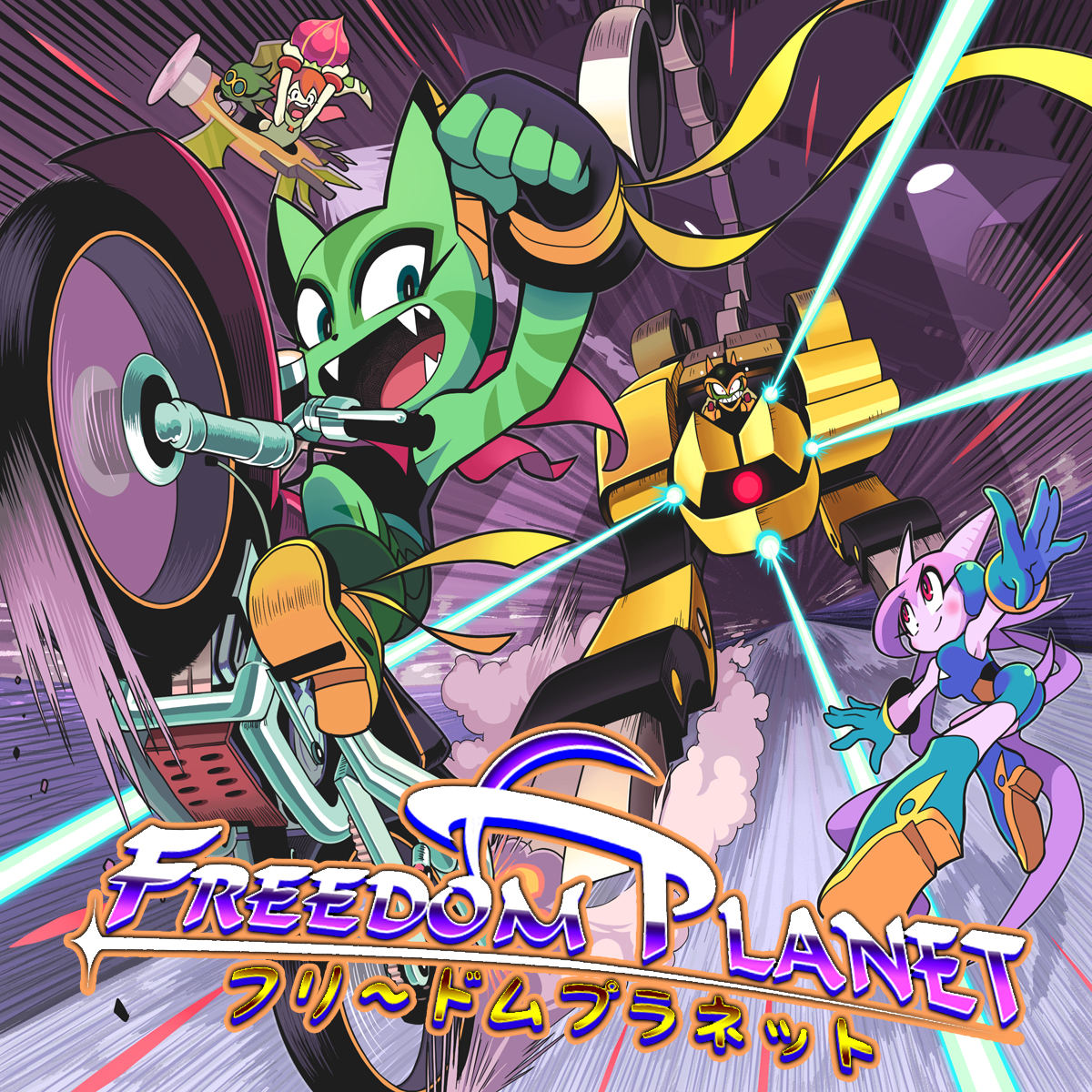
A cartoon cat is popping a wheelie on a motorcycle, with a slightly reptilian cartoon character running behind her. They are chased by a robotic vehicle that shoots laser beams.
DeveloperGalaxyTrail
PublisherGalaxyTrail
Xseed Games (consoles)
DirectorSabrina DiDuro
DesignerSabrina DiDuro
ProgrammerSabrina DiDuro
WritersSabrina DiDuro
Edwyn Tiong
(based on Sonic the Hedgehog by Yuji Naka, Naoto Ohshima, and Hirokazu Yasuhara)
Composers
  • Sabrina DiDuro
  • Leila Wilson
  • Claire Ellis
SeriesFreedom Planet
EngineClickteam Fusion
Platforms
ReleaseWindows
  • WW: July 21, 2014
OS X, Linux
  • WW: April 17, 2015
Wii U
  • NA: October 1, 2015
  • EU: October 29, 2015
PlayStation 4
  • NA: March 21, 2017
  • EU: August 25, 2017
  • JP: August 29, 2018
Nintendo Switch
  • WW: August 30, 2018
GenrePlatform
ModeSingle-player

Freedom Planet is a 2014 platform video game developed and published by GalaxyTrail. The player controls one of three anthropomorphic animal protagonists: the dragon girl Lilac, the wildcat Carol, or the basset hound Milla. Aided by a duck-like alien named Torque, the girls attempt to defeat the evil Lord Brevon, who plans to steal the Kingdom Stone and conquer the galaxy. While the game focuses on fast-paced platforming, its levels are interspersed with slower action scenes.

Game director Sabrina DiDuro (a.k.a. Strife) first began developing Freedom Planet as a Sonic the Hedgehog fangame using characters created by DeviantArt user Ziyo Ling for its main cast. Early into development, she lost interest in creating a derivative work and reconceived the project as her own intellectual property. Sash Lilac, originally a hedgehog, became a dragon; antagonist Doctor Eggman was replaced by Lord Brevon with his eyebrows resembling Doctor Eggman's mustache; and the Sonic series' ring-based health system was abandoned. Further changes were suggested by fans and incorporated throughout development. Freedom Planet was developed in Denmark and the United States, with its art direction carrying East Asian influences, such as medieval Chinese art inspiring its background visuals.

With development focused on the Windows platform, the game started out as a demo first released in August 2012 and was, after a successful Kickstarter campaign, released in its entirety via Steam in July 2014. Freedom Planet was later released for the Wii U in October 2015, for the PlayStation 4 in 2017, and for the Nintendo Switch in August 2018. The game received largely positive reviews; critics praised its gameplay, visuals, music, aesthetics, sense of humor and balance of Sonic elements with original content, but were mixed on its pacing, voice acting, story and the abundance of long cutscenes.

A sequel, Freedom Planet 2, was released in September 2022 for Windows. Ports for the Nintendo Switch, PlayStation 4, PlayStation 5, Xbox One and Xbox Series X/S, followed in April 2024.

Gameplay

[edit]
Milla in the "Aqua Tunnel" level. Her health, represented by red leaves, is partially depleted. Leaves that can be collected are visible.

Freedom Planet is a 2D platform game.[1] The player directs one of three characters—Lilac, Carol, or Milla—to run and jump through levels and destroy robotic enemies. Levels contain obstacles such as corkscrews,[2] loop-the-loops,[3] hills, ramps, and rock walls.[4] The player fights a miniboss in the middle of each level[5] and a main boss at the end, after which the story is advanced by cutscenes.[6] Because of its aesthetics, level design, and fast-paced gameplay, Freedom Planet has been compared to the Sonic the Hedgehog games released for the Sega Genesis in the early 1990s.[1][2][3][4][7]

Unlike in Sonic, the player character has a hit point meter instead of a ring-based health system.[2] To refill this meter, the player collects red leaves dropped by enemies and scattered throughout levels.[8] Lilac's and Carol's maximum health are seven leaves, Milla's is four. Being hit by enemies' and bosses' attacks reduces the character's health, and a life is deducted when no health remains. If all lives are lost, a game over screen appears, but the player may freely restart from the last checkpoint. Extra lives can be found within levels, as can shield and invincibility-type power-ups.[9]

Lilac fights one of the game's bosses, the Robopanther, while Carol assists her with attacks and Milla with extra health.

Each of the playable characters make use of an "attack" and "special" button.[3] Lilac and Carol both make use of an energy gauge on the heads-up display, which recharges on its own and limits the use of their special moves. The gauge can be recharged quicker by collecting crystals and keystones.

Lilac's basic attacks consist of strong but sluggish hair whips, an uppercut into the air, a crouching kick, and a dive kick from midair. The Dragon Cyclone, used by pressing jump midair, lets Lilac spin like a spinning top and deal touch damage, but also acts as a double jump with reduced gravity. Pressing the special button with a full energy gauge activates the Dragon Boost, an eight-directional air dash[2] that deals heavy touch damage and makes her temporarily invincible.

Carol regularly attacks with a cycle of three fast but weak punches, which is changed into a single strong claw attack while rolling or pouncing. The pounce acts as Carol's double jump, slightly moving her forward. Her special attack is a series of rapid kicks which steadily consume a fifth of the energy gauge and give her invincibility. Collecting a fuel tank mid-stage allows her to change into a "motorcycle mode", where her top speed is increased and her acceleration doubled. During "motorcycle mode", the double jump becomes a rolling attack and gets the same properties as Lilac's cyclone move. Pressing "special" on-ground triggers a nitro boost that consumes energy. For vertical mobility, regular Carol is capable of doing a wall jump, "motorcycle mode" Carol can ride up walls. Another set piece only Carol can interact with properly are jump pads, which are placed in a set order and lead to alternating paths by jumping off of them in succession.

Milla, who does not have an energy gauge, can create a cube of energy by holding down the attack button, which she can then throw at enemies. Holding down the special button lets her pull out her shield that can reflect projectiles.[9] Pressing "special" while holding a cube lets Milla use the Super Shield Burst, a strong mid-range beam which pushes Milla in the opposite direction. Milla can fly for a short time while holding the jump button midair by flapping her ears like wings.[10] Milla is considered to be the hardest to play as, since she only has 6 life petals and even though she could heavily damage an enemy by throwing a cube or reflect projectiles, it would always take some time before she could summon an energy block again.

The player may complete the game in either the "Adventure" mode with all cutscenes or "Classic" mode, which omits them[6] In Adventure mode, upon first starting the game, players are only given the option to select from either Lilac or Carol after a cutscene, in which the two temporarily split up.[9] Milla is unlocked by clearing the second stage, Relic Maze, as either Lilac or Carol. Once a stage been cleared for the first time, it is unlocked in the character's time attack mode, wherein the player tries to finish the level in the fastest possible time.[6] Players earn achievements by accomplishing certain goals, such as completing the game as a character or defeating an end boss with a special move.[9]

Plot

[edit]
General Gong and Neera Li, were initially unimpressed by Carol and Lilac's claims of a planned theft of the King's Stone.

The game begins as Sash Lilac and Carol Tea—an anthropomorphic dragon and wildcat —rescue a duck-billed creature named Torque after his spacecraft crash lands. At Torque's request, the three set out to protect a powerful relic called the Kingdom Stone. This involves them in a conflict between three nations on their planet: Shuigang, a country militarized by its new king, Dail; Shang Mu, led by the wealth-obsessed Mayor Zao (/ˈz/ or /ˈʒ/); and Shang Tu, whose Royal Magister is unprepared for war.[11] Lilac and Carol rush to the Kingdom Stone's shrine but are waylaid by the Shang Tu officers General Gong and Neera Li, who doubt that the Stone is threatened. The protagonists arrive just as the Stone is stolen by Spade, a henchman hired by Zao. After the shrine collapses, Carol is separated from Lilac and pinned by rubble, but gets saved by the timid basset hound Milla (/ˈmlə/) Basset.

That night, Torque tells Lilac, Carol, and Milla that he is an alien sent to apprehend the intergalactic warlord Arktivus Brevon, whose spacecraft wrecked on the planet. Brevon has invaded Shuigang, murdered its king, and brainwashed prince Dail to be his servant. He intends to steal the Stone to power his ship. The protagonists decide to reclaim the Stone from Zao, but they are accosted en route by Spade and Brevon's general, Serpentine. In a conversation with Spade, it's revealed that he secretly worked for his half-brother Dail all along. Talking to Spade soon falls short as the group is suddenly attacked by Serpentine using one of his mechs. The delays given by the chase give Dail and Brevon's forces time to steal the relic.

Afterward, Zao sends the protagonists as emissaries to Shang Tu to discuss an alliance against Shuigang. Traveling by airship, the team gets ambushed by Shuigang's sky battalion, and they crash into a river leading to Shang Tu. Arriving at the palace, they are detained by the Magister, as Neera accuses them of trying to cover up Zao's crimes. After an unsuccessful attempt of Milla to break out of jail, Torque is acquitted when Lilac falsely pleads guilty. Lilac, Carol, and Milla quickly break out together to reunite with Torque, only to see him captured by Brevon and Serpentine. Carol quarrels with Lilac and storms off. Lilac sends Milla to find her and then goes to save Torque from Brevon's nearby base, but she is captured and tortured by Brevon. Meanwhile, Carol and Milla ally with Spade to storm the base, where they rescue Torque and Lilac. They are all separated in the ensuing conflict. Neera finds Lilac, arrests her, and brings her back to Shang Tu, where the Magister determines that she is innocent and sends her on a mission to recover an artifact containing information about the Kingdom Stone and their history in return of clearing her name.

Afterwards, the Magister reveals that Zao has challenged Shuigang for the Stone. Lilac rejoins her friends and convinces Shang Mu and Shang Tu to unite against Dail and Brevon's army. During the battle, Brevon announces that his ship is repaired, and Lilac, Milla, and Carol board it. The team combats Brevon's minions, including his AI assistant, Syntax, and a mutated Serpentine. Brevon captures Milla and turns her into a grotesque monster that attacks the other protagonists, who are forced to render her unconscious. Enraged, Lilac and Carol attack and defeat Brevon, but the Kingdom Stone is destroyed and he escapes. Shortly after the battle, Milla awakens in a medical tent, and everyone sees the sky lit up by swirling, crystalline energy released from the Kingdom Stone. The realization of the Kingdom Stone persisting in a different form brought an end to the war. Once Milla has fully recovered, Torque says goodbye to the girls and returns to space, with the promise that he will one day meet them again.[11]

Development

[edit]

Freedom Planet was conceived in late 2011 by American game designer and programmer Sabrina DiDuro, who had just founded the independent developer GalaxyTrail Games a few years prior. Using the Multimedia Fusion 2 engine, the game was intended to be a small Flash game to "hone [her] skills as a game designer" but quickly grew to become a full indie game set in an original universe.[12] After struggling to find a fitting name for the game, it was made up of the first two words that came in DiDuro's mind, "freedom" and "planet".

Freedom Planet originally began as a direct homage to Sonic. ... As work on the game continued, I felt more and more like it was becoming a waste of time because I was ultimately creating [sic] something in the shadow of an established franchise and that it would never truly be my own work. So, I set out to try and design a main character that would pay homage to my main source of inspiration while still being unique enough to stand out on her own.

— Sabrina DiDuro[8]

Before becoming its own intellectual property, the game started off as a Sonic fangame; a version of the game only seen in early footage show rings and Doctor Eggman as the game's main antagonist. Early on, DiDuro had decided that the Sonic affiliation would hold back the game. By the time of the first publicly released demo, the rings were replaced with red leaves and the characters' abilities were altered.[8] Charging energy for special moves was dependent on Lilac's movement speed was changed to be generating gradually instead as it proved too difficult to control.[13] The physics and controls were also tweaked to be more responsive and tight; running up walls was made easier and jumps were less floaty to allow player to dodge enemy attacks more easily. While the game retained the "speed platform gameplay", it took it in a different direction by introducing combat mechanics based on one of Strife's earlier Sonic fan projects. According to DiDuro, instead of jumping on robots to destroy them, the players fight them with punches, kicks, and special attacks.[12]

In an interview, DiDuro described Freedom Planet as "a nod to '90s-style Japanese platform games, like Sonic, Mega Man, and a little bit of Gunstar Heroes".[14] Lilac's Dragon Boost is based on a game mechanic from Ristar, where the titular character slams its body against enemies similarly. Carol's Wild Kick ability resembles Chun-Li's signature special attack, and her wall kick feels similar to the one found in the Mega Man X games for SNES. Milla's floating ability as well as the ability to pick up items are based on Yoshi's flutter jump and Super Mario 2's throwing mechanics respectively.[14][15]

A shaggy-haired alien in a pilot's uniform strikes a serious pose.
Torque
A villainous alien with giant eyebrows and a suit of armor stares menacingly at the camera.
Brevon
Concept art by DiDuro

While the game was developed in Denmark and the United States,[16] its art direction was influenced by medieval East Asian art,[6][10] particularly that of China.[5] The game's visuals reference modern science fiction and fantasy as well.[6] Much of the text in the game world is written in Chinese characters, and the logo includes a subtitle written in Japanese katakana, Furīdamu Puranetto (フリーダム・プラネット), despite the game originally lacking Japanese language support.[10]

DiDuro's first attempt to design her own protagonist for the game was unsuccessful. Browsing on the art website DeviantArt, she soon discovered Chinese artist Ziyo Ling, requesting and getting permission to use her characters Sash Lilac, followed by Carol Tea and Milla, for her game.[8] Lilac, originally conceived as a hedgehog, was redesigned to be a dragon after criticism about her similar looks to Sonic were made. The design of Robotnik's replacement Lord Brevon, originally named Dr. Brevon, was inspired by Dr. Sloth, one of DiDuro's favorite characters from Neopets.

The soundtrack was composed by DiDuro in collaboration with Leila "Woofle" Wilson and Claire "Blue Warrior" Ellis,[7][13] the latter having contributed to two of the game's tracks before leaving the project. DiDuro would often provide a base composition in MIDI format, with Woofle creating the final arrangement, but also create additional compositions. Voice actor Dawn M. Bennett, the voice of Lilac, provided voice samples for the tracks Relic Maze 1 and Pangu Lagoon 1 respectively. There were disagreements on the direction of the soundtrack sometimes, with DiDuro wanting "fast-paced and in-your-face from the get-go" while Woofle aimed for more "fly-by-night"; starting "quieter and more happy" and progressively getting intense. Woofle mentioned the track Sky Battalion to have been the hardest thing to compose, stating that it was "the low point in [her] entire career", it wasn't a song that she felt was "appropriate for the game". Regardless, Woofle described DiDuro as "a great musician and (...) easy to collab with".[17]

Post-release, the game received updates, such as an update in December 2015 that made Milla accessible in Adventure mode.[18] Updates to make Torque and Spade playable characters were planned for release in 2016 but have been postponed to focus on the sequel. Another reason, according to DiDuro, were her displeasure with the way Torque felt in the existing stages.[19]

Release

[edit]

Freedom Planet was first released as a demo for Microsoft Windows in August 2012, to positive reception.[2][4][7] After a full version of the game was funded through Kickstarter, it was taken to Steam Greenlight and approved for Steam.[20] Its release was first projected for early 2014,[7] then delayed to June 30.[5] Shortly before that date, it was delayed again to July 19; the developers wanted to promote the game at a convention in Miami, Florida, and to avoid competition from the heavily discounted products in Steam's Summer Sale.[21] The game was released, after a third delay, on July 21, since Steam didn't allow games to be released on weekends.[22] Coinciding with the game's release, GalaxyTrail released Freedom Planet - Official Soundtrack, a digital version of the soundtrack, as DLC.[23]

To advertise the game, GalaxyTrail created branded T-shirts,[20] and Lilac was included as an easter egg in the 2013 game Sonic: After the Sequel.[13] DiDuro considered and rejected the idea of developing an Android version of Freedom Planet, but stated to be saving money to port the game to the PlayStation Vita.[13] The game was released on the website GOG.com in late 2014.[24] GalaxyTrail also developed versions for Mac OS X and Linux, which were released on Steam on April 17, 2015.[25]

A Nintendo's Wii U version was planned for release on the eShop online store for late 2015,[26][27] later specified as August 13.[28] A demo was released as part of a promotion titled "Nindies@home", wherein players were invited to try several upcoming Wii U games between June 15 and 22.[29] While it was still in production during the summer,[28] the projected release date was delayed; the Wii U version was set back by a "console-freezing bug", which would postpone the Wii U release indefinitely until the issue was fixed.[30] DiDuro later explained that the bug had taken so long to detect because it only occurred in retail versions of the console, preventing GalaxyTrail and Nintendo from learning of the issue. The bug required a hard reset of the system to address the problem, which could potentially cause damage to the Wii U hardware.[31] The bug was eventually fixed, and the game was successfully released on the eShop on October 1; customers who had tried the game's demo were rewarded with a 15-percent discount.[32] On the American Nintendo eShop, Freedom Planet was a best-seller, peaking at the 2nd spot, right behind Super Mario Maker.[33]

In November 2015, GalaxyTrail joined forces with the subscription box company IndieBox distribute an exclusive physical release of Freedom Planet. This limited collector's edition box included a flash-drive with a DRM-free game file, the official two-disc soundtrack, an instruction manual and Steam key, along with various custom-designed collectibles.[34][35] Steam and Wii U versions of Freedom Planet combined have sold over 250,000 times as of June 2016.[36]

A version for the Nintendo Switch was released by Marvelous Inc. and Xseed Games on August 30, 2018.[37][38] Quality of life updates present in the Switch version as well as the newly added language options were released for the remaining versions soon after.[39] In 2019, GalaxyTrail teamed up with Limited Run Games to distribute a physical release of the Switch version. Switch Limited Run #35: Freedom Planet and Freedom Planet Deluxe Edition, which includes a cover with interior art and full-color booklet, were up for pre-order. The Deluxe Edition also includes the two-disc soundtrack, a reversible poster, as well as a Genesis-style case.[40][41]

Reception

[edit]

Pre-release

[edit]

Tony Ponce of Destructoid reacted positively about the demo for Freedom Planet and commented that it was "nice to see a well-established style or formula applied to a new world with original characters".[4] Similarly, Eurogamer's Jeffrey Matulef described the game's preview as "an indie Sonic-esque platformer done right", and enjoyed the redesigned health system.[2] Dominic Tarison of IndieStatik complimented the game's "new and unfamiliar configuration" of elements from classic 16-bit games, but criticized the amount of viewable gameplay area.[5] John Polson of IndieGames.com believed that "the spectacles like loops and wall runs ... [are not] as magical to do or watch" as in Sonic games, but he encouraged platformer fans to download the demo.[7]

Nathan Grayson of Kotaku praised the demo for its balance of Genesis Sonic elements and original content: he described the product as "a love letter to classic Sonic, except when it's not". He praised the game's enemies, but experienced minor control issues. Pacing was remarked to be slower than that of the Genesis Sonic games because of the added combat sequences, though Grayson felt that this gave the player time to explore and appreciate the level design. Grayson was critical of the voice acting.[3] Ponce strongly praised the visuals, though criticized the bland foreground design.[4] Polson noted minor audio and visual flaws, most notably the recycling of sound effects from Genesis Sonic games, but he lauded the game's music.[7] Tarison praised the music and visuals, as well as the varied designs of the environments and playable characters.[5]

Post-release

[edit]

Freedom Planet was met with highly positive reviews upon release. Reviewing the full version, Jahanzeb Khan of Hardcore Gamer felt that it was a worthy successor to the 1994 game Sonic 3 & Knuckles - which he considered the series' pinnacle - and that it was "perhaps the most Sonic game to have come out since 1994, one that feels like a true evolution and more importantly a resounding step forward".[6] Jonatan Allin of the Danish version of Eurogamer, who had not enjoyed any Sonic games since the Genesis era, concurred with Khan.[45] Polygon's Griffin McElroy argued that Freedom Planet successfully performs "a difficult balancing act, borrowing and transforming elements from games like Sonic the Hedgehog and Rocket Knight Adventures without coming off as derivative".[51] McElroy and Pablo Taboada of the Spanish-language website MeriStation both compared the game to the work of developer Treasure. Taboada lamented the game's obscurity and suggested that, had Treasure obtained the rights to Sonic and released Freedom Planet as an official sequel, it would have been more popular.[52][51]

Khan commented that the levels "never feel like they're over too soon nor do they drag on unnecessarily", and he appreciated the setpiece moments such as "explosive chase/escape sequences, maze like labyrinths, traps, and even shoot-'em-up style shooting segments".[6] Taboada was mixed on the game's brevity: he thought it was suitable for speedrunning but unsatisfying for those seeking a deeper experience.[52] By contrast, Japanese website 4Gamer stated that the game's quirks allowed one to play extensively without boredom,[10] and Taboada enjoyed the large, Metroidvania-style levels.[52]

Regarding the game's visuals, Taboada said, "Técnicamente es excelso" (technically, it is excellent). He praised the colorful and detailed backgrounds, expressive character animations, sound effects, and music.[52] Khan agreed: he commented that "every inch of it exud[es] artistic diversity with high resolution sprites that resemble the quality of yesteryear". He called the audio a "nice mix of catchy chiptune style melodies with infectious synthetic beats".[6] Both Khan and 4Gamer were intrigued by the game's East Asian visual style.[10][6] Taboada believed that each character was likable and interesting to play.[52] Allin found himself unexpectedly captivated by the story, which he guessed many players would miss due to impatience with cutscenes.[45]

Sequel

[edit]

A direct sequel, Freedom Planet 2, was released on September 13, 2022 for Windows, with console versions published by Xseed Games released in April 4, 2024.[53]

References

[edit]
[edit]
Revisions and contributorsEdit on WikipediaRead on Wikipedia
from Grokipedia
Freedom Planet is a combat-based 2D platform developed and published by independent studio GalaxyTrail. Set on the fictional planet Avalice, it follows a group of anthropomorphic animal protagonists who unite to prevent an alien from stealing a powerful artifact known as the Kingdom Stone. The game features high-speed action gameplay inspired by classic 16-bit platformers, with players controlling characters who utilize unique abilities such as dragon flight, motorcycle riding, and energy-based attacks to navigate levels, battle enemies, and defeat bosses. The story centers on Sash Lilac, a spunky dragon girl and member of the Dragon Knight lineage, who discovers the crashed spaceship of Commander , a duck-like alien seeking to repair his vessel. Joined by her best friend Carol Tea, a with exceptional and a customized , and Milla Basset, a shy with inventive gadgets, Lilac helps Torque confront the sadistic Lord Brevon, whose invasion threatens Avalice's kingdoms of Shuigang, Shang Mu, and Shang Tu. Brevon's plan involves draining the planet's resources using the Kingdom Stone, leading to political tensions among Avalice's leaders and intense confrontations with his robotic mercenaries. The narrative unfolds across multiple stages divided into acts in Adventure Mode, with an optional Classic Mode offering linear, score-based challenges reminiscent of earlier platforming titles. Freedom Planet originated as a fan project inspired by but evolved into an original title following a successful campaign in 2013, which funded its full development after an initial demo release. Launched on July 21, 2014, for Microsoft Windows via , it later received ports to in 2015, PlayStation 4 in 2017, in 2018, and other platforms, broadening its accessibility. Key elements include five elemental shields that grant temporary powers, unlockable bonuses like extra lives and character-specific abilities, and lush, hand-drawn environments populated with detailed animations and a vibrant soundtrack. Critically acclaimed for its tight controls, engaging combat, and nostalgic yet innovative design, Freedom Planet has garnered an "Overwhelmingly Positive" rating on based on over 4,800 user reviews as of 2025, praising its faithful homage to retro platformers while establishing a unique world and cast. It received scores such as 5/5 from Gamerscape and 81/100 from Tech-Gaming, highlighting its replayability and charm. The game's success paved the way for in 2022, expanding the Avalice universe with additional characters and refined mechanics.

Gameplay

Core Mechanics

Freedom Planet is a 2D side-scrolling that emphasizes high-speed movement and precise platforming. Players control anthropomorphic characters navigating linear stages filled with environmental hazards such as spikes, bottomless pits, and explosive obstacles. Core platforming actions include running at variable speeds, performing standard jumps, double jumps for extended air time, and wall climbing or jumping to scale vertical surfaces and access hidden areas. These encourage momentum-based traversal, where maintaining speed is key to overcoming obstacles and achieving optimal stage completion times. The combat system integrates seamlessly with platforming, featuring a dedicated attack button for basic strikes that can be chained into directional for increased damage and against enemies like robotic foes and swarms. Special moves, such as charged projectiles or dashes, consume from a dedicated meter and provide tools for both offense and mobility, such as breaking through barriers or evading attacks. Health is represented by a meter composed of up to seven life petals (four for certain characters), which deplete upon taking damage from enemies or hazards; red life petals scattered throughout stages or dropped by defeated foes restore these, with two petals refilling one unit of . The meter, fueled by collecting blue crystal shards—small gems that also serve as —regenerates slowly over time but can be replenished faster by gathering more shards, enabling repeated use of special abilities. Levels are structured as self-contained stages with branching paths for exploration, featuring collectibles like crystal shards (200 of which grant an extra life on normal difficulty), guardian orbs that unlock bonus challenges, and hidden treasures. Checkpoints allow respawning after death without restarting the entire stage, promoting experimentation with routes. Boss battles cap many stages, requiring players to recognize attack patterns, dodge projectiles, and exploit vulnerabilities through timed combos and specials, often in multi-phase encounters that test and endurance. Power-ups, such as elemental shields (wood for attracting items, fire for contact damage, and others for specific resistances), provide temporary buffs, while rare items like rainbow gems grant brief invincibility to navigate hazardous sections unscathed. In Adventure Mode, the primary campaign integrates narrative progression through voiced cutscenes and branching dialogue trees that advance the story between stages, maintaining momentum by minimizing pauses in the action-oriented core loop. This mode contrasts with Classic Mode, which skips story elements for uninterrupted platforming and runs. While the universal mechanics apply across playthroughs, each playable character's unique abilities—such as flight or shielding—modify how these systems are executed, adding replayability without altering the foundational framework.

Playable Characters

Freedom Planet features three playable protagonists—Sash Lilac, Carol the Wildcat, and Milla the Basset Hound—each offering distinct abilities that shape combat, traversal, and overall playstyle. Players select one character at the beginning of a playthrough and remain locked to that choice for the entire campaign, with levels featuring tailored layouts, enemy placements, and boss encounters to accommodate each character's mechanics. This design encourages multiple playthroughs to experience variations in navigation and challenges. Sash Lilac, drawing from her dragon heritage, emphasizes agile, speed-oriented through moves like the Cyclone Kick, a multi-hit aerial spin attack that serves as her double jump for both offense and height gains, and the Dragon Dash, a rapid horizontal or diagonal boost that consumes energy for quick traversal across gaps or through hazards. Her kit suits fast-paced runs, allowing fluid aerial combos and efficient level progression via high mobility. Carol the Wildcat focuses on close-range brawling and momentum-driven movement, utilizing punch combos for rapid strikes and her summonable for ramming attacks that build speed for wall-climbing or ceiling traversal, bypassing certain obstacles that grounded characters cannot. This playstyle rewards aggressive positioning and chaining attacks, though it lacks flight options, prioritizing ground-based over vertical . Milla the promotes a defensive, strategic approach with her extendable staff for spinning strikes that clear crowds at mid-range and her alchemy-based bubbles, which provide protection, reflect projectiles, and enable puzzle-like interactions such as bouncing off surfaces for alternate paths. Her abilities encourage thoughtful positioning and , turning levels into opportunities for creative problem-solving rather than sheer speed.

Plot

World of Avalice

Avalice is a fictional serving as the primary setting for the Freedom Planet series, inhabited exclusively by anthropomorphic animals of various species, including dragons, pandas, ducks, and wildcats. The world features diverse , ranging from dense forested valleys and mountainous regions to urban centers and industrial waterways, blending natural landscapes with advanced technological infrastructures powered by crystalline sources. This absence of human inhabitants underscores Avalice's unique ecosystem, where societies have evolved around mystical artifacts and resource-driven economies. The planet is divided into three primary nations, each with distinct cultural, political, and economic characteristics that contribute to ongoing inter-nation tensions over resources and influence. Shang Tu, recognized as the birthplace of Avalice, is governed by the hereditary Royal Magister, an Earth Dragon who serves as both spiritual leader and commander of the royal guard, emphasizing wisdom, loyalty, and a pacifist yet guarded stance toward outsiders. His advisor, the former priestess Neera Li, a panda who enforces his will and leads the police force, shares this protective outlook. In contrast, Shang Mu functions as a prosperous merchant republic led by the greedy and militaristic Mayor Zao, a panda whose schemes prioritize accumulation and urban trade, fostering rivalry with Shang Tu. Shuigang, an industrial kingdom situated along waterways, is characterized by its militarized society under the duck Prince Dail, incorporating robotic technologies and a history of internal upheaval following the royal assassination. These nations maintain a tenuous balance, with historical frictions exacerbated by competition for energy resources essential to their survival. Central to Avalician lore is the Kingdom Stone, a legendary crystalline orb of unknown origin that has sustained the planet's civilizations for centuries by providing boundless free energy for technology, weaponry, and daily infrastructure. Revered as a divine relic, it originated from ancient dragon civilizations—evidenced by remnants like the forested Dragon Valley, home to long-extinct dragon clans—and symbolizes the fusion of mystical elements with steampunk-inspired machinery across the nations. Shang Tu's ancient heritage ties directly to these dragons, whose technological legacy powers the stone's capabilities, while inter-nation dynamics often revolve around its control, blending cultural reverence with strategic ambitions. This artifact's influence has shaped Avalice's history, from prehistoric wars among dragon clans to modern resource disputes, without human intervention in its development. The world of Avalice faces occasional disruption from external alien forces seeking to exploit its powerful relics, such as the Kingdom Stone, threatening the fragile peace among its nations.

Story Summary

Freedom Planet's narrative centers on the planet Avalice, where protagonists Sash Lilac and Carol Tea, soon joined by Milla Basset, embark on an initial mission to rescue a mysterious alien ally, Torque, after witnessing his ship's crash and subsequent capture by the militaristic forces of the Kingdom of Shuigang. The adventure begins when the Kingdom Stone is stolen by the Red Scarves bandit Spade on behalf of Shang Mu's Mayor Zao, escalating tensions. This rescue effort quickly uncovers an interstellar threat from the ruthless warlord Lord Brevon, whose invasion—having already assassinated Shuigang's king and brainwashed Prince Dail—aims to destabilize Avalice and seize control of its resources. The conflict intensifies as the heroes journey across Avalice's varied nations—such as the industrial panda realm of Shang Mu and the watery avian domain of Shuigang—forming uneasy alliances among the kingdoms' leaders to repel the alien invaders. Battles erupt over the Kingdom Stone, a mystical serving as Avalice's life-sustaining source, which Brevon covets to fuel his galactic ambitions and exploit the planet's inhabitants. Each playable character's campaign presents a slightly altered progression of events, leading to character-specific endings. The overarching arc culminates in a high-stakes space-based confrontation, weaving themes of unbreakable , personal heroism, and the fierce protection of one's from external domination and resource plundering.

Characters

Heroes

Sash Lilac serves as the optimistic leader of in Freedom Planet, functioning as a dragon knight and tasked with defending Dragon Valley. Her background as an has profoundly shaped her protective instincts and unwavering sense of , motivating her to confront threats with bravery and determination despite the mysteries surrounding her origins. Lilac's cheerful demeanor and eagerness for action often propel the group forward, though her obliviousness to personal dangers from her past adds layers to her character. Carol Tea, a tomboyish from a working-class family in Shang Mu, embodies hot-headed independence as a street racer and Lilac's longtime rival who has evolved into a close friend. Her impulsive nature frequently leads to trouble, but it is balanced by fierce loyalty to those she holds dear, particularly her idol Lilac, making her a reliable ally in high-stakes situations. Carol's energetic personality and competitive spirit contribute to the team's dynamic energy, often providing amid intense adventures. Milla , a shy raised by after being orphaned, brings a pacifist perspective to the group through her inventive talents, such as crafting gadgets like her boomerang staff. Her bashful and down-to-earth traits mask a vivid , though she grapples with self-confidence issues that challenge her role in conflicts. Despite her gentle instincts, Milla's loyalty and resourcefulness make her an indispensable support figure, gradually opening up to form deeper bonds with her companions. The interrelationships among Lilac, Carol, and Milla form the emotional core of their adventures, with Lilac acting as the natural leader guiding the team's direction, Carol serving as the muscle with her bold combat prowess, and Milla providing inventive support through her gadgets and . Their friendships, initially marked by and hesitation, evolve through shared trials, testing their unity and highlighting themes of growth and mutual reliance in the face of peril.

Villains and Allies

The primary antagonist in Freedom Planet is Lord Arktivus Brevon, a ruthless alien warlord from a distant who leads an of Avalice to capture the Kingdom Stone, an ancient artifact capable of granting immense power for his empire's galactic conquests. Brevon commands a fleet of advanced robotic forces and relies on his personal enforcers to execute his plans, demonstrating a commanding and sadistic presence that instills fear among his subordinates and the inhabitants of Avalice alike. His motive stems from the need to repair his damaged starship after a space battle, which he achieves by draining the planet's life energy, positioning him as a formidable threat driven by unyielding ambition. Brevon's key minions include Syntax, a sarcastic drone serving as his enforcer and assistant during the invasion. Designed with encrypted data protocols, Syntax provides tactical support and manages Brevon's operations on Avalice, often displaying a dry, mocking demeanor in communications. Another prominent subordinate is , an agile viper-like enhanced with robotic arms granted by Brevon, which also infected him with a control virus that induces and ensures absolute loyalty. functions as Brevon's most powerful field operative, utilizing his natural serpentine speed and mechanical augmentations for and roles, making him a relentless pursuer in Brevon's campaign. Local antagonists on Avalice add layers of internal conflict, particularly from the kingdom of Shuigang. Prince Dail, the newly crowned , pursues aggressive expansionist policies in his quest for vengeance against his father's assassin, unaware that he has been brainwashed by external influences tied to the broader . His royal advisor, General Spade—a cunning wolf assassin and member of the Red Scarves thieves' guild—harbors ambitions for the Kingdom Stone, plotting a grand heist to seize it for personal gain and domination, complicated by his familial ties to Dail as a royal brother. These Shuigang figures represent opportunistic threats rooted in Avalician politics, allying temporarily with Brevon's forces while pursuing their own dominion over the planet. Among the supporting characters with ambiguous allegiances is , an enigmatic duck-like alien disguised as a local inhabitant, who covertly aids the heroes against Brevon as a starship commander from another world. Equipped with a versatile energy blaster, Torque's involvement stems from a personal stake in halting Brevon's conquests, though his hidden origins connect to the warlord's interstellar empire, adding intrigue to his role as a reluctant ally. These villains and allies collectively drive the game's conflicts, clashing with the protagonists through orchestrated invasions and opportunistic schemes.

Development

Concept and Influences

Freedom Planet originated in 2011 as a fan-made modification for the Sonic the Hedgehog series, developed by Sabrina DiDuro—known online as "Strife" or "Spade"—using tools such as Clickteam Fusion to emulate classic 2D platforming mechanics. DiDuro, then a teenager inspired by the speed and fluidity of Sega's Sonic games, began prototyping levels and characters within the Sonic fan community, drawing on custom engines shared among hobbyists to recreate high-velocity gameplay and level design elements like loops and springs. This early phase focused on capturing the essence of 16-bit era platformers, with initial concepts featuring hedgehog-like protagonists and ring-based collection systems directly borrowed from Sonic. By late 2011, DiDuro transitioned the project from a Sonic fan game to an original intellectual property to circumvent potential legal challenges associated with fan works. This shift involved reimagining characters—such as changing the protagonist Lilac from a hedgehog to an anthropomorphic water dragon—and establishing the fictional world of Avalice, a planet populated by diverse animal species amid landscapes and architecture influenced by East Asian aesthetics, including medieval Chinese art styles. The Avalice setting incorporated elements of folklore, with dragon mythology and ancient kingdoms evoking traditional East Asian narratives, while the core speed-based mechanics retained heavy inspiration from Sonic for momentum-driven exploration and combat. Collaborations with artists like Ziyo Ling, a Chinese illustrator from DeviantArt, further shaped the vibrant, hand-drawn sprite designs for the cast, emphasizing expressive anthropomorphic figures. An early prototype demo was released in August 2012 for the Sonic Amateur Games Expo (SAGE), a fan convention, highlighting initial levels like Dragon Valley with prototype mechanics such as corkscrew paths and updated collectibles like crystal petals replacing Sonic's rings. This demo marked a pivotal in the art style, shifting toward colorful, detailed that blended Sonic's dynamic action with original puzzle-platforming touches, garnering positive feedback from the indie scene and paving the way for expansion.

Development Process

GalaxyTrail, an independent studio founded by Sabrina DiDuro in 2011 as a , led the development of Freedom Planet. The project expanded to a small international team comprising designers, coders, artists, and during production, enabling the realization of its ambitious scope. In January 2013, GalaxyTrail launched a campaign that successfully raised $25,472 from 1,105 backers over 30 days, surpassing the initial $2,000 goal and unlocking several stretch goals. These funds supported full development, including polish, localization efforts, animated cutscenes at the $3,000 tier, and the addition of as a playable character at the $5,000 and $7,000 tiers, along with plans for enhancements at higher levels. The game was built using Multimedia Fusion 2 (later known as Fusion 2.5), powered by a heavily modified version of the open-source Sonic Worlds engine (version 1.2c), which provided a foundation for 2D platforming mechanics. Art assets featured hand-animated pixel sprites, contributing to the game's retro aesthetic inspired by platformers. Development emphasized iterative refinement to ensure cohesive gameplay across the distinct playstyles of protagonists Lilac, Carol, and Milla, with their unique abilities requiring careful tuning for balance in story and modes. Key challenges included integrating a full English voice dub featuring over 20 , which added narrative depth but demanded synchronization with gameplay pacing and cutscenes. To prioritize core game polish, planned DLC expansions—such as making playable alongside additional stages—were postponed indefinitely in June 2014 due to engine limitations and integration issues with existing level designs. The title reached completion and launched on on July 21, 2014, marking the end of approximately three years of active development.

Release

Launch

Freedom Planet launched digitally on July 21, 2014, exclusively for Windows through the platform, where it was made available at a standard price of $14.99 but with an introductory launch discount reducing it to $9.99. The release marked the debut of GalaxyTrail's first commercial title, handled entirely by the independent studio without involvement from a major publisher. Marketing efforts centered on digital channels, including promotional trailers hosted on the Steam store page and YouTube, such as the official launch trailer that highlighted the game's fast-paced platforming and combat. There was no physical edition at launch, emphasizing the game's digital-only distribution model typical of early Steam indie releases. The day-one build delivered a complete single-player experience featuring three distinct character campaigns for protagonists Sash Lilac, Carol Tea, and Milla Basset, each offering unique abilities and story perspectives across 14 stages. Unlockable extras were included from the start, such as a gallery of and music tracks accessible by collecting in-game Star Cards, encouraging exploration and replayability. Initial availability was restricted to PC via , but GalaxyTrail quickly issued post-launch patches to address launch-day issues, including bugs affecting character ability switching during gameplay transitions and inconsistencies in boss AI behavior. These updates ensured smoother performance for early adopters, reflecting the studio's commitment to rapid iteration in the indie space.

Expansions

Following its initial PC release, Freedom Planet received ports to additional platforms to expand accessibility. The OS X and versions were made available on April 17, 2015, broadening support for non-Windows users. The Wii U port launched on the eShop on October 1, 2015, in (and October 29 in ), featuring adaptations for the console's controllers, including compatibility with the , Pro Controller, , and for optimized input during fast-paced gameplay. Subsequent console releases continued this expansion. The PlayStation 4 version debuted digitally via the on March 21, 2017, allowing PS4 players to experience the game's high-speed platforming with DualShock 4 controller integration. A physical edition for PS4 was later released by in 2019. The Nintendo Switch port followed on August 30, 2018, with optimizations for both docked and handheld modes to ensure smooth performance on the hybrid console. A physical edition for Switch was released by in 2019. Throughout 2015 to 2018, developer GalaxyTrail issued several minor patches addressing stability issues, adding support for modern displays, and introducing quality-of-life improvements such as enhanced gallery features and ladder mechanics refinements. No major expansions were ultimately released, though a planned DLC featuring as a playable character—announced in late 2015 with an open beta that December—was placed on indefinite hiatus in June 2016 due to complications and a shift in focus toward the sequel. By 2019, console versions incorporated standard cloud saving features for progress backup, though no cross-platform save synchronization was implemented.

Reception

Reviews

Freedom Planet received generally favorable reviews from critics upon its initial PC release in , earning an aggregate score of 82/100 on based on 16 reviews. Reviewers frequently praised the game's tight controls, which provide precise and responsive movement essential for its high-speed platforming. The vibrant style, featuring expressive high-resolution sprites and colorful environments, was highlighted as a standout element that captures a retro aesthetic while feeling fresh. Many compared the nostalgic platforming favorably to classic titles, noting how it blends speedy traversal with combat-oriented twists. Among the common positives were the fast-paced action sequences, diverse boss encounters that demand and quick reflexes, and the variety offered by playable characters with unique abilities—such as Lilac's dragon dash, Carol's charges, and Milla's defensive cubes. Hardcore Gamer awarded the game a 4.5 out of 5, lauding its replayability through multiple character-specific campaigns, a story-free Classic mode, and Time Attack challenges that encourage repeated runs for better times and hidden collectibles. Criticisms often centered on the uneven story pacing, which features lengthy animated cutscenes that disrupt the momentum of gameplay, alongside inconsistent voice acting that sometimes feels mismatched or overly enthusiastic. Difficulty spikes, particularly in later boss fights with cheap hitboxes and one-hit-kill mechanics, were another frequent point of contention, potentially frustrating less experienced players. Destructoid gave it a 7 out of 10, specifically critiquing the narrative's overload of generic tropes and disjointed delivery that makes the plot hard to follow. Console ports largely mirrored the PC version's reception, with the Nintendo Switch release in 2018 scoring 82/100 on from 16 s. Critics appreciated the enhanced portability, allowing the fast-paced platforming to be enjoyed in handheld mode without compromising the core experience. The ports maintained the game's smooth performance overall, though some noted minor technical adjustments were needed for controller compatibility across platforms.

Sales and Community

Freedom Planet achieved notable commercial success as an independent title, selling over 250,000 copies across its PC and versions by June , without relying on large-scale budgets. This milestone was driven primarily by word-of-mouth recommendations and promotional events on platforms like , where frequent helped expand its audience among platformer enthusiasts. The game's ports to additional consoles, including , , and in 2018, further broadened its availability and contributed to sustained growth. Subsequent console ports contributed to further , though exact figures beyond 2016 are unavailable. The title's positive reception played a key role in boosting its visibility through community sharing and influencer endorsements. The Steam version reflects ongoing popularity years after launch. The Freedom Planet community remains vibrant and engaged, with an active modding scene that includes custom levels, character skins, and asset packs shared via the Workshop and sites like GameBanana. Fans have produced extensive derivative works, such as artwork, , and , often centered on expanding the game's lore through player-driven stories and interpretations of its anthropomorphic characters. Speedrunning has emerged as a prominent activity, with dedicated leaderboards on Speedrun.com tracking categories like Lilac's any% run, which has been completed in under two hours by top players. Events at fan conventions and online gatherings highlight these achievements, fostering competitive play and strategy discussions. Ongoing interaction occurs through the official GalaxyTrail forums and server, where developers and fans collaborate on feedback, lore expansions, and updates for the franchise.

Legacy

Music

The soundtrack for Freedom Planet was primarily composed by Leilani "Woofle" Wilson and Sabrina "Strife" DiDuro, with additional compositions by BlueWarrior and vocals performed by Dawn Michelle Bennett. Conceptualized by DiDuro and arranged and mastered by Wilson, the score comprises 72 tracks totaling over three hours, emphasizing catchy, optimistic melodies infused with radical guitar riffs, synthesized sounds, and Eastern instrumentation to evoke the aesthetic of console games from platforms like the and PlayStation 1. Notable tracks include the energetic opening "Freedom Planet Theme," which serves as a central overworld motif with its fast-paced rock structure and Asian-inspired flourishes starting at the 0:28 mark; the intense electronic "Thermal Plant 1," an adrenaline-fueled boss accompaniment; and character motifs such as the upbeat, exploratory "Lilac's Treehouse" for protagonist Sash Lilac. The music draws clear influences from classic platformers like and , blending high-energy action themes with nostalgic retro elements to match the game's rapid pacing and anthropomorphic adventure narrative. Sound design incorporates layered audio that heightens immersion, with dynamic shifts during sequences and environmental effects such as mechanical whirs and energy bursts tailored to the sci-fi setting of planet Avalice. The complete soundtrack was released as on on July 21, 2014, priced at $6.99, enabling standalone access to the full collection.

Impact and Sequel

Freedom Planet contributed to the resurgence of retro-inspired 2D platformers in the indie scene during the mid-2010s, blending high-speed mechanics reminiscent of titles with original anthropomorphic characters and elements, which influenced subsequent games emphasizing fast-paced action and aesthetics. Its cult status among fans helped elevate awareness of Sonic-like platformers beyond direct franchises, drawing comparisons to acclaimed indies like for its character-driven adventures and level design. The game's dedicated community extended its lifespan through fan creations and competitive play; speedrunners established leaderboards and guides on platforms like Speedrun.com, optimizing routes and glitches to push sub-hour completions, while fan projects such as the exploratory title Shang Mu Architect and the school-themed Freedom Planet Academy expanded the Avalice universe with new stories and sprites. Modding efforts, though less formalized, included custom character tweaks shared via Steam Workshop, further embedding the title in niche gaming circles. Development of planned DLC for the original game, including playable updates for characters Torque and Spade initially slated for 2016, was indefinitely postponed in 2016 to prioritize the sequel, allowing GalaxyTrail to channel resources into expanding the core narrative and roster. Freedom Planet 2 was first announced in 2015 as a direct continuation, building on the original's momentum with a deeper story involving ancient threats and interpersonal conflicts on Avalice. Released on September 13, 2022, for PC via , Freedom Planet 2 introduced Li as a fully playable character wielding cryokinetic abilities through her staff, such as freezing enemies and creating ice platforms, alongside local co-op mode for two-player progression. The sequel features four distinct character campaigns across 24 stages, enhancing story pacing with branching paths and voice-acted cutscenes that resolve lingering threads from the first , while retaining an evolved composed by returning contributors Leilani Wilson and Sabrina DiDuro, along with Jason Lord, Will Bowerman, and others blending orchestral and elements. It earned a score of 81/100, praised for refining combat variety and boss encounters while maintaining the series' blistering pace. Console ports for , , , Xbox Series X/S, and followed on April 4, 2024, including all PC content plus new modes like Boss Rush for replayability. Through the series, GalaxyTrail solidified its reputation as a key indie developer specializing in homage-driven platformers, with the original achieving over 250,000 sales by 2016 and the sequel adding substantial revenue estimated at nearly $1 million gross by late 2023. While no additional DLC materialized for the first entry, free patches like version 1.20.2 in added minor fixes and tied into sequel cross-promotions, such as bundled discounts during console launches.

References

Add your contribution
Related Hubs
User Avatar
No comments yet.