


Community hub
0 subscribers8 pages, 0 posts
Recent from talks
All channels
Be the first to start a discussion here.
Be the first to start a discussion here.
Be the first to start a discussion here.
Be the first to start a discussion here.
Contribute something
Welcome to the community hub built to collect knowledge and have discussions related to Fringilla.
Nothing was collected or created yet.
Fringilla
View on Wikipediafrom Wikipedia
Not found
Fringilla
View on Grokipediafrom Grokipedia
Fringilla is a genus of small to medium-sized passerine birds in the finch family Fringillidae, comprising eight species of chaffinches and the brambling that are native to the Old World, primarily the Palearctic realm.[1] These seed-eating songbirds are the sole occupants of the subfamily Fringillinae and are distinguished by their robust conical bills, strong legs, and often sexually dichromatic plumage, with males typically featuring vibrant blues, pinks, and whites during breeding season.[2] The genus name Fringilla, derived from the Latin word for "finch," was established by Carl Linnaeus in 1758 and has remained stable for its core members despite recent taxonomic refinements.[3]
Recent genomic and morphological studies have clarified the diversity within Fringilla, recognizing a species-level radiation in the chaffinch complex driven by sequential colonization of Atlantic archipelagos.[4] The current species include the widespread Eurasian Chaffinch (F. coelebs), which breeds across much of Europe and western Asia; the migratory Brambling (F. montifringilla), known for massive winter irruptions in northern forests; the North African African Chaffinch (F. spodiogenys); and three island endemics from the common chaffinch radiation—the Azores Chaffinch (F. moreletti), Madeira Chaffinch (F. maderensis), and Canary Islands Chaffinch (F. canariensis), all restricted to their respective Macaronesian islands.[5] Additionally, the blue chaffinches represent an ancient lineage, split into the Tenerife Blue Chaffinch (F. teydea) and the Endangered Gran Canaria Blue Chaffinch (F. polatzeki), both confined to high-altitude pine forests in the Canary Islands where they face habitat loss and small population sizes; recent translocation efforts have increased the latter's population to around 430 mature individuals as of 2019.[6]
These birds inhabit a range of woodland, forest, and scrub habitats, with diets centered on seeds supplemented by insects during breeding.[1] Many species exhibit complex songs and displays, contributing to their ecological role in seed dispersal and as indicators of forest health, while conservation efforts focus on the endemic taxa threatened by deforestation and invasive species.[7]
Among these, the blue chaffinches (F. teydea and F. polatzeki) represent a distinct lineage with striking blue-gray male plumage, adapted to high-altitude pine forests, and face severe threats from habitat loss due to logging and invasive species, with populations estimated at 2,000–5,000 mature individuals for F. teydea and approximately 430 for F. polatzeki (2019 estimate). In contrast, the widespread F. coelebs and migratory F. montifringilla maintain stable or increasing populations exceeding hundreds of millions, benefiting from broad habitat tolerance including woodlands, farmlands, and urban areas. The island endemics (F. moreletti, F. maderensis, F. canariensis) show subtle morphological adaptations like larger bills for local food resources but remain relatively secure due to protected laurel forests, though climate change poses emerging risks to their restricted ranges.
Taxonomy and Systematics
Etymology and History
The genus name Fringilla derives from the Latin fringilla, meaning "chaffinch" or a small songbird, a term used in classical texts to describe finch-like birds noted for their calls.[8] This nomenclature reflects the prominence of the chaffinch in European avifauna, serving as the basis for the family name Fringillidae.[9] Carl Linnaeus formally established the genus Fringilla in the tenth edition of Systema Naturae in 1758, initially including 30 species of small passerines, many of which were later reclassified into other genera.[10] The type species is the Eurasian Chaffinch (Fringilla coelebs), and the genus has since been refined through systematic revisions, narrowing its scope to closely related Old World finches.[10] In 1820, William Elford Leach erected the family Fringillidae, with Fringilla as the type genus, distinguishing "true finches" from superficially similar groups like buntings and sparrows.[10] Subsequent classifications, such as Richard Bowdler Sharpe's 1888 division of Fringillidae into subfamilies including Fringillinae for Fringilla, and Leonid Sushkin's 1924 proposal of the superfamily Fringilloidea, further solidified its position.[10] Modern taxonomy, informed by molecular techniques like DNA-DNA hybridization in Sibley and Ahlquist's 1990 work and subsequent genomic studies, confirms Fringilla as monophyletic within Fringillinae. Recent revisions, including genomic and morphological analyses, have recognized a species-level radiation within the chaffinch complex, elevating island subspecies to full species status (e.g., Azores Chaffinch F. moreletti, Madeira Chaffinch F. maderensis, Canary Islands Chaffinch F. canariensis in 2021) and splitting the blue chaffinch into F. teydea (Tenerife) and F. polatzeki (Gran Canaria) in 2016. As of 2025, the genus comprises eight species: the Eurasian Chaffinch (F. coelebs), African Chaffinch (F. spodiogenys), Brambling (F. montifringilla), the three island chaffinches, and the two blue chaffinches.[5][4]Phylogenetic Position
The genus Fringilla occupies a basal position within the family Fringillidae, the true finches, forming the monotypic subfamily Fringillinae.[11] This placement is supported by molecular phylogenetic analyses using both mitochondrial and nuclear DNA markers, which resolve Fringilla as the earliest diverging lineage among the three recognized subfamilies: Fringillinae, Euphoniinae (comprising the Neotropical genera Euphonia and Chlorophonia), and the more diverse Carduelinae (encompassing the remaining finches, including Hawaiian honeycreepers nested within).[11] The Holarctic distribution of Fringilla species aligns with this ancient divergence, predating the radiation of the predominantly New World and Asian cardueline finches.[11] Within Fringillidae, Fringilla is the sister group to the clade uniting Euphoniinae and Carduelinae, with strong bootstrap support (typically >90%) in multi-locus phylogenies.[12] Earlier studies using nuclear introns confirmed this topology, positioning Fringilla as basal to the cardueline radiation while highlighting the polyphyletic nature of some genera like Carduelis.[12] The subfamily Fringillinae is characterized by morphological traits such as robust bills adapted for seed-cracking, which represent plesiomorphic features retained from the family's common ancestor.[11] Phylogenetic relationships among the species of Fringilla reveal a close clustering of the Eurasian Fringilla coelebs (common chaffinch) and Fringilla montifringilla (brambling) with the endemic Canary Islands taxa Fringilla teydea and Fringilla polatzeki (blue chaffinches).[13] Mitochondrial genome analyses indicate that F. montifringilla forms a well-supported clade with F. coelebs and the blue chaffinches, suggesting a relatively recent divergence within the genus, likely influenced by Pleistocene glacial cycles and island isolation.[13] This topology is consistent across Bayesian and maximum likelihood methods, with F. coelebs often positioned as the most widespread and derived member of the group.[13]Species
The genus Fringilla comprises eight species of finches, all belonging to the subfamily Fringillinae and characterized by their conical bills adapted for seed-cracking, with most exhibiting sexual dimorphism in plumage. These species are distributed across the Palearctic and Afrotropical regions, with several endemics to Atlantic islands where they have undergone adaptive radiation. Recent phylogenetic studies using genomic data have supported the recognition of distinct species within what was formerly treated as a single widespread chaffinch complex, highlighting divergence driven by isolation and local selection pressures.[5] The following table summarizes the species, their common names, primary distributions, and conservation statuses according to the IUCN Red List (assessed via BirdLife International criteria, with evaluations reflecting population trends, habitat threats, and range extent as of 2021–2024).| Scientific Name | Common Name | Primary Distribution | Conservation Status |
|---|---|---|---|
| Fringilla coelebs | Eurasian Chaffinch | Europe, western Asia, North Africa (introduced elsewhere) | Least Concern (2018)[14] |
| Fringilla spodiogenys | African Chaffinch | Atlas Mountains (Morocco, Algeria, Tunisia) | Least Concern[15] |
| Fringilla moreletti | Azores Chaffinch | Azores archipelago (Portugal) | Least Concern (2024)[16] |
| Fringilla maderensis | Madeira Chaffinch | Madeira Island (Portugal) | Least Concern[17] |
| Fringilla canariensis | Canary Islands Chaffinch | Eastern Canary Islands (Spain) | Least Concern[18] |
| Fringilla montifringilla | Brambling | Northern Eurasia (migratory) | Least Concern (2024)[19] |
| Fringilla teydea | Tenerife Blue Chaffinch | Tenerife (Canary Islands, Spain) | Near Threatened (2021)[20] |
| Fringilla polatzeki | Gran Canaria Blue Chaffinch | Gran Canaria (Canary Islands, Spain) | Endangered (2021)[6] |
Description
Morphology and Size
Members of the genus Fringilla exhibit a typical finch morphology, characterized by a compact, rounded body, a stout conical bill adapted for husking seeds, and a distinctive peaked crown that gives the head a slightly crested appearance. The bill is strong and triangular, with a cutting edge suited to their granivorous diet, and shows minor variations across species, such as larger, heavier bills in island endemics like the Tenerife blue chaffinch (F. teydea). Wings are moderately long and pointed, enabling agile flight and often displaying two prominent white bars formed by the pale median and greater secondary coverts, while the tail is square to slightly notched with white outer rectrices in many species.[21][22][23] In terms of size, Fringilla species range from 14 to 18 cm in total length, with body masses varying between 17 g and 32 g depending on sex, age, and subspecies; for example, the common chaffinch (F. coelebs) averages 14–18 cm and 17–29 g, the brambling (F. montifringilla) measures about 16 cm and 23–29 g, and the Tenerife blue chaffinch reaches 16–17 cm and up to 32 g in males. Sexual size dimorphism is subtle, with males generally 5–10% heavier than females in species like the common chaffinch, reflecting minimal divergence in skeletal structure. Legs and feet are short, robust, and dark-hued, facilitating both arboreal perching and terrestrial foraging.[21][24][22]Plumage and Sexual Dimorphism
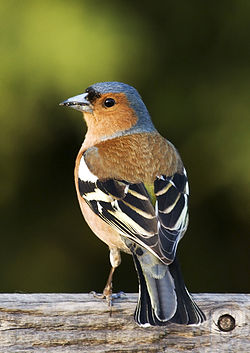
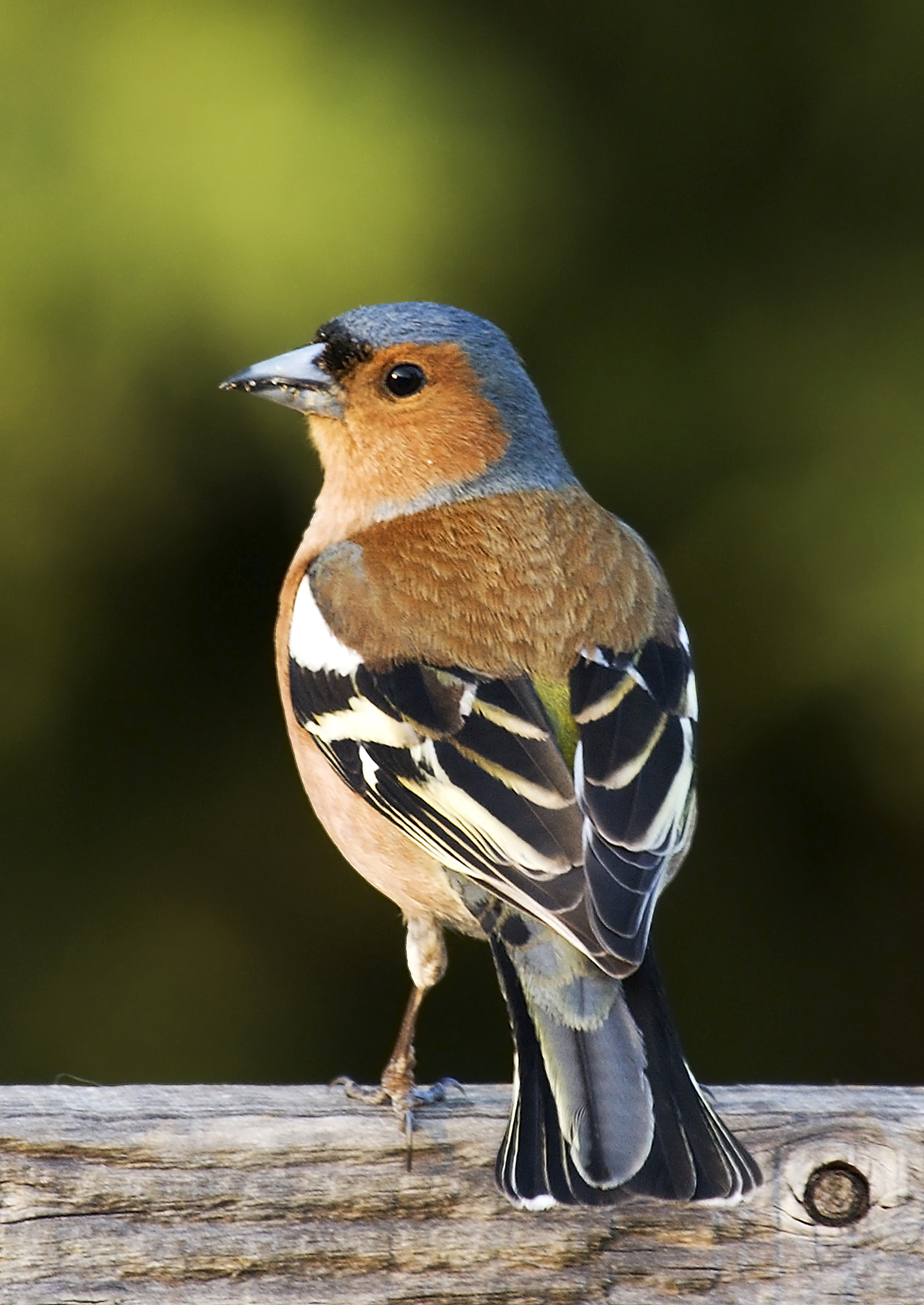
Species in the genus Fringilla exhibit pronounced sexual dimorphism in plumage, with males typically displaying brighter, more contrasting colors during the breeding season to signal fitness for mating and territory defense, while females show subdued, cryptic patterns that provide camouflage during incubation and brood care. This dimorphism is consistent across the genus, including the common chaffinch (F. coelebs), brambling (F. montifringilla), and blue chaffinch (F. teydea), though variations occur among insular taxa. All species share characteristic white wing bars and outer tail feathers, visible in flight, which aid in species recognition regardless of sex or age.[23][25][26] In the common chaffinch (F. coelebs), adult males in breeding plumage feature a slate-grey crown and nape, rosy-pink breast and cheeks, olive-brown upperparts, and a greenish rump, with two prominent white wing bars formed by the greater coverts and tertials. Females are duller overall, with a brown head, streaked brown upperparts, and pale buff underparts, retaining the white wing markings but lacking the male's vivid coloration; winter males show slightly faded pink tones. Juveniles resemble adult females but have fresher, less worn feathers and pointed tail tips. This dimorphism enhances male conspicuousness for courtship displays while allowing females to blend into woodland understory.[26][27][28] The brambling (F. montifringilla) demonstrates striking seasonal and sexual differences. Breeding males have a glossy black head, bib, and back, an orange throat and flanks, white belly and rump, and black wings accented by orange coverts, with a black bill; in winter, their plumage dulls to mottled grey-brown on the head and back, with a yellowish bill. Females maintain a greyish head with dark streaking, scaled grey-brown upperparts with buff fringes, pale orange-buff underparts, and a yellow bill year-round, appearing less vibrant and more uniformly patterned than males. Juveniles mimic female plumage but with ochre-edged feathers creating a scaly effect that wears off post-fledging. Such contrasts likely evolved to support male-male competition and mate attraction in territories.[23][29] The blue chaffinch (F. teydea), endemic to the Canary Islands, shows extreme dimorphism adapted to pine forest habitats. Adult males are predominantly slaty grey-blue across the body, with a paler blue-grey underbelly, white wing bars, and a stout grey bill, providing a bold appearance for display. Females are drab olive-brown above with paler underparts, heavily streaked for camouflage, and share the white markings; first-year males transition from brown-spotted crowns to fuller blue plumage after moult. This pattern persists in the closely related Gran Canaria blue chaffinch (F. polatzeki), where males retain similar blue tones but with localized variations.[25]Distribution and Habitat
Geographic Range
The genus Fringilla is primarily distributed across the Palearctic realm, encompassing temperate and boreal regions of Europe, Asia, and North Africa, as well as endemic populations in the Macaronesian islands. Species within the genus show varying degrees of range size, from widespread continental distributions to highly restricted island endemism. The common chaffinch (Fringilla coelebs) occupies the broadest range, breeding across most of continental Europe from the British Isles eastward to Siberia and Asia Minor, including the Iberian Peninsula, Balkans, Caucasus, and western Asia; it also occurs in northwestern Africa and on Mediterranean islands such as the Balearic Islands, Sardinia, and Crete. Northern populations are migratory, wintering in southern Europe, North Africa, and the Middle East, while southern forms are largely resident. Introduced populations exist in New Zealand, southern Australia, and South Africa. The brambling (Fringilla montifringilla) breeds extensively in boreal forests of northern Europe and Asia, from Fennoscandia and the Baltic states through Russia to eastern Siberia and Kamchatka, favoring birch and conifer woodlands. It is a long-distance migrant, wintering in large flocks across southern Europe, North Africa, the Middle East, and southern Asia as far as northern India and China, often congregating in beech woods and open agricultural areas.[23] The African chaffinch (Fringilla spodiogenys) is confined to North Africa, breeding in montane and lowland woodlands from southern Morocco through Algeria and Tunisia to northwestern Libya, with a disjunct population in northeastern Libya near the Egyptian border. It is mostly non-migratory but undertakes short-distance dispersals to lower-elevation scrub, oases, and coastal areas during the nonbreeding season. Two closely related species are endemic to the Canary Islands off northwestern Africa. The Tenerife blue chaffinch (Fringilla teydea) is restricted to high-altitude pine forests on Tenerife, where it is resident year-round. The Gran Canaria blue chaffinch (Fringilla polatzeki) occurs solely on Gran Canaria, primarily in two montane pine woodland sites, and is also non-migratory. The genus also includes other Macaronesian endemics: the Azores chaffinch (F. moreletti), endemic to all nine islands of the Azores archipelago; the Madeira chaffinch (F. maderensis), endemic to the island of Madeira; and the Canary Islands chaffinch (F. canariensis), endemic to the western Canary Islands (Tenerife, Gran Canaria, La Palma, La Gomera, and El Hierro), but absent from Fuerteventura and Lanzarote.[30][31][32][20][6]Habitat Preferences
Species of the genus Fringilla exhibit a strong affinity for forested habitats, particularly temperate woodlands, though preferences vary by species and region. The common chaffinch (F. coelebs) breeds predominantly in deciduous and mixed woodlands dominated by oak (Quercus spp.) and beech (Fagus spp.), but also occupies coniferous forests, parks, gardens, and orchards, ranging up to 2,800 m elevation in southern Europe. During non-breeding periods, it expands into open agricultural areas such as weedy fields, olive groves, and stubble, often at lower elevations or in southern wintering grounds. The brambling (F. montifringilla) favors coniferous-dominated breeding habitats in northern latitudes, including spruce (Picea spp.) and pine (Pinus spp.) forests often interspersed with birch (Betula spp.), typically below 1,200 m. In winter, it shifts to more open mixed woodlands, farmland edges, and areas with scattered trees across Europe and Asia. Similarly, the African chaffinch (F. spodiogenys) inhabits lowland and lower montane deciduous, mixed, or coniferous woodlands, showing a preference for mature stands of beech, hornbeam (Carpinus spp.), oak, spruce (Picea spp.), and pine; it also uses orchards, parks, and gardens for breeding, dispersing to scrubby fields, wadis, and desert oases outside the breeding season.[33] Island endemics within the genus display more specialized requirements tied to Macaronesian ecosystems. The Canary Islands chaffinch (F. canariensis) occupies monteverde (laurel and ericaceous forests) and Canary pine (P. canariensis) forests year-round across the archipelago.[34] The blue chaffinches (F. teydea on Tenerife and F. polatzeki on Gran Canaria) are restricted to high-altitude Canary pine forests, with F. teydea largely dependent on P. canariensis stands and reforested areas, while F. polatzeki centers on the Inagua pinewoods at elevations around 1,000 m.[20][35] The Madeira chaffinch (F. maderensis) and Azores chaffinch (F. moreletti) utilize laurel (Laurus spp.) and pine forests, including both native and non-native stands, reflecting adaptation to subtropical laurel woodlands.[36][37] Across the genus, habitat selection emphasizes tree cover for nesting and foraging, with mainland species showing greater versatility than the more habitat-restricted insulants.Behavior and Ecology
Foraging and Diet
Species of the genus Fringilla are primarily omnivorous, consuming a mix of seeds, fruits, and invertebrates, with dietary composition varying seasonally and by life stage. During the breeding season, invertebrates such as caterpillars, aphids, beetles, ants, spiders, and other arthropods form a significant portion of the diet, particularly for provisioning nestlings, while seeds and buds dominate outside breeding periods. Beech mast (Fagus sylvatica seeds), conifer seeds, and other plant material are key winter foods for many populations.[38][39] Foraging behaviors in Fringilla species typically involve ground-level probing and scratching for seeds, as well as gleaning insects from foliage, bark, and branches in trees and shrubs. Common Chaffinches (F. coelebs) often forage in mixed flocks during winter, preferring field boundaries with trees for accessing both ground seeds and arboreal invertebrates, and they exhibit selective habitat use based on prey availability, such as favoring cropped areas for nestling food. Nestling diets for F. coelebs are heavily invertebrate-based, dominated by flies (Diptera) and other small arthropods, reflecting intensive foraging in foliage and understory. Bramblings (F. montifringilla) shift from tree and shrub gleaning for moth larvae during summer breeding—where nestlings rely almost exclusively on these—to ground foraging in flocks for beech seeds and other mast in winter, sometimes forming massive communal roosts near food sources to enhance efficiency.[38][39][23] The blue chaffinches (F. teydea and F. polatzeki) are more specialized, with a diet centered on seeds from Canary pine (Pinus canariensis) and other conifers, supplemented by arthropods like beetles and ants, and occasionally small fruits; they forage predominantly on the ground beneath pines but also climb trees to extract seeds from cones. This pine-seed reliance makes them vulnerable to mast crop failures, prompting occasional shifts to adjacent habitats during scarcity. Overall, Fringilla foraging is opportunistic, influenced by habitat structure and food abundance, with ground foraging prevalent year-round but arboreal activity peaking in breeding seasons.[40][20]Reproduction and Breeding
Species of the genus Fringilla are generally monogamous, with breeding occurring seasonally in spring or summer depending on latitude and local conditions. The common chaffinch (F. coelebs) breeds from mid-March to mid-July in temperate Europe, constructing a deep cup-shaped nest of plant fibers, grass, lichens, moss, bark, and lined with hair and feathers, typically placed 1–10 m above ground in a tree fork or against a trunk.[14] The brambling (F. montifringilla) breeds from May to early August in boreal forests, building a bulky, loose nest of grass, moss, lichens, bark, and down, often in conifer or birch trees 2–15 m high.[19] The blue chaffinches (F. teydea and F. polatzeki), restricted to Canary Island pine forests, initiate nesting in late April to May, using nests of pine needles, broom, and lichens placed 5–20 m up in Pinus canariensis.[41][22] Clutch sizes vary across species, reflecting adaptations to environmental pressures. The common chaffinch lays 4–5 pale greenish-blue eggs spotted with reddish-brown, while the brambling produces 5–7 similar eggs.[21][24] In contrast, the blue chaffinches have a smaller clutch of 2 eggs (occasionally 1 or 3), likely due to higher predation risk and limited habitat.[41][22][42] Incubation, performed solely by the female and lasting 10–16 days for the common chaffinch and 11–12 days for the brambling, begins with the penultimate or last egg; the female is fed by the male during this period.[21][24] Both parents provision nestlings with invertebrates, especially caterpillars, for a nestling period of 11–18 days in the common chaffinch and 13–14 days in the brambling, after which fledglings remain dependent for 2–3 weeks.[21][24] Breeding success in Fringilla species is influenced by food availability and predation. Common chaffinches often raise 1–2 broods per season, with success enhanced by insect abundance during nestling stages.[21] Bramblings exhibit variable densities tied to seed crops but achieve higher fledging rates near other species' nests, such as fieldfares, due to reduced predation.[24] The Gran Canaria blue chaffinch (F. polatzeki) has low productivity, averaging 1.45 fledglings per successful nest, with about 33% of pairs attempting a second brood; overall nesting success is around 54%, primarily limited by predation from woodpeckers and low insect prey in its specialized habitat. The Tenerife blue chaffinch (F. teydea) shows similar patterns.[41]Migration and Vocalizations
Two species in the genus Fringilla, the Eurasian chaffinch (F. coelebs) and the brambling (F. montifringilla), exhibit notable migratory behaviors adapted to their boreal and temperate breeding ranges; other species, including the African chaffinch (F. spodiogenys) and the Macaronesian island endemics (F. moreletti, F. maderensis, F. canariensis, F. teydea, and F. polatzeki), are largely sedentary with only local movements or post-breeding dispersal. Migration in Fringilla is primarily driven by seasonal food availability and harsh northern winters, with patterns varying between partial and obligate migration. Populations breeding in northern Europe and Asia move southward to milder regions, often in large flocks during daytime flights, though distances and routes differ by species and sex.[43][21][16][22] The common chaffinch displays partial migration, with sedentary populations in milder western and southern Europe while northern breeders, particularly from Scandinavia and Russia, undertake short- to medium-distance movements to wintering grounds in southwestern and southern Europe. Juveniles and adult females typically travel farther than males, which often remain closer to breeding sites, resulting in winter flocks skewed toward younger and female birds; these patterns respond to annual climatic variations, such as milder winters reducing migration extent. Migratory routes generally follow a southwest-to-northwest axis, with birds departing in autumn (September–October) and returning in spring (March–April), sometimes crossing to northwestern Africa in irruptive events.[21][44][45] In contrast, the brambling is an obligate migrant, breeding across northern Eurasian taiga forests and moving long distances to non-breeding areas in southern Europe, North Africa, and southern Asia. Autumn migration begins in October, with flocks forming massive, nomadic waves that follow food resources like beech mast, leading to irregular irruptions where millions may concentrate in favorable sites; Norwegian populations sometimes take more southerly routes. Spring return migration occurs from March to April, with overall movements characterized by southwestward autumn flights and northeasterly spring returns, often in monospecific or mixed finch flocks.[46][24][47][23] Vocalizations in Fringilla serve functions in territory defense, mate attraction, and social coordination, with both species producing learned songs influenced by auditory experience and exhibiting regional dialects. Songs are more complex in males and develop through imitation of tutors, while calls are innate and used for alarm or contact. These vocal traits aid in species recognition during migration and breeding; vocalizations in other species resemble those of the Eurasian chaffinch but are less studied.[48] The common chaffinch's song is a well-studied model of vocal learning, consisting of a simple introductory phrase of 2–4 pure notes followed by an accelerated trill and terminal flourish, lasting 2–3 seconds and delivered from perches within territories; regional dialects vary in syllable structure and rhythm, reflecting cultural transmission across populations. Females occasionally sing simpler versions, potentially for duetting or pair bonding, a trait that has evolved rapidly in some lineages. Calls include a sharp "pink" or "chink" for contact, a wheezy "huit" alarm, and the distinctive "rain call"—a repetitive "dick dick dick"—long thought to predict rain but recent analyses suggest it functions as a female-directed alarm against predators. Urban populations show modified terminal flourishes in songs to counter noise pollution, without changes to core trills.[48][49][50][51][52][53][21][54] The brambling's vocal repertoire is less elaborate, with the male's song a brief, wheezy, descending buzz resembling "zweee" or "eerRRRRNnnn," often given sparingly from treetops during breeding and rarely on wintering grounds. Calls dominate communication, featuring a characteristic nasal, drawn-out "tjeeeeh" or "qweee" for contact and flight, a high-pitched "tsi-tsi" in flocks, and sharper "chuck" notes for alarms; these calls facilitate coordination in large migratory flocks and are more frequent than songs year-round.[55][29][24]Conservation
Status of Species
The genus Fringilla comprises eight recognized species, most of which are widespread and face minimal conservation threats, though two endemic to the Canary Islands are of greater concern. The Common Chaffinch (Fringilla coelebs) is assessed as Least Concern globally, with a stable to increasing population estimated at 500–799 million individuals across Europe, Asia, and North Africa.[14] Similarly, the Brambling (Fringilla montifringilla) is Least Concern, supported by an extremely large breeding population of 35–65 million mature individuals in northern Eurasia, despite some regional declines.[19] Among the recently split island endemics, the African Chaffinch (Fringilla spodiogenys) is Least Concern, occurring commonly in North African woodlands without significant threats. The Azores Chaffinch (Fringilla moreletti), Madeira Chaffinch (Fringilla maderensis), and Canary Islands Chaffinch (Fringilla canariensis) are also considered secure, with populations thriving in their respective Macaronesian habitats; the latter two were elevated from subspecies status in 2023 but retain Least Concern evaluations based on prior assessments of the F. coelebs complex.[14] In contrast, the Blue Chaffinch (Fringilla teydea), endemic to Tenerife, is classified as Near Threatened due to its small population of approximately 2,200–5,200 mature individuals and ongoing habitat degradation from invasive species and fires. The Gran Canaria Blue Chaffinch (Fringilla polatzeki), restricted to a single pine forest on Gran Canaria with approximately 430 mature individuals as of 2025, remains Endangered, primarily threatened by wildfires and limited genetic diversity, though recent translocation efforts have bolstered numbers.[6][22]| Species | IUCN Status | Key Rationale | Population Estimate (Mature Individuals) |
|---|---|---|---|
| Brambling (F. montifringilla) | Least Concern | Large range and population; minor regional declines | 35–65 million |
| Common Chaffinch (F. coelebs) | Least Concern | Widespread; stable/increasing trend | 500–799 million |
| African Chaffinch (F. spodiogenys) | Least Concern | Common in North Africa; no major threats | Not quantified (abundant) |
| Azores Chaffinch (F. moreletti) | Least Concern (inferred) | Thriving across Azores; habitat secure | Not quantified (common) |
| Madeira Chaffinch (F. maderensis) | Least Concern | Abundant in laurel/pine forests | Not quantified (common) |
| Canary Islands Chaffinch (F. canariensis) | Least Concern (inferred) | Widespread on Canary Islands; stable | Not quantified (common) |
| Blue Chaffinch (F. teydea) | Near Threatened | Small population; habitat loss | 2,200–5,200 (as of 2024) |
| Gran Canaria Blue Chaffinch (F. polatzeki) | Endangered | Tiny population; fire risk | ~430 (as of 2025) |