Hubbry Logo
InaguaInaguaMain
Open search
Inagua
Community hub
Inagua
logo
8 pages, 0 posts
0 subscribers
Be the first to start a discussion here.
Inagua
Inagua
from Wikipedia

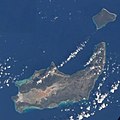
Inagua is the southernmost district of the Bahamas, comprising the islands of Great Inagua and Little Inagua. The headquarters for the district council are in Matthew Town.[2]

Key Information

History

[edit]

The original settlers were the Lucayan people (Taíno), who arrived sometime between 500 and 800 CE, crossing in dugout canoes from Hispaniola and/or Cuba to the Bahamas.[3]

The larger island was initially called by the name Heneagua, which may derive from a Spanish expression meaning 'water is to be found there'.[4] Two names of apparent Lucayan origin, Inagua (meaning "Small Eastern Island") and Baneque (meaning "Big Water Island"), were used by the Spanish to refer to Great Inagua.[5][6][7]

Between the years of 1500 and 1825, many documented treasure laden ships were destroyed on Inaguan reefs. The two most valuable wrecks lost off the Inaguas were treasure-laden Spanish galleons: the Santa Rosa in 1599; and the Infanta in 1788. Other ships of considerable value that were wrecked there include the French Le Count De Paix in 1713,[8] the British HMS Lowestoffe in 1801,[9][10] and the British HMS Statira in 1815.[11]

As early as the 1600s, salt was being produced and shipped to Spanish colonies,[12] and its extraction was a going business by 1803.[12]

Henri Christophe, king of northern Haiti from 1811 to 1820, built[when?] a summer retreat at the Northeast Point of Great Inagua.[12] Local legend has it that he also buried a cache of gold there.[13]

By 1918, after the end of World War I, lower salt prices and competition had driven the small producers on Great Inagua out of business, and the salt works were abandoned except for incidental local use.[14]

In 1935, the Erickson brothers from Massachusetts founded West India Chemicals Ltd., purchasing the abandoned salt works from the British government.[15] They drilled test holes, set up offices, and began restoration of the buildings, but the locals[16] felt threatened, fearing changes to the power structure status quo.[17] In August 1937, a riot broke out, an employee was killed, and the Ericksons were forced to flee.[18][19] They soon returned, and full-scale development resumed.[20]

In the mid-1950s, Morton Salt bought the Great Inagua saltworks,[21] which includes over 80 salt ponds,[22][self-published source] now the second largest such operation in North America.[20] Morton is the major employer on the island.[23][24][25]

Islands

[edit]

Great Inagua

[edit]

Great Inagua is the second largest island in the Bahamas at 596 sq mi (1544 km2), it is 4 times smaller then Andros, the largest island in the Bahamas.[citation needed] It lies about 55 miles (89 kilometres) from the eastern tip of Cuba. The island is about 55 by 19 mi (89 by 31 km) in extent and mostly flat with some sand hills, the highest points being East Hill at 132 ft (40 m), Salt Pond Hill at 102 ft (31 m), and James Hill at 90 ft (27 m).[4] It encloses several lakes, most notably the 12-mile (19 km) long Lake Windsor (also called Lake Rosa) which occupies nearly a quarter of the interior. The population of Great Inagua is 913 (2010 census).[26]

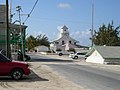
The island's capital and only harbour is Matthew Town, named after George Matthew, a 19th-century Governor of the Bahamas. This town houses the Morton Salt Company’s main facility, producing one million tonnes of sea salt a year — the second largest solar saline operation in North America and Inagua's main industry.[citation needed]

Great Inagua Airport (IATA: IGA, ICAO: MYIG) is located nearby.[27][28]

A large bird sanctuary in the centre of the island has a population of more than 80,000 West Indian flamingoes and many other bird species, including the Bahama parrot, Inagua woodstar, Bahama pintail, brown pelican, tricolored heron, snowy egret, reddish egret, stripe-headed tanager, double-crested cormorant, Neotropic cormorant, roseate spoonbill, American kestrel, and burrowing owl. The Union Creek National Reserve is specially set aside for the study of green sea turtles (Chelonia mydas).[29][30]

Little Inagua

[edit]

The neighbouring Little Inagua, 8 km (5 mi; 4 nmi) to the northeast, is uninhabited and occupied by a large Land and Sea Park.[29] It has an area of 30 sq mi (78 km2), with herds of feral donkeys and goats (descendants of stock introduced by the French). Various species of endangered sea turtles breed on the island.[29] Little Inagua has a large protective reef extending up to 1 mile (1,600 m) away from the island in all directions, which prevents boats from coming too close.[citation needed]

Politics

[edit]

The island is part of the MICAL constituency for elections to the House of Assembly of the Bahamas.[31]

[edit]

Notes

[edit]

Further reading

[edit]
[edit]
Revisions and contributorsEdit on WikipediaRead on Wikipedia
from Grokipedia
Inagua is the southernmost district of the Commonwealth of , encompassing the islands of Great Inagua and the uninhabited Little Inagua. Great Inagua spans approximately 1,544 square kilometers, making it the third-largest island in the Bahamian archipelago, while Little Inagua covers about 130 square kilometers. The district's population, concentrated on Great Inagua, totaled 913 residents as of the 2010 census, with most living in the administrative center of . The economy of Inagua relies predominantly on solar-evaporation salt production, operated by across roughly 80 ponds spanning over 12,000 acres, yielding substantial annual output from the island's hypersaline coastal lagoons. This industry has defined the region since the early 20th century, employing a significant portion of locals amid limited diversification into or small-scale . , established in 1965 and covering much of Great Inagua's interior, protects diverse ecosystems including mangrove wetlands and serves as the primary breeding ground for over 60,000 West Indian flamingos—the largest such colony in the —alongside other endemic species vulnerable to habitat loss and invasive predators. The islands' remoteness, arid climate, and exposure to hurricanes contribute to their sparse development and emphasis on conservation over mass .

Geography

Location and Physical Features

Inagua constitutes the southernmost district of the Bahamas, comprising Great Inagua and Little Inagua. Positioned between latitudes 20.9° and 21.4° N and longitudes 73° and 73.9° W, the district lies approximately 89 kilometers north of Cuba's eastern tip. Great Inagua, the district's primary island and the third-largest in , spans 1,544 square kilometers, extending about 85 kilometers in length and 30 kilometers in width at its broadest point. The island's terrain is largely flat and low-lying, with maximum elevations of 37 meters; it features extensive hypersaline lakes and salt flats occupying much of the interior, alongside coastal wetlands, dry scrub forests, and central savannas supporting such as and donkeys. Little Inagua, situated roughly 8 kilometers northeast of Great Inagua, covers 127 square kilometers and supports no permanent human population due to the absence of freshwater. Its physical landscape consists of arid, rocky expanses with sparse vegetation, encircled by coral reefs that extend up to 1.6 kilometers from shore, forming a .

Climate and Natural Hazards

The climate of Inagua is tropical maritime, characterized by warm temperatures year-round with minimal seasonal variation. Average daily temperatures in range from a low of 76°F (24°C) to a high of 84°F (29°C), rarely falling below 74°F (23°C) or exceeding 86°F (30°C). Annual rainfall is among the lowest in , averaging less than 30 inches (762 mm), reflecting its southeastern position in a . The spans May to October, coinciding with higher humidity and convective activity, while the from November to April features lower precipitation and more stable conditions. moderate humidity and provide consistent breezes, though occasional incursions can temporarily degrade air quality. Natural hazards in Inagua are dominated by tropical cyclones due to its location in the Atlantic hurricane belt. Hurricanes pose risks of high winds, , heavy rainfall-induced flooding, and , with the low-lying terrain amplifying vulnerability to inundation. Great Inagua, the larger island, has experienced direct impacts from several major storms; made a Category 3 on the island on September 7, 2008, causing widespread structural damage and power outages. , a Category 5 storm, passed over Inagua on September 1, 2017, damaging roofs on 70% of homes, downing power lines, and resulting in approximately $135 million in national damages with significant local effects. Flooding from such events is exacerbated by the islands' , which limits natural drainage and promotes rapid runoff into hypersaline lagoons and coastal zones. Droughts occur sporadically in the , straining limited freshwater resources reliant on rainfall and .

History

Indigenous and Pre-Colonial Period

The Lucayans, an Arawak-speaking branch of the peoples originating from the , established settlements across the Bahama archipelago, including Great Inagua, during the Ostionoid expansion phase circa A.D. 600–1200. Great Inagua, positioned near the , likely functioned as an initial colonization point for northward migration into the Bahamas from regions such as or , with evidence suggesting occupation by A.D. 800 or earlier. Archaeological investigations on Great Inagua have documented 13 pre-Columbian sites, primarily permanent villages situated adjacent to sand beaches and former tidal creeks that facilitated access to . These settlements exhibit characteristic Lucayan , including Palmetto Ware —locally produced from imported clays due to the absence of suitable local soils—alongside Meillacan-style imports, shell tools and middens (featuring species such as Strombus gigas, Codakia orbicularis, and Cittarium pica), and fire-cracked indicative of hearths. Inland farmsteads, such as those at sites GI11 and GI12, supplemented coastal villages, supporting of crops like and , supplemented by fishing and gathering in the island's arid environment. Radiocarbon dating from key sites confirms occupation spanning A.D. 1040–1270 at GI12 and A.D. 1320–1510 at GI3, aligning with broader Lucayan expansion patterns until European contact in 1492. Little Inagua, smaller and more remote, lacks documented archaeological surveys or confirmed sites, though its proximity suggests potential transient use or limited settlement tied to Great Inagua's networks. Lucayan on Inagua mirrored archipelago-wide traits: hierarchical communities led by caciques, with dugout canoes enabling inter-island and resource exchange, though the islands' isolation and marginal likely constrained population density compared to core territories.

Colonial and Post-Colonial Era

Bermudians began settling Great Inagua around 1803, migrating via the to exploit its natural salt ponds for commercial production, raking and selling salt to passing ships. Permanent European settlement followed in the mid-19th century, with the establishment of between 1844 and 1849 under British Governor George Matthew, who lent his name to the port. The Henagua Salt Pond Company, incorporated in 1848, represented the ' first formal , formalizing salt extraction amid the islands' British colonial administration formalized in 1718. Salt raking sustained a small , supplemented by and shipping services; by the early 1900s, Great Inagua served as a exchange hub, with over 220 vessels anchoring in 1902 alone. Infrastructure included a colonial jail built in 1849 to detain prisoners prior to transfer to Nassau and the Great Inagua Lighthouse constructed in 1870. Labor tensions erupted in the 1937 Inagua riot, triggered by wage disputes with salt company owners and broader colonial economic grievances, reflecting patterns of unrest in the . The salt industry revived in the 1930s when American brothers Wallace, Edgar, and Donald Erickson invested in modern evaporation techniques, boosting output before selling to in 1955, which expanded operations to over 80 ponds. Following Bahamian from Britain on July 10, 1973, Inagua experienced minimal structural shifts, retaining its economic dependence on —producing around 2 million tons annually by the late —as the dominant employer for its roughly 1,000 residents. Conservation efforts intensified post-independence, with the establishment of Inagua National Park in 1965 (covering 287 square miles) continuing under sovereign governance to safeguard the world's largest flamingo breeding colony at Lake Rosa. Isolation and salt-centric development persisted, with limited diversification into despite ecological assets.

20th and 21st Century Developments

In the early , Great Inagua experienced labor migration from other Bahamian islands to support expanding salt production, which strained local resources and led to social unrest. Tensions escalated in when a erupted, involving workers protesting control over labor recruitment and profits, resulting in that highlighted exploitative practices in the industry. Commercial salt operations modernized in the late 1930s, leveraging the island's arid climate for solar evaporation across over 80 ponds. In 1954, acquired the facility, transforming it into North America's second-largest solar salt producer, with annual output exceeding 1 million tons primarily for export to the . The establishment of Inagua National Park in 1965 marked a key conservation milestone, protecting 287 square miles and safeguarding the world's largest nesting colony of flamingos, amid growing awareness of ecological threats from alteration. Following in 1973, Inagua's development remained anchored to salt extraction, which employed most residents in , though vulnerability to natural disasters persisted. in 1992 inflicted widespread damage across the southern , contributing to $250 million in national losses from wind and surge impacts on . In the 21st century, recurrent hurricanes exacerbated economic challenges; in 2016 brought 19.7 inches of rain to , causing flooding and heightened risks, though structural damage was limited compared to other regions. Population on Great Inagua has declined significantly since the 2010 census figure of 913, mirroring broader Family Island trends driven by out-migration for better opportunities, limited diversification beyond salt, and hurricane recovery burdens. Conservation initiatives have intensified, including management of like feral hogs threatening flamingo habitats, alongside the 2002 designation of Little Inagua National Park to preserve marine and terrestrial ecosystems.

Demographics

Population Distribution and Settlements

The population of the Inagua islands is almost entirely concentrated on Great Inagua, as Little Inagua remains uninhabited due to its remote location, lack of freshwater, and designation as a . The 2022 Census of Population and Housing recorded 831 residents on Great Inagua, down from 913 in the census, reflecting a decline linked to economic dependencies on salt production and limited diversification. Matthew Town, situated on the southwest coast, is the sole significant settlement and administrative center, housing the vast majority of the island's residents. Established between 1844 and 1849 as a hub for salt industry laborers, it features essential including a harbor, station, and basic commercial outlets like grocery stores. A substantial portion of the —estimated at around 1,000 in earlier accounts, though aligned with totals—relies on employment from the Company operations nearby. No other permanent settlements exist, with sparse habitation limited to salt facility workers or transient visitors, underscoring the island's low of approximately 0.54 persons per square kilometer.

Cultural and Social Composition

The population of Great Inagua, totaling 913 residents as of the 2010 census, is predominantly of African descent, reflecting the broader demographic patterns of . Racial composition data indicate that 85.7% (782 individuals) identified as , 9.1% (83 individuals) as Black and White mixed, and 4.5% (41 individuals) as other races. This ethnic makeup stems from historical settlement by freed African slaves and laborers in the salt industry during the 19th and early 20th centuries, with minimal European or other influences due to the island's remoteness and economic focus. Religiously, the community is overwhelmingly Christian, aligning with national trends where Protestant denominations prevail. In Inagua specifically, Anglicans form the largest group at 34.3% (313 persons), followed by at 23.4% (214 persons) and Methodists at 11.2% (102 persons), with remaining adherents distributed among other Protestant sects and smaller Catholic or independent groups. and religious observances play a central role in social cohesion, often intersecting with events. English serves as the , supplemented by in daily interactions, which incorporates African linguistic elements and British colonial influences. Cultural expression draws from Afro-Bahamian roots, featuring music traditions exemplified by local artists such as and participation in festivals, which emphasize rhythmic drumming, costuming, and communal celebration during holidays like . Social structure revolves around extended families and the salt production workforce, promoting a tight-knit, interdependent community in , where mutual support mitigates the challenges of isolation and limited economic diversification.

Economy

Primary Industries: Salt Production

Salt production has been the cornerstone of Great Inagua's economy since the early , when Bermudian settlers initiated commercial operations by raking salt from natural salinas and selling to passing ships. Modern mechanized production began in the late , with the Erickson brothers establishing the West India Chemical Company to develop large-scale solar evaporation facilities. In 1954, acquired the operation, expanding it into one of the largest solar saltworks in the , spanning approximately 300,000 acres with around 80 evaporation ponds. The production process relies on solar evaporation: seawater is pumped into shallow ponds, where sun and wind concentrate the over months, allowing salt crystals to precipitate and be harvested mechanically or by hand. The facility produces high-purity primarily for industrial uses, such as and chemical processing, with annual output varying between 750,000 and 900,000 tonnes depending on rainfall and weather conditions. Exports are shipped to Morton Salt's U.S. operations and international markets, forming the island's principal revenue source. As Great Inagua's dominant employer, the saltworks supports over 100 local workers, representing a significant portion of the island's approximately 1,000 residents concentrated in . The operation's has historically buffered the island against fluctuations, though vulnerability to hurricanes—such as damage from Irma in —highlights risks to this mono-industry dependency. In September 2025, sold the facility to Bahamas-based Lusca Group's subsidiary, Salt Company Ltd., which rebranded it as Salt and committed to investments for operational upgrades while retaining all employees. This transition aims to enhance efficiency and sustain the industry's role amid ongoing environmental considerations, including coexistence with flamingo habitats in the ponds.

Tourism and Other Economic Activities

Tourism in the Inagua islands centers on , particularly , as the region is promoted as the Birdwatching Capital of due to its abundant avian populations, including flamingos in . The park spans 32,600 hectares and features , a supporting diverse wildlife, drawing naturalists and photographers for guided observation tours. Additional attractions include visits to Little Inagua , Hogsty Reef for and diving, and boat excursions for marine exploration. Infrastructure for visitors remains minimal, with no cruise ship ports or large resorts; accommodations are limited to a few guest houses and rental properties in , the primary settlement on Great Inagua. Island tours often combine wildlife viewing, cave explorations, and historical sites, but the remote location and lack of commercial flights beyond scheduled charters restrict visitor numbers, preserving the area's undeveloped character. Economic contributions from are modest compared to salt production, supporting local guides and small operators without driving significant growth. Beyond tourism, other economic activities are limited by the islands' arid and small of around 900 residents, primarily in . Small-scale fishing targets species like , , and , supplementing local diets and providing minor income through exports, though it forms a negligible share of the national fisheries output dominated by more accessible islands. is constrained by poor soils and low rainfall, yielding only subsistence crops and limited such as goats, with no commercial-scale farming reported. Informal sectors include basic retail and services in , but these rely heavily on salt industry employment for sustainability.

Challenges and Economic Dependencies

Great Inagua's economy is predominantly dependent on solar salt production, operated by Morton Bahamas Limited, which serves as the island's largest employer with over 100 workers and generates 750,000 to 900,000 tonnes of salt exports annually to the United States, subject to annual rainfall variations. This industry, established for decades, relies on the island's arid climate for evaporation in coastal ponds, but alternative sectors like tourism and fishing remain underdeveloped due to remoteness, limited infrastructure, and sparse population of around 1,000 residents. Such concentration exposes the local economy to fluctuations in global salt markets and operational disruptions, with minimal local agriculture or manufacturing to buffer dependencies on imported goods and external remittances. Key challenges include weather-induced production volatility, where excessive rainfall dilutes ponds and halts , prompting temporary layoffs of more than 100 workers as seen in recent operations. The island faces risks from hurricanes, which have historically contracted economic activity across Bahamian out-islands through infrastructure damage and supply chain interruptions, though Great Inagua has avoided direct catastrophic hits like in 2019 that devastated northern islands. Climate change exacerbates vulnerabilities via sea-level rise threatening salt facilities and natural processes, compounded by limited diversification efforts that perpetuate reliance on a single export commodity. In September 2025, Morton Limited was acquired by Bahamas-based Group, rebranded as Salt, with commitments to invest in efficiency, expand capacity, and secure long-term supply agreements, potentially mitigating some operational risks but eliciting mixed worker sentiments over job stability and local control. Despite these developments, persistent barriers to growth—such as inadequate air and sea access—and pressures from hinder broader resilience, underscoring the need for policy-driven diversification without verifiable progress to date.

Ecology and Conservation

Biodiversity and Key Species

Great Inagua supports a rich avian , with over 140 bird recorded, including residents, breeders, and winter migrants, thriving in such as saline lakes, mangroves, and scrublands. The island hosts the world's largest breeding colony of West Indian flamingos (Phoenicopterus ruber), with approximately 70,000 individuals concentrated in areas like Lake Windsor and Lake Rosa, a recovery from near-extinction in the mid-20th century due to conservation efforts including habitat protection and reduced human disturbance. Other notable birds include the endemic Inagua woodstar (Nesophlox lyrura), a small restricted to Great and Little Inagua and adapted to scrubby woodlands and gardens. The Bahama parrot (Amazona leucocephala bahamensis), an endemic , maintains a significant population on Great Inagua estimated at 8,000 to 13,000 individuals as of 2016 surveys, utilizing coppice forests and scrub for nesting and foraging despite historical pressures from habitat loss and hurricanes. Additional waterbirds such as , egrets, roseate spoonbills, and American flamingos frequent fringes and seasonal marshes. The island's interior also harbors the endemic Inagua freshwater (Trachemys malonei), a of slider turtle classified as endangered due to limited range and habitat threats. Little Inagua complements this with marine-focused , featuring coral reefs, seagrass beds, and no-take zones that sustain , , and larval replenishment for broader Bahamian waters. The island serves as a documented nesting ground for critically endangered , including hawksbills (Eretmochelys imbricata), which utilize undisturbed beaches amid its arid, vegetation-scarce terrain. Overall, the Inaguas' ecosystems, recognized as a Key Area under criteria for congregatory and restricted-range endemics, encompass brackish marshes, mangroves, and neritic marine zones that underpin these populations.

Protected Areas and Management

Inagua hosts two principal s managed by the Bahamas National Trust (BNT), a established in to oversee wildlife protection and park administration on Crown lands. Inagua , encompassing 287 square miles (743 km²) on Great Inagua, was designated in 1965 as the second in , following decades of prior conservation efforts focused on flamingo populations. It protects the largest breeding colony of West Indian flamingos (Phoenicopterus ruber) in the , estimated at over 50,000 individuals, alongside Bahama parrots (Amazona leucocephala bahamensis), over 140 , and diverse habitats. Management includes habitat monitoring, control—such as feral cats and rats threatening nesting sites—and partnerships with local entities like Morton Bahamas Limited for funding and logistical support. The BNT deploys wardens for patrolling and enforces restrictions on access to sensitive breeding areas to minimize disturbances, while promoting through guided to balance conservation with limited economic benefits. Little Inagua National Park, established in 2002, spans 62,800 acres (254 km²) including the and surrounding marine waters, designated as a no-take zone to safeguard seabirds, endangered sea turtles, and ecosystems. Its remoteness and lack of freshwater sources limit human impact, with management emphasizing marine protection through periodic surveys of beds and reefs, which support amid regional threats like bleaching events. Access is restricted to permitted research or conservation activities, primarily by boat, under BNT oversight to preserve its status as the largest in the Wider . Both parks contribute to the Bahamas National Protected Area System, which expanded in to cover 10% of the nation's coastal and marine environments, with BNT coordinating IUCN category assignments to enhance systematic planning and international compliance. Challenges in include funding constraints and , addressed through targeted programs like and conservation strategies developed in collaboration with governmental bodies.

Environmental Pressures and Debates

Great Inagua, as part of The Bahamas, experiences significant environmental pressures from climate change, including rising sea levels, intensified hurricanes, and increased aridity, which threaten coastal ecosystems, freshwater resources, and biodiversity. The archipelago's low-lying terrain, with much of it within one meter of sea level, heightens vulnerability to storm surges and erosion, as evidenced by damages from hurricanes like Matthew in 2016 and Dorian in 2019, which caused widespread habitat disruption and economic losses exceeding USD 129 million in the tourism sector alone. Precipitation patterns are shifting, with higher year-to-year variability and overall drying trends exacerbating drought conditions on the rainfall-deficient Inagua islands, where annual averages are as low as 750 mm, impacting potable water supplies reliant on fragile freshwater lenses contaminated by saline intrusion. Salt production, the dominant industry on Great Inagua operated by Morton Salt, exerts localized pressures through habitat alteration and potential pollution from solar evaporation ponds, which can lead to soil salinization and disruptions in nearby wetlands critical for species like the West Indian flamingo. While the process leverages the island's arid climate for evaporation, excessive rainfall events—potentially more variable under climate change—dilute brine and affect yields, indirectly pressuring land use expansions that may encroach on protected areas. General assessments of solar salt operations highlight risks of mangrove clearing and ecosystem threats, though Inagua's operations have been credited with coexisting benefits, such as providing foraging habitats for flamingos amid managed ponds. Marine habitats around Little Inagua face additional stressors, including from warming oceans and physical damage from hurricanes, compromising beds and reefs essential for fisheries and coastal protection. , such as feral pigs, pose ongoing threats to native vegetation and ground-nesting birds within , complicating conservation efforts despite successes in flamingo population recovery since the park's 1965 establishment. Debates center on balancing economic reliance on salt extraction with stringent conservation mandates, particularly as measures demand expanded protected areas versus industrial infrastructure needs. National Climate Change Policy emphasizes for coastal resources, yet tensions arise over resource allocation, with calls for enhanced monitoring of and integrity amid global pressures like . Audubon's historical advocacy underscores the park's role in averting risks, but contemporary challenges, including potential development in sensitive zones, highlight unresolved trade-offs between livelihoods and ecological preservation.

Government and Politics

Administrative Framework

Inagua operates as a district within the Commonwealth of , established under the Local Government Act, 2024, which divides the country into districts defined by schedules attached to the legislation. As a Third Schedule district, it is governed by a District Council comprising 5 to 9 members elected directly by registered voters in the district every three years, with the Chief Councillor elected internally from among the members to preside over meetings and coordinate local functions. The council holds corporate status, enabling it to enter contracts, manage property, and regulate local matters such as business licensing, town planning, traffic control, sanitation, and maintenance of public buildings and infrastructure, subject to oversight by the Minister responsible for . The Family Island Administrator, appointed by the , serves as the for the district, managing day-to-day operations including revenue collection, functions, disaster preparedness, and acting as secretary to the District Council and any town committees within the district. As of September 2024, the Administrator for Inagua is Herman Gilbert, based at the Administrator's Office in , Great Inagua, which coordinates with the Department of in Nassau. The office supports subsidiary roles filled by deputy and assistant administrators, handling administrative duties like public records and community services. For national representation, Inagua falls within the MICAL constituency (encompassing , Inagua, Crooked Island, and Long Cay), with local polling divisions (Nos. 11 and 12) used for both parliamentary and district elections, ensuring alignment between local and national governance structures. councils like Inagua's receive funding from allocations and local revenues, with councillors receiving stipends ranging from $125 to $950 monthly depending on position, as outlined in the Act's schedule. This framework emphasizes decentralized administration for Family Islands while maintaining central ministerial authority to promulgate regulations and resolve disputes.

Political Representation and Issues

Great Inagua and Little Inagua form part of the , Inagua, Crooked Island, , and Long Cay (MICAL) constituency, which elects a single member to the House of Assembly of , the lower house of the bicameral parliament comprising 39 such constituencies. The current representative is Basil McIntosh of the Progressive Liberal Party (PLP), who was elected in the September 2021 and also serves as for Aviation. McIntosh announced in June 2025 that he would not seek re-election in the next , expected around 2026, prompting discussions within the PLP and opposition (FNM) over successors, including resident support for FNM nominee Robert Dupuch-Carron in October 2025. Local administration falls under an appointed Island Administrator, who oversees day-to-day governance, public services, and community concerns under the national Ministry of National Security and other departments, with residents able to petition the MP or central government for constituency-specific needs. Prominent political issues in Inagua on the management of undocumented Haitian migration, which has intensified due to Haiti's , placing strain on limited local resources, healthcare, and security. Residents have repeatedly called for a dedicated detention facility to handle the growing number of interdicted migrants, as temporary holding arrangements overburden existing like the local . Proposals include establishing a base to bolster interdiction efforts and deter boat arrivals, alongside suggestions to repurpose uninhabited Little Inagua for a UNHCR-supervised migrant processing site. These pressures have fueled resident discomfort over safety and service access, with reports of influxes prompting health and security alerts as recently as 2021, though enforcement challenges persist amid broader national debates. Education represents another focal point, exemplified by chronic teacher shortages at the Inagua All Age School, where parents reported multiple classes operating without instructors as of September 2025, exacerbating understaffing in remote Family Islands and highlighting inequities in national . has also targeted perceived neglect in constituency development since the prior MP's tenure, with calls for greater in and services amid McIntosh's impending departure. These matters often intersect with national , where MICAL's MP advocates for Family Island priorities in budget debates, though implementation lags due to fiscal constraints and competing urban demands.

Infrastructure and Accessibility

Transportation and Connectivity

Great Inagua's primary transportation link to the rest of is via air service to Inagua International Airport (IATA: IGA), located approximately 2.8 kilometers from , with taxi travel time to the settlement averaging 7 minutes. Commercial flights are operated by , offering scheduled service from Nassau's on Mondays, Wednesdays, and Fridays, though frequencies may vary due to demand and weather conditions in this remote Out Island location. The airport features a single runway suitable for small to medium aircraft and serves both civilian and military operations, reflecting the island's limited infrastructure. Sea connectivity relies heavily on freight shipping rather than regular passenger ferries, with the handling cargo for Great Inagua and nearby southern islands. No scheduled passenger ferry services directly connect Inagua to Nassau or other major hubs, unlike more central Bahamian islands; instead, goods and occasional passengers arrive via mailboats or commercial shipping lines, which can take several days depending on routes and weather. The Royal Bahamas Defence Force occasionally provides air or sea transport for community needs, such as repatriation flights to during disruptions, but this is not a routine . Internal transportation on Great Inagua is rudimentary, consisting of unpaved or partially paved roads primarily linking to the production facilities on the northern shore and limited rural areas. ownership is low due to the island's small of around 1,000 residents, and most travel occurs by private car, truck, or shared , with no public bus system or rail . Little Inagua, largely uninhabited and used for ranching, lacks any formal roads or links beyond private boat access from Great Inagua. Overall connectivity remains constrained, contributing to the island's isolation and reliance on salt exports for economic viability.

Utilities and Recent Improvements

Electricity supply in Great Inagua is managed by Bahamas Power and Light (BPL), which operates diesel-powered generation facilities serving the island's approximately 1,000 residents and industrial users like the facility. The grid relies on transmission and distribution networks that, as of mid-2025, included infrastructure dating back nearly 70 years, contributing to periodic reliability issues in this remote location. Water services are provided by the Water and Sewerage Corporation (WSC), which depends heavily on due to the absence of surface freshwater sources and limited viable lenses on the arid island. Prior to October 2025, private operator Aqua Design managed key plants in Inagua, producing potable water that meets standards. Sewerage systems remain rudimentary, with most households using septic tanks rather than centralized treatment. Recent improvements have focused on enhancing reliability amid the island's isolation and vulnerability to hurricanes. In July 2025, the and Transport, in collaboration with BPL, replaced 46 of 50 damaged utility poles as part of a broader to the aging , aiming to reduce outages and improve resilience. Concurrently, BPL initiated major maintenance on Inagua's transmission and distribution network starting July 1, 2025, to bolster service stability. In October 2025, the acquired seven plants, including those in Inagua, from Aqua Design for $16 million, establishing WSCDesalCo Limited to oversee operations and ensure more consistent under control. These efforts reflect targeted interventions to address longstanding infrastructural deficits without broader renewable integration specific to Inagua as of late 2025.

References

Add your contribution
Related Hubs
User Avatar
No comments yet.