


Community hub
Recent from talks
Contribute something
Nothing was collected or created yet.
Frogfish
View on Wikipedia
| Frogfish Temporal range:
| |
|---|---|
.jpg)
| |
| Striated frogfish, Antennarius striatus | |
Scientific classification 
| |
| Kingdom: | Animalia |
| Phylum: | Chordata |
| Class: | Actinopterygii |
| Order: | Lophiiformes |
| Suborder: | Antennarioidei |
| Family: | Antennariidae Jarocki, 1822[1] |
| Genera | |
|
see text | |
Frogfishes are any member of the anglerfish family Antennariidae, of the order Lophiiformes. Antennariids are known as anglerfish in Australia, where the term "frogfish" refers to members of the unrelated family Batrachoididae. Frogfishes are found in almost all tropical and subtropical oceans and seas around the world, the primary exception being the Mediterranean Sea.
Frogfishes are small, short and stocky, and sometimes covered in spinules and other appendages to aid in camouflage. The camouflage aids in protection from predators and enables them to lure prey. Many species can change colour; some are covered with other organisms, such as algae or hydrozoa. In keeping with this camouflage, frogfishes typically move slowly, lying in wait for prey, and then striking extremely rapidly, in as little as 6 milliseconds.
Few traces of frogfishes remain in the fossil record, though Fowlerichthys monodi is known from the Miocene of Algeria, and a number of species are known from the Eocene of Italy.[2]
Etymology
[edit]The frogfish family, Antennariidae, has its name derived from Antennarius, its type genus. Antennarius suffixes -ius to antenna, an allusion to first dorsal spine being adapted into a tentacle on the snout used as a lure to attract prey.[3]
Taxonomy
[edit]Antennariidae was first proposed as a family in 1822 by the Polish zoologist Feliks Paweł Jarocki.[1] The 5th edition of the Fishes of the World recognises 13 genera within the family but no subfamilies.[4] Other authorities recognise two subfamilies, the Antennariinae and the Histiophryninae,[5] while others treat these as two separate families.[6] The Antennariidae is classified within the suborder Antennarioidei within the order Lophiiformes, the anglerfishes.[4] The Antennariidae is regarded, with its sister taxon, the Tetrabrachiidae as the most derived clade within the suborder Antennarioidei.[7]
Genera
[edit]


The following classification is based on Eschmeyer's Catalog of Fishes, based on Maile et al. (2025):[8][9]
Subfamily Antennariinae Jarocki 1822 (Fibonacci frogfishes)[clarification needed]
- Abantennarius Schultz, 1957
- Antennarius Daudin, 1816
- Antennatus Schultz, 1957
- †Eophryne Carnevale & Pietsch, 2009 (Early Eocene of Italy)[2]
- Histrio Fischer, 1813
- Nudiantennarius Schultz, 1957
Subfamily Brachionichthyinae Gill, 1863 (handfishes)
- Brachionichthys Bleeker, 1854
- Brachiopsilus Last & Gledhill, 2009
- †Histionotophorus Eastman, 1904 (Early Eocene of Italy)[10]
- †Orrichthys Carnevale & Pietsch, 2010 (Early Eocene of Italy)[11]
- Pezichthys Last & Gledhill, 2009
- Sympterichthys Gill, 1878
- Thymichthys Last & Gledhill, 2009
Subfamily Fowlerichthyinae Maile et al., 2025 (fanfin frogfishes)
- Fowlerichthys Barbour, 1941
- †Neilpeartia Carnevale et al., 2020[12]
Subfamily Histiophryninae Arnold & Pietsch, 2012 (starfingered frogfishes)
- Histiophryne Gill, 1863
Subfamily Lophichthyinae Boeseman, 1964 (lophichthyin frogfishes)
- Lophichthys Boeseman, 1964
- Lophiocharon Whitley, 1933
Subfamily Rhycherinae Hart et al., 2022 (Balrog frogfishes)
- Allenichthys Pietsch, 1984
- Echinophryne McCulloch & Waite, 1918
- Kuiterichthys Pietsch, 1984
- Phyllophryne Pietsch, 1984
- Porophryne Arnold, Harcourt & Pietsch, 2014
- Rhycherus Ogilby, 1907
Subfamily Tathicarpinae Hart et al., 2022 (longfin frogfishes)
- Tathicarpus Ogilby, 1907
Subfamily Tetrabrachiinae Regan, 1912 (tetrabrachiin frogfishes)
- Dibrachichthys Pietsch, J. W. Johnson & Arnold, 2009
- Tetrabrachium Günther, 1880
† = Extinct
The division of the family into multiple subfamilies is a recent treatment, as previously the Brachionichthyinae, the Lophichthyinae, and the Tetrabrachiinae were treated as their own families. Histiophrynidae was described as its own family in 2012. In 2022, these four families were found to be paraphyletic with respect to the former treatment of Antennariidae, and due to this, Rhycherinae and Tathicarpinae (both previously placed in Antennariidae) were uplifted to their own families.[13] A 2025 phylogenetic study combining Ultra-Conserved Elements (UCE)s, mitochondrial DNA, and morphological data found even this treatment to be paraphyletic, with Fowlerichthyinae being recognized as a distinct clade. However, to avoid taxonomic oversplitting, it was described as a distinct subfamily instead, and the Brachionichthyidae, Histiophrynidae, Lophichthyidae, Rhycheridae, Tathicarpidae, and Tetrabrachiidae were downgraded to subfamilies within the Antennariidae.[8] The frogfishes were also treated as a single family under an interpretive classification of the Actinopterygii in 2024.[14]
The most basal member of the family is thought to be the Fowlerichthyinae.[8]
Fossil record
[edit]
Very few fossil remains of frogfishes have been found. The oldest known fossil evidence of frogfishes are isolated otoliths, named Antennarius euglyphus Stinton, 1966 from the Early Eocene-aged London Clay Formation of England.[12] The highest diversity has been found in the northern Italian formation at Monte Bolca, formed from the sedimentation of the Tethys Ocean in the early Eocene (50-49 million years ago), which contains two handfish (Histionotophorus and Orrichthys)[15], a Fibonacci frogfish (Eophryne)[16], and a fanfin frogfish related to Fowlerichthys (Neilpeartia)[17]. Another fossil is known from Late Miocene Algeria (7 to 5 million years ago), Fowlerichthys monodi, believed to be most closely related to the extant Senegalese frogfish.[17][18]
Range
[edit]Frogfishes live in the tropical and subtropical regions of the Atlantic and Pacific, as well as in the Indian Ocean and the Red Sea. Their habitat lies for the most part between the 20 °C isotherms, in areas where the surface level water usually has a temperature of 20 °C (68 °F) or more. They extend beyond the 20 °C isotherms in the area of the Azores, Madeira and the Canary Islands, along the Atlantic coast of the United States, on the south coast of Australia and the northern tip of New Zealand, coastal Japan, around Durban, South Africa, and at Baja California, Mexico.[19][20] The greatest diversity of species is in the Indo-Pacific region, with the highest concentration around Indonesia. In the small Lembeh Strait, north-east of Sulawesi, divers have found 9 different species. Frogfish live generally on the ocean floor around coral or rock reefs, at most to 100 m (330 ft) deep.
A few exceptions to these general limits are known. The brackishwater frogfish is at home in ocean waters as well as brackish and fresh water around river mouths.[21] The sargassum fish lives in clumps of drifting sargassum, which often floats into the deeper ocean and has been known to take the sargassum fish as far north as Norway.[22]
Description
[edit]

Frogfishes have a stocky appearance, atypical of fish. Ranging from 2.5–38 cm (0.98–14.96 in) long, their plump, high-backed, unstreamlined body is scaleless and bare, often covered with bumpy, bifurcated spinules.[23] Their short bodies have between 18 and 23 vertebrae and their mouths are upward-pointed with palatal teeth. They are often brightly coloured, white, yellow, red, green, or black or spotted in several colours to blend in with their coral surroundings.[19] Coloration can also vary within one species, making it difficult to differentiate between them.
Antennarioidei fishes are characterised by the first dorsal fin being made up of three separate spines on the head, the first being the illicium with the second sometimes being short, although this spine is not ever embedded within the skin. The pterygiophores of the first dorsal spine and the third dorsal spine have highly compressed dorsal expansions. The interhyal has a central backwards directed process that touches the preoperculum.[24]
Rather than typical dorsal fins, the front-most of the three fins is called the illicium or "rod" and is topped with the esca or "lure". The illicium often has striped markings, while the esca takes a different form in each species. Because of the variety of colours even within a single species, the esca and illicium are useful tools to differentiate among different varieties.[25] Some of them resemble fish, some shrimp, some polychaetes, some tubeworms, and some simply a formless lump; one genus, Echinophryne, has no esca at all. Despite very specific mimicry in the esca, examinations of stomach contents do not reveal any specialized predation patterns—for example, only worm-eating fish consumed by frogfishes with worm-mimicking esca. If lost, the esca can be regenerated. In many species, the illicium and esca can be withdrawn into a depression between the second and third dorsal fins for protection when they are not needed.[26]
Frogfish have small, round gill openings behind their pectoral fins. With the exception of Butler's frogfish and the rough anglerfish, frogfish use a gas bladder to control their buoyancy.[citation needed]
Mimicry and camouflage
[edit]
The unusual appearance of the frogfish functions to conceal it from predators and sometimes to mimic a potential meal to lure it in. In the study of animal behavior, this is known as aggressive mimicry. Their unusual shape, colour, and skin textures disguise frogfish. Some resemble stones or coral, while others imitate sponges or sea squirts with dark splotches instead of holes. In 2005, a species was discovered, the striated frogfish, that mimics a sea urchin, while the sargassumfish is coloured to blend in with the surrounding sargassum.[22] Some frogfish are covered with algae or hydrozoa. Their camouflage can be so perfect that sea slugs have been known to crawl over the fish without recognizing them.[citation needed]
For the scaleless and unprotected frogfish, camouflage is an important defense against predators. Some species can also inflate themselves, like pufferfish, by sucking in water in a threat display.[27] In aquaria and in nature, frogfish have been observed, when flushed from their hiding spots and clearly visible, to be attacked by clownfish, damselfish, and wrasses, and in aquaria, to be killed.
Many frogfishes can change their colour.[19] The light colours are generally yellows or yellow-browns, while the darker are green, black, or dark red. They usually appear with the lighter color, but the change can last from a few days to several weeks. What triggers the change is unknown.[19]
Movement
[edit]
Frogfishes generally do not move very much, preferring to lie on the sea floor and wait for prey to approach. Once the prey is spotted, they can approach slowly using their pectoral and pelvic fins to walk along the floor.[26][28] They rarely swim, preferring to clamber over the sea bottom with their fins in one of two "gaits".[23] In the first, they alternately move their pectoral fins forward, propelling themselves somewhat like a two-legged tetrapod, leaving the pelvic fins out. Alternately, they can move in something like a slow gallop, whereby they move their pectoral fins simultaneously forward and back, transferring their weight to the pelvic fins while moving the pectorals forward. With either gait, they can cover only short stretches.
In open water, frogfishes can swim with strokes of the caudal fin. They also use jet propulsion, often used by younger frogfish. It is achieved by rhythmically gulping water and forcing it out through their gill openings, also called opercular openings, which lie behind their pectoral fins.[28]
The sargassum frogfish has adapted fins which can grab strands of sargassum, enabling it to "climb" through the seaweed.[19]
Hunting
[edit]Frogfishes eat crustaceans, other fish, and even each other. When potential prey is first spotted, the frogfish follows it with its eyes. Then, when it approaches within roughly seven body-lengths, the frogfish begins to move its illicium in such a way that the esca mimics the motions of the animal it resembles. As the prey approaches, the frogfish slowly moves to prepare for its attack; sometimes this involves approaching the prey or "stalking", while sometimes it is simply adjusting its mouth angle. The catch itself is made by the sudden opening of the jaws, which enlarges the volume of the mouth cavity up to 12-fold, pulling the prey into the mouth along with water.[26] The attack can be as fast as 6 milliseconds.[29] The water flows out through the gills, while the prey is swallowed and the esophagus closed with a special muscle to keep the victim from escaping. In addition to expanding their mouths, frogfish can also expand their stomachs to swallow animals up to twice their size.[26]
Slow-motion filming has shown that the frogfish sucks in its prey in just six milliseconds, so fast that other animals cannot see it happen.[26]
Reproduction
[edit].jpg)
 Striated frogfish mating - YouTube
The reproductive behavior of the normally solitary frogfish is still not fully researched. Few observations in aquaria and even fewer from the wild have been made. Most species are free-spawning, with females laying the eggs in the water and males coming in behind to fertilize them. From eight hours to several days before the egg-laying, the abdomen of the female starts to swell as up to 180,000 eggs absorb water.[25] The male begins to approach the female around two days before the spawning. Whether the spawn is predetermined by some external factor, such as the phase of the moon, or if the male is attracted to a smell or signal released by the female, is unknown. In all hitherto observed breeding pairs, one partner was noticeably larger than the other, sometimes as much as 10 times. When the gender could be determined, the larger partner was always the female.
During the free-spawning courtship ritual, the male swims beside and somewhat behind the female, nudges her with his mouth, then remains near her cloaca. Just before the spawning, the female begins to swim above the ocean floor toward the surface. At the highest point of their swim, they release the eggs and sperm before descending. Sometimes, the male pulls the eggs out of the female with his mouth. After mating, the partners depart quickly as otherwise the smaller male would likely be eaten. A few species are substrate-spawners, notably the genera Lophiocharon, Phyllophryne, and Rhycherus, which lay their eggs on a solid surface, such as a plant or rock. Some species guard their eggs, a duty assigned to the male in almost all species, while most others do not.[25][26] Several species practice brood carrying, for example the three-spot frogfish, whose eggs are attached to the male, and those in the genus Histiophryne, whose brood are carried in the pectoral fins.
The eggs are 0.5–1 mm (0.020–0.039 in) in diameter and cohere in a gelatinous mass or long ribbon, which in sargassumfish are up to a metre (3.3 ft) long and 16 cm (6.5 in) wide. These egg masses can include up to 180,000 eggs.[25][31] For most species, the eggs drift on the surface. After two to five days, the fish hatch and the newly hatched alevin are between 0.8 and 1.6 mm (0.031 and 0.063 in) long. For the first few days, they live on the yolk sac while their digestive systems continue to develop. The young have long fin filaments and can resemble tiny, tentacled jellyfish. For one to two months, they live planktonically. After this stage, at a length between 15 and 28 mm (0.59 and 1.10 in), they have the form of adult frogfish and begin their lives on the sea floor. Young frogfish often mimic the coloration of poisonous sea slugs or flatworms.
-
 Commerson's frogfish, Kona, Hawaii, Antennarius commerson
 -
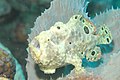
-
 Red ocellated frogfish, St. Kitts, F. ocellatus
 -
 Longlure frogfish, Bonaire, A. multiocellatus
 -
 Scarlet frogfish, A. coccineus
 -
 Painted frogfish, A. pictus
 -
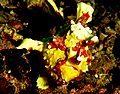 Warty frogfish, A. maculatus
 -
 Sargassum fish, Histrio histrio


References
[edit]- ^ a b Richard van der Laan; William N. Eschmeyer & Ronald Fricke (2014). "Family-group names of recent fishes". Zootaxa. 3882 (2): 1–230. doi:10.11646/zootaxa.3882.1.1. PMID 25543675.
- ^ a b Carnevale, Giorgio; Pietsch, Theodore W. (2009). "An Eocene Frogfish from Monte Bolca, Italy: The Earliest Known Skeletal Record for the Family". Palaeontology. 52 (4): 745–752. doi:10.1111/j.1475-4983.2009.00874.x. ISSN 1475-4983.
- ^ Christopher Scharpf (14 November 2022). "Order LOPHIIFORMES (part 1): Families LOPHIIDAE, ANTENNARIIDAE, TETRABRACHIIDAE, LOPHICHTHYIDAE, BRACHIONICHTHYIDAE, CHAUNACIDAE and OGCOCEPHALIDAE". The ETYFish Project Fish Name Etymology Database. Christopher Scharpf. Retrieved 23 March 2024.
- ^ a b Nelson, J.S.; Grande, T.C.; Wilson, M.V.H. (2016). Fishes of the World (5th ed.). Hoboken, NJ: John Wiley & Sons. pp. 508–518. doi:10.1002/9781119174844. ISBN 978-1-118-34233-6. LCCN 2015037522. OCLC 951899884. OL 25909650M.
- ^ Arnold, R. J.; R. G. Harcourt; and T. W. Pietsch (2014). "A new genus and species of the frogfish family Antennariidae (Teleostei: Lophiiformes: Antennarioidei) from New South Wales, Australia, with a diagnosis and key to the genera of the Histiophryninae". Copeia. 2014 (3): 534–539. doi:10.1643/CI-13-155.
- ^ Fricke, Ron; Eschmeyer, William N. & van der Laan, Richard (eds.). "Genera in the family Histiophrynidae". Catalog of Fishes. California Academy of Sciences. Retrieved 22 March 2024.
- ^ Miya, M.; T. Pietsch; J. Orr; R. Arnold; T. Satoh; A. Shedlock; H. Ho; M. Shimazaki; M. Yabe (2010). "Evolutionary history of anglerfishes (Teleostei: Lophiiformes): a mitogenomic perspective". BMC Evolutionary Biology. 10 (1): 58. Bibcode:2010BMCEE..10...58M. doi:10.1186/1471-2148-10-58. PMC 2836326. PMID 20178642.
- ^ a b c Maile, Alex J.; Smith, W. Leo; Davis, Matthew P. (May 2, 2025). "A total-evidence phylogenetic approach to understanding the evolution, depth transitions, and body-shape changes in the anglerfishes and allies (Acanthuriformes: Lophioidei)". PLOS. 20 (5) e0322369. Bibcode:2025PLoSO..2022369M. doi:10.1371/journal.pone.0322369. PMC 12047784. PMID 40315280.
- ^ Fricke, Ron; Eschmeyer, William N. & van der Laan, Richard (eds.). "Genera in the family Antennariidae". Catalog of Fishes. California Academy of Sciences. Retrieved 30 September 2025.
- ^ "†Histionotophorus Eastman 1904 (anglerfish)". Paleobiology Database. Retrieved 13 March 2024.
- ^ CARNEVALE, GIORGIO; PIETSCH, THEODORE W. (2010-11-24). "Eocene handfishes from Monte Bolca, with description of a new genus and species, and a phylogeny of the family Brachionichthyidae (Teleostei: Lophiiformes)". Zoological Journal of the Linnean Society. 160 (4): 621–647. doi:10.1111/j.1096-3642.2009.00623.x. ISSN 0024-4082. Archived from the original on 2022-08-17.
- ^ a b Carnevale, Giorgio; Pietsch, Theodore W.; Bonde, Niels; Leal, Maria E. C.; Marramà, Giuseppe (2020-03-03). "†Neilpeartia ceratoi, gen. et sp. nov., a new frogfish from the Eocene of Bolca, Italy". Journal of Vertebrate Paleontology. 40 (2) e1778711. doi:10.1080/02724634.2020.1778711. ISSN 0272-4634.
- ^ Hart, Pamela B.; Arnold, Rachel J.; Alda, Fernando; Kenaley, Christopher P.; Pietsch, Theodore W.; Hutchinson, Destinee; Chakrabarty, Prosanta (2022-06-01). "Evolutionary relationships of anglerfishes (Lophiiformes) reconstructed using ultraconserved elements". Molecular Phylogenetics and Evolution. 171 107459. doi:10.1016/j.ympev.2022.107459. ISSN 1055-7903.
- ^ Near, Thomas J.; Thacker, Christine E. (2024-04-18). "Phylogenetic Classification of Living and Fossil Ray-Finned Fishes (Actinopterygii)". Bulletin of the Peabody Museum of Natural History. 65 (1): 101. Bibcode:2024BPMNH..65..101N. doi:10.3374/014.065.0101. ISSN 0079-032X.
- ^ CARNEVALE, GIORGIO; PIETSCH, THEODORE W. (2010-11-24). "Eocene handfishes from Monte Bolca, with description of a new genus and species, and a phylogeny of the family Brachionichthyidae (Teleostei: Lophiiformes)". Zoological Journal of the Linnean Society. 160 (4): 621–647. doi:10.1111/j.1096-3642.2009.00623.x. ISSN 0024-4082. Archived from the original on 2022-08-17.
- ^ CARNEVALE, GIORGIO; PIETSCH, THEODORE W. (16 July 2009). "An Eocene Frogfish from Monte Bolca, Italy: The Earliest Known Skeletal Record for the Family". Palaeontology. 52 (4): 745–752. Bibcode:2009Palgy..52..745C. doi:10.1111/j.1475-4983.2009.00874.x. Retrieved 21 February 2025.
- ^ a b Carnevale, Giorgio; Pietsch, Theodore W.; Bonde, Niels; Leal, Maria E. C.; Marramà, Giuseppe (2020-03-03). "†Neilpeartia ceratoi, gen. et sp. nov., a new frogfish from the Eocene of Bolca, Italy". Journal of Vertebrate Paleontology. 40 (2) e1778711. doi:10.1080/02724634.2020.1778711. ISSN 0272-4634.
- ^ Carnevale, G.; Pietsch, T. W. (25 October 2006). "Filling the gap: a fossil frogfish, genus Antennarius (Teleostei, Lophiiformes, Antennariidae), from the Miocene of Algeria". Zoology. 270 (3): 448–457. doi:10.1111/j.1469-7998.2006.00163.x. Retrieved 21 February 2025.
- ^ a b c d e Antennariidae: Frogfishes Tree of Life Web Project
- ^ Froese, Rainer; Pauly, Daniel, eds. (February 2006). "Family Antennariidae". FishBase.
- ^ No recognised taxon options: order, family, genus, species, subspecies.
- ^ a b Froese, Rainer; Pauly, Daniel (eds.). "Histrio histrio". FishBase. Sep 2009 version.
- ^ a b Bray, Dianne. "Family ANTENNARIIDAE". Fishes of Australia. Archived from the original on 19 April 2014. Retrieved 6 October 2014.
- ^ Nelson, J.S.; Grande, T.C.; Wilson, M.V.H. (2016). Fishes of the World (5th ed.). Hoboken, NJ: John Wiley & Sons. pp. 508–518. doi:10.1002/9781119174844. ISBN 978-1-118-34233-6. LCCN 2015037522. OCLC 951899884. OL 25909650M.
- ^ a b c d Diving with Frogfish Dive the World 2009
- ^ a b c d e f Frogfish Factsheet Archived 2007-10-11 at the Wayback Machine Shedd Aquarium Explore by Animal 2009
- ^ Lloyd, Robin Crawling fish accepted as new species NBC News
- ^ a b Bertelsen, E.; Pietsch, T.W. (1998). Paxton, J.R.; Eschmeyer, W.N. (eds.). Encyclopedia of Fishes. San Diego: Academic Press. pp. 138–139. ISBN 0-12-547665-5.
- ^ Striated Frogfish Florida Museum of Natural History
- ^ Pietsch TW and Grobecker DT (1987) Frogfishes of the world Stanford University Press,ISBN 9780804712637.
- ^ Frogfish spawn on Valentine's Day[permanent dead link] National Sea Life Center, Birmingham
External links
[edit]


| International | |
|---|---|
| National | |
| Other | |

Frogfish
View on GrokipediaClassification
Etymology
The family name Antennariidae was established in 1822 by the Polish zoologist Feliks Paweł Jarocki in his work Zoologia czyli zwierzętopismo ogólne podług naynowszego systemu ułożone.[3] This nomenclature derives from the type genus Antennarius, coined by French naturalist Philibert Commerson and made available by François Marc Antoine Vallot de Champignolles (as Daudin) in 1816; the genus name stems from the Latin antenna (meaning a yardarm, mast, or sensory appendage, akin to "horns" in Aristotle's usage), alluding to the fish's first dorsal-fin spine, which modifies into an illicium—a tentacle-like lure employed for hunting prey.[4][5] The common English name "frogfish" reflects the family's distinctive squat, globular body form, short "leg-like" pectoral fins, and warty or spinulose skin texture, evoking the appearance of frogs or toads; this descriptive terminology traces back to ancient references, such as Aristotle's and Cicero's mentions of "fishing-frogs" or "sea-frogs" for similar marine creatures.[4][6]Taxonomy
Frogfishes belong to the family Antennariidae, established in 1822 by Jarocki, within the order Lophiiformes and suborder Antennarioidei of the class Teleostei.[3][7] This placement reflects their classification among the anglerfishes, characterized by benthic lifestyles in tropical and subtropical marine environments.[8] The family name Antennariidae derives from the Latin "antenna," alluding to the modified dorsal-fin spine that functions as a fishing lure.[9] A comprehensive phylogenetic revision by Maile et al. in 2025 integrated ultraconserved elements (UCEs), mitochondrial DNA sequences, and morphological data to reconstruct the evolutionary relationships within the broader Lophioidei clade, which encompasses frogfishes and allies.[10] This total-evidence approach recognized Antennariidae as a monophyletic family comprising 23 genera distributed across eight subfamilies: Antennariinae, Brachionichthyinae, Fowlerichthyinae (newly proposed), Histiophryninae, Lophichthyinae, Rhycherinae, Tathicarpinae, and Tetrabrachiinae.[10] The analysis expanded Antennariidae to incorporate taxa previously classified in separate families, resolving long-standing taxonomic uncertainties and emphasizing the group's diversity in body form and habitat adaptation.[10][11] The illicium, a specialized first dorsal-fin spine modified into an esca-bearing lure, serves as a key synapomorphy for Lophiiformes and particularly defines Antennariidae's predatory adaptations, distinguishing it from related families like the former Tetrabrachiidae—now reclassified as the subfamily Tetrabrachiinae based on shared morphological and genetic traits.[10] This trait enables precise luring behaviors unique to frogfishes, supporting their ambush hunting strategy in shallow waters.[10] The 2025 study highlights how such features, combined with molecular evidence, provide a robust framework for understanding the family's internal diversification.[10]Genera
Following the 2025 phylogenetic revision by Maile et al., the family Antennariidae comprises approximately 70 species distributed across 23 genera, grouped into eight subfamilies.[10] This expansion incorporates genera from previously separate families, such as Brachionichthyidae (handfishes) and Tetrabrachiidae, enhancing understanding of their evolutionary relationships. These subfamilies are differentiated primarily by variations in the morphology of the illicium (the modified dorsal-fin spine used as a lure) and associated adaptations to specific habitats, such as reef versus seagrass environments.[10][8] The subfamilies and selected genera include:- Antennariinae: Abantennarius, Antennarius (the most speciose, with around 12–17 species), Antennatus, Histrio, Nudiantennarius. A notable example is Histrio histrio, the sargassum frogfish, which inhabits floating seaweed in the open ocean.
- Fowlerichthyinae (newly proposed): Fowlerichthys.
- Brachionichthyinae: Brachionichthys, Sympterichthys, Thymichthys (incorporating former handfishes adapted to temperate waters).
- Histiophryninae: Allenichthys, Echinophryne, Histiophryne, Kuiterichthys, Phyllophryne, Porophryne.
- Lophichthyinae: Lophiocharon.
- Rhycherinae: Rhycherus.
- Tathicarpinae: Tathicarpus.
- Tetrabrachiinae: Tetrabrachium (adapted to deeper or specialized habitats).[10]