Hubbry Logo
FuefukiFuefukiMain
Open search
Fuefuki
Community hub
Fuefuki
logo
8 pages, 0 posts
0 subscribers
Be the first to start a discussion here.
Fuefuki
Fuefuki
from Wikipedia
Ichinomiya Asama Shrine

Key Information

Fuefuki (笛吹市, Fuefuki-shi) is a city in Yamanashi Prefecture, Japan. As of 1 September 2020, the city had an estimated population of 67,300 in 30,408 households,[1] and a population density of 340 persons per km2. The total area of the city is 201.92 square kilometres (77.96 sq mi).

Geography

[edit]

Fuefuki is located in central Yamanashi Prefecture at an average altitude of 261 meters.[1] Just over 58% of the area of the city is covered in forest. The Fuefuki River flows through the city.

Neighboring municipalities

[edit]

The following municipalities surrounding the city clockwise starting from Kōfu.

Climate

[edit]

The city has a climate characterized by hot and humid summers, and relatively mild winters (Köppen climate classification Cfa). The average annual temperature in Fuefuki is 10.7 °C. The average annual rainfall is 1524 mm with September as the wettest month. The temperatures are highest on average in August, at around 22.8 °C, and lowest in January, at around -1.0 °C.[2]

Demographics

[edit]

Per Japanese census data,[3] the population of Fuefuki peaked around the year 2000 and has declined since.

Historical population
YearPop.±%
1940 49,960—    
1950 61,882+23.9%
1960 53,064−14.2%
1970 50,380−5.1%
1980 55,950+11.1%
1990 62,322+11.4%
2000 71,025+14.0%
2010 70,529−0.7%
2020 66,947−5.1%

History

[edit]

Fuefuki was the center of ancient Kai Province and contains many burial mounds from the Kofun period. The ruins of the Kai Kokubun-ji, the Nara period provincial temple are also found within the city limits, as is the Ichinomiya Asama Shrine, the ichinomiya of Kai Province. During the Edo period, all of Kai Province was tenryō territory under direct control of the Tokugawa shogunate, with a daikansho based at the village of Isawa. During the cadastral reform of the early Meiji period on April 1, 1889, the rural districts of Higashiyatsushiro and Higashiyamanashi Districts were formed.[citation needed]

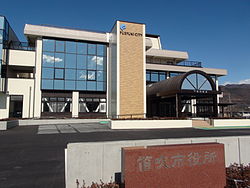
The modern city of Fuefuki was established on October 12, 2004, from the merger of the towns of Ichinomiya, Isawa, Misaka and Yatsushiro, the village of Sakaigawa (all from Higashiyatsushiro District), and the town of Kasugai (from Higashiyamanashi District).[4][5] The name refers to the Fuefuki River that flows through the city. The city hall is located at the former Isawa Town Hall, and other former towns and village halls were converted to satellite offices.

On August 1, 2006, Fuefuki later absorbed the village of Ashigawa (also from Higashiyatsushiro District. Higashiyatsushiro District was dissolved as a result of this merger.

Government

[edit]

Fuefuki has a mayor-council form of government with a directly elected mayor and a unicameral city legislature of 19 members.

Economy

[edit]

The economy of Fuefuki is based on agriculture (horticulture), seasonal tourism and the production of wine. Fuefuki is the largest producer of grapes and peaches in Japan.[1]

Education

[edit]

Fuefuki has 14 public elementary schools and five public junior high schools operated by the city government,[6] and one public high school operated by the Yamanashi Prefectural Board of Education.

Elementary Schools:

  1. Isawa Minami (South) 石和南
  2. Isawa Higashi (East) 石和東
  3. Isawa Kita (North) 石和北
  4. Fujimi 富士見
  5. Isawa Nishi (West) 石和西
  6. Misaka Higashi (East) 御坂東
  7. Misaka Nishi (West) 御坂西
  8. Ichinomiya Nishi (West) 一宮西
  9. Ichinomiya Minami (South) 一宮南
  10. Ichinomiya Kita (North) 一宮北
  11. Yatsushiro 八代
  12. Sakaigawa 境川
  13. Kasugai 春日居
  14. Ashigawa 芦川

Junior High Schools:

  1. Isawa 石和
  2. Misaka 御坂
  3. Ichinomiya 一宮
  4. Asakawa 浅川
  5. Kasugai 春日居

High School:

  1. Fuefuki 笛吹
[edit]

Transportation

[edit]

Sister cities

[edit]

Local attractions

[edit]

Notable people from Fuefuki

[edit]
[edit]
  • Fuefuki serves as the inspiration for the fictional town of Inaba in the 2008 video game Persona 4.[10]

References

[edit]
[edit]
Revisions and contributorsEdit on WikipediaRead on Wikipedia
from Grokipedia
Fuefuki (笛吹市, Fuefuki-shi) is a city in , central , situated in the Kōfu Basin along the Fuefukigawa River, approximately 100 kilometers west of and near . Formed on October 12, 2004, by the merger of the towns of Ichinomiya, Isawa, Misaka, and and the village of Sakaigawa (Higashiyamanashi District), with the village of Ashigawa (Higashiyatsushiro District) added on August 1, 2006, it spans an area of 201.9 square kilometers with a population of 66,947 as of the 2020 , yielding a density of about 331 persons per square kilometer. The city's name derives from the Fuefukigawa River, which traverses its center and supports recreational cycling paths amid scenic landscapes. Fuefuki's economy is predominantly agricultural, renowned for producing Japan's highest volumes of peaches and grapes, with fruit farming techniques in the Kyoutou region designated a Globally Important Agricultural Heritage System by the in 2022. These orchards, especially peach fields that bloom in spring, form a key part of the local identity, alongside grape varieties like used in wine production at numerous wineries. The region also features robust , drawing visitors for seasonal fruit-picking experiences, stays, and events such as the annual summer festival and winter illuminations. Complementing its rural charm, Fuefuki is home to prominent hot spring resorts like and , among Japan's top destinations for onsen relaxation, with alkaline waters believed to aid skin health and circulation. Cultural and historical sites include the Yamanashi Prefectural Museum, housing Jōmon-period artifacts from ancient settlements dating back over 3,000 years. The city's blend of natural beauty, agricultural innovation, and wellness offerings positions it as a gateway to Yamanashi's heritage and outdoor pursuits.

Geography

Location and Topography

Fuefuki is situated in central , , approximately 100 kilometers west of , with geographic coordinates of 35°38′50.3″N 138°38′23″E. The city lies within the Kofu Basin, a broad formed by deposits from surrounding mountains, which defines its predominantly flat terrain in the central and lower elevations while transitioning to hilly in the peripheries. The total area of Fuefuki spans 201.92 km², encompassing a mix of urban, agricultural, and natural landscapes. Approximately 58.5% (118.17 km²) of this area consists of forested land, primarily in the northern and eastern upland regions, contributing to the city's and watershed protection. The is 267 meters at city hall, with variations from around 200 meters in the basin floor to over 1,000 meters in the adjacent mountain ranges. The Fuefuki River, the city's main waterway, originates in the Misaka Mountains to the east and flows southwest through the heart of the basin, covering approximately 56 kilometers in total length before joining the Fuji River. This river has profoundly shaped the local by depositing fertile alluvial soils across the basin, creating expansive flatlands ideal for , particularly the cultivation of peaches, grapes, and other fruits that thrive in the region's well-drained, nutrient-rich sediments. The river's meandering path also forms natural corridors of riparian vegetation, enhancing the landscape's ecological connectivity. Fuefuki's position in the eastern Kofu Basin places it in close proximity to , approximately 40 kilometers to the south, allowing the iconic volcano's silhouette to dominate southern vistas and influencing local microclimates through seasonal winds and precipitation patterns. This strategic location within the basin integrates Fuefuki into a dynamic physiographic zone bounded by the Chichibu Mountains to the east and the South Alps to the west, underscoring its role as a transitional area between lowland plains and upland terrains.

Neighboring Municipalities

Fuefuki City is bordered by multiple municipalities entirely within Yamanashi Prefecture, forming part of the prefecture's central basin region known for its agricultural productivity and natural landscapes. The adjacent municipalities, oriented clockwise starting from the north, include Kōfu City, Kai City, Yamanashi City, Kōshū City, Minami-Alps City, and Fujikawaguchiko Town. These boundaries are largely defined by natural geographical features, such as segments of the Fuefuki River, which delineates parts of the northern and eastern edges with Kōfu and Kai, and the foothills of the Yatsugatake Mountains, which form the southern frontier shared with Minami-Alps. The western border with Fujikawaguchiko follows terrain influenced by the surrounding Fuji-Hakone-Izu National Park ranges, contributing to shared ecological zones. Positioned in the heart of , Fuefuki lies approximately 100 km west of central , enhancing its connectivity to the capital while preserving a distinctly rural character within the prefecture's network of 27 municipalities. This central location underscores Fuefuki's role in the broader regional fabric of , a landlocked prefecture focused on fruit cultivation and .

Climate

Fuefuki experiences a (Köppen classification Cfa), featuring hot, humid summers and relatively mild winters. The average annual temperature is 11.0 °C, with significant seasonal variations that define the region's weather patterns. Summers, from to , are warm and muggy, with average high temperatures reaching 29.5 °C in , accompanied by high levels that often exceed 70%. Winters, spanning to , are cooler but not severe, with average lows around -0.5 °C in and occasional frost. Annual precipitation totals approximately 1,961 mm, distributed unevenly throughout the year, with the bulk—over 60%—falling during the summer rainy season (tsuyu) and early autumn. and are the wettest months, averaging 236 mm and 220 mm respectively, due to the influence of the East Asian monsoon. In contrast, winter months see drier conditions, though light snowfall occurs periodically, accumulating to about 20-30 cm annually in lower elevations. These patterns contribute to a with four distinct seasons, marked by cherry blossoms in spring and vibrant foliage in fall. The city's location in the Kofu Basin, surrounded by the Chichibu and Akaishi mountain ranges, creates localized microclimates that moderate extreme temperatures and enhance diurnal variations, often exceeding 10 °C between day and night. This provides some protection from northerly fronts in winter and westerly winds, fostering relatively stable conditions overall. However, Fuefuki remains vulnerable to occasional extreme events, including typhoons that bring and strong winds during late summer—such as in 2019, which caused localized flooding—and rare heavy snowfalls during winter snaps.

History

Ancient and Feudal Periods

Fuefuki, situated in the fertile Kofu Basin, served as a central hub for early human activity in ancient due to its alluvial plains along the Fuefuki River, which facilitated agricultural settlements and cultural development from prehistoric times. Archaeological evidence from the Jomon period (c. 14,000–1,000 BCE) underscores this region's longstanding habitation, with the Shakado site yielding extensive artifacts that illuminate prehistoric life. The Shakado Museum of Jomon Culture, established in 1988 following excavations during Chuo Expressway construction, houses reconstructed pottery ranging from early coarse forms to later cord-marked and flat-bottomed vessels, alongside tools, arrowheads, and human effigies likely linked to rituals. These findings, discovered in the Kofu Basin, highlight Fuefuki's role in Japan's prehistoric societies and have drawn national attention for their representation of evolving Jomon material culture. Transitioning into the Kofun period (c. 250–700 CE), Fuefuki emerged as a key area within Kai Province, featuring numerous burial mounds that signify the rise of regional elites and centralized authority. One prominent example is the Kitsunezuka Tumulus, a square-shaped hofun located near Isawa Onsen Station, dating to the middle Kofun period and serving as the tomb of an unnamed local ruler. Unlike the more common keyhole-shaped kofun, this mound's design reflects regional variations in funerary practices, with excavations uncovering pottery sherds from Jomon, Yayoi, and Kofun eras, as well as later Edo-period items, indicating continuous site use. These tumuli, concentrated in the area, attest to Fuefuki's integration into broader Yamato state networks, where elite burials incorporated continental influences like bronze mirrors and iron weapons to symbolize power. By the Nara period (710–794 CE), Fuefuki's prominence continued as the administrative core of , evidenced by the establishment of Kai Kokubun-ji, a provincial temple commissioned by Shomu in 741 as part of a nationwide effort to propagate and unify the realm. Located in present-day Fuefuki, the temple complex originally included a main hall, , and monastic quarters, reflecting centralized imperial policy modeled on Chinese systems. Designated a National Historic Site in 1922, the ruins—destroyed by fire during the (1185–1333)—have been excavated to reveal foundations and artifacts that reconstruct its layout, underscoring early Buddhist influence in the region and Kai's alignment with the capital at Nara. Recent digs have further clarified its role in provincial governance and religious dissemination. During the feudal era, particularly the (1467–1603), Fuefuki held strategic value under the , which dominated from the 15th to late 16th centuries. The clan's fortified manor, Takeda Nobushige Yakata in Isawa, built in the , exemplifies their control amid turbulent power struggles, including conflicts with the Muromachi Shogunate and rival warlords. Nobushige, a key Takeda figure and brother to the renowned Shingen, governed from such sites, leveraging Fuefuki's position along trade routes for . Though no medieval structures remain—now overlaid by Jōjuin Temple—the site's commemorates the clan's resilience, as they navigated rebellions and expansions until their defeat by and in 1582. This era positioned Fuefuki as a vital logistical node in Kai's defenses, contributing to the Takeda's reputation as formidable Sengoku .

Modern Formation and Developments

The modern city of Fuefuki was established on October 12, 2004, through the merger of six municipalities in : the towns of Isawa, Misaka, Ichinomiya, and Yatsushiro from Higashiyatsushiro District, along with Sakaigawa Village from the same district and Kasugaichi Town from Higashiyamanashi District. This consolidation was part of Japan's broader municipal merger reforms under the 1999 Omnibus Decentralization Law, aimed at streamlining administration and enhancing regional efficiency in rural areas. On August 1, 2006, Fuefuki further expanded by absorbing Ashigawa Village from Higashiyatsushiro District, increasing its administrative scope and integrating additional rural territories into the city's framework. Post-World War II developments in Fuefuki were marked by significant agricultural advancements, driven by Japan's national program initiated in 1946, which redistributed farmland to tenant farmers and boosted productivity in the Kofu Basin region. Fruit cultivation, particularly grapes and peaches, expanded rapidly from the onward, transforming the area into a key production hub; by the , initiatives like the Fuefuki River project—spanning 1971 to 2001 and funded through national and prefectural efforts—enhanced water management across 1,200 hectares, supporting mechanized farming and higher yields. improvements, including road networks and under the Comprehensive Program starting in the , facilitated market access and contributed to the region's economic stabilization. In recent years, Fuefuki has focused on sustainable amid flood risks in the Kofu Basin, with the "Study Group to Promote Making the Kofu Basin Resilient against Floods," launched in 2019, involving city representatives in expert-led discussions on retention basins, elevated safe zones, and wide-area evacuation strategies; a prefecture-wide evacuation plan was advanced in June 2020 to protect approximately 310,000 residents. Ongoing preparations for the Linear Chuo , whose Tokyo-Nagoya section opening has been delayed to 2034 or later, are driving integrated land-use initiatives in the Kofu Basin to balance growth with environmental resilience, including proposals for high-rise developments on artificial ground to mitigate inundation depths of 5–10 meters during major floods.

Demographics

Population Statistics

As of October 31, 2025, Fuefuki City has an estimated of 66,441 residents living in 30,916 households. This figure reflects a stable population level, remaining in the range of 66,000 to 67,000 since 2020. The demographic breakdown includes 32,397 males and 34,044 females. The city's total land area measures 201.92 km², resulting in a population density of approximately 329 persons per km². Fuefuki features a mixed urban-rural distribution, with the bulk of residents concentrated in urbanized flatlands along the Fuefuki River that support denser settlements and economic activities, while rural mountainous peripheries host more dispersed populations amid orchards and forested areas. Fuefuki's population reached its peak of 71,711 residents in , following steady growth from 66,839 in 1995, but has since experienced a consistent decline, dropping to 66,947 by the 2020 . This downward trend reflects broader patterns in rural and semi-rural Japanese municipalities, driven primarily by an aging population structure and pressures that encourage out-migration. The aging demographic is pronounced, with approximately 29% of the population aged 65 and older in 2020, contributing significantly to natural population decrease through low birth rates and higher mortality among the elderly. Younger age groups are underrepresented, with only about 12% under 15 years old, exacerbating the imbalance as fewer residents enter reproductive ages. This structure mirrors national trends but is intensified in , where Fuefuki is located, due to limited local economic opportunities retaining youth. Ethnic diversity remains low, with 98.7% of residents holding Japanese citizenship and just 1.3% being foreign nationals in 2020, indicating minimal influx from to offset domestic declines. Migration patterns show net outflow, particularly among working-age individuals seeking employment in nearby urban centers like or the greater , further accelerating the population shrinkage.

Government and Administration

Local Government Structure

Fuefuki operates under a mayor-council system typical of Japanese municipalities, featuring a directly elected who serves as the chief executive responsible for policy implementation and administration. The unicameral city assembly, or shigikai, comprises 19 members elected by residents to deliberate on ordinances, budgets, and municipal affairs, providing legislative oversight and representation. This structure promotes balanced governance by separating executive and legislative functions while ensuring accountability to the electorate. The city's administrative framework is divided into districts reflecting its formation from the 2004 merger of former towns and villages such as Isawa, Misaka, Ichinomiya, , Sakaigawa, and Kasugai, with Ashigawa added in 2006. These legacy areas function as branch offices that deliver localized services, including resident support and community programs, to maintain effective administration across the city's 201.92 square kilometers. The branch offices include those in Ichinomiya, , Sakaigawa, Kasugai, and Misaka, delivering localized services. Key operational departments include the Comprehensive Policy Department, which handles , policy formulation, and strategic initiatives like local revitalization; the Health and Welfare Department, overseeing social welfare, , and support services; and the Citizen Life Department, managing , reduction, and control efforts. These departments collaborate under the mayor's office to address resident needs in areas like and . Fuefuki's fiscal management centers on an annual that funds , with local taxes forming a primary source. In 2024, the general account totaled approximately 42.5 billion yen, of which city taxes—including resident and taxes—accounted for about 8.69 billion yen, or roughly 20.4% of , underscoring the reliance on municipal levies for .

Elected Officials and Policies

The current mayor of Fuefuki is Masaki Yamashita, who was first elected in November 2016 and has since been re-elected twice, most recently in an on October 20, 2024, securing his third four-year term ending in 2028. Yamashita, a native of the city and former policy secretary to Diet member Mitsuo Horiuchi, as well as a former Yamanashi prefectural assembly member, focuses on fiscal responsibility, having reduced the city's debt by approximately 20%—or about 152 billion yen—since his initial election. Fuefuki's city assembly is a unicameral body comprising 19 members, elected by residents every four years through a system. The most recent occurred on October 27, 2024, with 23 candidates vying for seats, resulting in a diverse representation that includes independents and members affiliated with various local interests. The assembly reviews and approves municipal budgets, ordinances, and policies proposed by the , ensuring oversight of administrative decisions. Key policies under Yamashita's administration emphasize promotion, including the advancement of farming practices, local production for local consumption, and maintenance to support the city's fruit-based . Tourism development initiatives focus on enhancing attractions such as renovated public facilities themed around natural elements and seasonal events like the Starlight Museum to draw visitors while preserving cultural and . Disaster preparedness is addressed through the city's comprehensive Regional Disaster Plan, updated in March 2025, which outlines measures for , , and other hazards to safeguard residents' lives and in line with Japan's Countermeasures Basic Act. Recent initiatives include post-2020 environmental conservation efforts, such as multiple community tree-planting campaigns in 2024 and 2025—planting over 300 cherry trees in August 2025 alone—to bolster and combat impacts, integrated into the Second Fuefuki City Basic Environmental Plan.

Economy

Agriculture and

Fuefuki's agriculture sector is centered on fruit cultivation, with grapes and peaches as the primary crops that define the city's rural and landscape. The region features extensive orchards spanning thousands of hectares, supported by a favorable of ample , moderate temperatures, and well-drained alluvial soils ideal for . These conditions enable high-yield farming, making fruit production a cornerstone of local livelihoods and contributing substantially to Yamanashi Prefecture's status as a national leader in these commodities. Fuefuki holds the distinction of being Japan's largest producer of both and , measured by shipment volumes, with orchards dedicated to these fruits occupying the majority of its . Peach cultivation covers approximately 1,200 hectares, featuring varieties like Yume Mizuki and Hakuho that thrive in the area's conditions; the harvest occurs during the summer months, typically from late to early , yielding fruits prized for their juiciness and aroma. Grape production, meanwhile, involves a diverse array of cultivars grown across similarly vast expanses, with the fall harvest season spanning September to November and focusing on table grapes alongside wine varieties; annual outputs from these operations represent a significant share of Japan's total, underscoring Fuefuki's role in national fruit supply. The Koshu grape, a pale pink-skinned variety unique to the region and believed to be a natural hybrid of European and Asian species, plays a central role in local due to its resilience to local pests and climate. Farmers employ traditional techniques such as the tanashiki overhead trellising system—originated in the —to elevate vines for better air circulation, hail protection, and even ripening under the sun's rays, alongside practices like cluster thinning, berry bagging, and precise to enhance quality and yield. These methods, refined over generations, allow for the production of premium grapes that balance sweetness and acidity, though they require intensive labor on small-scale family farms typical of the area. Despite these advantages, agriculture in Fuefuki confronts challenges from variability, including prolonged heatwaves, irregular rainfall, and increased intensity, which have contributed to fluctuating yields and quality issues for both and grapes in recent years. For instance, elevated temperatures during critical growth stages can reduce sugar accumulation in grapes and accelerate maturation, leading to overall production declines in . In response, farmers are adopting sustainable practices such as , reduced chemical inputs, and through orchard cover crops, aligning with broader initiatives for carbon-free agriculture that promote resilience against environmental stresses while preserving and .

Tourism and Wine Production

Fuefuki serves as a central hub in Yamanashi Prefecture's renowned wine region, contributing significantly to Japan's domestic wine output through its cluster of over a dozen wineries that leverage the area's ideal terroir for cultivating indigenous grapes like Koshu and Muscat Bailey A. The city's wine production has grown steadily, supported by Yamanashi's overall share of approximately 30% of national wine volume, with Fuefuki's facilities such as Lumiere Winery—a family-operated estate producing acclaimed Koshu varietals—and Château Mercian emphasizing sustainable practices and traditional stone-fermentation methods. This growth accelerated post-2010 following the International Organisation of Vine and Vine (OIV) registration of Koshu and Muscat Bailey A grapes, which elevated their international status and spurred export expansion, with Yamanashi wines gaining recognition in global competitions. Tourism in Fuefuki thrives on wine-related experiences, including guided tours of vineyards and cellars at wineries like Lumiere, where visitors can participate in tastings of crisp, mineral-driven Koshu wines paired with local cuisine. Seasonal peaks occur during fruit harvest periods from June to October, when grape and peach picking complements wine visits, drawing crowds to explore the blooming orchards and participate in harvest festivals that highlight the transition from raw grapes—sourced from nearby horticultural fields—to finished bottles. Onsen soaks in the area's hot springs provide a relaxing counterpoint, attracting wellness tourists year-round but especially in cooler months to unwind amid the vine-dotted landscapes. The wine sector bolsters Fuefuki's economy by generating employment in hospitality, with winery tours and accommodations supporting local jobs in guiding, viticulture, and service industries. Exports have risen notably since the 2010s, contributing to regional revenue through international sales of premium labels that showcase Fuefuki's terroir-driven wines. Post-2010 developments include the expansion of wine trails across Yamanashi, such as those connecting Fuefuki's wineries to Koshu and Yamanashi City facilities, alongside annual tasting events like the Yamanashi Nouveau celebrations, which promote collaborative promotion and visitor engagement to sustain industry momentum.

Education

Primary and Secondary Schools

Fuefuki operates 14 public elementary schools under the city government, serving students from grades 1 through 6. These include institutions such as Isawakita Elementary School, Isawaminami Elementary School, Isawanishi Elementary School, and Kasugai Elementary School, among others, which provide standard with adaptations for local needs. The schools emphasize foundational education in subjects like , , , and , while incorporating elements of regional identity to foster community awareness. The city also manages five public junior high schools for grades 7 through 9, including Isawa Junior High School and Kasugai Junior High School. These institutions focus on building academic skills and , with enrollment reflecting the area's demographic trends; for instance, Isawa Junior High School had 505 students as of 2024. Like the elementary schools, the aligns with national standards but highlights local and , such as through integrated units on Yamanashi's fruit-growing heritage and historical sites along the Fuefuki River. Fuefuki's secondary education includes one prefectural high school, Yamanashi Prefectural Fuefuki High School, operated by the . Established to serve the , the school offers comprehensive facilities including specialized areas for practical training, such as a where students cultivate Koshu grapes for wine production activities. Its curriculum features a dedicated Fruit Farming Course, emphasizing agricultural techniques central to the local economy, alongside general academic tracks in and sciences that incorporate , such as the area's role in Yamanashi's traditions. The school promotes community collaboration, partnering with Fuefuki City to integrate local resources into education. Due to declining enrollment driven by the region's aging population, Fuefuki has undertaken school consolidation efforts to optimize resources and maintain educational quality. For example, Ashigawa Junior High School closed in 2010 with only 12 students remaining in 2009, merging operations to nearby facilities amid ongoing student number reductions projected from 4,479 in 2025 to 4,129 by 2030. These measures include facility reviews and scale adjustments to address imbalances caused by fewer children.

Educational Facilities and Programs

Fuefuki City maintains several public libraries that serve as key educational resources, offering access to books, audiovisual materials, and community programs. The Misaka Library, for instance, features multi-purpose facilities including a meeting room for up to 300 people and an audiovisual room for cultural and educational events. Similarly, the Sakaigawa Library and Ichinomiya Library provide spaces for reading, baby-friendly carts for young families, and open areas conducive to . These libraries often host workshops and lectures, supporting initiatives aligned with Yamanashi Prefecture's emphasis on enriching community knowledge through practical application. Community centers in Fuefuki, such as the Skole Center, function as hubs for vocational and recreational , equipped with halls accommodating up to 400 people and specialized rooms like cooking areas. Vocational programs focus on the city's agricultural strengths, particularly farming and wine production. The Fuefuki City Farm Stay Tourism Promotion Council organizes hands-on farm stay experiences, including corporate sessions where participants learn and cultivation techniques recognized globally for their excellence. These programs extend to adults seeking practical skills in , fostering ties between local and . Special educational initiatives in Fuefuki emphasize , cultural preservation, and ongoing . English classes are commonly offered at centers and libraries, promoting global communication through interactive sessions tailored for residents. classes are available through , located in Fuefuki, where the Division of History and Studies provides courses on , Asian , and science, integrating fieldwork and material analysis for adult learners. Adult is supported prefecture-wide, with Fuefuki participating in programs that encourage knowledge sharing and involvement, such as exchange meetings and collaborative activities. Partnerships with local museums enhance educational outreach, particularly through guided field trips and workshops. The Yamanashi Prefectural Museum Fuefuki collaborates with community groups for exhibits on Jomon culture and regional history, while the Shakado Museum of Jomon Culture offers hands-on sessions exploring ancient artifacts. These initiatives provide opportunities beyond formal settings, often integrated into adult and community programs. Recent developments in digital education reflect national trends adopted locally in Fuefuki. From the 2025/2026 academic year, schools and community facilities have begun incorporating digital textbooks and QR code-linked materials, enabling hybrid learning environments that support remote access to agricultural and cultural resources. This shift, part of Japan's broader in , aids vocational by providing online modules for wine production and heritage studies up to 2025.

Transportation

Rail Services

Fuefuki is served by the JR , a major railway route operated by (JR East) that connects to through . The line provides essential connectivity for the city, facilitating both daily commutes and regional travel. Key stations within Fuefuki include Isawa-Onsen Station, the primary hub, and Kasugaichō Station, a smaller local stop. Isawa-Onsen Station, located in the Isawa-Matsumoto neighborhood, serves as the main entry point for visitors and residents, handling a significant portion of the city's rail traffic. It was rebuilt and completed in as a two-story structure spanning 1,740 square meters, featuring modern amenities such as elevators, waiting areas, and ticket gates to accommodate passengers. The station includes facilities like a tourist information center and parking areas, supporting its role in tourist arrivals to nearby hot springs. The reconstruction included barrier-free improvements that enhanced usability for diverse travelers. Kasugaichō Station, situated in the Kasugai-Betsuden area, offers basic services including platforms for local and express trains, with standard amenities such as shelters and access to nearby bus connections. Train services on the include limited express trains like the Azusa and Kaiji, which run from Tokyo's to Isawa-Onsen in approximately 1.5 hours, providing direct and efficient access for commuters and tourists. Local trains operate along the line for shorter trips within Yamanashi, stopping at both Fuefuki stations multiple times daily. These services are covered by the , allowing international visitors unlimited on JR East lines, which enhances for sightseeing in the region. The rail infrastructure plays a vital role in Fuefuki's commuter patterns, linking residents to employment centers in and , while also supporting tourism by transporting visitors to resorts and cultural sites.

Road Infrastructure

Fuefuki is accessible via the Chūō Expressway, with the Ichinomiya Misaka Interchange and the Fuefuki-Yatsushiro Smart Interchange serving as primary entry points for vehicular traffic from and surrounding regions. These interchanges connect directly to local networks, facilitating efficient travel to the city's key areas. Additionally, National Route 20, which follows the historic Kōshū Kaidō path, runs through Fuefuki, providing a major arterial route that links the city to and beyond while supporting daily commuting and freight movement. The local road network in Fuefuki features well-maintained routes that integrate rural and urban elements, such as the Fruit Line road, which traverses expansive orchards on the northern slopes and connects to onsen districts like Isawa Onsen and central urban hubs. These roads, often flat and scenic, enable easy navigation between fruit-picking sites, facilities, and commercial centers, with designated paths promoting and pedestrian access for visitors exploring the area's agricultural landscapes. Highway bus services provide a convenient alternative to driving, with direct routes operating from Expressway Bus Terminal to Isawa Station in Fuefuki, taking approximately 130 minutes and departing hourly via operators like Keio Bus. To accommodate tourists arriving by bus or car, the city offers ample parking facilities, including the Sakaigawa Parking Area along the Chūō Expressway for rest stops with local shops and the Isawa Station North Exit , which provides 19 spaces at 100 yen per 30 minutes near onsen and transit points. Toll discount programs, such as those implemented by NEXCO Central for off-peak travel, have made expressway use more affordable for visitors to Fuefuki, with no major expansions reported specifically in the city but broader network optimizations benefiting local connectivity. Road networks also integrate with rail services at key interchanges, supporting multi-modal options for travelers combining bus or car journeys with train routes.

Culture and Tourism

Local Attractions

Fuefuki offers a variety of cultural and natural attractions that draw visitors seeking a blend of , relaxation, and scenic beauty. One prominent site is the Ichinomiya Asama Shrine, a historic dedicated to , the goddess of and volcanoes, located in the Ichinomiya neighborhood. Known for its serene grounds and stone zodiac statues, the shrine features ample parking and serves as a peaceful spot for reflection, with its main hall accessible via a short path from the gate. The Yamanashi Prefectural Museum, situated in Misaka-cho, provides an in-depth exploration of the prefecture's natural history, archaeology, and cultural heritage through exhibits spanning the Jomon period to modern times. Highlights include interactive displays on local , ancient , and Edo-period artifacts, emphasizing the interplay between people and the environment in . Opened in 2005, the museum hosts special exhibitions, such as those on regional warlords, and offers educational programs for visitors. For families and nature lovers, the Fuefukigawa Fruit Park in Yagi spans 32.2 hectares on a hillside overlooking Mount Fuji, themed around flowers, fruits, and wine. Visitors can stroll through orchards for seasonal fruit picking—such as grapes in autumn or peaches in summer—explore playgrounds, ride a road train, and enjoy illuminated night views recognized as one of Japan's new top three. The park's greenhouse and fruit museum showcase local produce, with cherry blossoms blooming vibrantly in spring. Nature enthusiasts will appreciate the Shosenkyo Gorge, a dramatic 5-kilometer ravine with hiking trails along the Aoki River, featuring waterfalls, oddly shaped rocks, and lush foliage. Accessible by a 30-minute drive from central Fuefuki, the gorge offers year-round appeal, from autumn foliage in to spring wildflowers, with a ropeway providing panoramic views of the rugged . Isawa Onsen, Fuefuki's renowned district along the Fuefuki River, features over 100 ryokans and public baths with alkaline waters beneficial for skin health. Stretching 900 meters, the area combines soaking in outdoor rotenburo with riverside walks, offering a relaxing escape amid the . Many facilities provide vistas, especially at dusk. Historical insights into the , rulers of , can be gained at the nearby Shingen Museum in Kofu, a short train ride from Fuefuki, which displays artifacts, maps, and videos detailing the clan's legacy under . For local ties, the Yamanashi Prefectural Museum also covers Takeda-era exhibits. Winery tours complement these visits, with sites like Lumiere Winery offering guided walks and tastings of Koshu varietals, highlighting Fuefuki's role in Japan's wine production—book in advance for groups. Fuefuki's attractions are easily accessible via JR Chuo Main Line trains to Isawa-Onsen Station, with buses and taxis connecting to sites like the fruit (10 minutes) or gorge (40 minutes). Visitor tips include visiting in spring for cherry blossoms at the and or autumn for harvest-season tours; wear comfortable shoes for gorge hikes, and check seasonal fruit availability for entry fees around ¥500–1,000. Public facilities often require reservations for tours, and English guides are available at major sites.

Festivals and Events

Fuefuki hosts a variety of annual festivals that celebrate its agricultural heritage, natural beauty, and hot spring culture, drawing both locals and tourists throughout the year. These events emphasize seasonal changes, with strong community participation from residents who organize parades, performances, and food stalls using locally sourced ingredients. Attendance has shown upward trends through 2025, boosted by rising inbound tourism to amid increased interest in rural Japanese experiences near . In spring, the Fuefuki Togenkyo Spring Festival, held from late to early , features guided tours through blooming and cherry orchards, evening illuminations, and displays that illuminate the blossoms against the night sky. This event coincides with peak flower viewing at local farms and parks, where visitors can enjoy picnics amid over 300,000 trees in full bloom. Complementing these natural spectacles is the annual matsuri at Ichinomiya Asama Shrine on April 15, a traditional ritual honoring the shrine's deities with processions, prayers, and community rituals that highlight Fuefuki's historical ties to worship. Summer brings vibrant onsen-related celebrations centered in the Isawa Onsen district, including the Fuefuki City Summer , which culminates in the Isawa Onsen Festival on August 24. This event launches over 10,000 fireworks along the Fuefuki , synchronized with and featuring star mines and rainbow effects, attracting around 45,000 spectators annually who gather at riverside spots for a festive atmosphere enhanced by nearby hot spring soaks. An earlier highlight is the Fuefuki Prefectural Summer Festival on July 26, offering similar displays that integrate onsen relaxation with communal viewing parties. Local volunteers play key roles in setup and safety, fostering a sense of neighborhood unity. Fall focuses on the region's fruit bounty through grape harvest festivals, particularly at the Fuefukigawa , where from late to include grape picking, tastings, and mini-festivals with fresh fruit samplings and educational demos on cultivation. The Fuefuki Wine Festa, an annual gathering in , showcases tastings from local wineries like Lumiere and Mars, paired with live music and sales of seasonal varieties such as Koshu s, drawing enthusiasts to celebrate the 's culmination. While peach harvesting occurs in summer without a dedicated large-scale , its fruits often feature in broader autumn , with groups hosting pop-up markets to promote Fuefuki's traditions. Tourist numbers for these harvest celebrations have risen steadily into 2025, reflecting growing interest in .

People and Culture

Notable People

Dakotsu Iida (1885–1962), born in a village now part of in , was a prominent Japanese haiku poet known for his naturalistic style and contributions to modern haiku literature. As the son of a major landowner near , Iida trained under the influential poet Takahama Kyoshi and served as chief editor of the haiku magazine Hototogisu, where he promoted innovative forms blending traditional and contemporary elements. His works, such as collections reflecting rural Yamanashi life, earned him recognition as a key figure in the Hototogisu school, influencing generations of poets with themes drawn from Fuefuki's scenic landscapes. Takeda Nobushige (1525–1561), a general and younger brother of the famed warlord , maintained close ties to the Fuefuki area through his fortified residence, the Takeda Nobushige Yakata in Isawa (now part of Fuefuki). Born into the powerful of , Nobushige distinguished himself as one of the Twenty-Four Generals of Takeda, leading campaigns in the and authoring the precepts Kyūjūkyū Kakun, which emphasized moral discipline and loyalty. His presence in Isawa underscored the clan's influence over Yamanashi's fertile eastern regions, contributing to Fuefuki's historical legacy as a strategic hub during feudal conflicts. In contemporary times, (born 1980), a bestselling author born in Fuefuki, has gained acclaim for her mystery novels and young adult fiction that explore psychological depth and social themes. Debuting with her novel A School Frozen in Time in 2004, Tsujimura has won multiple Naoki Prizes and Japan Mystery Writers Awards, with her stories often reflecting introspective elements inspired by her Yamanashi upbringing. Her contributions to literature highlight Fuefuki's role in nurturing artistic talent amid its agricultural heritage. Fuefuki has notably influenced Japanese video game narratives, serving as the primary inspiration for the fictional rural town of Inaba in , a 2008 role-playing game developed by . The game's depiction of a quiet countryside with hot springs, rivers, and small-town life mirrors Fuefuki's landscape, including elements like the Isawa area that informed the in-game Yasoinaba Station and surrounding environments. This connection has drawn fans to visit Fuefuki, blending real-world exploration with the game's themes of mystery and . In Japanese cinema, Fuefuki's geography features prominently in Keisuke Kinoshita's 1960 The River Fuefuki, set along the Fuefuki River in the region. The film chronicles five generations of a poor farming family from the through the era, using the river valley's rugged terrain to symbolize enduring hardship, familial bonds, and the futility of war. Adapted from Shichirō Fukazawa's novel of the same name, it critiques through intimate portrayals of rural life tied to Fuefuki's historical agricultural heartland. Fuefuki's onsen, wine production, and fruit orchards appear in numerous Japanese media, often in promotional videos and features that highlight experiential activities like grape harvesting and soaking in alkaline hot springs. For example, content from tourism outlets showcases 's therapeutic waters alongside wine tastings at facilities such as Château Mercian, positioning the city as a serene escape near for relaxation and gourmet indulgence. These portrayals emphasize seasonal —particularly peaches and s—as immersive cultural experiences that draw domestic travelers. Fuefuki's wines have emerged as a cultural export in international media by 2025, with Koshu varietals from the region celebrated for their crisp, mineral-driven profiles suited to Japan's climate. Château Mercian Fuefuki Koshu Gris de Gris, an orange-style wine macerated on skins, earned a gold medal at the 2021 International Wine Challenge and has been reviewed favorably in outlets like Decanter for its elegance and complexity. A March 2025 feature in Connoisseur Magazine further spotlighted Koshu from Fuefuki as a rising star in global viticulture, noting its pink-skinned grapes' resilience and pairing potential with Japanese cuisine.

References

Add your contribution
Related Hubs
User Avatar
No comments yet.