Hubbry Logo
Fulneck Moravian SettlementFulneck Moravian SettlementMain
Open search
Fulneck Moravian Settlement
Community hub
Fulneck Moravian Settlement
logo
8 pages, 0 posts
0 subscribers
Be the first to start a discussion here.
Fulneck Moravian Settlement
from Wikipedia

Fulneck Moravian Church

Key Information

Fulneck Moravian Settlement is a village in Pudsey in the City of Leeds metropolitan borough, West Yorkshire, England. The village (grid reference SE225319) lies on a hillside overlooking a deep valley. Pudsey Beck flows along the bottom of the valley.

Etymology

[edit]

The name of Fulneck is first attested in 1592, as Fall Neck and the Falle Necke, and is thought to originate in Old English: the name probably comes from the Old English words *fall ('place where something falls, a forest clearing') and hnecca ('neck, neck of land'). If so, it once meant 'a pronounced piece of land characterised by a clearing'.[1]: 47 

After members of the Moravian Church bought the land in 1744, the site was renamed Fulneck after Fulnek, a town in Northern Moravia, Czech Republic, where the Moravian denomination originated.[1][2]

History

[edit]

Members of the Moravian Church settled at Fulneck in 1744.[3] They were descendants of old Bohemian/Czech Unity of the Brethren, extinct in Bohemia after 1620 due to forcible re-Catholicisation imposed on the Czech lands by Habsburg emperors. These church members had found refuge in 1722 in Saxony on the estate of Nicolaus Ludwig Count von Zinzendorf. Within the next few years of settling at Fulneck, housing, a school and a chapel were built, the last completed in 1748. In 1753 and 1755, separate boys' and girls' schools were opened. They were combined into one school in 1994.

Amenities

[edit]
Fulneck Moravian Chapel

Fulneck Moravian Chapel is a Grade I listed building, making it one of the most architecturally significant buildings in Leeds. In addition to the normal Sunday Service(s), there are monthly concerts by Fulneck resident Dr Simon Lindley on a John Snetzler/Binns organ on the first Thursday of every month. This instrument was fully and comprehensively restored in the Autumn and early Winter of 2016 by Wood of Huddersfield. Other regular musical events include recitals by former Fulneck resident cornet virtuoso Phillip McCann and at least two annual visits by Saint Peter's Singers of Leeds for a Baroque music weekend in August and late November/early December for a concert of seasonal music normally including Part One and the Hallelujah Chorus from Handel's oratorio Messiah.

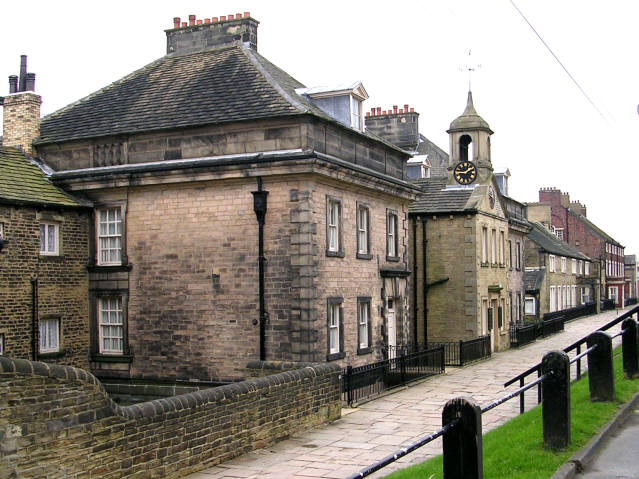
Many of the 18th-century stone houses in the village are listed buildings.

The fee-paying Fulneck School, established in 1753, forms a major part of the Moravian village.

Founded in 1892, Fulneck Golf Club is the oldest golf club in the Leeds area.

In recent years, a restaurant and cafe occupied an 18th-century listed building, that was the original shop for the settlement. Shop records still survive from its opening in 1762, and are believed to be some of the oldest shop archives in the UK. The premises are now run by Cafe 54 and Antiques and open every day except Saturday.

The Moravian Museum (opposite the church) has operated since 1969 and is open Saturdays and Wednesdays 2 pm-4 pm from April to September.

There are a number of footpaths and scenic walks in the area, including a footpath between Fulneck and the nearby village of Tong and the Leeds Country Way.

Notable people

[edit]
No.34 Fulneck, home of Benjamin Latrobe

See also

[edit]

References

[edit]
[edit]
Revisions and contributorsEdit on WikipediaRead on Wikipedia
from Grokipedia
The Fulneck Moravian Settlement is a historic religious community and planned village in , , , founded in 1743 by members of the as the first such settlement in the country. Established on a 22-acre hillside estate originally known as Fallneck, it was renamed Fulneck after the Moravian town of Fulnek, birthplace of the influential educator Jan Amos Comenius, and developed as a self-sufficient enclave reflecting the church's emphasis on communal piety and disciplined living. The settlement's origins trace back to the , a Protestant denomination descended from the 15th-century Unity of the Brethren in , which sought refuge from persecution and arrived in Britain in the 1720s under the patronage of Count Nikolaus Ludwig von Zinzendorf. In 1743, Zinzendorf selected the site, and land was purchased for £905; construction began soon after, with the of the central church—known as Grace Hall—laid in 1746 and the building completed in 1748. The community was designed with a linear layout along a one-way road and cobbled walkway, featuring purpose-built structures including choir houses for single brothers and sisters, a burial ground called God’s Acre consecrated in 1749, and various trades workshops that supported self-sufficiency through activities like blacksmithing, baking, weaving, and tailoring. Unique Moravian customs shaped daily life, such as arranged marriages determined by drawing lots (known as The Lot), the absence of mourning clothes at funerals, and an annual dawn service at the graveyard to emphasize resurrection over grief. By the mid-18th century, Fulneck had grown into a vibrant hub, with boys' and girls' schools opening in 1753 and 1755, respectively—these later merged into co-educational in 1994, which closed on 8 July 2025 after 272 years of operation. The settlement's architecture, largely Georgian in style with parallel terraces of cottages and public buildings, has preserved much of its 18th-century character, with nearly all structures (save one) remaining under church ownership. As of 2013, it housed around 98 residents, over 90% of whom are Moravians, maintaining traditions like monthly love-feasts and communion services while fostering a close-knit community with a waiting list for its approximately 40 homes. The closure of in July 2025 marked the end of over 270 years of educational tradition within the settlement, though the community continues to maintain its religious and cultural practices. Complementing its living heritage, the Fulneck Moravian Museum, opened in 1969 within two restored 17th-century cottages, showcases the settlement's history through exhibits of 18th-century Moravian and , international artifacts like Tibetan brassware and Labrador carvings, and recreated Victorian interiors including a chamber and an 1822 hand-pulled . The site also includes modern amenities such as an , craft centre, and the restaurant Zachary’s, housed in a building originally serving as a shop since 1771, underscoring Fulneck's evolution from isolated pious enclave to a preserved cultural landmark open to visitors.

Location and Naming

Geographical Setting

The Fulneck Moravian Settlement is situated in within the metropolitan borough, , . It occupies the OS grid reference SE 22210 31999 and falls under the postcode district LS28, with the local dialling code 0113. The settlement lies on a hillside at coordinates 53°47′01″N 1°39′53″W, overlooking the Tong and Fulneck where Pudsey Beck flows at the base. Historically part of the West Riding of Yorkshire until its abolition in 1974, Fulneck now forms part of the expanded Leeds urban area but preserves a semi-rural character distinct from the surrounding conurbation. It is adjacent to the town of Pudsey and approximately 6 miles (10 km) west of Leeds city centre.

Etymology

The name of the Fulneck Moravian Settlement traces its origins to a local designation recorded in 1592 as "Falle Necke," derived from Old English fall, denoting a clearing or felled area, and hnecca, referring to a narrow neck of land or ridge that characterized the site's topography. This early form evolved in subsequent records to variants such as "Fallneck" or "Falneck," reflecting phonetic adaptations in local usage through the 17th and early 18th centuries, as evidenced in parish registers and antiquarian accounts of Pudsey township. An alternative interpretation, suggesting "Fall'n ac" from Saxon roots meaning a fallen oak on an uncultivated common, appears in historical conjectures but lacks primary attestation and is generally discounted in favor of the topographical derivation. In 1744, upon the establishment of the Moravian settlement, the name was changed to "Fulneck" by the settlers, who adopted it to honor Fulnek in (present-day ), the birthplace of the influential Moravian bishop and educator Jan Amos Comenius and a site associated with 15th-century persecutions of the Unity of the Brethren, including exiles from the Fulnek region in 1481. This renaming supplanted both the proposed Moravian term "Lambshill," inspired by biblical imagery, and the prevailing local "Fallneck," marking a deliberate linkage to the church's Bohemian-Moravian heritage amid their flight from Habsburg persecution. The name "Fulneck" gained official adoption in settlement records by the mid-18th century, appearing consistently in baptismal entries from 1744 onward and in legal documents such as the 1813 act for the Fulneck estate, solidifying its use as the settlement's enduring identifier.

Historical Development

Founding and Early Settlement

The , known formally as the Unitas Fratrum or Unity of the Brethren, traces its origins to 15th-century , where followers of the proto-Protestant reformer established the church in 1457 amid . After centuries of suppression during the , remnants of the Bohemian Brethren renewed the movement in the under the patronage of Count Nikolaus Ludwig von Zinzendorf, a German nobleman and Lutheran pietist who envisioned self-sustaining communal settlements to foster spiritual renewal and missionary outreach. These refugees, fleeing Habsburg persecution, sought safe havens to practice their faith, drawing inspiration from the model of in , established in 1722 as the first such settlement. In 1743, Zinzendorf identified a suitable site in the , , during a visit to local religious societies, leading to the purchase of 22 acres of land known as Lambshill from William Moss for £905, negotiated by the Methodist clergyman Benjamin Ingham. Members of the , descendants of the Bohemian Brethren, arrived at the site in 1744 to begin establishing the settlement, driven by Zinzendorf's goal of creating a supportive community for single brethren and sisters organized into "s" based on age, marital status, and gender. Initial construction in the mid-1740s focused on a communal layout, including purpose-built choir houses for single brethren and sisters flanking the central area, reflecting the pietist emphasis on disciplined communal living and spiritual rebirth. A pivotal early event was the laying of the foundation stone for the , named Grace Hall, on September 13, , by Moravian elder John Toltschig, symbolizing the settlement's religious core. The was completed and consecrated in 1748, providing the first dedicated space for worship and community gatherings in this emerging self-sustaining enclave. By the late , the basic infrastructure supported a growing population committed to Zinzendorf's vision, marking Fulneck as the first Moravian settlement in .

Later Expansions and Events

In the mid-18th century, the Fulneck Moravian Settlement expanded its educational facilities with the establishment of a boys' boarding school in 1753, initially accommodating 25 students, followed by a girls' boarding school in 1755. These institutions, rooted in the Moravian emphasis on piety and learning, evolved to accept fee-paying pupils from 1804 onward, contributing to the settlement's growth as a center of learning. The two schools operated independently for over two centuries before merging in 1992 to form Fulneck School, a co-educational independent day and boarding institution that continued until its closure in July 2025 due to declining enrollment and financial pressures exacerbated by the COVID-19 pandemic. During the 19th century, Fulneck integrated with the burgeoning textile economy of West Yorkshire, where residents, particularly the Sisters' Choir, engaged in wool spinning, weaving, and needlework to sustain the community while trading with neighboring areas. This economic adaptation allowed the settlement to maintain its self-sufficiency through workshops, bakeries, and mills, even as regional industrialization drew some members toward urban opportunities in places like Manchester. However, the strict communal structure began to decline by the mid-1800s; the choir system—organizing life by age, gender, and marital status—faced Provincial Conference objections in 1842, leading to secularization and a shift toward more individualistic living arrangements. Challenges such as the trade depression of the 1840s and a typhoid epidemic in 1878 further tested the community's resilience, prompting diversification into farming, carpentry, and pottery. The 20th century brought profound disruptions from the World Wars, with claiming the lives of at least 16 men from the nearby Fairfield Moravian community, with 2 recorded burials at Fulneck, as residents integrated into British military service and emphasized amid strains on global Moravian unity. saw the settlement adopt an anti-war stance, with debates over and no recorded evacuations, though the conflict accelerated post-war reconciliation efforts, including a 1945 letter from Bishop Shawe and the 1946 Unity Conference. Following the wars, modernization initiatives included women's ordination approved at the 1957 Unity Synod, new infrastructure like science blocks and dormitories, and re-established international ties, such as visits to East German Moravians in the 1950s and 1970s–1980s. shifts reflected broader trends: the settlement peaked at 379 residents in 1805 but experienced gradual decline through the century, with a persistent female majority (around 62% in 1966) and an aging demographic due to property allocations favoring retired ministers. Into the , Fulneck has focused on preservation, with the Moravian retaining ownership of most properties and converting historic houses into apartments to sustain residency. Discussions for World Heritage recognition of Moravian settlements, as outlined in the 2024 nomination document, highlighted Fulneck as a comparable site to inscribed locations like Gracehill in , though it was not included in the serial property inscribed on the World Heritage List in July 2024, comprising Christiansfeld (), Herrnhut (), Bethlehem (), and Gracehill (). Adaptation to has grown, with the Fulneck and meditation walks promoting the site's heritage, while the 2025 school closure has prompted reflections on legacy amid ongoing efforts to balance tradition with modern needs.

Architecture and Built Environment

Moravian Chapel and Church

The Moravian Chapel at Fulneck, constructed between 1746 and 1748, stands as the settlement's central religious edifice, with its foundation stone laid on 21 May 1746 by Moravian leaders including John Toltschig and the building completed and dedicated as Grace Hall in 1748. This timeline reflects the rapid establishment of a dedicated worship space following the settlement's founding in 1743, enabling the community to centralize its spiritual activities amid the hillside terrain. The chapel received Grade I listed status on 17 May 1972, recognizing its exceptional architectural and historical importance within England's heritage. Architecturally, the chapel embodies the Civic Baroque style typical of settlements, drawing influence from German prototypes like those in , , while adapting to local Georgian conventions through symmetrical and brick facades, Tuscan columns, and Venetian windows. A prominent feature is the atop the rear , added in 1770 and fitted with a clock and weathervane, which enhances its visual dominance over the valley. Inside, the single-space interior includes a flat ceiling adorned with plaster foliage-decorated bosses and a historic organ installed in 1748 by Swiss builder John Snetzler, housed in a decorative fretted case that remains a focal point for musical . The functions as the heart of Fulneck's religious life, hosting daily prayers, rehearsals, and liturgical services that emphasize communal and Moravian hymnody. It is the venue for key festivals, including the dawn service commemorating the and the monthly Lovefeast on the first Sunday afternoon, where attendees share simple buns and coffee amid hymns to foster fellowship. In contemporary times, the space accommodates cultural events such as organ recitals, with monthly performances formerly led by resident Dr. Simon Lindley, who served as Organist Emeritus at Parish Church until his passing in 2025. Preservation efforts have sustained the chapel's integrity through the and into the present, including its formal listing and structural adaptations like the 1770 to address earlier design limitations. The organ received a comprehensive restoration in 2016 by Wood of , involving cleaning, part replacements, and tonal enhancements to revive its original Snetzler characteristics. As of 2025, ongoing maintenance supports active use, exemplified by participation in Heritage Open Days events focused on Moravian , ensuring the building's role in both worship and public .

Residential and Institutional Structures

The early residential layout of Fulneck Moravian Settlement was designed as a linear arrangement along a single terrace on a hillside, reflecting the Moravian Church's communal ideals of organized living for distinct social groups known as "." Purpose-built choir houses were constructed in the 1740s on either side of the central Grace Hall (now the church), with the Single Sisters' House accommodating women, widows, infants, and small children, and the Single Brethren's House housing men, widowers, and boys. These structures formed a planned, symmetrical composition facing south onto the terrace, emphasizing community cohesion and separation by life stage and . Later expansions in the 1749–1752 period added family accommodations, adapting to marriages arranged through the Moravian "Lot" system, while maintaining the settlement's orderly, one-way road and lower cobbled walkway. Institutional buildings complemented this residential core, integrating educational facilities directly into the terrace. The Boys' School opened in 1753 with 25 pupils, attached to the Brethren's House, followed by the Girls' School in 1755 linked to the Sisters' House; both were expanded with link blocks in 1768–1770 and 1784–1785, and a new Boys' School building erected in 1784. These three-storey structures, now part of —a co-educational, fee-paying independent institution since the schools' merger in 1992, which closed on 8 July 2025—feature hammer-dressed stone facades, red-brown brick in Flemish bond, pilaster strips, raised , and stone slate roofs, creating a unified range with the adjacent choir houses. The Moravian Museum, established in 1969, occupies two converted derelict buildings opposite the church, preserving artifacts related to the settlement's history while serving as a non-residential institutional space. Architectural design in Fulneck blended local Yorkshire materials, such as hammer-dressed stone and , with Moravian principles of and uniformity inspired by the settlement in . This is evident in residential examples like No. 34 Fulneck, the birthplace in 1764 of , who contributed to the settlement's structures, and Nelson House (No. 29), a late-18th-century two-storey building with , a plinth, mullioned windows, and a mid-19th-century canted bay, once home to and Charles Sebastian Nelson. The overall terrace exemplifies Georgian influences adapted to the hillside topography, forgoing a traditional grid for a linear form that prioritized communal visibility and access. In modern times, many structures have undergone adaptations to balance preservation with contemporary use, such as the conversion of parts of Nelson House into flats above former facilities while retaining its historical fabric. The original 18th-century buildings were refurbished in recent decades with upgraded facilities, including a 20th-century science block and dormitories. These changes have maintained the settlement's architectural integrity as a Grade I listed ensemble, ensuring the terrace's enduring role as a residential and institutional hub.

Community and Facilities

Religious and Cultural Practices

The Fulneck Moravian Settlement has long emphasized core practices rooted in the teachings of Count Nikolaus Ludwig von Zinzendorf, who promoted personal piety, communal fellowship, and a Christ-centered life inspired by the early Christian community at . Central to this is the historical choir system, which organized unmarried members into groups based on age, gender, and marital status—such as single sisters, single brothers, and youth choirs—to foster spiritual growth and mutual support within segregated living quarters. This structure encouraged daily devotionals, including hymn-singing and shared meals, reflecting Zinzendorf's vision of the church as a living "Gemeine" (congregation) where faith was expressed through relational bonds rather than rigid dogma. Lovefeasts, revived by the Moravians in 1727 and practiced monthly at Fulneck since the settlement's founding, exemplify this ethos; these services involve communal singing of hymns, a simple shared meal of tea and specially baked buns, and a review of church activities to promote unity and equality among participants. In the , Fulneck's practices were marked by distinctive customs that reinforced communal discipline and self-reliance. Residents lived in separate choir houses to maintain and age segregation, minimizing distractions and enabling focused spiritual development, while daily routines incorporated hymn-singing—drawing from the Moravian hymnal of , which contained over 900 hymns, many authored by Zinzendorf himself—and collective labor in a self-contained . This sustained the settlement through trades such as weaving, baking, wool spinning, farming, and milling, with goods produced for internal use and external sale, all under the oversight of the to embody Zinzendorf's ideals of honest work as worship. Such practices created a vibrant, enclosed community life, where personal piety was nurtured through regular "Singstunden" (song hours) and choir-specific ceremonies marking life transitions. Cultural events continue to anchor Fulneck's traditions, blending historical rituals with seasonal observances. The annual dawn service, held in the settlement's graveyard, commemorates the with trumpet calls and hymns, a practice echoing Moravian customs from the and fostering communal reflection at sunrise. Christmas celebrations feature the lighting of candles over four Sundays, culminating in a central on Day, alongside nativity scenes (known as "Putz") that emphasize Christ's and inspire acts of charity, such as support for local homeless shelters. A hallmark is the display of lanterns, originating from a 1830s geometry project at the Niesky Moravian school in ; at Fulneck, a large white star adorns the church bell tower from Advent until Epiphany, symbolizing Christ as the "bright Morning Star," with smaller stars illuminating cottage windows and the . By 2025, Fulneck's practices have evolved from strict 18th-century communalism to an integrated , with choir houses repurposed as private apartments rented primarily to church members and retirees, while retaining the church as a hub for worship. Monthly services, including Lovefeasts and Holy Communion, persist alongside ecumenical outreach through membership in Churches Together in and , promoting interdenominational fellowship. The active Moravian Singers and heritage events, such as organ recitals and hymn workshops, sustain cultural vitality, adapting Zinzendorf's emphasis on piety to contemporary life without the former economic isolation.

Educational and Recreational Amenities

Fulneck School, an independent co-educational day and boarding institution, operated within the settlement from its merger of separate boys' and girls' schools in 1992 until its closure on July 8, 2025, serving nearly 300 pupils aged 3 to 18 in its final years. The school's curriculum emphasized a broad education in subjects such as English, mathematics, sciences, humanities, and physical education, while incorporating Moravian principles of learning, service, and community to prepare students for further studies and personal development. Founded originally in 1753 to educate the children of Moravian ministers and missionaries, it represented a longstanding educational tradition in the settlement before declining enrollment led to its closure. The Fulneck Moravian Museum, established on July 9, 1969, preserves and displays artifacts and memorabilia from the settlement's history, including 18th-century Moravian , , and items reflecting daily in the pioneer . Housed in a historic building, the museum offers guided insights into the 18th-century Moravian way of through exhibits of period furnishings, , and objects, attracting visitors interested in religious and . It operates on Wednesdays and Saturdays from 1:30 p.m. to 4 p.m. between April and September, with free admission supported by donations. Recreational facilities in Fulneck include the Fulneck Golf Club, founded in 1892 and recognized as the oldest golf club in the Leeds area, located on the settlement's outskirts amid the scenic Fulneck Valley. The club's nine-hole course offers a picturesque and challenging layout with views of the surrounding countryside, welcoming members and visitors for golfing and social events in its function suite. Complementing this are walking trails such as the Meditation Walk, a self-guided path tracing the settlement's historical sites and commemorating its 250th anniversary in 1996, and the broader Tong and Fulneck Valley route, which winds through wooded valleys, ancient tracks, and key Moravian landmarks for a 4.9-mile moderate hike. The settlement's small community supports additional amenities like a multipurpose hall used for local events, including heritage open days and classic car shows, fostering social gatherings among residents and visitors. Limited commercial facilities reflect the area's intimate scale, featuring a historic listed shop building now adapted for a café and a small art gallery with craft center offering local handmade goods and Zachary's restaurant for casual dining.

People and Legacy

Notable Residents

One of the earliest notable figures associated with Fulneck was (1764–1820), born on 1 May 1764 at No. 34 in the settlement to Reverend Benjamin Latrobe, a Moravian minister, and Anna Margaretta Antes. He grew up in the close-knit Moravian community, receiving his early education at before attending the Moravian academy in . Latrobe later became a pioneering architect , serving as the second from 1803 and designing key elements of the , including neoclassical interiors and symbolic motifs like corncob and tobacco leaf capitals that incorporated American flora. His work extended to the and other public buildings, establishing him as a foundational influence on early American architecture. A from The Society marks his birthplace at No. 34 Fulneck today. In the 19th century, Fulneck's educational environment shaped several influential reformers and leaders. Elizabeth Wolstenholme Elmy (1833–1918), orphaned young, attended for two years starting in 1848, where her grandfather funded her and she developed a passion for learning amid the Moravian emphasis on discipline and scholarship. After leaving, she worked as a and teacher, eventually becoming a leading suffragette and feminist campaigner, co-founding the National for Women's Suffrage in 1867 and advocating for , , and emancipation over five decades. Emmeline Pankhurst later credited her as the "brains behind the suffragette movement" for her strategic organizing and unyielding advocacy. James Montgomery (1771–1854), another key figure, was sent to in 1777 after his parents, Moravian missionaries, departed for the West Indies; he studied there until 1787, honing his literary talents despite initial discouragement from secular pursuits. Montgomery became a prolific hymn writer and poet, authoring over 300 hymns including "Hail to the Lord's Anointed" and editing the Sheffield Iris newspaper, where he championed abolitionism and social reform. The late 19th and early 20th centuries saw Fulneck connected to political and missionary legacies. Herbert Henry Asquith (1852–1928), orphaned early and sent as a boarder to from 1861 to 1863, endured an unhappy experience there before transferring to the . He rose to become a prominent Liberal politician, serving as from 1908 to 1916, introducing old-age pensions, the 1911 Parliament Act limiting the ' power, and navigating crises like Irish Home Rule and the lead-up to . Fulneck's school magazine tracked his career milestones, from his 1886 election as MP to his premiership. Among Moravian leaders, figures like Reverend Benjamin La Trobe, the architect's father, served as a minister at Fulneck from the 1760s, overseeing community spiritual life and contributing to the church's pulpit design. Missionaries such as John Montgomery, James's father, exemplified Fulneck's global outreach, departing in 1783 for missionary work in the while leaving their son to the settlement's care. In the 20th century, Fulneck produced modern cultural icons. Dame Diana Rigg (1938–2020), born in and raised partly in , boarded at Fulneck Girls' School in the 1950s, where the strict Moravian regimen frustrated her but her speech and drama teacher, Sylvia Greenwood, sparked her interest in acting. She later trained at RADA and achieved stardom as in the 1960s TV series The Avengers, earning global fame for her poised, athletic portrayal, and as Lady Olenna Tyrell in from 2013 to 2017, delivering sharp-witted performances that won her new acclaim. Rigg was made a Dame in 1994 for her contributions to drama and revisited Fulneck in 2007. Sir Leonard Hutton (1916–1990), born in Fulneck to a local family, grew up in the settlement's Moravian community and played cricket for Pudsey St Lawrence before debuting for in 1934. As an opening batsman for in 79 Tests, he set the record for the highest (364 in 1938) and captained the side from 1952 to 1955, cementing his status as one of cricket's greatest. A at his Fulneck birthplace honors this legacy.

Cultural and Historical Significance

Fulneck Moravian Settlement represents one of the principal Moravian communities in Britain, alongside Fairfield, Ockbrook, and Gracehill, serving as a prime example of 18th-century pietist communalism within the Moravian Church's European expansion. Founded in 1743 under the guidance of Count Nikolaus Ludwig von Zinzendorf, it became the first such settlement in , embodying the Pietist movement's emphasis on individual spiritual rebirth and organized communal living modeled after earlier sites like . This communal structure, which included self-sufficient trades and distinct housing for different groups, reflected the Unitas Fratrum's ancient roots dating to 1457 while adapting to English contexts. The settlement's cultural impact extends to shaping the religious landscape of , where it influenced Protestant developments, notably through interactions that inspired and contributed to the origins of . Its educational initiatives, drawing from Jan Amos Comenius's progressive methods that prioritized reasoning and music, established enduring models for religious schooling in the region, with institutions founded as early as 1753. Architecturally, Fulneck's planned layout and buildings exemplify Moravian ideals of unity and simplicity, influencing later communal designs across the . Preservation at Fulneck is robust, with the chapel designated as a Grade I listed building and surrounding structures as Grade II, safeguarding the site's 18th-century integrity against surrounding urban development in . The Fulneck Moravian Museum, established in 1969, serves as an educational hub displaying artifacts from settlement life and Moravian missions, complemented by guided tours that promote public understanding of this heritage. Tourism is facilitated through annual events like Heritage Open Days, which draw visitors to explore the site's history, though the community faces challenges from its small size—approximately 98 residents as of recent counts—and external pressures such as the 2025 closure of due to declining enrollment. As of 2025, Fulneck maintains contemporary relevance through its participation in ecumenical initiatives, aligning with the Moravian Church's longstanding endorsement of Christian unity as affirmed in post-1957 synods. Annual festivals, including the Starlight Festival and Heritage Open Days, continue to attract visitors and reinforce community bonds, while scholarly works on Moravian —such as the 2022 study on the Moravian Star's origins—underscore the settlement's role in global historical narratives.

References

Add your contribution
Related Hubs
User Avatar
No comments yet.