



Community hub
Recent from talks
Contribute something
Nothing was collected or created yet.
Fuzzy logic
View on WikipediaFuzzy logic is a form of many-valued logic in which the truth value of variables may be any real number between 0 and 1. It is employed to handle the concept of partial truth, where the truth value may range between completely true and completely false.[1] By contrast, in Boolean logic, the truth values of variables may only be the integer values 0 or 1.
The term fuzzy logic was introduced with the 1965 proposal of fuzzy set theory by mathematician Lotfi Zadeh.[2][3] Fuzzy logic had, however, been studied since the 1920s, as infinite-valued logic—notably by Łukasiewicz and Tarski.[4]
Fuzzy logic is based on the observation that people make decisions based on imprecise and non-numerical information. Fuzzy models or fuzzy sets are mathematical means of representing vagueness and imprecise information (hence the term fuzzy). These models have the capability of recognising, representing, manipulating, interpreting, and using data and information that are vague and lack certainty.[5][6]
Fuzzy logic has been applied to many fields, from control theory to artificial intelligence.
Overview
[edit]Classical logic only permits conclusions that are either true or false. However, there are also propositions with variable answers, which one might find when asking a group of people to identify a color. In such instances, the truth appears as the result of reasoning from inexact or partial knowledge in which the sampled answers are mapped on a spectrum.[7]
Both degrees of truth and probabilities range between 0 and 1 and hence may seem identical at first, but fuzzy logic uses degrees of truth as a mathematical model of vagueness, while probability is a mathematical model of ignorance.[8]
Applying truth values
[edit]A basic application might characterize various sub-ranges of a continuous variable. For instance, a temperature measurement for anti-lock brakes might have several separate membership functions defining particular temperature ranges needed to control the brakes properly. Each function maps the same temperature value to a truth value in the 0 to 1 range. These truth values can then be used to determine how the brakes should be controlled.[9] Fuzzy set theory provides a means for representing uncertainty.
Linguistic variables
[edit]In fuzzy logic applications, non-numeric values are often used to facilitate the expression of rules and facts.[10]
A linguistic variable such as age may accept values such as young and its antonym old. Because natural languages do not always contain enough value terms to express a fuzzy value scale, it is common practice to modify linguistic values with adjectives or adverbs. For example, we can use the hedges rather and somewhat to construct the additional values rather old or somewhat young.[11]
Fuzzy systems
[edit]Mamdani
[edit]The most well-known system is the Mamdani rule-based one.[12] It uses the following rules:
- Fuzzify all input values into fuzzy membership functions.
- Execute all applicable rules in the rulebase to compute the fuzzy output functions.
- De-fuzzify the fuzzy output functions to get "crisp" output values.
Fuzzification
[edit]Fuzzification is the process of assigning the numerical input of a system to fuzzy sets with some degree of membership. This degree of membership may be anywhere within the interval [0,1]. If it is 0 then the value does not belong to the given fuzzy set, and if it is 1 then the value completely belongs within the fuzzy set. Any value between 0 and 1 represents the degree of uncertainty that the value belongs in the set. These fuzzy sets are typically described by words, and so by assigning the system input to fuzzy sets, we can reason with it in a linguistically natural manner.
For example, in the image below, the meanings of the expressions cold, warm, and hot are represented by functions mapping a temperature scale. A point on that scale has three "truth values"—one for each of the three functions. The vertical line in the image represents a particular temperature that the three arrows (truth values) gauge. Since the red arrow points to zero, this temperature may be interpreted as "not hot"; i.e. this temperature has zero membership in the fuzzy set "hot". The orange arrow (pointing at 0.2) may describe it as "slightly warm" and the blue arrow (pointing at 0.8) "fairly cold". Therefore, this temperature has 0.2 membership in the fuzzy set "warm" and 0.8 membership in the fuzzy set "cold". The degree of membership assigned for each fuzzy set is the result of fuzzification.

Fuzzy sets are often defined as triangle or trapezoid-shaped curves, as each value will have a slope where the value is increasing, a peak where the value is equal to 1 (which can have a length of 0 or greater) and a slope where the value is decreasing.[13] They can also be defined using a sigmoid function.[14] One common case is the standard logistic function defined as
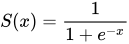
which has the following symmetry property

From this it follows that

Fuzzy logic operators
[edit]Fuzzy logic works with membership values in a way that mimics Boolean logic. To this end, replacements for basic operators ("gates") AND, OR, NOT must be available. There are several ways to accomplish this. A common replacement is called the Zadeh operators:
| Boolean | Fuzzy |
|---|---|
| AND(x, y) | MIN(x, y) |
| OR(x, y) | MAX(x, y) |
| NOT(x) | 1 – x |
For TRUE/1 and FALSE/0, the fuzzy expressions produce the same result as the Boolean expressions.
There are also other operators, more linguistic in nature, called hedges that can be applied. These are generally adverbs such as very, or somewhat, which modify the meaning of a set using a mathematical formula.[15]
However, an arbitrary choice table does not always define a fuzzy logic function. In the paper (Zaitsev, et al),[16] a criterion has been formulated to recognize whether a given choice table defines a fuzzy logic function and a simple algorithm of fuzzy logic function synthesis has been proposed based on introduced concepts of constituents of minimum and maximum. A fuzzy logic function represents a disjunction of constituents of minimum, where a constituent of minimum is a conjunction of variables of the current area greater than or equal to the function value in this area (to the right of the function value in the inequality, including the function value).
Another set of AND/OR operators is based on multiplication, where
x AND y = x * y
NOT x = 1 - x

Hence,
x OR y = NOT( AND( NOT(x), NOT(y) ) )
x OR y = NOT( AND( 1 - x, 1 - y) )
x OR y = NOT( (1 - x) * (1 - y) )
x OR y = 1 - (1 - x) * (1-y)
x OR y = x + y - xy
Given any two of AND/OR/NOT, it is possible to derive the third. The generalization of AND is an instance of a t-norm.
IF-THEN rules
[edit]IF-THEN rules map input or computed truth values to desired output truth values. Example:
IF temperature IS very cold THEN fan_speed is stopped
IF temperature IS cold THEN fan_speed is slow
IF temperature IS warm THEN fan_speed is moderate
IF temperature IS hot THEN fan_speed is high
Given a certain temperature, the fuzzy variable hot has a certain truth value, which is copied to the high variable.
Should an output variable occur in several THEN parts, then the values from the respective IF parts are combined using the OR operator.
Defuzzification
[edit]The goal is to get a continuous variable from fuzzy truth values.[17][18]
This would be easy if the output truth values were exactly those obtained from fuzzification of a given number. Since, however, all output truth values are computed independently, in most cases they do not represent such a set of numbers.[18] One has then to decide for a number that matches best the "intention" encoded in the truth value. For example, for several truth values of fan_speed, an actual speed must be found that best fits the computed truth values of the variables 'slow', 'moderate' and so on.[18]
There is no single algorithm for this purpose.
A common algorithm is
- For each truth value, cut the membership function at this value
- Combine the resulting curves using the OR operator
- Find the center-of-weight of the area under the curve
- The x position of this center is then the final output.
Takagi–Sugeno–Kang (TSK)
[edit]The TSK system[19] is similar to Mamdani, but the defuzzification process is included in the execution of the fuzzy rules. These are also adapted, so that instead the consequent of the rule is represented through a polynomial function (usually constant or linear). An example of a rule with a constant output would be:
IF temperature IS very cold = 2
In this case, the output will be equal to the constant of the consequent (e.g. 2). In most scenarios we would have an entire rule base, with 2 or more rules. If this is the case, the output of the entire rule base will be the average of the consequent of each rule i (Yi), weighted according to the membership value of its antecedent (hi):

An example of a rule with a linear output would be instead:
IF temperature IS very cold AND humidity IS high = 2 * temperature + 1 * humidity
In this case, the output of the rule will be the result of function in the consequent. The variables within the function represent the membership values after fuzzification, not the crisp values. Same as before, in case we have an entire rule base with 2 or more rules, the total output will be the weighted average between the output of each rule.
The main advantage of using TSK over Mamdani is that it is computationally efficient and works well within other algorithms, such as PID control and with optimization algorithms. It can also guarantee the continuity of the output surface. However, Mamdani is more intuitive and easier to work with by people. Hence, TSK is usually used within other complex methods, such as in adaptive neuro fuzzy inference systems.
Forming a consensus of inputs and fuzzy rules
[edit]Since the fuzzy system output is a consensus of all of the inputs and all of the rules, fuzzy logic systems can be well behaved when input values are not available or are not trustworthy. Weightings can be optionally added to each rule in the rulebase and weightings can be used to regulate the degree to which a rule affects the output values. These rule weightings can be based upon the priority, reliability or consistency of each rule. These rule weightings may be static or can be changed dynamically, even based upon the output from other rules.
Applications
[edit]Fuzzy logic is used in control systems to allow experts to contribute vague rules such as "if you are close to the destination station and moving fast, increase the train's brake pressure"; these vague rules can then be numerically refined within the system.
Many of the early successful applications of fuzzy logic were implemented in Japan. A first notable application was on the Sendai Subway 1000 series, in which fuzzy logic was able to improve the economy, comfort, and precision of the ride. It has also been used for handwriting recognition in Sony pocket computers, helicopter flight aids, subway system controls, improving automobile fuel efficiency, single-button washing machine controls, automatic power controls in vacuum cleaners, and early recognition of earthquakes through the Institute of Seismology Bureau of Meteorology, Japan.[20]
Artificial intelligence
[edit]Neural networks based artificial intelligence and fuzzy logic are, when analyzed, the same thing—the underlying logic of neural networks is fuzzy. A neural network will take a variety of valued inputs, give them different weights in relation to each other, combine intermediate values a certain number of times, and arrive at a decision with a certain value. Nowhere in that process is there anything like the sequences of either-or decisions which characterize non-fuzzy mathematics, computer programming, and digital electronics. In the 1980s, researchers were divided about the most effective approach to machine learning: decision tree learning or neural networks. The former approach uses binary logic, matching the hardware on which it runs, but despite great efforts it did not result in intelligent systems. Neural networks, by contrast, did result in accurate models of complex situations and soon found their way onto a multitude of electronic devices.[21] They can also now be implemented directly on analog microchips, as opposed to the previous pseudo-analog implementations on digital chips. The greater efficiency of these compensates for the intrinsic lesser accuracy of analog in various use cases.
Medical decision making
[edit]Fuzzy logic is an important concept in medical decision making. Since medical and healthcare data can be subjective or fuzzy, applications in this domain have a great potential to benefit a lot by using fuzzy-logic-based approaches.
Fuzzy logic can be used in many different aspects within the medical decision making framework. Such aspects include[22][23][24][clarification needed] in medical image analysis, biomedical signal analysis, segmentation of images[25] or signals, and feature extraction / selection of images[25] or signals.[26]
The biggest question in this application area is how much useful information can be derived when using fuzzy logic. A major challenge is how to derive the required fuzzy data. This is even more challenging when one has to elicit such data from humans (usually, patients). As has been said
"The envelope of what can be achieved and what cannot be achieved in medical diagnosis, ironically, is itself a fuzzy one"
— Seven Challenges, 2019.[27]
How to elicit fuzzy data, and how to validate the accuracy of the data is still an ongoing effort, strongly related to the application of fuzzy logic. The problem of assessing the quality of fuzzy data is a difficult one. This is why fuzzy logic is a highly promising possibility within the medical decision making application area but still requires more research to achieve its full potential.[27]
Image-based computer-aided diagnosis
[edit]One of the common application areas of fuzzy logic is image-based computer-aided diagnosis in medicine.[28] Computer-aided diagnosis is a computerized set of inter-related tools that can be used to aid physicians in their diagnostic decision-making.
Fuzzy databases
[edit]Once fuzzy relations are defined, it is possible to develop fuzzy relational databases. The first fuzzy relational database, FRDB, appeared in Maria Zemankova's dissertation (1983). Later, some other models arose like the Buckles-Petry model, the Prade-Testemale Model, the Umano-Fukami model or the GEFRED model by J. M. Medina, M. A. Vila et al.
Fuzzy querying languages have been defined, such as the SQLf by P. Bosc et al. and the FSQL by J. Galindo et al. These languages define some structures in order to include fuzzy aspects in the SQL statements, like fuzzy conditions, fuzzy comparators, fuzzy constants, fuzzy constraints, fuzzy thresholds, linguistic labels etc.
Logical analysis
[edit]In mathematical logic, there are several formal systems of "fuzzy logic", most of which are in the family of t-norm fuzzy logics.
Propositional fuzzy logics
[edit]The most important propositional fuzzy logics are:
- Monoidal t-norm-based propositional fuzzy logic MTL is an axiomatization of logic where conjunction is defined by a left continuous t-norm and implication is defined as the residuum of the t-norm. Its models correspond to MTL-algebras that are pre-linear commutative bounded integral residuated lattices.
- Basic propositional fuzzy logic BL is an extension of MTL logic where conjunction is defined by a continuous t-norm, and implication is also defined as the residuum of the t-norm. Its models correspond to BL-algebras.
- Łukasiewicz fuzzy logic is the extension of basic fuzzy logic BL where standard conjunction is the Łukasiewicz t-norm. It has the axioms of basic fuzzy logic plus an axiom of double negation, and its models correspond to MV-algebras.
- Gödel fuzzy logic is the extension of basic fuzzy logic BL where conjunction is the Gödel t-norm (that is, minimum). It has the axioms of BL plus an axiom of idempotence of conjunction, and its models are called G-algebras.
- Product fuzzy logic is the extension of basic fuzzy logic BL where conjunction is the product t-norm. It has the axioms of BL plus another axiom for cancellativity of conjunction, and its models are called product algebras.
- Fuzzy logic with evaluated syntax (sometimes also called Pavelka's logic), denoted by EVŁ, is a further generalization of mathematical fuzzy logic. While the above kinds of fuzzy logic have traditional syntax and many-valued semantics, in EVŁ syntax is also evaluated. This means that each formula has an evaluation. Axiomatization of EVŁ stems from Łukasziewicz fuzzy logic. A generalization of the classical Gödel completeness theorem is provable in EVŁ.[18]
Predicate fuzzy logics
[edit]Similar to the way predicate logic is created from propositional logic, predicate fuzzy logics extend fuzzy systems by universal and existential quantifiers. The semantics of the universal quantifier in t-norm fuzzy logics is the infimum of the truth degrees of the instances of the quantified subformula, while the semantics of the existential quantifier is the supremum of the same.
Decidability Issues
[edit]The notions of a "decidable subset" and "recursively enumerable subset" are basic ones for classical mathematics and classical logic. Thus the question of a suitable extension of them to fuzzy set theory is a crucial one. The first proposal in such a direction was made by E. S. Santos by the notions of fuzzy Turing machine, Markov normal fuzzy algorithm and fuzzy program (see Santos 1970). Successively, L. Biacino and G. Gerla argued that the proposed definitions are rather questionable. For example, in [29] one shows that the fuzzy Turing machines are not adequate for fuzzy language theory since there are natural fuzzy languages intuitively computable that cannot be recognized by a fuzzy Turing Machine. Then they proposed the following definitions. Denote by Ü the set of rational numbers in [0,1]. Then a fuzzy subset s : S [0,1] of a set S is recursively enumerable if a recursive map h : S×N Ü exists such that, for every x in S, the function h(x,n) is increasing with respect to n and s(x) = lim h(x,n). We say that s is decidable if both s and its complement –s are recursively enumerable. An extension of such a theory to the general case of the L-subsets is possible (see Gerla 2006). The proposed definitions are well related to fuzzy logic. Indeed, the following theorem holds true (provided that the deduction apparatus of the considered fuzzy logic satisfies some obvious effectiveness property).

Any "axiomatizable" fuzzy theory is recursively enumerable. In particular, the fuzzy set of logically true formulas is recursively enumerable in spite of the fact that the crisp set of valid formulas is not recursively enumerable, in general. Moreover, any axiomatizable and complete theory is decidable.
It is an open question to give support for a "Church thesis" for fuzzy mathematics, the proposed notion of recursive enumerability for fuzzy subsets is the adequate one. In order to solve this, an extension of the notions of fuzzy grammar and fuzzy Turing machine are necessary. Another open question is to start from this notion to find an extension of Gödel's theorems to fuzzy logic.
Compared to other logics
[edit]Probability
[edit]Fuzzy logic and probability address different forms of uncertainty. While both fuzzy logic and probability theory can represent degrees of certain kinds of subjective belief, fuzzy set theory uses the concept of fuzzy set membership, i.e., how much an observation is within a vaguely defined set, and probability theory uses the concept of subjective probability, i.e., frequency of occurrence or likelihood of some event or condition [clarification needed]. The concept of fuzzy sets was developed in the mid-twentieth century at Berkeley[30] as a response to the lack of a probability theory for jointly modelling uncertainty and vagueness.[31]
Bart Kosko claims in Fuzziness vs. Probability[32] that probability theory is a subtheory of fuzzy logic, as questions of degrees of belief in mutually-exclusive set membership in probability theory can be represented as certain cases of non-mutually-exclusive graded membership in fuzzy theory. In that context, he also derives Bayes' theorem from the concept of fuzzy subsethood. Lotfi A. Zadeh argues that fuzzy logic is different in character from probability, and is not a replacement for it. He fuzzified probability to fuzzy probability and also generalized it to possibility theory.[33]
More generally, fuzzy logic is one of many different extensions to classical logic intended to deal with issues of uncertainty outside of the scope of classical logic, the inapplicability of probability theory in many domains, and the paradoxes of Dempster–Shafer theory.
Ecorithms
[edit]Computational theorist Leslie Valiant uses the term ecorithms to describe how many less exact systems and techniques like fuzzy logic (and "less robust" logic) can be applied to learning algorithms. Valiant essentially redefines machine learning as evolutionary. In general use, ecorithms are algorithms that learn from their more complex environments (hence eco-) to generalize, approximate and simplify solution logic. Like fuzzy logic, they are methods used to overcome continuous variables or systems too complex to completely enumerate or understand discretely or exactly.[34] Ecorithms and fuzzy logic also have the common property of dealing with possibilities more than probabilities, although feedback and feed forward, basically stochastic weights, are a feature of both when dealing with, for example, dynamical systems.
Gödel G∞ logic
[edit]Another logical system where truth values are real numbers between 0 and 1 and where AND & OR operators are replaced with MIN and MAX is Gödel's G∞ logic. This logic has many similarities with fuzzy logic but defines negation differently and has an internal implication. Negation and implication are defined as follows:

![{\displaystyle {\xrightarrow[{G}]{}}}](https://wikimedia.org/api/rest_v1/media/math/render/svg/22501998f5f47d87375c66727b3a00f4d0abdb5d)
![{\displaystyle {\begin{aligned}\neg _{G}u&={\begin{cases}1,&{\text{if }}u=0\\0,&{\text{if }}u>0\end{cases}}\\[3pt]u\mathrel {\xrightarrow[{G}]{}} v&={\begin{cases}1,&{\text{if }}u\leq v\\v,&{\text{if }}u>v\end{cases}}\end{aligned}}}](https://wikimedia.org/api/rest_v1/media/math/render/svg/d276c8d6a62bcba62243231f1ebf09984825b63d)
which turns the resulting logical system into a model for intuitionistic logic, making it particularly well-behaved among all possible choices of logical systems with real numbers between 0 and 1 as truth values. In this case, implication may be interpreted as "x is less true than y" and negation as "x is less true than 0" or "x is strictly false", and for any and , we have that . In particular, in Gödel logic negation is no longer an involution and double negation maps any nonzero value to 1.


![{\displaystyle {\text{AND}}(x,x\mathrel {\xrightarrow[{G}]{}} y)={\text{AND}}(x,y)}](https://wikimedia.org/api/rest_v1/media/math/render/svg/f2cad129c8c32382d2a9f96e270d228e0940145b)
Compensatory fuzzy logic
[edit]Compensatory fuzzy logic (CFL) is a branch of fuzzy logic with modified rules for conjunction and disjunction. When the truth value of one component of a conjunction or disjunction is increased or decreased, the other component is decreased or increased to compensate. This increase or decrease in truth value may be offset by the increase or decrease in another component. An offset may be blocked when certain thresholds are met. Proponents[who?] claim that CFL allows for better computational semantic behaviors and mimic natural language.[vague][35]
According to Jesús Cejas Montero (2011) The Compensatory fuzzy logic consists of four continuous operators: conjunction (c); disjunction (d); fuzzy strict order (or); and negation (n). The conjunction is the geometric mean and its dual as conjunctive and disjunctive operators.[36]
Markup language standardization
[edit]The IEEE 1855, the IEEE STANDARD 1855–2016, is about a specification language named Fuzzy Markup Language (FML)[37] developed by the IEEE Standards Association. FML allows modelling a fuzzy logic system in a human-readable and hardware independent way. FML is based on eXtensible Markup Language (XML). The designers of fuzzy systems with FML have a unified and high-level methodology for describing interoperable fuzzy systems. IEEE STANDARD 1855–2016 uses the W3C XML Schema definition language to define the syntax and semantics of the FML programs.
Prior to the introduction of FML, fuzzy logic practitioners could exchange information about their fuzzy algorithms by adding to their software functions the ability to read, correctly parse, and store the result of their work in a form compatible with the Fuzzy Control Language (FCL) described and specified by Part 7 of IEC 61131.[38][39]
See also
[edit]

- Bayesian inference
- Expert system
- False dilemma
- Fuzzy architectural spatial analysis
- Fuzzy classification
- Fuzzy concept
- Fuzzy control system
- Fuzzy electronics
- Fuzzy subalgebra
- FuzzyCLIPS
- High performance fuzzy computing
- IEEE Transactions on Fuzzy Systems
- Interval finite element
- Noise-based logic
- Paraconsistent logic
- Rough set
- Sorites paradox
- Trinary logic
- Type-2 fuzzy sets and systems
- Vector logic
References
[edit]- ^ Novák, V.; Perfilieva, I.; Močkoř, J. (1999). Mathematical principles of fuzzy logic. Dordrecht: Kluwer Academic. ISBN 978-0-7923-8595-0.
- ^ "Fuzzy Logic". Stanford Encyclopedia of Philosophy. Bryant University. 23 July 2006. Retrieved 30 September 2008.
- ^ Zadeh, L. A. (June 1965). "Fuzzy sets". Information and Control. 8 (3). San Diego: 338–353. doi:10.1016/S0019-9958(65)90241-X. ISSN 0019-9958. Zbl 0139.24606. Wikidata Q25938993.
- ^ Pelletier, Francis Jeffry (2000). "Review of Metamathematics of fuzzy logics" (PDF). The Bulletin of Symbolic Logic. 6 (3): 342–346. doi:10.2307/421060. JSTOR 421060. Archived (PDF) from the original on 3 March 2016.
- ^ "What is Fuzzy Logic? "Mechanical Engineering Discussion Forum"". mechanicalsite.com. Archived from the original on 11 November 2018. Retrieved 11 November 2018.
- ^ Babuška, Robert (1998). Fuzzy Modeling for Control. Springer Science & Business Media. ISBN 978-94-011-4868-9.
- ^ "Fuzzy Logic". YouTube. 9 May 2013. Archived from the original on 5 December 2021. Retrieved 11 May 2020.
- ^ Asli, Kaveh Hariri; Aliyev, Soltan Ali Ogli; Thomas, Sabu; Gopakumar, Deepu A. (23 November 2017). Handbook of Research for Fluid and Solid Mechanics: Theory, Simulation, and Experiment. CRC Press. ISBN 978-1-315-34150-7.
- ^ Chaudhuri, Arindam; Mandaviya, Krupa; Badelia, Pratixa; Ghosh, Soumya K. (23 December 2016). Optical Character Recognition Systems for Different Languages with Soft Computing. Springer. ISBN 978-3-319-50252-6.
- ^ Zadeh, L. A.; et al. (1996). Fuzzy Sets, Fuzzy Logic, Fuzzy Systems. World Scientific Press. ISBN 978-981-02-2421-9.
- ^ Zadeh, L. A. (January 1975). "The concept of a linguistic variable and its application to approximate reasoning—I". Information Sciences. 8 (3): 199–249. doi:10.1016/0020-0255(75)90036-5.
- ^ Mamdani, E. H. (1974). "Application of fuzzy algorithms for control of simple dynamic plant". Proceedings of the Institution of Electrical Engineers. 121 (12): 1585–1588. doi:10.1049/PIEE.1974.0328.
- ^ Xiao, Zhi; Xia, Sisi; Gong, Ke; Li, Dan (1 December 2012). "The trapezoidal fuzzy soft set and its application in MCDM". Applied Mathematical Modelling. 36 (12): 5846–5847. doi:10.1016/j.apm.2012.01.036. ISSN 0307-904X.
- ^ Wierman, Mark J. "An Introduction to the Mathematics of Uncertainty: including Set Theory, Logic, Probability, Fuzzy Sets, Rough Sets, and Evidence Theory" (PDF). Creighton University. Archived (PDF) from the original on 30 July 2012. Retrieved 16 July 2016.
- ^ Zadeh, L. A. (January 1972). "A Fuzzy-Set-Theoretic Interpretation of Linguistic Hedges". Journal of Cybernetics. 2 (3): 4–34. doi:10.1080/01969727208542910. ISSN 0022-0280.
- ^ Zaitsev, D. A.; Sarbei, V. G.; Sleptsov, A. I. (1998). "Synthesis of continuous-valued logic functions defined in tabular form". Cybernetics and Systems Analysis. 34 (2): 190–195. doi:10.1007/BF02742068. S2CID 120220846.
- ^ Hájek, Petr (1998). Metamathematics of fuzzy logic (4 ed.). Springer Science & Business Media.
- ^ a b c d Kaveh Hariri Asli; Soltan Ali Ogli Aliyev; Sabu Thomas; Deepu Gopakumar; Hossein Hariri Asli (November 2017). "Fuzzy Logic". ResearchGate. Retrieved 15 December 2024.
- ^ Takagi, Tomohiro; Sugeno, Michio (January 1985). "Fuzzy identification of systems and its applications to modeling and control". IEEE Transactions on Systems, Man, and Cybernetics. SMC-15 (1): 116–132. doi:10.1109/TSMC.1985.6313399. S2CID 3333100.
- ^ Bansod, Nitin A; Kulkarni, Marshall; Patil, S. H. (2005). "Soft Computing- A Fuzzy Logic Approach". In Bharati Vidyapeeth College of Engineering (ed.). Soft Computing. Allied Publishers. p. 73. ISBN 978-81-7764-632-0. Retrieved 9 November 2018.
- ^ Elkan, Charles (1994). "The paradoxical success of fuzzy logic". IEEE Expert. 9 (4): 3–49. CiteSeerX 10.1.1.100.8402. doi:10.1109/64.336150. S2CID 113687.
- ^ Lin, K. P.; Chang, H. F.; Chen, T. L.; Lu, Y. M.; Wang, C. H. (2016). "Intuitionistic fuzzy C-regression by using least squares support vector regression". Expert Systems with Applications. 64: 296–304. doi:10.1016/j.eswa.2016.07.040.
- ^ Deng, H.; Deng, W.; Sun, X.; Ye, C.; Zhou, X. (2016). "Adaptive intuitionistic fuzzy enhancement of brain tumor MR images". Scientific Reports. 6 35760. Bibcode:2016NatSR...635760D. doi:10.1038/srep35760. PMC 5082372. PMID 27786240.
- ^ Vlachos, I. K.; Sergiadis, G. D. (2007). "Intuitionistic fuzzy information–applications to pattern recognition". Pattern Recognition Letters. 28 (2): 197–206. Bibcode:2007PaReL..28..197V. doi:10.1016/j.patrec.2006.07.004.
- ^ a b Gonzalez-Hidalgo, Manuel; Munar, Marc; Bibiloni, Pedro; Moya-Alcover, Gabriel; Craus-Miguel, Andrea; Segura-Sampedro, Juan Jose (October 2019). "Detection of infected wounds in abdominal surgery images using fuzzy logic and fuzzy sets". 2019 International Conference on Wireless and Mobile Computing, Networking and Communications (WiMob). Barcelona, Spain: IEEE. pp. 99–106. doi:10.1109/WiMOB.2019.8923289. ISBN 978-1-7281-3316-4. S2CID 208880793.
- ^ Das, S.; Guha, D.; Dutta, B. (2016). "Medical diagnosis with the aid of using fuzzy logic and intuitionistic fuzzy logic". Applied Intelligence. 45 (3): 850–867. doi:10.1007/s10489-016-0792-0. S2CID 14590409.
- ^ a b Yanase, Juri; Triantaphyllou, Evangelos (2019). "The Seven Key Challenges for the Future of Computer-Aided Diagnosis in Medicine". International Journal of Medical Informatics. 129: 413–422. doi:10.1016/j.ijmedinf.2019.06.017. PMID 31445285. S2CID 198287435.
- ^ Yanase, Juri; Triantaphyllou, Evangelos (2019). "A Systematic Survey of Computer-Aided Diagnosis in Medicine: Past and Present Developments". Expert Systems with Applications. 138 112821. doi:10.1016/j.eswa.2019.112821. S2CID 199019309.
- ^ Gerla, G. (2016). "Comments on some theories of fuzzy computation". International Journal of General Systems. 45 (4): 372–392. Bibcode:2016IJGS...45..372G. doi:10.1080/03081079.2015.1076403. S2CID 22577357.
- ^ "Lotfi Zadeh Berkeley". Archived from the original on 11 February 2017.
- ^ Mares, Milan (2006). "Fuzzy Sets". Scholarpedia. 1 (10): 2031. Bibcode:2006SchpJ...1.2031M. doi:10.4249/scholarpedia.2031.
- ^ Kosko, Bart. "Fuzziness vs. Probability" (PDF). University of South California. Archived (PDF) from the original on 2 September 2006. Retrieved 9 November 2018.
- ^ Novák, V (2005). "Are fuzzy sets a reasonable tool for modeling vague phenomena?". Fuzzy Sets and Systems. 156 (3): 341–348. doi:10.1016/j.fss.2005.05.029.
- ^ Valiant, Leslie (2013). Probably Approximately Correct: Nature's Algorithms for Learning and Prospering in a Complex World. New York: Basic Books. ISBN 978-0-465-03271-6.
- ^ Veri, Francesco (2017). "Fuzzy Multiple Attribute Conditions in fsQCA: Problems and Solutions". Sociological Methods & Research. 49 (2): 312–355. doi:10.1177/0049124117729693. S2CID 125146607.
- ^ Montero, Jesús Cejas (2011). "La lógica difusa compensatoria" [The compensatory fuzzy logic]. Ingeniería Industrial (in Spanish). 32 (2): 157–162. Gale A304726398.
- ^ Acampora, Giovanni; Di Stefano, Bruno; Vitiello, Autilia (November 2016). "IEEE 1855™: The First IEEE Standard Sponsored by IEEE Computational Intelligence Society [Society Briefs]". IEEE Computational Intelligence Magazine. 11 (4): 4–6. doi:10.1109/MCI.2016.2602068.
- ^ Di Stefano, Bruno N. (2013). "On the Need of a Standard Language for Designing Fuzzy Systems". On the Power of Fuzzy Markup Language. Studies in Fuzziness and Soft Computing. Vol. 296. pp. 3–15. doi:10.1007/978-3-642-35488-5_1. ISBN 978-3-642-35487-8.
- ^ On the Power of Fuzzy Markup Language. Studies in Fuzziness and Soft Computing. Vol. 296. 2013. doi:10.1007/978-3-642-35488-5. ISBN 978-3-642-35487-8.
Bibliography
[edit]- Arabacioglu, B. C. (2010). "Using fuzzy inference system for architectural space analysis". Applied Soft Computing. 10 (3): 926–937. doi:10.1016/j.asoc.2009.10.011.
- Biacino, Loredana; Gerla, Giangiacomo (1 October 2002). "Fuzzy logic, continuity and effectiveness". Archive for Mathematical Logic. 41 (7): 643–667. CiteSeerX 10.1.1.2.8029. doi:10.1007/s001530100128. S2CID 12513452.
- Cox, Earl (1994). The fuzzy systems handbook: a practitioner's guide to building, using, maintaining fuzzy systems. Boston: AP Professional. ISBN 978-0-12-194270-0.
- Gerla, Giangiacomo (March 2006). "Effectiveness and multivalued logics". Journal of Symbolic Logic. 71 (1): 137–162. doi:10.2178/jsl/1140641166. S2CID 12322009.
- Hájek, Petr (1998). Metamathematics of fuzzy logic. Dordrecht: Kluwer. ISBN 978-0-7923-5238-9.
- Hájek, Petr (August 1995). "Fuzzy logic and arithmetical hierarchy". Fuzzy Sets and Systems. 73 (3): 359–363. doi:10.1016/0165-0114(94)00299-M.
- Halpern, Joseph Y. (2003). Reasoning about uncertainty. Cambridge, Massachusetts: MIT Press. ISBN 978-0-262-08320-1.
- Höppner, Frank; Klawonn, F.; Kruse, R.; Runkler, T. (1999). Fuzzy cluster analysis: methods for classification, data analysis and image recognition. New York: John Wiley. ISBN 978-0-471-98864-9.
- Ibrahim, Ahmad M. (1997). Introduction to Applied Fuzzy Electronics. Englewood Cliffs, NJ: Prentice Hall. ISBN 978-0-13-206400-2.
- Klir, George Jiří; Folger, Tina A. (1988). Fuzzy sets, uncertainty, and information. Englewood Cliffs, NJ: Prentice Hall. ISBN 978-0-13-345984-5.
- Klir, George Jiří; St. Clair, Ute H.; Yuan, Bo (1997). Fuzzy set theory: foundations and applications. Englewood Cliffs, NJ: Prentice Hall. ISBN 978-0-13-341058-7.
- Klir, George Jiří; Yuan, Bo (1995). Fuzzy sets and fuzzy logic: theory and applications. Upper Saddle River, NJ: Prentice Hall PTR. ISBN 978-0-13-101171-7.
- Kosko, Bart (1993). Fuzzy thinking: the new science of fuzzy logic. New York: Hyperion. ISBN 978-0-7868-8021-8.
- Kosko, Bart; Isaka, Satoru (July 1993). "Fuzzy Logic". Scientific American. 269 (1): 76–81. Bibcode:1993SciAm.269a..76K. doi:10.1038/scientificamerican0793-76.
- Lohani, A. K.; Goel, N. K.; Bhatia, K. K. S. (2006). "Takagi–Sugeno fuzzy inference system for modeling stage–discharge relationship". Journal of Hydrology. 331 (1): 146–160. Bibcode:2006JHyd..331..146L. doi:10.1016/j.jhydrol.2006.05.007.
- Lohani, A. K.; Goel, N. K.; Bhatia, K. K. S. (2007). "Deriving stage–discharge–sediment concentration relationships using fuzzy logic". Hydrological Sciences Journal. 52 (4): 793–807. Bibcode:2007HydSJ..52..793L. doi:10.1623/hysj.52.4.793. S2CID 117782707.
- Lohani, A. K.; Goel, N. K.; Bhatia, K. K. S. (2012). "Hydrological time series modeling: A comparison between adaptive neuro-fuzzy, neural network and autoregressive techniques". Journal of Hydrology. 442–443 (6): 23–35. Bibcode:2012JHyd..442...23L. doi:10.1016/j.jhydrol.2012.03.031.
- Masmoudi, Malek; Haït, Alain (November 2012). "Fuzzy uncertainty modelling for project planning; application to helicopter maintenance" (PDF). International Journal of Production Research. 50 (24). Archived (PDF) from the original on 22 September 2017.
- Merigó, José M.; Gil-Lafuente, Anna M.; Yager, Ronald R. (February 2015). "An overview of fuzzy research with bibliometric indicators". Applied Soft Computing. 27: 420–433. doi:10.1016/j.asoc.2014.10.035.
- Mironov, A. M. (August 2005). "Fuzzy Modal Logics". Journal of Mathematical Sciences. 128 (6): 3461–3483. doi:10.1007/s10958-005-0281-1. S2CID 120674564.
- Montagna, Franco (2001). "Three complexity problems in quantified fuzzy logic". Studia Logica. 68 (1): 143–152. doi:10.1023/A:1011958407631. S2CID 20035297.
- Mundici, Daniele; Cignoli, Roberto; D'Ottaviano, Itala M. L. (1999). Algebraic foundations of many-valued reasoning. Dordrecht: Kluwer Academic. ISBN 978-0-7923-6009-4.
- Novák, Vilém (1989). Fuzzy Sets and Their Applications. Bristol: Adam Hilger. ISBN 978-0-85274-583-0.
- Novák, Vilém (2005). "On fuzzy type theory". Fuzzy Sets and Systems. 149 (2): 235–273. doi:10.1016/j.fss.2004.03.027.
- Novák, Vilém; Perfilieva, Irina; Močkoř, Jiří (1999). Mathematical principles of fuzzy logic. Dordrecht: Kluwer Academic. ISBN 978-0-7923-8595-0.
- Onses, Richard (1996). Second Order Experton: A new Tool for Changing Paradigms in Country Risk Calculation. Universidad, Secretariado de Publicaciones. ISBN 978-84-7719-558-0.
- Onses, Richard (1994). Détermination de l'incertitude inhérente aux investissements en Amérique Latine sur la base de la théorie des sous ensembles flous. Barcelona: Universitat de Barcelona. ISBN 978-84-475-0881-5.
- Passino, Kevin M.; Yurkovich, Stephen (1998). Fuzzy control. Boston: Addison-Wesley. ISBN 978-0-201-18074-9.
- Pedrycz, Witold; Gomide, Fernando (2007). Fuzzy systems engineering: Toward Human-centric Computing. Hoboken: Wiley-Interscience. ISBN 978-0-471-78857-7.
- Pao-Ming, Pu; Ying-Ming, Liu (August 1980). "Fuzzy topology. I. Neighborhood structure of a fuzzy point and Moore-Smith convergence". Journal of Mathematical Analysis and Applications. 76 (2): 571–599. doi:10.1016/0022-247X(80)90048-7.
- Sahoo, Bhabagrahi; Lohani, A. K.; Sahu, Rohit K. (2006). "Fuzzy multiobjective and linear programming based management models for optimal land-water-crop system planning". Water Resources Management. 20 (6): 931–948. Bibcode:2006WatRM..20..931S. doi:10.1007/s11269-005-9015-x. S2CID 154264034.
- Santos, Eugene S. (1970). "Fuzzy Algorithms". Information and Control. 17 (4): 326–339. doi:10.1016/S0019-9958(70)80032-8.
- Scarpellini, Bruno (June 1962). "Die nichtaxiomatisierbarkeit des unendlichwertigen Prädikatenkalküls von Łukasiewicz". Journal of Symbolic Logic. 27 (2): 159–170. doi:10.2307/2964111. hdl:20.500.11850/423097. JSTOR 2964111. S2CID 26330059.
- Seising, Rudolf (2007). The Fuzzification of Systems. The Genesis of Fuzzy Set Theory and Its Initial Applications -- Developments up to the 1970s. Springer-Verlag. ISBN 978-3-540-71795-9.
- Steeb, Willi-Hans (2008). The Nonlinear Workbook: Chaos, Fractals, Cellular Automata, Neural Networks, Genetic Algorithms, Gene Expression Programming, Support Vector Machine, Wavelets, Hidden Markov Models, Fuzzy Logic with C++, Java and SymbolicC++ Programs (4 ed.). World Scientific. ISBN 978-981-281-852-2.
- Tsitolovsky, Lev; Sandler, Uziel (2008). Neural Cell Behavior and Fuzzy Logic. Springer. ISBN 978-0-387-09542-4.
- Wiedermann, J. (2004). "Characterizing the super-Turing computing power and efficiency of classical fuzzy Turing machines". Theoretical Computer Science. 317 (1–3): 61–69. doi:10.1016/j.tcs.2003.12.004.
- Yager, Ronald R.; Filev, Dimitar P. (1994). Essentials of fuzzy modeling and control. New York: Wiley. ISBN 978-0-471-01761-5.
- Van Pelt, Miles (2008). Fuzzy Logic Applied to Daily Life. Seattle, WA: No No No No Press. ISBN 978-0-252-16341-8.
- Von Altrock, Constantin (1995). Fuzzy logic and NeuroFuzzy applications explained. Upper Saddle River, NJ: Prentice Hall PTR. ISBN 978-0-13-368465-0.
- Wilkinson, R. H. (1963). "A method of generating functions of several variables using analog diode logic". IEEE Transactions on Electronic Computers. 12 (2): 112–129. doi:10.1109/PGEC.1963.263419.
- Zadeh, L. A. (February 1968). "Fuzzy algorithms". Information and Control. 12 (2): 94–102. doi:10.1016/S0019-9958(68)90211-8.
- Zadeh, L. A. (June 1965). "Fuzzy sets". Information and Control. 8 (3). San Diego: 338–353. doi:10.1016/S0019-9958(65)90241-X. ISSN 0019-9958. Zbl 0139.24606. Wikidata Q25938993.
- Zaitsev, D. A.; Sarbei, V. G.; Sleptsov, A. I. (1998). "Synthesis of continuous-valued logic functions defined in tabular form". Cybernetics and Systems Analysis. 34 (2): 190–195. doi:10.1007/BF02742068. S2CID 120220846.
- Zimmermann, H. (2001). Fuzzy set theory and its applications. Boston: Kluwer Academic Publishers. ISBN 978-0-7923-7435-0.
External links
[edit]- IEC 1131-7 CD1 Archived 2021-03-04 at the Wayback Machine IEC 1131-7 CD1 PDF
- Fuzzy Logic – article at Scholarpedia
- Modeling With Words – article at Scholarpedia
- Fuzzy logic – article at Stanford Encyclopedia of Philosophy
- Fuzzy Math – Beginner level introduction to Fuzzy Logic
- Fuzziness and exactness – Fuzziness in everyday life, science, religion, ethics, politics, etc.
- Fuzzylite – A cross-platform, free open-source Fuzzy Logic Control Library written in C++. Also has a very useful graphic user interface in QT4.
- More Flexible Machine Learning – MIT describes one application.
- Semantic Similarity Archived 2015-10-04 at the Wayback Machine MIT provides details about fuzzy semantic similarity.

Fuzzy logic
View on GrokipediaHistory and Introduction
Historical Development
Fuzzy logic originated with the foundational work of Lotfi A. Zadeh, who introduced the concept of fuzzy sets in his 1965 paper, motivated by the need to mathematically represent vagueness and imprecision inherent in natural language and human reasoning.[2] Zadeh's innovation departed from classical binary set theory by allowing elements to have degrees of membership between 0 and 1, laying the groundwork for handling uncertainty in a more intuitive manner.[2] In the 1970s, early applications emerged in control systems, notably through the efforts of Ebrahim H. Mamdani and Sedrak Assilian, who developed the first fuzzy logic controller for a steam boiler in their 1975 paper, demonstrating practical linguistic synthesis for real-world dynamical systems.[10] The 1980s saw further advancements with the Takagi-Sugeno model, proposed by Toshiro Takagi and Michio Sugeno in 1985, which integrated fuzzy reasoning with linear models for improved system identification and control.[11] Key contributors during this period included Zadeh, Mamdani, and Sugeno, alongside efforts to institutionalize the field, such as the formation of the IEEE Fuzzy Systems Technical Committee in 1987 under the Systems, Man, and Cybernetics Society to promote research and standardization.[12] Milestones in commercialization began in 1990 when Matsushita Electric Industrial (now Panasonic) launched the world's first fuzzy logic-based washing machine, which adapted washing cycles to load variability, marking the transition from theory to consumer products.[13] The 1990s witnessed rapid industrial adoption, particularly in Japan and Europe, with fuzzy logic integrated into appliances, cameras, and automotive systems, driven by its ability to manage nonlinear processes without precise mathematical models.[14] Into the 2000s, fuzzy logic expanded into artificial intelligence, enhancing decision-making in expert systems and pattern recognition, as evidenced by its role in hybrid frameworks that combined fuzzy inference with other computational paradigms.[15] Recent developments from 2023 to 2025 have focused on integrating fuzzy logic with deep learning, such as hybrid fuzzy-neural networks that leverage fuzzy rules for interpretable AI in prediction tasks, as reviewed in 2024 studies showing improved accuracy in uncertain environments.[16] Additionally, type-2 fuzzy systems have gained traction for modeling higher-order uncertainty in machine learning, with 2025 trends emphasizing their application in trustworthy AI and adaptive forecasting under noisy data conditions.[17]Core Definition and Motivations
Fuzzy logic is a form of many-valued logic that allows for truth values to range continuously between 0 (completely false) and 1 (completely true), in contrast to classical binary logic, which restricts propositions to being either entirely true or entirely false.[1] This approach enables the modeling of partial truths and degrees of belief, making it suitable for handling imprecise or ambiguous information inherent in real-world scenarios.[1] Introduced through the concept of fuzzy sets by Lotfi A. Zadeh in 1965, fuzzy logic extends traditional set theory by assigning membership degrees to elements rather than strict inclusion or exclusion.[2] The primary motivation for fuzzy logic arises from the limitations of classical logic in capturing the vagueness and imprecision prevalent in human reasoning and natural language.[18] For instance, everyday statements like "the weather is somewhat hot" or "the room is moderately crowded" defy binary classification, as they embody gradations of truth that classical logic's strict dichotomies cannot adequately represent.[1] A key prerequisite is recognizing the shortcomings of classical principles, such as the law of the excluded middle (which asserts that every proposition is either true or false, with no middle ground), as this law does not hold in fuzzy contexts where a statement and its negation can both partially apply.[19] By accommodating such partialities, fuzzy logic better models uncertainty in decision-making, control systems, and linguistic processing.[20] Philosophically, fuzzy logic draws roots from early 20th-century multivalued logics, particularly Jan Łukasiewicz's work in 1920, which challenged binary truth values by proposing infinite gradations, though fuzzy logic extends these ideas to practical sets and computational systems.[21] In the 21st century, its focus has shifted from mid-20th-century applications in control engineering to advanced AI uncertainty modeling, including big data analytics and machine learning, where it addresses imprecise patterns in large-scale datasets.[22] For example, recent integrations in AI leverage fuzzy logic to enhance robustness in handling vague inputs for tasks like predictive modeling and intelligent decision support.[23]Fundamental Concepts
Fuzzy Sets and Membership Functions
Fuzzy set theory forms the mathematical foundation of fuzzy logic, extending classical set theory to handle uncertainty and imprecision by allowing elements to belong to sets to varying degrees. Introduced by Lotfi A. Zadeh, a fuzzy set in a universe of discourse is defined as , where is the membership function that assigns to each element a degree of membership ranging from 0 (no membership) to 1 (full membership).[2] This formulation captures the vagueness inherent in natural language concepts, such as "approximately equal to" or "somewhat high," by representing partial belonging rather than binary inclusion or exclusion.[2] In contrast to crisp sets, where membership is dichotomous (an element is either fully in or out, with ), fuzzy sets eliminate sharp boundaries, enabling gradual transitions. For instance, the concept of "tall people" in a population might assign a membership degree of 0.8 to someone 1.85 m tall, 0.5 to 1.70 m, and 0.1 to 1.50 m, reflecting subjective and context-dependent judgments rather than rigid thresholds.[2] Key properties of fuzzy sets include the support, defined as , the crisp subset where membership is positive; the core, , the subset of full membership; and the height, , the maximum membership value.[2] Additionally, α-cuts (or level sets) partition the universe into crisp sets at threshold : the strong α-cut is , while the weak α-cut uses ; a fuzzy set is normal if (i.e., the core is nonempty) and convex if all α-cuts are convex sets, ensuring the membership function is quasi-concave for real-valued universes.[2][24] Membership functions are typically continuous and piecewise-defined to model linguistic terms like "low," "medium," or "high." Common shapes include the **triangular** function, suitable for simple approximations; the trapezoidal for broader plateaus; and the Gaussian for smooth, bell-shaped distributions mimicking natural variability. The triangular membership function for parameters is given by or compactly as .[25] The trapezoidal variant extends this with a flat top between and , defined similarly but with for .[25] The Gaussian function, , uses mean and standard deviation for symmetric, unbounded tails.[25] Membership functions are constructed through expert elicitation, where domain specialists define shapes based on heuristics and experience, or via data-driven approaches such as fuzzy clustering (e.g., fuzzy c-means) to derive parameters from empirical distributions.[26] Tuning often involves optimization techniques like genetic algorithms or gradient descent to minimize error against observed data.[27][28] Recent integrations with machine learning, such as hybrid deep learning frameworks, automate membership extraction by embedding neural networks to learn fuzzy features from large datasets, enhancing adaptability in applications like essay scoring where traditional expert tuning is labor-intensive.[29] For example, parameter-free clustering combined with information criteria initializes triangular or Gaussian functions directly from data, improving model performance in neuro-fuzzy systems.[30]Truth Values and Linguistic Variables
In fuzzy logic, truth values are represented on a continuous scale within the unit interval [0,1], where 0 denotes complete falsity, 1 denotes complete truth, and values in between capture degrees of partial truth. This continuum allows for a more nuanced modeling of uncertainty compared to binary logic, as introduced by Lotfi A. Zadeh in his foundational work on fuzzy sets. The truth value of a proposition such as "x is A" is determined by the membership degree μ_A(x), which quantifies how well x belongs to the fuzzy set A. Linguistic variables extend this framework by allowing variables to take on values that are words or phrases from natural language, rather than precise numbers, thereby approximating human reasoning with vagueness. For instance, the variable "temperature" might have linguistic values such as "cold," "warm," or "hot," each corresponding to a fuzzy set over a universe like degrees Celsius.[31] The formal syntax of a linguistic variable includes: a name (e.g., "temperature"), a universe of discourse (e.g., real numbers from -50 to 100), a set of labels (the linguistic terms), and semantic rules that map each label to a fuzzy membership function.[31] This structure enables the representation of imprecise concepts in computational systems. A classic example is the linguistic variable "age," where "young" is defined with a membership function that peaks around 20–30 years, gradually decreasing to 0 beyond 50 and starting from 0 before 10, reflecting subjective perceptions of youth.[32] In expert systems, linguistic variables facilitate the encoding of domain knowledge in natural language terms, such as rules like "if pressure is high and temperature is very hot, then alarm is activated," bridging the gap between human expertise and machine inference.[32] Linguistic hedges serve as modifiers that refine the granularity of these terms, altering their membership functions to convey intensification or dilution. The hedge "very," for example, sharpens a fuzzy set by concentrating membership near 1, typically computed as which raises the original membership to the power of 2, emphasizing higher degrees of belonging.[33] This operation, part of Zadeh's interpretation of hedges, allows expressions like "very young" to represent stricter criteria than "young" alone.[33] Recent advancements have applied linguistic variables and truth values from fuzzy logic to enhance large language models (LLMs), particularly in prompting frameworks for adaptive tasks under uncertainty. For example, a 2025 framework uses fuzzy logic to dynamically adjust LLM outputs based on partial truth assessments, improving adaptability in scenarios like intelligent tutoring systems.[34]Logical Operations
Fuzzy Connectives and Operators
In fuzzy logic, negation operators extend the classical binary NOT by mapping membership degrees from the unit interval [0,1] to itself, providing a complement for fuzzy sets. The standard fuzzy negation, introduced by Zadeh, is defined as for all in the universe, satisfying boundary conditions and , monotonicity (non-increasing), and continuity.[2] This operator is involutive, meaning , and serves as the basis for De Morgan laws in fuzzy set operations. Alternative negations include the Sugeno complement, given by for , which generalizes the standard form and allows parameterization to model varying degrees of strictness in complementarity, with recovering the standard negation. Fuzzy conjunction, interpreted as the AND connective, is formalized using triangular norms (t-norms), which are binary operations that satisfy commutativity (), associativity (), monotonicity (non-decreasing in each argument), and the boundary condition .[35] These properties ensure that t-norms generalize crisp intersection while preserving algebraic structure for multi-valued logic. Prominent examples include the Gödel t-norm , which is the weakest (least informative) continuous t-norm and aligns with intuitive set intersection for conservative reasoning; the product t-norm , derived from probabilistic interpretations and suitable for modeling multiplicative dependencies; and the Łukasiewicz t-norm , a nilpotent strict t-norm that bounds the result away from 1 unless both inputs are high, emphasizing bounded sum semantics from many-valued logics.[35] Dually, fuzzy disjunction, or OR connective, employs triangular conorms (t-conorms), binary operations that are commutative, associative, non-decreasing, and satisfy .[35] T-conorms are linked to t-norms via the standard negation through the relation , ensuring De Morgan duality. Key examples are the Gödel t-conorm , the probabilistic sum , which models independent union probabilities, and the Łukasiewicz t-conorm , providing a bounded addition that prevents overflow beyond full membership.[35] These operators facilitate aggregation of partial truths in propositions. Fuzzy implication operators extend the classical material implication for handling IF-THEN rules in approximate reasoning, typically satisfying properties like left monotonicity, right boundary , and the law of simplification .[36] The Mamdani implication, defined as , uses the minimum t-norm to clip the consequent membership at the antecedent's degree, promoting conservative rule firing in control applications. In contrast, the Larsen product implication scales the consequent proportionally to the antecedent, allowing smoother interpolation and better suitability for probabilistic interpretations. The Goguen implication, given by , normalizes the consequent relative to the antecedent, providing a ratio-based inference that emphasizes relative strengths and avoids division by zero through boundary handling.[37] Aggregation operators combine multiple fuzzy values into a single representative, often using methods like weighted averages where and , to form consensus in multi-input scenarios without assuming strict intersection or union.[36] Selection of connectives depends on the application's requirements: for instance, the minimum t-norm and max t-conorm are preferred in conservative control systems for their idempotence and boundary adherence, while product-based operators suit probabilistic or statistical modeling due to their alignment with expected value computations.[35]Hedges and Modifiers
Hedges in fuzzy logic are unary operators that modify the membership function of a fuzzy set to intensify or dilute the degree to which elements belong to the set, allowing for the expression of nuanced linguistic concepts such as concentration ("very") or broadening ("somewhat"). These linguistic modifiers transform the original fuzzy set with membership into a modified set via , where is a monotonic function that either raises values toward 1 (intensification) or spreads them (dilution). Lotfi A. Zadeh introduced this framework to interpret natural language vagueness mathematically, enabling fuzzy systems to handle qualifiers that adjust the "fuzziness" of predicates.[38] Common hedges include "very," defined algebraically as , which concentrates the set by emphasizing higher membership values and suppressing lower ones. The hedge "more or less" dilutes the set via , expanding the range of acceptable memberships. For greater intensification, "extremely" employs a higher exponent, such as with (e.g., ), sharpening the boundary further. The hedge "approximately" typically involves smoothing, often realized through trapezoidal approximations or the tent function , which creates a plateau around intermediate memberships to represent rough equivalence. Zadeh's original collection of hedges encompasses "very," "more or less," "much more" (higher powers like to ), "slightly" (dilution via functions like or linear spreading), and similar terms, all defined through simple algebraic operations on the unit interval to ensure compatibility with fuzzy set operations. These definitions facilitate the translation of everyday language into computable forms, preserving the intuitive meaning while formalizing vagueness. In fuzzy inference systems, hedges support linguistic approximation by modifying core terms to represent intermediate concepts, thereby decreasing rule complexity—for instance, using "very hot" instead of defining a new distinct set, which streamlines knowledge bases without loss of expressiveness.[39] Parameterized extensions generalize these hedges for adaptability, such as where for tunable concentration or for dilution, allowing optimization based on context-specific needs like data distribution.[39] Recent applications in fuzzy machine learning leverage hedges for feature scaling and enhanced interpretability, as in hedge-embedded linguistic fuzzy neural networks that adjust memberships dynamically during training for tasks like system identification.[40] Key properties of hedges include preservation of convexity: for a convex fuzzy set (where -cuts are convex intervals), power-based transformations like squaring or rooting maintain convexity by preserving unimodality and non-decreasing/decreasing slopes in the membership function. Hedges also exhibit compositional behavior, such as "very very " equating to , where repeated applications multiply exponents in power formulations, enabling nested linguistic expressions. Hedges integrate briefly with truth values by modifying fuzzy propositions' degrees, such as intensifying "somewhat true" to "very true."Fuzzy Inference Systems
Mamdani Fuzzy Systems
The Mamdani fuzzy inference system, developed in 1975 by Ebrahim Mamdani and Sedrak Assilian, represents one of the earliest applications of fuzzy logic to control systems, specifically designed to automate a steam engine and boiler using linguistic rules derived from human operators.[10] This approach employs fuzzy sets for both antecedents (inputs) and consequents (outputs), enabling the modeling of imprecise human knowledge in a rule-based framework.[41] The inference process relies on min-max composition, where the minimum operator evaluates rule firing strength and the maximum aggregates multiple rule outputs into a composite fuzzy set.[42] The structure of a Mamdani system comprises a knowledge base of if-then rules expressed in linguistic terms and an inference engine that processes inputs through these rules. For a rule "If is then is ", the firing strength is computed as the minimum membership degree across antecedents, typically for single inputs or using t-norms for multiple. The consequent fuzzy set is then clipped or truncated at , yielding an implied fuzzy set . Outputs from all fired rules are combined via maximum aggregation to form the overall output fuzzy set before defuzzification. This min-max method preserves the shape of output fuzzy sets, making it suitable for nonlinear control.[43] A classic illustrative example is a two-input, one-output system for determining restaurant tipping based on service quality and food quality. Inputs are fuzzified into linguistic terms such as "poor," "good," or "excellent" for both service and food, while the output tip percentage uses terms like "cheap," "average," or "generous." Sample rules include: If service is poor and food is rancid, then tip is cheap; if service is good and food is delicious, then tip is generous. For given inputs, rule firing strengths are calculated using the minimum operator (e.g., min of service and food memberships), and consequents are clipped accordingly; the aggregated output fuzzy set is then defuzzified to yield a crisp tip value, such as 13% for moderate inputs. This demonstrates the system's ability to mimic human decision-making through intuitive rules. Mamdani systems offer advantages in intuitiveness, as their fuzzy outputs align closely with human linguistic descriptions, facilitating the incorporation of expert knowledge and effective handling of nonlinear relationships in control applications. However, they suffer from computational intensity, particularly with large rule bases, due to the need for extensive min-max operations and subsequent defuzzification, which can limit real-time performance. Recent advancements address these limitations through hybrids, such as integrating Mamdani inference with Random Forest algorithms for enhanced prediction in decision support, achieving high accuracy (e.g., 98.1% in psychiatric outcome forecasting) while improving interpretability and efficiency for real-time applications.[44]Takagi-Sugeno-Kang Fuzzy Systems
The Takagi-Sugeno-Kang (TSK) fuzzy system, introduced in 1985 by Takagi and Sugeno, represents a fuzzy modeling approach where rule antecedents are fuzzy sets and consequents are crisp polynomial functions of the input variables.[11] This structure was further developed in 1988 by Sugeno and Kang, who emphasized structure identification methods for fuzzy models.[45] In a TSK system, individual rules take the form "IF is AND is ... THEN ", where is typically a linear function such as .[11][45] During inference, the firing strength of each rule is computed using a t-norm operator, commonly the product or minimum, to aggregate the membership degrees of the antecedents.[46] The overall system output is then obtained as the weighted average of the individual consequent functions, weighted by their respective firing strengths, eliminating the need for a separate defuzzification process.[46] Model identification in TSK systems often involves least squares estimation to determine the consequent parameters, enabling systematic construction from input-output data.[11][45] Compared to Mamdani fuzzy systems, TSK models differ fundamentally by employing crisp functional consequents rather than fuzzy sets, which avoids defuzzification and yields a closed-form analytic expression for the output.[46] This design facilitates easier optimization through gradient-based methods and supports mathematical analysis, such as stability proofs in control applications.[46] TSK systems are particularly advantageous in adaptive control scenarios, where real-time parameter adjustment enhances performance in nonlinear dynamic environments.[47] In recent developments, TSK fuzzy systems have gained prominence in interpretable machine learning, serving as tools to enhance the explainability of black-box models by providing transparent rule-based approximations.[48]Type-2 Fuzzy Systems
Type-2 fuzzy systems extend the capabilities of type-1 fuzzy systems by incorporating a second level of fuzziness to model uncertainties in membership functions themselves. In a type-2 fuzzy set defined on a universe , each element is associated with a primary membership , and the membership grade for each primary membership is itself a fuzzy set in , known as the secondary membership function . This structure allows the system to represent higher-order uncertainties, such as vagueness in linguistic terms or noise in data, which type-1 systems cannot capture effectively.[49][50] The footprint of uncertainty (FOU) is a key concept in type-2 fuzzy sets, representing the union of all primary memberships: , where is the support of the secondary membership function for . For interval type-2 fuzzy sets, commonly used for computational efficiency, the secondary memberships are uniformly 1 across the FOU, bounding the set between an upper membership function and a lower membership function . The FOU thus delineates the region of possible type-1 membership curves, providing a visual and mathematical representation of uncertainty in the shape of the membership function.[49][50] Operations on type-2 fuzzy sets generalize those for type-1 sets using extensions of t-norms and t-conorms applied across the three-dimensional domain. For example, the meet operation (intersection) for two type-2 sets and is defined as for , with subsequent projections to form the resulting secondary memberships. These operations are computationally intensive due to the dimensionality, often simplified for interval type-2 sets by processing only the upper and lower bounds. To obtain a crisp output, type-reduction converts the type-2 output fuzzy set to a type-1 set, typically via the Karnik-Mendel iterative algorithm, which approximates the centroid by switching between upper and lower functions to solve for the representative type-1 membership.[49] In type-2 fuzzy inference systems, the process mirrors type-1 systems but accounts for the blurred nature of rules through type-2 antecedents and consequents. Firing strengths are computed as type-2 sets using the extended min or product operators on rule premises, and the overall output is aggregated via union operations before type-reduction and defuzzification, often using the centroid method on the reduced type-1 set. This approach builds on frameworks like Mamdani or Takagi-Sugeno-Kang by replacing type-1 sets with type-2 equivalents, enabling more robust handling of imprecise inputs.[50] Type-2 fuzzy systems offer significant advantages in modeling linguistic uncertainties, such as words like "about 0.7" whose meanings vary across contexts, and in performing well in noisy or dynamic environments where membership functions are hard to tune precisely. By capturing the variance in membership grades, they reduce the impact of outliers and improve generalization compared to type-1 systems. Recent applications in artificial intelligence highlight their integration with neural networks in hybrid models, enhancing explainability and adaptability in tasks like control systems and pattern recognition; for instance, bibliometric analyses show a rising trend in type-2 fuzzy-neural hybrids for robust decision-making in uncertain AI scenarios.[50][51][52]Processing and Inference
Fuzzification and Input Handling
Fuzzification is the initial stage in fuzzy inference systems where crisp input values, typically obtained from sensors or measurements, are transformed into fuzzy sets by assigning degrees of membership to linguistic terms defined over the input universe of discourse. This process maps a precise numerical input to membership degrees for each relevant fuzzy set , where quantifies the extent to which belongs to .[53] The transformation enables the handling of uncertainty and imprecision inherent in real-world data, allowing fuzzy rules to operate on partial truths rather than binary assignments.[54] Two primary methods are employed for fuzzification: singleton and standard approaches. In singleton fuzzification, the input is represented as a degenerate fuzzy set with membership degree exactly at and 0 elsewhere, simplifying computation for systems where inputs are assumed precise.[55] The standard method, in contrast, uses predefined membership functions—such as triangular, trapezoidal, or Gaussian—to compute continuous degrees of membership across the universe, providing a more nuanced representation suitable for gradual transitions in input values. For systems with multiple inputs, fuzzification proceeds via vector-based processing, where each crisp input component is independently mapped to membership degrees for its associated fuzzy sets. Joint membership for rule antecedents involving multiple inputs is then derived using t-norm operators, such as the minimum (min) for intersection or the product for algebraic operations, to combine degrees across variables. This approach ensures that multidimensional inputs, like temperature and pressure in a control system, are cohesively integrated into the fuzzy framework without loss of relational information. In practical implementations, inputs are often subjected to scaling or normalization to align with the defined universe of discourse, preventing overflow or underutilization of membership functions and enhancing system robustness.[56] Adaptive fuzzifiers further extend this by dynamically adjusting membership parameters during operation, such as through learning algorithms in neuro-fuzzy hybrids, to accommodate evolving data patterns or environmental changes.[57] Fuzzification serves as the critical bridge between raw, real-world data and interpretable linguistic rules, facilitating the application of fuzzy logic in domains like control systems—for instance, where sensor inputs for vehicle speed and steering angle are fuzzified to generate smooth trajectory adjustments.[58] Recent advancements address challenges in dynamic environments, such as online fuzzification for streaming data, where evolving fuzzy systems incrementally update membership assignments in real-time without full recomputation, as demonstrated in 2024 implementations for predictive modeling.[59]Rule Evaluation and Consensus Formation
In fuzzy inference systems, rules are typically expressed in the form of IF-THEN statements, where the antecedent consists of fuzzy propositions connected by conjunctions, and the consequent is either a fuzzy set (as in Mamdani systems) or a crisp function (as in Takagi-Sugeno-Kang systems).[60] The evaluation of a rule begins with computing its firing strength, denoted as , which represents the degree to which the antecedent is satisfied for given inputs . This is achieved by applying a t-norm to the membership degrees of the antecedent fuzzy sets: , where common t-norms include the minimum () or product () operators.[61][62] Once the firing strength is determined, the rule's consequent is modified accordingly to reflect this activation level. In Mamdani systems, where consequents are fuzzy sets , two primary methods are used: clipping, which truncates the consequent membership function at height using the minimum operator (), or scaling, which multiplies the entire membership function by ().[63][64] These implied fuzzy sets from multiple overlapping rules are then aggregated to form a consensus output. For Mamdani systems, this consensus is typically obtained via an s-norm, such as the maximum operator, yielding the overall output fuzzy set , where is the s-norm and is the number of rules.[61] In contrast, Takagi-Sugeno-Kang systems employ linear consequents of the form , with consensus formed by a weighted sum: .[65] The rule base in fuzzy systems can grow exponentially with the number of inputs and linguistic terms, leading to a complexity of rules for inputs and terms per input, often termed the curse of dimensionality or rule explosion, which hampers computational efficiency and interpretability.[66] To mitigate this, reduction techniques such as fuzzy clustering (e.g., fuzzy c-means) are applied to identify representative rules from data, pruning redundant or similar ones while preserving system accuracy.[67][68] Recent advancements leverage fuzzy rules for enhancing interpretability in machine learning models, where rule evaluation and consensus mechanisms provide transparent explanations for black-box predictions, as reviewed in comprehensive studies on fuzzy logic's role in explainable AI.[48]Defuzzification Techniques
Defuzzification is the process of transforming an aggregated fuzzy output set into a single crisp scalar value, enabling practical decision-making or control actions in fuzzy inference systems. This step is particularly prominent in Mamdani fuzzy systems, where the output from rule evaluation and aggregation results in a fuzzy set that must be converted to a precise numerical output for real-world application.[69] The choice of defuzzification method influences the system's responsiveness, accuracy, and computational efficiency, with the goal of preserving the inherent uncertainty representation while yielding a representative crisp value.[70] Among the most widely adopted techniques is the center of gravity (COG), also known as the centroid method, which computes the weighted average of the output variable based on the membership function's area. For a continuous fuzzy set, it is defined as: This method provides a balanced representation of the fuzzy output, making it suitable for applications requiring smooth control signals, such as in robotics or process control.[71] However, its computation can be intensive for complex or discretized membership functions, often necessitating numerical approximations like Simpson's rule for discrete implementations.[72] Another common approach is the mean of maximum (MOM), which identifies the peak(s) of the membership function—where reaches its maximum value—and takes their average as the crisp output. For multiple peaks at values , the defuzzified value is . This technique is computationally efficient and favors extreme values, rendering it ideal for rapid response systems like fault detection, though it may overlook the full shape of the fuzzy set and lead to less smooth outputs.[71] Additional methods include the bisector technique, which draws a vertical line through the fuzzy set such that the integrated areas on either side are equal, effectively bisecting the support region. This yields a value akin to the COG but is simpler for symmetric sets and useful in scenarios prioritizing median-like representations. Variants of the maxima approach, such as the smallest of maximum (SOM) and largest of maximum (LOM), select the lowest or highest peak, respectively, for conservative or optimistic decisions in risk-sensitive applications.[71] The height method, often applied in Mamdani systems, computes a weighted average using the firing strengths (heights) of individual rules: , where is the height of the -th rule's output and its representative crisp value (e.g., centroid of the singleton or set). This approach is efficient for systems with singleton outputs and balances rule contributions effectively. In type-2 fuzzy systems, defuzzification follows type-reduction, which first collapses the three-dimensional fuzzy set into a type-1 interval set, often via the Karnik-Mendel (KM) algorithm to obtain upper and lower bounds. The final crisp value is then typically the average of the COGs of these bounds, enhancing robustness to linguistic uncertainties compared to type-1 methods.[73] Selection of a defuzzification technique depends on application needs: COG excels in smooth, continuous control due to its integral nature, while MOM suits discrete or high-speed decisions for its simplicity; trade-offs involve balancing accuracy against computational cost, with MOM requiring operations versus COG's for discretization points.[70]| Method | Formula/Procedure | Key Advantage | Key Disadvantage | Typical Use Case |
|---|---|---|---|---|
| Center of Gravity (COG) | Smooth, comprehensive representation | High computational load | Continuous control systems | |
| Mean of Maximum (MOM) | Average of where | Fast and simple | Ignores non-peak areas | Rapid decision processes |
| Bisector | Line where left/right areas are equal | Balances asymmetry well | Requires area integration | Symmetric output handling |
| Height | Efficient for rule-based weights | Dependent on rule representative | Mamdani systems with singletons | |
| Smallest/Largest of Maximum | Min/max where | Extreme value selection | Oversimplifies distribution | Risk-averse/optimistic choices |
Applications
Engineering and Control Systems
Fuzzy logic has found extensive application in engineering and control systems, particularly in scenarios involving nonlinear dynamics and uncertain parameters where traditional precise modeling is challenging. One of the earliest industrial implementations was a fuzzy controller for a cement kiln developed in the 1970s by E.H. Mamdani and S. Assilian, which successfully regulated temperature and material flow using linguistic rules without requiring a detailed mathematical model of the process.[75] This approach demonstrated fuzzy logic's potential for real-time process control in complex chemical reactions. Another pioneering application occurred in 1987 with the Sendai subway system in Japan, where Hitachi deployed a fuzzy logic controller to optimize train speed, braking, and stopping precision, resulting in smoother rides and energy savings compared to conventional systems.[7] PID-like fuzzy controllers extend classical proportional-integral-derivative (PID) methods by incorporating fuzzy rules to dynamically adjust gains based on system error and its rate of change. These controllers typically use error (e) and change in error (Δe) as inputs to a fuzzy inference system, which evaluates rules to output adjusted proportional (Kp), integral (Ki), and derivative (Kd) gains, enabling adaptive tuning without manual recalibration.[76] Such designs, often based on Mamdani or Takagi-Sugeno-Kang inference systems, provide a bridge between rule-based heuristics and numerical control.[77] Representative examples illustrate fuzzy logic's efficacy in stabilization and regulation tasks. In inverted pendulum systems, fuzzy controllers balance the pendulum by processing angle deviation and angular velocity as inputs, achieving effective stabilization even under external disturbances, outperforming linear PID in nonlinear regimes.[78] For heating, ventilation, and air conditioning (HVAC) systems, fuzzy logic regulates temperature and humidity by fuzzifying sensor data and applying rules for fan speed and valve adjustments, reducing energy consumption while maintaining occupant comfort.[79] In automotive anti-lock braking systems (ABS), fuzzy controllers monitor wheel slip and vehicle speed to modulate brake pressure, improving stopping distance on varied surfaces.[80] Key advantages of fuzzy controllers in engineering include their ability to operate without a precise mathematical model of the plant, relying instead on expert knowledge encoded in rules, which simplifies design for ill-defined systems.[81] They also exhibit robustness to nonlinearities and parameter variations, maintaining performance under uncertainties like sensor noise or environmental changes, often with faster settling times than model-based alternatives.[82] Fuzzy logic's industrial impact spans consumer products and advanced automation. In cameras, such as Canon's autofocus systems from the early 1990s, fuzzy rules process focus error and subject motion to achieve sharp images.[83] Elevator controls, like Otis's fuzzy dispatching algorithms, optimize car assignments based on fuzzy estimates of passenger demand, reducing wait times.[84] Recent advancements include fuzzy control in robotics for industrial processes, where collaborative robots use fuzzy inference to adapt to variable payloads and paths, enhancing precision in assembly lines.[85] Emerging integrations with Internet of Things (IoT) and edge computing leverage fuzzy logic for decentralized control, such as energy-efficient node management in sensor networks, optimizing resource allocation and extending battery life in real-time industrial monitoring.[86]Artificial Intelligence and Machine Learning
Fuzzy expert systems extend traditional rule-based reasoning in artificial intelligence by incorporating fuzzy logic to manage uncertainty and imprecision in knowledge representation and inference. These systems use if-then rules where antecedents and consequents involve fuzzy sets, allowing for degrees of truth rather than binary logic, which emulates human-like decision-making under incomplete information. A notable example is the fuzzy extension of early expert systems like MYCIN, where fuzzy rules enhance diagnostic reasoning by handling probabilistic certainties through fuzzy implication operators.[87][88] Neuro-fuzzy hybrids integrate fuzzy inference with neural networks to combine the interpretability of fuzzy systems with the learning capabilities of neural architectures. The Adaptive Neuro-Fuzzy Inference System (ANFIS), introduced by Jang in 1993, employs a five-layer network structure that tunes fuzzy membership functions and rule weights using backpropagation and least squares estimation, enabling adaptive learning from data while preserving fuzzy rule transparency. This hybrid approach has been widely adopted for function approximation and pattern recognition tasks in AI.[89] In machine learning, fuzzy logic facilitates algorithms that deal with ambiguity in data partitioning and decision boundaries. Fuzzy clustering, exemplified by the Fuzzy C-Means (FCM) algorithm developed by Bezdek in 1981, assigns membership degrees to data points across multiple clusters, minimizing the objective function: where is the membership of point in cluster , are cluster centers, is the fuzziness parameter, and the summation optimizes soft assignments for noisy or overlapping data. Fuzzy decision trees, as formalized by Janikow in 1998, extend classical decision trees by using fuzzy splits on continuous attributes, allowing gradual thresholds and probabilistic paths to improve robustness in classification tasks with uncertain features.[90][91] Recent developments underscore fuzzy logic's role in enhancing explainability and adaptability in advanced AI systems. A 2025 review highlights fuzzy systems' contributions to explainable AI (XAI) by generating interpretable rules that elucidate black-box models like neural networks, addressing the opacity challenge in high-stakes applications. Additionally, a 2025 framework proposes fuzzy logic prompting for large language models (LLMs), where fuzzy membership functions modulate prompt uncertainty to improve adaptive responses in ambiguous tasks without model fine-tuning.[48][34] Fuzzy logic finds applications in image recognition for edge detection and segmentation under varying lighting, where fuzzy rules filter noise and enhance feature extraction in convolutional pipelines. In natural language processing, it supports sentiment analysis and semantic parsing by modeling linguistic ambiguity through fuzzy sets, improving handling of vague expressions in text corpora. Linguistic variables, such as "high temperature" defined over fuzzy domains, enable fuzzy logic to represent qualitative knowledge directly in AI reasoning processes.[92][93] Despite these advances, gaps persist in scaling fuzzy methods to big data and machine learning environments, as noted in a 2024 Purdue University publication, which identifies limitations in processing high-dimensional datasets and integrating with distributed computing frameworks. A key challenge is scalability when combining fuzzy logic with deep neural networks, where the computational overhead of fuzzy rule evaluation and membership computations hinders efficiency on large-scale training sets.[22][94]Medical Diagnosis and Decision Support
Fuzzy logic has been applied in medical diagnosis since the 1980s, particularly through early computer-aided diagnosis (CAD) systems that utilized fuzzy sets to assess symptoms under uncertainty. One seminal system, CADIAG-2, developed in the mid-1980s, employed fuzzy set theory and fuzzy logic to model medical relationships and generate diagnostic hypotheses from patient symptom patterns, enabling the handling of imprecise clinical data in internal medicine.[95] This approach formalized approximate reasoning, allowing for degrees of confirmation or exclusion of diagnoses rather than binary outcomes, which was particularly useful for complex cases involving vague symptom descriptions.[96] In disease classification, fuzzy logic facilitates the interpretation of continuous variables like blood sugar levels through rule-based systems. For instance, a fuzzy rule-based model for diabetes diagnosis processes inputs such as fasting glucose and HbA1c via membership functions and inference rules to classify patients into categories like normal, prediabetic, or diabetic, achieving high interpretability in clinical settings.[97] Similarly, in image analysis, fuzzy segmentation enhances MRI-based tumor detection by accounting for pixel intensity uncertainties; an ensemble fuzzy deep learning method integrates fuzzy logic with convolutional neural networks to delineate brain tumors, improving segmentation accuracy on noisy scans over traditional methods.[98] For decision support in treatment planning, multi-criteria fuzzy models combine analytic hierarchy process (AHP) with fuzzy logic to evaluate options under conflicting objectives. In iron-overload thalassemia management, a fuzzy AHP framework ranks chelation therapies by weighting criteria like efficacy, side effects, and cost, aiding personalized selection with reduced subjectivity.[99] Hybrid systems further advance this by integrating fuzzy logic with machine learning; a 2025 fuzzy logic-random forest model predicts psychiatric treatment order outcomes, such as involuntary commitment, with 98.1% accuracy, using fuzzy preprocessing to handle vague behavioral symptoms from patient records.[44] Type-2 fuzzy logic extends this in CAD for noisy data, as seen in meniscal tear diagnosis from MRI, where interval type-2 sets model footprint-of-uncertainty to classify tears with 90% accuracy despite imaging artifacts.[100] A prominent example is fuzzy logic in ECG arrhythmia detection, where it processes waveform features like QRS duration via fuzzy rules to identify rhythms such as atrial fibrillation, outperforming crisp classifiers in real-time monitoring by tolerating signal noise.[101] The key advantage of fuzzy logic in handling vague symptoms lies in its ability to model linguistic terms (e.g., "mild pain" or "elevated risk") through membership degrees, enabling robust decisions in scenarios with incomplete or subjective data, as evidenced in reviews of its medical applications.[102] This supports prognosis and personalized medicine, particularly in mental health hybrids that predict outcomes from ambiguous indicators like mood variability.[44]Databases and Data Management
Fuzzy relational databases extend traditional relational models by incorporating fuzzy set theory to handle imprecise or uncertain data, where tuples are assigned degrees of membership between 0 and 1 to represent the extent to which they satisfy relation conditions. This approach allows for the representation of vague concepts, such as "tall" or "approximately equal," by associating membership values directly with tuples rather than binary true/false assignments. A foundational model in this area is the one proposed by Buckles and Petry, which uses possibility distributions to model linguistic variables in relational schemas. Similarity relations form a core mechanism in fuzzy relational databases, enabling the comparison of attribute values with degrees of resemblance. For instance, a common similarity measure is defined as , where and are attribute values, providing a membership degree that quantifies how similar they are on a scale from 0 (completely dissimilar) to 1 (identical). This relation supports operations like fuzzy joins, where tuples are matched based on partial similarities rather than exact equality, enhancing the model's ability to manage real-world data imprecision.[103] Querying in fuzzy relational databases often involves extensions to SQL that incorporate linguistic hedges and fuzzy predicates to process imprecise user requests. For example, a query like "SELECT * FROM employees WHERE age APPROXIMATELY 30" can be evaluated using trapezoidal membership functions to retrieve employees whose ages belong to the fuzzy set around 30 with varying degrees of satisfaction.[104] Aggregation operators, such as t-norms (e.g., minimum) for conjunction and t-conorms (e.g., maximum) for disjunction, are applied to combine multiple fuzzy conditions in WHERE clauses, yielding a overall membership degree for each result tuple.[104] These extensions maintain compatibility with standard SQL while allowing ranked retrieval of results ordered by their fuzzy matching degrees. Fuzzy databases distinguish between possibilistic and probabilistic approaches to uncertainty, with possibilistic methods dominating due to their alignment with fuzzy set theory's focus on degrees of possibility rather than likelihood. In possibilistic frameworks, membership values stored in tuples represent the plausibility of data satisfying a condition, enabling nested possibility distributions for hierarchical vagueness, whereas probabilistic approaches model uncertainty via probability distributions over possible worlds, often requiring more complex storage for joint probabilities.[105] Membership values are typically stored as additional attributes in the relation schema or integrated into the tuple structure, with values normalized to [0,1] to facilitate efficient querying and avoid exponential storage growth in large datasets.[106] Applications of fuzzy databases in information retrieval leverage similarity-based indexing to rank documents by relevance degrees, improving search precision for natural language queries with vague terms.[107] In recommendation systems, fuzzy logic processes user preferences as linguistic variables (e.g., "somewhat interested"), using fuzzy matching to suggest items with graded compatibility scores.[108] Fuzzy data mining extends these capabilities by discovering approximate patterns, such as fuzzy association rules, in imprecise datasets, which is particularly useful for extracting insights from noisy or incomplete data sources.[109] Recent advancements integrate fuzzy logic into big data lakes to manage schema-on-read uncertainty, as explored in Tsoukalas's 2024 work, which demonstrates fuzzy partitioning techniques for scalable analysis of heterogeneous data volumes.[22] In 2025 trends, fuzzy modeling addresses uncertainty in NoSQL databases by embedding membership functions into document or graph structures, enhancing flexible querying for unstructured data without rigid schemas.[110] Challenges in fuzzy databases include efficient indexing of fuzzy attributes, where traditional B-tree structures fail due to the continuous nature of membership degrees, necessitating specialized metric indexes like fuzzy R-trees that balance query accuracy and computational overhead.[111] Performance issues arise from the iterative evaluation of fuzzy operators during joins and aggregations, often leading to higher latency in large-scale systems; optimizations such as precomputing membership thresholds or hybrid crisp-fuzzy indexing mitigate these but introduce trade-offs in storage and update costs.[112]Formal Aspects
Propositional Fuzzy Logics
Propositional fuzzy logics extend classical propositional logic by allowing truth values in the unit interval [0,1], enabling the modeling of partial truth and vagueness through truth-functional semantics. Interpretations assign to each proposition a value in [0,1], with logical connectives defined via triangular norms (t-norms) for conjunction and their residual implications. A t-norm * is a binary operation on [0,1] that is commutative, associative, monotonic, and satisfies a * 1 = a; the residuum of * is given by . Negation is typically defined as , yielding a weak negation in most cases. Disjunction and other connectives can be derived residually. This semantics generalizes truth tables, where classical two-valued logic corresponds to the boundary cases 0 and 1.[113] The foundational system is basic logic (BL), which captures the common core of all continuous t-norm based fuzzy logics and is complete with respect to semantics over BL-algebras—residuated lattices satisfying additional axioms like prelinearity ((a → b) ∨ (b → a)) = 1 and integrality (a * b ≤ a ∧ b, where ∧ is the lattice meet). BL has a Hilbert-style axiomatization consisting of axioms for residuated lattices (e.g., (a → b) ∧ (b → c) → (a → c), a → (a * b) → b → a * b) plus fuzzy-specific axioms such as ((a → b) ∧ b) → a (contraction). Soundness and completeness hold relative to all BL-algebras, with strong completeness (preserving truth-value bounds) for the standard [0,1] semantics under continuous t-norms.[114][115] Prominent extensions include Łukasiewicz logic (L), product logic (Π), and Gödel logic (G), each defined by a specific continuous t-norm. In Łukasiewicz logic, conjunction is interpreted as , implication as , and negation as , yielding a strong involutive negation. This logic extends BL by the double negation axiom , and it is complete with respect to MV-algebras, the algebraic counterpart of many-valued Łukasiewicz logics. Product logic uses the t-norm for conjunction, with implication if , else , and weak negation if , else 1; it extends BL with the axiom (or equivalently, divisibility ) and is complete over product algebras. Gödel logic employs the minimum t-norm for conjunction, implication if , else , and a crisp negation if , else 0; it extends BL via the idempotency axiom and is complete with respect to Gödel chains, which are linearly ordered residuated lattices with the minimum t-norm. These logics are mutually incomparable, but every continuous t-norm is an ordinal sum of Łukasiewicz, product, and Gödel components, linking their semantics.[113][116][115] Key validities in these systems include the fuzzy modus ponens rule, where from and , infer , which holds semantically since by the residuation property. Another tautology is the contraction principle , valid in BL and its extensions. For instance, in Łukasiewicz logic, the formula evaluates to 1 for all a, b in [0,1], as . These examples illustrate how propositional fuzzy logics preserve core inference patterns while accommodating graded truth.[114] These propositional frameworks form the basis for further extensions to predicate logics.[117]Predicate Fuzzy Logics
Predicate fuzzy logics extend propositional fuzzy logics to first-order structures by incorporating predicates and quantifiers, allowing for the formalization of vague relations and properties over domains. These logics generalize classical predicate logic by assigning truth values in the interval [0,1], enabling the representation of degrees of applicability for predicates such as "tall" or "approximately equal." The foundational framework was established in the late 1990s, building on many-valued logics to handle uncertainty in relational statements.[113] The syntax of predicate fuzzy logics mirrors that of classical first-order logic but operates over a language with predicates , variables, constants, function symbols, and logical connectives including conjunction (), implication (), negation (), and quantifiers and . Atomic formulas are predicates applied to terms, and complex formulas are formed recursively using connectives and quantifiers binding variables. For instance, a formula like expresses that the degree to which all elements satisfying also satisfy is fuzzy. This syntax supports the same prenex normal forms as classical logic, facilitating proof procedures.[113] Semantics for predicate fuzzy logics are defined over structures consisting of a non-empty domain and an interpretation function that assigns to each predicate of arity a function from to [0,1], reflecting the degree of truth for each tuple. Connectives are interpreted via a [0,1]-valued algebra, such as a residuated lattice or t-norm-based structure, where conjunction is often a t-norm (e.g., minimum or product), implication its residuum, and negation the residuum of the constant 1 with the argument. Quantifiers are generalized as and , capturing the weakest/strongest satisfaction over the domain. Herbrand models in this setting are fuzzy interpretations over the Herbrand universe, where ground atoms receive truth values consistent with the theory, providing a basis for resolution-based theorem proving.[113][118] Prominent variants include many-valued first-order logics based on monoidal t-norms (MTL) and residuated predicate logics. MTL, the logic of left-continuous t-norms, extends to predicate form (MTL) with the same syntax but semantics over MTL-algebras, where the monoidal operation models conjunction and the residuum implication; it is complete with respect to linearly ordered MTL-algebras. Residuated predicate logics, such as those based on Basic Logic (BL), use continuous t-norms and their residua, supporting stronger axioms for quantifier distribution and equality handling. These logics ensure that fuzzy theories have models in [0,1]-valued structures, with adaptations for witnessed models where quantifiers are restricted to explicit witnesses.[119][113] Key metatheoretical results include soundness and completeness theorems for countable languages. For BL and its extensions like Łukasiewicz predicate logic, Hilbert-style axiomatizations are sound and strongly complete with respect to the class of all models over the standard [0,1] algebra, meaning that a formula is provable if and only if its truth value is 1 in every model. Similar completeness holds for monadic MTL predicate logic (mMTL), proven algebraically via canonical models, where monadic restrictions limit predicates to unary relations. Skolemization adaptations replace existentially quantified variables with fuzzy Skolem functions or constants, preserving satisfiability in the fuzzy semantics while enabling resolution derivations; this process is sound for t-norm based logics but requires care with the choice of Skolem terms to maintain degree preservation.[113][120][121] In applications, predicate fuzzy logics underpin fuzzy description logics (FDLs) for ontologies in the semantic web, where concepts and roles are fuzzy predicates. For example, fuzzy SHOIN(D), an extension of the OWL DL description logic, uses Gödel semantics (min for conjunction, Gödel implication) to assign degrees to axioms like "Person Tall," enabling graded subsumption and instance checking. Recent integrations, such as fuzzy ontology embeddings in 2025 systems like FuzzyVis, combine predicate fuzzy semantics with vector embeddings for approximate querying in biomedical ontologies, supporting visual exploration of vague knowledge without rigid syntax.[122][123]Decidability and Computational Complexity
In propositional fuzzy logics, decidability is often established through specialized methods tailored to the underlying t-norm semantics. For instance, the satisfiability problem in Łukasiewicz fuzzy logic is decidable, with linear-time algorithms available for certain clausal forms of formulas, while other forms are NP-complete.[124] Similarly, reasoning tasks in fuzzy description logics under Łukasiewicz semantics can leverage automata-based techniques to determine consistency and satisfiability, particularly in finite-valued settings.[125] These results highlight the tractability of propositional fragments when restricted to specific t-norms or syntactic forms. In contrast, predicate fuzzy logics exhibit undecidability akin to classical logic, drawing parallels to Gödel's incompleteness theorems. For example, arithmetical theories over Gödel fuzzy logic or intuitionistic predicate logic demonstrate essential incompleteness and undecidability, as any consistent axiomatizable extension fails to capture all truths.[126] Likewise, extensions of basic fuzzy logic (BL) to first-order settings, such as BL∀, admit Gödel-style incompleteness for arithmetic interpretations, rendering full predicate theories undecidable.[127] Decidability holds, however, for certain fragments, such as monadic predicates in Gödel logics, where results range from decidable to undecidable depending on the valuedness.[128] Key issues in decidability arise from the distinction between finite-valued and infinite-valued semantics, as well as the inclusion of general concept inclusions (GCIs) or continuous domains. Finite-valued fuzzy logics, like those based on residuated lattices with finitely many truth values, often preserve decidability for subsumption and satisfiability, whereas infinite-valued cases under t-norms like Łukasiewicz introduce undecidability borders, especially with GCIs.[129] For basic logic (BL), decidability is achievable in finite models, but full infinite models pose challenges leading to undecidability in expressive fuzzy description logics.[130] Computational complexity in fuzzy logics varies by the t-norm and fragment considered. Satisfiability in finite-valued Łukasiewicz modal logic is PSPACE-complete, reflecting the resource demands of exploring exponential state spaces.[131] For t-norm based logics like monoidal t-norm logic (MTL), the global satisfiability problem is PSPACE-complete, while local variants can be co-NP-hard under certain t-norms with zero divisors.[132] Propositional fuzzy logics over continuous t-norms often exhibit NP-hard satisfiability, escalating to PSPACE-completeness when incorporating fixed-point constructs or lattice-based semantics.[133] Algorithms for decision procedures in fuzzy logics adapt classical methods to handle graded truth values. Tableau methods, extended with optimization procedures for fuzzy operators, enable reasoning in fuzzy description logics supporting multiple t-norm families, such as Gödel and product logics.[134] Satisfiability modulo theories (SMT) solvers address fuzzy constraints by reducing problems to quantifier-free formulas over non-linear real arithmetic, effectively handling continuous t-norms in logics like BL, Łukasiewicz, Gödel, and product.[135][136] Challenges persist in continuous domains, where infinite truth values and GCIs render many fuzzy description logics undecidable, necessitating restrictions to witnessed models or approximations for practical resolution.[137] In practice, approximations via finite discretizations or heuristic solvers mitigate these issues, though they may compromise completeness. Recent theoretical work on type-2 fuzzy extensions explores added complexity layers, with control systems showing increased computational overhead compared to type-1 variants, though formal decidability results remain emerging.[138]Comparisons and Extensions
With Probability and Stochastic Methods
Fuzzy logic, through its foundation in possibility theory, addresses epistemic uncertainty arising from vagueness or imprecision in knowledge, such as linguistic terms like "tall" or "hot," where membership degrees reflect graded possibilities rather than frequencies of occurrence.[139] In contrast, probability theory models aleatory uncertainty due to inherent randomness or likelihood, using additive measures to quantify the expected frequency of events over repeated trials.[140] This distinction highlights that fuzzy measures are non-additive, allowing for subadditivity in possibility distributions (e.g., the possibility of A or B may exceed the sum of individual possibilities if they overlap in vagueness), unlike the strict additivity of probability for disjoint events.[141] Formally, a possibility measure for a fuzzy set is defined as , where is the membership function assigning degrees between 0 and 1.[139] By contrast, a probability measure integrates over the sample space, , ensuring normalization and additivity.[140] These formulations underscore fuzzy logic's focus on qualitative ordering of possibilities without probabilistic calibration, making it unsuitable for scenarios involving random variation, such as coin flips, but ideal for handling incomplete or subjective information.[142] A common misconception equates fuzzy degrees with probabilities, leading to erroneous interpretations like treating a 0.8 membership in "tall" as an 80% chance of tallness, whereas it actually denotes the compatibility of a height with the vague concept of tallness.[142] For instance, the statement "John is tall" uses fuzzy logic to express vagueness in the boundary of tallness, independent of frequency, while "It will rain tomorrow with 80% probability" relies on statistical likelihood from historical data.[143] This confusion arises because both deal with uncertainty in [0,1], but fuzzy values do not normalize to sum to 1 across mutually exclusive alternatives, unlike probabilities.[142] Overlaps exist where fuzzy possibility theory serves as a special case of probabilistic reasoning, such as through Sugeno integrals, which aggregate fuzzy measures and reduce to expected values under probability when the measure is additive.[144] Dempster-Shafer evidential theory further bridges the gap by generalizing both, using belief functions that encompass consonant approximations (aligning with possibility distributions) and probabilistic plausibility, enabling combined handling of ignorance and randomness.[145] Hybrid fuzzy-probabilistic models integrate these paradigms for enhanced uncertainty management, particularly in risk assessment, where fuzzy sets capture expert vagueness in threat descriptions and probabilities model event frequencies.[146] For example, in nuclear safety analysis, fuzzy fault trees quantify imprecise failure modes, combined with probabilistic reliability data to compute overall risk intervals.[147] Recent applications in machine learning, such as uncertainty quantification in neural networks, employ fuzzy-probabilistic hybrids to distinguish epistemic (model ignorance) from aleatory (data noise) components, improving predictive confidence in domains like healthcare diagnostics.[148] Critiques from frequentist perspectives argue that fuzzy logic's non-probabilistic nature leads to fallacies in decision-making under uncertainty, as it lacks a coherent frequency interpretation and may violate intuitive additivity expectations. Despite this, modern hybrids in machine learning address such concerns by embedding fuzzy elements within probabilistic frameworks, as seen in 2024-2025 works on granular fuzzy models for average uncertainty evaluation in classifiers.[149]With Classical and Alternative Logics
Fuzzy logic fundamentally differs from classical bivalent logic, which assigns strict true (1) or false (0) truth values to propositions, by employing a continuum of truth values in the interval [0,1] to represent degrees of truth and handle vagueness.[1] This continuous scale allows fuzzy logic to model imprecise or ambiguous statements, such as "this temperature is warm," where classical logic's binary framework would force an arbitrary sharp boundary, leading to counterintuitive results in real-world applications.[1] A key inference mechanism in fuzzy logic is the generalized modus ponens, which extends the classical rule (from premises and , infer ) to accommodate partial truths. In this formulation, given fuzzy propositions with truth degrees for and for , the inferred truth degree for is , reflecting the minimum compatibility under the Gödel t-norm structure commonly used in fuzzy systems.[115] This generalization enables approximate reasoning, where conclusions are drawn with graded certainty rather than absolute deduction. Fuzzy logic shares conceptual affinities with alternative non-classical logics, such as many-valued logics, which tolerate intermediate truth values.[21] Similarly, certain fuzzy logics exhibit paraconsistent properties, allowing systems to tolerate contradictions without deriving arbitrary conclusions (explosion), achieved through product t-norms that dampen the impact of conflicting truths rather than amplifying them as in classical logic.[150] In contrast to ecorithms, which facilitate non-algorithmic decision-making by adapting to complex, evolving environments through generalization and simplification without fixed rules, fuzzy logic provides an algorithmic approximation for handling such imprecision via membership functions and inference rules.[151] Gödel logics, particularly the infinitary variant G∞, extend this fuzzy-like hierarchy by incorporating infinite truth value chains and minimum-based connectives, enabling reasoning over transfinite structures that approximate vagueness at scalable levels.[152] One strength of fuzzy logic lies in its ability to approximate solutions where classical logic falters, notably in resolving paradoxes of vagueness like the sorites paradox, where incremental changes (e.g., removing grains from a heap) defy binary classification; fuzzy membership degrees provide a smooth transition, avoiding the paradox's abrupt boundary shifts.[153] Historically, Jan Łukasiewicz's three-valued logic, introduced in the 1920s with truth values true, false, and indeterminate, served as a direct precursor, inspiring the multi-valued foundations that Lotfi Zadeh later expanded into continuous fuzzy systems.[154] In modern AI trends as of 2025, fuzzy logic's emphasis on vagueness supports interpretable decision-making in uncertain domains through neurosymbolic approaches.Compensatory Fuzzy Logic and Variants
Compensatory fuzzy logic encompasses aggregation operators in fuzzy systems that enable trade-offs among input values, where a high degree in one input can offset a low degree in another to influence the overall output. This property distinguishes compensatory operators from non-compensatory ones, such as the minimum (strict AND), which propagate low values without allowance for balancing. For instance, the arithmetic mean serves as a prototypical compensatory aggregator, as the overall result can rise above the lowest input if other inputs are sufficiently high, modeling scenarios where partial satisfaction suffices.[155] Yager's compensatory approach employs weighted means parameterized by an orness measure to balance conjunctive (AND-like) and disjunctive (OR-like) behaviors in aggregation. The orness degree quantifies this balance, defined for a weight vector with aswhere values near 0 indicate AND dominance and near 1 indicate OR dominance. A specific realization of Yager's compensatory operator is the weighted power mean form
with and controlling the compensation level: as , it approaches the minimum; at , it yields the weighted arithmetic mean; and as , it approaches the maximum. This formulation draws from generalized means, providing a continuum of compensatory behaviors.[156][157] Compensatory fuzzy logic finds core applications in multi-attribute decision making, where criteria like cost, quality, and reliability must be traded off, such as in supplier evaluation or resource allocation. The generalized means family—encompassing harmonic, geometric, arithmetic, and quadratic means—offers versatile tools for these tasks, with selection based on the desired compensation degree to reflect decision-maker preferences.[158] Key variants include ordered weighted averaging (OWA) operators, which apply weights to sorted inputs to emphasize extremes while maintaining compensation, and unnormalized compensatory operators that relax the unit-sum weight constraint for scaled aggregations in probabilistic or utility-based contexts. OWA, in particular, extends basic means by incorporating ordering, enabling nuanced modeling of risk attitudes in decisions.[159][160] These operators excel in capturing human compensatory reasoning, such as deeming a candidate acceptable if excellence in one skill offsets mediocrity in another, thereby enhancing the realism of fuzzy models in preference-based systems over rigid threshold rules.
Standardization and Implementation
Markup Languages for Fuzzy Systems
Fuzzy Markup Language (FML) is an XML-based standard for representing fuzzy inference systems (FIS), enabling the modeling of fuzzy sets, linguistic variables, rules, and inference processes in a platform-independent manner. Defined by IEEE Standard 1855-2016, FML provides a unified schema to describe the structure and behavior of fuzzy systems, facilitating interoperability across different software environments and hardware platforms.[161][162] The language uses W3C XML Schema to enforce syntax and semantics, allowing developers to specify components such as domains, variables, membership functions, and rule bases without proprietary formats.[162] Key components of FML include the fuzzy knowledge base, which defines input/output variables and associated fuzzy sets with membership functions like triangular, trapezoidal, or Gaussian shapes. For instance, a Gaussian membership function can be represented as<GaussianMembershipFunction mean="5" standardDeviation="1"/> within a fuzzy set element, specifying the center and spread for linguistic terms.[163] The rule base component outlines inference rules in a declarative form, such as <Rule antecedent="IF input1 IS high AND input2 IS medium" consequent="THEN output IS low"/>, supporting methods like Mamdani or Takagi-Sugeno inference. FML also encompasses fuzzification, defuzzification, and inference engine specifications to complete the FIS description.[164] These elements are organized hierarchically under a root <fuzzySystem> tag, promoting modular design.[163]
Beyond FML, earlier proposals like XFSML (eXtensible Fuzzy System Markup Language) laid groundwork for XML-based fuzzy modeling, emphasizing universal compatibility through schema transformations like XSLT for software integration.[165] FuzzyML variants extend UML notations to incorporate fuzziness in object-oriented designs, while XFML focuses on extensible schemas for fuzzy controllers. Integration with fuzzy ontologies, such as Fuzzy OWL 2, allows FML to embed semantic reasoning, where fuzzy membership degrees are mapped to OWL axioms for enhanced knowledge representation in domains like malware analysis or decision support.[166][167][168]
The primary benefits of these markup languages lie in their portability, enabling fuzzy systems to be shared and simulated across tools without reconfiguration; for example, JFML (Java Fuzzy Markup Language) parses FML files to execute FIS in Java environments. Initially proposed around 2004 and formalized as IEEE 1855 in 2016, the standard has seen updates into the 2020s, including version 2.0, under finalization as of mid-2025, to support type-2 fuzzy systems with interval-valued memberships for handling higher uncertainty.[169][161][170] However, gaps persist in native support for hybrid systems combining fuzzy logic with machine learning, though 2025 implementations via JFML extensions address preliminary ML fusions for interpretable models in IoT and energy management. MATLAB's Fuzzy Logic Toolbox supports FIS export to workspace formats but lacks direct FML output, relying on custom converters for compatibility.[171][172][173]