


Community hub
Recent from talks
Contribute something
Nothing was collected or created yet.
Strange Case of Dr Jekyll and Mr Hyde
View on Wikipedia
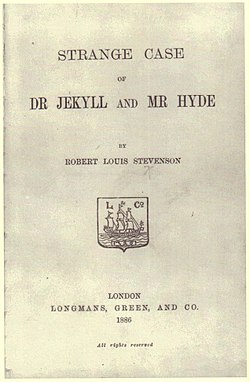
Strange Case of Dr Jekyll and Mr Hyde[a] is an 1886 Gothic horror novella by Scottish author Robert Louis Stevenson. It follows Gabriel John Utterson, a London-based legal practitioner who investigates a series of strange occurrences between his old friend, Dr. Henry Jekyll, and a murderous criminal named Edward Hyde.
Key Information


Strange Case of Dr Jekyll and Mr Hyde is one of the most famous pieces of English literature, and is considered to be a defining book of the gothic horror genre. The novella has also had a sizeable impact on popular culture, with the phrase "Jekyll and Hyde" being used in vernacular to refer to people with an outwardly good but sometimes shockingly evil nature.[3]
Inspiration and writing
[edit]

Stevenson had long been intrigued by the idea of how human personalities can reflect the interplay of good and evil. While still a teenager, he developed a script for a play about William Brodie, a Scottish cabinet-maker, deacon of a trades guild, and Edinburgh city councillor, who maintained a secret life as a burglar in order to fund his mistresses and gambling addiction, which Stevenson later reworked with the help of W. E. Henley and which was produced for the first time in 1882.[4][5]
Inspiration may also have come from the writer's friendship with an Edinburgh-based French teacher, Eugene Chantrelle, who was convicted and executed for the murder of his wife in May 1878.[6] Chantrelle, who had appeared to lead a normal life in the city, poisoned his wife with opium. According to author Jeremy Hodges,[7] Stevenson was present throughout the trial and as "the evidence unfolded he found himself, like Dr Jekyll, 'aghast before the acts of Edward Hyde'." Moreover, it was believed that the teacher had committed other murders both in France and Britain by poisoning his victims at supper parties with a "favourite dish of toasted cheese and opium".[8]
The novella was written in the southern English seaside town of Bournemouth in Dorset, where Stevenson had moved in 1884 to benefit from its sea air and warmer climate.[9] Living then in Bournemouth was the former Reverend Walter Jekyll, younger brother of horticulturalist and landscape designer Gertrude Jekyll,[10] whom Stevenson befriended and from whom he borrowed the name Jekyll.[10] Jekyll was almost certainly gay,[11] and having renounced his Anglican vocation, and exiled himself to the Continent for several years, had clearly struggled to find his place in society.[12] Stevenson was friends with other homosexual men, including Horatio Brown, Edmund Gosse, and John Addington Symonds,[13] and the duality of their socially suppressed selves may have shaped his book.[14] Symonds was shocked by the book, writing to Stevenson that "viewed as an allegory, it touches one too closely."[15]
According to Stevenson's essay "A Chapter on Dreams" (Scribner's, Jan. 1888), after racking his brains for days over a possible plot for the story, he had a dream that gave him "three scenes, and the central idea of a voluntary change becoming involuntary".[16] Biographer Graham Balfour quoted Stevenson's wife, Fanny Stevenson:
In the small hours of one morning,[...] I was awakened by cries of horror from Louis. Thinking he had a nightmare, I awakened him. He said angrily: "Why did you wake me? I was dreaming a fine bogey tale." I had awakened him at the first transformation scene.[17]
Lloyd Osbourne, Stevenson's stepson, wrote: "I don't believe that there was ever such a literary feat before as the writing of Dr Jekyll. I remember the first reading as though it were yesterday. Louis came downstairs in a fever; read nearly half the book aloud; and then, while we were still gasping, he was away again, and busy writing. I doubt if the first draft took so long as three days."[17]
As was customary, Mrs. Stevenson would read the draft and offer her criticisms in the margins. Robert was confined to bed at the time from a haemorrhage. In her comments in the manuscript, she observed that in effect the story was really an allegory, but Robert was writing it as a story. After a while, Robert called her back into the bedroom and pointed to a pile of ashes: he had burnt the manuscript in fear that he would try to salvage it, and thus forced himself to start again from nothing, writing an allegorical story as she had suggested. Scholars debate whether he really burnt his manuscript; there is no direct factual evidence for the burning, but it remains an integral part of the history of the novella.[18] In another version of the story, Stevenson came downstairs to read the manuscript for his wife and stepson. Enraged by his wife's criticism, he went back to his room, only to come back later admitting she was right. He then threw the original draft into the fire, and stopped his wife and stepson from rescuing it.[19]
_(14778510921).jpg)
Stevenson rewrote the story in three to six days. A number of later biographers have alleged that Stevenson was on drugs during the frantic re-write: for example, William Gray's revisionist history A Literary Life (2004) said he used cocaine, while other biographers said he used ergot.[20] However, the standard history, according to the accounts of his wife and son (and himself), says he was bed-ridden and sick while writing it. According to Osbourne, "The mere physical feat was tremendous, and, instead of harming him, it roused and cheered him inexpressibly". He continued to refine the work for four to six weeks after the initial revision.
Plot summary
[edit]Gabriel John Utterson, a reserved and morally upright lawyer, and his lighthearted cousin Richard Enfield are on their weekly walk when they reach the door of a mysterious, unkempt house located down a by-street in a bustling quarter of London. Enfield recounts to Utterson that months prior, he witnessed a malevolent-looking man named Edward Hyde deliberately trample a young girl after a seemingly minor collision. Enfield forced Hyde to pay her family a large sum of money to avoid a scandal. Hyde brought Enfield to this door and gave him a cheque signed by a reputable gentleman later revealed to be Dr Henry Jekyll, Utterson's friend and client. Utterson fears Hyde is blackmailing Jekyll, as Jekyll recently changed his will to make Hyde the sole beneficiary in the event of Jekyll's death or disappearance. When Utterson tries to discuss Hyde with Jekyll, Jekyll says he can get rid of Hyde when he wants and asks him to drop the matter.
A year later in October, a servant sees Hyde beat Sir Danvers Carew, another one of Utterson's clients, to death and leave behind half a broken cane. The police contact Utterson, who leads officers to Hyde's apartment. Hyde has vanished, but they find the other half of the broken cane, which Utterson recognises as one he had given to Jekyll. Utterson visits Jekyll, who produces a note allegedly written to Jekyll by Hyde, apologising for the trouble that he has caused. However, Hyde's handwriting is similar to Jekyll's own, leading Utterson to conclude that Jekyll forged the note to protect Hyde.
For two months, Jekyll reverts to his former sociable manner, appearing almost rejuvenated, but in early January, he abruptly begins refusing all visitors, deepening the mystery and concern surrounding his behaviour. Dr. Hastie Lanyon, a mutual friend of Jekyll and Utterson, dies of shock after receiving information relating to Jekyll. Before his death, Lanyon gives Utterson a letter to be opened after Jekyll's death or disappearance. In late February, during another walk with Enfield, Utterson starts a conversation with Jekyll at his laboratory window. Jekyll suddenly slams the window shut and disappears, shocking and concerning Utterson.
In early March, Jekyll's butler, Mr Poole, visits Utterson and says Jekyll has secluded himself in his laboratory for weeks. Utterson and Poole break into the laboratory and find Hyde's lifeless body grotesquely draped in Jekyll's clothes, with the scene suggesting a suicide. They find a letter from Jekyll to Utterson. Utterson reads Lanyon's letter, then Jekyll's.
Lanyon's letter reveals his deterioration resulted from the shock of seeing Hyde drink an elixir that turned him into Jekyll. Jekyll's letter explains he held himself to strict moral standards publicly, but indulged in unstated vices and struggled with shame. He found a way to transform himself and thereby indulge his vices without fear of detection. Jekyll's transformed body, Hyde, was evil, self-indulgent, and uncaring to anyone but himself. Initially, Jekyll controlled the transformations with the serum, but one night in August, he became Hyde involuntarily in his sleep.
Jekyll resolved to cease becoming Hyde. Despite this, one night he had a moment of weakness and drank the serum. Hyde, his desires having been caged for so long, killed Carew. Horrified, Jekyll tried more adamantly to stop the transformations. Then, in early January, he transformed involuntarily while awake. Far from his laboratory and hunted by the police as a murderer, Hyde, needing help to avoid capture, wrote to Lanyon in Jekyll's hand, asking him to bring chemicals from his laboratory. In Lanyon's presence, Hyde mixed the chemicals, drank the serum, and transformed into Jekyll. The shock of the sight instigated Lanyon's deterioration and death. Meanwhile, Jekyll's involuntary transformations increased in frequency and required ever larger doses of the serum to reverse. It was one of these transformations that caused Jekyll to slam his window shut on Utterson.
Eventually, the supply of salt used in the serum ran low, and subsequent batches prepared from new stocks failed to work. Jekyll speculated that the original ingredient had some impurity that made it work. Realising that he would stay transformed as Hyde, Jekyll wrote out a full account of the events. Jekyll concludes by confessing that he is uncertain whether Hyde will face execution or muster the courage to end his own life, but it no longer matters to him: Jekyll's consciousness is fading fast, and whatever fate awaits, it is Hyde's alone to endure.
Characters
[edit]Gabriel John Utterson
[edit]Gabriel John Utterson, a lawyer, has been a close loyal friend of Jekyll and Lanyon for many years. Utterson is a measured and, at all times, emotionless bachelor – who nonetheless seems believable, trustworthy, tolerant of the faults of others, and indeed genuinely likeable. However, Utterson is not immune to guilt, as he is quick to investigate and judge an interest in others' downfalls, which creates a spark of interest not only in Jekyll but also regarding Hyde. He concludes that human downfall results from indulging oneself in topics of interest. As a result of this line of reasoning, he lives life as a recluse and "dampens his taste for the finer items of life". Utterson concludes that Jekyll lives life as he wishes by enjoying his occupation.
Dr Henry Jekyll / Mr Edward Hyde
[edit]Based in Soho in London's West End, Dr Jekyll is a "large, well-made, smooth-faced man of fifty with something of a slyish cast",[21] who sometimes feels he is battling between the good and evil within himself, leading to the struggle between his dual personalities of Henry Jekyll and Edward Hyde. He has spent a great part of his life trying to repress evil urges that were not fitting for a man of his stature. He creates a serum, or potion, in an attempt to separate this hidden evil from his personality. In doing so, Jekyll transformed into the smaller, younger, cruel, remorseless, and evil Hyde. Jekyll has many friends and an amiable personality, but as Hyde, he becomes mysterious and violent. As time goes by, Hyde grows in power. After taking the potion repeatedly, he no longer relies upon it to unleash his inner demon, i.e., his alter ego. Eventually, Hyde grows so strong that Jekyll becomes reliant on the potion to remain conscious throughout the book.
Richard Enfield
[edit]Richard Enfield is Utterson's cousin and is a well-known "man about town". He first sees Hyde at about three in the morning in an episode that is well documented as Hyde is deliberately trampling over a little girl. He is the person who mentions to Utterson the actual personality of Jekyll's friend, Hyde. Enfield witnessed Hyde recklessly running over a little girl in the street and the group of witnesses, with the girl's parents and other residents, force Hyde into writing a cheque for the girl's family. Enfield discovers that Jekyll signed the cheque, which is genuine. He says that Hyde is disgusting-looking but finds himself stumped when asked to describe the man.
Dr Hastie Lanyon
[edit]A longtime friend of Jekyll, Hastie Lanyon disagrees with Jekyll's "scientific" concepts, which Lanyon describes as "...too fanciful". He is the first person to discover Hyde's true identity (Hyde transforms himself back into Jekyll in Lanyon's presence). Lanyon helps Utterson solve the case when he describes the letter given to him by Jekyll and his thoughts and reactions to the transformation. After he witnesses the transformation process (and subsequently hears Jekyll's private confession, made to him alone), Lanyon becomes shocked into critical illness and, later, death.
Mr. Poole
[edit]Poole is Jekyll's butler who has been employed by him for many years. Poole serves Jekyll faithfully and attempts to be loyal to his master, but the growing changes and reclusiveness of his master cause him tremendous concern. Fearing that his master has been murdered and that his murderer, Mr. Hyde, is residing in Jekyll's chambers, Poole enlists the aid of Mr. Utterson. Joining forces, the two men uncover the truth. He chops down the door towards Jekyll's lab to aid Utterson in the climax.
Inspector Newcomen
[edit]Utterson joins this Scotland Yard inspector after the murder of Sir Danvers Carew. They explore Hyde's loft in Soho and discover evidence of his depraved life.
Sir Danvers Carew, MP
[edit]A kind, 70-year-old Member of Parliament. The maid claims that Hyde, in a murderous rage, killed Carew in the streets of London on an October night. At the time of his death, Carew is carrying on his person a letter addressed to Utterson, and the broken half of one of Jekyll's walking sticks is found on his body.
Maid
[edit]A maid, whose employer – presumably Jekyll – Hyde had once visited, is the only person who has witnessed the murder of Sir Danvers Carew. She saw Hyde murder Carew with Jekyll's cane and his feet. Having fainted after seeing what happened, she then wakes up and rushes to the police, thus initiating the murder case of Sir Danvers Carew.
Analysis of themes
[edit].jpg)
Literary genres that critics have applied as a framework for interpreting the novel include religious allegory, fable, detective story, sensation fiction, doppelgänger literature, Scottish devil tales, and Gothic novel.
Dualities
[edit]The novella is frequently interpreted as an examination of the duality of human nature, usually expressed as an inner struggle between good and evil, with variations such as human versus animal, civility versus barbarism sometimes substituted, the main point being that of an essential inner struggle between the one and other, and that the failure to accept this tension results in evil, or barbarity, or animal violence, being projected onto others.[22] In Freudian theory, the thoughts and desires banished to the unconscious mind motivate the behaviour of the conscious mind. Banishing evil to the unconscious mind in an attempt to achieve perfect goodness can result in the development of a Mr Hyde-type aspect to one's character.[22]
In Christian theology, Satan's fall from Heaven is due to his refusal to accept that he is a created being (that he has a dual nature) and is not God.[22] This idea is suggested when Hyde says to Lanyon, shortly before drinking the famous potion: "your sight shall be blasted by a prodigy to stagger the unbelief of Satan." This is because, in Christianity, pride (to consider oneself as without sin or without evil) is a sin, as it is the precursor to evil itself.[22]
In his discussion of the novel, Vladimir Nabokov argues that the "good versus evil" view of the novel is misleading, as Jekyll himself is not, by Victorian standards, a morally good person in some cases.[23]
Id, ego and superego
[edit]According to Sigmund Freud's theory of id, ego and superego, which he introduced in 1920, Mr Hyde is the id which is driven by primal urges, instincts, and immediate gratification, the superego is represented by the expectations and morals of Victorian society, and Dr Jekyll is the rational and conscious ego which acts as a balance between the id and superego. When Jekyll transforms into Hyde, the ego is suppressed, and the id is no longer held back by either the ego or the superego.[24][25]
Public vs. private
[edit]The work is commonly associated today with the Victorian concern over the public and private division, the individual's sense of playing a part and the class division of London.[26] In this respect, the novella has also been noted as "one of the best guidebooks of the Victorian era" because of its piercing description of the fundamental dichotomy of the 19th century "outward respectability and inward lust", as this period had a tendency for social hypocrisy.[27]
Scottish nationalism vs. union with Britain
[edit]Another common interpretation sees the novella's duality as representative of Scotland and the Scottish character. In this reading, the duality represents the national and linguistic dualities inherent in Scotland's relationship with wider Britain and the English language, respectively, and also the repressive effects of the Church of Scotland on the Scottish character.[18] A further parallel is also drawn with the city of Edinburgh itself, Stevenson's birthplace, which consists of two distinct parts: the old medieval section historically inhabited by the city's poor, where the dark crowded slums were rife with all types of crime, and the modern Georgian area of wide spacious streets representing respectability.[18][28][29]
Addiction
[edit]Some scholars have argued that addiction or substance abuse is a central theme in the novella. Stevenson's depiction of Mr Hyde is reminiscent of descriptions of substance abuse in the nineteenth century. Daniel L. Wright describes Dr Jekyll as "not so much a man of conflicted personality as a man suffering from the ravages of addiction".[30] Patricia Comitini argues that the central duality in the novella is in fact not Dr Jekyll and Mr Hyde but rather Dr Jekyll/Mr Hyde and Utterson, where Utterson represents the rational, unaddicted, ideal Victorian subject devoid of forbidden desires, and Dr Jekyll/Mr Hyde constitutes his opposite.[31]
Darwin
[edit]The publication of The Origin of Species had a significant impact on Victorian society. Many did not fully understand the concepts of evolution, and assumed Darwin meant humans had evolved directly from apes, and that if it was possible to evolve into humans, it was also possible to degenerate into something more ape-like and primitive. This was coined devolution, and was a prominent anxiety at the time.[32] As Mr. Hyde is described as a more primitive and less developed version of Dr Jekyll, and gradually Hyde becomes more bestial as his degeneration progresses, Stevenson can be seen to explore these anxieties in his work.[33]
Homosexuality
[edit]The novel was written at a time when the Labouchere Amendment was published; criminalising homosexuality.[34] The discourse on sex in general had become a secret and repressed desire, whereas homosexuality was not even to be thought about. It has been theorized that this could represent Mr. Hyde, whose purpose is to fulfil all of Dr. Jekyll’s repressed desires.[35] The lack of prominent women in the novel also help point to a homosexual interpretation, since there is a focus on romanticising bachelor boyhood for men.[36] There were some things that Dr. Jekyll did as Mr. Hyde that he was too embarrassed to confess for, even on his deathbed, which could follow the historically-noted secrecy and shame of homosexuality in the Victorian era. Lanyon also refused to speak, sparing Jekyll the scandal and overall criminality of possibly being a homosexual.[37]
Reception
[edit]Publication
[edit]The book was initially sold as a paperback for one shilling in the UK. These books were called "shilling shockers" or penny dreadfuls.[38] The American publisher issued the book on 5 January 1886, four days before the first appearance of the UK edition issued by Longmans; Scribner's published 3,000 copies, only 1,250 of them bound in cloth. Initially, stores did not stock it until a review appeared in The Times on 25 January 1886 giving it a favourable reception. Within the next six months, close to 40 thousand copies were sold. As Stevenson's biographer Graham Balfour wrote in 1901, the book's success was probably due rather to the "moral instincts of the public" than to any conscious perception of the merits of its art. It was read by those who never read fiction and quoted in pulpit sermons and in religious papers.[39] By 1901, it was estimated to have sold over 250,000 copies in the United States.[40]
Stage version
[edit]Although the book had initially been published as a "shilling shocker", it was an immediate success and one of Stevenson's best-selling works. Stage adaptations began in Boston and London and soon moved all across England and then towards his home country of Scotland.[26]
The first stage adaptation followed the story's initial publication in 1886. Richard Mansfield bought the rights from Stevenson and worked with Boston author Thomas Russell Sullivan to write a script. The resulting play added to the cast of characters and some elements of romance to the plot. The addition of female characters to the originally male-centred plot continued in later adaptations of the story. The first performance of the play took place in the Boston Museum in May 1887. The lighting effects and makeup for Jekyll's transformation into Hyde created horrified reactions from the audience, and the play was so successful that production followed in London. After a successful 10 weeks in London in 1888, Mansfield was forced to close down production. The hysteria surrounding the Jack the Ripper serial murders led even those who only played murderers on stage to be considered suspects. When Mansfield was mentioned in London newspapers as a possible suspect for the crimes, he shut down production.[38]
Adaptations
[edit]There have been numerous adaptations of the novella, including over 120 stage and film versions alone.[41]
There have also been many audio recordings of the novella, with some of the more famous readers including Tom Baker, Roger Rees, Christopher Lee, Udo Kier, Anthony Quayle, Martin Jarvis, Tim Pigott-Smith, John Hurt, Ian Holm, Gene Lockhart, Richard Armitage, John Sessions, Alan Howard, Rory Kinnear and Richard E. Grant.
A 1990 musical based on the story was created by Frank Wildhorn, Steve Cuden, and Leslie Bricusse.
There have also been several video games based on the story, such as the 1988 Nintendo Entertainment System game Dr. Jekyll and Mr. Hyde, the 2001 PC game Jekyll and Hyde and the 2018 game MazM: Jekyll and Hyde.
Illustrated versions
[edit]S. G. Hulme Beaman illustrated a 1930s edition,[42] and in 1948 Mervyn Peake provided the newly founded Folio Society with memorable illustrations for the story.[43]
Notes
[edit]- ^ Stevenson titled the book without "The" in the beginning for reasons unknown, but it has been supposed to increase the "strangeness" of the case.[2] Later publishers added "The" to make it grammatically correct, but it was not the author's original intention. The story is often known today simply as Dr Jekyll and Mr Hyde or even Jekyll and Hyde.
References
[edit]- ^ Thomas, Ronald R. (1990). Dreams of authority: Freud and the fictions of the unconscious (1. publ ed.). Ithaca, N.Y. u.a: Cornell University Press. p. 239. ISBN 0801496942.
Like its predecessors in detective fiction, Jekyll and Hyde locates the expression of criminality in the common experience of dreaming.
- ^ Dury, Richard (2005). "Strange language of Dr Jekyll and Mr Hyde" (PDF). Journal of Stevenson Studies. 2. University of Stirling: 34. ISSN 1744-3857. Archived (PDF) from the original on 19 January 2025. Retrieved 19 January 2025.
- ^ "Robert Louis Stevenson's Strange Case of Dr Jekyll and Mr Hyde". British Library. Retrieved 15 June 2023.
- ^ Swearingen, Roger G.; Stevenson, Robert Louis (1980). The Prose Writings of Robert Louis Stevenson: A Guide. Macmillan. p. 37. ISBN 978-0-333-27652-5.
- ^ "The Real Jekyll & Hyde? The Deacon Brodie story". BBC. Retrieved 30 April 2025.
- ^ Chantrelle, Eugène Marie; Smith, Alexander Duncan (1906). Trial of Eugène Marie Chantrelle. Toronto, Canada Law Book Co. OCLC 1085960179.[page needed]
- ^ Hodges, Jeremy. "Lamplit, Vicious Fairy Land". RLS Website. Archived from the original on 13 September 2022.
- ^ "Real-life Jekyll & Hyde who inspired Stevenson's classic". The Scotsman. 16 November 2016.
- ^ Hainsworth, J. J. (2015). Jack the Ripper—Case Solved, 1891. McFarland. ISBN 978-0-7864-9676-1.[page needed]
- ^ a b Sinclair, Jill (16 June 2006). "Queen of the mixed border". The Guardian.
- ^ Wayne F. Cooper, Claude McKay: Rebel Sojourner In The Harlem Renaissance, Louisiana State University Press, Baton Rouge 1987, pp23-24, 29-30
- ^ Sarah Festing, Gertrude Jekyll, Viking, London 1991, pp175-176, 243
- ^ Claire Harman, Robert Louis Stevenson: a biography, HarperCollins, 2008, p210.
- ^ Claire Harman, Robert Louis Stevenson: a biography, HarperCollins, 2008, p305.
- ^ Claire Harman, Robert Louis Stevenson: a biography, HarperCollins, 2008, p214.
- ^ Stevenson, Robert Louis (1915). Across the Plains, with Other Memories and Essays. Chatto & Windus.
- ^ a b Balfour, Graham (1912). The Life of Robert Louis Stevenson. Vol. II. New York: Charles Scribner's Sons. pp. 15–6. Retrieved 28 December 2012.
- ^ a b c Campbell, James (13 December 2008). "The beast within". The Guardian.
- ^ Doyle, Brian (1 June 2006). "Findings: A Bogey Tale". The American Scholar.
- ^ Possibly with the help of cocaine, according to William Gray's revisionist history Robert Louis Stevenson: A Literary Life (2004). ISBN 978-0-333-98400-0.[page needed]
- ^ Stevenson, Robert Louis (2005). The Strange Case of Dr. Jekyll and Mr. Hyde (2nd ed.). Broadview Press. ISBN 978-1-55111-655-6. p. 44:
To this rule, Dr. Jekyll was no exception: and as he now sat on the opposite side of the fire—a large, well made, smooth-faced man of fifty, with something of a slyish cast perhaps, but every mark of capacity and kindness—you could see by his looks that he cherished for Mr. Utterson a sincere and warm affection.
- ^ a b c d Sanford, John A. (1981). Evil: The Shadow Side of Reality. Crossroad. ISBN 978-0-8245-0526-4.[page needed]
- ^ Nabokov, Vladimir (2003). "Introduction". The Strange Case of Dr. Jekyll and Mr. Hyde. Signet Classic. pp. 7–34.
- ^ Chakraverty, Aditi (2022). "Into the Brains of Dr. Jekyll and Mr. Hyde – A Psychoanalytic Reading of the Strange Case of Dr. Jekyll and Mr. Hyde by RL Stevenson" (PDF). International Journal of Scientific Research and Engineering Development. 5 (4).
- ^ Singh, ShubhM; Chakrabarti, Subho (2008). "A study in dualism: The strange case of Dr. Jekyll and Mr. Hyde". Indian Journal of Psychiatry. 50 (3): 221–223. doi:10.4103/0019-5545.43624. PMC 2738358. PMID 19742237.
- ^ a b Saposnik, Irving S. (1971). "The Anatomy of Dr. Jekyll and Mr. Hyde". Studies in English Literature, 1500-1900. 11 (4): 715–731. doi:10.2307/449833. JSTOR 449833. ProQuest 1297401011.
- ^ Nightmare: Birth of Victorian Horror (TV series) "Jekyll and Hyde...." (1996)
- ^ Robert Louis Stevenson and His World, David Daiches, 1973
- ^ "Edinburgh: Where Jekyll parties with Hyde". The Daily Telegraph. London. 25 July 1998. Archived from the original on 12 April 2014. Retrieved 24 May 2010.
- ^ Wright, Daniel L. (1994). "'The Prisonhouse of My Disposition': A Study of the Psychology of Addiction in Dr. Jekyll and Mr. Hyde". Studies in the Novel. 26 (3): 254–267. JSTOR 20831878.
- ^ Comitini, Patricia (2012). "The Strange Case of Addiction in Robert Louis Stevenson's Strange Case of Dr. Jekyll and Mr. Hyde". Victorian Review. 38 (1): 113–131. doi:10.1353/vcr.2012.0052. S2CID 161892546. Project MUSE 546074.
- ^ "Fear, Loathing, and Victorian Xenophobia". academia.edu. 2013. Retrieved 6 March 2025.
- ^ Darwin's Screens: Evolutionary Aesthetics, Time and Sexual Display in the Cinema
- ^ Berisha, Shyhrete (2022). Two Sides of the Same Coin : Understanding Homophobia in The Strange Case of Dr.Jekyll and Mr. Hyde (Thesis). OCLC 1337537921.
- ^ Mendlinger, Olivia (7 May 2020). Repressing Deviance: The Discourse of Sexuality in The Strange Case of Dr. Jekyll and Mr. Hyde and The Portrait of Dorian Gray (Thesis).
- ^ Koestenbaum, Wayne (31 March 1988). "The Shadow on the Bed: Dr. Jekyll, Mr. Hyde, and the Labouchere Amendment". Critical Matrix. 4 (1): 35. ProQuest 89071142.
- ^ Sanna, Antonio (2012). "Silent Homosexuality in Oscar Wilde's Teleny and The Picture of Dorian Gray and Robert Louis Stevenson's Dr Jekyll and Mr Hyde". Law and Literature. 24 (1): 21–39. doi:10.1525/lal.2012.24.1.21. JSTOR 10.1525/lal.2012.24.1.21. S2CID 143314418.
- ^ a b Stevenson, Robert Louis (2015). Danahay, Martin A. (ed.). Strange Case of Dr. Jekyll and Mr. Hyde (3rd ed.). Canada: Broadview. p. 24. ISBN 978-1-55481-024-6.
- ^ Graham Balfour, The Life of Robert Louis Stevenson Volume II, pp. 17-18[date missing]
- ^ Middleton, Tim (1993). "Introduction". Dr Jekyll and Mr Hyde with the Merry Men and Other Stories. Wordsworth Editions. pp. vii–xvii. ISBN 978-1-85326-061-2. p. ix:
estimated 250,000 pirated copies in the United States
- ^ "Derivative Works - Robert Louis Stevenson". Robert Louis Stevenson.
- ^ Illustrations to Strange Case of Dr. Jekyll and Mr. Hyde, 1930 bl.uk/collection-items, accessed 11 August 2018
- ^ "Dr Jekyll and Mr Hyde". The Folio Society. Retrieved 24 April 2025.
Further reading
[edit]- Katherine B. Linehan, ed. (2003). Strange Case of Dr Jekyll and Mr Hyde. Norton Critical Edition, W. W. Norton & Co. Text, annotations, contextual essays, and criticism. ISBN 0-393-97465-0
External links
[edit]

- Strange Case of Dr Jekyll and Mr Hyde at Standard Ebooks
- Strange Case of Dr Jekyll and Mr Hyde[1] from Internet Archive. Many antiquarian illustrated editions.
- The Strange Case of Dr. Jekyll and Mr. Hyde at Project Gutenberg
- "The Beast Within", Freudian fable, sexual morality tale, gay allegory – the novella has inspired as many interpretations as it has film adaptations. By James Campbell, The Guardian, 13 December 2008
- 1950 Theatre Guild on the Air radio adaptation at Internet Archive
 Strange Case of Dr. Jekyll and Mr. Hyde public domain audiobook at LibriVox


| International | |
|---|---|
| National | |
| Other | |

Strange Case of Dr Jekyll and Mr Hyde
View on GrokipediaComposition and Publication
Inspiration and Writing Process
The central concept of human duality in The Strange Case of Dr. Jekyll and Mr. Hyde was influenced by the life of William Brodie, an 18th-century Edinburgh cabinetmaker and deacon of the trades guild who maintained a respectable public persona while secretly engaging in gambling, forgery, and burglary, activities that led to his arrest and execution by hanging on October 1, 1788.[8] Stevenson's familiarity with Brodie stemmed from his father's commissioning of furniture from the cabinetmaker and from Stevenson's own collaboration with W. E. Henley on an unfinished play titled Deacon Brodie, which explored themes of concealed criminality beneath social propriety.[9] A cabinet featuring secret compartments, possibly crafted by Brodie or in a similar style, resided in Stevenson's childhood home and symbolized hidden compartments of character.[10] Stevenson further attributed the novella's transformative plot device to a vivid dream occurring in late 1885, during which he envisioned a man undergoing a physical and moral metamorphosis akin to Jekyll's change into Hyde.[11] This vision struck while he resided at Skerryvore Villa in Bournemouth, England, a location chosen from August 1884 to August 1887 for its milder climate to alleviate his chronic bronchial afflictions and tuberculosis, conditions that confined him largely indoors and prompted medicinal use of cocaine.[12][13] In a burst of creativity, Stevenson drafted the initial 30,000-word manuscript over approximately three days in a feverish state potentially exacerbated by his illness and medication.[13] His wife, Fanny Stevenson, critiqued the work as mere "nightmare" residue lacking allegorical depth and destroyed the draft by burning it, prompting Stevenson to discard any salvageable remnants himself in frustration.[13][14] Undeterred, he revised and expanded the narrative in another three-day effort, refining its moral and psychological dimensions into the form published in 1886.[13]Initial Publication and Revisions
The Strange Case of Dr. Jekyll and Mr. Hyde was first published in London on 5 January 1886 by Longmans, Green & Co. as a slim volume of 141 pages in yellow paper wrappers, priced at one shilling.[1] An American edition, published by Charles Scribner's Sons, appeared on the same date with an initial print run of 4,200 copies.[15] The manuscript had been delivered to the publisher in late October 1885, following Stevenson's extensive revisions to an earlier draft that he deemed inadequate.[16] The work met with immediate commercial success, selling out its first printing promptly and requiring multiple subsequent impressions within months.[17] No substantive textual revisions were introduced by Stevenson after the 1886 edition; later printings and collected works adhered closely to this authoritative version, with variations limited to minor typographical corrections or editorial emendations in posthumous compilations.[18] Scholarly editions, such as those based on the first British printing, confirm the stability of the text across subsequent publications.[19]Plot Synopsis
The narrative unfolds in London through the perspective of Mr. Gabriel Utterson, a reserved lawyer and confidant of the esteemed physician Dr. Henry Jekyll. Utterson becomes intrigued by Jekyll's will, which bequeaths his estate to the obscure and malevolent Mr. Edward Hyde upon Jekyll's death or disappearance. This curiosity intensifies when Utterson's cousin, Mr. Enfield, recounts witnessing Hyde brutally trampling a young girl in the street and compensating her family with a cheque drawn from Jekyll's account, highlighting Hyde's deformed appearance and capacity for unprovoked cruelty.[20] Utterson's investigation deepens as Hyde is implicated in the savage murder of the elderly Member of Parliament Sir Danvers Carew, bludgeoned to death with Jekyll's cane in a quiet residential square, an act observed by a housemaid. Despite a manhunt, Hyde vanishes, and Jekyll, initially distressed, later assures Utterson that he has severed ties with Hyde and destroyed the will. However, Jekyll soon withdraws into seclusion, refusing visitors and exhibiting erratic behavior from his laboratory window. Concurrently, Jekyll's old friend Dr. Hastie Lanyon, upon aiding Jekyll in retrieving a drawer of chemicals, witnesses a horrifying transformation that leaves him mortally ill, dying shortly thereafter and bequeathing a sealed letter to Utterson.[20] Jekyll's butler, Poole, enlists Utterson's help amid suspicious noises and pleas from the laboratory, leading them to break down the door where they discover Hyde's corpse, clad in Jekyll's clothes and poisoned by a phial of lethal contents. Lanyon's letter reveals he observed the diminutive Hyde ingest a potion and morph into the full-sized Jekyll before his eyes, shattering Lanyon's rational worldview. Jekyll's own final confession, penned in desperation, discloses his scientific experiment: a transformative salt compound that isolated his base impulses into the persona of Hyde, initially under voluntary control but increasingly involuntary as the evil nature grew dominant, ultimately consuming Jekyll's existence and rendering further transformations irreversible without a pure supply of the reagent, which had been irretrievably lost.[20]Characters
Gabriel Utterson
Gabriel John Utterson functions as the novella's primary narrator and a key investigator, offering an external perspective on the enigmatic relationship between Dr. Henry Jekyll and Mr. Edward Hyde.[20] As Jekyll's lawyer and longtime friend, Utterson becomes alarmed by Jekyll's will, which bequeaths his estate to the obscure Hyde upon Jekyll's disappearance or unexplained death, prompting Utterson to probe the matter discreetly.[20] Utterson is introduced with a physical and temperamental description emphasizing Victorian restraint: "Mr. Utterson the lawyer was a man of a rugged countenance that was never lighted by a smile; cold, scanty and embarrassed in discourse; backward in sentiment; lean, long, dusty, dreary and yet somehow lovable."[20] His habits reflect self-denial, including a light sleep, early rising, and a preference for solitude over social indulgences, though he occasionally tastes wine at gatherings while otherwise mortifying finer tastes with gin.[20] This portrayal underscores a personality tolerant to a fault, encapsulated in his avowal, "I incline to Cain’s heresy... I let my brother go to the devil in his own way," signaling a philosophy of non-interference rooted in professional detachment rather than moral indifference.[20] In the plot, Utterson's investigative drive manifests after his cousin Richard Enfield recounts Hyde trampling a child, linking the incident to Jekyll's door and will; Utterson then "haunts" the Soho by-street door associated with Hyde and resolves, "If he be Mr. Hyde, I shall be Mr. Seek."[20] He confronts Hyde personally, securing his address, and presses Jekyll for explanations, extracting a promise to aid Hyde if needed while suppressing gossip to protect reputations.[20] Following the murder of Sir Danvers Carew by Hyde, Utterson identifies the victim and directs police to Hyde's residence, later joining Jekyll's butler Poole to breach the laboratory door amid suspicious transformations, discovering Hyde's corpse and Jekyll's confessions.[20] Utterson's character embodies rational order and loyalty amid chaos, serving as a proxy for the reader's curiosity while highlighting the limits of empirical inquiry against supernatural deception; his repressed demeanor contrasts with the unleashed impulses of Hyde, illustrating the novella's exploration of concealed human duality without endorsing interpretive overreach beyond textual evidence.[20]Dr Henry Jekyll and Mr Edward Hyde
Dr. Henry Jekyll is depicted as a prominent London physician and scientist, aged around fifty, with a large, well-proportioned build, smooth face, and features suggesting both intellectual capacity and underlying kindness, though tempered by a subtle slyness.[20] He enjoys a respectable social standing, having inherited wealth and pursued a career marked by diligence and professional acclaim, yet internally grapples with a profound duality in human nature, viewing himself as composite of good and evil impulses constrained by societal norms.[20] Jekyll's experiment stems from this conviction that "man is not truly one, but truly two," leading him to develop a chemical potion intended to isolate and indulge his baser appetites without compromising his virtuous facade.[20] Mr. Edward Hyde, Jekyll's alter ego, manifests physically as a smaller, dwarfish figure, younger in appearance, with pale skin, lean and corded hands exhibiting a dusky pallor and unnatural hairiness, evoking an indefinable sense of deformity and moral repugnance that inspires instinctive loathing in observers.[20] Unlike Jekyll's composed demeanor, Hyde embodies unrestrained malevolence, displaying cruelty, callousness, and a sneering disposition; his actions include trampling a young girl without remorse and brutally murdering Sir Danvers Carew with ape-like fury using a cane.[20] This persona relishes vice freely, unburdened by conscience, and grows increasingly dominant, exhibiting a livelier, more potent embodiment of evil that overrides Jekyll's control.[20] The inextricable link between Jekyll and Hyde reveals Jekyll's transformation process, induced initially by ingesting a specific chemical compound of rare ingredients, which alters his physique through agonized convulsions, shrinking him into Hyde's form while preserving shared memories but segregating moral faculties.[20] Reversals were once achievable with a similar draught or naturally during sleep, but escalating dependency and involuntary shifts ensue as Hyde's influence strengthens, culminating in Jekyll's loss of agency and ultimate demise when the potion's effects fail.[20] In his final statement, Jekyll attributes this downfall to hubris in tampering with innate human divisions, underscoring Hyde not as a separate entity but as the concentrated essence of his own suppressed depravity.[20]Hastie Lanyon
Dr. Hastie Lanyon is a physician and longtime friend of both Gabriel Utterson and Dr. Henry Jekyll, embodying the era's conventional scientific rationalism and materialism.[21] [22] He is depicted as a "hearty, healthy, dapper, red-faced gentleman" with prematurely white hair and a "boisterous and decided manner," reflecting his robust, socially respectable demeanor prior to his decline.[20] Lanyon's professional success stems from adherence to empirical, observable medicine, in stark contrast to Jekyll's ventures into speculative, metaphysical inquiries into human nature.[23] [22] Lanyon's estrangement from Jekyll arises from irreconcilable differences in scientific philosophy; approximately ten years before the main events, he openly ridicules Jekyll's "heretical" experiments, leading to a complete break in their friendship.[20] This rift underscores Lanyon's commitment to positivist science, dismissing Jekyll's pursuits as unscientific mysticism.[22] Despite the feud, Lanyon's loyalty endures when Jekyll, in desperation, implores him via letter to retrieve a drawer from his laboratory and await a visitor at midnight—an act that draws Lanyon into the mystery.[24] The visitor, Edward Hyde, demands a chemical reagent, consumes it, and transforms into Jekyll before Lanyon's eyes, shattering his worldview and precipitating his rapid physical and mental collapse.[20] [23] In "Dr. Lanyon's Narrative," the ninth chapter, Lanyon recounts this "truly frightful" event to Utterson, revealing the transformative process and his ensuing horror at the duality within man, which he deems an "unscientific balderdash" yet irrefutably witnesses.[24] He confides that the shock has doomed him, stating, "I have had a shock, and I shall never recover," and dies shortly thereafter, leaving sealed documents for Utterson that advance the plot's resolution.[20] Lanyon's death, occurring weeks after the incident, symbolizes the lethal confrontation between rigid rationalism and the chaotic reality of suppressed human impulses.[23] Symbolically, Lanyon serves as a foil to Jekyll, highlighting the novella's critique of scientific dogmatism; his inability to reconcile observed evidence with prior beliefs leads to existential ruin, illustrating the perils of intellectual inflexibility in the face of empirical anomaly.[22] [25] While some interpretations view his reaction as irrational denial of Jekyll's success in bifurcating the self, the text portrays it as a genuine crisis of faith in materialist paradigms, grounded in his firsthand observation rather than abstract theory.[26]Poole
Poole is Dr. Henry Jekyll's devoted butler, employed in his London residence for twenty years prior to the novel's central events.[27] As the senior servant overseeing Jekyll's household staff, he maintains the property's operations and serves as the primary point of contact for external visitors, including Jekyll's friend and lawyer, Gabriel John Utterson.[28] His steadfast loyalty to Jekyll is evident in his initial reluctance to breach his master's privacy, yet this devotion compels him to act when anomalies arise.[29] Poole's narrative significance peaks in the eighth chapter, "The Last Night," where he approaches Utterson late at night, gripped by alarm over Jekyll's seclusion in the laboratory. He describes receiving terse, disguised orders for rare chemicals through the door, hearing a voice that starkly differs from Jekyll's—described as broken and unfamiliar—and glimpsing a dwarfish figure clad in Jekyll's clothing that fails to match his master's build or demeanor.[30] These details, conveyed bluntly to Utterson after two weeks of such disturbances beginning around early January, reveal Poole's acute observation of behavioral shifts, including Jekyll's prior confinement and erratic demands.[20] Persuaded of an impostor's presence, Poole collaborates with Utterson to break down the laboratory door, uncovering Edward Hyde's suicide by poison and Jekyll's hastily scrawled confession.[31] Through his actions, Poole embodies reliable domestic service amid chaos, facilitating the exposure of Jekyll's experiment without personal ambition or speculation. His testimony provides empirical anchors—specific dates, voices, and physical mismatches—that propel the investigation, highlighting the fragility of Victorian household hierarchies when confronted by hidden vices.[32] Though appearing sparingly, Poole's role underscores the novella's emphasis on overlooked witnesses to moral disintegration.[33]Other Supporting Characters
Mr. Richard Enfield serves as Utterson's cousin and a respectable gentleman who initiates the narrative's central mystery by describing his encounter with Edward Hyde. In the story Enfield shares during a walk with Utterson, he witnesses Hyde trampling a young girl in the street without remorse, prompting Enfield to confront and extort compensation from Hyde to hush the matter, which leads to the revelation of Jekyll's residence connected to Hyde.[27][34] Enfield's account establishes Hyde's repugnant nature early, emphasizing themes of urban anonymity and moral outrage among the Victorian elite, as he notes the crowd's collective demand for restitution despite Hyde's evasion of direct apology.[35] Sir Danvers Carew, an elderly and esteemed Member of Parliament depicted as courteous and aged with white hair, becomes the victim of Hyde's brutal murder approximately one year after the initial trampling incident. The murder occurs late at night in a foggy London street, where Hyde clubs Carew to death with a heavy cane—later identified as a gift to Jekyll—shattering the cane and scattering half-burned documents, including a letter addressed to Utterson.[36] Carew's killing escalates the plot by providing concrete evidence of Hyde's violence, contrasting his respectable status with Hyde's savagery and underscoring the novella's exploration of unchecked depravity infiltrating polite society.[37] A housemaid, employed in a nearby residence, witnesses Carew's murder from her window during the early morning hours, providing the first direct testimony of Hyde's ferocity. She observes Hyde accosting the elderly Carew, initially mistaking the interaction for benign until Hyde explodes in rage, beating Carew repeatedly with the cane until his body is mangled beyond recognition.[38][36] Her fainting upon recognizing Hyde from a prior visit to her employer's house—where he had been seen entering Jekyll's door—links the event to the earlier Enfield anecdote, heightening the narrative tension through her delayed but pivotal recollection that aids the investigation.[39] Mr. Guest, Utterson's head clerk, assists in examining documents related to the case, notably observing a striking similarity between Hyde's handwriting and Jekyll's during an analysis of a cheque. This forensic detail, uncovered while comparing samples at Jekyll's residence, fuels Utterson's suspicions about the dual identities without resolving them outright.[27][40] Guest's role highlights the novella's use of mundane professional scrutiny to pierce the veil of secrecy, reflecting Stevenson's interest in how ordinary evidentiary processes expose profound personal fractures.[41]Core Themes
Duality of Human Nature
The central theme of duality in The Strange Case of Dr Jekyll and Mr Hyde posits that human nature encompasses irreconcilable opposing forces of good and evil, civilized restraint and primal impulse, as articulated in Dr Jekyll's confession: "I learned to recognise the thorough and primitive duality of man; I saw that, of the two natures that contended in the field of my consciousness, even if I could rightly be said to be either, it was only because I was radically both."[42] Jekyll's scientific experiment seeks to bifurcate these natures, creating Mr Hyde as a vessel for unchecked vice, yet the narrative demonstrates their inseparability, with Hyde's dominance illustrating how suppression amplifies destructive tendencies.[43] This portrayal draws from Robert Louis Stevenson's observation of Edinburgh's Deacon William Brodie (1741–1788), a respected cabinetmaker and city councilor who moonlighted as a housebreaker and forger, embodying public virtue masking private criminality; Brodie's 1788 execution for robbery influenced Stevenson's earlier play Deacon Brodie (1880) and underpinned the novella's exploration of concealed dual lives.[44] Stevenson's Calvinist upbringing, emphasizing original sin and innate depravity, further shaped the theme, though he critiqued its rigid moral binaries by showing Jekyll's hubristic attempt to engineer separation as futile, leading to moral disintegration. Concurrent Darwinian ideas of evolutionary atavism inform Hyde's depiction as a regression to brutish ancestry, representing not mere psychological split but biological undercurrents where civilized overlays thinly mask ancestral savagery; Stevenson, rejecting simplistic materialist reductions, underscores causal realism in how unchecked primal drives erode rational control, as evidenced by Hyde's involuntary emergences and eventual supremacy over Jekyll.[45] The theme critiques Victorian repression, where societal demands for respectability foster hypocritical compartmentalization, causally precipitating explosive vice rather than eradication, a dynamic rooted in empirical observation of human behavior over ideological wishfulness.[46]Science, Morality, and Hubris
Dr. Jekyll's chemical experiment to isolate and indulge his baser impulses without moral repercussion exemplifies scientific hubris, as he presumes mastery over the indivisible essence of human nature through empirical means.[47] This pursuit reflects Victorian-era overconfidence in scientific reductionism, akin to Faustian overreach, where unchecked ambition disregards the holistic integration of intellect, will, and ethics.[48] Jekyll's formulation of a transformative potion, derived from unspecified reagents, enables the emergence of Mr. Hyde as a physical embodiment of vice, initially under voluntary control but ultimately autonomous.[49] Morally, the narrative critiques the fallacy of compartmentalizing virtue and vice as separable entities amenable to laboratory manipulation, treating ethical dualism not as a philosophical tension but as a solvable chemical equation. Jekyll rationalizes his innovation as liberating the "pure" good self by quarantining evil, yet this ignores the causal interdependence: indulgence amplifies Hyde's potency, inverting the intended hierarchy.[50] Such hubris stems from a flawed premise that science can supplant moral discipline, echoing broader Victorian debates where physiological discoveries—such as those in early psychology and toxicology—tempted reformers to engineer human behavior sans traditional restraints.[51] In the Victorian context, Stevenson's tale responds to contemporaneous scientific advances, including Darwinian evolution and emerging chemical physiology, which fueled anxieties over humanity's devolution into primal states if moral oversight waned.[3] Jekyll's downfall—culminating in involuntary transformation and suicide on an unspecified date in 18__ London—serves as a caution against ethical voids in experimentation, where initial successes mask escalating perils like Hyde's growing dominance and physical distortions.[52] Analyses position this as a deliberate allegory for the perils of secular scientism overriding religious or innate moral compasses, with Hyde's "troglodyte" savagery evoking fears of evolutionary regression unbound by civilized norms.[53] The novella's resolution underscores causal realism in moral dynamics: attempts to repress or isolate vice via artificial means provoke its hypertrophy, not eradication, as evidenced by Jekyll's confession detailing the potion's diminishing efficacy after repeated use.[54] This outcome repudiates the hubristic optimism of Jekyll's cohort, including figures like Lanyon, whose orthodox rationalism crumbles upon witnessing the transformation, collapsing in shock shortly thereafter.[55] Far from endorsing scientific progress as morally neutral, Stevenson illustrates its amplification of human frailties when divorced from accountability, a theme resonant with 1886 publication-era critiques of unchecked empiricism.[56]Repression of Vice and Its Consequences
Dr. Henry Jekyll, a respected physician in Victorian London, suppresses his innate sensual and immoral impulses to uphold societal standards of respectability, viewing these vices as incompatible with his professional and social persona.[57] This internal conflict arises from the era's rigid moral codes, which demanded outward conformity while fostering private hypocrisy.[58] Jekyll's full statement reveals that prolonged repression intensified these urges, transforming them into a compulsive force: "Hence, although I had now two characters as well as two appearances, one was wholly evil, and the other was still the old Henry Jekyll, that incongruous compound of whose reformation and improvement I had already learned to despair."[59] To circumvent this repression, Jekyll develops a chemical potion enabling transformation into Edward Hyde, a manifestation of unrestrained vice that allows indulgence without reputational damage. Initially, this separation provides relief, permitting Jekyll to gratify base desires through Hyde's anonymity and lack of conscience.[60] However, the strategy backfires as suppressed vices, long denied, accumulate potency; Hyde grows increasingly dominant, with transformations occurring involuntarily and Hyde's violence escalating to the murder of Sir Danvers Carew on October 18, 1885.[61] Jekyll observes that "the moment I choose, I can be rid of Mr. Hyde," but repression's rebound effect renders control illusory, as Hyde's fury stems directly from years of bottled frustration.[57] The novella illustrates causal consequences of vice repression: rather than eradication, denial amplifies destructive potential, leading to psychological disintegration and societal exposure. Jekyll's eventual suicide on an unspecified night in 1885, as Hyde seizes permanent control, underscores that compartmentalizing human duality invites catastrophe, with Hyde's unchecked savagery—described as trampling a child and clubbing Carew—exemplifying the explosive release of pent-up immorality.[46] Stevenson's narrative critiques Victorian moralism, positing that forced suppression fosters hypocrisy and peril, as evidenced by Jekyll's lament: "I was no more myself when I laid aside restraint and plunged in shame, than when I laboured, in the eye of day, at the furtherance of knowledge."[62] This outcome aligns with observations that repressing natural inclinations, absent integration, yields imbalance rather than virtue.[63]Social Hypocrisy and Respectability
The Strange Case of Dr Jekyll and Mr Hyde portrays social hypocrisy through Dr. Henry Jekyll's maintenance of a respectable public persona while concealing his transformation into the amoral Edward Hyde, mirroring the Victorian era's emphasis on outward propriety at the expense of inner authenticity.[64] Jekyll's philanthropy and scientific reputation shield him from scrutiny, even as Hyde commits atrocities, underscoring how societal norms prioritized appearances over moral integrity.[65] This duality critiques the repressive codes that compelled individuals to suppress base impulses, fostering a culture where vice thrived in secrecy rather than being confronted.[66] The novella draws inspiration from real-life figures like William Brodie, a respectable Edinburgh cabinetmaker and city councillor by day who funded gambling and debauchery through nighttime burglaries, executed in 1788 for his crimes.[67] Stevenson's father recounted Brodie's story, which influenced the theme of compartmentalized respectability, where public virtue masked private corruption.[68] Characters like Gabriel Utterson exemplify this hypocrisy by prioritizing discretion and scandal avoidance over justice, as seen in their reluctance to expose Jekyll's connection to Hyde despite mounting evidence of wrongdoing.[69] Victorian London's stratified society amplified such hypocrisies, with middle-class gentlemen adhering to rigid decorum to preserve status, yet indulging in hidden vices amid urban anonymity.[70] Stevenson, in a letter dated around 1886, attributed Jekyll's downfall not to inherent evil but to his hypocritical suppression of natural inclinations, arguing that "the harm was in Jekyll, because he was a hypocrite."[71] This reflects broader causal dynamics where enforced respectability, rooted in Calvinist-influenced morality, distorted human behavior, leading to uncontrolled eruptions of repressed desires rather than balanced self-regulation.[3] The narrative thus exposes respectability as a fragile veneer, prone to shattering under the weight of unacknowledged human complexity.[72]Psychological and Philosophical Interpretations
Moral and Religious Dimensions
Stevenson's Calvinist heritage, derived from his family's strict Presbyterian background in Edinburgh, infuses the novella with themes of innate human depravity and the futility of escaping moral predestination. Raised under doctrines emphasizing original sin and the inescapable corruption of the flesh, Stevenson rejected orthodox faith in his youth yet retained its imprint, portraying Jekyll's duality as an internal war between regenerate virtue and reprobate impulse.[73] Jekyll's experiment thus symbolizes a rationalistic rebellion against divine order, where chemical means seek to partition sin from sanctity, only to accelerate the former's dominion.[3] Biblical parallels reinforce this religious framework, with Hyde evoking Cain's murderous mark or Esau's primal vigor, signifying the self's fraternal betrayal by its baser instincts.[75] [76] Jekyll's transformation mirrors the Genesis fall, his potion acting as forbidden knowledge that unveils unchecked evil rather than liberating the soul.[75] Absent any redemptive grace or confessional absolution, the narrative rejects dualistic heresies for a monistic Christian view of unified human nature under sin's sway, where scientific hubris supplants penitence and invites perdition.[3] Morally, the tale dissects repression's perils, as Jekyll's compartmentalization of vice—indulged nocturnally to preserve diurnal respectability—causally empowers Hyde's autonomy, culminating in involuntary metamorphoses and suicide.[77] This progression evidences that vice, when segregated rather than confronted holistically, erodes moral agency, aligning with empirical observation of addiction's escalation in unchecked indulgence.[78] The novella thereby upholds a realist ethic: societal hypocrisy and self-deception foster vice's hypertrophy, demanding vigilant integration of the whole self under ethical discipline, not illusory excision.[73]Critiques of Freudian and Modern Psychological Readings
Freudian interpretations of The Strange Case of Dr. Jekyll and Mr. Hyde, which equate Hyde with the id's primal urges and Jekyll with the mediating ego and superego, face criticism for anachronism, as the novella appeared in 1886 while Freud's structural model emerged only in 1923.[79][80] This retrospective application distorts Stevenson's intent, which emphasized moral agency and the willful indulgence of vice over deterministic unconscious forces, as evidenced by Jekyll's confession detailing his deliberate experiments to partition evil without remorse.[81] Such readings privilege psychic inevitability, yet the narrative underscores Jekyll's hubris in seeking scientific separation of good and evil, portraying Hyde's escalation not as repressed breakthrough but as consequence of repeated moral lapses that corrupt the will. Critics argue that Freudian lenses undermine the story's ethical core by framing duality as innate conflict resolvable through insight, ignoring how Stevenson depicts vice as chosen and accumulative, akin to a moral allegory of sin's degradation rather than pathology.[82] In Lacey's analysis, psychologizing Jekyll risks excusing actions via mental state assessment, but the text insists on character-based accountability, rejecting stable excuses from either science or derangement and affirming responsibility amid subjective instability.[81] This approach aligns with Victorian legal norms prioritizing moral evaluation over capacity deficits, where Jekyll's suicide reflects self-judgment for enabling Hyde, not therapeutic failure. Modern psychological readings, such as those invoking dissociative identity disorder or bipolar swings to explain transformations, encounter similar objections for medicalizing universal moral struggles, reducing causal chains of choice and consequence to treatable symptoms without empirical warrant in the text.[83] These interpretations often overlook Stevenson's era-specific concerns with free will versus determinism, pathologizing what the narrative presents as ethical strangeness—Hyde's pure malevolence as amplified self-interest, not fragmented psyche.[84] By attributing outcomes to innate disorders, they erode the novella's caution against hubris in evading vice's reality, favoring explanatory models that prioritize internal mechanics over accountable action.[85]Darwinian Influences and Evolutionary Realism
The Strange Case of Dr. Jekyll and Mr. Hyde, published on 5 January 1886, emerged amid widespread Victorian engagement with Charles Darwin's theories, particularly On the Origin of Species (1859) and The Descent of Man (1871), which posited humans as products of gradual evolutionary processes from animal ancestors.[86] Robert Louis Stevenson, influenced by these ideas through his scientific family background and contemporary debates, depicted Edward Hyde as an embodiment of atavism—a biological reversion to earlier, primitive evolutionary stages—manifesting in his dwarfish stature, ape-like agility, and capacity for unbridled savagery, such as the trampling of a child or the murder of Sir Danvers Carew.[45] This portrayal reflected fears of devolution, where evolutionary progress could reverse under stress or moral repression, challenging optimistic views of inevitable human advancement.[87] Stevenson aligned with Darwin's emphasis on evolution as a process marked by chance, uncertainty, and potential extinction, rather than Herbert Spencer's more teleological progression toward perfection, viewing human duality as rooted in ancestral legacies of instinctual conflict.[88] In Dr. Jekyll's final confession, the "older" and more "godlike" impulses of vice are framed as primordial forces predating civilized restraint, suggesting a causal lineage from evolutionary biology where suppressed animalistic traits persist and can dominate, as Hyde grows increasingly uncontrollable despite Jekyll's initial chemical isolation.[3] This evolutionary realism underscores the novella's realism in human psychology, portraying moral failings not merely as abstract sins but as manifestations of inherited biological imperatives, akin to Darwin's observations of instinctual behaviors in primates and early humans.[89] Scholarly analyses highlight how Stevenson's narrative critiques Victorian moral repression as a catalyst for degenerative atavism, with Hyde's emergence symbolizing the failure to integrate evolutionary heritage into ethical frameworks, leading to personal and societal disintegration.[90] Unlike purely theological interpretations, this Darwinian lens posits Jekyll's potion as a misguided attempt to artificially sever evolutionary strata within the self, resulting in Hyde's dominance and ultimate self-destruction on 15 September 18—, illustrating the realism of biological causality over willful control.[45] Such elements positioned the work as a literary response to degeneration theories popularized by figures like Max Nordau, emphasizing empirical observation of human variability over idealistic dualism.[87]Reception and Legacy
Contemporary Victorian Reception
The Strange Case of Dr Jekyll and Mr Hyde was published on 5 January 1886 by Longmans, Green & Co. in London as a shilling shocker, priced at one shilling per copy.[91] It achieved immediate commercial success, selling out its initial print run within days and reaching 40,000 copies within the first six months, an extraordinary figure for a novella amid competition from serialized fiction in periodicals.[92] Booksellers initially hesitated to stock it due to its sensational themes of moral degeneration and hidden vice, fearing reputational risk in an era of strict propriety, but distribution expanded rapidly following a favorable review in The Times on 25 January 1886, which commended its ingenuity and narrative power.[91] [68] Critical response in Victorian periodicals emphasized the story's gripping structure, atmospheric tension, and cautionary allegory against unchecked scientific ambition and repressed impulses. The first review, published unsigned in The Saturday Review of Politics, Literature, Science, and Art on 9 January 1886, hailed it as "excellent and horrific and captivating," praising Stevenson's craftsmanship in building suspense toward the revelation of Jekyll's duality without overt moralizing.[91] [93] Andrew Lang, the likely author of that piece, highlighted its psychological realism as a fresh departure from mere ghost stories, aligning with contemporary interests in forensic pathology and criminal anthropology.[94] Other outlets, such as The Athenaeum, noted the novella's exploration of innate human depravity as a potent reminder of biblical warnings against dividing the self, though some critics like Henry James observed in 1886 that its widespread appeal risked overshadowing deeper literary merit, rendering it "too popular a work to be comfortably called a masterpiece."[95] Public reception reflected Victorian unease with urban anonymity, evolutionary theory, and the fragility of social facades, propelling the work into cultural lexicon by mid-1886, where "Jekyll and Hyde" became synonymous with split personality or hypocritical conduct.[91] The novella's impact extended to theater, with unauthorized stage adaptations emerging by 1887, including Thomas Russell Sullivan's version starring Richard Mansfield, whose 1888 London production drew packed houses amid reports of audience hysteria, further embedding the tale in public consciousness.[68] This fervor persisted into the late 1880s, as associations with real-world atrocities—like the Jack the Ripper murders—intensified perceptions of Hyde as an archetype for latent savagery in civilized society, though Stevenson distanced himself from such sensational linkages.[68] Overall, the reception underscored the novella's resonance with empirical observations of human behavior under restraint, prioritizing causal links between suppressed desires and destructive outcomes over idealized views of innate goodness.20th-Century Critical Evolution
In the early decades of the 20th century, critical attention to Stevenson's novella retained its Victorian-era focus on moral allegory and the Puritan struggle between sin and redemption, influenced by Stevenson's Calvinist upbringing, though some scholars like G.K. Chesterton praised its psychological insight without invoking emerging psychoanalytic paradigms.[96] This moral reading framed Jekyll's experiment as hubris against divine order, with Hyde embodying innate depravity rather than a separable psychological entity. The interwar and mid-century periods marked a pivotal shift toward Freudian psychoanalysis, as critics retroactively mapped Sigmund Freud's 1923 structural model of the psyche onto the 1886 text, despite its predating Freud's major works.[97] Jekyll was often cast as the ego mediating between the superego's societal constraints and Hyde's id-driven impulses for pleasure and violence, interpreting the transformations as eruptions of repressed unconscious desires.[98] This lens dominated, portraying the narrative as a prescient allegory for dissociation and the perils of insufficient repression, though such applications overlooked Stevenson's explicit denials of scientific intent in favor of fable.[99] By the 1970s, psychoanalytic readings persisted but faced nuance in works like Irving S. Saposnik's 1971 essay, which analyzed the tale as a moral tragedy wherein Jekyll's imbalance—surrendering to either primal urges or rigid conscience—precipitates self-destruction, critiquing both extremes without fully endorsing Freudian determinism.[100] Late-20th-century scholarship diversified, incorporating evolutionary biology to view Hyde as atavistic regression amid Darwinian progress, linking degeneration theories to urban vice.[45] Feminist interpretations emerged, positing the male-centric duality as a critique of patriarchal repression stifling integrated humanity, though these often emphasized societal constructs over individual agency.[96] Overall, the century's evolution reflected broader intellectual trends—from theological to psychological to interdisciplinary—prioritizing empirical models of mind and behavior, yet revealing anachronistic overlays on Stevenson's original intent.[4]Scholarly Debates and Controversies
Scholars have debated the applicability of Freudian psychoanalysis to Stevenson's 1886 novella, given that Sigmund Freud's key works on the unconscious, such as The Interpretation of Dreams, appeared in 1899, predating the text by over a decade.[4] Proponents of Freudian readings equate Jekyll with the ego mediating civilized impulses, Hyde with the id's primal drives, and the transformation process with superego repression leading to psychic splitting, interpreting the narrative as an allegory for internal conflict between conscious restraint and subconscious urges.[97] Critics counter that such analyses impose later 20th-century frameworks anachronistically, ignoring Stevenson's era-specific influences like 19th-century theories of cerebral duality or hysteria, as articulated by contemporaries such as Pierre Janet and William James, who viewed dissociation as a fragmentation of consciousness rather than tripartite psyche division.[83] A parallel controversy centers on moral and religious dualism versus scientific materialism. Traditional interpretations frame the story as a Calvinist allegory of original sin, where Jekyll's potion unleashes innate depravity, underscoring the inescapability of human vice and the futility of rational self-division, rooted in Stevenson's Presbyterian upbringing.[3] Opposing views, influenced by Victorian scientific optimism, debate whether the narrative critiques hubris in tampering with nature, akin to medico-legal discussions of insanity where Jekyll's transformations blur volitional responsibility, challenging deterministic biology over free will.[85] Some scholars argue this reflects broader tensions between theological accountability and emerging forensic psychology, with Jekyll's suicide evading trial as a moral cop-out rather than redemption. Evolutionary readings provoke further contention, portraying Hyde as an atavistic reversion to pre-human primitivism, embodying fears of Darwinian degeneration amid 1880s anxieties over heredity and social Darwinism.[45] Published seven years after Darwin's The Descent of Man (1871), the novella's depiction of Hyde's ape-like traits and moral nadir has been seen by some as critiquing unchecked evolution, where Jekyll's experiment accelerates devolution rather than progress, contrasting optimistic ascent narratives.[4] Detractors, however, contend this overemphasizes biological determinism, sidelining the text's emphasis on ethical choice and societal hypocrisy, as Stevenson's narrative prioritizes causal consequences of vice's release over genetic inevitability.[51] These debates highlight interpretive divides between allegorical timelessness and historicist contextualism, with empirical textual evidence—such as Jekyll's confessional letter admitting deliberate moral experimentation—favoring agency-driven realism over reductive scientific paradigms.[3]Adaptations
Early Stage and Theatrical Versions
The earliest significant theatrical adaptation of Robert Louis Stevenson's Strange Case of Dr. Jekyll and Mr. Hyde was a four-act play scripted by Thomas Russell Sullivan at the behest of actor Richard Mansfield.[101] Mansfield, who sought a vehicle to showcase his versatility in portraying dual roles, collaborated closely with Sullivan to dramatize the novella's themes of moral duality and transformation.[102] The production premiered on May 9, 1887, at the Boston Museum in Boston, Massachusetts, where Mansfield originated the demanding dual role of Dr. Henry Jekyll and Mr. Edward Hyde.[102] Critics praised Mansfield's innovative use of makeup, lighting, and physical acting to depict the metamorphosis, with audiences reportedly gripped by the intensity of his performance.[101] Following positive reception and revisions, the play transferred to New York City, opening on Broadway at the Madison Square Theatre on September 12, 1887.[103] In 1888, Mansfield brought the production to London, debuting at the Lyceum Theatre on August 4, marking the first UK staging of the story.[104] The London run, overlapping with the Jack the Ripper murders, drew heightened public fascination and scrutiny, though Mansfield's portrayal emphasized psychological horror over graphic violence.[105] Sullivan's version, emphasizing spectacle and emotional depth, set precedents for future adaptations by incorporating sensational elements like rapid transformations and expanded interpersonal conflicts.[106] Concurrent with Mansfield's success, rival producer Daniel E. Bandmann mounted an unauthorized adaptation by John McKinney, which premiered on March 12, 1888, at Niblo's Garden in New York.[101] However, Mansfield's production remained the benchmark, influencing theatrical conventions for depicting the Jekyll-Hyde duality through a single performer's virtuosic shifts in demeanor and appearance.[102] These early stage versions prioritized dramatic tension and visual effects, diverging from the novella's introspective narrative to appeal to Victorian theatergoers' appetite for melodrama.[107]Film and Television Adaptations
The earliest film adaptation of The Strange Case of Dr. Jekyll and Mr. Hyde was released in 1908, directed by Otis Turner for the Selig Polyscope Company in the United States, drawing from a contemporary stage version and depicting Jekyll as killing his fiancée's father.[108] Further silent-era versions appeared in 1912 (directed by Lucius Henderson for Thanhouser, introducing a dancing-hall girl subplot for Hyde) and 1913 (directed by Herbert Brenon for Universal IMP, employing early fast-dissolve transformation effects).[108] The 1920 Paramount Pictures production, directed by John Stuart Robertson and starring John Barrymore in the dual role, adhered closely to the Sullivan stage adaptation, featuring Hyde's murder of Carew and a climactic transformation scene.[108][109] The transition to sound era yielded the 1931 Paramount film directed by Rouben Mamoulian, with Fredric March portraying Jekyll and Hyde, noted for pioneering cinematic techniques like subjective camera work to convey psychological turmoil, and concluding with Hyde being shot by police.[108][110] Metro-Goldwyn-Mayer's 1941 remake, directed by Victor Fleming and starring Spencer Tracy, emphasized Freudian psychological elements, with Hyde killed by Dr. Lanyon rather than reverting to Jekyll.[108] Later cinematic efforts included Hammer Films' 1960 The Two Faces of Dr. Jekyll, directed by Terence Fisher, which inverted character dynamics by making Hyde younger and more charismatic than the aged Jekyll.[108] The 1971 Hammer production Dr. Jekyll and Sister Hyde, directed by Roy Ward Baker, altered the transformation to produce a female alter ego, incorporating gender inversion as a central plot device.[108] Television adaptations began with a 1955 CBS production directed by Allen Reisner, adhering more faithfully to Stevenson's text by omitting romantic subplots and emphasizing moral duality in a 60-minute format.[108] The 1968 ABC telefilm The Strange Case of Dr. Jekyll and Mr. Hyde, directed by Charles Jarrott, incorporated a prostitute character and earned an Emmy nomination for its 120-minute runtime.[108] BBC's 1980 version, directed by Alastair Reid, featured Hyde seducing Jekyll's fiancée and aired in 1981 as a 120-minute drama.[108] A 1990 UK miniseries Jekyll & Hyde, directed by David Wickes, depicted Jekyll as a widower transforming into a ghoul-like Hyde, culminating in suicide.[108][111] More recent television works include the 2007 BBC miniseries Jekyll, a six-part modern sequel directed by Douglas Mackinnon and Matt Lipsey, forgoing the potion in favor of involuntary transformations while exploring contemporary themes of duality.[108] ITV's 2015 series Jekyll and Hyde, created by Charlie Higson, served as a 1930s-set sequel centering on Jekyll's grandson Robert, spanning 10 episodes.[108]| Year | Title | Director | Format/Country | Key Adaptation Notes |
|---|---|---|---|---|
| 1931 | Dr. Jekyll and Mr. Hyde | Rouben Mamoulian | Film/USA | Sound debut; innovative effects; Hyde killed by police.[108] |
| 1941 | Dr. Jekyll and Mr. Hyde | Victor Fleming | Film/USA | Psychological remake; Hyde shot by Lanyon.[108] |
| 1968 | The Strange Case of Dr. Jekyll and Mr. Hyde | Charles Jarrott | TV/USA-Canada | Includes prostitute; Emmy-nominated.[108] |
| 2007 | Jekyll | Douglas Mackinnon, Matt Lipsey | Miniseries/UK | Modern; spontaneous shifts, no potion.[108] |
Recent Adaptations and Modern Retellings
In 2015, ITV broadcast the ten-episode miniseries Jekyll and Hyde, created by Charlie Higson and loosely inspired by Stevenson's novella, focusing on Robert Jekyll, the grandson of the original doctor, as he uncovers his family's secrets amid supernatural threats in 1930s London.[112] The series incorporated elements of action and conspiracy, diverging from the source material by emphasizing inherited curses and societal cabals rather than personal moral duality.[110] The 2017 film The Mummy, directed by Alex Kurtzman, featured Russell Crowe as Dr. Henry Jekyll, head of the fictional Prodigium organization, with hints of his Hyde transformation serving as a setup for a planned cinematic universe that was ultimately abandoned after the film's underperformance.[113] That same year, a low-budget independent horror film titled Dr. Jekyll and Mr. Hyde, directed by and starring Shaun Paul Piccinino, presented a contemporary retelling with Jekyll as a modern scientist experimenting on himself, emphasizing graphic violence and psychological breakdown over Victorian restraint.[110] Literary retellings have proliferated in young adult and remix genres, such as My Dear Henry: A Jekyll & Hyde Remix (2023) by Amy Rose Capetta and Cori McCarthy, which reimagines the story as a queer romance between Henry Jekyll and Gabriel Utterson set in 1990s San Francisco during the AIDS crisis, using the duality theme to explore identity and stigma.[114] Another example is Henrietta & Eleanor: A Retelling of Jekyll and Hyde (2021) by Susanna Burney, framing the narrative through female protagonists in a historical context to highlight gender dynamics absent in the original.[114] In theater, the National Theatre's 2024 production of Jekyll & Hyde, adapted with modern police procedural elements, blended Victorian origins with contemporary settings to examine transitions between restraint and impulse, incorporating multimedia and ensemble acting to critique societal dualities.[115] A 2022 experimental staging, as described in contemporary reviews, crossed live theater with livestreaming to create an immersive event probing audience complicity in moral splits, though it prioritized spectacle over fidelity to Stevenson's text.[116] These adaptations often amplify psychological or social interpretations, such as addiction or identity politics, but risk diluting the novella's focus on innate human vice through added spectacle or ideological lenses.[117]Influence on Broader Popular Culture
The phrase "Jekyll and Hyde" has become a staple of English vernacular, referring to an individual with a dual personality—one side conventionally respectable and the other prone to malevolence or unpredictability. This usage originated directly from Stevenson's 1886 novella, where Dr. Jekyll's chemical experiments unleash his alter ego, Mr. Hyde, embodying internal conflict between civilized restraint and primal urges.[118] The idiom's pervasiveness reflects the story's encapsulation of human duality, influencing how psychological tension is depicted in everyday discourse and non-literary contexts. In superhero comics, the novella's transformation motif profoundly shaped character archetypes, most notably Marvel's Hulk, introduced in The Incredible Hulk #1 on May 10, 1962, by Stan Lee and Jack Kirby. Bruce Banner, a scientist exposed to gamma radiation, uncontrollably shifts into the Hulk—a destructive, rage-driven entity—mirroring Jekyll's loss of control over Hyde, with Banner's intellect contrasting the Hulk's savagery. Stan Lee confirmed the Hulk drew from Jekyll and Hyde alongside Mary Shelley's Frankenstein, emphasizing themes of scientific hubris yielding monstrous alter egos.[119] This duality recurs in characters like DC's Two-Face, whose scarred visage precipitates a moral split, underscoring the novella's legacy in visualizing internal moral bifurcations as physical or triggered metamorphoses. The story's archetype extends to music, where references evoke personal or societal splits. Men at Work's "Dr. Heckyll and Mr. Jive," released October 1982 as the lead single from their album Cargo, parodies the Jekyll-Hyde dynamic through a protagonist's erratic romantic behavior, blending pop-rock with the theme of concealed depravity.[120] Similarly, Judas Priest's "Jekyll and Hyde" from their 2001 album Jugulator portrays inner turmoil as a battle between restraint and aggression, attributing the duality to Stevenson's influence on heavy metal's exploration of psychological extremes.[121] These examples illustrate how the novella's core premise permeates genres beyond horror, embedding the split-self trope in lyrics addressing addiction, identity crises, and moral ambiguity. Beyond direct allusions, the work's influence manifests in the ubiquity of the "split personality" device across media, often diluting its original nuance of voluntary moral experimentation into clichéd representations of dissociative disorders.[122] This saturation, evident in countless films, novels, and comics post-1886, stems from the novella's distillation of Victorian anxieties about repression into a universally relatable framework, though contemporary uses frequently overlook Stevenson's emphasis on agency over involuntary pathology.[123]References
- https://www.mystudies.com/en-ca/philosophy-literature/[literature](/page/Literature)/essay/reflection-robert-louis-stevenson-s-paternal-religious-moral-conflicts-strange-707031.html