Hubbry Logo
GamateGamateMain
Open search
Gamate
Community hub
Gamate
logo
8 pages, 0 posts
0 subscribers
Be the first to start a discussion here.
Gamate
Gamate
from Wikipedia
Gamate
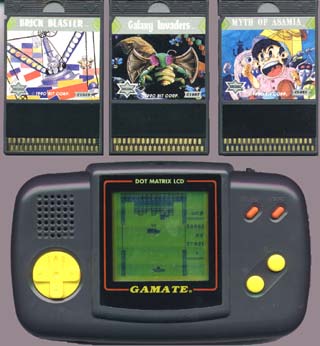
Gamate and 3 games
ManufacturerBit Corporation
United Microelectronics
TypeHandheld game console
GenerationFourth generation
Lifespan1990–1994
MediaROM Card
CPUUMC UA6588F (earlier revision)
NCR 81489 (later revision)
both 6502 based
Memory16KB RAM
DisplayLCD in 4 greyscale
Graphics160 x 152 pixels
SoundAY-3-8910[1]
mono internal speaker
Power6V, four AA batteries
Dimensions16.7 × 9.7 × 3.3 cm (6.58 × 3.82 × 1.3 inches)

The Gamate,[2] known as 超級小子 (pinyin: chāojí xiǎozi, literally "Super Boy") in Taiwan and 超级神童 (pinyin: chāojí shéntóng, literally "Super Child Prodigy") in China, is a handheld game console manufactured by Bit Corporation in the early 1990s, and released in Australia, some parts of Europe, Asia (Taiwan and China[3]), Argentina, and the United States.

The only emulator that supports it is MAME, with games also playable on a MiSTer. 61 games are known to have been released for the system, but additional ones may have been produced.

History

[edit]

The Gamate was first of the many handheld consoles released following Nintendo's Game Boy.

UK magazine advert

It was originally released by the Taiwanese game company Bit Corporation[4] in conjunction with local distributors around the world, such as Alston Research in the USA, the joystick maker Cheetah Marketing in the UK, toy company GIG in Italy, video game importer Uranium in Switzerland, Greek Software in Greece,[5] ITMC subsidiary Yeno in Germany, Famiclone manufacturer Electrolab in Argentina and PlayMix in Sweden.[6][7]

Bit Corp. ceased operating in 1992[8] but UMC and its subsidiary Funtech continued to produce Gamate hardware and software.[6]

Hardware

[edit]

Unlike other Taiwanese or Hong Kong Game Boy competitors, such as the Watara Supervision, Hartung Game Master and the Mega Duck, the Gamate's internal hardware contains no epoxy covered chips and was assembled in a quality manner. The build quality is relatively akin to that of the Game Boy. The shell is made of thick plastic and with batteries installed, the unit feels very similar to the weight of a Game Boy.

Screen

[edit]

The screen on the Gamate is very similar to the Game Boy. It is a greenish color, with manual contrast adjustment, and non-backlit. Backlit screens were not common in 1990. Moving objects appear blurry and faint - the quality known as "ghosting" - which can make game play very frustrating.

The Gamate seems, however, to have had two different types of LCD screen used throughout its lifespan. The easiest way to tell which type one has is by turning the Gamate on without a game in - the "bad" one displays vertical lines while the "good" one displays a slightly corrupted checkerboard pattern.[9]

Sound

[edit]

The Gamate internally uses an AY-3-8910 sound chip that can generate 3 channels of square waves and one for noise. The Gamate's mono internal speaker is of poor quality, giving off sound that is quite distorted, particularly at low volumes.[9] However, if a user plugs into the headphone jack, some of the sound channels are mapped to the headphone's left/right channels that forms stereo audio, and the output is of a relatively high quality.

Shell

[edit]

The original Gamate is dark grey in color and has a "x" D-pad and small speaker vents and produces the full game stereo soundtrack through the monaural speaker. The later Gamate are dark grey in color and have a "+" D-pad design and large speaker vents and have louder volume output but output only a single mono track through the console's mono speaker and requires headphones for the entire L/R audio tracks to be heard.

A variant in the latter design, with a white shell and red buttons also exists.

Serial numbers

[edit]

All Gamates have a seven digit serial number near the card port on the rear of the console. The first two digits represent the year of manufacture, while the last five represent the unit's chronology. Therefore, a unit with the number "9001687", was the 1687th produced in 1990. The newest unit thus far discovered was produced in 1993.[9]

Specifications

[edit]
  • CPU UMC UA6588F (earlier revision); NCR 81489, 8 bits (BIT WS39323F)[9] in a QFP-100 shell (later revision)
  • ROM 2 KB (UM6116M-2L CMOS static RAM, pin compatible with ROM/EPROM chips)
  • RAM 16 KB (2 × CXK5864M-15L chips) of static RAM
  • Case: Grey plastic
  • Keys D-pad, A, B, START and SELECT
  • Sound General Instrument AY-3-8910, output via either internal mono speaker or external stereo headphones
  • Media ROM card, very similar to HuCard (PC-Engine), My Card (SG-1000) and Sega Card (Master System) 19×2 pins
  • Input/Output
    • Cartridge Slot
    • Stereo headphones
    • Power
    • External link connector (for 2-player games)

Expansion

[edit]
  • Gamate link cable
  • Ni-CD battery pack

Games

[edit]
Snowman Legend screenshot
Snowman Legend
Tornado screenshot
Tornado
Treasure Hunter screenshot
Treasure Hunter
Screenshots from three Gamate games

Games cartridges for the Gamate are slim plastic cards with exposed pins, similar to PC-Engine or Master System cards.[10] Within the large illustrations are the game title and, unlike most systems, a simple numerical designation (C1-001, C1-002, etc.), making organization reasonably simple for collectors. The exact number of games released remains unknown. Some articles regarding the Gamate state it has "about 35 games or so", but the true number may be closer to 70. One contributing factor to this ambiguity is that as Bit Corp. had passed into bankruptcy, games continued to be published by UMC, but very few left the Asian market.

Many titles are clones of popular games from the era (Tetris, Bomberman, Lode Runner, Battle City, etc.). Bit Corp. (and later UMC) is given sole credit within each game, but inconsistencies in game content and labeling make it far more likely that several developers were involved in designing individual games; two external developers are currently known, Gamtec and Hengmao Electronics.[6] Some titles suffer from assorted bugs. A few titles seem to be original concepts, and a great many more remain mysterious due to their scarcity.

While in general the higher-numbered games were released later and in smaller quantities, there seems to be little correlation with this principle prior to the C1-040's, with random numbers inexplicably difficult to find.

Game list (incomplete)

[edit]
Serial number[11] Title AKA title(s) Developer Release year
C1-001 Cube-Up[11] Bit Corp. 1990
C1-002 Witty Apee Bit Corp. 1991
C1-003 Box Forum Bit Corp. 1991
C1-004 Mighty Tank Bit Corp. 1990
C1-005 Enchanted Bricks Bit Corp. 1990
C1-006 Mini Golf Bit Corp. 1990
C1-007 Galaxy Invaders Bit Corp. 1990
C1-008 Legend of Dragon Knight Bit Corp. 1991
C1-009 Tornado Bit Corp. 1991
C1-010 Bump N' Run[citation needed]
C1-011 Money Maze Bit Corp. 1990
C1-012 Pharaoh Revenger Bit Corp. 1991
C1-013 Dino Bibo Bit Corp. 1991
C1-014 Time Warrior Bit Corp. 1990
C1-015 Kill Shot Bit Corp. 1991
C1-016 Volcano Panic[12] Bit Corp. 1991
C1-017 Devil Castle Bit Corp. 1991
C1-018 Kung-Fu Fighter Bit Corp. 1990
C1-019 Dino Ball Bit Corp. 1991
C1-020 Bad Bud Chou Chu's Adventure[citation needed]
C1-021 Myth of Asamia Bit Corp. 1990
C1-022 Pipemania Bit Corp. 1991
C1-023 Tennis Bit Corp. 1991
C1-024 Marauder Bit Corp. 1991
C1-025 Jackpot[citation needed]
C1-026 Flipuzzle Bit Corp. 1991
C1-027 Monster Pitfall Bit Corp. 1990
C1-028 Vindicators Bit Corp. 1990
C1-029 Brick Blaster Bit Corp. 1990
C1-030 Beach Volleyball[citation needed]
C1-031 Bomb Blaster Bomb Blast Bit Corp. 1990
C1-032 Cosmic Fighter Bit Corp. 1990
C1-033 Fist of Thunder Bit Corp. 1991
C1-034 Superboy[citation needed]
C1-035 Treasure Hunter Bit Corp. 1990
C1-036 Jewelriss Bit Corp. 1991
C1-037 Nightmare of Santa Claus Bit Corp. 1991
C1-038 Mars Voyage Bit Corp. 1991
C1-039 Bomb Blaster Bomb Blast Bit Corp.
C1-040 Money Maze Bit Corp.
C1-041 Mighty Boxer[citation needed]
C1-042 Flying Goblin Bit Corp. 1991
C1-043 Boom! Bit Corp. 1991
C1-044 Snowman Legend Bit Corp. 1991
C1-045 World Cup Soccer
C1-046 Kiki Inland Kiki Island Bit Corp. 1992
C1-047 Fortune 'n Luck[13] Fortune and Luck Bit Corp. 1992
C1-048 Baseball Super Baseball Bit Corp. 1992
C1-049 Punk Boy Bit Corp. 1992
C1-050 Fortress of Fierceness Bit Corp. 1991
C1-051 Incantational Couple Bit Corp. 1992
C1-052 Famous 1) 7 Famous
2) Famous 7
UMC 1993
C1-053 Metamorphosiser Tough Guy UMC 1993
C1-054 Magic Jigsaw Bit Corp. 1991
C1-055 (unknown title, possibly unreleased)
C1-056 GP Race Bit Corp. 1992
C1-057 Fantasy Travel UMC 1993
C1-058 Heaven Clash QuizFighter UMC 1993
C1-059 (unknown title, possibly unreleased)
C1-060 Further Adventures of Hannibal The Cat 1993
C1-061 Dinosaur Park Phinnex Co., Ltd. 1993
C1-062 (unknown title, possibly unreleased)
C1-063 Basketball
C1-064 Bao Qing Tian The Legendary Judge 1994
C1-065 Hot Hero Huǒbào Yīngxióng 1994
C1-066 (unknown title, possibly unreleased)
C1-067 Robin Hood Phinnex Co., Ltd. 1994
C1-068 The Golden Pyramid 1995
C1-069 Riddle of the Ancient Tomb Bǎozàng Zhī Mí 1994
C1-070 Insect War UMC 1995
C1-401 4-in-1 (Mini Golf, Cube-Up, Brick Blaster, and Vindicators) Bit Corp. 1991
K1-001 One Million Whys Lǜyě Mí Zōng UMC 1993

References

[edit]
[edit]
Revisions and contributorsEdit on WikipediaRead on Wikipedia
from Grokipedia
The Gamate is a handheld video game console manufactured by the Taiwanese company Bit Corporation and released in 1990, as one of the earliest direct competitors to Nintendo's Game Boy. It utilized a monochrome LCD screen capable of displaying four shades of gray, powered by four AA batteries or a 6V external adapter, and included a built-in speaker with headphone jack support, along with standard directional pad and button controls. The system employed proprietary card-style cartridges rather than traditional ROM carts, and over 70 games were developed for it by Bit Corporation, Gamtec, and Hengmao Electronics, including titles like Bomb Blaster (a Bomberman clone) and Monster Pitfall (a Pitfall clone). Despite its technical similarities to the Game Boy—such as an 8-bit processor and comparable RAM—the Gamate suffered from a notably blurry LCD display prone to motion artifacts, which hampered gameplay visibility. Marketed internationally in regions including North America, Europe (UK, France, Germany, Italy, Switzerland), Argentina, Uruguay, and Taiwan under names like Super Boy (超級小子) and Super Child Prodigy (超级神童), it achieved limited commercial success and contributed to Bit Corporation's bankruptcy during production. Production continued under UMC and its subsidiary Funtech until the console's discontinuation in 1994, but low sales volumes made it a rare item even in its era. Today, the Gamate is prized by retro gaming collectors for its obscurity and as an artifact of early 1990s handheld cloning efforts, with emulators and FPGA recreations preserving its library for modern audiences.

History

Development

Bit Corporation, a Taiwanese electronics firm founded in , initially specialized in producing clones of the console and various LCD-based games throughout the . The company built its reputation by developing hardware and software for third-party systems, including home computers like the BIT-60 and BIT-90, before shifting focus toward original designs. In the late , Bit Corporation decided to enter the handheld gaming market, drawing inspiration from Nintendo's series and the newly launched in 1989. This move aimed to capitalize on the growing popularity of portable gaming by creating a cost-effective competitor with similar features, such as an 8-bit processor and cartridge-based games. Development involved collaboration with external partners, including (UMC) for custom chip production, while game software was handled by entities like Gamtec Corp and Hengmao Electronics. Initial prototypes emerged around 1989, featuring experimental case designs with variations in button layouts and speaker placements, which underwent testing to refine and display performance. During development, the console was known internally and in under the alternative name "Super Boy" (超級小子), reflecting its targeted branding for local markets before adopting the global "Gamate" moniker.

Release and distribution

The Gamate handheld console was officially released in 1990 by Bit Corporation, initially launching in and other Asian markets including . By early 1991, it expanded to international regions such as , various parts of Europe (including the , , , , , and ), , and limited availability in the United States through mail-order channels. At launch, the Gamate was priced at approximately $69 USD or £59.99, making it a more budget-friendly option relative to the Nintendo Game Boy's $89.99 . This pricing strategy aimed to appeal to cost-conscious consumers in emerging portable gaming markets. Distribution relied on partnerships with local importers and retailers to navigate regional variations. In the UK, Cheetah Marketing handled initial sales, later followed by Maplin; Italy's GiG leveraged its existing network from NES distribution; Yeno managed and ; Electrolab covered ; Uranium operated in ; PlayMix in ; and Alston Research facilitated mail-order in the , while Bit Corporation directly oversaw Asian markets including . Regional branding adapted to local preferences, with the console marketed as "Super Boy" (超級小子) in and "Super Child Prodigy" (超级神童) in . Marketing campaigns positioned the Gamate as an accessible alternative to the Game Boy, highlighting its similar 8-bit capabilities, LCD display, and link-up functionality at a lower cost to attract entry-level gamers.

Production end and legacy

Bit Corporation, the original manufacturer of the Gamate, filed for in 1992 amid severe financial difficulties exacerbated by the handheld's underwhelming commercial performance and intense market competition from Nintendo's . The company's heavy investment in developing and marketing the Gamate as an original product—departing from its prior focus on Famicom clones—failed to yield sufficient returns, as the console struggled against Nintendo's superior titles and established . This marked the end of Bit Corporation's independent operations, which had positioned the Gamate as Taiwan's ambitious entry into the global handheld market. Following Bit Corporation's collapse, production rights were acquired by (UMC), a Taiwanese firm, and its subsidiary Funtech (also known as Technology), which sustained manufacturing of Gamate hardware and software through minor revisions until approximately 1994. Under this stewardship, the console received limited updates, but support waned as the market shifted toward color handhelds and more advanced systems, leading to the effective cessation of production by the mid-1990s. Overall remained modest, estimated in the tens of thousands of units worldwide, with stronger uptake in Asian markets like and , as well as , compared to limited penetration in and the . The Gamate's legacy endures as an early exemplar of third-party innovation in the fourth-generation handheld era, highlighting the challenges faced by non-Japanese developers in challenging Nintendo's dominance while inspiring subsequent Taiwanese hardware efforts. Despite its commercial shortcomings, it represented a bold pivot toward original designs in an industry dominated by clones. In modern times, the console has garnered interest among retro gaming collectors for its rarity and , with preservation efforts focused on documenting its software library and emulating its hardware to prevent further loss of its obscure titles.

Hardware

Technical specifications

The Gamate handheld console employs an 8-bit (CPU) compatible with the architecture, utilizing either the UMC UA6588F chip in earlier revisions or the NCR 81489 in later revisions. These processors operate at approximately 2.2 MHz, derived from a 4.43 MHz divided by two, enabling efficient handling of game logic and system operations typical of fourth-generation handhelds. The system's memory consists of 16 KB of static RAM, implemented via two CXK5864M-15L chips, which supports game data storage, graphics buffering, and temporary variables during . This configuration aligns with the console's overall architecture, featuring a cartridge slot for ROM-based games that interfaces directly with the CPU and bus to load program code and assets per title. Power is provided by four AA batteries delivering 6 V to the system. The console measures 16.7 × 9.7 × 3.3 cm, contributing to its portable design as a fourth-generation device released in the early .

Display and controls

The Gamate features a non-backlit LCD screen with a resolution of 160 × 152 pixels, supporting 4 levels of for basic visual rendering. Two variants of this LCD were produced: a standard version common in early units, which suffered from significant motion blur and reduced detail visibility, and a sharper version in later models that provided clearer imagery and better projectile distinction in games. The screen's lack of severely limited visibility in low-light conditions, requiring external illumination for effective play. Early Gamate units commonly experienced viewing angle and contrast issues with their LCD displays, often making the screen painful to view for prolonged sessions due to blurring and poor quality. The input controls include a directional pad (D-pad) for character navigation and two action buttons (A and B) for primary interactions, delivering responsive but basic ergonomics typical of late-1980s handheld designs.

Audio system

The Gamate's audio hardware centers on a clone of the General Instrument AY-3-8910 programmable sound generator (PSG), a widely used chip from the late 1970s that enables software-controlled sound synthesis. This PSG features three independent tone channels capable of producing square waves at programmable frequencies up to approximately 125 kHz (depending on the system clock), a single noise channel for percussion and effects using periodic or white noise generators, and hardware envelope control for dynamic amplitude shaping across all channels. Audio output is delivered through a built-in mono speaker, accompanied by a physical volume control dial for basic adjustment. The system also supports headphones connected via a standard 3.5 mm jack, which separates the PSG's channels for improved spatial audio—though the handheld's internal mixing remains fundamentally mono for the speaker. The AY-3-8910 clone imposes several limitations on , including 4-bit volume resolution per channel (yielding 16 discrete levels) and reliance on simple synthesis without support for advanced digital processing like reverb, filtering, or sample playback. The internal speaker exacerbates these constraints with frequent at higher volumes due to its low-cost design and aging components, resulting in tinny, low-fidelity playback typical of early handheld consoles. In practice, Gamate games leverage the PSG for melodies composed of layered square waves and rudimentary sound effects such as beeps for actions or noise bursts for explosions, emphasizing melodic simplicity over complex orchestration.

Physical design and variants

The Gamate handheld console features an ergonomic plastic shell designed for comfortable portable use, closely resembling the form factor of the with its rectangular shape and integrated grip areas. The casing, typically in a gray , was constructed to withstand everyday handling, though it shares the era's common vulnerability to yellowing from prolonged exposure to and environmental factors. Build quality is considered solid and comparable to the original , with responsive buttons and a directional pad that hold up well under repeated use, despite occasional reports of minor wear over decades of age. Production variants exhibit subtle external differences, particularly in early models from 1990, which featured unique button recess depths, shapes, and speaker grille patterns compared to later revisions. Regional adaptations include Taiwanese units with molded English and Chinese labeling on the shell, while European and North American exports often relied on printed stickers for branding and instructions, potentially leading to peeling or fading over time. A standard model dominates collections, but unconfirmed reports suggest a white "second generation" variant and possible colored shells in Asian markets like , though no verified examples have surfaced. Serial numbers, etched on the rear near the game card slot, consist of seven digits where the first two denote the production year—ranging from "90" in 1990 to "93" in 1993—followed by a unique unit identifier, allowing collectors to trace manufacturing batches without evident ties to external design changes. Launch bundles typically included essential accessories such as a user manual, a pre-installed or bundled game like Brick Blaster, AA batteries, and headphones, with some international packages offering optional soft protective cases for storage and transport.

Connectivity and expansion

The Gamate utilizes a cartridge slot for ROM cards, which are credit card-sized plastic cards featuring exposed pins on one end and a containing ROM chips, sharing the same pin layout as Soft Cards for compatibility with certain adapters. These cards function as the primary medium for loading games onto the console. A dedicated extension supports a link cable, allowing two Gamate units to connect for head-to-head multiplayer gameplay in compatible titles. The official link cable is rare, and while reproductions can be fabricated relatively easily, non-standard cables often result in connection failures due to incompatible signaling or pin configurations. The console also includes a 3.5 mm headphone jack for stereo audio output to external , providing clearer sound reproduction compared to the built-in mono speaker. No official expansion packs or peripherals beyond the link cable were produced by Bit Corporation, though limited third-party accessories existed to support extended use.

Games

Library overview

The Gamate's game library consists of 61 confirmed titles, with estimates suggesting up to 70 or more, including some multi-game compilations and potentially unreleased entries. These games are numbered using a "C1-" prefix system, ranging from C1-001 to at least C1-070, reflecting the console's card-based format. Primary development was handled by Bit Corporation, the console's original manufacturer, alongside (UMC), which assumed production after Bit's closure in 1992. Additional developers included Gamtec Corporation in , Hengmao Electronics in , and Phinnex Co., Ltd., which published later titles. The library emphasizes puzzle, action, and genres, with a significant portion comprising unlicensed clones of established hits such as and . Titles were released from 1990 to 1994, peaking in 1990–1991 during the console's active market period. Games were distributed on ROM-based card cartridges, typically credit-card sized with a printed circuit board containing masked ROM chips, often featuring vibrant, multilingual labels but exhibiting inconsistent quality control across production runs.

Notable titles and clones

The Gamate's launch title, Cube-Up (cartridge code C1-001, released in 1990), is a puzzle game that closely emulates the block-stacking mechanics of Tetris, featuring falling tetromino-like shapes rendered in grayscale LCD visuals to complete horizontal lines for scoring. Other early notable titles include Tornado (C1-009, 1991), a vertical scrolling shooter where players control a spacecraft battling waves of enemies across multiple stages, and Snowman Legend (C1-044, 1991), a winter-themed puzzle-platformer in which the protagonist rolls snowballs to capture foes and solve environmental challenges. A significant portion of the Gamate library consists of unlicensed clones of popular arcade and console games, often with modified names, simplified graphics, and occasional technical issues such as collision detection glitches that affect gameplay fairness. Examples include Bomb Blaster, an adaptation of Bomberman involving maze-based explosive combat; Galaxy Invaders, a fixed shooter inspired by Space Invaders with descending alien formations; and Monster Pitfall, a side-scrolling adventure echoing Pitfall!'s exploration and jumping mechanics. These clones typically retained core gameplay loops but adapted them to the system's limited 8x16 monochrome sprite capabilities, sometimes introducing bugs like imprecise enemy hitboxes. While clones dominate, original titles are rarer and often feature basic narratives to differentiate them, such as Riddle of the Ancient Tomb (C1-069, 1994), an action-adventure game where players navigate traps and solve riddles in an Egyptian-themed pyramid to uncover treasures. Select titles supported multiplayer modes, enabling competitive play between two Gamate units connected via an optional link cable, as seen in versus battles in games like Mighty Tank, a Battle City-inspired tank shooter.

Development and emulation

Game development for the Gamate primarily involved programming in on the system's UA6588F CPU, a 6502-compatible processor produced by UMC. Developers utilized tools and ASIC integration provided by Bit Corporation for early titles and UMC for later ones after Bit Corporation's closure in 1992. The process was constrained by the console's limited 1 KB of system RAM and 16 KB of video RAM, which necessitated simple and efficient code to fit within the 256x256 video buffer, often resulting in basic sprite-based designs without complex animations. Cartridge production included protection mechanisms, such as a requiring the string "BIT CORPORATION" and a verification in the ROM's 7000-7FFF range, adding complexity to loading and execution. As Bit Corporation wound down operations, later game development was outsourced to external firms like Gamtec, which handled titles with improved mechanics despite the hardware limitations. Emulation of the Gamate became viable with the integration of its driver into MAME starting in 2017, when initial cartridge support was added and marked as working. By 2023, full preservation was achieved with the dumping of the rare cartridge Mighty Boxer, completing ROM sets for all known released titles and enabling accurate playback of the in MAME 0.256. A hardware-accurate FPGA core for platform was developed by Jamie Blanks and added to the official repository, supporting the system's (with CRC32 verification for Bit Corporation and UMC variants) and cartridge ROMs for cycle-precise . Preservation efforts have been driven by the retro gaming community, including scanning and dumping of physical cartridges to create complete ROM archives hosted on sites like the Internet Archive. However, some rare titles, such as those under the C1-010 designation, remain incompletely dumped due to scarcity and protection challenges. Homebrew development is possible through emulators like MAME, though the system's obscure architecture and limited documentation restrict widespread adoption compared to more popular 6502 platforms.

References

Add your contribution
Related Hubs
User Avatar
No comments yet.