Hubbry Logo
Barotropic fluidBarotropic fluidMain
Open search
Barotropic fluid
Community hub
Barotropic fluid
logo
8 pages, 0 posts
0 subscribers
Be the first to start a discussion here.
Barotropic fluid
Barotropic fluid
from Wikipedia
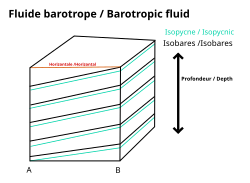
Barotropic fluid stratification of pressure and density

In fluid dynamics, a barotropic fluid is a fluid whose density is a function of pressure only.[1] The barotropic fluid is a useful model of fluid behavior in a wide variety of scientific fields, from meteorology to astrophysics.

The density of most liquids is nearly constant (isopycnic), so it can be stated that their densities vary only weakly with pressure and temperature. Water, which varies only a few percent with temperature and salinity, may be approximated as barotropic. In general, air is not barotropic, as it is a function of temperature and pressure; but, under certain circumstances, the barotropic assumption can be useful.

In astrophysics, barotropic fluids are important in the study of stellar interiors or of the interstellar medium. One common class of barotropic model used in astrophysics is a polytropic fluid. Typically, the barotropic assumption is not very realistic.

In meteorology, a barotropic atmosphere is one that for which the density of the air depends only on pressure, as a result isobaric surfaces (constant-pressure surfaces) are also constant-density surfaces. Such isobaric surfaces will also be isothermal surfaces, hence (from the thermal wind equation) the geostrophic wind will not vary with depth. Hence, the motions of a rotating barotropic air mass is strongly constrained. The tropics are more nearly barotropic than mid-latitudes because temperature is more nearly horizontally uniform in the tropics.

A barotropic flow is a generalization of a barotropic atmosphere. It is a flow in which the pressure is a function of the density only and vice versa. In other words, it is a flow in which isobaric surfaces are isopycnic surfaces and vice versa. One may have a barotropic flow of a non-barotropic fluid, but a barotropic fluid will always follow a barotropic flow. Examples include barotropic layers of the oceans, an isothermal ideal gas or an isentropic ideal gas.

A fluid which is not barotropic is baroclinic, i. e., pressure is not the only factor to determine density. For a barotropic fluid or a barotropic flow (such as a barotropic atmosphere), the baroclinic vector is zero.

See also

[edit]

References

[edit]
Revisions and contributorsEdit on WikipediaRead on Wikipedia
from Grokipedia
In , a barotropic fluid is defined as a in which the is a function solely of the , expressed mathematically as p=F(ρ)p = F(\rho), where FF is a prescribed function, implying that surfaces and surfaces are parallel or coincident. This condition simplifies the governing equations by eliminating explicit dependence on other thermodynamic variables like , making it a useful idealization for modeling incompressible or nearly homogeneous flows. Barotropic fluids exhibit key properties that distinguish them from more general baroclinic fluids, where varies independently of . In such fluids, the α=1/ρ\alpha = 1/\rho is constant along contours, leading to zero and no vertical shear in the velocity field, so that motion is uniform across isobaric levels. The sound speed is given by cs2=dp/dρc_s^2 = dp/d\rho, which must be positive for stability and typically bounded for physical realism in applications like . Conservation laws play a central role: in frictionless conditions, holds, stating that the circulation CC around a loop satisfies DC/Dt=0DC/Dt = 0, as the αdp=0\oint \alpha \, dp = 0 vanishes due to constant α\alpha on surfaces. These characteristics make barotropic fluids essential in various scientific domains. In and , they model phenomena like tidal currents, storm surges, and large-scale circulations where density variations are minimal, often assuming incompressibility for depth-averaged flows. In cosmology, barotropic equations of state p=f(ρ)p = f(\rho) describe components, with asymptotic behaviors mimicking pressureless dust at high densities and a at low densities, influencing models of expansion. The Euler equations for a barotropic fluid, ρDuDt=p\rho \frac{D\mathbf{u}}{Dt} = -\nabla p alongside the ρt+(ρu)=0\frac{\partial \rho}{\partial t} + \nabla \cdot (\rho \mathbf{u}) = 0, form the foundational framework, often extended with or for realistic simulations.

Definition and Basics

Core Definition

A barotropic fluid is defined as a fluid in which the pressure pp is a function solely of the ρ\rho, expressed mathematically as p=p(ρ)p = p(\rho). This relationship implies that surfaces of constant pressure (isobaric surfaces) coincide precisely with surfaces of constant (isosteric or isopycnal surfaces), eliminating any misalignment between pressure and density gradients. Consequently, the fluid exhibits no dependence on other thermodynamic variables such as or composition, which simplifies its behavior by removing sources of baroclinicity that would otherwise arise from such dependencies. This defining characteristic leads to streamlined thermodynamic properties, particularly in inviscid flows where the absence of density variations independent of facilitates the conservation of certain quantities along paths. For instance, in steady, inviscid barotropic flows, the variation along streamlines is directly tied to velocity changes via the Bernoulli relation, without additional complications from or thermal effects. The term "barotropic" originated in the late 19th and early 20th centuries within the framework of , building on 19th-century hydrodynamic principles from figures like Helmholtz and , and was formalized by in his 1921 work on vortex dynamics in the atmosphere. A classic example of a barotropic fluid is the idealized incompressible , where density ρ\rho remains constant regardless of , trivially satisfying p=p(ρ)p = p(\rho) as ρ\rho is constant and representing a limiting case often used in basic analyses.

Prerequisites and Context

In , the motion of fluids is described using either Eulerian or Lagrangian frameworks. The Lagrangian tracks individual fluid particles as they move through , following their trajectories and properties over time. In contrast, the Eulerian observes the fluid from fixed points in , focusing on field variables such as v(x,t)\mathbf{v}(\mathbf{x}, t) at position x\mathbf{x} and time tt. The Eulerian approach is typically preferred for most analyses due to its compatibility with fixed coordinate systems and computational methods. A fundamental equation in fluid dynamics is the continuity equation, which expresses the conservation of mass. In its differential form, it states that the local rate of change of density ρ\rho plus the divergence of the mass flux equals zero: ρt+(ρv)=0\frac{\partial \rho}{\partial t} + \nabla \cdot (\rho \mathbf{v}) = 0. This equation ensures that mass is neither created nor destroyed within a fluid element. Complementing this is the momentum equation, derived from Newton's second law applied to a fluid parcel, which governs the acceleration of the fluid: DvDt=1ρp+f\frac{D \mathbf{v}}{Dt} = -\frac{1}{\rho} \nabla p + \mathbf{f}, where DDt\frac{D}{Dt} is the material derivative (following the fluid motion), pp is pressure, and f\mathbf{f} represents body forces per unit mass such as gravity. These equations form the basis for modeling fluid behavior under various assumptions. Thermodynamically, fluids are characterized by state variables including pp, ρ\rho, and TT, which together define the under equilibrium conditions. The equation of state relates these variables, and fluids are classified based on its form; for instance, a barotropic fluid has depending solely on (p=p(ρ)p = p(\rho)), independent of or , whereas non-barotropic fluids exhibit more complex dependencies involving multiple variables. This influences how thermodynamic processes affect fluid motion. Understanding fluid dynamics requires familiarity with vector calculus operators in three dimensions. The gradient ϕ\nabla \phi of a scalar field ϕ\phi points in the direction of steepest increase and measures spatial variation, as seen in the pressure gradient term driving fluid acceleration. The divergence A\nabla \cdot \mathbf{A} of a vector field A\mathbf{A} quantifies net flux out of a volume, central to the continuity equation for mass conservation. The curl ×A\nabla \times \mathbf{A} captures rotational tendencies, such as vorticity in fluid flows, which will be relevant for later discussions of circulation. These operators enable the mathematical formulation of physical laws in continuum mechanics. The study of barotropic fluids builds on early foundational work in ideal fluid theory. In the , Leonhard Euler developed the for inviscid fluids in , introducing the modern form of the momentum equation and assuming incompressible, ideal behavior without . Earlier, Daniel Bernoulli's treatise on hydrodynamics established the principle relating , , and elevation along streamlines in steady, inviscid flows, laying groundwork for assumptions where variations are tied directly to pressure changes. These contributions set the stage for analyzing fluids under barotropic conditions, where is uniform and pressure is a function of alone.

Physical and Mathematical Properties

Equation of State

A barotropic fluid is characterized by an in which the pp depends solely on the ρ\rho, expressed as p=p(ρ)p = p(\rho), or equivalently ρ=ρ(p)\rho = \rho(p). This functional relationship implies that surfaces of constant coincide with surfaces of constant , simplifying the fluid's thermodynamic by eliminating explicit dependence on other variables such as or . Common forms of this equation include linear and nonlinear relations. A linear example is p=c2(ρρ0)p = c^2 (\rho - \rho_0), where cc is a constant speed (often the sound speed) and ρ0\rho_0 is a reference ; this approximates weakly compressible flows, such as in the Boussinesq . Nonlinear cases, like the polytropic equation p=Kργp = K \rho^\gamma, where KK and γ\gamma are constants, arise in contexts requiring more realistic compressibility, such as stellar interiors or adiabatic gas dynamics. The polytropic form derives from adiabatic processes, where is conserved along paths. For an undergoing an isentropic (reversible adiabatic) compression or expansion, the first law of thermodynamics and the yield p/pr=(ρ/ρr)γp / p_r = (\rho / \rho_r)^\gamma, with γ=Cp/Cv\gamma = C_p / C_v as the adiabatic index; generalizing the reference values to constants KK and γ\gamma gives the polytropic . This relation holds for barotropic flows assuming constant , linking variations directly to changes without . In barotropic flows, the specific enthalpy hh (per unit mass) is given by h=dpρh = \int \frac{dp}{\rho}, which integrates to a function of density alone since p=p(ρ)p = p(\rho). For steady, inviscid flows, this enthalpy remains constant along streamlines, facilitating the application of Bernoulli-like theorems. Thermodynamically, the barotropic condition implies that the specific uu depends only on , u=u(ρ)u = u(\rho), as the equation of state closes the system without needing independent or fields. TT, if required (e.g., for ideal gases via p=ρRT/Mp = \rho R T / M), is then derived as T=T(ρ)T = T(\rho) from the pressure- relation, ensuring no independent thermodynamic variables beyond .

Density-Pressure Relationship

In a barotropic fluid, the density ρ\rho is a function of pressure pp alone, such that ρ=ρ(p)\rho = \rho(p). This relationship implies that surfaces of constant pressure (isobaric surfaces) coincide with surfaces of constant density (isosteric surfaces), as the gradients p\nabla p and ρ\nabla \rho are parallel everywhere. Consequently, the baroclinic torque term p×ρ=0\nabla p \times \nabla \rho = 0, eliminating vorticity generation due to misalignment between pressure and density gradients. This alignment leads to neutral stability for vertical displacements of fluid parcels. When a parcel is displaced vertically in , its density adjusts instantaneously to match the local according to the equation of state, resulting in no net force and thus no restoring mechanism perpendicular to the . In such cases, the fluid exhibits neutral buoyant stability, with parcels neither accelerating away nor oscillating back to their original positions. For compressible barotropic fluids, the density-pressure relation determines the speed of sound cc, which governs the propagation of small pressure disturbances. The sound speed is given by c=dpdρ,c = \sqrt{\frac{dp}{d\rho}},
Add your contribution
Related Hubs
User Avatar
No comments yet.