


Community hub
Recent from talks
Contribute something
Nothing was collected or created yet.

In Norse mythology (a subset of Germanic mythology), Elli (Old Norse: [ˈelːe], "old age"[1]) is a personification of old age who, in the Prose Edda book Gylfaginning, defeats Thor in a wrestling match.[2]
Gylfaginning
[edit]In Gylfaginning, Thor and his companions Loki and Þjálfi are in the hall of the jötunn Útgarða-Loki where they meet difficult challenges testing their strength and skill. Thor has just been humiliated in a drinking challenge and wants to get even.
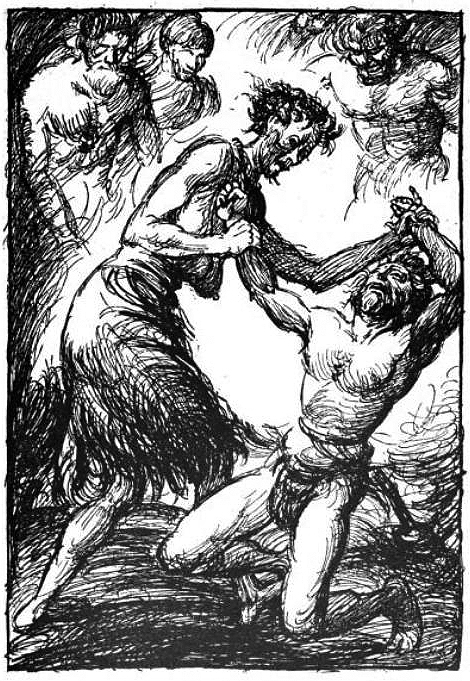
Then said Thor: 'Little as ye call me, let any one come up now and wrestle with me; now I am angry.' Then Útgarda-Loki answered, looking about him on the benches, and spake: 'I see no such man here within, who would not hold it a disgrace to wrestle with thee;' and yet he said: 'Let us see first; let the old woman my nurse be called hither, Elli, and let Thor wrestle with her if he will. She has thrown such men as have seemed to me no less strong than Thor.' Straightway there came into the hall an old woman, stricken in years. Then Útgarda-Loki said that she should grapple with Ása-Thor. There is no need to make a long matter of it: that struggle went in such wise that the harder Thor strove in gripping, the faster she stood; then the old woman attempted a hold, and then Thor became totty on his feet, and their tuggings were very hard. Yet it was not long before Thor fell to his knee, on one foot. Then Útgarda-Loki went up and bade them cease the wrestling, saying that Thor should not need to challenge more men of his body-guard to wrestling.[3]
Later, when Thor and his company are safely out of Útgarða-Loki's hall the jötunn explains that Thor's opponent was much more formidable than she appeared to be and that Thor's prowess was, in fact, astonishing.
It was also a great marvel concerning the wrestling-match, when thou didst withstand so long; and didst not fall more than on one knee, wrestling with Elli; since none such has ever been and none shall be, if he become so old as to abide "Old Age," that she shall not cause him to fall.[3]
Elli is not mentioned in any other extant source but the notion that not even the gods are immune to the effects of aging is supported by the fact that they must consume the apples of Iðunn regularly to stay young.
See also
[edit]
- Geras, Greek personification of old age
Notes
[edit]References
[edit]- Brodeur, Arthur Gilchrist (trans.) (1916). The Prose Edda by Snorri Sturluson. New York: The American-Scandinavian Foundation.
- Orchard, Andy (1997). Dictionary of Norse Myth and Legend. Cassell. ISBN 0-304-34520-2
| Astronomical bodies |  | |
|---|---|---|
| Time | ||
| Water bodies |
| |
| Worlds |
| |
| Cosmogenesis, cyclic time, and eschatology | ||
| Other | ||
| Related | ||
Name and Etymology
Linguistic Meaning
The name Elli derives from the Old Norse noun elli, denoting "old age" or "senility," thereby associating the mythological figure with the inexorable progression of advanced years and the associated physical and mental decline.[3] Etymologically, elli traces back to Proto-Germanic *alþį̄ ("oldness" or "age"), formed by combining the adjective *aldaz ("grown up" or "old") with the abstract noun suffix -į̄. This root *aldaz originates from the Proto-Indo-European *h₂el- ("to grow" or "nourish"), reflecting an ancient conceptual shift from nourishment and maturity to the decay inherent in senescence.[5] Linguistic evidence for this shared heritage appears in cognates across Germanic languages, such as Old English ielðu ("age" or "old age") and Gothic alþeis ("old" or "elderly"), both descending from the same Proto-Germanic and Indo-European foundations. These terms underscore the semantic consistency of "old age" as a metaphor for life's culminating phase in early Germanic speech.Old Norse Context
In Old Norse literature, the term elli appears frequently in the Icelandic sagas and skaldic poetry to denote not merely chronological age but a state of frailty and diminished capacity, often marking the transition to social withdrawal or retirement from active life. For instance, in Njáls saga, the character Njáll refers to himself as "maður gamall" (an old man) when refusing to flee during the burning of his house, emphasizing his physical vulnerability and inability to avenge his sons despite his wisdom, portraying old age as a debilitating force that overrides personal agency. Similarly, in Egils saga, the poet Egill Skallagrímsson uses elli in his verses to lament the toll of aging on his body and spirit, as in his sonnet where he describes himself as controlled by elli in contrast to the youthful vigor of others around him, highlighting frailty as an inexorable decline. These usages underscore elli as a descriptor for elderly characters whose physical weaknesses contrast with their potential for sagacity, such as aged warriors in sagas who retain advisory roles but are sidelined from combat.[7] Culturally, old age in Norse society, as reflected through elli, embodied a dual perception: a revered phase of accumulated wisdom and experience, yet one fraught with vulnerability to illness, isolation, and loss of honor if physical prowess waned. Elderly individuals were often depicted as sources of counsel in communal decisions, but elli connoted exposure to exploitation or marginalization, with the term evoking images of bodily decay and mental fog that eroded one's standing in a honor-based culture. In skaldic verse, elli is sometimes juxtaposed with concepts of deterioration, amplifying its sense of inevitable weakening, as seen in Egill's poetry where aging brings impotence and sorrow, reinforcing the societal view of old age as a precarious balance between esteemed insight and corporeal frailty. This duality is evident in saga narratives where aged figures like Ófeigr in Bandamanna saga strategically leverage their elli to manipulate social dynamics, turning perceived weakness into a tool for influence.[7][8] The historical attestation of elli as a common noun traces to 13th-century Icelandic manuscripts, such as those preserving Njáls saga and Egils saga, which compile oral traditions dating back to the 9th and 10th centuries during the Viking Age. These texts, composed in the post-Christian era, capture pre-Christian cultural attitudes toward aging without direct mythological personification. No runic inscriptions from the pre-Christian period (circa 8th–11th centuries) attest to elli employed as a proper name, suggesting its primary role in literature was as a descriptive term rather than a titular or divine identifier. While the basic linguistic meaning of elli translates to "old age," its contextual applications in sagas and poetry reveal deeper societal layers of interpretation.[7]Attestations in Texts
Prose Edda Account
In the Prose Edda, specifically in the section Gylfaginning (chapter 44), Elli appears during Thor's visit to the hall of the giant Utgard-Loki in Jötunheim. As part of a series of illusory challenges designed to humble the god, Utgard-Loki summons Elli as Thor's final opponent in a wrestling match, after Thor's previous feats of drinking from an enchanted horn and attempting to lift a massive cat have seemingly failed. Thor grapples with Elli but finds himself unable to overpower her; despite his immense strength, she resists all his efforts until he is forced to one knee, symbolizing the relentless advance of age that weakens even the mightiest.[9] Elli is depicted as an ancient, frail-looking woman, described as Utgard-Loki's nurse, whose deceptive weakness belies an unbeatable power.[9] This account forms part of Thor's three trials in Utgard, a narrative framed as a dialogue between the Swedish king Gylfi and disguised figures representing Odin, intended to convey Norse cosmological and mythological knowledge. Authored by the Icelandic scholar Snorri Sturluson around 1220 CE, the Prose Edda draws from earlier oral traditions and lost poetic sources to preserve pagan lore for skaldic poets. Utgard-Loki later reveals the illusions to a departing Thor, explaining Elli's true nature with the words: "Elli is Old Age, and strong though thou wast, thou didst strive with her well, but no man may throw her, if he shall be older than she; for the day will come when every man will fall before her."[10] The primary manuscripts of the Prose Edda—including AM 242 fol. (Codex Trajectinus, c. 1600) and Codex Upsaliensis (DG 11 4to, c. 1300)—exhibit minor variations in the phrasing of the wrestling scene, such as slight differences in wording for Thor's holds and Elli's responses, but the core narrative remains consistent across them.[10]Absence in Poetic Edda
The Poetic Edda, a collection of anonymous Old Norse poems composed between the 9th and 13th centuries and preserved mainly in the 13th-century Codex Regius manuscript, serves as a primary source for Norse mythology and heroic legends. Despite its frequent exploration of themes like fate, mortality, and the inexorability of doom in works such as Völuspá and Hávamál, the Poetic Edda contains no explicit mention of Elli as a personified figure.[11] Scholars note possible indirect allusions to old age as an abstract force of decline, but without naming a specific entity like Elli. Such references appear in other eddic lays as well, portraying age as a grim equalizer rather than a named antagonist or deity. Some scholars suggest that Elli may represent a later rationalization by Snorri Sturluson, transforming vague poetic concepts of mortality into a concrete character within his prose framework.[11] This absence implies that Elli's role is confined to prose traditions, potentially adapted by Snorri to systematize and rationalize myths for a Christian audience, in contrast to the more fragmented and archaic poetic corpus.[11]Mythological Role
Personification of Old Age
In Norse mythology, Elli serves as the personification of old age, depicted as an elderly woman whose inherent strength symbolizes the inexorable weakening that afflicts all beings over time.[12] According to Snorri Sturluson's Prose Edda, in the section Gylfaginning, she is explicitly identified as "old age" itself, an abstract force that no one can fully overcome, as Utgarda-Loki explains: "there never has been anyone, and there never will be anyone, if they get so old that they experience old age, that old age will not bring them all down."[12] Elli embodies one of several personified natural inevitabilities in Norse cosmology, akin to the representations of consumption (as in Logi for wildfire) and mental swiftness (as in Hugi for thought), underscoring forces beyond the control of gods or mortals.[12] Positioned within Utgard, the illusory realm of giants and extremes, her role highlights old age as an unbeatable adversary that humbles even the mighty Thor, bringing him to one knee in their brief wrestling match.[12] This placement emphasizes Norse views on mortality, where aging represents a universal law eroding physical prowess irrespective of divine status. While broader Norse lore connects aging to the themes of decay preceding Ragnarök—such as the gods' vulnerability without Idunn's youth-preserving apples—Elli specifically focalizes on individual senescence rather than the cosmic apocalypse.[12] Her portrayal reflects Viking-era societal attitudes toward elders, who were valued for advisory wisdom yet constrained by physical decline, as evidenced in the Grágás law codes that mandated family obligations to support aged dependents while acknowledging their reduced capacity for labor or combat.[13] These codes, compiled in medieval Iceland from earlier oral traditions, illustrate a cultural balance between reverence for accumulated knowledge and pragmatic recognition of frailty in old age.[14]Wrestling with Thor
In the hall of Útgarða-Loki, the third challenge presented to Thor was a wrestling match against an old woman named Elli, introduced by the giant king as his nurse who had bested many strong opponents.[1] Thor, enraged by his previous failures, accepted the contest readily, grasping Elli firmly and exerting his full strength to lift her. However, the more forcefully Thor strained, the more immovable she remained, her stance unyielding like a rooted mountain.[1] As the struggle intensified, Elli countered with a hold that made Thor stagger, forcing him to one knee in a desperate bid to stay upright; unable to raise her even that far without collapsing under her weight, Thor was ultimately subdued.[1] The mechanics of the match carry deep symbolic weight, with each phase of Thor's efforts mirroring the inexorable progression of human life stages: his initial vigorous attempts evoke youthful vigor, the mounting strain reflects middle-age exertion, and the final defeat symbolizes the frailty of old age's grip, from which none escape.[15] This progression underscores old age's ultimate triumph over even the mightiest, as Elli—personifying the inevitable decay that affects all beings—proves an adversary beyond physical overpowering.[1] Following the bout, Útgarða-Loki intervened to end the contest, declaring no further challenges necessary and hosting Thor's company for the night.[1] The next morning, as Thor departed, Útgarða-Loki unveiled the illusions behind the trials, explaining that Elli embodied old age itself, an force so potent that it fells everyone who reaches its threshold, humiliating Thor and illustrating the gods' subjection to universal natural laws.[1][15] Scholars interpret the wrestling as a metaphorical kenning for the broader struggles of existence, where victory against Elli remains impossible, distinguishing it from Thor's typical triumphs over giants and emphasizing mortality's dominion over divine and mortal alike.[15] This encounter highlights Thor's moral resilience amid defeat, foreshadowing his unyielding role in cosmic events like Ragnarök.[15]Interpretations and Symbolism
Symbolic Significance
In Norse mythology, Elli's encounter with Thor exemplifies themes of hubris and the inexorable nature of fate, underscoring that even the most powerful deities cannot overcome the passage of time. Thor's inability to fully subdue Elli during their wrestling match serves as a humbling reminder of divine limitations, where physical might yields to the universal force of aging. This narrative illustrates fatalism, as old age, personified by Elli, triumphs not through superior strength but through inevitability, foreshadowing the gods' eventual downfall at Ragnarök, where time and decay prevail over eternal vigor.[15] As a female figure, Elli embodies the impartiality of aging, transcending gender-specific vulnerabilities to represent a neutral, all-encompassing force that affects every individual regardless of status or power. Her portrayal as an elderly woman highlights the crone archetype in mythological symbolism, evoking the inexorable progression of life stages without explicit ties to other fate-weaving entities like the Norns, yet reinforcing the theme of time's unyielding equity.[16] Elli appears rarely in medieval artistic representations, reflecting her niche role within the broader corpus of Norse iconography, but she features symbolically in later 19th-century illustrations, such as Robert Engels' depiction of Thor grappling with the aged giantess, which captures the tension of youthful prowess against inevitable decline. These woodcuts and engravings emphasize the dramatic struggle, portraying Elli as a stooped yet formidable crone to visually convey the myth's lesson on mortality's dominance.[17]Modern Scholarly Views
In the 19th and early 20th centuries, scholars like Jacob Grimm sought to integrate Elli into a broader Germanic mythological framework, comparing her to folklore figures embodying decay and senescence, such as the aged crones in Low German tales who symbolize inevitable decline. Grimm positioned Elli not merely as a Snorronic allegory but as a potential goddess reflecting pan-Teutonic motifs of mortality's grip on vitality. Later 20th-century analyses, particularly by John Lindow, interpret Elli as a structural device within Snorri Sturluson's Gylfaginning, underscoring the narrative's theme of divine vulnerability to inexorable natural forces. Lindow emphasizes that Elli's defeat of Thor illustrates the limits of physical might against abstract inevitabilities like aging, serving as a counterpoint to Thor's triumphs over giants and reinforcing the myth's exploration of cosmic balance in the Prose Edda.[18]References
- https://en.wikisource.org/wiki/The_Prose_Edda_(1916_translation_by_Arthur_Gilchrist_Brodeur)/Gylfaginning
- https://en.wikisource.org/wiki/The_Prose_Edda_(1916_translation_by_Arthur_Gilchrist_Brodeur)
- https://en.wiktionary.org/wiki/elli#Old_Norse
- https://en.wiktionary.org/wiki/Reconstruction:Proto-Germanic/alþį̄
- https://en.wiktionary.org/wiki/Reconstruction:Proto-Germanic/aldaz
- https://en.wiktionary.org/wiki/alþeis