


Community hub
Recent from talks
Contribute something
Nothing was collected or created yet.
German Cross
View on Wikipedia
| German Cross Deutsches Kreuz | |
|---|---|
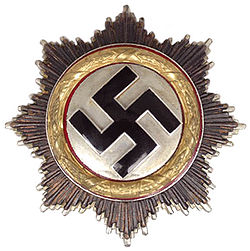
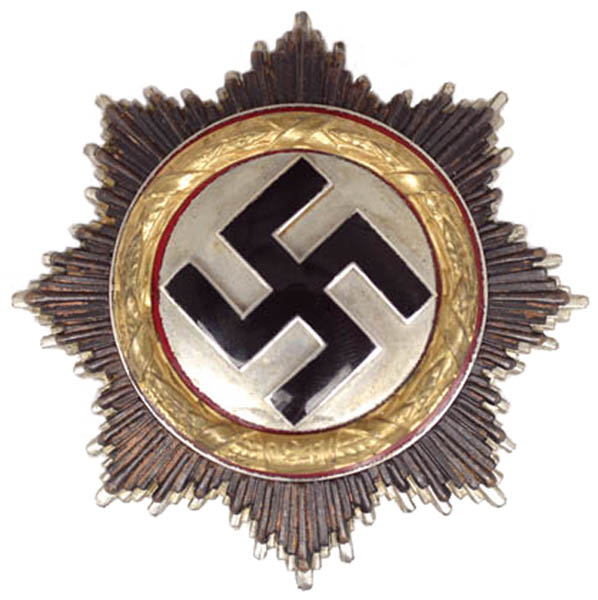
  German Cross in Gold (left) and Silver (right) | |
| Type | Military Order |
| Awarded for | Gold: for repeated exceptional acts of bravery or troop leadership Silver: for continued distinguished acts of service in the war effort |
| Presented by | Nazi Germany |
| Eligibility | Military personnel |
| Campaign | World War II |
| Status | Obsolete |
| Established | 28 September 1941 |
| Total | ~25,964 in Gold ~ 2,471 in Silver[1] |
 German Cross in Silver, Gold, and with Diamonds. Post-war de-nazified versions below. | |
| Precedence | |
| Next (lower) | Iron Cross (1939) 1st Class Clasp to the Iron Cross, 1st Class War Merit Cross 1st Class with Swords |
The War Order of the German Cross (German: Der Kriegsorden Deutsches Kreuz), normally abbreviated to the German Cross or Deutsches Kreuz, was instituted by Adolf Hitler on 28 September 1941. It was awarded in two divisions: in gold for repeated acts of bravery or military leadership; and in silver for distinguished non-combat war service. The German Cross in Gold ranked higher than the Iron Cross First Class but below the Knight's Cross of the Iron Cross, while the German Cross in Silver ranked higher than the War Merit Cross First Class with Swords but below the Knight's Cross of the War Merit Cross with Swords.[2]
Eligibility
[edit]The German Cross was issued in two versions: gold and silver (the color of the laurel wreath around the swastika). The gold version was awarded to military personnel for repeated acts of bravery in combat, or of military leadership, with 6–8 acts as a rule of thumb.[3] The silver version was awarded for multiple distinguished services in the war effort and was considered a continuation of the War Merit Cross with swords. Where a recipient had been awarded both the silver and gold versions, only the gold version was authorized for wear.[4]
Article three of the law governing the German Cross states that to qualify for the German Cross in gold or silver, the recipient must be a holder of the Iron Cross (1939) 1st Class or Clasp to the 1914 Iron Cross 1st Class, or the War Merit Cross 1st Class with Swords.[5] The award of the German Cross was not a prerequisite for the award of the Knight's Cross of either the Iron Cross or War Merit Cross, and the German Cross could be awarded to Knight's Cross holders.[6]
While civilians were not eligible, awards could be made to members of uniformed formations including the police and railway workers.[7]
From 30 August 1944, recipients of the gold class of the Close Combat Clasp were normally also awarded the German Cross in gold, without the need for further justification,[8][9] although the additional award was not made in all cases.[10]
While estimates vary, approximately 25,964 gold and 2,471 silver crosses were awarded.[1][11]
Appearance
[edit]The order consists of a star badge, containing a swastika. It had a diameter of 6.5 centimetres (2.6 in) and was worn on the right-hand side of the tunic.[2]
From June 1942 the gold version was officially available in cloth form, for easier wear on the combat uniform.[6] This had the same dimensions as the original decoration, with the wreath circling the swastika, the only metal part of the badge. The backing cloth reflected the arm of service: field grey for the army, or navy dark blue or air force pale blue.[7]
Twenty specimen copies of a special grade, the German Cross in Gold with Diamonds, were manufactured in 1942, but this grade was never formally instituted or bestowed.[7]
1957 version
[edit]The wearing of Nazi-era decorations was banned in Germany after the war, as was any display of the swastika. In 1957, the Federal Republic of Germany authorized the wearing of alternative de-nazified replacement versions of a number of war decorations. These included the German Cross, with the swastika replaced by a representation of the Iron Cross for the gold division, and the War Merit Cross with Swords for the silver division. Qualifying members of the Bundeswehr wore the award on their ribbon bar, represented by a small replica of the decoration on a field grey ribbon.[12]
-
 Award certificate: German Cross in Gold to Count Claus von Stauffenberg 8 May 1943
 -
 Award of a Marine (submarine crew) with the German Cross in Gold (1942)
 -
 Worn on chest pocket of the field blouse (Captain Alfred Jaedtke, 1944)
 -
 Cloth version worn on Luftwaffe flight suit (Lieutenant Siegfried Lemke, 1944)
 -
 Worn on the field uniform by an Oberfeldwebel of the Großdeutschland Division in Central Russia, 1943
 -
 German Cross in Gold (cloth form)


Recipients
[edit]Select recipients of both gold and silver grades included:
- SS-Sturmbannführer Wilhelm Mohnke, 26 December 1941 (gold)
- Oberst Hans Krebs, 26 January 1942 (gold)
- SA-Obergruppenführer Günther Gräntz, 23 February 1942 (gold)
- Generalmajor Helmuth Weidling, 23 June 1942 (gold)
- Hauptmann Franz Maierhofer, 1 July 1942 (gold)
- Generalmajor Ernst Merk, 11 February 1944 (gold) & 6 July 1942 (silver)
- Luftwaffe Leutnant Walter Krupinski, 27 August 1942 (gold)
- SS-Obersturmbannführer Fritz Knoechlein, 15 November 1942 (gold)
- Oberst Bodo Zimmermann, 25 September 1944 (gold) & 15 February 1943 (silver)
- SS-Standartenführer und Oberst der Polizei Walther Rauff, 7 February 1945 (gold) & 20 May 1943 (silver)
- SS-Hauptsturmführer Alfred-Ingemar Berndt, 17 July 1943 (gold)
- Luftwaffe Hauptmann Günther Specht, 25 November 1943 (gold)[13]
- Generalleutnant Felix Schwalbe, 7 December 1944 (gold) & 30 November 1943 (silver)
- SS-Obersturmbannführer Oskar Dirlewanger, 5 December 1943 (gold)
- SS-Standartenführer Bruno Streckenbach, 15 December 1943 (gold)
- SS-Obersturmbannführer Kurt Weisse, 25 August 1944 (gold)
- Luftwaffe Oberleutnant Franz Stigler, 1 October 1944 (gold)
- SS-Gruppenführer und Generalleutnant der Polizei Odilo Globocnik, 7 February 1945 (gold) & 20 January 1945 (silver)
- SS-Standartenführer Rudolf Lange, 6 February 1945 (gold) awarded posthumously by Adolf Hitler.
- Major Josef Gangl, 8 March 1945 (gold)
Foreign recipients
[edit]In October 1942, eligibility for the German Cross in Gold was extended to the armed forces of allied countries on the same basis as awards to German forces.[6]
Select foreign recipients of the German Cross in Gold include:
- Belgium
- SS-Standartenführer Léon Degrelle, 9 October 1944
- Croatia
- Lieutenant Cvitan Galić, 23 June 1943
- 1st Lieutenant Mato Dukovac
- Estonia
- Senior Lieutenant Hando Ruus, 30 December 1944
- Finland
- General Erik Heinrichs, 17 August 1943
- Lieutenant General Jarl Lundqvist, 9 November 1943
- Lieutenant General Karl Lennart Oesch, 5 August 1944,
- SS-Obersturmführer Ulf-Ola Olin, 28 February 1945
- Italy
- Vice Admiral Luigi Sansonetti, 18 January 1942
- Marshal Ettore Bastico, 5 December 1942
- General Enea Navarini, 21 December 1942
- Colonel General Rino Corso Fougier ,18 January 1943
- Latvia
- Untersturmführer Kārlis Mūsiņš
- Standartenführer Vilis Janums, 1 March 1945
- Romania
- General Gheorghe Avramescu, 25 October 1942
- Major General Leonard Mociulschi, 25 October 1942
- Major General Ermil Gheorghiu, 11 February 1943
- Captain Nicolae Dabija, 10 February 1944
- Spain
- Major General Emilio Estéban Infantes y Martín, 9 April 1943
In all, some 26 non-German volunteers of the Waffen-SS from Belgium, Denmark, Estonia, Finland, Hungary, Latvia, Netherlands and Norway received the German Cross in Gold.
Nicknames
[edit]Colonel Hans von Luck called it "Hitler's fried egg", in response to its gaudiness.[14] Another name for the decoration was "The Party Reflector for the Near-Sighted"[15]
References
[edit]- Citations
- ^ a b Maerz 2009, pp. 53.
- ^ a b Angolia 1976, pp. 327–334.
- ^ Note: Littlejohn & Dodkins p 123 says 7–12 further acts.
- ^ Littlejohn & Dodkins 1968, pp. 122–124.
- ^ Reichsgesetzblatt 1941.
- ^ a b c Klietmann 1981, pp. 47–49.
- ^ a b c Littlejohn & Dodkins 1968, p. 123.
- ^ Klietmann 1981, p. 106.
- ^ Michaelis 2008, p. 29.
- ^ Williamson 2002, p. 6.
- ^ Note: Klietmann page 48 estimates 17,000 gold and 900 silver awards to the army and Waffen-SS alone.
- ^ Littlejohn & Dodkins 1968, p. 225.
- ^ Patzwall & Scherzer 2001, p. 450.
- ^ Von Luck 1989.
- ^ Fowler 1992.
- Bibliography
- Angolia, John (1976). For Führer and Fatherland: Military Awards of the Third Reich. R. James Bender Publishing. ISBN 0-912138-14-9.
- Fowler, EWW (1992). Nazi Regalia. Brompton Books Corp. ISBN 1-55521-767-2.
- Klietmann, Kurt-Gerhard (1981). Auszeichnungen des Deutschen Reiches. 1936–1945, 11 Auflage (in German). Motorbuch, Stuttgart. ISBN 3-87943-689-4.
- Littlejohn, David; Dodkins, Colonel C. M. (1968). Orders, Decorations, Medals and Badges of the Third Reich. R. James Bender Publishing, California. ISBN 978-0854200801.
- Lumsden, Robin (2001). Medals and Decorations of Hitler's Germany. Airlife Publishing Ltd, Shrewsbury. ISBN 978-1840371789.
- Von Luck, Hans (1989). Panzer Commander. Praeger Publishers, New York. ISBN 0-440-20802-5.
- Maerz, Dietrich (2009). The German Cross in Gold and Silver. B&D Publishing, Richmond, MI. ISBN 978-0-9797969-2-0.
- Michaelis, Rolf (2008). Deutsche Kriegsauszeichnungen 1939–1945 Heer – Waffen-SS – Polizei (in German). Winkelried Verlag, Leisnig. ISBN 978-3930849314.
- Patzwall, Klaus D.; Scherzer, Veit (2001). Das Deutsche Kreuz 1941–1945. Geschichte und Inhaber, Band II [The German Cross 1941–1945. History and Recipients, Volume 2] (in German). Norderstedt, Germany: Verlag Klaus D. Patzwall. ISBN 978-3-931533-45-8.
- Reichsgesetzblatt (PDF) (in German). Reichsministerium des Inneren (Ministry of the Interior). 2 October 1941. Teil I, S. 593. Retrieved 19 August 2014 – via Österreichische Nationalbibliothek, alex.onb.ac.at.
- Williamson, Gordon (2002). World War II German Battle Insignia. Osprey Publishing. ISBN 1841763527.


_4Jahre_BAR.svg)
_ribbon.svg)
.svg)


.jpg)


German Cross
View on GrokipediaHistorical Background
Institution and Initiation
The War Order of the German Cross (Kriegsorden des Deutschen Kreuzes) was established by Adolf Hitler, as Führer and Supreme Commander of the Wehrmacht, through a decree dated 28 September 1941.[8][9] This wartime decoration aimed to honor repeated acts of bravery in combat or outstanding non-combat service that warranted recognition beyond the Iron Cross First Class but fell short of the Knight's Cross of the Iron Cross, thereby filling a perceived gap in the Wehrmacht's hierarchy of valor awards without diluting elite distinctions.[8][1] The order consisted of two classes—Gold for combat merit and Silver for meritorious service—and was intended for award to personnel across all branches of the armed forces, including foreign volunteers, excluding those already holding the Knight's Cross.[9][2] The initiation followed rapidly, with the first presentations occurring on 18 October 1941, primarily to Eastern Front combatants amid the ongoing invasion of the Soviet Union.[1] Production of the awards began concurrently, featuring a reverse inscription of the institution year 1941 beneath the swastika and eagle motif, symbolizing its origin as a product of the war's expansion.[2] Unlike traditional crosses, the German Cross adopted a star-like pin-back design for practicality in field wear, reflecting logistical considerations for prolonged combat operations.[8] Authority for recommendations rested with divisional commanders, with final approvals channeled through the Wehrmacht High Command, ensuring centralized control over distributions.[9]Wartime Evolution and Context
The German Cross, officially the War Order of the German Cross, was instituted on September 28, 1941, by Adolf Hitler as a Wehrmacht decoration to recognize military achievements that exceeded those meriting the Iron Cross First Class but fell short of the Knight's Cross of the Iron Cross.[10][1] This intermediate award addressed the growing need to honor repeated instances of extraordinary bravery or leadership amid the escalating demands of World War II, where frontline contributions intensified following the invasion of the Soviet Union.[10] The first presentations occurred on October 18, 1941, with the Gold variant awarded for combat valor—typically after approximately six acts for enlisted personnel or eight for officers, prerequisite to holding the Iron Cross First Class—while the Silver variant recognized exceptional non-combat service, requiring similar repetition after the War Merit Cross First Class with Swords.[10][1] Over the course of the war, the award's application evolved to adapt to operational pressures and material constraints. In October 1942, eligibility extended to allied forces possessing comparable German decorations like the Iron Cross.[10] By January 1943, recipients of the Silver Cross who later earned the Gold were permitted to wear only the latter, reflecting a hierarchy prioritizing combat distinction.[10] In 1944, Silver awards were discontinued entirely, and the Kriegsmarine implemented a points-based system for the Gold, assigning values to actions such as 500 points for disposing of an unknown mine, culminating in a 6,000-point threshold.[10] Additionally, from August 1944, holders of the Golden Close Combat Clasp received the Gold Cross without further review, streamlining recognition for sustained close-quarters combat amid Germany's defensive posture.[10] Ultimately, approximately 26,000 Gold Crosses and 1,100 Silver Crosses were conferred by war's end, underscoring the award's role in sustaining morale and rewarding mid-level valor across branches without inflating the rarer Knight's Cross.[1] These adaptations highlighted causal pressures of prolonged conflict, including resource scarcity and the imperative to incentivize performance as defeats mounted, though the core criteria remained anchored in verifiable repeated excellence rather than diluted standards.[10]Design and Production
Classes and Symbolism
The German Cross was instituted in two principal variants: the German Cross in Gold and the German Cross in Silver, differing primarily in the material and color of their wreaths and intended for distinct categories of merit.[1] The Gold variant recognized repeated acts of exceptional bravery in combat or superior troop leadership, positioned hierarchically between the Iron Cross First Class and the Knight's Cross of the Iron Cross, with approximately 26,205 awards conferred from 1942 to 1945.[1][11] In contrast, the Silver variant honored sustained distinguished non-combat service contributing to the war effort, such as exemplary administrative or logistical achievements, and was far rarer, with only 1,176 issued; fourteen individuals received both awards sequentially.[1] The design of the German Cross blended Prussian military tradition with National Socialist iconography, symbolizing a synthesis of historical valor and ideological commitment. At its core lay a black, white, and red enameled Iron Cross—evoking the 1813 Prussian emblem of martial sacrifice—with a superimposed gold swastika, the Nazi regime's central symbol representing Aryan supremacy and national rebirth.[12][11] Encircling this was a gilded (for Gold) or silver (for Silver) laurel wreath, a classical motif denoting victory and enduring honor, inscribed with the institution date "1941" at its base to commemorate Adolf Hitler's decree.[11] The overall eight-pointed star configuration, rendered in a streamlined, angular form, elevated the award's prestige, distinguishing it from simpler crosses while underscoring the recipient's exceptional contributions to the Reich's cause.[12] The term "Cross" specifically alluded to the swastika element rather than the star shape, emphasizing its ideological primacy.[11]Physical Specifications and Manufacturers
The German Cross consisted of a star-shaped badge measuring 63 mm in diameter, constructed from five primary components: an outer silver star with eight rays (63.0 mm), an inner darkened star (59.0 mm), a central silver disk (40.2 mm), a surrounding wreath (38.7 mm exterior diameter), and a mobile swastika (21.5 mm square).[13] The assembly utilized 4 to 10 hollow rivets, varying by producer, to secure the layered elements. Materials included cupal, tombac, and nickel silver, with thicknesses ranging from 0.6 mm for the inner star to 2.3 mm for the outer star.[13] The version in Gold featured a gilt-finished wreath with embossed oak leaves and ribbons, bearing the date "1941," overlaid on a red-enamel banded disk, topped by a black-enamel swastika with silver edging; the Silver variant used silvered finishes for the wreath and swastika to denote non-combat merit.[13] Weights varied between 44 and 70 grams depending on the maker and construction quality.[14] A cloth variant, introduced for field uniforms to conserve metal, employed bullion wire embroidery for the stars and swastika, often retaining a stamped metal wreath.[15] Authorized production was limited to select firms, each marked with a code under the LDO (Leistungsgemeinschaft der deutschen Abzeichenhersteller) system. Deschler & Sohn of Munich (mark 1) served as the primary early producer, issuing both heavy and lighter models with 4 to 10 rivets. Other manufacturers included C.E. Juncker (Berlin, mark 2), Steinhauer & Lück (Lüdenscheid, mark 4), P. Meybauer (Berlin, mark 7), C.F. Zimmermann (Pforzheim, mark 20), Gebrüder Godet & Co. (Berlin, mark 21), and Klein & Quenzer (Hanau, mark 134).[13][14] These firms produced equivalents in both Gold and Silver classes, with variations in rivet count and detail quality reflecting wartime resource constraints.[13]Post-1945 Variants and Reproductions
In the aftermath of World War II, official production of the German Cross ended with the defeat of Nazi Germany in May 1945, and no state-sanctioned variants were authorized by Allied occupation forces or the Federal Republic of Germany, which prohibited Nazi-era symbols in public display under Section 86a of the Criminal Code. Private reproductions emerged to meet demand from collectors, veterans, and historians, ranging from deceptive fakes mimicking wartime originals to acknowledged copies for display or reenactment purposes. These post-war items often replicated the gold and silver classes, with manufacturers like Rudolf Souval in Vienna producing high-fidelity versions that closely imitated pre-1945 construction, including five-piece assembly with rivets and enamel finishes, complicating authentication without expert examination.[16] A notable variant appeared in 1957 as a denazified adaptation, compliant with emerging legal restrictions on swastikas: the gold class substituted the central swastika with the 1957 Iron Cross design, while the silver class featured a War Merit Cross without swords in its place. These exhibited inferior craftsmanship, such as thinner stamping and less durable gilding or enameling compared to wartime examples from firms like Gebrüder Godet or C.E. Juncker, and remain in sporadic production for educational or commemorative use at lower cost.[17] Cloth reproductions of the German Cross in Gold—originally introduced on June 5, 1942, for field wear on uniforms with branch-specific backings (field-gray for Heer/Waffen-SS, blue-gray for Luftwaffe, black for Kriegsmarine)—proliferated from the 1970s onward, often using bullion wire for the laurel wreath instead of the original stamped metal, and non-period backings like olive drab or white fabric, which deviate from wartime specifications.[17] No official cloth silver variants existed during the war, though post-war copies sometimes fabricate them. Identification of reproductions versus originals typically involves scrutinizing rivet count and alignment (four standard for metal versions), enamel thickness, weight (genuine gold crosses averaging 35-40 grams), and die flaws absent in wartime tooling, with magnetic tests confirming core composition where applicable.[18] Modern reproductions, frequently sourced from Eastern European or Asian producers, are marketed openly for reenactment and bear minimal risk of deception due to declared status, but earlier 1950s-1980s fakes from European workshops flooded markets, inflating prices for verified originals.[19]Award Criteria
Eligibility and Requirements
The German Cross consisted of two distinct classes, the Gold variant for exceptional combat performance and the Silver variant for non-combat meritorious service, both instituted to recognize achievements intermediate between the Iron Cross First Class and higher honors like the Knight's Cross. Eligibility extended to personnel across all branches of the Wehrmacht—Heer (Army), Luftwaffe (Air Force), Kriegsmarine (Navy)—as well as armored forces and, from 1942 onward, the Waffen-SS, encompassing officers, non-commissioned officers, and enlisted men alike.[20][7] For the German Cross in Gold, recipients were required to already possess the Iron Cross First Class or the War Merit Cross First Class with Swords as a prerequisite, ensuring it built upon established valor. The award criteria emphasized bravery and outstanding achievements in direct combat, such as repeated acts of gallantry, tactical leadership under fire, or significant contributions to battlefield success, but only where the recipient's performance fell short of the exceptional standards justifying the Knight's Cross.[20] Proposals typically documented at least four decisive combat feats meeting these thresholds, reflecting sustained rather than singular heroism.[21] From March 10, 1945, an Oberkommando der Wehrmacht (OKW) decree prohibited its conferral for "multiple remarkable services in troop leadership," reserving it strictly for frontline valor.[20] The German Cross in Silver shared the same branch-wide eligibility but targeted supportive roles, requiring prior possession of the War Merit Cross First Class with Swords or Iron Cross First Class. Criteria focused on honorable, prolonged service advancing the war effort, including exemplary troop administration, logistical innovation, or devotion to duty in rear-echelon capacities, without involving direct combat exposure sufficient for the Gold class or Knight's Cross.[7] Awards were suspended from May 3 to June 8, 1944, amid administrative reviews, and after July 21, 1944, OKW personnel recommendations were accepted only upon termination of their service.[7] Neither class served as a mandatory prerequisite for subsequent decorations, allowing flexibility in the Wehrmacht's honors system.[20][7]Process and Authorities
Nominations for the German Cross originated from commanding officers within the Wehrmacht branches or Waffen-SS, who submitted proposals (Verleihungsvorschläge) detailing the recipient's qualifying actions. For the Gold class, proposals emphasized repeated combat bravery or leadership, often requiring prior awards such as the Iron Cross First and Second Classes, though not strictly mandatory. Silver class nominations focused on exceptional non-combat contributions, such as logistical or administrative excellence. These proposals ascended through the chain of command for initial vetting before reaching centralized personnel offices.[22] Approval authority resided with the Oberkommando der Wehrmacht (OKW) or the commanders-in-chief of the Army (OKH), Navy (OKM), and Air Force (OKL), with practical administration delegated to branch-specific personnel amts. In the Army, the Heerespersonalamt under the OKH processed and signed award certificates, with chiefs including Generalleutnant Linnarz from October 1942 to October 1944 authorizing many conferrals. Luftwaffe awards were handled analogously by the Luftwaffenpersonalamt, while naval and SS nominations followed similar hierarchical reviews. The Waffen-SS awards were approved through SS administrative channels, integrated into Wehrmacht structures for uniformity.[23][24][25] Upon approval, recipients received a certificate (Urkunde) signed by the relevant authority, often accompanied by the medal in a presentation case. Preliminary certificates (Vorlauf-Urkunden) were sometimes issued pending formal processing to expedite recognition in field conditions. Delays in the bureaucratic process were common due to wartime strains, with proposals scrutinized for evidentiary support to prevent inflation of awards. Posthumous awards followed identical procedures, honoring fallen personnel through surviving documentation.[23][26]Recipients and Distribution
Statistical Overview
The German Cross in Gold was awarded approximately 26,000 times for exceptional combat bravery falling short of Knight's Cross criteria, while the Silver variant, recognizing prolonged meritorious non-combat service, saw about 2,500 bestowals.[5][27] These figures, derived from comprehensive post-war research compiling award documents and personnel records, reflect the Gold class's emphasis on frontline achievements amid escalating Eastern Front demands after 1941.[5] Exact tallies remain approximate due to wartime record losses and incomplete Wehrmacht archives, though scholarly works like Patzwall and Scherzer's analysis verify over 26,900 Gold awards to German personnel.[5]| Class | Estimated Awards | Primary Basis |
|---|---|---|
| Gold | 26,000 | Combat valor, repeated actions |
| Silver | 2,500 | Administrative/logistic merit |