Hubbry Logo
German RummyGerman RummyMain
Open search
German Rummy
Community hub
German Rummy
logo
8 pages, 0 posts
0 subscribers
Be the first to start a discussion here.
German Rummy
German Rummy
from Wikipedia
German Rummy
Rommé
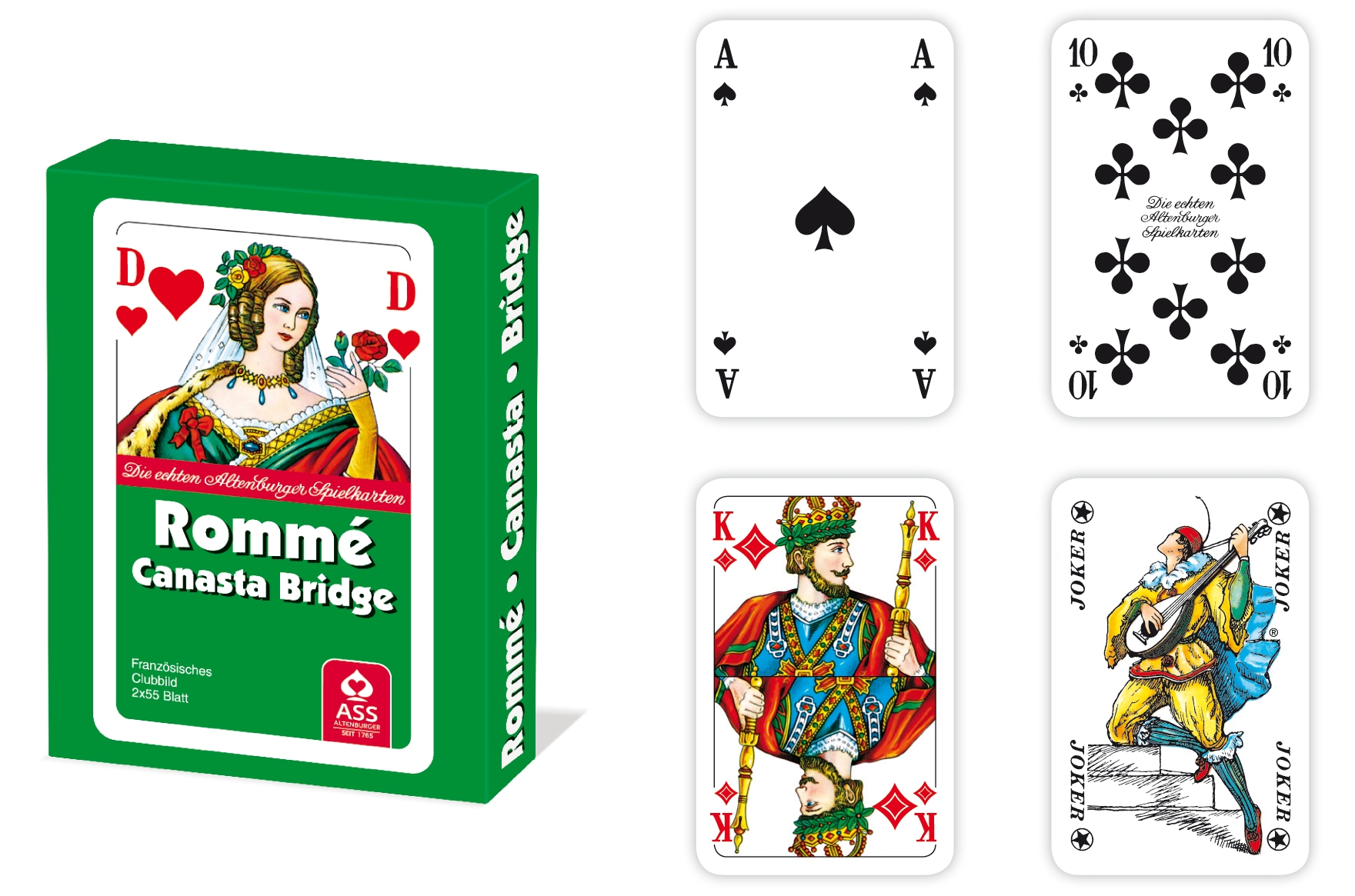
A pack of 110 German Rummy cards
OriginGermany
TypeMatching
Players2–6
Age rangeAll
Cards2 x 52 + 6 Jokers
DeckFrench
Rank (high→low)A K Q J 10 9 8 7 6 5 4 3 2 (A)
PlayClockwise
Playing time6-15 minutes/hand
ChanceMedium
Related games
Rummy • Viennese Rummy

German Rummy or Rommé (German: Deutsches Rommé or Rommé mit Auslegen) is the most popular form of the worldwide game, Rummy, played in Austria and Germany. It is a game for two to six players and is played with two packs of French playing cards, each comprising 52 regular cards and three jokers. There are no partnerships. In Germany, the Germany Rummy Association (Deutscher Romméverband) is the umbrella organisation for local rummy clubs and organises national competitions. The game is often just known as Rommé in Germany and Rummy in Austria.

History

[edit]

The American game of Rummy was derived from Mexican Conquian after 1900 and the name "Rhum" or "Rhummy" had appeared by 1905.[1] As Rommee, the game arrived in Germany from Austria and its rules were first recorded in 1933.[2]

Rules

[edit]

The following rules largely follow Danyliuk and Grupp.[3][4]

Aim

[edit]

The aim of Rommé is to organise one's hand into sets or runs and to meld them by placing them on the table. The player who is first to meld all his or her cards, wins the game.

Preparation

[edit]

Before the first hand begins, the cards are shuffled and laid face down in an arc. Each player draws one card; the player with the highest card selects a seat and is the first dealer. The other players sit to the left of the dealer in the order of the rank of the cards drawn.

Dealing

[edit]

The deal changes clockwise after each hand. The dealer reshuffles the cards and has the pack cut by the player to the right. The cards are dealt face down clockwise, each player is dealt thirteen cards in 3 packets of three and 1 packet of four. The remaining cards are placed face down in the middle of the table as a Stoß (i.e. a talon or stock, pronounced "shtowss") and the top card is turned and placed beside the stock to form the waste pile.

Variations: In many cases, the rule is that a player who finds a joker when cutting may keep it. This is known as robbing or plundering (rauben), not to be confused with the rule allowing a joker to be exchanged (see below). In some rules, the top card is not turned but the dealer (or forehand) receives a fourteenth card and is first to play. In this case that player does not draw a card, but simply makes an initial meld if able and discards a card to start the waste pile.

Melds

[edit]

Melds (Figuren) are combinations of at least three cards as follows:

  • Sets (Sätze) of 3 or 4 equal-ranking cards of different suits, such as K–K–K or 3–3–3–3,
  • Runs (Folgen, Reihen, Sequenzen) of 3 or more cards in suit and in sequence - Aces may be high or low; for example A–2–3, 8–9–10–B or D–K–A, but not K–A–2.

Melds may be built with the aid of Jokers. Jokers are wild cards which may be used to represent any other card; for example B–D–JA or 6–6–J.

A meld may not be built with just one natural card and two Jokers; in a run of at least four cards, however, two Jokers may follow one another so, for example 3–JJ6 is an allowed combination.

Card values

[edit]

The card values are as follows:[5]

  • Court cards – King, Queen and Jack – 10 points each
  • Pip cards – 2 to 10 – score their value in pips
  • Ace (Ass)
    • 11 points in a set or run after the King
    • 11 points at the end of the game
    • 1 point when used first in a run A-2-3.
  • Joker
    • during the game - as many points as the card it represents
    • 30 points at the end of the game

Playing

[edit]

The dealer goes first and begins by laying out any melds, provided the requirement for the first meld is met, and ends by placing a card face-up next to the pile ("discards"). Then the turn passes to the left.

Each following player begins by picking up either:

  • the card turned up by the previous player
  • the topmost face-down card of the stock (Stoß)

After that, a player may meld cards and finish the turn by placing a card face up on the discard pile.

Sometimes the game is played in such a way that a player may only pick up the top card of the discard pile if it is immediately played in a meld, either by using the card for an initial meld - in this case it counts towards the required 40 points (see below) - or by using it in another meld.

First meld

[edit]

For the first meld by each player, the cards being melded must have a value of at least 40 points (but see variants). Players may not lay off cards onto existing melds when making their first melds.

Subsequent melds

[edit]

A player who has placed an initial meld may, in turn, play additional melds at any time; their point value is only relevant for the first meld, not subsequent ones.

Lay-offs

[edit]

A player who has made an initial meld may at any time, when it is that player's turn, lay off individual cards to melds already made, regardless of whether the meld was made by the player or an opponent.

Example: On the table is 2-3-4. A player who holds A and 5 in hand may lay off two cards to the melded sequence.

Once melded, cards may no longer be returned to the hand or discarded.

Swapping a Joker

[edit]
When exchanging a Joker

If there is a figure with a Joker on the table, for example 6-6-J, and a player who holds the card that is represented by the Joker, here the 6 or 6, they can swap the Joker for this card. The Joker must be immediately used in a new meld and not just added to the player's hand. A Joker may only be swapped out after the first meld has been made.

The rules of the German Skat Association are stricter on this point: according to their rules, a Joker may only be replaced in a set if the set is completed with four cards of the same rank.[6]

Ending

[edit]

The player who is first to get rid of all cards by melding and/or laying off and, if need be, placing a last card face down (verdeckt) on the discard pile, while announcing "Rommé" - to signify the end of the game - wins the game. All the remaining players receive as many minus points as they have card points in their respective hands.

Differences from Basic Rummy

[edit]

The main differences compared with Basic Rummy (according to Parlett) are that German Rummy:[7]

  • Uses 2 packs and 6 Jokers, as opposed to one pack and 2 Jokers
  • Players are dealt an initial hand of 13 cards as opposed to 7 or 10
  • Players must score at least 40 points on the first meld

Differences from Scala Quaranta

[edit]

The main differences compared with the Italian variant, Scala Quaranta, are that, in German Rummy:[8]

  • There are 3 Jokers per pack instead of 2.
  • Jokers score 30 at the end, not 25.
  • The cards are dealt in packets, not singly.
  • The rule that a card from the discard pile must be melded immediately is optional.
  • A card need not be discarded to end the play.
  • Players need not retire on reaching 101.

See also

[edit]

References

[edit]

Literature

[edit]
  • _ (1988) Erweitertes Spielregelbüchlein aus Altenburg, 8th edition, Verlag Altenburger Spielkartenfabrik, Leipzig, pp. 168-172.
  • Babsch, Fritz (1983). Internationale und österreichische Kartenspiel-Regeln, Piatnik, Vienna.
  • Bamberger, Johannes (2011). Die beliebtesten Kartenspiele, Perlen-Reihe Vol. 648, 25th edition, Verlag Perlen-Reihe, Vienna, pp. 127-133. ISBN 978-3-99006-002-5
  • Danyliuk, Rita (2017). 1 x 1 der Kartenspiele, 19th edn. Hanover: Humboldt ISBN 978-3-86910-367-9
  • Grupp, Claus D. (1975–1979). Kartenspiele Niederhausen: Falken ISBN 3-8068-2001-5
  • Grupp, Claus D. (1982). Rommé und Canasta in allen Variationen, Falken-Verlag Niedernhausen/Ts.
  • Heinrich, Rudolf [Rudolf Bretschneider]: Rommé - Rummy international Alle Spielarten, Verlag Perlen-Reihe, Vol. 650, 7th edition, Vienna, 19??
  • Kopp, Dr. Bernhard (1987). Die schönsten Kartenspiele, Buch und Zeit Verlag, Wiesbaden, pp. 46-48. ISBN 3-8166-9570-1
  • Lembke, Robert E. (1974?). Das große Haus- und Familienbuch der Spiele. Lingen, Cologne, pp. 207-211.
  • Meister, Friedrich (1933). Rommee und Doppelkopf. Leipzig: Hackmeister & Thal.
  • Parlett, David (1990). The Oxford Guide to Card Games. Oxford: OUP ISBN 0-19-214165-1
  • Parlett, David (2008). The Penguin Book of Card Games. London: Penguin ISBN 978-0-141-03787-5
  • Smith-Creighton, John (1927). Das Rummyspiel, 3rd edition, Vienna.
[edit]
Revisions and contributorsEdit on WikipediaRead on Wikipedia
from Grokipedia
German Rummy, known in its native language as Rommé, is a strategic popular in that belongs to the family of games, emphasizing the formation of melds through skill and chance. It is typically played by 2 to 6 players, though 3 to 5 is ideal, using two standard 52-card decks combined (104 cards total) plus 3 to 6 , depending on regional or house variations. The objective is to empty one's hand by creating valid melds—either sets (three or more cards of the same rank but different suits) or runs (three or more consecutive cards of the same suit)—while minimizing penalty points from unmelded cards, with the overall winner determined by the lowest cumulative score after multiple rounds. The game is regulated by official rules from the Deutscher Skatverband (DSkV), which standardize play across , including specifics like card values where face cards (kings, queens, jacks) are worth 10 points, aces 11, numbered cards their face value, and 20. Each round begins with the dealer distributing 10 to 13 cards per player (often 13), forming a draw pile from the remainder and a face-up discard pile. On their turn, a player draws a card from either the draw or discard pile, may lay down an initial meld totaling at least 40 points, add cards to existing melds (including replacing with natural cards, a feature called "plundering"), and must end by discarding one card. A round concludes when one player successfully melds all cards and discards the final one, achieving "Rommé," earning bonus points while opponents score penalties based on their remaining hand. Distinct from basic Rummy variants like those played in English-speaking countries, German Rummy often incorporates contract elements in some versions, where players must fulfill escalating meld requirements over seven rounds (e.g., starting with two sets of three and culminating in complex combinations like three runs of four), adding layers of strategy. Jokers serve as wild cards that can substitute for any card but are movable once a natural replacement is available, enhancing tactical depth. Aces hold flexibility as high (after king) or low (before 2) cards in runs, and suits follow a traditional order: clubs, spades, hearts, diamonds. The game's cultural significance in Germany stems from its suitability for family gatherings and social settings, with formalized rules dating back to at least the early 2000s under the DSkV to promote fair tournament play.

Overview and History

Introduction

German Rummy, known as Rommé in its native language, is a draw-and-discard belonging to the family, in which players aim to form melds—sets of cards of the same rank or runs of consecutive cards in the same suit—from a hand of cards. This variant emphasizes strategic melding and the use of jokers as to complete combinations, distinguishing it through flexible rules that allow for extensive card manipulation. Rommé holds significant popularity as a national pastime in German-speaking regions, including , , and , where it has been a beloved fixture in family gatherings and social events for decades. The game gained rapid traction in following its introduction, leading to official recognition by the German Skat Association, which established a dedicated department and hosted the first national Rummy Championship in 2007—a event that has since become a staple in their tournaments. The core gameplay loop involves players drawing a card from the stock pile or discard pile, forming or adding to melds on the table, laying off additional cards to existing melds, and discarding one card to end the turn, with the objective of being the first to empty their hand while minimizing deadwood (unmatched cards) points. Typically accommodating 2 to 6 players, Rommé fosters social interaction through its competitive yet accessible nature, often played over multiple rounds until a target score is reached.

Historical Development

German Rummy, known as Rommé in , emerged in the early as an adaptation of international variants, which trace their roots to the Mexican game Conquián that spread through and the . This influence likely arrived in via transatlantic cultural exchanges, evolving into a distinct form suited to local playing traditions with two decks and multiple jokers. The game was first introduced to in the 1920s, where the name "Rommé," a German adaptation of the English "," became established, distinguishing it from other European variants. In the , Rommé has adapted to digital platforms, with online versions proliferating since the early 2000s through sites and apps that facilitate multiplayer play. Organizations like the Deutsche Skatverband have supported its growth by hosting championships and issuing official tournament guidelines, including the 2012 Richtlinien für das Romméspiel, underscoring its enduring role in German culture.

Equipment and Setup

Required Materials

German Rummy, also known as Rommé, requires two standard 52-card decks, combining for a total of 104 cards, along with additional . The number of jokers varies from 2 to 6 depending on regional or house rules, with traditional German versions often including six and the official Deutscher Skatverband (DSkV) rules specifying three (totaling 106 to 110 cards). Jokers serve as wild cards, capable of representing any rank or suit to complete melds during gameplay. To facilitate scoring across multiple rounds, players typically use score sheets or pen and paper as optional accessories. Before dealing, the designated dealer must shuffle the combined deck thoroughly to randomize the cards, ensuring an unbiased distribution; another player may then cut the deck for added fairness.

Dealing and Player Count

German Rummy, known as Rommé in German-speaking regions, is typically played with 2 to 6 players, though the optimal number is 3 to 5 for balanced gameplay and strategic depth. For fewer than 3 players, the game remains playable with the same rules, while more than 6 may require additional decks or house adjustments to maintain pace, though this exceeds standard recommendations. Official DSkV rules are designed for 3 to 4 players. The dealer is selected randomly for the first round, often by drawing cards or agreement among players, and the role then rotates after each round concludes. The dealer shuffles two standard 52-card decks combined with 2 to 6 (totaling 106 to 110 cards, depending on the joker count), ensuring a thorough mix to prevent predictability. Cards are dealt face down, one at a time starting with the player to the dealer's left, until each participant receives 13 cards in basic play (though some variants like contract Rommé use 10 or 12 cards depending on the round); this size applies uniformly regardless of player count in standard rules. After dealing, the dealer places the next card face up to initiate the discard pile, with the remaining cards forming the face-down draw pile in the center of the table. All cards must be distributed evenly and concealed during the process to uphold fairness, with no peeking allowed until the hand is complete. Play then begins with the player to the dealer's left.

Core Gameplay Rules

Objective and Melds

The objective of German Rummy, also known as Rommé, is for a player to be the first to form melds with all cards in their hand and discard their final card, thereby "going out" and ending the round. The player who goes out earns a Rommé bonus of 5 points (or more for special cases), while opponents score penalty points equal to the value of their deadwood; the game continues over multiple rounds until a player reaches a target score such as 100 or 500 points depending on the variant, with the overall winner being the player with the lowest cumulative score. This win condition emphasizes strategic melding to minimize personal deadwood while maximizing opponents' penalties. Melds in German Rummy consist of two types: sets and runs, each requiring a minimum of three cards. A set comprises three or four cards of the same rank but different suits, such as three kings (K♥, K♦, K♣) or four sevens (7♠, 7♥, 7♦, 7♣). A run is a sequence of three or more consecutive cards in the same suit, such as 8♥-9♥-10♥-J♥, with aces usable as high (after king) or low (before 2) but not wrapping around (e.g., Q-K-A-2 is invalid). Melds must initially be "pure," meaning no jokers in the first meld laid down, though subsequent additions may include them; sets are limited to four cards maximum, with no larger "books" allowed. Deadwood refers to any cards remaining unmelded in a player's hand when the round ends, and their values are summed to determine penalty points. For example, an unmelded jack and 5 would count as 15 points (10 for the jack + 5 for the number card). Specific card values, such as 10 points for face cards, are used in this calculation but detailed further in card valuation rules.

Card Values and Jokers

In German Rummy, also known as Rommé, each card has a specific point value used primarily for scoring the unmelded cards, or deadwood, in opponents' hands at the end of a round. Numbered cards from 2 to 10 are worth their face value (e.g., a 7 scores 7 points), while face cards—Jacks, Queens, and Kings—are each valued at 10 points. Aces are worth 11 points when unmelded, and are penalized at 20 points if left in hand. Aces exhibit flexibility in runs (sequences of consecutive cards of the same suit), where they can play high, following the King and valued at 11 points (e.g., Queen-King-Ace), or low, preceding the 2 and valued at 1 point (e.g., Ace-2-3). However, Aces cannot wrap around to connect high and low ends of a suit, such as forming King-Ace-2, which is invalid. Jokers function as wild cards, substituting for any missing card in a meld—either a set (three or more cards of the same rank) or a run—while adopting the point value of the card they represent for calculations like initial meld requirements. A Joker cannot stand alone as a meld and must be paired with at least one natural card; furthermore, multiple Jokers are prohibited from being adjacent in a meld or exceeding the number of natural cards within it (e.g., two Jokers cannot form a set with one natural card). If a player holds the natural card matching a melded Joker, they may exchange it during their turn, but the displaced Joker must immediately be incorporated into another valid meld. When a player goes out by melding all their 13 cards without deadwood, they score the Rommé bonus, ranging from 5 points for a simple completion to 15 points for a "Super-Rommé" where all cards are melded in the initial turn without drawing. These card values underpin the formation of sets and runs central to the game's objective.

Turn Structure

In German Rummy, also known as Rommé, a player's turn follows a structured sequence designed to advance toward forming valid melds while managing hand size. The turn begins with drawing one card, either from the top of the face-down draw pile or the top card of the face-up discard pile, which is always visible to all players to allow strategic decisions based on available discards. Following the draw, the player may form or add to melds if their hand meets the requirements, such as the initial meld threshold of at least 40 points in total value, though subsequent turns allow more flexible additions without this minimum. Melding occurs immediately after drawing if possible, but there is no declaration of "rummy" or going out mid-turn; instead, players integrate the drawn card into potential sets or runs before proceeding. Players cannot pass their turn even if unable to meld, ensuring active participation in every round. The turn concludes with the mandatory discard of one card from the hand to the top of the discard pile, face-up, which replenishes options for the next player and maintains the game's flow. This discard step is always required unless the player has emptied their hand through melding, at which point the round ends. The visible nature of the discard pile promotes observation and anticipation among opponents throughout the game.

Initial Meld Requirements

In German Rummy, also known as Rommé, players cannot lay off cards to existing melds until they have satisfied the initial meld requirement by laying down one or more valid melds totaling at least 40 points. This threshold ensures that entry into active play requires a substantial combination, preventing premature small-scale melds. The point total for the initial meld is calculated by summing the face values of all natural cards in the laid-down meld or melds, with aces valued at 11 points when played high (e.g., in sequences after the king) or 1 point when played low (e.g., in A-2-3 runs). Kings, , and jacks each count as 10 points, while numbered cards from 2 to 10 are worth their pip value. For clarity, the standard card values used in this calculation are as follows:
Card TypePoint Value
Ace (high)11 points
Ace (low)1 point
King, Queen, Jack10 points each
2–10Face value (e.g., 7 = 7 points)
Jokers function as wild cards and can substitute for any missing card in a meld, contributing to the 40-point total by adopting the point value of the card they replace—often a high-value one like a face card or ace to efficiently meet the threshold. However, jokers are subject to restrictions: a three-card meld cannot include more than one joker unless it has at least two natural cards, and no meld can consist solely of jokers or exceed two consecutive jokers in longer runs. Players may lay down multiple melds (sets of three or four cards of the same rank, or runs of three or more consecutive cards of the same ) in a single turn to collectively reach the 40-point minimum, but all must be formed solely from cards in hand without prior lay-offs. Once this requirement is met, the player ends their turn by discarding, and subsequent turns allow additions to any table melds, including their own. Some variants lower the threshold to 30 points, particularly in casual play, but the standard rule adheres to 40.

Adding Cards and Lay-offs

After completing their initial meld, players in German Rummy (Römme) may lay off cards from their hand by adding them to existing melds on the table, either their own or those of other players who have already melded. This phase allows for strategic expansion of combinations without forming entirely new melds from scratch. Lay-offs must conform to the meld's type: for sets, added cards must match the rank but differ in suit; for runs, they must be consecutive in rank and the same suit. Players can add single cards or small groups in a single turn, provided they extend the meld validly—for instance, appending a 6 of hearts to an existing run of 4-5 of hearts, or adding a queen of diamonds to a set of three in other suits. Melds cannot be rearranged or broken apart once formed; additions must simply attach to the ends of runs or integrate into sets without altering the original structure. There is no strict limit on the number of lay-offs per turn in standard rules, allowing multiple additions as long as they are valid, though the player must still end their turn by discarding one card unless going out. Some variants restrict lay-offs to one action per turn, but this is not universal. Jokers, which serve as wild cards substituting for any rank and suit, can be swapped out of an existing meld once the player has completed their initial meld. To do so, a player replaces the joker with the natural card it represents from their hand—for example, substituting a 7 of spades for a joker standing in as the 7 in a run of 5-6-joker of spades—provided the meld remains valid afterward. The displaced joker cannot return to the hand; it must be immediately incorporated into another meld or lay-off during the same turn. cannot be adjacent to each other in a meld or form the majority of its cards, ensuring natural cards predominate.

Ending the Round

A round in German Rummy concludes when one player goes out by forming valid melds and lay-offs with all cards in their hand and then discarding their final card to the discard pile. This action requires that the player has already satisfied the initial meld requirement of at least 40 points in a prior turn; going out without previous melds is possible only in the special case of Hand-Rommé, where all cards are played in a single turn. If the draw pile is depleted before any player can go out, the round ends immediately without a winner in official tournament play, and scoring proceeds based on all players' remaining hands. Some variants allow the discard pile to be turned face down—either shuffled or unshuffled—to form a new draw pile, enabling continued play until exhaustion occurs again or a player goes out. Scoring begins once the round ends, with the winner earning a base of 5 points for a standard going out, potentially more for special achievements like Hand-Rommé (8-12 points) or Super-Rommé (15 points, using all 13 cards without drawing). Opponents tally penalty points equal to the deadwood value of their unmelded cards, using standard values: aces at 11 points, face cards (kings, queens, jacks) at 10 points each, numbered cards (2-10) at face value, and jokers at 20 points. Players holding over 100 points in deadwood without having laid any cards earlier face an additional penalty of 1 point. The final round score adjusts these values, typically multiplying going-out points by 10 and subtracting accumulated deadwood penalties. The overall game comprises multiple rounds and terminates when one player reaches a target score of 100 or 500 points—depending on the variant—or after a predetermined number of rounds, at which point the player with the lowest net score prevails.

Variations and Comparisons

Common Variations

German Rummy, known as Rommé in its native language, features several common variations that adapt the standard rules to regional preferences or group dynamics, often altering joker usage, meld requirements, and dealing procedures. One prevalent variation involves the number of jokers included in the game, which can range from 2 to 6 per two decks of 52 cards. Traditional German Rommé decks incorporate 6 jokers to enhance wild card flexibility, while many players using standard French-suited decks opt for only 2, and intermediate setups with 4 jokers are also common to balance strategy and luck. Meld point thresholds for the initial meld vary between groups, with some requiring a minimum of 30 points in valid sets or runs, while others increase this to 40 points to heighten the challenge of entering the melding phase. In certain house rules, subsequent melds or lay-offs after the initial one may have a reduced threshold of 10 points, allowing quicker integration of cards once a player has established their presence on the table. These adjustments to point values maintain the core objective of forming melds but tailor the pace to player skill levels or session length. Dealing procedures also differ, with the standard distribution of 13 cards per player sometimes modified to 10 cards, particularly in games with fewer participants to expedite play. Some groups employ packet dealing, distributing cards in small bundles (such as groups of three or four) rather than singly, which adds a ritualistic element without altering mechanics. These tweaks ensure the game remains accessible across varying player counts from 2 to 6. Additional tweaks include restrictions on joker swapping, where some variants prohibit exchanging a joker in an existing meld for its natural card equivalent entirely, preserving meld integrity and reducing manipulation opportunities. Conversely, a popular bonus rule awards extra points—often 25—for achieving a "," where a player melds their entire hand on their first turn without prior lay-offs, rewarding bold and efficient play. A notable variation is Contract Rommé, which requires players to fulfill escalating meld contracts over seven rounds, such as starting with two sets of three and progressing to three runs of four.

Differences from Standard Rummy

One key divergence in German Rummy lies in the initial meld requirement, where players must form and lay down melds totaling at least 30 points before adding cards to existing table melds or laying off additional cards; in contrast, basic imposes no such point threshold, allowing players to meld freely from the start of their turn without a minimum value. play a more prominent and flexible role in German Rummy, where they serve as valued at 20 points if left unplayed in a hand and can be swapped out from existing melds with a matching natural card, which must then be incorporated into a new meld on the same turn; basic typically does not include jokers, or if are used in variants, they lack defined point values and swapping mechanics. Lay-offs in German Rummy permit players to add cards to any melds on the table, regardless of ownership, fostering a more communal table-building dynamic once the initial meld is met; basic restricts lay-offs primarily to a player's own melds, limiting strategic interactions with opponents' plays. Scoring in German Rummy awards the winner points equal to the total value of opponents' unmelded deadwood cards, with unplayed aces at 11 points and jokers at 20, emphasizing penalties on leftover hands; basic similarly penalizes deadwood but calculates values more simply, with aces at 1 point and no jokers, and often lacks the high-value wild card penalties. Unlike basic , which features no mechanisms for buying turns or knocking to end play prematurely, German Rummy relies solely on discarding the final card to conclude a round, without these optional interruptions.

Differences from Scala Quaranta

German Rummy and Scala Quaranta are both multi-deck rummy variants popular in , but they diverge in deck composition, particularly regarding . German Rummy utilizes two standard 52-card decks supplemented by six jokers total (three per deck), allowing for greater flexibility in forming melds due to the increased number of . In contrast, Scala Quaranta employs two decks with only four jokers (two per deck), which limits wild card availability and influences strategic planning around substitutions. The valuation of unmelded jokers at the end of a round also differs, with German Rummy assigning 20 points to each joker left in hand, compared to 25 points in Scala Quaranta. This higher penalty in Scala Quaranta encourages players to incorporate into melds more aggressively relative to German Rummy. in both games function as that assume the value and of any card they replace within a set or , but in German Rummy, players may later exchange a melded joker for its counterpart from their hand, repositioning the joker elsewhere—a mechanic absent in Scala Quaranta. Dealing procedures vary significantly, affecting initial hand structure. In German Rummy, each player receives 13 cards, sometimes distributed in small packets (such as groups of three or fewer) to build anticipation and allow for face-down organization, with the remainder forming separate draw piles. Scala Quaranta, however, deals 13 cards singly to each of 2–6 players, creating larger starting hands and a single central stock pile alongside a face-up discard. This packet method in German Rummy contrasts with the straightforward single-card distribution in Scala Quaranta, potentially altering early-game visibility and strategy. Both games impose an initial meld requirement of at least 40 points to "open" and participate fully, but German Rummy enforces stricter conditions on what qualifies, often prohibiting excessive reliance on in the opening meld (e.g., no meld of one natural card plus two ) and emphasizing balanced combinations of sets and sequences. Scala Quaranta permits quicker entry by allowing to flexibly contribute to the 40-point threshold through their represented values, facilitating faster integration into play. The mechanics for ending a round highlight further contrasts, particularly in closure and emphasis on meld types. German Rummy concludes when a player melds or lays off all cards, potentially including a final discard, with the unique joker-swapping option enabling late adjustments to achieve this. Scala Quaranta requires a player to meld all but one card before discarding the final card to close, without joker replacement, and prioritizes longer sequences (scala) over sets for bonus scoring, fostering a greater focus on suit-based runs compared to the more balanced meld approach in German Rummy.

Strategies

Basic Tactics

In German Rummy, effective basic tactics revolve around efficient hand management to achieve the initial meld threshold and minimize deadwood points. New players should prioritize incorporating high-value cards, such as aces (11 points), face cards (10 points each), and tens (10 points), into early melds to rapidly accumulate the required 40 points for the first laydown. This approach reduces the risk of accumulating high penalties if the round ends prematurely, as unmelded high-value cards count heavily against the player. Safe discarding is crucial to avoid benefiting opponents while progressing one's own hand. Players must track the discard pile and opponents' picks to identify cards that are unlikely to be needed by others, such as low-value cards from suits already heavily discarded or ranks that do not align with visible melds. Discarding high-value cards that cannot fit into potential melds early on also prevents them from becoming burdensome deadwood later in the round. Maintaining a balanced hand across suits and ranks enhances the flexibility to form multiple melds simultaneously. Aim to distribute cards evenly, avoiding over-reliance on a single suit or narrow rank range, which allows for quicker adaptation to draws and supports laying off onto existing table melds once the initial threshold is met. For instance, holding pairs or near-sequences in two or three suits positions the player to complete sets or runs as opportunities arise. When deciding between drawing from the discard pile or the , players should only take from the discard if the visible card immediately fits into an existing or potential meld, such as completing a or set toward the 40-point threshold. Otherwise, drawing from the preserves unpredictability and avoids signaling hand intentions to opponents, who may adjust their strategies based on observed picks. This selective approach balances immediate gains with long-term hand development.

Advanced Plays

In German Rummy, or Rommé, experienced players optimize joker usage by strategically saving them for high-impact replacements in existing melds on the table, including those formed by opponents, to acquire the joker for their own hand while maintaining the meld's integrity. This tactic disrupts opponents by removing a valuable wild card they might have planned to manipulate later, as a player can replace a joker with its natural card counterpart from their hand during their turn, provided the resulting meld remains valid. For instance, if an opponent's includes a joker representing the 8 of hearts between the 7 and 9 of hearts, holding onto the actual 8 of hearts allows retrieval of the joker to complete a personal set elsewhere, enhancing hand flexibility without breaking the original meld. Such optimization requires careful timing, as jokers are limited (typically 2 to 6 per deck), and premature use in low-value melds forfeits opportunities for greater disruption. Bluffing through discards involves intentionally selecting cards that mislead opponents about the composition of one's hand, thereby throwing off their ability to track and predict needed cards for their own melds. By varying discard patterns—such as occasionally discarding from a in which a player holds strong potential melds—players can create the illusion of weakness in that , encouraging opponents to discard useful cards prematurely or hesitate in picking from the pile. This psychological element is particularly effective in multi-round games, where consistent bluffing builds uncertainty, but it must be balanced to avoid revealing true intentions through repetitive patterns. For example, discarding a mid-value card from an overrepresented might signal disinterest, prompting an opponent to hold or discard complementary cards that could otherwise benefit the bluffer. Endgame timing demands delaying the declaration of "Rommé" (going out) when opponents appear burdened with high-value deadwood cards, as prolonging the round allows them to accumulate penalty points from unmelded high cards like kings or aces while the depletes. Skilled players assess visible melds and discards to gauge opponents' progress; if an adversary has several unlayable high cards and the deck is thinning, holding a completing discard for one more turn can inflate their score significantly, especially since Rommé awards points based on opponents' remaining hand values. This conservative approach contrasts with aggressive play earlier in the round and is most potent when one's own hand is low in deadwood, ensuring minimal personal risk. Brief reference to lay-off rules enables adding to table melds during this phase, but the focus remains on strategic . Counting cards in Rommé involves meticulously tracking the depletion of the draw pile alongside discarded and melded cards to predict likely draws and opponents' potential hands, enabling proactive adjustments to one's . With two decks and in play, players note the absence of specific ranks or suits—such as the of spades after several have been discarded—to anticipate what remains in the , particularly as it nears exhaustion (around 10-15 cards left signals high predictability). This calculative method, akin to basic probability assessment, helps decide whether to draw from the pile or stock and informs safe discards, reducing the chance of aiding rivals. For instance, if six 10s have appeared and only two remain unaccounted for, avoiding discards near those can prevent completing an opponent's set.
Add your contribution
Related Hubs
User Avatar
No comments yet.