Hubbry Logo
God LGod LMain
Open search
God L
Community hub
God L
logo
8 pages, 0 posts
0 subscribers
Be the first to start a discussion here.
God L
God L
from Wikipedia
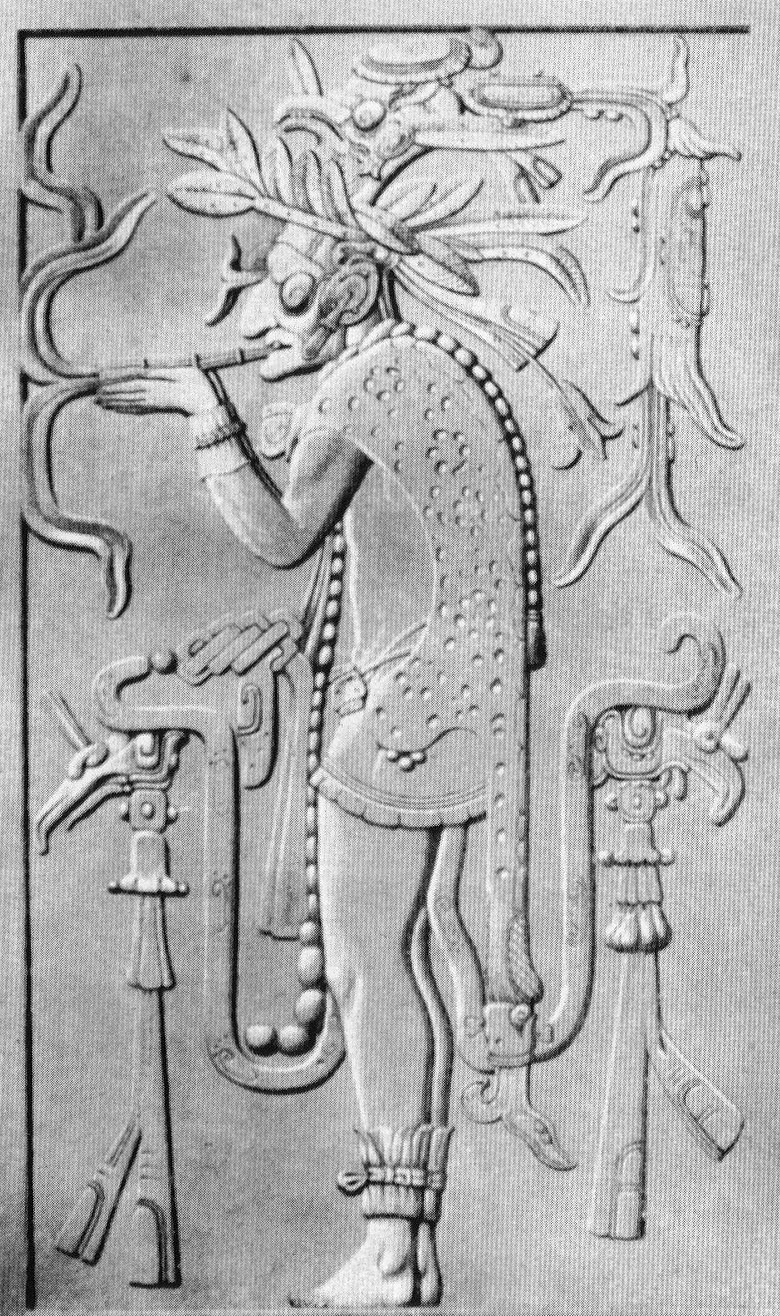
God L, Palenque, Temple of the Cross

God L of the Schellhas-Zimmermann-Taube classification of codical gods is one of the major pre-Spanish Maya deities, specifically associated with trade. Characterized by high age, he is one of the Mam ('Grandfather') deities. More specifically, he evinces jaguar traits (particularly the ear), a broad feathery hat topped by an owl, and a jaguar mantle or a cape with a pattern somewhat resembling that of an armadillo shell. The best-known monumental representation is on a doorjamb of the inner sanctuary of Palenque's Temple of the Cross.

Name

[edit]

The main sign of god L's name glyph in the Dresden Codex consists of the head of an aged man painted black. The reading is unknown, but may conceivably have been Ekʼ Chuah (see below).

Functions

[edit]

Attributes and scenes of god L are indicative of at least three main functions.

Wealth

[edit]

Recurrent attributes are a bundle of merchandise and a walking-stick. The floating ends of god L's cloth can show footsteps, again pointing to travelling merchants. In view of the further functions of god L, the Maya merchants should perhaps be compared to the Aztec nahualoztomecah, warriors disguised as merchants. The wealth of god L has been suggested to refer specifically to the cacao orchards of the Gulf Coast; in Cacaxtla, god L is associated with maize stalks and cacao trees.[1] God L's wealth seems to include women as well. On the Princeton vase (see figure), god L is surrounded by five young women, whereas in the Dresden Codex (14c2), he holds a young woman (goddess I) with a maize sign.

God L residing in his palace and surrounded by young women. Central scene of the Princeton Vase, Classic period

Magic and shamanism

[edit]

The cigar which, more often than not, is smoked by god L suggests the apotropaic magic of a merchant or, perhaps, the habit of a shaman. The owl on the hat points to a connection to the underworld and night, and recalls the Nahua term for sorcerer, tlacatecolotl 'Man-Owl'. The jaguar is also a reference to night and the underworld.

War

[edit]

God L's jaguar and owl (kuy) attributes point to sorcery, violence, and warfare,[2] qualities that may be related to his Postclassic role as a personification of Venus rising from the underworld, and throwing spears at his victims (Dresden Codex). God L's connection to warfare is also suggested by the decapitation of a bound prisoner, perhaps a captive writer, in front of god L's jaguar palace (Princeton vase). On the central relief of the Palenque Temple of the Sun – a war temple – god L, together with one of the other Maya jaguar gods (viz. the Jaguar God of Terrestrial Fire), supports an emblem consisting of the sacred shield and lances of the Palenque kings. His submissive posture suggests he now represents a defeated enemy chief.

Connections to other deities

[edit]
God L carrying K'awiil on his back, column from Bakna
  • God M. As a merchant deity, god L is paralleled by another, Postclassic merchant god, the black god M (Madrid Codex).
  • Ek Chuah. A Yucatec merchant god who, like god L, was connected to cacao orchards, bore the name Ek Chuah (Landa). This name is usually connected to god M, but could as well refer to god L.[3]
  • Bolon-Yokte. Together with the deity Bolon-Yokte ('Nine-Strides'), god L and god M have been argued to represent the abstract idea of travelling and of movement in space and time.[4]
  • K'awiil (God K). God L is often combined and related with K'awill (also known as god K), the lightning deity who, as an owner of the seeds, was considered a bringer of abundance.[5] More specifically, god L can extend the head of god K, or carry an infant god K in a sling on his back.[6] This is depicted on a carved stone column from Bakna showing god L carrying a small K'awiil on his back.[7] God K also happens to be the victim of god L as a Venus patron (Dresden Codex).
  • Itzamna. It has been suggested that god L is the underworld counterpart of Itzamna, the supreme Maya deity.[8]

Ritual

[edit]

The acantun stone shafts depicted in the Dresden Codex, which were venerated during the five unlucky and dangerous days (wayeb) at the end of the year, are draped with the mantle and footprint-marked loincloth of god L.[9]

New year ritual with acantun, Dresden Codex

Narrative scenes

[edit]

Narrative scenes on pottery show the denudation and clothing of god L, while focussing on his owl hat, mantle, and staff. These scenes involve the Maya moon goddess, the rabbit, the tonsured maize god, the Hero Twins, and also (in a Dresden Codex vignette) Chaak, the rain deity. In this connection, god L has been interpreted (in terms of the Popol Vuh hero myth) as one of the principal lords of the Underworld, or Xibalba.[10]

Presence in contemporary Maya religion

[edit]

It has been suggested[11] that god L corresponds to that most famous of all Tzʼutujil deities, the cigar-smoking 'Grandfather' (Mam) Maximón, whose manifold associations include long-distance travel, witchcraft, and jaguars, and who is especially venerated during the last days of Holy Week. In the cult of Maximón, the latter's cloths receive special emphasis.

References

[edit]
[edit]
Revisions and contributorsEdit on WikipediaRead on Wikipedia
from Grokipedia
God L is a prominent in the Classic Maya pantheon, classified by Paul Schellhas in his 1904 system as one of the major gods depicted in and . He is portrayed as an elderly figure with skin markings, a fringed cape, a large in his mouth, and a distinctive broad-brimmed hat adorned with feathers, often labeled with sky-related numerals such as '13-Sky', '12-Sky', or '9-Sky'. As the Merchant Lord of the , God L serves as a patron of , cacao wealth, and merchants, embodying the perils and profits of long-distance commerce in the Maya world. He is closely associated with warfare, , and the darker aspects of the calendar year, including the winter cacao harvest, and appears in contexts linking him to the Night Sun and journeys. His name has been proposed as B'olon Yokte' K'uh ("Nine [are] his Steps/Feet" or " [are] his Feet"), drawing from period inscriptions and Postclassic sources that connect him to a of nine-footed lords. Depictions of God L appear frequently in , murals like those at , and architectural contexts such as Palenque's Temple of the Cross, where he is shown with scorpion elements, pelts, and ritual combat attributes. In the Postclassic period, he overlaps with the merchant god God M and influences later figures like the Aztec Yacatecuhtli, underscoring his enduring role in Mesoamerican and cosmology.

Identity and Iconography

Name and Classification

God L is designated within the Schellhas-Zimmermann-Taube classification system, a scholarly framework for identifying Maya deities primarily from postclassic codices. Developed by Paul Schellhas in his 1904 publication "Representation of Deities of the Maya Manuscripts," the system assigns alphabetic labels (A through P) to recurring divine figures based on their consistent iconographic traits, enabling cross-referencing across texts like the , , and codices. German scholar Günter expanded this in 1956 by incorporating variations and monumental depictions, while Karl Taube further refined it in the 1990s, integrating epigraphic and contextual data from Classic period sites to distinguish core identities from aspectual forms. This early 20th-century approach arose amid limited decipherment of , prioritizing visual consistency over nominal readings to catalog the pantheon's complexity. The identifying glyph for God L typically portrays the head of an aged man, rendered in black paint with a prominent aquiline (Roman) nose, furrowed brow, and a tobacco leaf or protruding from the mouth, symbolizing an elderly, world-weary figure. This appears in codical almanacs and dedicatory inscriptions, such as 46b, where it labels a seated, armed , emphasizing the god's mature, introspective persona. Variations may include subtle additions like an owl headdress, but the core facial features remain diagnostic across media. No definitively attested Maya name for God L survives in hieroglyphic texts, marking it as one of the major pre-Spanish deities whose linguistic identity eludes direct phonetic correlation. Early scholars proposed tentative links to Ek' Chuah ("Black Star"), a postclassic merchant patron, due to shared dark pigmentation and nocturnal associations, though this identification lacks confirmatory syllabic readings and conflates God L with the distinct God M. Alfred M. Tozzer, in his 1941 edition of Bishop Diego de Landa's , debated God L's equivalence to Yucatec "old gods" tied to creation myths, while J. Eric S. Thompson, in "Maya History and Religion" (1970), argued for overlaps with worldbearers or aspects, highlighting the deity's polymorphic nature without resolving a singular . These debates underscore God L's foundational yet enigmatic status in the Maya pantheon, reliant on alphabetic classification for scholarly discourse.

Depictions and Attributes

God L is consistently depicted as an elderly male figure in Classic Maya art, characterized by wrinkled facial features, a prominent , and large, often square or spiral-shaped eyes that emphasize his aged and otherworldly appearance. His skin is typically rendered with black spots or full blackening, signifying associations with darkness, while jaguar ears or a spotted pelt around the mouth highlight feline traits. He frequently wears a broad, feather-trimmed headdress topped with an or black-tipped owl feathers, paired with a -skin mantle or cape that denotes elite status and mobility. Additional attributes include a or square-nosed serpent scepter for support during , and a merchandise bundle symbolizing his itinerant role; variations show him in a cigar-smoking pose, with smoke curling from his mouth to evoke ritualistic or shamanic elements. Prominent appearances of God L occur in key artifacts that showcase these traits in diverse contexts. In the (pages 14b, 14c, and 23c), he is portrayed as a blackened merchant figure carrying a bundle that includes cacao beans, emphasizing his portable regalia against a backdrop of scenes. The Princeton Vase (K511), a period ceramic in codex style, depicts him enthroned as an aged lord surrounded by attendants, his owl headdress and mantle prominently displayed in a palace-like setting that underscores his authoritative presence. At Palenque's Temple of the Cross, architectural tablets illustrate God L in a static, frontal pose facing the ruler Chan Bahlum, with his characteristic headdress and black-spotted skin integrated into the temple's symbolic framework. Symbolic elements in God L's iconography reinforce his multifaceted character through animal and material motifs. The associations, via ears and pelt, evoke nocturnal power and dominion, positioning him as a fierce, transformative entity in Maya cosmology. The atop his headdress serves as a marker of night, , and shamanic vision, with its feathers linking to avian intermediaries between realms. Feathers and mantles further symbolize prestige and long-distance journeys, as seen in his bundled goods and staff, which appear across painted ceramics and codices to convey mobility and status. Depictions of God L evolved from the Classic to Postclassic periods, with greater emphasis in the latter's Yucatecan codices compared to the Petén region's monumental art. In Classic lowland contexts, such as vases and temple reliefs, he appears more dynamically in narrative scenes with full regalia, while Postclassic representations in manuscripts like the simplify traits like the owl headdress and bundle for almanac-like formats, reflecting regional shifts toward portable, esoteric knowledge. These variations highlight his adaptability, though core attributes like the jaguar and owl motifs persist across media.

Functions and Associations

Trade and Wealth

God L served as a primary patron of merchants and commerce in Classic Maya society, frequently depicted as an elderly figure bearing a merchant's bundle or backpack containing valuable trade goods such as feathers, , or , symbolizing his oversight of long-distance exchange networks that connected city-states through overland trails and coastal canoes. These portrayals underscore his role in facilitating the circulation of prestige items essential to elite economies, including those transported along routes vital for regional market exchanges during the Late Classic period (ca. 600–900 CE). Symbols of wealth prominently associated with God L include cacao beans, which functioned as a form of , tribute payment, and ritual offering in Maya transactions, often linked to his domain through scenes of elite consumption on pottery vessels. The renowned Princeton Vase (ca. 670–750 CE), a codex-style used for drinking frothed , illustrates God L enthroned in a palace-like setting surrounded by five elegant women—possibly concubines or symbolic trade goods—preparing and serving the beverage, evoking prosperous banquet rituals that highlighted material abundance and social status. , another key trade commodity smoked in rituals and valued for its psychoactive properties, fell under God L's , reinforcing his ties to economic derived from agricultural and exchange activities. Scholarly analysis by Tokovinine and Beliaev (2013) interprets God L, alongside the related God M, as "people of the road" in Classic Maya inscriptions, emphasizing their embodiment of , , and exchange in textual narratives, though direct monumental depictions of these deities in trading contexts are absent from Petén sites. This characterization highlights God L's abstract role in supporting itinerant commerce without explicit visual representations of markets, focusing instead on his endorsement of safe passage and successful dealings. In the broader economic context, God L's influence extended to elite patronage of trader groups, potentially encompassing vital commodities like salt for preservation and for tools and weapons, which were staples of Maya long-distance trade systems sustaining urban centers. Evidence from codex-style ceramics and surviving , such as scenes of God L amid opulent gatherings with offerings, further illustrates his presence in depictions of accumulation and ceremonial feasting tied to commercial success.

Magic, Shamanism, and Underworld

God L's depiction as an elderly figure frequently shown smoking a large underscores his role in among the ancient Maya, where served as a psychoactive agent to induce states for and spirit communication. This cigar-smoking attribute, evident in Period reliefs such as the east door jamb of Palenque's Temple of the Cross, links him to "tobacco shamanism," a tradition involving visionary experiences and healing rituals that persisted into Postclassic times. The headdress, often featuring black-tipped feathers from the Moan bird, symbolizes and mediation with supernatural entities, reinforcing God L's position as a shamanic intermediary between the human world and spiritual realms. As a principal patron of the Maya underworld, known as or Metnal, God L embodies the aged lord overseeing cycles of death and rebirth, frequently appearing in codical scenes of descent and transformation. In the Madrid Codex, he is portrayed as an amid directional glyphs, highlighting his governance over chthonic domains and interactions with other death lords defeated by the Hero Twins in mythological narratives. These depictions emphasize his authority in the nocturnal realm, where souls undergo trials and renewal, aligning with broader Maya cosmological views of the underworld as a place of fright and regeneration. God L's magical attributes further tie him to sorcery and otherworldly power, including feathers in his headdress that evoke and astral travel during . His black body markings and paint, seen in Classic Maya art as symbols of potency, denote transformative abilities in and malevolent , drawing from associations with jaguars and that signify stealth and sorcery. Archaeological evidence from deposits, such as residues in vessels and offerings linked to shaman-priest activities, suggests invocations of God L facilitated spiritual journeys, with items like mantles and cigar-like artifacts in burials reflecting Postclassic continuities of these practices.

Warfare and Celestial Connections

God L functions as a patron of warfare in Maya ideology, often depicted in scenes involving violence, captive-taking, and martial symbolism. On the central relief of Palenque's Temple of the Sun—a structure dedicated to —God L appears alongside another supporting the sky, while the Tonsured God raises a sun-shield emblematic of battle standards and conflict. This imagery underscores God L's role in legitimizing royal conquests, where rulers invoked the to sanction campaigns and the of captives. Such depictions integrate God L into the broader rhetoric of divine kingship, portraying warfare as a cosmic necessity tied to authority. The deity's martial associations are deeply intertwined with celestial phenomena, particularly the planet , which Maya cosmology linked to cycles of aggression and renewal. As a manifestation of the morning star, God L embodies the destructive phase of the planet's 584-day synodic period, presiding over raids and sacrifices during its . In the Codex's Venus table, God L appears as a black-spotted figure wielding spears against victims, symbolizing Venus's combative reemergence and its role in timing military actions. Scenes on ceramics, such as the Vase of the Seven Gods, further illustrate God L with war bundles and sacrificial tools, capturing enemies for rites aligned with Venus's cycles. Iconographic elements reinforce God L's aggressive and celestial power, blending terrestrial ferocity with astronomical motifs. Jaguar spots on his body and attire evoke the predatory might of the , associating him with nocturnal battles and cosmic predation. His , interpreted as a spear-like implement, appears in confrontational contexts, such as on the Princeton Vase, where God L oversees the Hero Twins' execution of a bound captive amid underworld figures, emphasizing themes of judgment and violence. glyphs and star motifs often accompany these portrayals, linking the to with celestial bodies during 's evening star descent. In royal ideology, God L's dual role as warrior and Venus deity served to sacralize conquests, with post-2013 analyses of codical Venus tables highlighting how his manifestations integrated astronomical predictions into . These interpretations reveal God L as a bridge between earthly raids and heavenly portents, where 's phases dictated the auspicious timing for captive-taking and territorial expansion. By embodying this synthesis, God L reinforced the divine mandate of Maya lords in warfare, ensuring that victories were seen as alignments of cosmic and political order.

Mythology and Narratives

Connections to Other Deities

God L exhibits close ties to God M, another prominent merchant deity in Maya iconography, with whom he shares identifying features such as black-painted skin and contexts related to and , leading to occasional mergers in Postclassic representations. Ek Chuah serves as a Postclassic variant of God L, incorporating additional star and attributes while preserving core associations with and the , though distinguished by a long nose and drooping lip absent in God L's typical Roman-nosed profile. These relationships highlight God L's integration into the merchant pantheon, where functional overlaps in economic and ritual spheres underscore a continuum of divine patronage for long-distance exchange. Broader symbolic links connect God L to Bolon Yokte, the nine-footed war god, through shared appearances in scenes of cosmic renewal and spatiotemporal alignments, positioning God L's stability at the primordial center against Bolon Yokte's dynamic "traveler" role. Associations with K'awiil, the and lightning deity, emerge in warfare motifs, where God L's power symbols complement K'awiil's scepter form and imagery. God L also relates to , the creator god, via shared aged features and motifs, with some interpretations viewing God L as Itzamna's counterpart, evident in parallel elderly depictions across codices and monuments. Jaguar elements, including ears, thrones, and pelt capes, further bind God L to other figures, emphasizing themes of sorcery, wealth, and nocturnal power. In functional terms, God L pairs with the Hero Twins in trade-related myths, often portrayed as their maternal grandfather overseeing mercantile transformations, such as the Maize God's cacao tree conversion as a of exchange. Underworld alliances link him to death gods like God A, co-appearing in scenes where God L's lordship complements God A's skeletal dominion over mortality and sacrifice. Scholarly debates center on distinguishing God L from similar elderly deities like God D () and God N (Pawahtuun), relying on codex variations such as God L's distinctive owl-feather headdress, cigar-smoking pose, and merchant bundles, which contrast with God D's world-tree associations and God N's quadripartite earth-bearing role. These fluid identifications arise from deities adopting hybrid attributes, complicating rigid classifications but revealing the pantheon's interconnected nature.

Roles in Mythological Scenes

God L frequently appears in Maya codical and as a participant in key mythological narratives, often embodying themes of conflict, renewal, and underworld authority. In the , particularly on page 74, God L is depicted as a black-painted warrior god armed with a and darts, perched with an owl on his head, positioned at the base of a chaotic scene symbolizing the destruction and regeneration of the world. This portrayal aligns him with cycles, where his aggressive stance evokes the Morning Star's role in cosmic upheaval, contributing to myths of creation through cataclysmic events like the deluge that ends previous eras. Interactions between God L and the , often identified as or Ix Chel in her youthful form, occur in almanac vignettes of the , such as those involving descent motifs tied to lunar and eclipse tables. These scenes suggest narrative elements of celestial courtship or pursuit, with God L's presence alongside the moon goddess, rabbit scribe, and tonsured maize god, implying relational dynamics in lunar cycles and fertility myths, though exact sequences remain partially opaque due to the codex's divinatory format. God L also intersects with the Hero Twins (Hunahpu and Xbalanque) in challenges, as seen in codex-style vessels where his authority is tested amid ballgame-related trials, echoing broader Popol Vuh-inspired episodes of and victory over death lords. In , particularly the renowned Princeton Vase (K511), God L emerges as a central lord hosting a tense scene within Xibalba's palace, where he sits enthroned as an aged, toothless deity wearing a feathered headdress and raptor bird emblem. Here, he oversees a confrontation involving masked visitors—the Hero Twins in disguise—who perform a ritual execution of a bound captive with two masked figures, while animated ladies pour and God L adorns a young woman with a jade bracelet, blending hospitality with impending conflict. This episode portrays God L as both host and antagonist, deceived by the Twins' magic trick aimed at subverting Xibalba's rulers, highlighting his role in episodic power struggles. God L's involvement extends to cosmic myths at sites like , where tablets in the Cross Group temples depict him as a high-ranking lord with black body paint, participating in royal rituals that link divine creation to dynastic legitimacy. In these narratives, his presence alongside patron deities underscores themes of rebirth and celestial ordering, tying Venus-associated destruction to the renewal of kingship through journeys. Interpretive challenges persist in reconstructing God L's mythological roles, as limited decipherment of hieroglyphic texts restricts full narrative coherence, leading scholars to rely heavily on episodic details from paintings and illustrations for insights into his actions.

Worship and Continuity

Ancient Rituals and Practices

In ancient , ceremonies dedicated to God L often centered on the liminal period of Wayeb, the five nameless days at the end of the 365-day , during which boundary markers known as acantun stones were venerated to invoke protection and prosperity in trade. These acantun, typically stone shafts or stelae positioned at cardinal directions, were depicted in the surmounted by images of God L, symbolizing his role as a guardian against chaos and a patron of merchants during this dangerous interlude. Priests would perform rituals involving the placement or symbolic draping of pelts—evoking God L's characteristic jaguar mantle—over these stones to channel his shamanic power for safeguarding journeys and ensuring bountiful exchanges. Such practices underscored God L's dual aspects as a tobacco-smoking elder and underworld mediator, warding off malevolent forces while blessing economic endeavors. Offerings to God L frequently included items tied to his domains of trade and transformation, such as cacao beans, tobacco cigars, and merchandise deposited in temple caches during periodic festivals. Archaeological evidence from Classic-period sites, including fragments of jaguar pelts and bundled artifacts resembling merchant loads, supports the occurrence of these rites, as seen in vessel paintings like the Vase of the Seven Gods (K2796), where a bundle is placed on a jaguar throne behind the enthroned God L. Priests invoked his shamanic form through cigar-smoking rituals, burning tobacco to facilitate visions and underworld communication, a practice echoed in codical almanacs prescribing invocations for safe passage and wealth accumulation. These deposits, often found in association with incense burners and jade items, highlight God L's integration into renewal ceremonies that paralleled broader Maya efforts to harmonize cosmic and terrestrial cycles. At , rituals honoring God L were closely linked to royal accessions, as evidenced in the Temple of the Cross and Temple of the Sun, where inscriptions depict rulers like Chan B'alum II presenting the sun scepter to God L on key dates, such as 9.12.11.12.10 (8 Oc 3 Kayab), to legitimize their authority through patronage. These temple rites, involving and symbolic offerings, positioned God L as a guide for the solar journey into the , particularly during solstice alignments, thereby connecting dynastic continuity to his protective and mercantile influences. Codex almanacs, such as those in the , further prescribed merchant-specific invocations to God L for successful ventures, aligning these practices with the site's emphasis on celestial and terrestrial harmony.

Modern Interpretations and Presence

In contemporary Maya communities, particularly among the Tz'utujil people of Guatemala's highlands, God L exhibits with the (also known as San Simón), a traveling figure associated with , , and protective , often portrayed with a , bundle of goods, and attributes echoing the ancient deity's aged merchant persona. This blending incorporates Catholic saint imagery while preserving pre-Hispanic elements of prosperity and underworld navigation, allowing Maximón to serve as a patron for merchants seeking safe journeys and economic success. Modern practices continue this legacy through offerings by Guatemalan to effigies, including cigars, rum, and bundled items symbolizing trade goods, performed in cofradías (brotherhoods) to invoke protection during commerce and travel. These rituals parallel ancient merchant invocations but adapt to post-conquest contexts, with 's annual festival in Santiago Atitlán incorporating processions and Venus-aligned motifs reminiscent of warfare and celestial renewal, akin to Aztec Huitzilopochtli celebrations. Post-2013 scholarship, such as the work of Alexandre Tokovinine and Dmitri Beliaev, has advanced understanding of God L through analysis of Classic Maya travel inscriptions, revealing his role in long-distance and networks via depictions on monuments and vessels, thus bridging epigraphic with archaeological findings on routes. This research critiques earlier interpretations overly reliant on Postclassic codices, which underemphasized God L's Classic-period associations with itinerant wealth and transit, favoring instead diverse textual and visual sources for a more nuanced view of regional variations. God L's legacy persists in Lacandon and Q'eqchi' oral traditions as an elder spirit tied to hidden paths and resource guardianship, reflecting ongoing animistic reverence for ancestral figures in forested domains. In cultural revival efforts, his appears in eco-tourism initiatives and heritage sites across and , such as those promoting Maya biocultural corridors, where ancient merchant motifs educate visitors on sustainable trade heritage and indigenous continuity.

References

Add your contribution
Related Hubs
User Avatar
No comments yet.