


Community hub
Recent from talks
Contribute something
Nothing was collected or created yet.
Swiss Grand Prix
View on Wikipedia | This article needs additional citations for verification. (August 2021) |
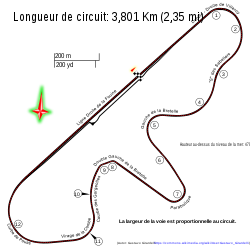
| Dijion-Prenois Circuit (1976 onwards layout used for the 1982 Swiss Grand Prix) | |
 | |
| Race information | |
|---|---|
| Number of times held | 16 |
| First held | 1934 |
| Last held | 1982 |
| Most wins (drivers) |   Rudolf Caracciola (3) Rudolf Caracciola (3) |
| Most wins (constructors) |  Mercedes (5) Mercedes (5) |
| Circuit length | 3.800 km (2.361 miles) |
| Race length | 304.000 km (188.897 miles) |
| Laps | 80 |
| Last race (1982) | |
| Pole position | |
| |
| Podium | |
| Fastest lap | |
| |


The Swiss Grand Prix (French: Grand Prix de Suisse, German: Großer Preis der Schweiz, Italian: Gran Premio di Svizzera) was the premier auto race of Switzerland. In its later years it was a Formula One race.
History
[edit]Bremgarten (1934–1939, 1947–1954)
[edit]Grand Prix motor racing came to Switzerland in 1934, to the Bremgarten circuit, located just outside the town of Bremgarten, near the Swiss de facto capital of Bern. The Bremgarten circuit was the dominant circuit on the Swiss racing scene; it was a fast 7.27-kilometre (4.52 mi) stretch made up of public roads that went through stunning countryside and forests, sweeping from corner to corner without any real length of straight. From the outset, Bremgarten's tree-lined roads, often poor light conditions, and changes in road surface made for what was acknowledged to be a very dangerous circuit, especially in the wet- even after it stopped raining and the sun came out, the trees covering the circuit were still soaking wet, and water would drip onto the tarmac for at least an hour. Conditions at this circuit were similar to that of the Nürburgring in West Germany- and this circuit was as highly popular with drivers as the Nürburgring was.
The first Swiss Grand Prix was a non-championship race; it was won by Hans Stuck in an Auto Union; British driver Hugh Hamilton died in a horrific accident in his Maserati. The car's left front wheel broke at the very fast Wohlenstrasse corner, and Hamilton then lost control and then the whole car violently hit a tree, and continued going for about 70 feet before it hit and was stopped by a bigger tree, shattering the car and killing Hamilton (who had not been thrown from the car) instantly. Despite this occurrence (there was hardly any, if any, thought put into safety in those days), the Swiss Grand Prix counted toward the European Championship from 1935 to 1939, during which time it was dominated by the German Silver Arrows.
Grand Prix racing returned after World War II, and the Bremgarten track remained the home of the Swiss Grand Prix. The first post-war race was won by Frenchman Jean-Pierre Wimille, and in 1948 it was designated the European Grand Prix, in a time when this title was an honorary designation given each year to one Grand Prix race in Europe. This event, which was perhaps the blackest and most tragic Grand Prix of the 1940s saw multiple fatalities and serious injuries from massive accidents all around the circuit throughout the weekend. Veteran Italian racer and pre-WWII legend Achille Varzi would die during a rain-soaked practice session in an Alfa Romeo- helmets were not compulsory in those days, and Varzi, whose Alfa had overturned during the accident, was crushed by the 700kg Alfetta, which was more than 10 times his weight (Varzi was not wearing a helmet, and cars did not have roll-over protection in those days). The race also saw Swiss Christian Kautz die in a Maserati after going off the road and crashing into an embankment at the second Eymatt corner; the race was won by Carlo Felice Trossi. Frenchman Maurice Trintignant was nearly killed in another accident after crashing and being thrown out of his car and landing unconscious on the track. Three drivers including Nino Farina went off and crashed while trying to avoid the motionless Frenchman, who survived after multiple serious injuries and spending 8 days in a coma.
1950 saw the Swiss Grand Prix being inducted as part of the new Formula One World Championship (although at the time, all the races were run in Europe except the Indianapolis 500, but this race was not run to F1 regulations). This race was won by Italian Nino Farina, who would go on to be the first Formula One world champion. 1951 saw Argentine Juan Manuel Fangio dominate in his Alfa after taking advantage of Farina's wrong decision not to make a pit stop to change tyres during changing wet-to-dry conditions. 1952 saw Briton up-and-comer Stirling Moss run as high as third in his underfunded Alta-powered HWM, and Italian Piero Taruffi scored his first and only F1 victory; it was also the only championship race (other than the Indianapolis 500) not won that year by his Ferrari teammate and countryman Alberto Ascari. Pre-war great and three-time Swiss GP winner Rudolf Caracciola was competing in a support sportscar race and crashed into a tree, and the violent accident that ensued ended up breaking one of his legs, which effectively ended his long racing career. 1953 saw Ascari battling back after a pit stop to fix the misfiring engine in his Ferrari; he came back out in fourth and stormed round the circuit, passed Fangio in a Maserati, his teammates Farina and Mike Hawthorn to take victory. Ascari also won his second Drivers' Championship at that event. 1954 saw Fangio (now driving a Mercedes) lead from start to finish in rainy weather and he took his second Drivers' Championship from countryman José Froilán González.
In 1955, however, the Swiss Grand Prix at Bremgarten was to be no more. After the Le Mans disaster in France that year which killed more than 80 people, the Swiss government declared circuit motor racing to be an unsafe sport and it was promptly banned; this forced the organizers to cancel the Grand Prix that year. Bremgarten was ultimately abandoned and was never used again for motor racing.
Dijon-Prenois, France (1975, 1982)
[edit]The Swiss Grand Prix returned in 1975 as a non-Championship Grand Prix just across the border, at the Dijon-Prenois circuit, France. Swiss Clay Regazzoni won the race. The Swiss Grand Prix only ran once more, when it returned to the Formula One World Championship in 1982. The 1982 race, also held at Dijon, was organized by the Swiss Auto Club and was the first F1 win by Finland's Keke Rosberg, driving for Williams, in what proved to be his Championship-winning season. Rosberg displayed a spirited drive in which he passed several cars, and was held up for some time by backmarker Andrea de Cesaris, then caught and passed polesitter Alain Prost. Although both the 1975 and 1982 races were held on French soil, the Dijon circuit was near the French-Swiss border, with both races organized by the Swiss Automobile Club.
Legislation
[edit]On 6 June 2007, the National Council voted to lift the ban of circuit racing in Switzerland, 97 in favor and 77 opposed.[1] However, the legislation was subsequently not ratified by the Council of States.[2] In 2015 the Swiss government allowed a relaxation of the law, permitting head-to-head racing events to be held in Switzerland for electric vehicles only.[3] As a result, on 10 June 2018, Switzerland hosted its first motor race in 64 years when the first Zürich ePrix was held as a round of the all-electric Formula E championship.[4]
Winners
[edit]Repeat winners (drivers)
[edit]A pink background indicates an event which was not part of the Formula One World Championship.
A yellow background indicates an event which was part of the pre-war European Championship.
| Wins | Driver | Years won |
|---|---|---|
| 3 | Rudolf Caracciola
|
1935, 1937, 1938 |
| 2 |  Alberto Ascari Alberto Ascari
|
1949, 1953 |
 Juan Manuel Fangio Juan Manuel Fangio
|
1951, 1954 | |
| Sources:[5][6] | ||
Repeat winners (constructors)
[edit]A pink background indicates an event which was not part of the Formula One World Championship.
A yellow background indicates an event which was part of the pre-war European Championship.
Constructors in bold are competing in the Formula One championship in 2026.
| Wins | Constructor | Years won |
|---|---|---|
| 5 | / Mercedes
|
1935, 1937, 1938, 1939, 1954 |
| 4 | Alfa Romeo
|
1947, 1948, 1950, 1951 |
| Ferrari
|
1949, 1952, 1953, 1975 | |
| 2 | Auto Union
|
1934, 1936 |
| Sources:[5][6] | ||
Repeat winners (engine manufacturers)
[edit]A pink background indicates an event which was not part of the Formula One World Championship.
A yellow background indicates an event which was part of the pre-war European Championship.
Manufacturers in bold are competing in the Formula One championship in 2026.
| Wins | Manufacturer | Years won |
|---|---|---|
| 5 | / Mercedes
|
1935, 1937, 1938, 1939, 1954 |
| 4 | Alfa Romeo
|
1947, 1948, 1950, 1951 |
| Ferrari
|
1949, 1952, 1953, 1975 | |
| 2 | Auto Union
|
1934, 1936 |
| Sources:[5][6] | ||
By year
[edit]
A pink background indicates an event which was not part of the Formula One World Championship.
A yellow background indicates an event which was part of the pre-war European Championship.
| Year | Driver | Constructor | Location | Report |
|---|---|---|---|---|
| 1934 | Hans Stuck
|
Auto Union | Bremgarten | Report |
| 1935 | Rudolf Caracciola
|
Mercedes-Benz | Bremgarten | Report |
| 1936 | Bernd Rosemeyer
|
Auto Union | Report | |
| 1937 | Rudolf Caracciola
|
Mercedes-Benz | Report | |
| 1938 | Rudolf Caracciola
|
Mercedes-Benz | Report | |
| 1939 | Hermann Lang
|
Mercedes-Benz | Report | |
| 1940 – 1946 |
Not held | |||
| 1947 |  Jean-Pierre Wimille Jean-Pierre Wimille
|
Alfa Romeo | Bremgarten | Report |
| 1948 | Carlo Felice Trossi
|
Alfa Romeo | Report | |
| 1949 | Alberto Ascari
|
Ferrari | Report | |
| 1950 | Nino Farina
|
Alfa Romeo | Bremgarten | Report |
| 1951 | Juan Manuel Fangio
|
Alfa Romeo | Report | |
| 1952 | Piero Taruffi
|
Ferrari | Report | |
| 1953 | Alberto Ascari
|
Ferrari | Report | |
| 1954 | Juan Manuel Fangio
|
Mercedes | Report | |
| 1955 – 1974 |
Not held | |||
| 1975 |  Clay Regazzoni Clay Regazzoni
|
Ferrari | Dijon (France) |
Report |
| 1976 – 1981 |
Not held | |||
| 1982 |  Keke Rosberg Keke Rosberg
|
Williams-Ford | Dijon (France) |
Report |
| Sources:[5][6] | ||||
References
[edit]- ^ "Switzerland lifts motor racing ban". Updatesport.com. 6 June 2007. Archived from the original on 10 October 2007. Retrieved 14 October 2007.
- ^ "Swiss vote against racing". GrandPrix.com. 10 October 2007. Retrieved 14 October 2007.
- ^ Adams, Ariel (3 March 2015). "TAG Heuer and Formula E Racing Help End 60-Year Auto Racing Ban in Switzerland". forbes.com. Retrieved 10 June 2018.
- ^ Pauchard, Olivier (8 June 2018). "Motor racing returns to Switzerland via Formula E". Swissinfo. Retrieved 10 June 2018.
- ^ a b c d "Swiss GP". ChicaneF1. Retrieved 9 December 2021.
- ^ a b c d Higham, Peter (1995). "Swiss Grand Prix". The Guinness Guide to International Motor Racing. London, England: Motorbooks International. p. 443. ISBN 978-0-7603-0152-4 – via Internet Archive.

Swiss Grand Prix
View on GrokipediaHistory
Inception and Pre-War Era (1934–1939)
The Swiss Grand Prix was first organized on 26 August 1934 at the Bremgarten circuit, a 7.28 km road course near Bern utilizing public roads through wooded areas and villages.[10] This inaugural event followed the 750 kg formula, with Hans Stuck winning in an Auto Union Type A after 70 laps, covering 509.6 km at an average speed of 154.5 km/h in the final.[11] [12] The race attracted top European entries, primarily from German and Italian manufacturers, establishing Bremgarten as a demanding venue known for high speeds and minimal safety features. From 1935 onward, the Swiss Grand Prix formed part of the AIACR European Championship, heightening its prestige amid the era's technological arms race in Grand Prix racing.[13] Rudolf Caracciola claimed victory in 1935 driving a Mercedes-Benz W25B, followed by Bernd Rosemeyer's 1936 win for Auto Union, where he completed 70 laps in 3 hours, 9 minutes, and 1.6 seconds.[14] [15] Mercedes-Benz's Rudolf Caracciola then dominated 1937 and 1938 with the W125 and W154 models, respectively, reflecting the German teams' engineering superiority enabled by extensive state-backed resources under the Nazi regime, which prioritized motorsport for propaganda and technological development.[16] [17] The pre-war series concluded on 20 August 1939 with Hermann Lang winning in a Mercedes-Benz W154, finishing 30 laps ahead of Rudolf Caracciola, as war loomed in Europe.[18] [19] These events underscored the Swiss Grand Prix's role in the interwar European racing calendar, with German entries securing all victories from 1935 to 1939 due to advanced supercharged engines and chassis designs that outpaced competitors like Alfa Romeo and Maserati. Attendance grew annually, drawing tens of thousands despite the circuit's rudimentary barriers and the inherent dangers of road racing, where accidents often resulted in severe consequences given the era's limited safety standards.[20]Post-War Resumption and Final Years at Bremgarten (1947–1954)
The Swiss Grand Prix resumed at the Bremgarten circuit on 8 June 1947, marking the first event since the 1939 edition interrupted by World War II.[21] The race adopted a format of two 20-lap heats followed by a 30-lap final, with French driver Jean-Pierre Wimille securing victory in an Alfa Romeo 158, ahead of compatriots Achille Varzi and Louis Chiron.[21] Alfa Romeo vehicles dominated the field, reflecting their technical superiority in supercharged engines post-war.[22] Tragedy struck during practice when Swiss driver Ernst Wenger fatally crashed.[23] In 1948, the event returned on 4 July, again at Bremgarten, with Carlo Felice Trossi winning in an Alfa Romeo after Jean-Pierre Wimille's fatal accident earlier that year at Monza prevented his participation.[24] The race claimed two lives: Achille Varzi perished in pre-event practice on 1 May, and Christian Kautz died during the event itself, underscoring the circuit's high-risk profile with its tree-lined, high-speed corners.[24] By 1949, on 3 July, Italian Alberto Ascari claimed the win driving a Ferrari 125, signaling the marque's rising competitiveness against Alfa Romeo's established dominance.[25] From 1950 onward, the Swiss Grand Prix integrated into the Formula One World Championship, hosting rounds at Bremgarten until 1954. Nino Farina triumphed in the 4 June 1950 edition for Alfa Romeo, capitalizing on the team's straight-line speed advantage over the 7.28 km layout.[3] Juan Manuel Fangio followed with victories in 1951 for Alfa Romeo and 1954 for Mercedes-Benz, the latter on 22 August showcasing the German manufacturer's aerodynamic and engine innovations in their W196.[26] Piero Taruffi won in 1952 for Ferrari, and Ascari repeated in 1953, also for Ferrari, amid evolving regulations favoring naturally aspirated engines by 1952.[27]| Year | Date | Winner | Constructor | Polesitter | Fastest Lap |
|---|---|---|---|---|---|
| 1947 | 8 June | Jean-Pierre Wimille | Alfa Romeo | Carlo Felice Trossi | N/A |
| 1948 | 4 July | Carlo Felice Trossi | Alfa Romeo | Jean-Pierre Wimille | Jean-Pierre Wimille |
| 1949 | 3 July | Alberto Ascari | Ferrari | N/A | N/A |
| 1950 | 4 June | Nino Farina | Alfa Romeo | Giuseppe Farina | Juan Manuel Fangio |
| 1951 | 27 May | Juan Manuel Fangio | Alfa Romeo | Giuseppe Farina | Giuseppe Farina |
| 1952 | 18 May | Piero Taruffi | Ferrari | Alberto Ascari | Piero Taruffi |
| 1953 | 31 May | Alberto Ascari | Ferrari | Alberto Ascari | Alberto Ascari |
| 1954 | 22 August | Juan Manuel Fangio | Mercedes | José Froilán González | Hans Herrmann |
Temporary Hosting at Dijon-Prenois (1975 and 1982)
The 1975 Swiss Grand Prix was organized as a non-championship Formula One race at the Dijon-Prenois circuit near Dijon, France, on 24 August 1975, due to Switzerland's nationwide ban on motorized circuit racing enacted after the 1955 Le Mans disaster.[31] This event, supported by Swiss automotive interests seeking to demonstrate the safety of modern racing and lobby for lifting the ban, attracted 16 entries and was won by Swiss driver Clay Regazzoni driving for Scuderia Ferrari, with Patrick Depailler in a Tyrrell-Ford finishing second.[32] Regazzoni led after early leader Jean-Pierre Jarier's Shadow DN5 failed, completing the 80-lap race on the 3.801 km circuit in challenging conditions that highlighted the track's demanding elevation changes and high-speed corners.[31] In 1982, the Swiss Grand Prix returned as a full World Championship round, again at Dijon-Prenois on 29 August, as the Swiss ban remained in effect, preventing any domestic venue from hosting.[33] Finnish driver Keke Rosberg secured victory for Williams-Ford, overtaking Alain Prost's Renault on the penultimate lap of the 80-lap race to claim his first career win, which contributed to his eventual drivers' title that season.[34] Prost finished second, with Niki Lauda's McLaren-Ford third, amid a field of 22 cars navigating the circuit's technical layout, where Renault's turbos initially dominated qualifying but struggled in the hot conditions.[33] These two events marked the only post-war Formula One grands prix under the Swiss banner until the ban's partial easing decades later, underscoring Dijon-Prenois's role as a proximate substitute venue appealing to Swiss spectators.[35]Circuits
Bremgarten Circuit Characteristics and Layout
The Bremgarten Circuit was a 7.28 km (4.52 mi) road course situated in the forests northwest of Bern, Switzerland, adjacent to the Wohlensee lake.[36] Constructed primarily on public roads that were temporarily closed for events, it opened in 1931 for motorcycle racing before accommodating automobile competitions, including the Swiss Grand Prix starting in 1934.[1][37] The layout featured a continuous sequence of long and short corners with minimal straights, emphasizing high-speed flow and requiring exceptional driver precision due to its origins in two-wheeled racing design.[37][38] Officially comprising 13 corners, the track incorporated numerous subtle direction changes, creating a demanding path through tree-lined sections that offered limited visibility and tested braking and cornering techniques.[39] Characteristics included moderate elevation variations and blind approaches, contributing to its reputation as a fast yet unforgiving venue where overtaking was challenging amid the narrow, winding configuration.[2] The circuit's integration with natural surroundings amplified risks, as barriers were rudimentary and the forested environment heightened the stakes for errors during high-speed passages.[37]Dijon-Prenois as a Substitute Venue
The Dijon-Prenois circuit, situated in Prenois near Dijon in eastern France, approximately 250 kilometers from the Swiss border, was selected as a substitute venue for the Swiss Grand Prix owing to Switzerland's longstanding ban on motorized circuit racing enacted after the 1955 Le Mans disaster.[35] This prohibition, which halted all competitive events on public roads and circuits within Switzerland, prompted the Swiss Automobile Club to organize races abroad to maintain national interest in Formula One.[40] Opened in 1972, the 3.8-kilometer track featured significant elevation changes up to 80 meters and a series of fast, sweeping bends that rewarded precise handling and high-speed stability, making it suitable for grand prix machinery despite its relatively short length.[41][42] In 1975, the circuit hosted a non-championship Swiss Grand Prix on August 24, organized explicitly to gauge Swiss enthusiasm for reviving domestic racing amid the ban.[40] Seven years later, on August 29, 1982, it accommodated the World Championship edition, with the layout's long uphill straight and technical esses challenging turbocharged engines prevalent in the era.[43] The venue's proximity to Switzerland facilitated attendance from Swiss spectators, who could travel across the border easily, while its FIA Grade 1 certification ensured compliance with Formula One standards.[44] However, the substitute arrangement underscored the limitations imposed by Swiss legislation, as the events lacked the home-soil prestige of pre-ban races at Bremgarten.[35] Dijon-Prenois's configuration, including a 1-kilometer main straight and undulating forest sections, promoted overtaking opportunities but exposed setup vulnerabilities, as seen in 1982 when turbocharged cars struggled with traction on the hill climb.[42] Post-1982, the circuit ceased hosting Formula One after the French Grand Prix relocated, limiting further Swiss events there.[43] The choice of Dijon-Prenois reflected pragmatic geography and infrastructure over ideal national alignment, serving as a temporary bridge until Switzerland's ban began easing in the 21st century.Legislation and Bans
Origins of the Swiss Motorsport Ban Post-1955 Le Mans Disaster
The 1955 24 Hours of Le Mans, held on June 11, 1955, at the Circuit de la Sarthe in France, saw a catastrophic collision at approximately 2:00 p.m. local time between Pierre Levegh's Mercedes-Benz 300 SLR and a slower-moving Jaguar D-Type driven by Lance Macklin.[6] Levegh's car launched into the air, struck an earth bank, disintegrated upon impact, and scattered flaming magnesium debris and engine components into packed spectator grandstands, killing Levegh instantly and 83 bystanders while injuring around 180 others.[6] [45] This incident marked the deadliest single accident in motorsport history, with total casualties exceeding 84 due to the unprecedented scale of spectator involvement in the carnage.[46] Although the disaster unfolded in France, Swiss authorities viewed it as a stark warning for domestic racing, where circuits like Bremgarten relied on public roads closed temporarily for events, heightening risks of debris penetration into uncontrolled crowds without modern barriers.[7] Switzerland had already hosted its last major circuit race—the 1954 Swiss Grand Prix at Bremgarten—amid growing pre-existing safety concerns from prior incidents, but Le Mans amplified fears of mass casualties from high-speed failures on shared infrastructure.[37] The Federal Council responded by imposing an immediate de facto ban on public circuit racing in 1955, canceling any planned events and prioritizing public safety over motorsport traditions, as the potential for similar mechanical disintegrations and fire propagation on Swiss venues was deemed unacceptable.[47] This precautionary measure reflected causal risks of open-wheel racing's inherent dangers—uncontained wreckage, flammable materials, and dense roadside viewing—exacerbated by 1950s technology limits, rather than direct involvement in the Le Mans crash. The provisional halt transitioned to statutory prohibition via Article 52 of the Road Traffic Act (Strassenverkehrsgesetz, SVG), enacted June 16, 1958, which explicitly forbade "the organization of motor vehicle races on public roads."[48] This federal legislation targeted circuit-style events using highways or byways, sparing non-circuit formats like hill climbs on fully secured paths, as a calibrated response to Le Mans' lessons on spectator exposure.[9] The ban's origins thus stemmed from empirical evidence of racing's lethal externalities, prioritizing causal prevention of debris-related fatalities over economic or cultural benefits of hosting Grands Prix, a stance that persisted amid international safety advancements elsewhere.[46]Enforcement, Exceptions, and Long-Term Effects
The Swiss motorsport ban, formalized in Article 52 of the Road Traffic Act following the 1955 Le Mans disaster, was enforced with stringent federal oversight, prohibiting all organized circuit racing events involving multiple vehicles on public roads or dedicated tracks starting in 1957. This effectively ended the Swiss Grand Prix after its 1954 iteration at Bremgarten, with no professional circuit races held domestically thereafter, distinguishing Switzerland as the only European nation with a nationwide prohibition on such activities. Enforcement relied on cantonal authorities to prevent unauthorized events, backed by federal legislation that classified circuit racing as a public safety risk due to the potential for spectator harm, as evidenced by the Le Mans incident where debris killed 83 people.[47][6] Exceptions to the ban permitted non-circuit disciplines, including hillclimb competitions, rally events on controlled public roads, and single-vehicle time trials, which were deemed lower-risk due to limited vehicle interactions and spectator exposure. Go-karting on private facilities and international participation by Swiss drivers abroad were also allowed, enabling figures like Jo Siffert and Clay Regazzoni to compete globally without domestic infrastructure. A partial amendment in 2007 authorized low-emission or electric vehicle demonstrations under supervised conditions, but these did not extend to full-scale circuit racing until parliamentary approval in 2022.[47][49][6] Over seven decades, the ban suppressed domestic motorsport development, preventing circuit construction or upgrades and shifting Swiss involvement to foreign venues, which sustained interest but eroded local expertise and facilities. This led to a reliance on rallying and hillclimbs for national expression, while professional drivers pursued careers in series like Formula 1 without home support, potentially limiting talent pipelines. The policy, driven by precautionary safety prioritization amid post-Le Mans global reforms, arguably averted localized disasters but isolated Switzerland from motorsport evolution, including safety advancements like improved barriers and runoff areas; its repeal, set for June 1, 2026, via Road Traffic Act revisions, may revive discussions on Bremgarten's restoration, though infrastructural decay poses barriers to immediate resurgence.[50][51]Lifting of the Ban and Recent Legal Changes (2007–2026)
In June 2007, Switzerland's National Council voted 97 to 77 to repeal Article 52 of the Federal Road Traffic Act, which had prohibited circuit racing since 1955, aiming to end the 52-year ban on motorized speed events on closed tracks.[52] However, the proposal faced opposition from environmental groups and the Senate, which rejected it in subsequent votes, including a 2011 parliamentary initiative, preserving the ban on combustion-engine circuit racing.[53] A partial exception emerged in 2015 when the Road Traffic Act was amended to permit circuit events using exclusively electric or emission-free vehicles, reflecting advancements in sustainable technology and allowing limited motorsport resumption.[53] This enabled the Formula E Zurich ePrix in December 2018 and the Bern ePrix in 2019, though the Zurich event drew criticism for noise pollution despite compliance with electric mandates.[53] Debates persisted amid safety, environmental, and infrastructural concerns, with further attempts to fully repeal the ban failing until recent parliamentary action. In 2022, initial steps toward broader deregulation were taken, but the federal prohibition endured for non-electric events.[54] By 2025, legislative changes removed barriers for historic circuits like Bremgarten, rendering them eligible for FIA approval and potential races under updated safety standards.[55] The full repeal of Article 52 is scheduled for June 1, 2026, eliminating the nationwide ban on circuit racing with motorized vehicles and devolving authority to cantons for event approvals.[56] This shift addresses long-standing criticisms of the ban's rigidity in light of modern safety protocols, though stakeholders like the Swiss Road Traffic Association have questioned its implications for public roads and emissions.[56] No immediate plans exist for reviving the Swiss Grand Prix as a Formula 1 event, citing the absence of grade-1 certified facilities and ongoing economic hurdles.[50]Winners and Records
Repeat Winners Among Drivers
Rudolf Caracciola secured three victories at the Swiss Grand Prix, the most by any driver, winning in 1935, 1937, and 1938 driving Mercedes-Benz W25 and W125/154 models during the pre-World War II era at the Bremgarten circuit.[57][17] His 1937 triumph involved leading throughout the race in the Mercedes-Benz W125, fending off challenges from Auto Union drivers.[57] In 1938, Caracciola again prevailed in the W154, demonstrating Mercedes-Benz dominance on the demanding Bremgarten layout.[17] Alberto Ascari achieved two wins, in 1949 with a Ferrari 166 and in 1953 with the Ferrari 500, the latter clinching his second consecutive Formula One World Drivers' Championship.[58] His 1953 victory featured a dominant 1-2-3 finish for Ferrari, with Ascari defying team orders to lead from pole.[58] Juan Manuel Fangio also recorded two successes, taking the 1951 race in an Alfa Romeo 159 amid wet conditions for his first Formula One victory, and the 1954 event in a Mercedes-Benz W196, contributing to his second world title.[59][26] No other drivers have multiple wins, as the post-1954 editions in 1975 and 1982 were won by distinct individuals—Jochen Mass and Keke Rosberg, respectively—under exceptional circumstances at Dijon-Prenois. The limited number of events after the motorsport ban curtailed opportunities for repeats.Repeat Winners Among Constructors
Mercedes-Benz secured the most victories among constructors at the Swiss Grand Prix, with five triumphs spanning the pre-war and early Formula One eras. These included Rudolf Caracciola's win in 1935 driving the W125 at Bremgarten, Hermann Lang's 1937 victory in the W125K, Caracciola's repeat in 1938 with the W154, Lang's 1939 success in the same model, and Juan Manuel Fangio's 1954 win in the W196, marking Mercedes' return to Grand Prix racing after a 15-year hiatus.[60][11] Alfa Romeo achieved four wins, dominating the immediate post-World War II period and the inaugural Formula One seasons. Jean-Pierre Wimille won in 1947 with the Alfa 158 at Bremgarten, followed by Carlo Felice Trossi's 1948 victory in the same car, Nino Farina's 1950 triumph in the 158/159 during the first F1 World Championship event at the circuit, and Fangio's 1951 success in the 159 amid challenging wet conditions.[21][3][59] Ferrari also recorded four victories, beginning with Alberto Ascari's 1949 win in the 166C at Bremgarten, followed by consecutive successes in the Formula One era with Ascari driving the 500 model in 1952 and 1953—both featuring strong performances on the demanding triangular layout—and Clay Regazzoni's 1975 non-championship win in the 312T at the temporary Dijon-Prenois venue.[61][62] No other constructor repeated victories across the event's history, which included 11 editions at Bremgarten from 1934 to 1954 and two exceptions at Dijon-Prenois in 1975 and 1982 due to Switzerland's motorsport ban.[7]| Constructor | Wins | Years Won |
|---|---|---|
| Mercedes-Benz | 5 | 1935, 1937, 1938, 1939, 1954 |
| Alfa Romeo | 4 | 1947, 1948, 1950, 1951 |
| Ferrari | 4 | 1949, 1952, 1953, 1975 |
Repeat Winners Among Engine Manufacturers
Mercedes-Benz engines secured the most victories among engine manufacturers at the Swiss Grand Prix, powering winning cars in 1935 (Rudolf Caracciola in Mercedes-Benz W25), 1937 (Caracciola in W125), 1938 (Caracciola in W154), 1939 (Hermann Lang in W154), and 1954 (Juan Manuel Fangio in W196).[14][16][60][30] These successes reflected Mercedes-Benz's dominance in the 1930s Silver Arrows era, leveraging advanced supercharged inline-8 engines, and a brief post-war return with the straight-8 W196.[63] Alfa Romeo engines achieved four wins, in 1947 (Jean-Pierre Wimille in Alfa Romeo 158), 1948 (Carlo Felice Trossi in 158), 1950 (Giuseppe Farina in 158), and 1951 (Fangio in 159).[60][27][59] The supercharged 1.5-liter straight-8 in the Alfetta models provided superior power output, enabling Alfa Romeo to outperform rivals in the immediate post-World War II period before withdrawing from Grand Prix racing at the end of 1951.[22] Ferrari engines powered three consecutive victories from 1949 to 1953: 1949 (Alberto Ascari in Ferrari 125 F1 with V12), 1952 (Piero Taruffi in 500 F2 with inline-4), and 1953 (Ascari in 500).[60] These triumphs marked Ferrari's emergence as a competitive force, particularly with the reliable 2.0-liter inline-4 in the 500 under Formula 2 regulations that governed the World Championship in 1952–1953.[29] Auto Union engines, featuring innovative rear-mounted supercharged V16 configurations, yielded two wins: 1934 (Hans Stuck in Type A) and 1936 (Bernd Rosemeyer in Type C).[60][64] These victories highlighted Auto Union's engineering prowess in the mid-1930s, though the team's radical layout posed handling challenges on the demanding Bremgarten circuit.[65]| Engine Manufacturer | Number of Wins | Years |
|---|---|---|
| Mercedes-Benz | 5 | 1935, 1937, 1938, 1939, 1954 |
| Alfa Romeo | 4 | 1947, 1948, 1950, 1951 |
| Ferrari | 3 | 1949, 1952, 1953 |
| Auto Union | 2 | 1934, 1936 |
Comprehensive List of Winners by Year
- 1950: Giuseppe Farina of Italy won in an Alfa Romeo at the Bremgarten circuit near Bern on 4 June.[3]
- 1951: Juan Manuel Fangio of Argentina won in an Alfa Romeo at Bremgarten on 27 May.[59]
- 1952: Piero Taruffi of Italy won in a Ferrari at Bremgarten on 15 June.[5]
- 1953: Alberto Ascari of Italy won in a Ferrari at Bremgarten on 23 August, securing his second consecutive drivers' championship.[66]
- 1954: Juan Manuel Fangio of Argentina won in a Mercedes-Benz at Bremgarten on 22 August.[67]
- 1982: Keke Rosberg of Finland won in a Williams-Ford at the Dijon-Prenois circuit in France on 29 August, as the event could not be held in Switzerland due to the ongoing motorsport ban.[33]