


Community hub
Recent from talks
Contribute something
Nothing was collected or created yet.
Grape leaves
View on Wikipedia Merchant selling grape leaves in Damascus (2008) | |

Grape leaves, the leaves of the grapevine plant, are used in the cuisines of a number of cultures. They may be obtained fresh, or preserved in jars or cans.[1][2] The leaves are commonly rolled or stuffed with mixtures of meat and rice to produce dolma (often, sarma), found widely in the Mediterranean, Caucasus, Balkans, and Middle East.[3] They may also be used in various other recipes and dishes.[4] When cut into smaller pieces they are used as a savory addition to soups that include greens and cabbage.[5]
Nutrition
[edit]Canned grape leaves (cooked, salted) are 76% water, 12% carbohydrates, 4% protein, and 2% fat.[6] In a reference amount of 100 grams (3.5 oz), the leaves supply 69 calories and are a rich source (20% or more of the Daily Value, DV) of sodium (119% DV), vitamin A (105% DV), copper (95% DV), pantothenic acid (43% DV), and several other B vitamins and dietary minerals.[6]
Gallery
[edit]-
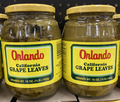 Preserved grape leaves in jars
 -
 Stuffed grape leaves with yogurt mint sauce


See also
[edit]
References
[edit]- ^ Ingalls, Julia (October 2019). "The Complicated Comfort Of Syrian Grape Leaves". LAist. Retrieved 2020-12-16.
- ^ Sakellis, Eleni. "Dolamadakia, Stuffed Grape Leaves". The National Herald. Archived from the original on 2021-10-27. Retrieved 2020-12-16.
- ^ Davidson, Alan, ed. (2014). The Oxford Companion to Food. Oxford University Press. p. 879. ISBN 978-0-19-967733-7 – via Google Books.
- ^ "Grape Leaf Herb and Yogurt Pie". The Splendid Table. Retrieved 2020-12-16.
- ^ John Thorne. Simple Cooking. Farrar, Straus and Giroux; 16 November 1996. ISBN 978-0-86547-504-5. p. 183–.
- ^ a b "Grape leaves, cooked, canned and salted (varies by manufacturer)". Nutritiondata.com, Conde Nast and US Department of Agriculture. 2018. Retrieved 17 December 2021.
Traditional biodegradable culinary wrappings, beddings, layering & dishware | ||
|---|---|---|
| Latin America |  | |
| Asia |
| |
| Africa | ||
| As dishware | ||
 | This vegetable-related article is a stub. You can help Wikipedia by expanding it. |
Grape leaves
View on GrokipediaBotany
Description
Grape leaves are the simple, alternate foliage produced by woody vines in the genus Vitis, most notably Vitis vinifera, the primary species cultivated for grapes worldwide. These leaves feature palmate venation and typically display a circular to ovate or suborbicular outline, with blades measuring 5–25 cm in length and breadth. They arise from long petioles, often 5–15 cm in length, which attach at the cordate or reniform base of the leaf.[6][7][8] The leaf blades are generally divided into 3–5 lobes, though variations up to 7 lobes occur, separated by deep sinuses and bordered by coarsely toothed or serrated margins. The adaxial (upper) surface is smooth and bright to dark green, while the abaxial (lower) surface is paler, frequently bearing fine, curly hairs lying flat against the epidermis or thicker, upright bristles, resulting in a downy or tomentose texture in many species. Prominent veins radiate from the petiole in a distinctive palmate pattern, providing structural support and facilitating nutrient transport.[6][9][8][10] As deciduous structures, grape leaves exhibit notable seasonal transformations; in autumn, chlorophyll breakdown leads to vibrant color shifts from green to yellow, orange, or red before abscission. These leaves serve as the primary sites for photosynthesis in the grapevine, enabling carbon fixation that supports overall plant growth and fruit development.[7][11]Varieties
Grape leaves exhibit notable variations across primary Vitis species, influencing their morphology and utility in identification. The European grape, Vitis vinifera, typically features leaves that are palmately lobed with three to five shallow lobes and coarsely serrated margins, and a glabrous or lightly hairy surface, measuring 5–25 cm wide.[12] In contrast, the fox grape, Vitis labrusca, produces heart-shaped, orbicular leaves up to 10–15 cm long with pronounced pubescence, including woolly hairs on the undersides that impart a downy texture.[13] The summer grape, Vitis aestivalis, displays coarsely toothed leaves that are glabrous to pubescent and suborbicular, variably lobed from shallow to deeply three- or five-lobed, often 7–20 cm in length, with a smooth, leathery surface.[14] These species-level differences in lobing, serration, and hairiness aid in distinguishing wild from cultivated vines in natural settings.[15] Within V. vinifera cultivars, leaf morphology further diverges based on intended use, affecting tenderness and suitability for culinary or viticultural applications. Wine grape varieties like Cabernet Sauvignon have deeply lobed leaves typically with three to five lobes, U-shaped sinuses, and overlapping lateral lobes, contributing to enhanced light interception in dense canopies.[16] Table grape cultivars, such as Thompson Seedless, feature broader, less deeply lobed leaves with reduced serration, resulting in a more rounded, orbicular form that supports larger fruit clusters.[17] American hybrid varieties, derived from crosses involving V. labrusca and other native species, often exhibit increased pubescence on the leaf undersides, thicker texture, and variable lobing, which may reduce palatability for direct consumption.[18] Ampelometry, the morphological analysis of grape leaves, leverages these traits for precise varietal identification, particularly in distinguishing wine from table grapes. Key metrics include leaf shape (e.g., orbicular vs. reniform), lobe depth (shallow in many table varieties vs. deep in wine types), and vein angles (e.g., acute basal vein angles in lobed forms), enabling differentiation among over 60 cultivars through averaged shape outlines derived from standardized landmarks.[17] Such methods, inspired by historical ampelographic techniques, confirm that wine grape leaves tend toward more pronounced lobing and venation complexity compared to the broader, simpler profiles of table grape leaves.[19] All grape leaves share a palmate venation pattern, with a central midvein branching into primary laterals.[20]Cultivation and Harvesting
Growing Conditions
Grape leaves, harvested from Vitis vinifera vines, thrive in Mediterranean-like climates characterized by long, warm, dry summers and cool, moist winters, which support robust vegetative growth essential for tender, high-quality foliage.[21] Optimal daytime temperatures during the growing season range from 25 to 32°C, allowing for vigorous photosynthesis and leaf expansion without excessive heat stress.[22] Full sun exposure of at least 6 to 8 hours per day is crucial, as it promotes healthy chlorophyll development and prevents leggy, pale leaves that result from shaded conditions.[23] Well-drained, loamy soils enriched with organic matter provide the ideal foundation for grapevine root systems, ensuring adequate aeration and nutrient uptake while minimizing the risk of root rot.[24] A soil pH between 6.0 and 7.0 is preferred, as it facilitates optimal mineral availability; acidic or alkaline extremes can lead to nutrient deficiencies manifesting as leaf discoloration.[24] Moderate irrigation is necessary, typically supplying 25 to 35 inches of water annually during the active growth period, to sustain hydration without causing waterlogging, which induces oxygen deprivation in roots and subsequent leaf yellowing.[25] Annual pruning during the dormant season (late winter) is vital to stimulate the production of new, tender shoots that yield the most desirable leaves for culinary purposes, removing up to 90% of old wood to redirect energy toward fresh growth.[26] Training vines on trellis systems, such as bilateral cordons or vertical shoot positioning, supports structural integrity, enhances air circulation to reduce disease pressure on leaves, and maximizes sunlight interception for uniform leaf quality.[26]Harvesting Methods
Grape leaves for culinary purposes are harvested during late spring to early summer, typically from May to June in the Northern Hemisphere, when the leaves are young, tender, and bright green in color, reaching sizes of approximately 4 to 5 inches (10 to 13 cm).[27][3] This timing ensures the leaves remain soft and free from the toughness that develops in older growth, and harvesting occurs before grape clusters form on the vine.[27] Picking is ideally performed early in the morning to capture peak freshness and minimize wilting.[3] Selection focuses on leaves from the tips of new growth, counting about three leaves down from the newest shoots to target the youngest specimens that are light green, shiny, smooth, and undamaged, without holes, fuzz, or signs of disease.[27][3] Leaves must be sourced from unsprayed vines to avoid pesticide, fungicide, or herbicide residues, with hands washed thoroughly using warm, soapy water for at least 20 seconds prior to handling.[3] Harvesting involves hand-plucking individual leaves directly from the vine or using scissors or small clippers for clean cuts at the base to prevent tearing the leaf structure.[27] Approximately 1.5 pounds of leaves yield 100 to 120 suitable medium-sized specimens.[27] Following harvest, leaves are rinsed under cold running water to remove dirt, insects, and potential contaminants.[27][3] Stems are trimmed off, and the leaves undergo initial blanching in boiling water or brine (prepared as 4 cups water to 1 cup salt) for 1 to 2 minutes to soften the texture and reduce inherent bitterness.[27][3] They are then immediately cooled in ice water to halt cooking, preserve vibrant color, and maintain tenderness, followed by gentle patting dry with paper towels.[27][3] Leaves from Vitis vinifera varieties are particularly favored for their suitable texture and flavor in edible applications.[5]Culinary Uses
Preparation and Preservation
Grape leaves require careful cleaning before use to ensure they are free of contaminants. They are rinsed thoroughly under cold, running water to remove dirt, insects, or any brine residue from prior preservation. Stems are trimmed off, and tough central veins are often removed to improve pliability and tenderness during cooking.[27][3] Softening the leaves is essential to make them flexible for wrapping. This is typically achieved by blanching in boiling water or a salt brine solution for 1 to 2 minutes until the leaves become soft and pliable, followed by immediate immersion in ice-cold water to halt the cooking process and preserve color. An alternative method involves soaking the leaves in very hot water for about 15 minutes to achieve similar softening without boiling. Leaves harvested in late spring or early summer, when they are young and tender, are ideal for these preparation steps.[3][27] Preservation methods allow grape leaves to be stored for later use while maintaining quality. For freezing, blanched leaves are patted dry, stacked or rolled between layers of paper towels to absorb excess moisture, and placed in airtight plastic bags with air removed; they can be kept in the freezer for up to 6 months. Brining involves packing the leaves in a saltwater solution, commonly at 5% salt concentration (w/v), to promote fermentation at room temperature, enabling storage for up to 90 days; higher concentrations like 12% or 19% extend preservation by inhibiting microbial growth more effectively. After brining, jars can be refrigerated to further prolong shelf life. No research-tested home canning procedures exist for grape leaves, so this method is not recommended for safety reasons.[3][27][28]Traditional Dishes
Grape leaves are a staple in dolma and sarma, traditional rolled dishes found across Mediterranean, Middle Eastern, and Balkan cuisines, where blanched leaves are wrapped around a filling of rice, ground meat such as lamb or beef, fresh herbs like dill and parsley, and pine nuts for added texture and flavor.[29][30] Vegetarian variations substitute the meat with lentils or chickpeas, combined with rice and aromatic spices, creating a lighter yet hearty option suitable for Lenten or vegan preparations.[31] In the Greek tradition, these stuffed rolls, known as dolmadakia, are often simmered until tender and finished with avgolemono, a creamy lemon-egg sauce that adds a tangy, velvety finish.[32] In Middle Eastern cooking, particularly Lebanese and Egyptian styles, the dish is called warak enab, featuring grape leaves stuffed primarily with spiced rice, tomatoes, onions, and herbs, sometimes including ground meat, then rolled tightly and cooked in a light broth.[33] These rolls are typically served at room temperature or chilled as a meze appetizer, accompanied by yogurt or tahini for dipping, emphasizing their role in communal dining.[34] Beyond rolls, grape leaves appear in other regional preparations, such as Greek pies where they form an edible crust wrapping a filling of thickened yogurt, fresh herbs like tarragon and parsley, scallions, and pine nuts, baked until crisp and served with extra yogurt.[35] In Balkan cuisines, variations of sarma incorporate grape leaves, often brined or fermented for preservation, stuffed with rice and meat mixtures, and layered in pots with smoky meats for slow cooking, imparting a tangy depth from the fermentation process.[36] Preserved grape leaves, typically brined in jars, enable year-round use in these dishes across cultures.[37]Nutritional Profile and Health Benefits
Nutritional Composition
Grape leaves, when cooked and canned, are composed primarily of water, accounting for about 81% of their weight per 100 g serving, with the remaining composition featuring 11.8% carbohydrates (including 10 g of dietary fiber), 4.3% protein, and 2.1% fat, yielding a total energy content of 75 calories.[38] The vitamin profile of canned grape leaves includes contributions from fat-soluble vitamins derived from beta-carotene and other carotenoids. A 100 g serving delivers 29% of the daily value (DV) for vitamin A, 81% DV for vitamin K, 13% DV for vitamin C, and 12% DV for vitamin E.[38] Regarding minerals, canned preparations often exhibit elevated sodium levels due to preservation processes, providing 124% DV, alongside 194% DV for copper, 17% DV for iron, 22% DV for calcium, modest contributions from potassium (1% DV) and magnesium (3% DV); pantothenic acid is prominent at 85% DV. Grape leaves further contain bioactive compounds such as polyphenols, which contribute to their antioxidant capacity.[38]| Nutrient Category | Key Components per 100 g (Cooked, Canned) | % Daily Value |
|---|---|---|
| Macronutrients | Water: 80.9 g; Carbohydrates: 11.8 g (fiber: 10 g); Protein: 4.3 g; Fat: 2.1 g | N/A |
| Calories | 75 kcal | N/A |
| Vitamins | Vitamin A: 29% (from beta-carotene); Vitamin K: 81%; Vitamin C: 13%; Vitamin E: 12% | As listed |
| Minerals | Sodium: 124% (salted); Copper: 194%; Iron: 17%; Calcium: 22%; Pantothenic acid: 85% | As listed |