Hubbry Logo
Aegopodium podagrariaAegopodium podagrariaMain
Open search
Aegopodium podagraria
Community hub
Aegopodium podagraria
logo
8 pages, 0 posts
0 subscribers
Be the first to start a discussion here.
Aegopodium podagraria
from Wikipedia

Aegopodium podagraria
Illustration from Otto Wilhelm Thomé's Flora von Deutschland, Österreich und der Schweiz (1885)
Scientific classification Edit this classification
Kingdom: Plantae
Clade: Tracheophytes
Clade: Angiosperms
Clade: Eudicots
Clade: Asterids
Order: Apiales
Family: Apiaceae
Genus: Aegopodium
Species:
A. podagraria
Binomial name
Aegopodium podagraria
Synonyms[1]
  • Aegopodium angelicifolium Salisb.
  • Aegopodium simplex Lavy
  • Aegopodium ternatum Gilib. nom. inval.
  • Aegopodium tribracteolatum Schmalh.
  • Apium biternatum Stokes
  • Apium podagraria (L.) Caruel
  • Carum podagraria (L.) Roth

Aegopodium podagraria, commonly called ground elder, is a species of flowering plant in the carrot family Apiaceae that grows in shady places. The name "ground elder" comes from the superficial similarity of its leaves and flowers to those of elder (Sambucus), which is not closely related. Other common names include herb gerard, bishop's weed, goutweed, gout wort, snow-in-the-mountain, English masterwort[2] and wild masterwort.[2] It is the type species of the genus Aegopodium. It is native to Europe and Asia, but has been introduced around the world as an ornamental plant, where it occasionally poses an ecological threat as an invasive exotic plant.[3]

Description

[edit]

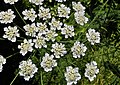
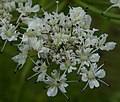
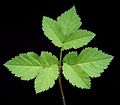
This herbaceous perennial grows to a height of 1 metre (3+12 ft)[4] from underground rhizomes. The stems are erect, hollow, and grooved. The upper leaves are ternate, broad and toothed. It flowers in spring and early summer. Numerous flowers are grouped together in an umbrella-shaped flowerhead known as a compound umbel. This is divided into several individual umbels (known as umbellets). Each umbellet has 15 to 20 rays (pedicels) that are each topped with a single, small, five-petaled white flower.[5][6][7] These are visited by many types of pollinating insects.[8]

The fruits, produced in late summer and autumn, are small and have long curved styles.[9][10]

Distribution and habitat

[edit]

Aegopodium podagraria is distributed widely in the temperate zone of western Asia and the whole of mainland Europe.[11] It has been introduced elsewhere, including Ireland,[12] the United Kingdom,[13] the United States,[14] Canada,[14] Australia (including Tasmania),[15] New Zealand,[16] and Japan.[17]

Ecology

[edit]
Phyllopertha horticola beetle on goutweed flowers

In Eurasia, it is used as a food plant by the larvae of some species of Lepidoptera, including dot moth, grey dagger and grey pug, although A. podagraria is not the exclusive host to any of these species.[citation needed]

Invasiveness

[edit]

Seed dispersal and seedling establishment are typically limited by shading, and new establishments from seed are restricted to disturbed areas. However A. podagraria readily spreads over large areas of ground by underground rhizomes. Once established, the plants are highly competitive, even in shaded environments, and can reduce the diversity of ground cover and prevent the establishment of tree and shrub seedlings. Because of its limited seed dispersal ability, short-lived seed bank and seedling recruitment, the primary vector for dispersal to new areas is human plantings as an ornamental, medicinal or vegetable plant, as well as by accidentally spreading rhizomes by dumping of garden waste. It spreads rapidly under favorable growing conditions.[18] Because of this it has been described as a nuisance species,[19] and been labelled one of the "worst" garden weeds in perennial flower gardens.[18]

Status as an invasive exotic plant

[edit]

Aegopodium podagraria has been introduced around the world, including in North America, Australia, New Zealand and Japan, most commonly as an ornamental plant. It readily establishes and can become naturalized in boreal, moist-temperate and moist-subtropical climates. It is an aggressive invader in the upper Great Lakes region and northeastern North America, Australia, Tasmania and New Zealand.[15] It can pose an ecological threat owing to its invasive nature, with potential to crowd out native species.[3] Because of its potential impacts on native communities and the difficulty of controlling it, it has been banned or restricted in some jurisdictions outside its native range, including in Connecticut, Massachusetts, Wisconsin and Vermont in the U.S.[14]

Control

[edit]
Rhizomes developing new shoots

Once established, goutweed is difficult to eradicate. The smallest piece of rhizome left in the ground will quickly form a sturdy new plant. All-green goutweed may be more persistent and spread more rapidly than ornamental, variegated goutweed varieties, making the all-green type particularly difficult to control. And all-green, wild type forms are known to reappear from seeds of variegated varieties.[citation needed]

Integrative management strategies that combine herbicide with landscape cloth, bark mulch, and hand weeding to control goutweed in a garden are largely unsuccessful because sprouting occurs from either rhizomes or root fragments left in the soil.[20] Hand pulling, raking, and digging followed by monitoring to control goutweed may be effective; however, caution must be taken to remove the entire rhizome and root system. Removing flowers before seed set may help control the spread of goutweed.[21] Because goutweed's starch reserves are typically depleted by spring, removal of leaves in spring could be effective in starving the plant. Once goutweed has been removed, the patch should be carefully monitored periodically for a few years. New shoots should be dug up and destroyed. Revegetation with other plant materials is recommended.[citation needed]

Systemic herbicides such as glyphosate are recommended because A. podagraria will regrow if merely defoliated.[22][23]

The most effective means of control is to prevent its establishment in natural communities. It is thus recommended to plant goutweed only on sites not adjacent to wildlands and in gardens where root spread can be restricted (e.g., between a sidewalk and a house).[19] However, the aggressive nature of this plant makes even this strategy risky. Several states have banned sales of goutweed (also known as bishop's weed).[24]

Uses

[edit]

The tender leaves can be utilized as a spring leaf vegetable akin to spinach,[4] having been used thus since antiquity. It is commonly used for soup. Young leaves are preferred as a pot herb. It is best picked from when it appears (as early as February in the UK and other parts of northern Europe) to just before it flowers (May to June). If it is picked after this point it tastes pungent and has a laxative effect. However, it can be stopped from flowering by pinching out the flowers, ensuring the plant remains edible if used more sparingly as a pot herb.[25]

It has been used as a medicinal herb to treat gout and arthritis.[26]

The plant is said to have been introduced into Great Britain by the Romans as a food plant and into Northern Europe as a medicinal herb by monks.[27] It is still found growing in patches surrounding many monastic ruins in Europe, and descriptions of its use are found among monastic writings, such as in Physica by Hildegard von Bingen.[27]

As a member of Apiaceae, its flowers may be confused with extremely toxic species such as poison hemlock and hemlock water dropwort; attention to the leaves is required for a conclusive identification.

An ornamental form with variegated leaves

A variegated form is grown as an ornamental plant. However it is banned in several states owing to its invasiveness. Seeds from the variegated form may revert to the more aggressive green form.[24]

[edit]

References

[edit]
[edit]
Revisions and contributorsEdit on WikipediaRead on Wikipedia
from Grokipedia
Aegopodium podagraria, commonly known as ground elder, goutweed, , or keçiayağı (Turkish), is a in the family , characterized by its creeping rhizomes, compound leaves, and white umbellate flowers, native to and northern but widely introduced and invasive in . The plant grows 0.5 to 3 feet tall, forming dense mats through aggressive vegetative spread via fleshy white rhizomes, which allow it to colonize disturbed areas such as forests, fields, and gardens. Its leaves are compound and triternate, with serrated margins, typically medium green but sometimes variegated with white or cream edges in cultivated forms; the stems are green and fleshy, supporting flat-topped umbels of small white flowers that bloom from May to June, attracting pollinators like bees and flies. Fruits are small, brown seeds that aid in occasional , though rhizomes are the primary means of expansion. Thriving in partial to full shade and adaptable to a range of well-drained soils from clay to with levels from acidic to alkaline, A. podagraria tolerates , compaction, and , making it suitable for ground cover in but problematic in natural ecosystems. It has been introduced to the as an ornamental, where it is now widespread and considered invasive in states like , , , , , , and , and prohibited from sale in , , , and as of 2024, outcompeting such as Zizia aurea and Osmorhiza spp., reducing , and inhibiting the growth of in forested areas. Historically, A. podagraria has been used medicinally to treat and —hence its species name "podagraria," derived from the Greek for — with young leaves edible raw or cooked in salads, soups, or as a potherb before flowering, imparting a carrot-like scent due to its affiliation. Despite these uses, its high maintenance and potential for escape from cultivation necessitate careful management, including containment or removal via digging, mowing, or herbicides like or . The variegated 'Variegatum' is less vigorous but still requires monitoring to prevent spread.

Taxonomy

Classification

Aegopodium podagraria is a perennial herbaceous plant classified in the kingdom Plantae, phylum Tracheophyta, class Magnoliopsida, order Apiales, family Apiaceae, genus Aegopodium, and species podagraria. Placement within the Apiaceae (carrot or parsley family) is justified by diagnostic features such as compound umbellate inflorescences, alternate leaves that are typically pinnate or ternate with sheathing petioles, and erect or ascending stems often hollow between nodes. The genus encompasses twelve perennial rhizomatous species distributed across temperate , with A. podagraria serving as the . Compared to other species like A. alpestre, which occurs in mountainous regions of and , A. podagraria is notable for its more extensive system, characterized by long, white, branching underground structures that facilitate widespread ; biometric analyses indicate larger root dimensions in A. podagraria relative to A. alpestre.

Etymology and nomenclature

The genus name Aegopodium derives from the Greek words aix (or aigos, meaning "") and podion (meaning "little foot"), alluding to the supposed resemblance of the plant's leaves to a 's foot. This etymology is paralleled in the Turkish common name "keçi ayağı" (also spelled "keçiayağı"), meaning "goat's foot". The specific epithet podagraria originates from the Latin term podagra, referring to , in recognition of the plant's historical use as a remedy for this condition. Common names for Aegopodium podagraria reflect its cultural associations and appearances, including ground elder, , goutweed, herb Gerard, and snow-in-the-mountain, with regional variations such as "egopodium" appearing in older botanical texts. The species was first formally described by in his 1753 work , where it was named Aegopodium podagraria L., and this binomial remains the accepted name under the International Code of Nomenclature for , fungi, and (ICN).

Description

Vegetative morphology

Aegopodium podagraria is a that grows 30–100 tall and forms dense colonies through its extensive rhizomatous system. It exhibits a creeping, mounding habit, spreading aggressively to create thick mats in suitable conditions. The stems are erect, branched, glabrous, hollow, and often grooved, reaching heights of up to 100 depending on environmental factors such as richness and . Leaves are and alternate, typically tri-pinnate with 3–5 pairs of ovate to lanceolate leaflets measuring 2–5 cm long and featuring serrated margins. Lower leaves are larger and more toothed, borne on longer petioles, while upper leaves are smaller; the wild type has medium green foliage, though variegated cultivars with creamy white edges exist. The plant's rhizomes are extensive, white, creeping, and horizontal, often reaching lengths of 5–300 cm with a of about 2 ; they branch extensively and produce new shoots (ramets) from nodes, facilitating rapid vegetative spread. Roots are fibrous and shallow, arising adventitiously from rhizome nodes, including thick storage and thin feeding roots that support the plant's clonal growth.

Reproductive morphology

The of Aegopodium podagraria is a compound umbel measuring 4–12 cm in , typically comprising 10–20 rays, with bracts absent or reduced to small scales at the base. The flowers are small, bisexual, and white, each featuring five obovate petals with retuse tips and measuring 2–3 mm across; they bloom from May to July in temperate regions. Fruits develop as schizocarps, ovoid in shape and 3–4 mm long, with filiform ribs and vittae (oil tubes) present on the mericarps, which split into two flattened segments for dispersal primarily by gravity and occasional attachment to animals. Seeds exhibit high viability, with germination rates reaching up to 88% following cold stratification to overcome morphological and physiological , though seed propagation remains secondary to the plant's primary reliance on rhizomes for .

Distribution and habitat

Native range

Aegopodium podagraria is native to the temperate regions of , spanning much of from the eastward to and beyond, as well as temperate Asia including , the , , and parts of . Its core distribution is centered in Eurasian woodlands, where it thrives in forests, shrublands, and grasslands, though it is not considered endemic to any specific locale within this range. The species extends northward up to approximately 71°N , reflecting its adaptation to cooler temperate and zones across its native territory. Historical records, including evidence from Pleistocene deposits, indicate that A. podagraria underwent post-glacial expansion following the , with pollen and macro remains documented in late glacial and early sediments across and western Asia. These findings suggest the plant recolonized northern areas as ice sheets retreated, contributing to its current broad native footprint in post-glacial landscapes. The native range is closely associated with temperate climates characterized by moist conditions, with mean annual ranging from 495 to 832 mm and temperatures around 5.6–7°C in key habitats. Altitudinally, it occurs from up to about 1,063 m. It favors shaded, humid environments within its core.

Introduced range and preferred habitats

Aegopodium podagraria, commonly known as goutweed or , has been introduced to several regions outside its native Eurasian range, primarily through human activities such as ornamental planting in gardens and accidental transport via ballast or waste disposal. It first appeared in in the early 1800s, with records of escape from cultivation in the by 1859, and has since naturalized widely across the continent. In the United States, it is established from to in the east, extending westward to and , and in the from to . In , it is widespread across all provinces and several territories. Beyond , the plant has been introduced to (including ), , and , where it has become naturalized in temperate zones, often spreading via discarded garden waste or intentional planting as a ground cover. The species thrives in a variety of disturbed and semi-natural environments in its introduced ranges, particularly those altered by activity. It commonly invades shaded woodlands, edges, riparian zones, and floodplains, as well as urban and suburban sites such as gardens, roadsides, and waste grounds. Goutweed shows a strong preference for moist, well-drained soils, tolerating periodic saturation, and is often found in areas with consistent moisture availability, including ditches and thickets. It favors nitrogen-rich, loamy soils with a range of 6.1 to 7.8, though it can adapt to weakly acidic to basic conditions ( 4.0–9.0) and partial clay or sand content. In terms of light, A. podagraria prefers partial shade but demonstrates high tolerance for deep shade, succeeding under up to 90% canopy cover in or coniferous woodlands and shrublands. This adaptability allows it to persist in both natural grasslands and anthropogenically modified habitats, contributing to its rapid establishment in introduced areas. Observations indicate increasing prevalence in urban settings since the early 2000s, potentially linked to warming climates enhancing its growth in suitable microhabitats.

Ecology

Growth and life cycle

Aegopodium podagraria is a that completes its life cycle through vegetative and reproductive phases, overwintering primarily as an extensive network of underground rhizomes that serve as storage organs for carbohydrates and enable regrowth each year. New shoots emerge from these rhizomes in early spring, typically to in temperate European climates, marking the onset of active growth as the transitions from . During this vegetative phase, which spans to May, the rapidly develops compound leaves and expands aboveground to form dense mats, reaching heights of 60–90 cm depending on and light availability. The reproductive phase follows in to , when flowering occurs under longer photoperiods typical of summers, producing compound umbels of small white flowers that facilitate limited production. Cooler stratification in winter (around 5°C) is required to break and trigger spring emergence. expansion intensifies in autumn, with growth rates up to 70 cm per year allowing the formation of expansive colonies, while aboveground parts enter from August to October, yellowing after the first as resources are translocated belowground. Colonies exhibit long-term persistence, often lasting over 20 years, due to the dominance of via fragmentation and sprouting, which accounts for the vast majority of spread in established populations, with via seeds playing a subordinate role and low rates in natural settings. Individual may take 5–7 years to reach reproductive maturity from seed, but clonal accelerates colony expansion and longevity.

Ecological interactions

Aegopodium podagraria is primarily insect-pollinated, with flowers attracting a variety of pollinators including bees through nectar and volatile compounds. Hoverflies and beetles have also been observed visiting the flowers, contributing to pollen transfer. The species is self-compatible, allowing for autogamous reproduction, but outcrossing is favored in natural populations due to the promotion of genetic diversity via insect vectors. The plant serves as a food source for certain herbivores, particularly slugs, which consume its foliage in shaded habitats. Snails may shelter on the leaves but typically do not feed on them extensively. As a member of the family, A. podagraria produces polyacetylenes such as , which act as chemical defenses against potential herbivores by deterring feeding and exhibiting properties. Associations with soil microbes enhance nutrient acquisition for A. podagraria, particularly through arbuscular mycorrhizal fungi (AMF) that form symbioses with its roots, improving and other uptake in environments. These fungi are more abundant and diverse in dominated by the plant, indicating a facilitative interaction that supports its growth in nutrient-limited settings. In mixed stands, the species may indirectly benefit from availability, though it does not fix itself; its presence can promote overall microbial activity conducive to . A. podagraria engages in competitive interactions with other plants by forming dense rhizomatous mats that suppress species through resource competition and . Root exudates containing inhibitory compounds reduce and growth of neighboring , allowing the species to dominate herbaceous layers in shaded woodlands. This effect is particularly pronounced in eutrophic soils, where it limits by outcompeting native .

Invasiveness

Aegopodium podagraria, commonly known as goutweed or , exhibits several traits that contribute to its invasiveness in non-native regions. It spreads rapidly via extensive rhizomes, which can extend up to 70 cm per year, enabling the plant to form dense monoclonal patches that outcompete surrounding . Additionally, its high tolerance for shade allows it to thrive in forested understories and shaded gardens, where it persists even under closed canopies. These characteristics, combined with from root fragments, make it particularly difficult to contain once established. The ecological impacts of A. podagraria are significant, particularly in woodlands and gardens, where it forms thick mats that displace native plant species and reduce overall . Studies indicate that it can dominate the ground layer, suppressing native flora through competition for light, nutrients, and space, leading to decreased in invaded areas. Economically, its proliferation imposes costs on and , as control efforts in affected landscapes require substantial resources, though specific figures vary by region. In non-native habitats, these invasions alter structure, hindering the regeneration of native and affecting associated . A. podagraria is recognized as invasive in parts of , where it is listed as a or species of concern in several states, including a ban on its sale in and designation as a weed of concern in Washington. While native to , its spread raises concerns in managed landscapes across the EU due to its aggressive growth. Climate change is expected to exacerbate its invasiveness by expanding suitable habitats through warmer temperatures and altered patterns, potentially increasing its range in temperate regions. As a garden escapee introduced to North America in the mid-19th century for ornamental and medicinal purposes, A. podagraria has since naturalized widely, often forming impenetrable mats in urban parks and disturbed sites. For instance, in eastern North American woodlands, it has invaded from adjacent s, creating monocultures that persist for decades and require intensive management. These case studies highlight its role as a persistent invader originating from historical plantings.

Uses

Culinary applications

Aegopodium podagraria, commonly known as ground elder or goutweed, has young leaves, shoots, stems, flowers, and rhizomes that are , with the young leaves and shoots harvested in spring exhibiting a flavor reminiscent of or . In traditional , particularly in peasant diets across , , and , the plant has been used for centuries in simple preparations such as raw salads, cooked soups, and as a pot herb in stews and fillings. The fresh young leaves are often added to spring salads or blanched for use in omelets and pastas, while flowers serve as decorations; dried aerial parts have been incorporated into and functional foods. Nutritionally, 100 grams of the fresh leaves provide approximately 40 kcal, with vitamin C at about 80 mg, at around 0.17 mg, iron at 2 mg, and at 770 mg, though values can vary by growing conditions and harvest time; the plant is a valuable source of these nutrients in greens. In modern practices, ground elder has gained popularity within wild food movements for its accessibility and versatility in contemporary recipes like pestos and stir-fries, but foragers are advised to harvest from uncontaminated areas away from roadsides or treated gardens to avoid pollutants.

Medicinal properties

Aegopodium podagraria, commonly known as goutweed or ground elder, has been utilized in traditional European folk medicine since ancient times as a remedy for , , , and , owing to its and properties. The plant was often applied externally as a made from boiled leaves and roots to alleviate and swelling. Its specific epithet podagraria derives from the Greek word for , reflecting this longstanding association with treating the condition. The medicinal effects of A. podagraria are attributed to bioactive compounds such as polyacetylenes, including and falcarindiol, which exhibit and activities by inhibiting cyclooxygenases. present in the leaves contribute properties, helping to reduce and . For relief, the plant's action and hypouricemic effects, demonstrated in animal models, aid in reducing levels. Modern research on A. podagraria remains limited but ongoing, with studies primarily conducted and on animal models from the through 2025. For instance, falcarindiol isolated from the plant showed COX-1 inhibitory activity, suggesting potential relevant to in rat models. extracts demonstrated effects by suppressing and modulating in fluoride-exposed cell lines and rats. Recent 2025 research indicates potential anti-cancer properties, particularly against , and benefits for preventing hyperuricaemia. However, human clinical trials are lacking, and there is insufficient evidence to support its efficacy for conditions like or . While generally considered safe at therapeutic doses due to a wide margin between effective and toxic levels, A. podagraria can cause mild toxicity in excess, including skin irritation and from sensitization. Polyacetylenes may lead to neurotoxic effects at high concentrations. Use is not recommended for pregnant or breastfeeding individuals due to insufficient safety data.

Management

Control methods

Mechanical control methods for Aegopodium podagraria primarily involve manual removal to target the extensive network, which can regenerate from small fragments. is effective for small infestations, requiring the removal of rhizomes to a depth of at least 60 cm to minimize regrowth, though complete eradication often necessitates repeating the process over 2-3 years with vigilant monitoring for resprouts. Smothering with opaque materials, such as landscape fabric or black plastic sheeting extended 1 meter beyond the infestation, can suppress growth by blocking light; tarping is more effective than mulching, and this approach is suitable when applied after mowing and maintained for at least two years in sunny, flat areas. Chemical control relies on systemic herbicides applied as foliar sprays to translocate to the roots. (1-3% solution) or (1-5% solution) are commonly used, with applications timed for spring or pre-flowering stages (May to early July) when plants are actively growing; 2-3 treatments spaced several weeks apart are typically required for substantial reduction. These herbicides achieve substantial reduction in and stem density after repeated applications, though non-selective nature demands caution near desirable vegetation. Biological control options for A. podagraria remain limited, with no approved pathogens or insects currently available in . Grazing by goats has shown promise in suppressing similar invasive perennials by consuming foliage and weakening rhizomes, though it requires repeated sessions and is best suited for larger, non-sensitive areas. Research on fungal pathogens, such as Mycosphaerella podagrariae (identified in a study), indicates potential but lacks widespread implementation or proven field efficacy as of 2025. Integrated approaches combining mechanical, chemical, and cultural methods offer the highest success rates, with consistent application over multiple seasons. For instance, initial treatment followed by tarping and hand-weeding prevents regrowth, with timing before flowering critical to disrupt reproduction; long-term monitoring is essential to address any surviving rhizomes.

Challenges in eradication

Eradication of Aegopodium podagraria is hindered by its robust regenerative capacity, primarily through rhizomes that allow regrowth from even small fragments as short as 1 cm, which remain viable in soil for over four years. This vegetative persistence enables the plant to form dense patches that outcompete , with rhizomes extending up to 70 cm annually. Additionally, its may contribute to reinvasion, though seed longevity is unknown; primary spread is vegetative. Environmental factors exacerbate these biological traits, as A. podagraria spreads efficiently via contaminated or equipment, where fragments are inadvertently transported to new sites. The demonstrates notable resilience to abiotic stresses, tolerating frost without significant dieback—hardy to USDA zone 5—and persisting through moderate drought once established, though it prefers moist, shaded habitats. This adaptability allows it to survive in diverse settings, complicating targeted removal without affecting surrounding vegetation. Socioeconomic barriers further impede effective management, with control often demanding substantial labor for repeated manual excavation or monitoring, especially in larger infestations. In organic gardening contexts, aversion to synthetic herbicides leads to dependence on non-chemical strategies like tarping or digging, which are highly labor-intensive and prone to incomplete fragment removal, prolonging efforts over multiple seasons. Control is costly, especially for established infestations. Knowledge gaps persist in assessing long-term eradication success, as most available studies predate 2025 and focus on short-term trials, leaving uncertainties about sustained efficacy across varied climates and soil types; the 2022 Best Management Practices guide provides current recommendations, with no major updates as of November 2025. Emerging observations in weeds suggest a potential for resistance development in A. podagraria, underscoring the urgency for updated, comprehensive research to refine management protocols.

References

Add your contribution
Related Hubs
User Avatar
No comments yet.