Hubbry Logo
HiltHiltMain
Open search
Hilt
Community hub
Hilt
logo
8 pages, 0 posts
0 subscribers
Be the first to start a discussion here.
Hilt
Hilt
from Wikipedia
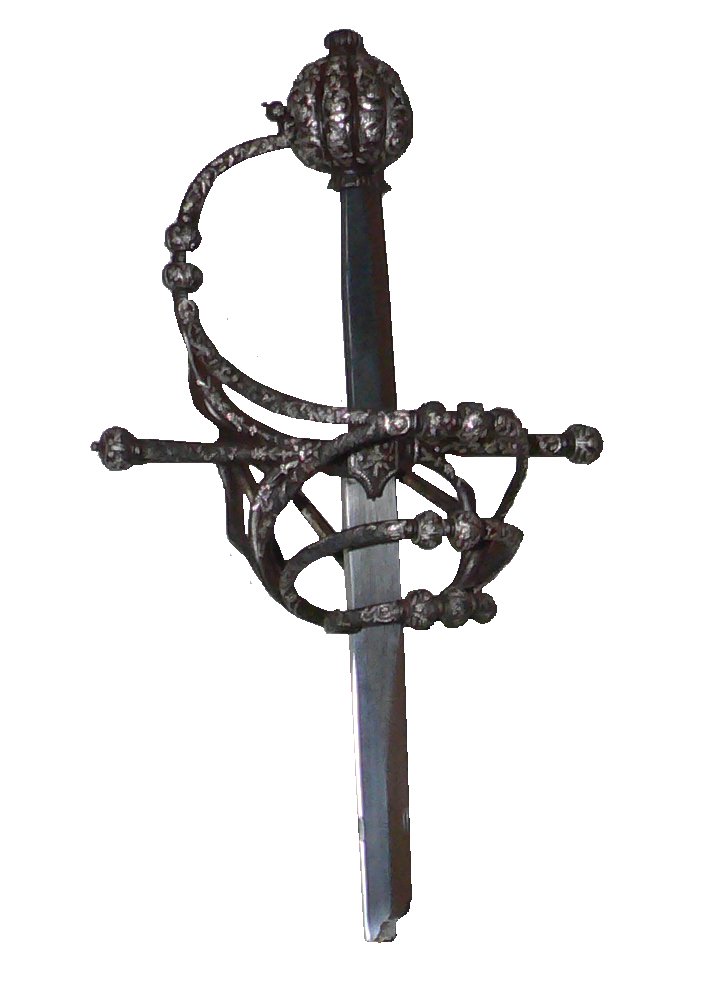
Silver pattern welded rapier guard, from between 1580 and 1600, with reproduction blade

The hilt (rarely called a haft or shaft) is the handle of a knife, dagger, sword, or bayonet, consisting of a guard, grip, and pommel. The guard may contain a crossguard or quillons. A tassel or sword knot may be attached to the guard or pommel.

Pommel

[edit]
A Visayan tenegre horn hilt from the Philippines, depicting the moon-engulfing sea serpent deity, Bakunawa, a prominent figure in Philippine mythology.

The pommel (Anglo-Norman pomel "little apple"[1]) is an enlarged fitting at the top of the handle. They were originally developed to prevent the sword from slipping from the hand. From around the 11th century in Europe, they became heavy enough to be a counterweight to the blade.[2] This gave the sword a point of balance not too far from the hilt, allowing a more fluid fighting style. Depending on sword design and swordsmanship style, the pommel may also be used to strike the opponent (e.g. using the Mordhau technique).

Pommels have appeared in a wide variety of shapes, including oblate spheroids, crescents, disks, wheels, and animal or bird heads. They are often engraved or inlayed with various designs and occasionally gilt and mounted with jewels. Ewart Oakeshott introduced a system of classification of medieval pommel forms in his The Sword in the Age of Chivalry (1964) to stand alongside his blade typology.[3] Oakeshott pommel types are enumerated with capital letters A–Z, with subtypes indicated by numerals.

  1. the "Brazil-nut" pommel derived from the classical Viking sword
  2. a more rounded and shorter form of A. B1 is the variant with a straight lower edge, known as "mushroom" or "tea-cosy"
  3. "cocked-hat" form, derived from the Viking sword
  4. a bulkier and slightly later variant of C
  5. a variant of D with an angular top
  6. a more angular variant of E
  7. a plain disk. G1 and G2 are disk pommels ornamented with flower-shaped or shell-like ornaments, respectively, both particular to Italy
  8. a disk with the edges chamfered off. One of the most common forms, found throughout the 10th to 15th centuries. H1 is an oval variant
  9. a disk with wide chamfered edges, the inner disk being much smaller than in H. I1 is a hexagonal variant
  10. as I, but with the chamfered edges deeply hollowed out. J1 is an elaborated form of the classic wheel-pommel
  11. a very wide and flat variant of J, popular in the late medieval period
  12. a tall type of trefoil shape; rare and probably limited to Spain in the 12th and 13th centuries
  13. a late derivation of the multi-lobed Viking pommel type, found frequently on tomb effigies during 1250–1350 in southern Scotland and northern England, but with few surviving examples; see Cawood sword
  14. boat-shaped, rare both in art and in surviving specimens
  15. a rare type of crescent-shape
  16. a rare shield-shaped form only known from a statue at Nuremberg cathedral
  17. flower-shaped pommels, only known from artistic depictions of swords
  18. rare spherical pommel, mostly seen in the 9th and 10th centuries
  19. a rare type in the form of a cube with the corners cut off
  20. the "fig" or "pear" or "scent-stopper" (for its resemblance to the stopper on a bottle of scent) shape, first found in the early 14th century, but seen with any frequency only after 1360, with numerous derived forms well into the 16th century. T1 to T5 are variants of this basic type
  21. "key-shaped" type of the later half of the 15th century
  22. the "fish-tail" pommel of the 15th century, with variants V1 and V2
  23. a "misshapen wheel" shape
  24. square shape, with its sub-types used to closely define the area and age, Z1 and Z2b (most common in south-eastern Europe), Z3 ("cat's head", typical for Venetian swords), Z4 (typical for Serbia and Bosnia)

Grip

[edit]
Image detailing the parts of a sword
Parts of a sword

The grip is the handle of the sword. It is usually made of wood or metal and often covered with shagreen (untanned tough leather or shark skin). Shark skin proved to be the most durable in temperate climates but deteriorates in hot climates. Consequently, rubber became popular in the latter half of the 19th century. Many sword types alternatively opt for ray skin, referred to in katana construction as same. Whatever material covers the grip, it is usually both glued on and wrapped with wire in a helix.

Guard

[edit]

The guard is just above the grip. It is a common misconception that the cross-guard protects the wielder's entire hand from the opposing sword; only with the abandonment of the shield and then the armoured gauntlet did a full hand guard become necessary. The crossguard still protected the user from a blade that was deliberately slid down the length of the blade to cut off or injure the hand.

Early swords do not have true guards but simply a form of stop to prevent the hand slipping up the blade when thrusting, as they were invariably used in conjunction with a shield.

From the 11th century, European sword guards took the form of a straight crossbar (later called "quillon") perpendicular to the blade.

Beginning in the 16th century in Europe, guards became more and more elaborate, with additional loops and curved bars or branches to protect the hand. A single curved piece alongside the fingers (roughly parallel with the handle/blade and perpendicular to any crossguards) was referred to as a knuckle-bow.[4]

Ultimately, the bars could be supplemented or replaced with metal plates that could be ornamentally pierced. The term "basket hilt" eventually came into vogue to describe such designs, and there are a variety of basket-hilted swords.

Simultaneously, emphasis upon the thrust attack with rapiers and smallswords revealed a vulnerability to thrusting. By the 17th century, guards were developed that incorporated a solid shield that surrounded the blade out to a diameter of up to two inches or more. Older forms of this guard retained the quillons or a single quillon, but later forms eliminated the quillons, altogether being referred to as a cup-hilt. This latter form is the basis of the guards of modern foils and épées.

Ricasso

[edit]

The ricasso is a blunt section of blade just above the guard. On developed hilts it is protected by an extension of the guard.[5] On two-handed swords, the ricasso provided a third hand position above the guard, permitting the user's hands to be placed further apart for better leverage while sacrificing the protection of the crossguard.

Sword knot

[edit]
Germany 19th century: Various colours and tassels of sword knots.
German cavalry officers' Stichdegen (dress sword, literally 'stabbing rapier') with sword knot, or Troddel. When worn, the sword knot is wrapped around the sword guard, or sometimes looped though a slot in the guard.

The sword knot or sword strap, sometimes called a tassel, is a lanyard—usually of leather but sometimes of woven gold or silver bullion, or more often metallic lace—looped around the hand to prevent the sword being lost if it is dropped. Although they have a practical function, sword knots often had a decorative design. For example, the British Army generally adopted a white leather strap with a large acorn knot made out of gold wire for infantry officers at the end of the 19th century. Such acorn forms of tassels were called 'boxed', which was the way of securing the fringe of the tassel along its bottom line such that the strands could not separate and become entangled or lost. Many sword knots were also made of silk with a fine, ornamental alloy gold or silver metal wire woven into it in a specified pattern.

The art and history of tassels are known by its French name, passementerie, or Posamenten as it was called in German. The military output of the artisans called passementiers (ornamental braid, lace, cord, or trimmings makers) is evident in catalogs of various military uniform and regalia makers of centuries past. The broader art form of passementerie, with its divisions of decor, clergy and nobility, upholstery, coaches and livery, and military, is covered in a few books on that subject, none of which are in English.

Indian swords had the tassel attached through an eyelet at the end of the pommel.

Chinese swords, both jian and dao, often have lanyards or tassels attached. As with Western sword knots, these serve both decorative and practical functions, and the manipulation of the tassel is a part of some jian performances.

References

[edit]
Revisions and contributorsEdit on WikipediaRead on Wikipedia
from Grokipedia
A hilt is the of a , , , or , designed to provide control, balance, and hand protection during use. It typically consists of three main components: the grip, which is the portion held by the hand and often wrapped in , wire, or other materials for secure handling; the guard (or ), which extends perpendicular to the blade to shield the fingers from an opponent's weapon; and the pommel, a at the end of the grip that aids in balancing the sword and can serve as an impact weapon. The term "hilt" derives from hilt or hilte, stemming from Proto-Germanic *heltą, referring specifically to the of a or . The hilt's design has evolved significantly since its origins in the late , around 1200–1000 BCE, when early forms appeared on swords as simple riveted attachments to secure the to a basic handle. By the early (circa 1000–500 BCE), hilts became more defined, with rudimentary guards emerging to protect the hand, as seen in transitional bronze-to-iron weapons. In the (8th–11th centuries CE), European hilts featured short, straight quillons (arms of the guard) on pattern-welded blades, emphasizing functionality for slashing and thrusting in close combat. The Carolingian period (8th–10th centuries CE) introduced longer, slightly curved quillons for enhanced protection, while the (11th–13th centuries) saw broader guards and more substantial grips to accommodate heavier blades. Medieval advancements, particularly from the 14th to 16th centuries, reflected changes in armor, tactics, and , leading to diverse hilt types such as the simple for arming swords, knuckle-bow guards for rapiers, and elaborate hilts for broadswords that fully enclosed the hand. Two-handed swords of the 15th–16th centuries featured extended grips, typically 12-18 inches (30-46 cm) long, large quillons, and heavy pommels to counterbalance massive blades used against plate armor. By the , as techniques emphasized precision over brute force, hilts incorporated shell guards and swept quillons, evolving into the complex designs of smallswords and rapiers. Across cultures, variations abound: Indian pata swords integrated gauntlet-like hilts for mailed fists, while employed distinctive quillons and lobed pommels from the onward. In the , following the rise of firearms in the 18th–19th centuries, hilts became largely ceremonial, retaining ornate forms like those on naval cutlasses or parade sabers, though their core principles of ergonomics and protection persist in historical replicas and .

Design and Components

Pommel

The pommel is the enlarged terminal knob at the end of the sword's grip, serving as a to balance the and secure the hilt components onto the blade's tang. It allows the hand to rest against it for stability during use and can function as an impact weapon in techniques like the mordhau. Pommels vary in shape, from spherical or disk-like in medieval swords to more ornate forms in later periods, and are often made of metal such as , , or iron to provide sufficient mass for balance.

Grip

The grip is the portion of the hilt held by the hand, designed for secure and comfortable control of the sword. It is typically constructed from wood, bone, or metal cores, wrapped in materials like leather, wire, sharkskin (shagreen), or cord to enhance friction and prevent slipping. Grip length varies by sword type: shorter for one-handed weapons (around 3-4 inches) and longer for two-handed swords (up to 10 inches or more) to accommodate both hands. The shape may be straight, faceted, or ergonomic to fit the hand's natural position and allow for different grips, such as hammer or finger-on-guard holds.

Guard

The guard functions as the primary protective element of the sword hilt, positioned between the grip and to shield the wielder's hand from enemy strikes and sliding blades. This component typically manifests as a cross-piece or branching structure, with the straight —comprising two projecting arms called quillons—offering basic deflection against attacks. More elaborate variants include S-shaped guards, which curve over the fingers for broader coverage, and basket hilts that form a wire-woven enclosure around the entire hand, commonly seen in broadswords for superior defense during cut-and-thrust combat. In terms of mechanics, quillons are designed to catch and trap an opposing blade during parries, enabling the swordsman to bind or redirect the attack with leverage from the hilt. Their length generally varies from 6 to 12 inches total, scaled to the sword type—shorter for agile rapiers and longer for broadswords—to optimize balance and trapping efficacy without hindering wrist mobility. Guards are frequently integrated by them as a single unit with the blade's tang, which ensures durability and transmits force effectively during defensive maneuvers. This proximity to the also supports half-swording grips for close-quarters control.

The is defined as the unsharpened, often flattened portion of the immediately adjacent to the guard, typically measuring 2 to 4 inches in length. This feature provides a area for hand placement without risk of cutting, distinguishing it from the sharpened edges of the blade's foible and forte. Tactically, the ricasso enables techniques such as half-swording, where the off-hand grips the unsharpened section to "choke up" on the blade, facilitating precise thrusting, , or close-quarters maneuvers, particularly in armored combat where slashing is less effective. This grip shortens the weapon's effective length for better control in wrestling or targeting gaps in plate armor, and it supports strikes like the mordhau, using the pommel as a while holding the ricasso. Historically, the was prominent on medieval longswords, such as Oakeshott types XVII and XVIII, where it supported half-swording for armored engagements from the 14th to 15th centuries. In later rapiers of the 16th and 17th centuries, it allowed for finesse in civilian dueling and fencing by enabling the to wrap around it for enhanced tip precision. Design-wise, the ricasso's width varies to preserve blade integrity while offering grip space, and it is sometimes engraved with decorative motifs or maker's marks for aesthetic or identificatory purposes. Bluing or other finishes may appear on later examples to prevent in this exposed area. By extending the hilt's functional reach, the ricasso integrates seamlessly with the guard, allowing secure hand positioning without dulling the blade's cutting edges beyond this zone.

Sword Knot

The sword knot is a looped typically made of or fabric, attached to the hilt of a sword, and frequently adorned with a at one end. This accessory serves primarily as a to secure the , allowing the user to loop it around the or belt to prevent accidental loss during use. In its practical role, the sword knot originated with mounted soldiers around the , when complex hilt designs emerged in to support dynamic combat on horseback. It was designed to keep the sword from being dropped or knocked away amid the chaos of mounted charges, with the strap wrapping securely around the wrist for and retention. Over time, as battlefield tactics evolved and swords shifted from primary weapons to sidearms, the knot's utilitarian function diminished, giving way to ceremonial significance. By the 18th and 19th centuries, sword knots had transformed into ornate elements on military sabers and naval dress swords, evolving from simple cords to elaborate designs featuring acorn-shaped tassels or bullions. In naval contexts, these knots became symbols of rank and tradition, particularly on officer swords developed for sea service in the late 18th century. Attachment methods for the sword knot vary by design but commonly involve passing the strap through an eyelet or slot in the guard, then wrapping it around the guard before draping over the pommel or handle. Alternatively, it may slide directly over the pommel for simpler fixation. Variations in sword knots reflect their dual practical and decorative roles, ranging from plain leather straps for everyday utility in cavalry use to gilded silk or gold-lace versions for parades and formal ceremonies. Modern armed forces maintain strict regulations on these knots; for instance, U.S. Navy officers wear a 1/2-inch gold lace loop with tassel, prescribable for ranks of lieutenant commander and above during ceremonies. Enlisted personnel often use simpler black leather variants to denote service distinctions.

Materials and Construction

Common Materials

Sword hilts have historically been constructed from a variety of materials chosen for , , and aesthetic appeal. Organic materials such as , , horn (including ox-horn and ), and (e.g., ) were commonly used for grips to provide a comfortable hold and absorb shock during use. Grips were often wrapped in , cord, (untanned skin), or bound with wire for added security. Metal components like guards and pommels were typically made from iron or , with , , silver, or used for decoration or higher-status weapons. Inlays of silver, , garnets, or enamel added ornamental value to iron fittings. Whalebone was occasionally employed for pommels and guards in early medieval examples. In modern replicas and reproductions, traditional materials persist, including hardwoods like or boxwood for grips, and or for metal parts. Synthetic materials may be used for in weapons, but high-quality replicas favor historical authenticity.

Manufacturing Techniques

Historical hilt construction involved assembling components around the blade's tang. The tang was inserted through the grip and secured by (hammering the end to flare it) or riveting, ensuring a tight fit. Guards and pommels were often forged from iron, with some cast in or silver for elite pieces. Decorative inlays were created by cutting fine channels into the metal surface using chisels, then hammering contrasting wires (e.g., or ) into place to form patterns like herringbone designs. Grips were carved from organic materials and fitted directly onto the tang. In the , hilts are produced using a mix of traditional and contemporary methods. and remain common for metal parts, while (joining with ) is used for secure pommel attachments in some designs. Wooden components are hand-carved or machined for precision. High-end reproductions emphasize tight fittings to prevent loosening, often tested for combat durability.

Historical Development

Ancient and Medieval Periods

The origins of sword hilts trace back to the around 2000 BCE, when simple cast designs emerged in Egyptian and Mesopotamian weaponry to ensure basic grip security and balance during combat. In , Middle sickle swords () featured integral hilts cast as part of the blade, often with minimal decoration to prioritize functionality in close-quarters fighting. Similarly, in the broader , Late swords incorporated cast hilts with engraved motifs or figurative designs, reflecting advancements in that allowed for durable, one-piece construction suitable for thrusting and slashing. These early hilts emphasized practicality over ornamentation, marking the transition from daggers to longer blades in organized warfare. Advancements accelerated in the around 450 BCE, particularly with the Celtic La Tène style in , which introduced more sophisticated hilt components like curved guards for hand protection and pommels adorned with animal motifs symbolizing status and significance. La Tène swords often featured anthropomorphic hilts where the grip formed the figure's body, short curved guards represented arms or legs, and pommels depicted stylized animals such as birds or beasts, blending functionality with artistic expression in a culture where weapons held ceremonial value. These innovations improved and weapon handling, influencing broader European designs during a period of expanding trade and conflict. In parallel, Asian sword hilts evolved distinctly; during the (206 BCE–220 CE), jian swords employed straight grips for precise two-handed control and crescent-shaped guards to shield the hand while maintaining a streamlined profile for agile strikes. This design reflected the emphasis on balance and fluidity in Chinese martial traditions, contrasting with European developments but sharing the goal of enhancing combat effectiveness. The Medieval period in (500–1500 CE) saw a shift to components for greater durability, with the providing a framework for classification, including examples with straight crossguards (quillon Type 2) and wheel-shaped pommels (Type J) that offered robust hand protection without excessive weight. These were prevalent in 13th-century swords, used extensively in feudal warfare. Full tang construction, where the blade's extension ran continuously through the hilt and was peened at the pommel, ensured structural integrity under the stresses of mounted and combat. This method, refined by blacksmiths to meet the demands of prolonged engagements, solidified the hilt as an integral part of the weapon's strength.

Renaissance to Modern Eras

During the (14th–17th centuries), hilt designs evolved to support new techniques and armor styles. Rapiers featured elaborate swept or parabolic hilts with quillons and knuckle-bows for enhanced finger protection, as seen in Spanish and Italian schools of . Basket-hilted swords emerged in the for broadswords and backswords, fully enclosing the hand to prevent disarming in close combat, particularly in Scottish and British military use. In the 17th–18th centuries, smallswords developed complex cage or hilts with shell guards for civilian dueling, emphasizing speed and precision over power. The saw naval cutlasses with simplified D-guards for shipboard fighting, while sabers incorporated curved knuckle-bows adapted to mounted charges. By the (20th–21st centuries), following the dominance of firearms, hilts transitioned to ceremonial roles in military parades and historical reenactments. Contemporary and replicas maintain traditional designs for training, with ergonomic improvements in materials like carbon fiber for grips, preserving core principles of balance and protection as of 2025.

Variations and Cultural Aspects

Regional Styles

In European sword hilts, designs varied significantly by period and purpose, with a strong emphasis on hand protection through complex guards. Sixteenth-century Spanish rapiers featured elaborate cup-hilts crafted from iron or , often pierced and engraved with intricate patterns to deflect blows during duels. These guards, sometimes embellished with or , provided comprehensive coverage for the hand while maintaining balance for thrusting techniques. In contrast, early medieval Viking swords employed sturdy disk or lobed pommels, typically of iron with silver or copper inlays, to counterbalance long blades and ensure durability in close-quarters battle. Middle Eastern and Persian hilts, exemplified by those on cavalry swords, prioritized ergonomic curvature for mounted combat, with grips shaped to fit the rider's hand and down-turned animal-form pommels for added security. Elite examples incorporated luxurious materials like for the pommel, often set with gems such as rubies, reflecting status among while the hilt's langets reinforced the blade junction for swift slashing motions. Wrist straps or loops attached to the pommel enhanced control during high-speed charges, distinguishing these hilts from infantry-focused designs. East Asian hilts, particularly on Japanese , emphasized balance and subtlety, with the tsuka grip wrapped in ito silk cord over rayskin for a secure, absorbent hold that prevented slippage in dynamic combat. The tsuba, an oval or round guard, served primarily to stop the hand from sliding onto the blade, evolving from plain iron forms in the to artistically perforated designs in the Muromachi era, featuring openwork motifs like foliage or dragons from schools such as Owari or Kyo-sukashi. These perforations not only lightened the hilt but also showcased craftsmanship, aligning with samurai aesthetics of simplicity. African weapon handles, as seen in the Zulu iklwa short , adapted wooden constructions for intimate, stabbing engagements, with short grips often reinforced by wire bindings or inlays to withstand rigorous close combat. This design facilitated quick thrusts in shield-and-spear tactics, prioritizing portability over elaborate protection. Overall, regional styles highlight divergent priorities: European hilts favored layered defenses against edged weapons, while Asian variants stressed harmonious balance and minimalism, Persian forms optimized for mobility, and African examples underscored raw functionality in tribal warfare.

Ergonomic and Functional Adaptations

Hilts are adapted to accommodate varying hand sizes through customizable grip designs, such as adjustable swells that allow users to modify the handle's contour for a secure fit without slippage during dynamic movements. In custom foils, for instance, pistol grips are selected based on palm circumference, with smaller sizes providing precise control for fencers with narrower grips, while larger variants prevent cramping in broader hands. Combat demands influence guard reinforcements, where longsword hilts feature robust, expanded quillons and plates to withstand impacts during heavy , enhancing hand protection against forceful clashes. In contrast, rapier hilts employ lightweight, intricate cage or swept designs that prioritize agility and quick parries over brute force absorption, reducing overall weapon mass for extended dueling. Accessibility in hilt design manifests through pommel variations that optimize leverage; one-handed swords often incorporate larger, counterweighted pommels to amplify and control for single-arm wielding, whereas two-handed variants use slimmer, lighter pommels to facilitate fluid transitions between hands without excessive bulk. This adaptation ensures effective power generation across grip styles, particularly for users with varying strength levels. In modern sport fencing, ergonomic hilts integrate foam padding on grips for enhanced safety and comfort, minimizing blisters and strain during prolonged bouts while maintaining tactile feedback for blade control. Tactical knives further echo traditional hilts by adopting contoured, finger-choiled designs inspired by historical guards, providing secure holds in high-stress scenarios like or utility tasks. Biomechanical principles guide hilt configurations to distribute weight evenly, with pommels and guards positioned to shift the balance point toward the hilt, thereby reducing forearm and wrist fatigue during swings with total sword weights of 1-2 kg. This optimization promotes sustained endurance by aligning the weapon's center of gravity closer to the user's hand, allowing efficient force transmission without excessive muscular strain.

References

Add your contribution
Related Hubs
User Avatar
No comments yet.