


Community hub
Recent from talks
Contribute something
Nothing was collected or created yet.
Guinea (coin)
View on Wikipedia
The guinea (/ˈɡɪniː/; commonly abbreviated gn., or gns. in plural)[1] was a coin, minted in Great Britain between 1663 and 1814, that contained approximately one-quarter of an ounce of gold.[2] The name came from the Guinea region in West Africa, from where much of the gold used to make the coins was sourced.[3] It was the first English machine-struck gold coin, originally representing a value of 20 shillings in sterling specie, equal to one pound,[2] but rises in the price of gold relative to silver caused the value of the guinea to increase, at times to as high as thirty shillings. From 1717 to 1816, its value was officially fixed at twenty-one shillings.[4]
In the Great Recoinage of 1816, the guinea was demonetised and replaced by the gold sovereign. Following the Great Recoinage, the word "guinea" was retained as a colloquial or specialised term, even though the coins were no longer in use; the term guinea also survived as a unit of account in some fields. Notable usages included professional fees (medical, legal, etc.), which were often invoiced in guineas, and horse racing and greyhound racing,[2] and the sale of rams. In each case a guinea meant an amount of one pound and one shilling (21 shillings).[a]

Origin
[edit]The first guinea was produced on 6 February 1663; a proclamation of 27 March 1663 made the coins legal currency. One troy pound of 11⁄12 (0.9133)[citation needed] fine gold (22 carat or 0.9167 pure by weight) would make 44+1⁄2 guineas,[5] each thus theoretically weighing 129.438 grains (8.385 grams crown gold, 7.688 grams fine gold, or 0.247191011 ozt (troy ounces) fine gold).
The coin was originally worth twenty shillings (one pound), but an increase in the price of gold during the reign of King Charles II led to the market trading it at a premium. The price of gold continued to increase, especially in times of trouble, and by the 1680s, the coin was worth 22 silver shillings. Indeed, in his diary entries for 13 June 1667, Samuel Pepys records that the price was 24 to 25 shillings.[6]
The diameter of the coin was 1 in (25.4 mm) throughout Charles II's reign, and the average gold purity (from an assay done in 1773 of samples of the coins produced during the preceding year) was 0.9100. "Guinea" was not an official name for the coin, but much of the gold used to produce the early coins came from Guinea (largely modern Ghana) in West Africa.[7]
The coin was produced every year between 1663 and 1684, with an elephant appearing on some coins[4] each year from 1663 to 1665 and 1668, and the elephant with a howdah on other coins minted from 1674 or 1675 onwards.[4] The elephant, with or without a howdah, was the emblem of the Royal African Company (RAC), which had been granted a monopoly on English trade with Africa in slaves, gold and other goods, from 1672 until 1698; gold imported from Africa by the RAC bore the elephant emblem beneath the monarch's head on the coin.[8]
Seventeenth century
[edit]
The obverse and reverse of this coin were designed by John Roettiers (1631–c. 1700). The obverse showed a fine right-facing bust of Charles II wearing a laurel wreath (amended several times during the reign), surrounded by the legend CAROLVS II DEI GRATIA ("Charles II by the grace of God"), while the reverse showed four crowned cruciform shields bearing the arms of England, Scotland, France, and Ireland, between which were four sceptres, and in the centre were four interlinked "C"s, surrounded by the inscription MAG BR FRA ET HIB REX ("Of Great Britain, France, and Ireland King"). The edge was milled to deter clipping or filing, and to distinguish it from the silver half-crown which had edge lettering. Until 1669 the milling was perpendicular to the edge, giving vertical grooves, while from 1670 the milling was diagonal to the edge.

James II
[edit]John Roettiers continued to design the dies for this denomination during the reign of King James II. In this reign, the coins weighed 8.5 g (0.27 ozt) with a diameter of 25–26 mm (0.98–1.02 in), and were minted in all years between 1685 and 1688, with an average gold purity of 0.9094. Coins of each year were issued both with and without the elephant-and-castle mark. The king's head faces left in this reign, and is surrounded by the inscription IACOBVS II DEI GRATIA ("James II by the grace of God"), while the reverse is the same as in Charles II's reign except for omitting the interlinked "C"s in the centre of the coin. The edge of the coins are milled diagonally.
William & Mary
[edit]
With the removal of James II in the Glorious Revolution of 1688 his daughter Mary and her husband, Prince William of Orange, reigned jointly as co-monarchs. Their heads appear conjoined on the guinea piece in Roman style, with William's head uppermost, with the legend GVLIELMVS ET MARIA DEI GRATIA (William and Mary by the grace of God). In a departure from the previous reigns, the reverse featured a totally new design of a large crowned shield bearing the arms of England and France in the first and fourth quarters, of Scotland in the second quarter and of Ireland in the third quarter, the ensemble having a small shield in the centre bearing the rampant lion of Nassau; the legend on the obverse read MAG BR FR ET HIB REX ET REGINA (Of "Magna Britannia" Great Britain, "Francia" France and "Hibernia" Ireland King and Queen) and the year. By the early part of this reign the value of the guinea had increased to nearly 30 shillings. The guineas of this reign weighed 8.5 g (0.27 ozt), were 25–26 mm (0.98–1.02 in) in diameter and were the work of James and Norbert Roettiers. They were produced in all years between 1689 and 1694 both with and without the elephant and castle; in 1692 and 1693 the mark of the elephant alone was also used.
Following the death of Queen Mary from smallpox in 1694, William continued to reign as William III. The guinea coin was produced in all years from 1695 to 1701, both with and without the elephant and castle, the design probably being the work of Johann Crocker, also known as John Croker, since James Roettiers had died in 1698 and his brother Norbert had moved to France in 1695.
The coins of William III's reign weighed 8.4 g (0.27 ozt) with an average gold purity of 0.9123. The diameter was 25–26 mm (0.98–1.02 in) until 1700 and 26–27 mm (1.02–1.06 in) in 1701. William's head faces right on his coins, with the legend GVLIELMVS III DEI GRATIA, while the reverse design of William and Mary's reign was judged to be unsuccessful so the design reverted to that used by Charles II and James II but with a small shield with the lion of Nassau in the centre, with the legend MAG BR FRA ET HIB REX and the year. The coin had a diagonal milled edge.
Eighteenth century
[edit]Queen Anne
[edit]During the reign of Queen Anne (1702–1714) guineas were produced in all years between 1702 and 1714 except for 1704. The 1703 guinea bears the word VIGO under the Queen's bust, to commemorate the origin of the gold taken from Spanish ships captured at the Battle of Vigo Bay.
With the Acts of Union 1707 creating a unified Kingdom of Great Britain through the union of the Parliament of Scotland with the Parliament of England, the design of the reverse of the first truly British guinea was changed. Until the Union, the cruciform shields on the reverse showed the arms of England, Scotland, France, and Ireland in order, separated by sceptres and with a central rose, and the legend MAG BR FRA ET HIB REG ("Of Great Britain, France, and Ireland Queen") and the year. With the Act of Union, the English and Scottish arms appear conjoined on one shield, with the left half being the English arms and the right half being the Scottish arms, and the order of arms appearing on the shields becomes England and Scotland, France, England and Scotland, Ireland. The elephant and castle can appear on the coins of 1708 and 1709. The centre of the reverse design shows the Star of the Order of the Garter.
The coins weighed 8.3 g (0.27 ozt), were 25 mm (0.98 in) in diameter, and had a gold purity of 0.9134. The edge of the coin is milled diagonally.
The dies for all guineas of Queen Anne and King George I were engraved by John Croker, an immigrant originally from Dresden in the Duchy of Saxony.[9]
George I
[edit]
King George I's guinea coins were struck in all years between 1714 and 1727, with the elephant and castle sometimes appearing in 1721, 1722 and 1726. His guineas are notable for using five different portraits of the king, and the 1714 coin is notable for declaring him to be Prince Elector of the Holy Roman Empire. The coins weighed 8.3–8.4 grams and were 25–26 millimetres in diameter, and the average gold purity was 0.9135.
The 1714 obverse shows the right-facing portrait of the king with the legend GEORGIVS D G MAG BR FR ET HIB REX F D (George, by the grace of God of Great Britain, France, and Ireland King, Fidei Defensor), while the later coins bear the legend GEORGIVS D G M BR FR ET HIB REX F D. The reverse follows the same general design as before, except the order of the shields is England and Scotland, France, Ireland and Hanover, with the legend in 1714 BRVN ET LVN DUX S R I A TH ET PR EL ("Duke of Brunswick and Lueneburg, Arch-Treasurer and Prince Elector of the Holy Roman Empire") and the year, and in other years BRVN ET L DUX S R I A TH ET EL ("Duke of Brunswick and Lueneburg, Arch-Treasurer and Elector of the Holy Roman Empire") and the year. The edge of the coin is milled diagonally.
The value of the guinea had fluctuated over the years from 20 to 30 shillings and back down to 21 shillings and sixpence by the start of George's reign. In 1717 Great Britain adopted the gold standard, at a rate of one guinea to 129.438 grains (8.38 g, 0.27 ozt) of crown gold, which was 22 carat gold,[10][11] and a royal proclamation in December of the same year fixed the value of the guinea at 21 shillings sterling. In Ireland the guinea was fixed to a value of 22 (Irish) shillings and ninepence, effectively pegging the Irish pound to sterling at a rate of 13 Irish pounds to 12 pounds sterling.[12]
George II
[edit]
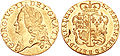
King George II's guinea pieces are a complex issue, with eight obverses and five reverses used through the 33 years of the reign. The coins were produced in all years of the reign except 1742, 1744, 1754, and 1757. The coins weighed 8.3–8.4 g (0.27–0.27 ozt), and were 25–26 mm (0.98–1.02 in) in diameter except for some of the 1727 coins which were 24–25 mm. The average gold purity was 0.9140. Some coins issued between 1729 and 1739 carry the mark EIC under the king's head, to indicate the gold was provided by the East India Company, while some 1745 coins carry the mark LIMA to indicate the gold came from Admiral George Anson's round-the-world voyage. In the early part of the reign the edge of the coin was milled diagonally, but from 1739 following the activities of a particularly bold gang of guinea filers for whom a reward was posted, the milling was changed to produce the shape of a chevron or arrowhead. In 1732 the old hammered gold coinage was demonetised, and it is thought that some of the old coins were melted down to create more guineas.
The obverse has a left-facing bust of the king with the legend GEORGIVS II DEI GRATIA (GEORGIUS II DEI GRA between 1739 and 1743), while the reverse features a single large crowned shield with the quarters containing the arms of England+Scotland, France, Hanover, and Ireland, and the legend M B F ET H REX F D B ET L D S R I A T ET E ("King of Great Britain, France and Ireland, Defender of the Faith, Duke of Brunswick and Lüneburg, Arch-Treasurer and Elector of the Holy Roman Empire").
Unlike the two-guinea and five-guinea coins, production of the guinea continued through much of the long reign of King George III.
George III
[edit]
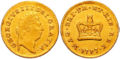
The guineas of King George III weighed 8.4 g (0.27 ozt) and were 25 mm (0.98 in) in diameter, with an average gold purity (at the time of the 1773 assay) of 0.9146 (meaning it contained 7.7 g (0.25 ozt) of gold). They were issued with six different obverses and three reverses in 1761, 1763–79, 1781–99, and 1813. All the obverses show right-facing busts of the king with the legend GEORGIVS III DEI GRATIA with different portraits of the king. The reverse of guineas issued between 1761 and 1786 show a crowned shield bearing the arms of England+Scotland, France, Ireland and Hanover, with the legend M B F ET H REX F D B ET L D S R I A T ET E and the date ("King of Great Britain, France and Ireland, Defender of the Faith, Duke of Brunswick and Lüneburg, Arch-Treasurer and Elector of the Holy Roman Empire"). In 1787 a new design of reverse featuring a spade-shaped shield was introduced, with the same legend; this has become known as the spade guinea.
In 1774 almost 20 million worn guineas of King William III and Queen Anne were melted down and recoined as guineas and half-guineas.
Towards the end of the century gold began to become scarce and rise in value. The French Revolution and the subsequent French Revolutionary Wars had drained gold reserves and people started hoarding coins. Parliament passed a law making banknotes legal tender in any amount, and in 1799 the production of guineas was halted, although half- and third-guineas continued to be struck. Following the Act of Union between Great Britain and Ireland in 1800, the king's titles changed, and an Order in Council of 5 November 1800 directed the Master of the Mint to prepare a new coinage, but although designs were prepared, the production of guineas was not authorised.
Nineteenth century
[edit]
In 1813 it was necessary to strike 80,000 guineas to pay the Duke of Wellington's army in the Pyrenees, as the local people would accept only gold in payment. This issue has become known as the Military Guinea. At this time, gold was still scarce and the guinea was trading on the open market for 27 shillings in paper money, so the coining of this issue for the army's special needs was a poor deal for the government, and this was the last issue of guineas to be minted. The reverse of the military guinea is a unique design, showing a crowned shield within a Garter, with HONI SOIT QUI MAL Y PENSE on the Garter, and BRITANNIARUM REX FIDEI DEFENSOR ("King of the Britains, Defender of the Faith") around the edge, and "1813" between the edge inscription and the garter.
Replacement by the pound
[edit]In the Great Recoinage of 1816, the guinea was replaced by the pound as the major unit of currency and in coinage by the sovereign.
Twentieth century onwards
[edit]After the guinea coin ceased to circulate, the guinea continued in use as a unit of account worth 21 shillings (£1.05 in decimalised currency). The guinea had an aristocratic overtone, so professional fees, and prices of land, horses, art, bespoke tailoring, furniture, white goods and other "luxury" items were often quoted in guineas until a couple of years after decimalisation in 1971.[13] In 2002, Erik Samuelson agreed to be paid the nominal sum of one guinea a year for his role as chief executive of The Dons Trust because "it sounded posher than a pound".[14] Samuelson retired in 2019.[15] The guinea was used in a similar way in Australia until that country converted to decimal currency in 1966, after which it became worth $2.10.
Bids are still made in guineas for the sale of racehorses at auction, at which the purchaser will pay the guinea-equivalent amount but the seller will receive only that number of pounds. The difference (5p in each guinea) is traditionally the auctioneer's commission (which thus, effectively, amounts to 5% on top of the sales price free from commission). Many major horse races in Great Britain, Ireland, Canada, New Zealand and Australia bear names ending in "Guineas", even though the real values of their purses today are much higher than the £1,050 or £2,100 suggested by their names.[b]
Commemorative £2 coin (2013)
[edit]In 2013 the Royal Mint issued a £2 coin to celebrate the 350th anniversary of the minting of the first guinea coin.[16] The new coin was designed by the artist Anthony Smith and features a reworking of the spade guinea from the late 18th century. The edge of the coin contains a quotation from the writer Stephen Kemble: "What is a guinea? 'Tis a splendid thing." This was the first time in the United Kingdom that one coin has been used to celebrate another.[17]
Gallery
[edit]-
 William and Mary
 -
 George I (quarter guinea)
 -
 George II (two guineas)
 -
 George II
 -
 George II (half guinea)
 -
 George III
 -
 George III, "Spade" issue, 1798
 -
 George III (half guinea)
 -
 George III (half guinea)
 -
 George III (third guinea)


See also
[edit]

- Angel (coin), the coin the guinea replaced.
Notes
[edit]- ^ At 2021 prices, the purchasing power of an 1815 guinea is about £83
- ^ for example, the Caulfield Guineas, the 2000 Guineas Stakes, New Zealand 1000 Guineas
References
[edit]- ^ The Oxford Dictionary of Abbreviations. Oxford University Press. 1998. ISBN 0-1928-0003-5.
- ^ a b c Roberts, Chris (2006). Heavy Words Lightly Thrown: The Reason Behind Rhyme. Thorndike Press. ISBN 0-7862-8517-6.
- ^ Chambers, Robert, Domestic Annals of Scotland. Edinburgh: W & R Chambers, 1885. p. 259.
- ^ a b c Chisholm, Hugh, ed. (1911). . Encyclopædia Britannica. Vol. 12 (11th ed.). Cambridge University Press. p. 697.
- ^ Stride, H. G. (1955). "The Gold Coinage of Charles II" (PDF). British Numismatic Journal. 28: 386–393. Archived (PDF) from the original on 2023-04-15. Retrieved 2020-12-24.
- ^ Wikisource:Diary of Samuel Pepys/1667/June
- ^ Chambers, Robert, Domestic Annals of Scotland. Edinburgh: W & R Chambers, 1885. p. 259.
- ^ Margolin, Sam (13 December 2010). "Guineas". In Rice, Kym S.; Katz-Hyman, Martha B. (eds.). World of a Slave: Encyclopedia of the Material Life of Slaves in the United States. ABC-CLIO (published 2010). p. 259. ISBN 9780313349430. Archived from the original on 2024-01-20. Retrieved 2015-02-08.
The coins were named because much of the gold used to produce them came from the Gold or 'Guinea' Coast of West Africa and was provided by the Royal African Company, which had been granted a monopoly of the Africa trade from 1672 until 1698. Coins produced from African gold bore the company's distinctive emblem below the monarch's head: an elephant or elephant and a castellated howdah, an ornate canopied seat used for riding on elephants and camels.
- ^ Wroth, Warwick William (1885–1900). "Croker, John (1670–1741)" in Dictionary of National Biography. Smith, Elder & Co.
- ^ Kindleberger, Charles P. (1993). A financial history of western Europe. Oxford: Oxford University Press. pp. 60–63. ISBN 0-19-507738-5. OCLC 26258644.
- ^ Newton, Isaac, Treasury Papers, vol. ccviii. 43, Mint Office, 21 Sept. 1717 Archived 2017-04-06 at the Wayback Machine
- ^ Frank Whitson Fetter, ed. (2013) [2005]. The Irish Pound, 1797-1826: A Reprint of the Report of the Committee of 1804 of the House of Commons on the Condition of the Irish Currency. Hoboken: Taylor and Francis. ISBN 9781136611070. OCLC 869091365.
- ^ Flood, John A. (1983). Barristers' Clerks: Middlemen of the Law (PDF). Manchester University Press. ISBN 0-7190-0928-6. Archived from the original (PDF) on 2006-05-02. Retrieved 2009-03-01.
- ^ "Resurrection awaits AFC Wimbledon or Luton own in play-off final". The Guardian. 19 May 2011. Retrieved 21 May 2011.
- ^ "Club announcement: Erik Samuelson". AFC Wimbledon. 8 April 2019.
- ^ "Two Pound Coins". Royal Mint. Archived from the original on 11 November 2020. Retrieved 31 October 2016.
- ^ "The 350th Anniversary of the Guinea 2013". Royal Mint. Archived from the original on 6 September 2017. Retrieved 31 October 2016.
External links
[edit]
- "Guinea, Coin Type from United Kingdom". Online Coin Club. Archived from the original on 5 June 2023. Retrieved 30 May 2022.
Guinea (coin)
View on GrokipediaOrigins and Etymology
Introduction and Naming
The guinea was a gold coin minted in Great Britain from 1663 to 1816, initially valued at 20 shillings (one pound sterling) and later adjusted to 21 shillings amid fluctuations in gold prices.[8][9] Introduced during the reign of Charles II, it marked one of the earliest instances of machine-struck gold coinage in England, produced at the Tower Mint using imported bullion to facilitate international trade.[8] The coin weighed approximately 8.4 grams, composed of 22-carat gold, and circulated widely in commerce, including payments for slaves, commodities, and professional fees such as those for physicians and lawyers.[1][10] The name "guinea" originated from the Guinea Coast of West Africa, the chief provenance of the gold bullion used in the coin's production, which was procured by the Royal African Company chartered in 1660.[11] This African gold, often stamped with an elephant trademark by the Company to denote its origin, comprised a significant portion of early guinea issues, distinguishing them from coins made with European-sourced metal marked by anchors or plumes.[11][12] The designation reflected the coin's ties to transatlantic trade networks, where gold from Guinea facilitated England's mercantile expansion, though the term itself echoed broader European nomenclature for the region dating to Portuguese explorations in the 15th century.[13][10] Although the guinea's intrinsic value derived from its gold content, its nominal rating was proclaimed legal tender on 27 March 1663, shortly after the first strikes on 6 February, establishing it as a stable yet flexible medium in an era of recoinage and metallic scarcity.[14] This naming convention persisted through subsequent monarchs, even as gold sources diversified, underscoring the coin's enduring association with its inaugural African provenance.Initial Minting in 1663
The guinea coin was first struck at the Royal Mint in London on 6 February 1663 during the reign of King Charles II, marking the introduction of Britain's first machine-milled gold coinage.[15] [16] This innovation stemmed from Charles II's exposure to advanced minting techniques in the Netherlands during his exile, prompting the adoption of screw presses and collar dies to produce uniform, edge-marked coins resistant to clipping and counterfeiting, supplanting traditional hammered methods.[14] [17] The coin's name derived from the Guinea Coast of West Africa, the primary source of the gold bullion used, imported via the newly chartered Royal African Company established on 10 January 1663 to facilitate trade in gold, ivory, and enslaved persons.[14] [18] The gold, typically 22-carat fine (11/12 purity), weighed approximately 129.4 grains (8.387 grams) per guinea, with one troy pound yielding about 44.5 such coins, each containing roughly one-quarter ounce of pure gold.[15] Early issues often bore an elephant mark beneath the bust to denote African-sourced metal, reflecting the direct causal link between colonial extraction and domestic currency reform.[19] A royal proclamation on 27 March 1663 established the guinea as legal tender valued at 20 shillings, equivalent to one pound sterling, intended to stabilize trade amid post-Civil War economic recovery and rising gold inflows.[3] The obverse featured a laureate bust of Charles II facing right, inscribed "CAROLVS II DEI GRATIA," while the reverse displayed cruciform shields of England and Scotland with the motto "MAG BR FRA ET HIB REX," designed by chief engraver John Roettiers to evoke Stuart legitimacy and imperial dominion.[20] These initial mintings addressed the scarcity of reliable gold currency, leveraging African gold to bolster England's mercantile position without reliance on debased silver coinage.[21]Physical Characteristics
Specifications and Composition
The guinea coin was struck in 22-carat gold, an alloy comprising 91.67% pure gold (22 parts in 24) with the balance primarily copper to enhance durability and prevent excessive wear.[5][4] This standard fineness was established under the gold standard practices of the Restoration period and remained consistent through the coin's production from 1663 to 1813, yielding an actual fine gold content of approximately 7.66 grams (0.246 troy ounces) per guinea.[5][2] The alloy's composition ensured the coin's intrinsic value closely tracked gold market fluctuations while maintaining legal tender status equivalent to 44½ guineas per troy pound of fine gold.[2] The standard weight was fixed at 8.35 grams (129.4 grains), with a diameter of 25 to 26 millimeters, though early issues from 1663 to circa 1717 weighed slightly less at around 8.3 grams due to initial minting variations and adjustments to gold supply.[5][22] Post-1717 stabilization aligned the weight precisely to support the guinea's fixed nominal value of 21 shillings, with the edge featuring diagonal milling to deter clipping and counterfeiting.[23] No significant compositional changes occurred over the guinea's run, unlike contemporaneous silver coinage, as the gold alloy's purity was upheld by royal assays and parliamentary acts to preserve trust in the currency.[2]Designs and Markings
The obverse designs of guinea coins featured a detailed portrait of the reigning monarch, typically laureate or draped, facing right for male rulers and left for Queen Anne, with surrounding Latin inscriptions such as "CAROLVS II DEI GRATIA" for Charles II (1660–1685), denoting divine grace and royal authority.[24] These portraits, often engraved by John Roettier for early issues, transitioned to later styles like the fifth laureate head for George III (1760–1820).[25] Reverse designs predominantly showcased heraldic elements, including crowned cruciform shields emblematic of England and Scotland (combined post-1707 Union), France, and Ireland, arranged around a central motif like interlinked monogram letters under Charles II or a Garter star under George I (1714–1727).[26] [27] Under George II (1727–1760), the reverse evolved to a single ornate crowned shield quartered with the royal arms, including Hanoverian elements.[28] George III's guineas from 1787 onward adopted a distinctive spade-shaped composite shield on the reverse, earning the colloquial "spade guinea" designation due to its broad, implement-like outline.[25] Privy marks distinguished gold provenance, with an elephant—symbolizing imports from West Africa via the Royal African Company—appearing below the obverse bust on guineas from Charles II through James II (1685–1688) and sporadically to Anne (1702–1714), sometimes accompanied by a castle atop the elephant to denote specific shipments.[29] [12] Rose marks below the bust signified alternative gold sources, such as from the East India Company or recoinages, appearing on issues under William III (1689–1702) and successors.[5] These markings ensured traceability amid diverse bullion origins, reflecting the coin's ties to African trade.[16]Denominations and Variants
Standard and Fractional Guineas
The standard guinea was the principal denomination of this gold coin series, minted continuously from 1663 under Charles II until 1813.[1] It consisted of 22-carat gold weighing 8.35 grams, with a fine gold content of approximately 7.66 grams (0.246 troy ounces).[30] Initially valued at 20 shillings, its official rating was raised to 21 shillings in 1717 upon Britain's adoption of the gold standard, reflecting the premium on gold over silver.[9] This value remained stable thereafter, making the guinea equivalent to £1 1s.[31] Fractional guineas were produced in half, quarter, and third denominations to facilitate smaller transactions while maintaining the gold standard's integrity. The half guinea, introduced in 1669, mirrored the standard coin's design but halved in weight to about 4.18 grams and value to 10 shillings 6 pence; it was minted sporadically across reigns up to George III in 1813.[3] The quarter guinea, a short-lived variant weighing roughly 2.09 grams and valued at 5 shillings 3 pence, appeared only in 1718 under George I—at the suggestion of Sir Isaac Newton to align with the silver crown—and again in 1762 under George III.[32][33] The third guinea, unique to George III's reign from 1797 to 1813, weighed approximately 2.83 grams with a value of 7 shillings; it was struck at 133.5 coins per troy pound of gold to meet demand for mid-range gold currency.[34]| Denomination | Minting Periods | Approximate Weight (g) | Nominal Value (shillings) |
|---|---|---|---|
| Guinea | 1663–1813 | 8.35 | 21 |
| Half Guinea | 1669–1813 (intermittent) | 4.18 | 10.5 |
| Quarter Guinea | 1718, 1762 | 2.09 | 5.25 |
| Third Guinea | 1797–1813 | 2.83 | 7 |
Rarity and Collectibility
The rarity of guinea coins varies significantly by reign, date, and variety, with survival rates influenced by circulation wear, melting for bullion, and historical hoarding. Early issues from Charles II's reign (1663–1684) benefited from higher mintages to establish the gold coinage, making them relatively more available today, though uncirculated examples remain scarce due to over 350 years of potential attrition. James II guineas (1685–1688) are notably rarer owing to the short reign and political instability, with few surviving in high grades; for instance, a 1686 variety featuring the elephant and castle mark commands premiums in numismatic markets.[35][36] Queen Anne guineas (1702–1714), particularly the "Vigo" issues struck from gold captured at the Battle of Vigo Bay in 1702, represent exceptional rarity; the five-guinea counterpart is among Britain's rarest coins, with limited production and high collector demand driving values into tens of thousands of pounds for choice specimens. Half-guinea Vigo varieties are even scarcer, with only three certified examples by major grading services like NGC or PCGS, none in mint state. George III issues (1761–1813), while more plentiful overall due to sustained minting, include rare subtypes such as the 1813 "military" guinea, with mintage estimates ranging from 80,000 to 361,473 but low survival in fine condition. "Spade" guineas from 1798, named for their shield shape, are collectible for design appeal but not inherently rare.[37][38][39] Collectibility stems from the guineas' historical role in British commerce, intrinsic gold value (approximately 0.246 troy ounces of 22-carat gold), and variety of obverse/reverse designs, including early trademarks like the elephant (indicating African gold sourcing) and later anchors or roses. Numismatic premiums escalate with condition, as graded by services like PCGS or NGC; a George III 1798 guinea in MS64 fetched $2,520 at auction in 2020, while common circulated examples trade near melt value around $1,000–$1,500 depending on spot gold prices. Rare proofs and patterns, such as quarter-guineas under George I, appeal to specialists, often realizing £5,000 or more. Fractional denominations like thirds and halves enhance appeal for type collectors, though low mintages for some (e.g., George III third guineas) amplify scarcity. Overall, guineas attract investors balancing bullion stability with numismatic upside, with auction houses like Heritage reporting consistent demand for verified rarities.[30][40][35]Economic Role and Valuation
Fluctuations in Value
The guinea coin, introduced in 1663 during the reign of Charles II, was initially assigned a nominal value of 20 shillings, equivalent to one pound sterling, based on its gold content and the prevailing bimetallic standard tying gold to silver coinage.[5] However, market forces quickly caused deviations, as the coin's intrinsic gold value—derived from African imports and weighing approximately 8.4 grams at 22-carat fineness—often exceeded its face value amid fluctuations in gold supply and the deteriorating condition of silver coins.[31] By the late 1660s, rising gold inflows from trade elevated its trading premium, with values occasionally reaching 22-24 shillings in transactions.[5] These variations intensified in the 1690s during the Nine Years' War, when clipped and worn silver shillings circulated at reduced weight, driving demand for reliable gold alternatives like the guinea.[5] By June 1695, under William III, the guinea's market value had surged to as high as 30 shillings, reflecting a de facto revaluation prompted by silver scarcity and gold's relative abundance from Guinea coastal trade.[5] [31] Government proclamations attempted periodic adjustments, such as reducing it to 22 shillings in 1696, but enforcement proved challenging amid wartime finance and bullion hoarding, leading to persistent volatility until the early 18th century.[5] Stabilization occurred in 1717 under George I, when Master of the Mint Isaac Newton recalibrated the gold-silver ratio to 21:1, fixing the guinea's official value at 21 shillings to align with empirical assays of metal contents and curb arbitrage.[41] This adjustment, informed by increased gold production and Newton's advocacy for a gold-based standard, minimized further nominal swings, though the guinea retained a slight premium in professional fees (e.g., auctions, horse sales) due to custom rather than market dictate.[41] From 1717 to its discontinuation in 1814, the value held steady at 21 shillings nominally, but real purchasing power eroded with broader inflation from Napoleonic Wars and colonial trade expansions, dropping its effective worth to under 10 shillings in constant terms by 1813.[31] Such shifts underscored the guinea's role as a barometer for bimetallic tensions, ultimately contributing to the 1816 sovereign's adoption under a pure gold standard.[41]Contribution to the Gold Standard
The guinea coin facilitated Britain's transition to a de facto gold standard through its 1717 revaluation by Sir Isaac Newton, Master of the Royal Mint. Initially minted in 1663 at a value of 20 shillings using gold imported from West Africa, the guinea's worth had risen amid increased gold supplies and market fluctuations under the prevailing bimetallic system. Newton adjusted its official value to 21 shillings to align with prevailing exchange rates, thereby overvaluing gold relative to silver.[42][43] This valuation shift encouraged the retention and circulation of gold guineas while prompting the export or melting of silver coins, as arbitrageurs exploited the disparity in official versus market ratios. With the guinea standardized at 22-carat crown gold, the policy effectively pegged the pound sterling to gold, rendering silver subsidiary and establishing gold as the dominant monetary base by the early 18th century.[44][42] The mechanism stabilized domestic currency without formal legislation, influencing international trade by favoring gold inflows and setting a precedent for the 1819 legislative commitment to gold convertibility.[43] The guinea's role persisted until the 1816 Great Recoinage, when it was supplanted by the sovereign coin fixed at 20 shillings with a precise gold content equivalent to 95% of the guinea's, formalizing the standard on the earlier foundation. This evolution underscored the guinea's practical contribution in resolving bimetallism's instabilities through empirical adjustment rather than theoretical fiat.[44][42]Historical Usage
Seventeenth Century Developments
The guinea coin was introduced in December 1663 during the reign of Charles II, marking the first machine-milled gold coin produced by the Royal Mint, with a standard weight of 129.4 grains (approximately 8.39 grams) of 22-carat gold and an initial nominal value of 20 shillings.[14] This innovation replaced hammered coinage, reducing counterfeiting and clipping while facilitating smoother trade, particularly overseas transactions linked to gold imports from the Guinea region of West Africa via the Royal African Company, which supplied the raw material and inspired the coin's name and its distinctive elephant symbol beneath the monarch's bust.[8][18] Minting continued uninterrupted under James II from 1685 to 1688, with designs featuring the king's laureate bust on the obverse and crowned shields on the reverse, though production volumes were lower due to political instability culminating in the Glorious Revolution.[45] The coin's market value began diverging from its face value amid rising gold scarcity; by the early years of James II's reign, guineas traded at nearly 30 shillings, reflecting premiums driven by international gold price dynamics and domestic monetary pressures rather than debasement.[46] Following the accession of William III and Mary II in 1689, guineas incorporated joint conjoined busts of the monarchs—the only instance of dual sovereign portraits on English gold coinage—while maintaining the elephant mark on select issues tied to African gold provenance.[47] Value fluctuations intensified in the 1690s, with guineas appreciating by up to 35% in mere months during 1695 amid wartime demands and clipped silver coin recoinage strains, underscoring the guinea's role as a de facto gold standard precursor amid sterling's silver-based instability.[3] These developments cemented the guinea's utility in high-value commerce, though its variable worth complicated fixed-price accounting until later stabilizations.[16]Eighteenth Century Circulation
Following the issuance of a royal proclamation in December 1717 by Isaac Newton, then Master of the Royal Mint, the guinea's value was officially fixed at 21 shillings, establishing it as legal tender at that rate throughout the eighteenth century.[9] This stabilization addressed prior fluctuations driven by gold inflows from trade and mining, which had previously elevated its market value above the nominal 20 shillings.[48] Thereafter, guineas circulated reliably in British domestic transactions, serving as the principal gold coin for payments exceeding the capacity of depreciated silver currency.[49] Guineas were minted extensively under monarchs from William III to George III, with production encompassing the standard guinea alongside fractional denominations such as halves, quarters, and multiples up to five guineas.[28] Large-scale issuances supported growing economic activity, including the industrial expansion and imperial trade, where guineas facilitated high-value exchanges due to their gold content of approximately 129.4 grains at 22 carats fine.[4] By the mid-century, under George II, the coin's design evolved to include advanced portraiture and symbols of sovereignty, enhancing its recognition and trust in circulation.[28] In everyday and commercial use, guineas predominated over silver in professional fees, auctions, and international dealings, reflecting gold's premium as a store of value amid silver shortages.[50] Their stability post-1717 contributed to monetary consistency, though wear and occasional foreign gold imports necessitated periodic recoinages; nonetheless, they remained integral to Britain's bimetallic system until the early nineteenth century.[51] Late eighteenth-century issues under George III, including the distinctive "spade" series from 1798, continued this role amid wartime demands, underscoring the guinea's enduring utility in a expanding economy.[3]Nineteenth Century Decline
The guinea's production dwindled in the early nineteenth century amid Britain's wartime exigencies and monetary reforms. Minting ceased after 1813, when a limited issue of approximately 20,000 "military" guineas was struck exclusively to finance the Peninsular War, utilizing scarce gold supplies at a time when the metal's premium value made routine coining unprofitable for the Treasury.[52][53] These final coins bore no marks distinguishing them from prior issues but reflected the guinea's entrenched role in high-value military payments, though their output was minimal compared to earlier peaks of millions annually in the eighteenth century.[5] The Great Recoinage of 1816 formalized the guinea's obsolescence by demonetizing it in favor of the sovereign, a new gold coin fixed at exactly 20 shillings (£1) and containing 7.322 grams of fine gold, aligning Britain's currency with a precise gold standard.[1][41] This shift addressed the guinea's longstanding inconvenience—its valuation at 21 shillings had originated from seventeenth-century gold premiums but persisted as an anomaly, complicating arithmetic in an economy increasingly oriented toward decimal-like precision and international trade stability.[54] Sovereigns began circulating in 1817, rapidly supplanting guineas as the standard gold unit, with the latter's irregular weight and value rendering them unsuitable for the post-Napoleonic era's emphasis on fixed convertibility.[6] Circulation of existing guineas declined thereafter, as wear, melting for bullion, and exchange for sovereigns eroded their prevalence; by mid-century, they were largely confined to niche professional fees (e.g., physicians and auctioneers quoting in guineas to embed a customary premium) rather than general commerce.[5][41] The coin's physical form thus faded, though its nominal value endured as an accounting unit until decimalization in 1971, underscoring a transition from tangible currency to symbolic retainer in elite transactions.[54] This decline mirrored broader numismatic rationalization, prioritizing uniformity over the guinea's historical flexibility tied to gold market fluctuations.[6]Trade Associations and Controversies
Links to African Trade
The guinea coin acquired its name from the Guinea region along the West African coast, the origin of much of the gold dust used in its production following the first minting in 1663.[12] British merchants, operating through chartered companies, imported this gold primarily from areas encompassing modern-day Guinea, Sierra Leone, and Ghana, where alluvial deposits yielded high-purity metal traded for European goods like cloth, metalware, and firearms.[21] The Royal African Company, established in 1660 with a monopoly on English trade south of the Sahara, dominated these exchanges, shipping an estimated 100,000 ounces of gold annually by the late seventeenth century to fuel coinage at the Royal Mint.[55] Early guineas under Charles II and subsequent reigns frequently featured the "elephant" mark—a stylized elephant and castle emblem of the Royal African Company—indicating coins struck from African-sourced bullion rather than recycled or domestic gold.[56] This practice persisted into the 1680s, with issues like the 1686 James II guinea exemplifying the direct tie between West African extraction and British monetary expansion; the mark assured merchants of the coin's fine gold content, approximately 91% pure and weighing 8.4 grams.[12] By linking coinage to transatlantic commerce, guineas facilitated payments in international trade, their value stabilizing around 21 shillings due to the consistent influx of African gold that offset domestic silver shortages.[21] The reliance on West African gold underscored causal dependencies in early modern economics: disruptions in coastal trade, such as conflicts with Dutch competitors or local Ashanti expansions, periodically strained supplies, influencing guinea valuations and prompting mint adjustments.[57] Historical records from company ledgers confirm that between 1672 and 1698, the company alone imported over 2.3 million ounces of gold, forming the backbone of guinea circulation and Britain's gold reserves.[58] This trade network not only denominated the coin but embedded African resource flows into the fabric of English fiscal policy, enabling the shift from hammered to milled coinage for greater uniformity.[1]Involvement in Slave Trade
The gold used to mint guinea coins was sourced predominantly from the West African Guinea coast, the origin of the coin's name, with imports facilitated by the Royal African Company (RAC) from 1672 onward.[12] The RAC, granted a monopoly on English trade to West Africa by Charles II, imported gold dust alongside enslaved Africans, ivory, and other goods; the company's activities intertwined gold procurement with the slave trade, as African suppliers often exchanged captives for European manufactures obtained via slaving voyages.[59] Historians estimate the RAC transported over 100,000 enslaved people to the Americas between 1672 and 1731, more than any single contemporaneous entity, with gold imports bearing the company's elephant trademark before refining and minting.[59] This dual trade secured both the raw material for guineas—approximately one-quarter ounce of gold per coin—and the profits that underpinned their economic role.[55] Early guinea issues, particularly under James II from 1685 to 1688, incorporated the RAC's elephant and castle logo beneath the king's effigy, directly emblemizing the coin's ties to the company's African operations, which included slave shipments to English colonies.[12] The RAC's monopoly ended in 1698 amid competition and scandals over slave trading practices, but guinea production continued using African gold amid the broader Atlantic system, where slave labor generated commodities like sugar that cycled back to fund further imports. While guineas themselves were not primary barter items for slaves in Africa—where textiles, guns, and iron predominated—their high value (initially 20 shillings, rising to 21 by 1717) made them a key currency in colonial auctions and plantation economies reliant on enslaved labor, equivalent to about 4.67 Spanish dollars in late-18th-century America.[50][60] The guinea's linkage to slavery reflects causal realities of mercantilist extraction: African gold fields, often controlled by kingdoms engaging in captive raids amplified by European demand, supplied mints while slaves fueled downstream profitability, though direct coin-for-slave exchanges in Africa were rare due to gold's export orientation.[61] This association persisted culturally, with "guineaman" denoting slave ships by the 18th century, underscoring the coin's embedded role in the triangular trade's imbalances.[62]Legacy and Modern References
Replacement and Cultural Persistence
The guinea coin was demonetized and ceased production as part of the Great Recoinage of 1816, which standardized British gold coinage around the sovereign valued at exactly one pound sterling (20 shillings), containing 7.98805 grams of gold compared to the guinea's traditional 21-shilling valuation and slightly higher gold content of 8.348 grams.[1][5] The final guineas were minted in 1813 under George III, after which the Royal Mint shifted to sovereigns, first issued in 1817, to align currency more closely with the emerging gold standard and eliminate the guinea's fluctuating premium over the pound.[63][64] Despite its physical replacement, the guinea endured as a notional unit of account equivalent to 21 shillings (£1.05 in post-1971 decimal currency), retaining prestige in transactions involving luxury goods, professional services, and elite markets due to its historical association with high-status dealings.[41][5] This persistence stemmed from the guinea's role as a "gentleman's currency," often used for fees charged by physicians, lawyers, and architects, as well as for pricing art, estates, and livestock, where the extra shilling premium symbolized quality or exclusivity.[41][9] In equestrian and auction contexts, the guinea's legacy proved most resilient, particularly in the sale of Thoroughbred racehorses, where bids and prices are conventionally quoted in guineas at major bloodstock auctions like those at Tattersalls or Newmarket.[65] This practice, dating back to the 18th century when guineas facilitated trade in high-value animals, allows the auction house to retain the 5% differential (one shilling per guinea) as commission, with buyers remitting £1.05 per guinea while sellers receive £1.[66] The tradition continues unabated in modern British horse racing, even after decimalization in 1971 rendered pre-decimal units obsolete for everyday use, underscoring the guinea's embedded role in preserving auction economics and cultural norms within the industry.[41][65] Similar conventions occasionally appear in fine art and antique sales, though less ubiquitously, reflecting the guinea's adaptation from coin to symbolic pricing standard.[41]Commemorative Issues Post-1813
Following the discontinuation of the guinea as a circulating coin in 1813, no further official issues were produced by the Royal Mint or British government mints. However, private and commemorative producers revived the guinea design for collector and bullion purposes in the 21st century, primarily through the modern East India Company, a branding entity distinct from the historical corporation dissolved in 1874. These issues replicate the historical guinea's specifications, including approximately 8.3 grams of 22-carat gold and designs inspired by 17th- and 18th-century prototypes, but serve no circulating role and carry nominal legal tender status in territories such as Saint Helena.[67] In 2016, the East India Company released a five-coin commemorative gold guinea set marking the approximate 200th anniversary of the guinea's replacement by the sovereign during the Great Recoinage of 1816. Each coin featured reverse designs drawn from historic guineas of Charles II, William III, Queen Anne, George I, and George II, struck to proof quality with limited mintages ranging from 200 to 999 pieces per variety. These were marketed as evoking the East India Company's historical use of guineas in trade, though produced by modern minting facilities rather than official British ones.[67][68] Subsequent series expanded on this theme. The 2020 three-coin proof set commemorated the 200th anniversary of King George III's death in 1820, incorporating military-style portraits akin to the 1813 issue and shield reverses, with mintages of 199 pieces per coin. By 2023, a standalone gold proof guinea was issued, emphasizing the coin's legacy in international trade and featuring updated engravings of Charles II-era motifs, limited to 299 examples. These modern guineas maintain the historical valuation nomenclature of 21 shillings but trade primarily as gold bullion, with premiums reflecting collector demand rather than face value.[69][70]| Year | Issue Description | Key Features | Mintage |
|---|---|---|---|
| 2016 | 200th Anniversary of Guinea Era End (5-coin set) | Historic reverse designs (Charles II to George II); proof finish | 200–999 per variety[67] |
| 2020 | George III Bicentenary (3-coin set) | Military portrait and shield motifs; proof | 199 per coin[69] |
| 2023 | Legacy Trade Guinea | Charles II-inspired engravings; proof | 299[70] |