


Community hub
Recent from talks
Contribute something
Nothing was collected or created yet.
Siddhasana
View on Wikipedia

Siddhasana (Sanskrit: सिद्धासन; IAST: siddhāsana) or Accomplished Pose is an ancient seated asana in hatha yoga and modern yoga as exercise suitable for meditation.[1] The names Muktasana (Sanskrit: मुक्तासन, Liberated Pose) and Burmese position are sometimes given to the same pose, sometimes to an easier variant, Ardha Siddhasana. Svastikasana has each foot tucked as snugly as possible into the fold of the opposite knee.
Siddhasana is one of the oldest asanas. It is described as a meditation seat in the early Hatha Yoga text, the 10th century Goraksha Sataka. This states that Siddhasana ranks alongside Padmasana (lotus position) as the most important of the asanas, opening the way to liberation. The 15th-century Hatha Yoga Pradipika similarly suggests that all other asanas are unnecessary once Siddhasana has been mastered.
Etymology
[edit]
.jpg)
The name comes from the Sanskrit words siddha (सिद्ध) meaning both "perfect" and "adept",[2] and āsana (आसन) meaning "posture" or "seat".[3] The name Muktasana comes from मुक्त mukta meaning "liberation".[4][5] Ann Swanson writes that the pose is called accomplished as it was the goal of all other asanas to ready the body to sit in meditation in this way.[6]
The name Svastikasana is from the Sanskrit svastika (स्वस्तिक) meaning "auspicious". The posture is described in the eighth century Pātañjalayogaśāstravivaraṇa and in the tenth century Vimānārcanākalpa, where it is a meditation seat.[7]
History
[edit]Medieval
[edit]Siddhasana is one of the oldest asanas, being described as a meditation seat in the 10th century Goraksha Sataka 1.10-12. It states that along with lotus position, Siddhasana is the most important of the asanas (1.10), breaking open the door of liberation (1.11).[8]
The 15th century Hatha Yoga Pradipika 1.37–45 praises the asana, implying it is the only one that practitioners would need, asking "When Siddhasana is mastered, of what use are the various other postures?"[8] It describes Siddhasana as "the opener of the door of salvation" and "the chief of all asanas", explaining that this is because the posture "cleanses the impurities of 72,000 nadis", channels of the subtle body.[9]
The 17th century Gheranda Samhita 2.7 states in terms similar to the earlier texts that "the practitioner who has subdued his passions, having placed one heel at the anal aperture should keep the other heel on the root of the generative organ; afterwards he should rest his chin upon the chest, and being quiet and straight, gaze at the spot between the two eyebrows. This is called the Siddhasana which leads to emancipation".[9]
Modern
[edit]Siddhasana is traditionally used for dhyana (meditation) and pranayama (breath exercises).[10][11] The early Western student of Hatha Yoga, Theos Bernard, wrote that he practised the meditation asanas after the others (that he called the reconditioning asanas) so as to gain the flexibility to do them easily. He stated that he used only Padmasana (lotus position) and Siddhasana.[9]
In his 1966 book Light on Yoga, B. K. S. Iyengar quotes several scriptures, stating that the yogin who contemplates Atman and practises Siddhasana for 12 years obtains the yoga siddhis, supernatural powers; and that once the pose is mastered, samadhi follows "without effort".[10] In the Yoga Sutras of Patañjali, Edwin F. Bryant quotes Śaṅkara's verse, among others from a survey of scriptures and commentaries, stating that mastery of postures does not produce the goals of yoga; only getting rid of the Kleshas obstacle to yoga, and samadhi, undeviated absorption on the object of meditation, can produce the goals of yoga.[12]
Description
[edit]From a seated position, one heel is brought to press on the perineum with the sole of the foot flat against the inner thigh. The body sits on top of this heel. Adjustments are made until the body is comfortable and the pressure is firmly applied. Then the opposite ankle is placed over the first, so the ankle bones are touching and the heels are above one another with the top heel pressing the pubis directly above the genitals. The genitals will then lie in between the two heels. The toes and outer edge of the top foot are pushed down into the space between the calf and thigh muscles. The toes of the bottom foot are pulled up into the similar space on the opposite side. The spine is held erect. A small meditation cushion or zafu is sometimes used to help align the back vertically.[13] The same pose for women is sometimes called Siddha Yoni Asana.[13]
Variations
[edit]Muktasana, Liberation Pose, is either exactly the same as Siddhasana, as stated in the 15th century Hatha Yoga Pradipika, or a variant with the feet close in to the perineum but resting on the ground, that is, left foot touches the perineum, and the right foot is close to the left foot, but resting on the ground.[5] This variant is sometimes called Ardha Siddhasana (Sanskrit अर्ध ardha, half), and much easier for beginners.[14] Both variants are sometimes called Burmese position when used for meditation.[15][16]
Svastikasana has each foot tucked as snugly as possible into the fold of the opposite knee.[17]
Sukhasana, Easy Pose, has the legs crossed at mid-calf. The pose can be supported by sitting on a cushion.[6]
-
 Svastikasana in the 19th century Jogapradipika
 -
 Muktasana, easier variant with feet on ground, useful for meditation
 -
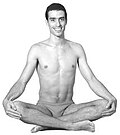 Sukhasana, easy pose


See also
[edit]References
[edit]- ^ "Witold Fitz-Simon - Siddhasana (Accomplished Pose)". Archived from the original on September 22, 2008. Retrieved 4 July 2011.
- ^ Feuerstein, Georg; Payne, Larry (5 April 2010). Yoga For Dummies. For Dummies. p. 92. ISBN 978-0-470-50202-0.
- ^ Sinha, S. C. (1 June 1996). Dictionary of Philosophy. Anmol Publications. p. 18. ISBN 978-81-7041-293-9.
- ^ "Pavana Muktasana". The Yoga Tutor. Retrieved 23 November 2018.
- ^ a b "Muktasana". Yogapedia. Retrieved 23 November 2018.
- ^ a b Swanson, Ann (2019). Science of yoga : understand the anatomy and physiology to perfect your practice. DK Publishing. p. 46. ISBN 978-1-4654-7935-8. OCLC 1030608283.
- ^ Mallinson, James; Singleton, Mark (2017). Roots of Yoga. Penguin Books. pp. 97–98, 100–101. ISBN 978-0-241-25304-5. OCLC 928480104.
- ^ a b Feuerstein, Georg (22 March 2011). The Path of Yoga: An Essential Guide to Its Principles and Practices. Shambhala Publications. p. 63. ISBN 978-1-59030-883-7.
- ^ a b c Bernard, Theos (2007) [1944]. Hatha Yoga: The Report of A Personal Experience. Harmony. pp. 25–26. ISBN 978-0-9552412-2-2. OCLC 230987898.
- ^ a b Iyengar, B. K. S. (1979) [1966]. Light on Yoga. Thorsons. pp. 116–120.
- ^ Upadhyaya, Rajnikant; Sharma, Gopal (1 January 2006). Awake Kundalini. Lotus Press. p. 54. ISBN 978-81-8382-039-4.
- ^ Bryant, Edwin F. (2009). The Yoga sūtras of Patañjali : a new edition, translation, and commentary with insights from the traditional commentators (First ed.). North Point Press. pp. Ch 2, Verse 46 (Patañjali II.46) referenced commentary. ISBN 978-0-86547-736-0. OCLC 243544645.
- ^ a b Swami Satyananda Saraswati (1996). Asana Pranayama Mudra Bandha (PDF). Yoga Publications Trust. pp. 100, 102. ISBN 978-81-86336-14-4.
- ^ Maehle, Gregor (2011). Ashtanga Yoga: Practice and Philosophy. New World Library. p. 57. ISBN 978-1-57731-986-3.
- ^ Reninger, Elizabeth (2015). Meditation Now: A Beginner's Guide: 10-Minute Meditations to Restore Calm and Joy Anytime, Anywhere. Callisto Media. ISBN 978-1623154981.
- ^ Powers, Sarah (2020). Insight Yoga: An Innovative Synthesis of Traditional Yoga, Meditation, and Eastern Approaches to Healing and Well-Being. Shambhala Publications. ISBN 978-0834822429.
- ^ Sivananda, Swami. Yoga Asanas. ASIN 8170520088.
_from_Jogapradipika_1830_(cropped).jpg)
| Topics |
|  | |||||||||||
|---|---|---|---|---|---|---|---|---|---|---|---|---|---|
| History |
| ||||||||||||
| Schools (Gurus) |
| ||||||||||||
| Related | |||||||||||||
| Subtle body |  | |
|---|---|---|
| Texts (Asanas) |
| |
| Mudras | ||
| Shatkarmas | ||
| Pranayama | ||
| Related | ||
Siddhasana
View on GrokipediaEtymology
Name Derivation
The name Siddhasana derives from two Sanskrit terms: siddha and āsana. The word siddha translates to "accomplished," "perfected," or "adept," originating from the verbal root sidh, which means "to achieve," "to succeed," or "to accomplish."[3] This root underscores a state of mastery or fulfillment, often associated with spiritual or yogic attainment. Meanwhile, āsana means "pose," "posture," or "seat," derived from the root ās, signifying "to sit" or "to remain steady," particularly in the context of a stable position for meditation.[4] In the linguistic framework of yoga texts, Siddhasana thus symbolizes the seated posture of one who has achieved spiritual accomplishment, embodying steadiness and inner perfection conducive to meditative practice.[5] The term is transliterated in the International Alphabet of Sanskrit Transliteration (IAST) as siddhāsana and pronounced approximately as /sɪd̪ˈɦɑːsɑːnɑ/ in phonetic notation, with emphasis on the long vowels and aspirated consonants typical of Sanskrit phonology.Alternative Terms
Siddhasana is commonly translated into English as the Accomplished Pose, reflecting its association with the posture of a realized or perfected yogi in meditative practice. It is also known as the Adept's Pose, highlighting the mastery and spiritual accomplishment it facilitates for advanced practitioners. Another English rendering is the Perfect Pose, drawing from the Sanskrit root "siddha," which denotes perfection or attainment. In some yoga traditions, Siddhasana overlaps with or is alternatively termed Muktasana, meaning the Liberated Pose. In the Hatha Yoga Pradipika, Siddhasana is described as the same as Muktasana, though some modern interpretations distinguish Muktasana as a simpler cross-legged variation without the specific perineal pressure.[6] For female practitioners, the pose is adapted and named Siddha Yoni Asana, where "yoni" signifies the sacred space or womb, emphasizing its role in balancing feminine energies and pelvic alignment during meditation.[7] This gender-specific variation maintains the core meditative benefits while accommodating anatomical differences.[8]History
Early and Medieval References
The earliest known reference to Siddhasana appears in the 11th–12th-century Goraksha Shataka, a foundational text of the Nath tradition attributed to Gorakshanath, where it is described in verses 1.10-12 as a primary meditation posture that "opens the door of release" and is deemed the perfect asana (siddhasana) for stabilizing the body and mind during yogic practice.[9] This text positions Siddhasana alongside a limited set of asanas, emphasizing its role in facilitating pranayama and inner focus essential for spiritual progress.[9][10] By the 15th century, the Hatha Yoga Pradipika, composed by Swami Svatmarama, elaborates on Siddhasana in verses 1.35-1.37 as one of the four key asanas among the eighty-four enumerated, highlighting its efficacy in controlling prana (vital energy) and destroying the "knots" of karma, disease, and mortality.[11] The text praises it as supreme, stating that mastery of Siddhasana alone suffices for the yogi, enabling the upward flow of energy through the subtle body and leading to liberation (moksha).[11] The 17th-century Gheranda Samhita provides a detailed instruction in verse 2.7, portraying Siddhasana as a posture that presses the perineum to awaken kundalini energy, with the practitioner maintaining a steady gaze between the eyebrows to achieve steadiness and sense control, ultimately "breaking open the door to liberation."[12] Similarly, the Shiva Samhita (verse 3.85) describes it as a foundational seated asana for hatha yoga, where one heel presses the perineum and the other rests on the thigh, supporting breath retention and meditation to refine the body's subtle energies.[13][14] Siddhasana's prominence in these texts underscores its deep ties to the Nath yogis, a medieval Shaiva sect founded by figures like Gorakshanath, who revered it as the favored seat of the siddhas—accomplished beings attaining supernatural powers (siddhis) through hatha practices.[15] In tantric traditions, particularly within alchemical yoga (rasayana) as outlined in the Shiva Samhita, the pose facilitates the transmutation of bodily essences, akin to internal alchemy, by directing prana to awaken dormant energies and purify the nadis (channels), aligning with the Nath pursuit of immortality and enlightenment.[13]Modern Adoption
The revival of Siddhasana in modern yoga began in the early 20th century through the efforts of Indian pioneers who sought to integrate traditional practices with scientific validation. Swami Kuvalayananda, founding the Kaivalyadhama Health and Yoga Research Center in 1924 near Lonavala, India, conducted pioneering studies on yogic postures, including Siddhasana, as part of his broader mission to document and legitimize hatha yoga techniques amid colonial skepticism toward indigenous health practices.[16] Similarly, Sri Yogendra established The Yoga Institute in Mumbai in 1918, promoting accessible hatha yoga including meditative asanas like Siddhasana to counter Western medical dominance and foster national wellness.[17] These initiatives, rooted in 1920s research, marked a shift from esoteric traditions to structured, evidence-based teaching, with Kuvalayananda's 1931 publication Asanas detailing Siddhasana's alignment for pranayama and meditation. Siddhasana's integration into Western yoga gained momentum in the mid-20th century through influential teachers who adapted it for global audiences. B.K.S. Iyengar featured the pose prominently in his seminal 1966 book Light on Yoga, describing its precise alignment to support spinal stability and meditative focus, thereby embedding it in the Iyengar method's emphasis on therapeutic precision.[18] This adoption aligned with the 1960s counterculture movement in the West, where yoga, including seated asanas like Siddhasana, symbolized rebellion against materialism and a quest for spiritual authenticity amid hippie explorations of Eastern philosophies.[19] In the 21st century, Siddhasana has seen widespread popularization within mindfulness and restorative yoga contexts, evolving from a tantric meditation staple to a versatile wellness tool. Post-2000 studies highlight its role in enhancing focus during guided sessions, with anatomical reviews confirming its efficacy in promoting pelvic stability for prolonged sitting in therapeutic practices.[20] Its inclusion in meditation apps and online classes surged during the 2020 pandemic-driven yoga boom, where virtual platforms democratized access to restorative sequences featuring the pose for stress reduction.[21] Culturally, adaptations since the 2010s have rendered it more inclusive, shifting from gender-specific heel placements in classical texts to neutral modifications prioritizing comfort and accessibility, reflecting broader wellness trends toward equity in yoga instruction.[22]Description
Physical Alignment
Siddhasana, also known as the Accomplished Pose, involves a precise seated configuration where the practitioner sits on the floor with the legs crossed. The left leg is bent such that the heel presses firmly against the perineum, the area between the anus and genitals, while the right leg is folded with the heel placed at the pubic bone and the toes tucked under the left thigh for stability. This arrangement, traditionally described for male practitioners (with the legs reversed for females), ensures the pelvis remains neutral and the weight is distributed evenly on the sit bones, or ischial tuberosities. The spine is held erect, lengthening from the base to the crown, with the chin gently tucked toward the chest to imply engagement of jalandhara bandha, the throat lock, which supports cervical alignment and prevents forward head posture.[22][23][24] Key alignments emphasize external rotation and openness in the hips to facilitate grounding, with both knees directed toward the floor to promote pelvic stability and prevent strain on the lower back. The shoulders remain relaxed and rolled back, away from the ears, allowing the arms to rest comfortably on the knees with palms facing up or in jnana mudra. The gaze is typically directed forward or softly inward, fostering meditative focus without tension in the neck. These cues ensure the torso remains upright, countering any tendency for the spine to round due to tight hip flexors or limited rotation.[25][26][24] Anatomically, Siddhasana targets the lower body through hip flexion, abduction, and external rotation, which stretch the adductor muscles of the inner thighs while engaging the abductors and hip flexors like the iliopsoas for balanced mobility. The heel's pressure at the perineum compresses the pelvic floor, facilitating mula bandha, the root lock, by activating muscles such as the pubococcygeus and supporting overall core stability via the multifidus and transversus abdominis. Biomechanical studies highlight how this configuration aligns the spinal axis over the ischial tuberosities, reducing compressive forces on the lumbar vertebrae during prolonged sitting and enhancing neuromuscular coordination for sustained meditation.[24][27][26] For practitioners with limited hip mobility, a folded blanket or cushion placed under the hips elevates the pelvis above the knees, tilting it forward to maintain neutral alignment and alleviate pressure on the sacroiliac joints. This modification, recommended in modern yoga biomechanics, prevents compensatory rounding of the lower back and allows for safer access to the pose's foundational mechanics.[25][22][26]Performance Instructions
To perform Siddhasana safely, begin with proper preparation to ensure the body is warmed and aligned, reducing the risk of strain. Start in Dandasana (Staff Pose), sitting with both legs extended forward and the spine upright. Warm up the hips with gentle openers such as Baddha Konasana (Bound Angle Pose), where the soles of the feet are brought together and the knees allowed to fall outward, holding for 1-2 minutes to increase flexibility in the inner thighs and pelvis.[28] This preparation aligns with classical instructions in the Hatha Yoga Pradipika, which emphasize a stable base for seated asanas to facilitate prana flow.[29] Follow these sequential steps to enter the pose:- Sit on a yoga mat or folded blanket with legs extended in Dandasana, hands resting by the sides, and spine elongated. Inhale deeply to center the breath.[30]
- Bend the left knee and slide the left heel firmly against the perineum (the area between the anus and genitals), ensuring the heel presses gently to stimulate energy channels without discomfort. For men, position the heel to lightly compress the urethra; for women, align it similarly at the perineum.[29][28]
- Bend the right knee, crossing it over the left leg, and place the right heel at the pubic bone or just above the genitals, tucking the right toes alongside the inner left calf for stability. If flexibility is limited, rest the right foot on the left ankle instead. The knees should aim toward the floor, but do not force them.[30][28]
- Straighten the spine, drawing the crown of the head upward while relaxing the shoulders away from the ears. Place the hands on the knees in Jnana Mudra, touching the tips of the thumbs and index fingers together with palms facing up to promote mental focus. Gaze softly at the tip of the nose or between the eyebrows, as described in traditional texts for meditative stability.[29][28]