Hubbry Logo
search
logo

Hamiltonian vector field

logo
Community Hub0 Subscribers
Read side by side
from Wikipedia

In mathematics and physics, a Hamiltonian vector field on a symplectic manifold is a vector field defined for any energy function or Hamiltonian. Named after the physicist and mathematician Sir William Rowan Hamilton, a Hamiltonian vector field is a geometric manifestation of Hamilton's equations in classical mechanics. The integral curves of a Hamiltonian vector field represent solutions to the equations of motion in the Hamiltonian form. The diffeomorphisms of a symplectic manifold arising from the flow of a Hamiltonian vector field are known as canonical transformations in physics and (Hamiltonian) symplectomorphisms in mathematics.[1]

Hamiltonian vector fields can be defined more generally on an arbitrary Poisson manifold. The Lie bracket of two Hamiltonian vector fields corresponding to functions and on the manifold is itself a Hamiltonian vector field, with the Hamiltonian given by the Poisson bracket of and .

Definition

[edit]

Suppose that is a symplectic manifold. Since the symplectic form is nondegenerate, it sets up a fiberwise-linear isomorphism

between the tangent bundle and the cotangent bundle , with the inverse

Therefore, one-forms on a symplectic manifold may be identified with vector fields and every differentiable function determines a unique vector field , called the Hamiltonian vector field with the Hamiltonian , by defining for every vector field on ,

Or more succinctly, .

Note: Some authors define the Hamiltonian vector field with the opposite sign. One has to be mindful of varying conventions in physical and mathematical literature.

Examples

[edit]

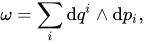
Suppose that is a -dimensional symplectic manifold. Then locally, one may choose canonical coordinates on , in which the symplectic form is expressed as:[2]


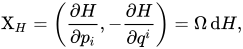
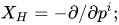
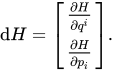
where denotes the exterior derivative and denotes the exterior product. Then the Hamiltonian vector field with Hamiltonian takes the form:[1]

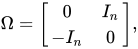
where is a square matrix

and
The matrix is frequently denoted with .

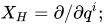
Suppose that is the -dimensional symplectic vector space with (global) canonical coordinates.

  • If then
  • if then
  • if then
  • if then

Properties

[edit]
  • The assignment is linear, so that the sum of two Hamiltonian functions transforms into the sum of the corresponding Hamiltonian vector fields.
  • Suppose that are canonical coordinates on (see above). Then a curve is an integral curve of the Hamiltonian vector field if and only if it is a solution of Hamilton's equations:[1]
  • The Hamiltonian is constant along the integral curves, because . That is, is actually independent of . This property corresponds to the conservation of energy in Hamiltonian mechanics.
  • More generally, if two functions and have a zero Poisson bracket (cf. below), then is constant along the integral curves of , and similarly, is constant along the integral curves of . This fact is the abstract mathematical principle behind Noether's theorem.[nb 1]
  • The symplectic form is preserved by the Hamiltonian flow. Equivalently, the Lie derivative .

Poisson bracket

[edit]

The notion of a Hamiltonian vector field leads to a skew-symmetric bilinear operation on the differentiable functions on a symplectic manifold , the Poisson bracket, defined by the formula

where denotes the Lie derivative along a vector field . Moreover, one can check that the following identity holds:[1] ,

where the right hand side represents the Lie bracket of the Hamiltonian vector fields with Hamiltonians and . As a consequence (a proof at Poisson bracket), the Poisson bracket satisfies the Jacobi identity:[1] ,

which means that the vector space of differentiable functions on , endowed with the Poisson bracket, has the structure of a Lie algebra over , and the assignment is a Lie algebra homomorphism, whose kernel consists of the locally constant functions (constant functions if is connected).

Remarks

[edit]
  1. ^ See Lee (2003, Chapter 18) for a very concise statement and proof of Noether's theorem.

Notes

[edit]

Works cited

[edit]
  • Abraham, Ralph; Marsden, Jerrold E. (1978). Foundations of Mechanics. London: Benjamin-Cummings. ISBN 978-080530102-1.See section 3.2.
  • Arnol'd, V.I. (1997). Mathematical Methods of Classical Mechanics. Berlin etc: Springer. ISBN 0-387-96890-3.
  • Frankel, Theodore (1997). The Geometry of Physics. Cambridge University Press. ISBN 0-521-38753-1.
  • Lee, J. M. (2003), Introduction to Smooth manifolds, Springer Graduate Texts in Mathematics, vol. 218, ISBN 0-387-95448-1
  • McDuff, Dusa; Salamon, D. (1998). Introduction to Symplectic Topology. Oxford Mathematical Monographs. ISBN 0-19-850451-9.
[edit]
Revisions and contributorsEdit on WikipediaRead on Wikipedia
from Grokipedia
In mathematics and physics, a Hamiltonian vector field is a vector field XHX_H on a symplectic manifold (M,ω)(M, \omega) associated to a smooth function H:MRH: M \to \mathbb{R}, called the Hamiltonian, and defined by the equation ιXHω=dH\iota_{X_H} \omega = -dH, or equivalently, ω(XH,)=dH\omega(X_H, \cdot) = -dH.[1] This construction arises in the study of Hamiltonian mechanics and symplectic geometry, where the flow generated by XHX_H describes the time evolution of a physical system conserving both the symplectic structure ω\omega and the energy function HH.[2] In local coordinates on R2n\mathbb{R}^{2n} with the standard symplectic form ω=i=1ndqidpi\omega = \sum_{i=1}^n dq_i \wedge dp_i, the components of XHX_H are given by dqidt=Hpi\frac{dq_i}{dt} = \frac{\partial H}{\partial p_i} and dpidt=Hqi\frac{dp_i}{dt} = -\frac{\partial H}{\partial q_i}, yielding Hamilton's canonical equations.[3] The Hamiltonian vector field XHX_H is uniquely determined by the non-degeneracy of ω\omega, and its integral curves lie on the level sets of HH, ensuring that HH is constant along the flow: LXHH=0\mathcal{L}_{X_H} H = 0.[1] Moreover, XHX_H preserves the symplectic form, satisfying LXHω=0\mathcal{L}_{X_H} \omega = 0, which classifies it as a symplectic vector field.[3] The collection of all Hamiltonian vector fields forms a Lie algebra under the Lie bracket of vector fields, isomorphic to the Lie algebra of smooth functions on MM equipped with the Poisson bracket {f,g}=Xf(g)=ω(Xf,Xg)=Xg(f)\{f, g\} = X_f(g) = \omega(X_f, X_g) = -X_g(f), satisfying [Xf,Xg]=X{f,g}[X_f, X_g] = -X_{\{f,g\}}.[2] Not every symplectic vector field is Hamiltonian; on a connected symplectic manifold, the Hamiltonian ones correspond to exact symplectic vector fields, with the obstruction lying in the first de Rham cohomology group H1(M;R)H^1(M; \mathbb{R}).[3] Key examples include the harmonic oscillator on R2\mathbb{R}^2, where H(q,p)=p22m+kq22H(q, p) = \frac{p^2}{2m} + \frac{k q^2}{2} generates circular orbits via XH=pmqkqpX_H = \frac{p}{m} \frac{\partial}{\partial q} - k q \frac{\partial}{\partial p}, illustrating volume-preserving and energy-conserving dynamics.[2] In broader contexts, Hamiltonian vector fields underpin integrable systems, geometric quantization, and the study of symplectomorphisms, with applications extending to celestial mechanics, quantum field theory, and differential geometry.[1] Their divergence-free nature in canonical coordinates ensures Liouville's theorem on phase space volume preservation.[2]

Background Concepts

Symplectic Manifolds

A symplectic manifold is a pair (M,ω)(M, \omega), where MM is a smooth manifold and ω\omega is a closed nondegenerate 2-form on MM.[4] The closedness condition means that the exterior derivative satisfies dω=0d\omega = 0, ensuring that ω\omega defines a cohomology class in the de Rham cohomology of MM. Nondegeneracy implies that for every point pMp \in M, the map vωp(v,)v \mapsto \omega_p(v, \cdot) from the tangent space TpMT_p M to its dual TpMT_p^* M is an isomorphism.[4] The nondegeneracy of ω\omega forces the dimension of MM to be even, say dimM=2n\dim M = 2n, as the induced pairing on tangent spaces pairs distinct directions without fixed points.[4] A fundamental local property is given by Darboux's theorem, which states that around any point in MM, there exist coordinates (q1,,qn,p1,,pn)(q^1, \dots, q^n, p_1, \dots, p_n) such that
ω=i=1ndqidpi. \omega = \sum_{i=1}^n dq^i \wedge dp_i.
This canonical local expression highlights the "standard" form of symplectic structures, independent of global topology.[4][5] In classical mechanics, symplectic manifolds naturally arise as phase spaces, particularly the cotangent bundle TQT^*Q of a configuration manifold QQ, equipped with the canonical symplectic form ω=dθ\omega = -d\theta. Here, θ\theta is the tautological 1-form defined by θ(q,p)(δq,δp)=p(δq)\theta_{(q,p)}(\delta q, \delta p) = p(\delta q), where (q,p)TQ(q,p) \in T^*Q and (δq,δp)T(q,p)(TQ)(\delta q, \delta p) \in T_{(q,p)}(T^*Q).[4] This structure captures the kinematics of systems with generalized coordinates qq and momenta pp, providing a geometric foundation for Hamiltonian dynamics.[5] The concept originated in classical mechanics during the late 19th century, with foundational contributions from Henri Poincaré in his studies of celestial mechanics, and was formalized in symplectic geometry by pioneers including Hermann Weyl, who coined the term "symplectic" in 1939 to describe the associated linear group.[6][4]

Hamiltonian Functions

A Hamiltonian function on a symplectic manifold (M,ω)(M, \omega) is defined as a smooth real-valued function H:MRH: M \to \mathbb{R}.[4] Such functions serve as scalar potentials that generate dynamics on the manifold, bridging classical mechanics with symplectic geometry.[4] In the context of mechanics, the Hamiltonian function HH typically represents the total energy of a system, comprising both kinetic and potential components, within the phase space modeled by the symplectic manifold.[4] This formulation generalizes the energy function from Lagrangian mechanics to a geometric setting, where HH encodes the conserved quantities associated with the system's symmetries via Noether's theorem.[4] Locally, on any symplectic manifold, the Darboux theorem guarantees the existence of canonical coordinates (q1,,qn,p1,,pn)(q^1, \dots, q^n, p_1, \dots, p_n) in which HH can be expressed as a function H(q,p)H(q, p).[4] These coordinates reflect the natural separation into generalized positions qq and momenta pp, facilitating the analysis of mechanical systems in a coordinate-dependent manner.[7] Hamiltonian functions are inherently globally defined as smooth maps on MM, but the associated dynamics distinguish between locally and globally Hamiltonian cases: global Hamiltonians correspond to exact 1-forms dHdH, while local ones arise when the generating 1-form is merely closed, requiring the first de Rham cohomology group Hde Rham1(M)=0H^1_{\mathrm{de\ Rham}}(M) = 0 for all symplectic vector fields to be globally Hamiltonian.[4]

Definition and Local Expression

Abstract Definition

In the context of a symplectic manifold (M,ω)(M, \omega), where ω\omega is a closed, non-degenerate 2-form, a Hamiltonian function H:MRH: M \to \mathbb{R} defines the associated Hamiltonian vector field XHX_H as the unique vector field satisfying ιXHω=dH\iota_{X_H} \omega = dH, with ι\iota denoting the interior product. The non-degeneracy of ω\omega ensures the uniqueness of XHX_H, as it induces a bundle isomorphism ω:TMTM\flat_\omega: TM \to T^*M given by vιvωv \mapsto \iota_v \omega, which maps vector fields bijectively to exact 1-forms and thus inverts to yield a unique vector field from the exact 1-form dHdH. Since HH is smooth, dHdH is a smooth 1-form, and the isomorphism ω\flat_\omega is smooth, it follows that XHX_H is a smooth vector field. There is a common sign convention variation in the literature, where some texts define XHX_H via ιXHω=dH\iota_{X_H} \omega = -dH, often when using the symplectic form ω=dpidqi\omega = \sum dp_i \wedge dq^i (the negative of the standard dqidpi\sum dq_i \wedge dp_i), to match conventions in physics. This choice affects the direction of the flow but preserves the underlying symplectic structure and dynamics up to time reversal.[8]

Canonical Coordinates

In symplectic geometry, local coordinates that simplify the expression of the symplectic form are known as canonical or Darboux coordinates. On a symplectic manifold (M,ω)(M, \omega) of dimension 2n2n, Darboux's theorem guarantees the existence of a coordinate chart (U,(q1,,qn,p1,,pn))(U, (q^1, \dots, q^n, p_1, \dots, p_n)) around any point such that the symplectic form takes the standard expression
ω=i=1ndqidpi. \omega = \sum_{i=1}^n \, dq^i \wedge dp_i.
This canonical form highlights the pairing between position-like coordinates qiq^i and momentum-like coordinates pip_i, facilitating explicit computations of geometric objects like vector fields. The Hamiltonian vector field XHX_H associated to a smooth function H:MRH: M \to \mathbb{R} admits a concrete local expression in these canonical coordinates. Assuming the abstract definition via the interior product ιXHω=dH\iota_{X_H} \omega = dH, the vector field takes the form
XH=i=1n(HpiqiHqipi). X_H = \sum_{i=1}^n \left( \frac{\partial H}{\partial p_i} \frac{\partial}{\partial q^i} - \frac{\partial H}{\partial q^i} \frac{\partial}{\partial p_i} \right).
This expression arises from the nondegeneracy of ω\omega, which uniquely determines XHX_H for each HH.[8] To derive this, substitute the assumed coordinate form of XH=i=1n(ai/qi+bi/pi)X_H = \sum_{i=1}^n (a_i \partial/\partial q^i + b_i \partial/\partial p_i) into the defining equation and compute the interior product with ω\omega. The interior product yields
ιXHω=i=1n(aidpibidqi), \iota_{X_H} \omega = \sum_{i=1}^n \left( a_i \, dp_i - b_i \, dq^i \right),
since ω\omega pairs the basis forms as specified. Setting this equal to dH=i=1n(Hqidqi+Hpidpi)dH = \sum_{i=1}^n \left( \frac{\partial H}{\partial q^i} dq^i + \frac{\partial H}{\partial p_i} dp_i \right) and equating coefficients gives ai=H/pia_i = \partial H / \partial p_i (from dpidp_i) and bi=H/qi-b_i = \partial H / \partial q^i so bi=H/qib_i = -\partial H / \partial q^i (from dqidq^i), confirming the explicit expression. This local computation makes the intrinsic definition tangible and is valid on any Darboux chart.[8] Under canonical transformations, which are symplectomorphisms preserving ω\omega, the Hamiltonian vector field transforms covariantly as a vector field. Specifically, if ϕ:MM\phi: M \to M is a symplectomorphism, then the pushforward ϕXH\phi_* X_H is the Hamiltonian vector field associated to the transformed Hamiltonian Hϕ1H \circ \phi^{-1}. This ensures the geometric structure remains consistent across coordinate systems.[8]

Examples

Simple Mechanical Systems

In classical mechanics, simple systems provide intuitive illustrations of Hamiltonian vector fields, where the phase space is typically the cotangent bundle of the configuration space with canonical symplectic structure. For the one-dimensional harmonic oscillator, the Hamiltonian function is given by
H(q,p)=p22m+12kq2, H(q, p) = \frac{p^2}{2m} + \frac{1}{2} k q^2,
where qq is the position, pp is the momentum, mm is the mass, and kk is the spring constant.[9] The corresponding Hamiltonian vector field is then
XH=pmqkqp, X_H = \frac{p}{m} \frac{\partial}{\partial q} - k q \frac{\partial}{\partial p},
which arises from the standard expression in canonical coordinates XH=HpqHqpX_H = \frac{\partial H}{\partial p} \frac{\partial}{\partial q} - \frac{\partial H}{\partial q} \frac{\partial}{\partial p}.[9] This vector field describes oscillatory motion in phase space, with trajectories forming closed ellipses centered at the origin. For a free particle in one dimension, the Hamiltonian simplifies to the kinetic energy term alone,
H(q,p)=p22m, H(q, p) = \frac{p^2}{2m},
since there is no potential.[9] The associated Hamiltonian vector field is
XH=pmq, X_H = \frac{p}{m} \frac{\partial}{\partial q},
indicating constant velocity motion parallel to the position axis in phase space, as momentum pp remains fixed while position qq evolves linearly with time.[9] In systems with central forces, such as the Kepler problem describing planetary motion under inverse-square gravitation, polar coordinates in the plane are natural, with radial position rr, radial momentum prp_r, and conserved angular momentum LL. The Hamiltonian becomes
H(r,pr)=pr22m+L22mr2+V(r), H(r, p_r) = \frac{p_r^2}{2m} + \frac{L^2}{2m r^2} + V(r),
where V(r)=krV(r) = -\frac{k}{r} for the gravitational potential with k=Gm1m2k = G m_1 m_2.[10] The Hamiltonian vector field XHX_H in these coordinates generates bounded elliptical orbits for negative energies, reflecting the effective potential combining centrifugal and attractive terms. In each case, the vector field XHX_H generates flows along trajectories that conserve the energy represented by HH.[9][10]

Symplectic Geometry Examples

In symplectic geometry, coadjoint orbits provide a fundamental example of Hamiltonian vector fields arising from group actions. For a Lie group GG acting on its coadjoint orbit Oλg\mathcal{O}_\lambda \subset \mathfrak{g}^* equipped with the Kostant-Kirillov-Souriau symplectic form, the action is Hamiltonian with moment map μ:Oλg\mu: \mathcal{O}_\lambda \to \mathfrak{g}^* given by the inclusion μ(m)=m\mu(m) = m.[4] For an element ξg\xi \in \mathfrak{g}, the Hamiltonian function Hξ=μ,ξH_\xi = \langle \mu, \xi \rangle generates the infinitesimal generator XHξX_{H_\xi} of the action, which is the fundamental vector field XξX_\xi tangent to the orbit.[4] This vector field satisfies iXHξω=dHξi_{X_{H_\xi}} \omega = -dH_\xi, where ω\omega is the symplectic form, illustrating how Lie algebra elements produce Hamiltonian flows preserving the orbit's symplectic structure. Another illustrative example occurs on cotangent bundles, which carry a canonical symplectic structure. Consider the cotangent bundle TNT^*N of a smooth manifold NN with the standard symplectic form ω=dθ\omega = -d\theta, where θ\theta is the tautological 1-form.[4] The Hamiltonian H:TNRH: T^*N \to \mathbb{R} defined by the quadratic form H(q,p)=12gij(q)pipjH(q, p) = \frac{1}{2} g^{ij}(q) p_i p_j, corresponding to a Riemannian metric gg on NN, generates the geodesic flow vector field XHX_H.[4] The integral curves of XHX_H project to geodesics on NN, and XHX_H satisfies Hamilton's equation iXHω=dHi_{X_H} \omega = -dH, demonstrating the symplectic nature of geodesic dynamics in this geometric setting.[4] Hamiltonian actions of tori or circles on symplectic manifolds yield vector fields that manifest as rotations in suitable coordinates. For instance, the circle group S1S^1 acts on the 2-sphere S2S^2 with symplectic form ω=dθdh\omega = d\theta \wedge dh (where θ\theta is the azimuthal angle and hh the height function) by rotations eit(θ,h)=(θ+t,h)e^{it} \cdot (\theta, h) = (\theta + t, h).[11] This action is Hamiltonian with moment map μ=h\mu = h, and the generating vector field Xh=/θX_h = \partial/\partial \theta satisfies iXhω=dhi_{X_h} \omega = -dh, producing rotational flows around the vertical axis that preserve ω\omega.[11] More generally, for a torus TkT^k acting effectively on a compact symplectic manifold (M,ω)(M, \omega) of dimension 2n2n, the action admits a moment map μ:MRk\mu: M \to \mathbb{R}^k if knk \leq n, with each component generating a Hamiltonian vector field corresponding to circle subgroup rotations.[4] A key non-example highlights the structural constraints: on an odd-dimensional manifold, no symplectic form exists, precluding the definition of Hamiltonian vector fields in this context.[4] Specifically, a nondegenerate closed 2-form ω\omega on a manifold of dimension 2n+12n+1 cannot exist, as the associated map TMTMTM \to T^*M induced by ω\omega would fail to be an isomorphism due to mismatched dimensions, rendering ω\omega degenerate.[12] Consequently, the equation iXω=dHi_X \omega = dH admits no unique solution XX for arbitrary smooth HH, as the nondegeneracy required for well-defined Hamiltonian vector fields is absent.[4]

Properties of Hamiltonian Vector Fields

Hamilton's Equations

The integral curves of a Hamiltonian vector field XHX_H on a symplectic manifold (M,ω)(M, \omega) are smooth curves γ:IM\gamma: I \to M, where II is an interval in R\mathbb{R}, satisfying the differential equation γ(t)=XH(γ(t))\gamma'(t) = X_H(\gamma(t)) for all tIt \in I. These curves describe the trajectories of the dynamical system generated by XHX_H, with the Hamiltonian function H:MRH: M \to \mathbb{R} determining the direction of motion at each point via the relation ιXHω=dH\iota_{X_H} \omega = -dH.[7] In canonical coordinates (qi,pi)(q^i, p_i) on a cotangent bundle TQT^*Q, where the symplectic form takes the standard expression ω=idpidqi\omega = \sum_i dp_i \wedge dq^i, the components of XHX_H are given by XH=i(HpiqiHqipi)X_H = \sum_i \left( \frac{\partial H}{\partial p_i} \frac{\partial}{\partial q^i} - \frac{\partial H}{\partial q^i} \frac{\partial}{\partial p_i} \right). To derive Hamilton's equations, consider the action of XHX_H on the coordinate functions: the derivative along an integral curve γ(t)=(qi(t),pi(t))\gamma(t) = (q^i(t), p_i(t)) yields ddtqi(γ(t))=XH(qi)=Hpi\frac{d}{dt} q^i(\gamma(t)) = X_H(q^i) = \frac{\partial H}{\partial p_i} and ddtpi(γ(t))=XH(pi)=Hqi\frac{d}{dt} p_i(\gamma(t)) = X_H(p_i) = -\frac{\partial H}{\partial q^i}, since XH(f)=i(HpifqiHqifpi)X_H(f) = \sum_i \left( \frac{\partial H}{\partial p_i} \frac{\partial f}{\partial q^i} - \frac{\partial H}{\partial q^i} \frac{\partial f}{\partial p_i} \right) for any smooth function ff.[13][7] Thus, the integral curves of XHX_H are precisely the solutions to Hamilton's equations:
dqidt=Hpi,dpidt=Hqi, \begin{aligned} \frac{dq^i}{dt} &= \frac{\partial H}{\partial p_i}, \\ \frac{dp_i}{dt} &= -\frac{\partial H}{\partial q^i}, \end{aligned}
which form a system of 2n2n first-order ordinary differential equations on the 2n2n-dimensional phase space. This equivalence establishes Hamilton's equations as the coordinate manifestation of the flow generated by XHX_H.[13]

Conservation Laws

One key property of the Hamiltonian vector field XHX_H on a symplectic manifold (M,ω)(M, \omega) is that it preserves the Hamiltonian function HH along its integral curves. Specifically, the Lie derivative of HH with respect to XHX_H vanishes: LXHH=0\mathcal{L}_{X_H} H = 0. This implies that the time derivative of HH along the flow of XHX_H is zero, dHdt=0\frac{dH}{dt} = 0, ensuring conservation of the Hamiltonian, which often represents the total energy in mechanical systems. The proof follows directly from the definition of the Hamiltonian vector field. By definition, ιXHω=dH\iota_{X_H} \omega = -dH, so the Lie derivative LXHH=XH(H)=dH(XH)=ω(XH,XH)\mathcal{L}_{X_H} H = X_H(H) = dH(X_H) = -\omega(X_H, X_H). Since the symplectic form ω\omega is skew-symmetric, ω(XH,XH)=0\omega(X_H, X_H) = 0, hence LXHH=0\mathcal{L}_{X_H} H = 0. More generally, any smooth function KK on MM that Poisson commutes with HH, i.e., {K,H}=0\{K, H\} = 0, is conserved along the flow of XHX_H. Indeed, the time evolution of KK satisfies dKdt={H,K}\frac{dK}{dt} = \{H, K\}, so {K,H}=0\{K, H\} = 0 implies dKdt=0\frac{dK}{dt} = 0. Such functions KK are called constants of motion or integrals of the system. This conservation arises from symmetries via Noether's theorem in the Hamiltonian setting: if a one-parameter group of canonical transformations preserves the Hamiltonian HH, it generates a conserved quantity corresponding to the infinitesimal generator of the symmetry.

Symplectomorphism Generation

A Hamiltonian vector field $ X_H $ on a symplectic manifold $ (M, \omega) $ is defined such that its contraction with the symplectic form satisfies $ \iota_{X_H} \omega = -dH $, where $ H $ is the Hamiltonian function. This ensures that $ X_H $ preserves the symplectic structure infinitesimally, as the Lie derivative of $ \omega $ along $ X_H $ vanishes: $ \mathcal{L}_{X_H} \omega = 0 $.[1][14] To see this, apply Cartan's magic formula for the Lie derivative of a differential form:
LXHω=ιXHdω+d(ιXHω). \mathcal{L}_{X_H} \omega = \iota_{X_H} d\omega + d(\iota_{X_H} \omega).
Since $ \omega $ is closed, $ d\omega = 0 $, so the first term is zero. The second term simplifies to $ d(-dH) = -d^2 H = 0 $, as the exterior derivative of an exact form is zero. Thus, $ \mathcal{L}_{X_H} \omega = 0 $, confirming that $ X_H $ is a symplectic vector field.[1][15][14] This condition positions $ X_H $ as an infinitesimal generator of symplectomorphisms, tangent to the symplectomorphism group $ \mathrm{Sympl}(M, \omega) $ at the identity. The space of all such symplectic vector fields forms a Lie algebra under the Lie bracket, with Hamiltonian vector fields comprising a distinguished subspace.[14][15] A key consequence is Liouville's theorem, which states that the flow of $ X_H $ preserves the Liouville volume form $ \frac{\omega^n}{n!} $ on the $ 2n $-dimensional manifold $ M $. This follows because
LXH(ωnn!)=1n!(LXHω)ωn1++1n!ωn(LXHω)=0, \mathcal{L}_{X_H} \left( \frac{\omega^n}{n!} \right) = \frac{1}{n!} \left( \mathcal{L}_{X_H} \omega \right) \wedge \omega^{n-1} + \cdots + \frac{1}{n!} \omega^n \wedge \left( \mathcal{L}_{X_H} \omega \right) = 0,
since each term involves $ \mathcal{L}_{X_H} \omega = 0 $. This volume preservation is fundamental in classical mechanics for understanding phase space incompressibility.[1][14]

Poisson Brackets

Definition via Vector Fields

In the context of a symplectic manifold (M,ω)(M, \omega), where ω\omega is a closed non-degenerate 2-form, the Poisson bracket of two smooth functions f,gC(M)f, g \in C^\infty(M) is defined using the associated Hamiltonian vector fields XfX_f and XgX_g. These vector fields are uniquely determined by the relations ιXfω=df\iota_{X_f} \omega = -df and ιXgω=dg\iota_{X_g} \omega = -dg, where ι\iota denotes the interior product and dd is the exterior derivative.[1] The Poisson bracket is then given by
{f,g}=ω(Xf,Xg), \{f, g\} = \omega(X_f, X_g),
which establishes a bilinear operation on the space of smooth functions that encodes the symplectic structure algebraically.[1] This definition highlights the role of Hamiltonian vector fields in translating the geometric data of ω\omega into an algebraic bracket operation. The Poisson bracket satisfies several fundamental properties derived directly from the symplectic form and the linearity of the interior product. It is bilinear over R\mathbb{R}, meaning that for constants a,bRa, b \in \mathbb{R} and functions g,hC(M)g, h \in C^\infty(M),
{f,ag+bh}=a{f,g}+b{f,h}, \{f, ag + bh\} = a \{f, g\} + b \{f, h\},
and similarly in the second argument.[16] It is also skew-symmetric:
{f,g}={g,f}, \{f, g\} = -\{g, f\},
which follows from the antisymmetry of ω\omega.[1] Additionally, it obeys the Leibniz rule, acting as a derivation in each argument:
{f,gh}=g{f,h}+h{f,g}, \{f, gh\} = g \{f, h\} + h \{f, g\},
reflecting the product rule for the underlying vector fields.[16] These properties position the Poisson bracket as a key tool for analyzing the algebraic structure induced by the symplectic geometry. An important equivalence relates the Poisson bracket to the action of Hamiltonian vector fields as derivations. Specifically,
{f,g}=Xf(g)=Xg(f), \{f, g\} = X_f(g) = -X_g(f),
where Xg(f)X_g(f) denotes the directional derivative of ff along XgX_g.[1] This identity underscores that the bracket measures how one Hamiltonian vector field differentiates another function, providing a coordinate-free interpretation of the operation. This definition arises naturally from the symplectic form via the interior product relations. Contracting ιXgω=dg\iota_{X_g} \omega = -dg with XfX_f yields ω(Xg,Xf)=dg(Xf)=Xf(g)\omega(X_g, X_f) = -dg(X_f) = -X_f(g), and since {f,g}=Xf(g)\{f, g\} = X_f(g) by the equivalence above while ω(Xf,Xg)=ω(Xg,Xf)\omega(X_f, X_g) = - \omega(X_g, X_f), the bracket aligns directly with ω(Xf,Xg)\omega(X_f, X_g).[1] Symmetrically, applying ιXfω=df\iota_{X_f} \omega = -df gives ω(Xf,Xg)=df(Xg)=Xg(f)\omega(X_f, X_g) = -df(X_g) = -X_g(f), ensuring the operation is well-defined and independent of local coordinates.[16]

Lie Algebra Structure

The Poisson bracket on the space of smooth functions C(M)C^\infty(M) on a symplectic manifold (M,ω)(M, \omega) defines a Lie algebra structure, with the bracket satisfying bilinearity, antisymmetry, and the Jacobi identity. Specifically, for any f,g,hC(M)f, g, h \in C^\infty(M),
{f,{g,h}}+{g,{h,f}}+{h,{f,g}}=0. \{f, \{g, h\}\} + \{g, \{h, f\}\} + \{h, \{f, g\}\} = 0.
This identity holds because the Poisson bracket is derived from the symplectic form, ensuring the algebraic consistency required for a Lie bracket. The Jacobi identity for the Poisson bracket directly implies a corresponding structure on the Hamiltonian vector fields. The canonical map associating each function ff to its Hamiltonian vector field XfX_f, defined by ιXfω=df\iota_{X_f} \omega = -df, yields the relation [Xf,Xg]=X{f,g}[X_f, X_g] = -X_{\{f, g\}}, where [,][ \cdot, \cdot ] denotes the Lie bracket of vector fields. This equality follows from the definition of the Poisson bracket as {f,g}=Xf(g)=ω(Xf,Xg)\{f, g\} = X_f(g) = \omega(X_f, X_g) and the properties of the interior product and Lie derivative, confirming that the image of Hamiltonian vector fields forms a Lie subalgebra of the Lie algebra of all smooth vector fields on MM. The map ϕ:C(M)X(M)\phi: C^\infty(M) \to \mathfrak{X}(M), ϕ(f)=Xf\phi(f) = X_f, is a Lie algebra anti-homomorphism from (C(M),{,})(C^\infty(M), \{ \cdot, \cdot \}) to the Lie algebra of vector fields, with kernel consisting precisely of the constant functions, as constant functions generate the zero vector field. Thus, it induces a Lie algebra isomorphism between the quotient C(M)/RC^\infty(M)/\mathbb{R} (with the induced bracket) and the Lie algebra ham(M,ω)\mathfrak{ham}(M, \omega) of Hamiltonian vector fields. The adjoint representation in this Lie algebra acts infinitesimally on functions via adf(g)={f,g}\mathrm{ad}_f(g) = \{f, g\}, mirroring the action of the Lie bracket on the vector fields through the identification.

Hamiltonian Flows

Local Flows

The local flow of a Hamiltonian vector field XHX_H on a symplectic manifold (M,ω)(M, \omega) is defined as a one-parameter family of diffeomorphisms ϕt:UM\phi_t: U \to M, where UM×RU \subset M \times \mathbb{R} is an open set containing the zero section {(x,0)xM}\{(x, 0) \mid x \in M\}, satisfying the initial value problem
ddtϕt(x)=XH(ϕt(x)),ϕ0(x)=x \frac{d}{dt} \phi_t(x) = X_H(\phi_t(x)), \quad \phi_0(x) = x
for all xMx \in M.[17] This flow describes the integral curves of XHX_H, which locally evolve points along the direction specified by the Hamiltonian HH. The diffeomorphisms ϕt\phi_t preserve the symplectic structure locally, as the Lie derivative LXHω=0\mathcal{L}_{X_H} \omega = 0 ensures that each ϕt\phi_t pulls back ω\omega to itself.[3] By the standard Picard-Lindelöf theorem for ordinary differential equations on manifolds, local existence and uniqueness of the flow hold whenever XHX_H is smooth, which it is since HH is assumed smooth and ω\omega is nondegenerate.[2] Specifically, for each initial point xMx \in M, there exists a maximal time interval Ix=(ax,bx)I_x = (a_x, b_x) with 0Ix0 \in I_x and bx>0b_x > 0 such that the solution ϕt(x)\phi_t(x) is defined and unique for tIxt \in I_x, remaining within a compact subset of MM where XHX_H is Lipschitz continuous. The flow is compact in the sense that it is defined only on this maximal interval, beyond which the solution may escape any compact set or approach the boundary of the domain if MM is not complete.[18] In the time-dependent case, where the Hamiltonian H=H(t,)H = H(t, \cdot) varies with time, the associated vector field XH(t)X_{H(t)} becomes time-dependent, generating a non-autonomous flow ϕt\phi_t satisfying
ddtϕt(x)=XH(t)(ϕt(x)),ϕ0(x)=x. \frac{d}{dt} \phi_t(x) = X_{H(t)}(\phi_t(x)), \quad \phi_0(x) = x.
Local existence and uniqueness still follow from standard ODE theory, provided H(t,)H(t, \cdot) is smooth in its spatial arguments uniformly in tt over compact time intervals. The maximal interval of definition depends on both the spatial domain and the time variation of H(t)H(t), potentially shortening if the time dependence causes rapid growth in XH(t)X_{H(t)}. This setup arises naturally in perturbed mechanical systems, where external time-varying forces modify the energy function.

Global Hamiltonian Vector Fields

A Hamiltonian vector field XHX_H on a symplectic manifold (M,ω)(M, \omega) generates a global flow if it is complete, meaning the flow ϕtH:MM\phi_t^H: M \to M is defined for all tRt \in \mathbb{R} and every point in MM. Completeness ensures that integral curves extend indefinitely without singularities or escape in finite time. On compact symplectic manifolds, every smooth Hamiltonian vector field is complete. This follows from the general fact that any smooth vector field on a compact manifold generates a complete flow, as compactness bounds the trajectory and prevents finite-time blow-up. Since Hamiltonian vector fields arise from smooth Hamiltonians, and compact manifolds imply bounded Hamiltonians, the flows remain confined within the manifold for all time. Cotangent bundles TQT^*Q of smooth manifolds QQ provide prominent examples of spaces supporting Hamiltonian vector fields with global flows. Equipped with the canonical symplectic form ω=dθ\omega = -d\theta, where θ\theta is the tautological 1-form, smooth functions on TQT^*Q—such as mechanical Hamiltonians—yield globally defined XHX_H. For typical mechanical Hamiltonians on TQT^*Q with compact QQ, the resulting XHX_H often generate complete flows.[19] The Arnold-Liouville theorem illustrates global structure in integrable systems: for a completely integrable Hamiltonian system on a 2n2n-dimensional symplectic manifold with nn independent commuting Hamiltonians, if a regular level set is compact and connected, it is diffeomorphic to an nn-torus, and global action-angle coordinates exist on a saturated neighborhood, linearizing the flows to constant speeds on the tori and ensuring completeness thereon.
User Avatar
No comments yet.