


Community hub
Recent from talks
Contribute something
Nothing was collected or created yet.
Calling Festival
View on Wikipedia | This article has multiple issues. Please help improve it or discuss these issues on the talk page. (Learn how and when to remove these messages)
|


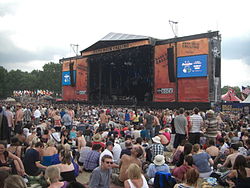
Calling Festival (formerly Hyde Park Calling and Hard Rock Calling) was an annual music festival, formerly held in Hyde Park, London, from 2006 until 2012, and from 2013 in Queen Elizabeth Olympic Park, London. In September 2013, Hard Rock International announced that they would no longer be sponsoring the festival; however, the event returned in 2014 and 2015 under the name Calling Festival at the Clapham Common.[1]
The music played is primarily rock music, and various performers, including The Killers, Paul McCartney, Eric Clapton, The Who, Bon Jovi, Roger Waters (with Nick Mason), The Police, Aerosmith, Neil Young and Bruce Springsteen have played at the event. The festival was organised by Hard Rock Cafe and Live Nation.
Hyde Park Calling 2006
[edit]The inaugural festival had two stages and was headlined by Roger Waters (performing in its entirety the Pink Floyd album The Dark Side of the Moon as part of his set) and his band (featuring Pink Floyd drummer Nick Mason) on the Saturday and The Who on the Sunday. Gates opened at 14:00, and the show ended at 22:15 on both evenings.[2] The Who's Sunday headline performance was released as part of their Encore Series 2006 of CDs & DVDs. British TV Show Top Gear filmed a brief segment of The Who’s concert as part of a Van review between the three hosts.
The festival was a peaceful one, being inside the city the event required attendees to rely on external accommodation - unlike more popular festivals such as Download Festival or Reading and Leeds Festival, which require camping on site for most people.
Despite the veteran status of the headline acts, most other bands were younger and with a more 'contemporary' audience, providing a contrast in musical styles. Since this festival, Razorlight particularly has acquired much fame and in under a year has gone from second slot in a smaller inaugural event like Hyde Park Calling to headlining the long-running and respected Reading/Leeds Festival. The festival mainstage proved to be unusually British, with the British Isles being represented by seven English bands and two Scottish, with only one American and one New Zealand band from abroad. However of the ten second stage bands, three were from Canada and two from the USA.
| (Main Stage) | |
| Saturday | Sunday |
|---|---|
| Second Stage | |
| Saturday | Sunday |
|---|---|
| |
Hyde Park Calling 2007
[edit]After Hyde Park Calling's success, a Hyde Park Calling 2007 quickly entered planning stages. It was announced that the event would take place during the weekend of 23–24 June 2007. It was Aerosmith's first concert in the United Kingdom for eight years and featured Peter Gabriel and the recently reformed Crowded House as a joint-headliner for the first day. Other draws to this year's event were the addition of a new third stage. Only one band to have played at the previous Hyde Park Calling, Rose Hill Drive, played again in 2007. With six bands per stage, instead of five, and an extra stage, the expansion of the festival only a year after its inception was dramatic.
One of the many incarnations of the Buena Vista Social Club featured. Hyde Park Calling 2007's version of the band includes Manuel "Guajiro" Mirabal (trumpet), Orlando "Cachaito" López (double bass), Manuel Galbán (guitar) and Jesus "Aguaje" Ramos (trumpet). Unlike the previous years' mostly British mainstage, of the nine bands playing, three were American, one from New Zealand and one from Australia.
Despite Aerosmith having the headline slot on Sunday, Chris Cornell played for the same length of time. His set combined Audioslave and Soundgarden songs with his own. In keeping with the family theme Aerosmith brought with them, on Saturday Peter Gabriel's daughter sang and played percussion. On Sunday Cornell brought his two children onto the stage for the audience to see.
Aerosmith had to finish at 10.30 pm due to the curfew, and the police were forcing them to leave. The encore was the usual "Walk this Way" song, but featured Darryl McDaniels (commonly referred to simply as 'DMC'). This was the first time a member of Run-D.M.C. had performed with Aerosmith since their 2002 tour, five years previous.
| Main Stage | |
| Saturday | Sunday |
|---|---|
| The Pepsi Stage | |
| Saturday | Sunday |
|---|---|
| Third Stage | |
| Saturday | Sunday |
|---|---|
Hard Rock Calling 2008
[edit]In late December 2007, the Hyde Park Calling 2008 website was launched. It confirmed the dates for 28–29 June 2008.
On 28 January 2008, the headliners for each day were announced, along with two support acts for each day:
| Main Stage | |
| Saturday | Sunday |
|---|---|
| Second Stage | |
| Saturday | Sunday |
|---|---|
Attendance: 57,561; Capacity: 60,000[3]
Hard Rock Calling 2009
[edit]In 2009, for the first time it was a three-day event, beginning on the Friday rather than a Saturday, running over 26, 27 and 28 June.[4] Neil Young headlined on Saturday and his encore was a cover version of "A Day in the Life" by the Beatles. Paul McCartney joined him on stage for parts of this performance. Bruce Springsteen finished his headlining set with "Dancing in the Dark", while he also joined The Gaslight Anthem for their song "The '59 Sound". Springsteen's entire set was released on DVD in June 2010, titled London Calling: Live in Hyde Park.
| Main Stage | ||
| Friday | Saturday | Sunday |
|---|---|---|
| Pepsi Max Stage | ||
| Friday | Saturday | Sunday |
|---|---|---|
Hard Rock Calling 2010
[edit]Hard Rock Calling 2010 took place of the weekend beginning 25 June. Wolfmother was scheduled to perform on Friday but backed out in advance.
| Main Stage | ||
| Friday 25 June | Saturday 26 June | Sunday 27 June |
|---|---|---|
| Pepsi Max Stage | ||
| Friday | Saturday | Sunday |
|---|---|---|
| Band Stand | ||
| Friday | Saturday | Sunday |
|---|---|---|
|
||
Hard Rock Calling 2011
[edit]The 2011 festival took place over the weekend of 24–26 June.
| Main Stage | ||
| Friday | Saturday | Sunday |
|---|---|---|
|
| |
| Pepsi Max Stage | ||
| Friday | Saturday | Sunday |
|---|---|---|
|
|
|
| Bandstand | ||
| Saturday | Sunday | |
|---|---|---|
|
| |
Hard Rock Calling 2012
[edit]During the song "Twist and Shout", performed by Bruce Springsteen and guest Paul McCartney at the Saturday show, Springsteen was forced to cut his set short when he ran overtime on a council curfew.[6] Paul Simon's set featured Hugh Masekela, Ladysmith Black Mambazo and Jimmy Cliff; it was released on DVD and album in June 2017, titled The Concert in Hyde Park.[7]
"I don't recall anything of Hyde Park," Soundgarden bassist Ben Shepherd said in 2013, "except looking stage-right and seeing that Jimmy Page was watching us. So, if anything, we actually played a lot more professionally than we usually do. I thought we were spot-on."[8]
| Main Stage | ||
| Friday | Saturday | Sunday |
|---|---|---|
| Pepsi Max Stage | ||
| Friday | Saturday | Sunday |
|---|---|---|
|
|
|
| Hard Rock Rising Stage | ||
| Friday | Saturday | Sunday |
|---|---|---|
|
|
|
| Band Stand | ||
| Friday | Saturday | Sunday |
|---|---|---|
|
|
|
Hard Rock Calling 2013
[edit]The 2013 event was moved to the Queen Elizabeth Olympic Park in Stratford after Live Nation had pulled out of the tender for Hyde Park. The 2013 festival returned to being a two-day event, unlike the four previous years which had run over three consecutive days. The first announcement was made on 5 March, when Kasabian and Bruce Springsteen & The E Street Band were confirmed as headliners. It would be the latter's second headline performance in consecutive years.
| Main Stage | |
| Saturday | Sunday |
|---|---|
| Pepsi Max Stage | |
| Saturday | Sunday |
|---|---|
| |
| Hard Rock Rising Stage | |
| Saturday | Sunday |
|---|---|
|
|
Calling Festival 2014
[edit]Hard Rock Calling returned under the name of Calling Festival from 28 to 29 June 2014 at Clapham Common. It was renamed Calling Festival when the previous sponsor, Hard Rock International, pulled out.
| Main Stage | |
| Saturday | Sunday |
|---|---|
|
|
| Pepsi Max Stage | |
| Saturday | Sunday |
|---|---|
|
|
Calling Festival 2015
[edit]Calling Festival returned to Clapham Common the following year, but only as a one-day festival, on 4 July.
| Main Stage |
| Saturday |
|---|
| Stage 2 | |
| Saturday | |
|---|---|
References
[edit]- ^ "Hard Rock ends sponsorship deal with Calling festival". NME. 23 September 2013. Retrieved 28 January 2014.
- ^ "royalparks.gov.uk". Archived from the original on 10 June 2007. Retrieved 24 June 2009.
- ^ "Concert Boxscore for the 2008-10-22 issue". 11 February 2011.
- ^ "hardrockcalling.co.uk". Archived from the original on 19 June 2009. Retrieved 24 June 2009.
- ^ "Pearl Jam top Hard Rock in 2010". News.bbc.co.uk. 7 December 2009. Retrieved 5 November 2022.
- ^ Rawlinson, Linnie. "Springsteen and McCartney cut off by London curfew". CNN. Retrieved 15 July 2012.
- ^ Filcman, Deborah (11 May 2017). "Paul Simon Announces 'A Concert in Hyde Park' Film and Album". Ultimate Classic Rock. Townsquare Media, Inc. Retrieved 22 May 2017.
- ^ Ling, Dave (October 2013). "Live! Soundgarden". Classic Rock. No. 189. p. 108.
External links
[edit]
Calling Festival
View on GrokipediaOverview
Festival Concept and Format
Calling Festival was an annual outdoor rock music festival held in London, initially launched as a two-day weekend event in 2006 under the name Hyde Park Calling before evolving into multi-day formats in subsequent years.[10] The festival emphasized high-profile performances across rock genres, including classic rock, alternative, and hard rock, creating an immersive experience centered on live music in an open-air setting.[11] Over its run, it rebranded to Hard Rock Calling in 2008 and then to Calling Festival in 2014, maintaining its focus as a premier summer rock event.[12] The typical structure featured a multi-stage setup, beginning with two stages (main and second) in its inaugural year and expanding to include a third stage dedicated to emerging acts by 2007.[13][14][15] Performances were scheduled across these stages to allow simultaneous sets, enabling attendees to navigate between acts while prioritizing headliners on the main stage. This format supported a diverse lineup of rock-oriented artists, with sets typically running from midday into the evening.[16] Operationally, the festival offered general admission tickets priced around £50–£60 per day, alongside VIP options that included reserved seating and access to exclusive facilities.[12][17] Daily capacity ranged from 40,000 to 50,000 attendees, reflecting its scale as a major London event.[18] Event durations varied, starting with two-day weekends and extending to three days for the first time in 2009, with gates opening around midday to accommodate full-day programming.[19][16]Genre Focus and Audience
The Calling Festival, along with its predecessors Hyde Park Calling and Hard Rock Calling, centered on rock music as its primary genre, featuring a broad spectrum that included classic rock acts such as The Who in 2006 and Aerosmith in 2014, as well as alternative and indie rock performers like The Killers and Kasabian during the Hard Rock Calling era.[20][21] Occasional crossovers into other styles, such as soul with Stevie Wonder headlining in 2014, added diversity while maintaining a rock foundation.[22] The festival's lineup evolved over time, beginning with an emphasis on legacy acts in its inaugural years—exemplified by headliners like The Who and Roger Waters in 2006—to a more balanced mix during the Hard Rock Calling period (2008–2013), incorporating both established icons and emerging rock bands such as Soundgarden and The Gaslight Anthem.[23][24] This shift reflected a deliberate effort to bridge generational rock appeal, culminating in the rebranded Calling Festival (2014–2015), which highlighted hard rock stalwarts like Aerosmith alongside contemporary acts. The audience primarily consisted of a mature demographic, often in their 30s to 50s, drawn to the festival's celebration of rock heritage and big-name headliners, with a notable international contingent attracted by global stars like Bon Jovi and Aerosmith.[24] Attendance figures underscored its appeal, reaching 57,561 in 2008 and exceeding 80,000 across the two days in 2014, indicating strong draw among rock enthusiasts seeking a polished, urban festival experience without camping.[25][26] Culturally, the festival positioned itself as a modern successor to Hyde Park's storied rock history, notably the iconic 1969 Rolling Stones concert that drew up to 500,000 fans and symbolized the era's counterculture, blending nostalgia for such landmark events with contemporary rock performances in the same venue during its early years.[27] This legacy enhanced its role in the UK rock scene, offering attendees a connection to rock's enduring traditions amid evolving lineups.[28]Historical Development
Inception as Hyde Park Calling (2006–2007)
The Hyde Park Calling festival was launched in 2006 by promoter Live Nation as a two-day rock music event held at Hyde Park in London on July 1 and 2. The inaugural edition featured two stages and headlined by Roger Waters on the opening Saturday, where he performed Pink Floyd's The Dark Side of the Moon in its entirety, and The Who on Sunday, delivering selections from their rock opera Tommy, including "Pinball Wizard" and "See Me, Feel Me". This format emphasized classic rock acts and aimed to revive Hyde Park's legacy as a venue for landmark outdoor rock concerts, building on historic performances like the Rolling Stones' 1969 free show. The event drew large crowds, estimated in the tens of thousands per day, establishing its appeal to rock enthusiasts without the multi-day camping structure of larger festivals.[29][10][30] The 2007 edition, held on June 23 and 24, built on this foundation with expanded programming, including the addition of a third stage to accommodate more emerging and supporting acts alongside the main attractions. Saturday's headliners were Peter Gabriel, supported by Crowded House, while Sunday featured Aerosmith, who incorporated a guest appearance by Run-D.M.C.'s Darryl McDaniels during their set. Organized again by Live Nation under the sponsorship-free "Hyde Park Calling" branding, the festival maintained its focus on high-caliber rock performances in an accessible, urban setting, attracting similar substantial attendance and reinforcing its role in London's summer music scene.[14][31][32] These early years demonstrated the festival's commercial potential, particularly highlighted by the release of The Who's 2006 Hyde Park performance as a live album in the band's Encore Series, which captured the energy of the event and contributed to its growing reputation among fans and promoters. Overall, the inception phase solidified Hyde Park Calling as a premier rock event, prioritizing quality lineups and historical venue resonance over expansive scale.[33][34]Hard Rock Calling Era (2008–2013)
In 2008, Hard Rock International entered into a partnership with Live Nation, rebranding the event as Hard Rock Calling and marking a significant expansion from its initial two-day format under the previous Hyde Park Calling name. This sponsorship infused the festival with the Hard Rock brand's rock heritage, enhancing production elements such as stage designs and fan experiences while introducing official merchandise lines featuring festival-specific apparel and memorabilia tied to the event's rock theme. The inaugural Hard Rock Calling took place on June 28–29 in London's Hyde Park, headlined by Eric Clapton on Saturday and The Police on Sunday, drawing strong crowds and setting the stage for future growth by attracting a broader range of classic and contemporary rock acts.[35][36][37] The festival expanded to three days in 2009, running June 26–28, with headliners The Killers on Friday, Neil Young on Saturday—joined by a surprise guest appearance from Paul McCartney for a rendition of "A Day in the Life"—and Bruce Springsteen and the E Street Band on Sunday, whose performance was later released as a DVD. This extension allowed for a more diverse lineup, including acts like Fleet Foxes and the Pretenders, and sold approximately 145,000 tickets, underscoring the event's rising popularity. In 2010 (June 25–27), Pearl Jam, Stevie Wonder, and Paul McCartney topped the bills, further diversifying the rock spectrum with soul and grunge influences, while 2011 (July 1–3) featured The Killers, Bon Jovi, and Rod Stewart, emphasizing arena-rock anthems and veteran performers.[38][39][40][41][42] The 2012 edition (June 29–July 1) highlighted Bruce Springsteen's Saturday headline set, which included a surprise onstage collaboration with Paul McCartney on "Twist and Shout" and "I Saw Her Standing There" before being abruptly cut short by a curfew, alongside headliners Soundgarden on Friday and Paul Simon on Sunday performing his Graceland album in full. By 2013, the festival shortened to two days (June 29–30) and relocated to Queen Elizabeth Olympic Park to accommodate larger capacities and fewer noise restrictions, headlined by Kasabian on Saturday and Bruce Springsteen on Sunday; this move supported attendance growth to around 80,000 over the weekend. The Hard Rock sponsorship concluded after 2013 as the company shifted focus to broader European music initiatives, though the partnership had elevated the event's profile through branded after-parties and merchandise integrations that boosted fan engagement.[43][44][12]Rebranding and Final Years (2014–2015)
Following the conclusion of the Hard Rock sponsorship after the 2013 edition, organizers Live Nation rebranded the event as Calling Festival for 2014, seeking to maintain its momentum without the previous corporate backing.[4] The festival shifted venues to Clapham Common in south London and expanded to a two-day format, held on June 28 and 29, to broaden its appeal amid the transition.[45] Aerosmith headlined the Saturday with a focus on classic rock, supported by acts like Joe Bonamassa and Thunder, while Stevie Wonder topped the Sunday bill, drawing on soul and pop influences alongside performers such as Jack Johnson and Paloma Faith.[46][45] The lineup emphasized mainstream rock and crossover genres to sustain audience interest post-rebranding, attracting over 80,000 attendees across the weekend.[21] By 2015, the event contracted to a single-day format on July 4 at Clapham Common, headlined by Noel Gallagher's High Flying Birds and Ryan Adams, with additional rock-oriented acts including The Hives, Echo & the Bunnymen, and Modest Mouse.[47][48] This downsized structure signaled ongoing challenges, including lower attendance compared to the festival's earlier peaks under Hard Rock Calling.[47] The absence of renewed sponsorship directly contributed to the shorter duration, venue relocation from central London, and diminished scale, with the 2016 edition cancelled and no further announcements, effectively concluding the series.[4] As of November 2025, no revivals or continuations of the Calling Festival have taken place.[4]Venues and Organization
Hyde Park (2006–2012)
Hyde Park, located in central London, served as the primary venue for the Calling Festival from its inception in 2006 through 2012, hosting the event on a sprawling greenfield site that accommodated large-scale outdoor performances. The main stage was positioned near the Serpentine lake, utilizing the park's natural amphitheater for optimal acoustics and sightlines across the open terrain. With a daily capacity exceeding 50,000 attendees, the setup emphasized efficient crowd flow in a camping-free environment, featuring designated zones for food vendors offering diverse options like fish and chips alongside vegetarian alternatives, multiple bars, and accessible facilities including toilets and viewing platforms for disabled patrons.[49][50] The venue's historical significance as a rock music hub enhanced the festival's prestige, building on a legacy of iconic events such as Blind Faith's debut concert in 1969, which drew an estimated 100,000–120,000 fans to the park for a free outdoor show. Following the 2008 rebranding to Hard Rock Calling under sponsorship by the Hard Rock Cafe chain, the layout incorporated themed areas reflecting the brand's rock heritage, including pop-up cafes and merchandise zones that integrated seamlessly with the park's pathways and greenery. This period solidified Hyde Park's role as a premier site for rock festivals, free from overnight camping to preserve the public space's accessibility.[51][52] Logistically, the festival navigated typical challenges of an urban park setting, including variable British weather; for instance, the 2007 edition endured heavy rain that soaked crowds but did not disrupt proceedings significantly. Advanced sound systems were deployed to ensure clear audio distribution across the expansive site for audiences up to 50,000, while transportation relied heavily on London's Tube network, with nearby stations like Marble Arch and Hyde Park Corner providing direct access via Central and Piccadilly lines, supplemented by bus routes from surrounding areas. No major safety incidents were reported during these years, reflecting effective organization by promoters Live Nation.[53][54][49] The 2012 event marked the final use of Hyde Park, as organizers faced scheduling conflicts stemming from disputes with the Royal Parks Agency over noise complaints and tender conditions, prompting a relocation to Queen Elizabeth Olympic Park in 2013.[55][56]Queen Elizabeth Olympic Park (2013)
The Queen Elizabeth Olympic Park in Stratford, East London, hosted the 2013 edition of the festival on June 29 and 30, marking the first major music event at the site since the 2012 Summer Olympics. Developed as the primary venue for the Games, the park featured modern infrastructure designed for large-scale gatherings, including AstroTurf surfaces that minimized mud during inclement weather and supported a main stage capacity of up to 60,000. Its location in the Lea Valley provided an expansive, open-air setting with clear sightlines and an isolated environment that allowed for louder sound levels without disturbing nearby residents. Iconic elements like the ArcelorMittal Orbit tower enhanced the visual experience, offering striking backdrops visible from the festival grounds. The venue was adapted for the event through the installation of temporary structures for three stages, leveraging the park's existing pathways and event-ready layout to create a seamless festival footprint. This move from Hyde Park was driven by an exclusive agreement between promoter Live Nation and the London Legacy Development Corporation, following years of noise complaints from Hyde Park residents that had complicated prior editions. The Olympic Park's availability as a post-Games legacy site positioned it as an ideal temporary home, enabling the festival to maintain its scale while testing the venue's potential for future concerts. Operationally, the park benefited from improved public transport access via Stratford station and the London Overground, facilitating easier entry for attendees from across the city compared to the congested central location of Hyde Park. Queues for facilities like toilets and concessions remained manageable, and the flat terrain supported efficient crowd flow. However, some visitors reported a lengthy initial walk from transport hubs through adjacent areas, and the site's concrete-heavy layout—described by critics as resembling a "car park"—lacked natural greenery or extensive shelter options for rain. Headliners Kasabian and Bruce Springsteen drew strong crowds, with the event's attendance aligning closely with previous years' figures around 50,000–60,000 per day. Ultimately, the 2013 use of Queen Elizabeth Olympic Park proved to be a one-off arrangement, as shifting sponsorship dynamics led to the festival's rebranding and relocation away from the site for the following year.Clapham Common (2014–2015)
The Calling Festival relocated to Clapham Common, a large open park in south London spanning approximately 220 acres, for its 2014 and 2015 editions following the loss of its previous sponsorship and venue arrangements. The event utilized an open-field layout with a single main stage for headliners and a smaller tented stage for supporting acts, accommodating a daily capacity of around 40,000 attendees. In 2014, it ran over two days on June 28–29, drawing an estimated 80,000 total visitors[3], while the 2015 edition was scaled back to a single day on July 4 due to budgetary constraints and reduced production scope.[26][21] This venue shift offered advantages such as lower operational costs in the absence of corporate sponsorship, with day tickets priced at £62.50 plus fees, making it more accessible than prior iterations at premium sites. Proximity to Clapham Common Underground station on the Northern line facilitated easier public transport access for attendees from central London, reducing reliance on buses or cars compared to more remote locations. However, the smaller scale of Clapham Common contributed to a diminished festival footprint, limiting it to fewer stages and a more intimate atmosphere, which ultimately led to the single-day format in 2015. The event integrated with the local community by generating £142,350 in income for Lambeth Council in 2014 alone, with two-thirds reinvested into park maintenance and cultural initiatives, supporting local businesses through increased footfall.[21][57] Logistically, the festival emphasized streamlined operations with reduced infrastructure, including efficient crowd management and no reported major disruptions such as weather-related cancellations or security incidents. Organizer Festival Republic implemented sustainability measures aligned with their broader policy, focusing on waste reduction through on-site recycling stations and encouraging reusable cups to minimize environmental impact on the park. These efforts were part of a strategy to balance commercial events with park preservation, aiming for up to 40 major event days annually across Lambeth's green spaces.[57][58][59] Clapham Common marked the final venue for the Calling Festival, which did not return after the 2015 edition amid ongoing challenges from the earlier sponsorship withdrawal and evolving festival economics. The site's use highlighted a transition to a more community-oriented, budget-conscious model in the festival's later phase, contrasting with its grander origins.[57]Performers and Events
Headlining Acts by Period
The Hyde Park Calling festival in its inaugural years emphasized a revival of progressive and classic rock influences, drawing on iconic figures from the genre's golden era. In 2006, the event was headlined by Roger Waters of Pink Floyd fame and The Who, showcasing a focus on veteran British and American rock acts known for their enduring appeal and elaborate live productions. This selection underscored an intent to attract audiences nostalgic for the 1970s rock renaissance, blending symphonic elements from Waters' performance with The Who's high-energy mod rock anthems.[60][20] The following year, 2007, continued this trend with Peter Gabriel headlining the Saturday bill alongside Crowded House, highlighting art rock and new wave influences, while Aerosmith closed Sunday with their blues-infused hard rock. Gabriel's set, featuring theatrical staging and world music fusions, and Aerosmith's raw guitar-driven spectacle reinforced the festival's commitment to progressive rock revivalists and classic American hard rockers, appealing to multigenerational crowds seeking sophisticated yet accessible performances.[61][32]| Year | Period | Headliners |
|---|---|---|
| 2006 | Hyde Park Calling | The Who, Roger Waters |
| 2007 | Hyde Park Calling | Peter Gabriel & Crowded House (Sat), Aerosmith (Sun) |
| Year | Period | Headliners |
|---|---|---|
| 2008 | Hard Rock Calling | Eric Clapton |
| 2009 | Hard Rock Calling | Neil Young (Sat), Bruce Springsteen (Sun) |
| 2010 | Hard Rock Calling | Pearl Jam (Fri), Stevie Wonder (Sat), Paul McCartney (Sun) |
| 2011 | Hard Rock Calling | The Killers (Fri), Bon Jovi (Sat), Rod Stewart (Sun) |
| 2012 | Hard Rock Calling | Soundgarden (Fri), Bruce Springsteen (Sat), Paul Simon (Sun) |
| 2013 | Hard Rock Calling | Kasabian (Sat), Bruce Springsteen (Sun) |
| Year | Period | Headliners |
|---|---|---|
| 2014 | Calling Festival | Aerosmith (Sat), Stevie Wonder (Sun) |
| 2015 | Calling Festival | Noel Gallagher's High Flying Birds (Sat), Ryan Adams (Sun) |