Hubbry Logo
Clapham CommonClapham CommonMain
Open search
Clapham Common
Community hub
Clapham Common
logo
8 pages, 0 posts
0 subscribers
Be the first to start a discussion here.
Clapham Common
Clapham Common
from Wikipedia

Clapham Common is a large triangular urban park in Clapham, south London, England. Originally common land for the parishes of Battersea and Clapham, it was converted to parkland under the terms of the Metropolitan Commons Act 1878. It is 220 acres (89 hectares)[1] of green space, with three ponds and a Victorian bandstand. It is overlooked by large Georgian and Victorian mansions and nearby Clapham Old Town.

Key Information

Holy Trinity Clapham, an 18th-century Georgian church overlooking the park, is important in the history of the evangelical Clapham Sect. Half of the park is within the London Borough of Wandsworth, and the other half is within the London Borough of Lambeth.

History

[edit]
View on Clapham Common by J. M. W. Turner (1800–1805)

Originally common land for the parishes of Battersea and Clapham, William Hewer was among the early Londoners to build adjacent to it. Samuel Pepys, the diarist, died at Hewer's house in 1703. The land had been used for cricket in 1700[2] and was drained in the 1760s,[3] and from the 1790s onwards fine houses were built around the common as fashionable dwellings for wealthy business people in what was then a village detached from metropolitan London. Some later residents were members of the Clapham Sect of evangelical reformers and slavery abolitionists, including William Wilberforce, Lord Teignmouth and Henry Thornton.[4]

In the early 1770s, during his stay in London representing America in affairs of the state, Benjamin Franklin had written a paper explaining how he used the ponds for science experiments, and in developing a "magic" trick. While traveling on a ship, Franklin had observed that the wake of a ship was diminished when the cooks scuttled their greasy water. He studied the effects at Clapham Common on a large pond there. "I fetched out a cruet of oil and dropt a little of it on the water ... though not more than a teaspoon full, produced an instant calm over a space of several yards square." He later used the trick to "calm the waters" by carrying "a little oil in the hollow joint of my cane."[5][6][7]

J. M. W. Turner painted "View on Clapham Common" between 1800 and 1805, showing that even though the common had been drained, it still remained "quite a wild place".[3]

The common was converted to parkland under the terms of the Metropolitan Commons Act in 1878.[8] As London expanded in the 19th century, Clapham was absorbed into the capital, with most of the remaining palatial or agricultural estates replaced with terraced housing by the early 1900s.[9]

In 1911, Scottish evangelist and teacher Oswald Chambers founded and was principal of the Bible Training College in Clapham Common, an "embarrassingly elegant" property situated at 45 North Side that had been purchased by the Pentecostal League of Prayer.[10]

During World War II, a heavy anti-aircraft artillery site had been set up on the common. Storage bunkers were built on the Battersea Rise side; two mounds remain.[11][12]

Governance

[edit]

Half of the common is within the London Borough of Wandsworth and half within the London Borough of Lambeth. It is wholly managed and maintained by Lambeth Council.[13] Policing of the open space is divided between the Wandsworth and Lambeth borough "commands" of the Metropolitan Police, which follow the local government boundaries.[14][15] The roads surrounding the common fall within the SW4, SW11 and SW12 postcodes.[16]

Clapham Common war memorial, located outside the Holy Trinity Church

Local government

[edit]

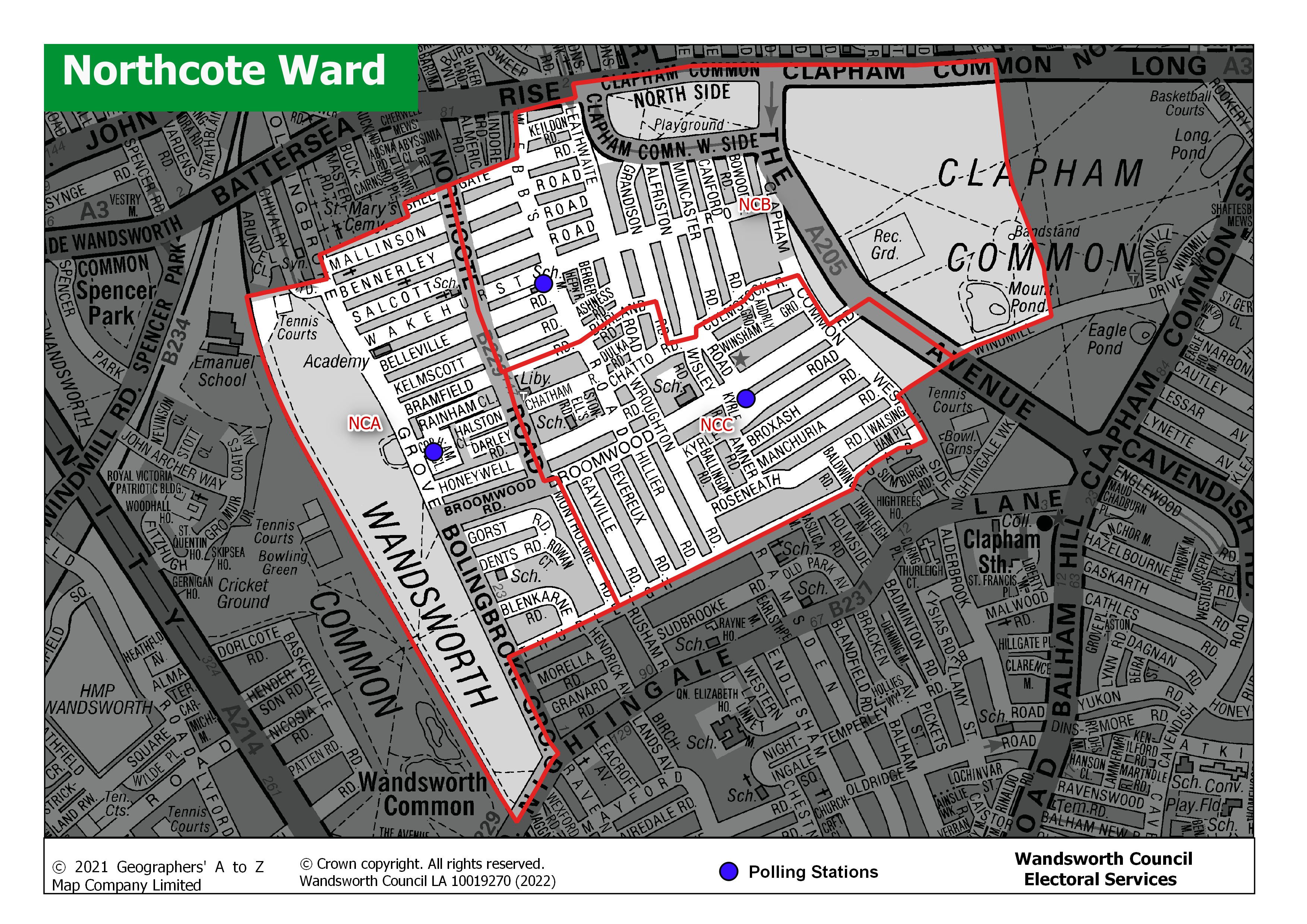
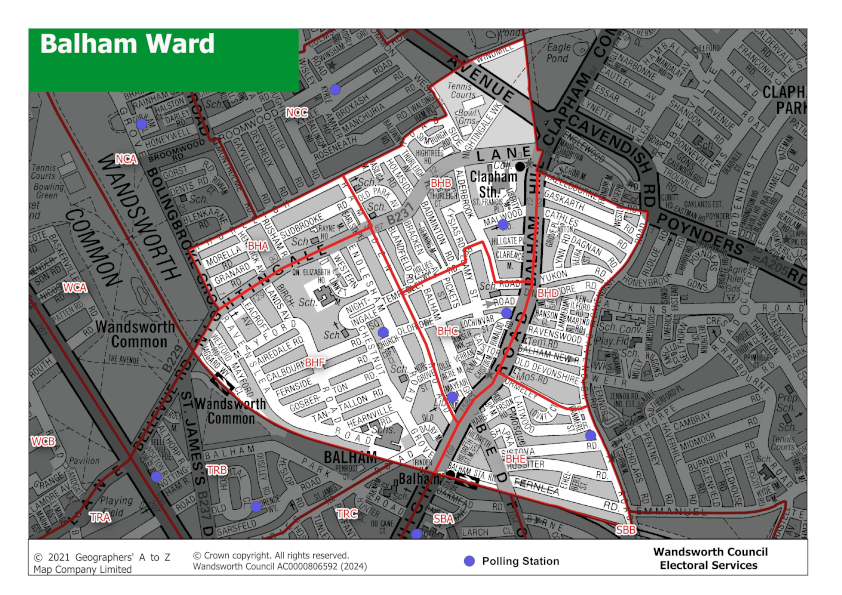
Electoral wards for Lambeth are within the eastern half of the common; mainly in the Clapham Common and Abbeville ward with smaller parts divided between the Clapham Town ward and Clapham East ward.[17] In Wandsworth, most of the western half of the common is in the Northcote ward and a small part of the south-western corner is in the Balham ward.[18][19]

Amenities

[edit]

Clapham Common has a range of sporting facilities, including tennis and netball courts, a running track, bowling green, cricket, football, rugby and Australian rules football pitches, and a skateboard venue.[13] In 2021, Foot Locker, in partnership with the NBA, completed the refurbishment of the Clapham Common Basketball Court.[20][21]

The park contains three ponds, two of which are historical features, and a more modern paddling pool known as Cock Pond. Eagle Pond and Mount Pond are used for angling and contain a variety of species including carp to 20 lb, roach, tench and bream. Eagle Pond was extensively refurbished in 2005 when it was completely drained, landscaped and replanted to provide a better habitat for the fish it contained. Long Pond has a century-old tradition of use for model boating.[22][23][24]

Holy Trinity Church (1776) is close to the north side of the park. An Anglican church, it hosts its fete in the park every summer.[25]

Clapham Common and Clapham South Underground stations are on the edge of the common at its easternmost and southernmost points respectively. Both stations are served by the Northern line.[26][27]

A 270-degree panoramic view of Clapham Common

The bandstand

[edit]

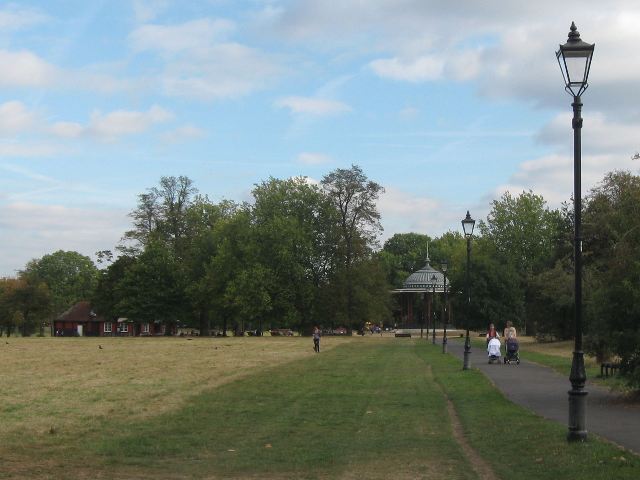
In the centre of the park is a bandstand constructed in 1890. It is the largest bandstand in London and a Grade II listed building. For many years it was also erroneously thought to be one of the bandstands first erected in 1861 in the Royal Horticultural Society's gardens in South Kensington, which would have made it the oldest surviving cast iron bandstand in Europe. However, further research has shown that these bandstands went to Southwark Park and Peckham Rye, and it appears that the Clapham bandstand was fabricated to a very similar design almost thirty years later.[28][29][30]

Clapham Common bandstand, a Grade II listed building, in 2023

The bandstand's maintenance had been neglected by Lambeth Council for thirty years, and by 2001 it was thought to be in danger of collapse and had to be shored up with scaffolding for five years. In 2005–2006, a full restoration of the bandstand and surrounding landscape took place, partly funded by an £895,000 lottery grant from the Heritage Lottery Fund matched by £300,000 from Lambeth Council and a further £100,000 from local fundraising efforts and the proceeds of the Ben and Jerry's Summer Sundae event held on the common.[24][31] The drainage bund around the bandstand was restored with granite setts during the summer of 2011 at a cost of £12,000 to resolve design faults in the earlier works.[32]

Events

[edit]

The park has hosted various musical festivals, including Colourscape Music Festival since 1989,;[33][34] Get Loaded in the Park, from 2004 to 2011 when Razorlight were the headline act;[35] South West Four Eurodance music festival annually in August since 2004;[36][37] and other music events, such as Subway Picnic Rocks in 2008, organised by Action Against Hunger[38] In 2014 the Calling Festival, which had previously been held in Hyde Park under the name Hard Rock Calling Festival, moved to Clapham Common; artists included Aerosmith and Stevie Wonder.[39]

Sporting events held in Clapham Common and sports teams based in the park include the Latin American football League, which has played organised football on the red car pitches located on the south side of the park since the 1980s;[40] the British Australian Rules Football League Grand Final, for which the park is the traditional venue; South West London Chargers rugby club formed in 2013 have their home in the park;[41] Sunday league football[42] is regularly played with London Titans[43] and Clapham Alexandra football clubs using the park;[44] various teams from other sports are also active on the park, including softball and korfball.[45]

A Lesbian & Gay Pride event, to be termed Pride House, was planned to take place on the park during the 2012 Summer Olympics, but ran into opposition from the Friends of Clapham Common[46] and was eventually cancelled for lack of funding.[47] Every Easter and February half-term George Irvin's Funfair visits the park.[48]

On 13 March 2021, a vigil was held on the common following the murder of Sarah Everard, who was kidnapped nearby by then-serving Metropolitan Police officer Wayne Couzens.[49]

Cruising

[edit]

Clapham Common has a reputation as a place for men seeking anonymous sex with other men in public places.[50] When Welsh politician Ron Davies was robbed at knifepoint in 1998 after he gave a lift to strangers he had met in the park, there was speculation that the incident involved "cruising"; Davies resigned his position in the UK government, denying the incident had anything to do with drugs or sex.[51][52][53] There have been several attacks on men in the vicinity of the park, including one in 2005 on a young man, Jody Dobrowski, thought by his attackers to be gay, during which he was badly beaten and later died.[54] The incident was the impetus for the making of the 2007 Channel 4 film Clapham Junction.[55]

[edit]

References

[edit]
[edit]
Revisions and contributorsEdit on WikipediaRead on Wikipedia
from Grokipedia
Clapham Common is a large public open space covering over 85 hectares in southwest London, situated primarily between the districts of Clapham, Battersea, and Balham across the boroughs of Lambeth and Wandsworth. Originally comprising the waste lands of the medieval manors of Clapham and Battersea, it served as common land where local villagers grazed livestock and collected brushwood for fuel. By the late 17th century, the common had evolved into a site for recreational activities such as horse racing and cricket, reflecting its transition toward organized leisure use amid London's suburban expansion. The common holds particular historical significance due to its proximity to the residences of the Clapham Sect, a network of influential evangelical reformers in the late 18th and early 19th centuries, including William Wilberforce, who worshipped at the nearby Holy Trinity Church and coordinated campaigns that contributed to the abolition of the British slave trade in 1807. Today, Clapham Common functions as a vital green lung for the capital, featuring three ponds, extensive sports facilities for football, rugby, and athletics, and a Victorian bandstand that hosts community events, while accommodating large gatherings such as music festivals and public demonstrations. Its preservation as open space amid urban development underscores its enduring role in providing accessible recreation and biodiversity in a densely populated area.

Geography and Layout

Location and Boundaries

Clapham Common constitutes a triangular expanse of approximately 89 hectares (220 acres) in , . It is situated primarily within the London Borough of , encompassing roughly 92 acres (37 hectares), while the remaining portion of about 108 acres (44 hectares) falls under the London Borough of Wandsworth, reflecting a near-even administrative split. This division stems from the common's historical allocation as shared grazing land between the adjacent parishes of and , a status that persists in modern borough governance despite boundary adjustments over time. The park's boundaries are defined by densely residential neighborhoods: to the north along Clapham High Street, to the east beyond the boundary with , and to the southwest. Key transport infrastructure enhances accessibility, including Clapham Common Underground station on the at its northern edge and proximity to the A24 (Balham Hill) along the southern perimeter near Clapham South station. These features integrate the common into the urban fabric of southwest , serving as a green buffer amid Victorian and Edwardian housing stock.

Physical Features and Size

Clapham Common covers approximately 220 acres (89 hectares) of primarily , forming a triangular expanse between the districts of , , and in . The terrain is largely flat, with open fields dominating the landscape and facilitating informal divisions into zones for various natural and recreational elements. This configuration integrates the common seamlessly into the urban fabric, distinguishing it as one of the largest inner-city greenspaces in , comparable in scale to other historic commons like but more compactly embedded within residential surroundings. Key natural features include three ponds—Eagle Pond, Mount Pond, and Long Pond—along with avenues of mature trees numbering around 2,500, comprising species such as oaks and scattered patches that contribute to edge . The , encompassing both amenity mown areas and rougher patches with native hedges, form the bulk of the surface, supporting ecological functions like carbon absorption and providing substrates for . and grassland interfaces host , including aquatic and species, enhancing the site's value despite its urban setting. Prominent structural landmarks within the common include a Victorian erected in 1890, serving as a central octagonal , and a war memorial dedicated initially to First World War casualties and later extended to the Second World War. These elements punctuate the open layout without altering the prevailing flat topography, which lacks significant elevation changes or rugged features.

Historical Development

Origins as Common Land

Clapham Common originated as communal waste associated with the manors of and , serving as shared and resource area for local villagers from at least the late Saxon period. Known then as Grendel's Mere, denoting boggy terrain, the area supported commoners' rights to , collect brushwood, fruits, furze for , and access from ponds and springs, with evidence of early cultivation in 'lazy beds' dating to century amid periodic shortages. The of 1086 records the settlement as Clopeham, with 11 households and assets including 3 hides of , 6 ploughs, and meadow, held under Geoffrey de Mandeville, indicating its established rural character divided between the parishes of and . Boundary disputes between the parishes emerged as early as the over fuel-gathering rights, escalating in the with lawsuits and physical confrontations regarding the western portion, aligned with the modern Lambeth-Wandsworth divide. A notable conflict occurred in when parishioners excavated a ditch along a Saxon-Norman boundary line to restrict access, but prevailed in court under principles upholding communal usage rights, leading to the ditch's restoration. These resolutions preserved , contrasting with widespread enclosures elsewhere, as no formal parliamentary acts privatized the common before the 18th century. By the late , Clapham Common retained its rural village-edge status but showed early signs of semi-urbanization, with influxes of refugees fleeing the plague and 1666 fire prompting recreational uses like and , alongside gravel extraction for roads. Surrounding fields remained agricultural, with minimal development pressure delaying full and favoring continued communal exploitation over private claims.

18th and 19th Century Transformations

During the , Clapham emerged as a favored suburban retreat for prosperous merchants and professionals seeking respite from London's industrial haze and overcrowding, leading to the construction of numerous villas along the edges of the common. These residences, often featuring expansive grounds and commanding views, transformed the surrounding rural landscape into a semi-urban enclave while preserving the central open space for grazing and recreation. Unlike many English commons subjected to parliamentary acts that privatized land for , Clapham Common largely escaped full division and fencing, maintaining its status as shared waste land under manorial rights shared between the parishes of and . This preservation stemmed from local opposition to development pressures and the absence of successful , allowing continued public access amid encroaching villas. The area gained cultural prominence through its association with the Clapham Sect, a network of evangelical reformers including William Wilberforce and John Venn, who established households in nearby villas from the 1780s to the 1830s. Centered around Holy Trinity Church, the group advocated moral and social reforms, notably contributing to the abolition of the slave trade in 1807, which imbued Clapham with a reputation for piety and philanthropy. However, their activities focused on private estates and broader societal campaigns rather than direct modifications to the common itself, though the ethos of communal benefit may have indirectly supported resistance to enclosure. In the 19th century, rapid urbanization—driven by London's expansion and improved transport like the 1838 opening of the South Western Railway—intensified demographic pressures, with Clapham’s population rising from around 5,000 in 1801 to over 50,000 by 1901. Local trustees assumed management, formalizing the space through leveling uneven terrain, laying gravel paths for pedestrian access, and planting avenues of London plane trees in the late Victorian period to enhance aesthetics and shade. These interventions responded causally to the need for recreational outlets in a burgeoning suburb, countering speculative building trends by prioritizing open-air leisure over complete commercialization, thus linking population density to deliberate conservation efforts.

20th and 21st Century Changes

![Clapham Common bandstand, a Grade II listed building, in 2023](./assets/Bandstand%252C_Clapham_Common_0101 In the early 20th century, Clapham Common saw expansions in recreational facilities, including dedicated pitches for football, rugby, and hockey, building on longstanding traditions of cricket and other sports. The Victorian bandstand, constructed in 1890, underwent periodic maintenance amid growing public use, though it faced neglect by the late 20th century. The common hosted the Greater London Horse Show annually, attracting competitors and spectators with events featuring various horse breeds, including Shires, continuing through the 1970s. Post-World War II developments brought increased urban pressures, with surrounding areas experiencing expansions and rising traffic volumes that impacted access and tranquility. The bandstand deteriorated significantly by the early 2000s, requiring shoring up to prevent collapse, followed by restorations including a new base and ramps in 2006, drainage improvements in 2011, and repainting in 2019. The Clapham Common Management Plan 2017-2027, developed by the Clapham Common Management Advisory Committee and , prioritizes enhancement, flood resilience through sustainable drainage, and measures to address . Recent infrastructure updates include proposals for new artificial grass pitches to meet demand for year-round sports, outlined in 's Active Lambeth Strategy 2022-2027 and Playing Pitch Strategy. The splash pad waterplay facility reopened on May 31, 2025, providing seasonal family recreation after prior closures. Urban safety challenges persist, particularly along the (Clapham High Street) bordering the common, where the junction with Gauden Road recorded 23 cyclist accidents from 2020 to 2023, prompting calls for infrastructure improvements in 2025 reports. These efforts reflect ongoing adaptations to balance preservation with modern recreational and safety needs.

Governance and Administration

Local Authority Management

Clapham Common is owned and managed by the London Borough of Lambeth, despite approximately half of its area falling within the London Borough of Wandsworth. This responsibility was formally vested in Lambeth under the London Authorities (Parks and Open Spaces) Order 1971, transferring management from the . As a registered common under the Commons Act 2006, the site is protected from unauthorized development or enclosure, requiring consent from the Secretary of State for any restricted works, such as infrastructure alterations. Lambeth Council allocates funding from its parks budget for routine maintenance, including annual contracts for grass cutting, tree surveys, and , though no fixed capital sum is dedicated solely to Clapham Common, with expenditures drawn from varied sources like heritage grants. The council enforces parks byelaws that prohibit littering, open fires, and unauthorized commercial activities, with provisions for fixed penalty notices introduced in 2025 to address offences. These byelaws explicitly preserve common rights while regulating public use to prevent environmental degradation. Lambeth coordinates with (TfL) on perimeter roads and cycle paths encircling the common, such as segments of the , where TfL has implemented safety improvements including segregated cycle tracks following consultations in 2022. Safety audits and enhancements have been prioritized post-2025 data highlighting high cyclist accident rates at nearby junctions, like the High Street/Gauden Road intersection, which recorded 23 cyclist-involved incidents from 2020-2023, prompting ongoing initiatives.

Community and Volunteer Oversight

The Clapham Common Management Advisory Committee (CCMAC) functions as a consultative body partnering with Council, incorporating residents, elected councillors, and community representatives to evaluate park management reports, guide working groups on maintenance issues, and incorporate public feedback into operational decisions. Established under a formal outlining its aims and procedures, the convenes monthly to address practical matters such as post-storm tree assessments and enhancements, thereby channeling volunteer and resident input to inform council-led implementations without assuming executive control. Friends of Clapham Common, a registered charity (number 1199785) with approximately 700 members, supports conservation through volunteer-driven actions including monthly collection events—typically held on the first Saturday—and habitat projects like woodland regeneration and scrubland management. These initiatives, funded primarily by member donations and targeted grants, extend council resources by delivering hands-on environmental monitoring and workshops, as outlined in the 2017-2027 management plan where the group contributes to wildlife education and site improvements. Resident organizations such as the Clapham Society, founded in 1963 to safeguard local amenities and heritage, engage in for preserving the common's open spaces and historic features, including past collaborations on restoration funding bids with the council. The society provides input on consultations, prioritizing ecological and architectural integrity over certain modern upgrades, which has occasionally highlighted divergences from authority priorities like expanded recreational facilities. Such groups thus augment official oversight by amplifying evidence-based preservation arguments derived from local observation, though their influence remains advisory amid council statutory responsibilities.

Amenities and Recreational Facilities

Sports and Open Spaces

Clapham Common features extensive sports infrastructure, including multiple football and rugby pitches, as well as facilities, which are available for public hire and support organized club activities. courts number eight in total, with five equipped for floodlit play, enabling year-round access managed through the Lawn Tennis Association's booking system. A and courts further accommodate athletic training and team sports, though the latter require measures to prevent long-term capacity loss. The common's ponds, specifically Eagle and Mount Ponds, permit fishing under strict regulations, requiring an annual Lambeth Council permit costing £55 alongside a valid rod licence; other ponds remain closed to to preserve . Informal play areas include dedicated playgrounds, such as the redesigned Windmill Drive facility with inclusive equipment for children and enhancements. Family-oriented amenities emphasize the splash pad, a 601 m² zero-depth play area with 41 features, which reopened on 31 May 2025 following seasonal maintenance and operates through early to promote safe summer recreation. Vast open grasslands spanning the 220-acre site facilitate picnics, dog-walking, and unstructured leisure, drawing high volumes of visitors that underscore benefits while challenging upkeep efforts by Council.

Cultural and Structural Features

The central bandstand on Clapham Common, constructed in 1890 at a cost of £598 with ironwork from George Smith's Sun Foundry in Glasgow, functions primarily as a pavilion for musical performances and public gatherings. Following years of deterioration, including structural shoring in 2001 to prevent collapse, it received comprehensive restoration in 2006 through a Heritage Lottery Fund project that addressed roofing, decking, and brickwork issues. War memorials form significant structural commemorations of local history, with the Clapham Common War Memorial—initially dedicated to First World War casualties and later extended to the Second World War—listed as a historic structure by English Heritage. Positioned near Holy Trinity Church, it exemplifies the common's role in preserving public tributes to military sacrifice through enduring stone and plaque elements. Ecological zones enhance the common's built landscape, featuring three integrated with for sustainable access, such as the bespoke curved hardwood at Mount Pond designed to a 5 kN/m² live load for viewing without disruption. The ongoing and Reedbeds project, including a viewing deck and accessible for panoramic observation of attracting like dragonflies, frogs, and birds, advances restoration efforts set for completion by March 2025. Path and lighting upgrades, guided by the Clapham Common Management Plan 2017-2027, prioritize accessibility and illumination for safety, incorporating resurfaced paths responsive to user feedback on layout and materials. Recent enhancements include 37 additional lamp columns installed circa 2022 at a cost of £200,000 to ensure comprehensive ground coverage, complemented by six CCTV cameras in strategic areas to bolster public security.

Events and Public Use

Recurring Activities

Clapham Common hosts regular community sports leagues, including football, touch rugby, and basketball, organized through local groups on dedicated pitches. Multi-sport programs rotate activities like netball and volleyball over eight-week seasons, drawing participants from surrounding areas. A weekly event occurs every Saturday at 9:00 a.m., offering a free, timed or walk open to all abilities and organized by volunteers, with courses starting near the . Outdoor fitness classes, such as HIIT sessions and bootcamps, run multiple times weekly via providers like One Element and Rabble, focusing on strength and cardio in open spaces. Model yacht clubs race radio-controlled boats on Long Pond, with regular sessions for DF65-class fleets accommodating beginners and experienced sailors. flying remains a permitted activity in grassy expanses, monitored by and councils to ensure safety, echoing historical uses documented in local records. and predominate as daily pursuits along perimeter paths and trails, supported by scenic routes ideal for casual exercise. Informal summer barbecues occur in designated zones during warmer months, while pet walking draws owners year-round. Visitor patterns, per Lambeth Council consultations, show over 50% of users residing within 15 minutes' walk or cycle, with 90% within 30 minutes, skewing toward local families and peaking on weekends.

Notable Large-Scale Events

The International London Horse Show was hosted annually on Clapham Common from 1954 to 1985, featuring equestrian competitions with international competitors and drawing large crowds for events such as show jumping and Shire horse displays. These gatherings generated revenue that funded improvements like the refurbishment of the Clapham Common Bandstand, London's largest. However, the events caused significant ground compaction and disruption, leading to resident complaints about damage and logistics, which contributed to the show's relocation after 1985. South West Four (SW4), an festival, has been held annually on Clapham Common during the August weekend since the early 2000s, attracting tens of thousands of attendees with performances by prominent DJs and producers. The event provides economic benefits through increased tourism and local spending but has faced challenges including noise complaints, , and post-event cleanup requirements managed by organizers and Council. Bonfire Night fireworks displays were a traditional large-scale event on or near , typically the Friday prior, attended by thousands until logistical and cost issues led to cancellations or relocations, such as in 2013 when the display moved to due to capacity and safety concerns. The Colourscape Music Festival, held periodically on Clapham Common since the 1980s, features immersive sensory experiences with live music, , and a multi-chamber , accommodating hundreds of visitors over multiple days in September. COVID-19 restrictions from 2020 to 2022 curtailed large gatherings, including festival cancellations and adaptations for smaller events, with full recovery evident in the resumption of SW4 and similar activities by 2023. Crowd management during this period was tested in unsanctioned assemblies, such as the 2021 , where policing efforts to enforce limits resulted in arrests and public backlash over heavy-handed tactics.

Social Dynamics and Controversies

Public Cruising Activities

Clapham Common has maintained a reputation as a site for public cruising—anonymous sexual encounters primarily between men—concentrated in its wooded peripheries and shrubbery, especially after dark. This usage traces to at least the early and predates the partial decriminalization of homosexual acts in private under the , with historical accounts placing such activities in commons like Clapham as key venues for men evading sodomy laws. Such conduct violates public indecency laws, including sections of the addressing exposure and lewd acts in public, as well as provisions under the for behavior causing alarm or distress. Enforcement by the has proven inconsistent, permitting persistence despite periodic patrols and warnings, as the site's seclusion facilitates evasion. A prominent case illustrating associated perils occurred on October 29, 1998, when Ron , then UK , encountered a stranger while cruising on the Common, leading to his transport to , a knifepoint , and ; resigned, attributing the episode to a "serious lapse of judgment" in pursuing . The incident drew media scrutiny to the Common's role, yet failed to eradicate the practice, which reports confirm enduring into the amid local notoriety.

Safety, Crime, and Community Impacts

Clapham Common, situated in the Borough of , experiences crime rates reflective of broader urban challenges in the area, with ranking among the top 10 most dangerous boroughs in at 99 crimes per 1,000 people in 2025. Local data for the Clapham Common and ward highlight as the predominant issue, comprising 22 incidents in recent monthly reports, alongside other theft (12 cases), vehicle crime (11), and violence and sexual offences (10). Knife crime remains a persistent concern, exemplified by a incident on the Common in July 2024 that underscored rising offences, with data showing a 20% increase to 14,577 knife crimes borough-wide from December 2022 to 2023. The Common has been associated with targeted violence linked to its historical use for public cruising activities, particularly homophobic assaults on . In October 2005, 27-year-old Jody Dobrowski was beaten to death in a brutal attack on the Common, where perpetrators sought out victims for "homophobic thuggery," as described by the trial judge; the site was chosen due to its reputation as a gathering spot for , heightening vulnerability to such predations. This incident illustrates causal risks from nocturnal gatherings, where isolation facilitates opportunistic violence, though police investigations confirmed no sexual motive in the assault itself but emphasized the attackers' intent to target perceived homosexuals. Recent years have seen spillover from adjacent urban violence, including multiple s in the Clapham vicinity in 2025, signaling broader pressures on community . A double on New Park Road in September 2025 left a 27-year-old man dead and another injured, prompting a investigation amid concerns over gun-enabled activity. Earlier that year, in March, a 16-year-old boy succumbed to gunshot wounds in nearby , part of a pattern of youth homicides exacerbating local fears. These events, while not occurring directly on the Common, contribute to diminished public confidence in the area's for families and routine users, diverting police resources toward reactive measures rather than preventive patrols. Cycling infrastructure around the Common poses additional hazards, with junctions like Clapham High Street and Gauden Road recording 23 cyclist-involved accidents from 2020 to 2023, marking it as one of Britain's most perilous spots due to inadequate segregation from motor traffic. A 2011 fatal collision east of the Common further highlighted design flaws in routes like the South Circular, where cyclists face heightened collision risks from lorries and poor visibility. Such incidents underscore causal links between underinvestment in protected lanes and injury rates, impacting commuters and recreational users who traverse the Common's perimeter paths. viewpoints diverge on , with residents advocating enhanced lighting and to safeguard family-oriented spaces against both opportunistic and infrastructural neglect, prioritizing empirical deterrence over permissive interpretations of public conduct.

Cultural and Historical Significance

Associations with Key Figures and Movements

The , a network of evangelical Anglican reformers active from the to the , maintained close ties to Clapham Common through residences along its borders, including those of on Broomwood Road and Henry Thornton on Battersea Rise. These locations facilitated informal gatherings, walks, and discussions that advanced their agenda of moral and social reform, with the Common serving as a communal space adjacent to their "Clapham circle." The group's proximity enabled direct engagement with local residents, embedding evangelical priorities such as personal piety and into the area's fabric, evidenced by their establishment of Sunday schools and support for institutions like the for freed slaves. Central to their legacy was advocacy for abolishing the slave trade, with members coordinating grassroots efforts that fed into national campaigns; in , Wilberforce introduced a parliamentary motion against the trade, bolstered by petitions and organized within their circle, including testimonies on slave conditions gathered through networks rooted in . This culminated in tangible legislative impact, as their persistent contributed to the 1807 Slave Trade Act and the 1833 Slavery Abolition Act, reflecting a causal from local moral mobilization to imperial policy shifts. In the early 20th century, the evangelical tradition persisted with establishing the Bible Training College on Clapham Common in , training over 700 students in practical ministry before its closure in 1915 due to demands; this institution extended the Sect's emphasis on faith-driven social action into modern contexts, though on a smaller scale. Preservation movements in the 20th and 21st centuries, led by groups like the Friends of Clapham Common and the Clapham Society, have invoked the Sect's historical footprint to resist overdevelopment, as seen in campaigns maintaining the Common's open spaces against urban encroachment since the 19th-century enclosure acts.

Representation in Media and Culture

Clapham Common has been depicted in visual art, notably in Joseph Mallord William Turner's View on Clapham Common (c. 1800–1805), which captures the landscape's open expanses and distant views toward , emphasizing its role as a rural retreat amid early ; the work, held by , reflects the site's pre-industrial serenity but omits later social complexities like public use patterns. In literature, the common features prominently in Graham Greene's 1951 novel , set during , where it serves as a backdrop for clandestine meetings and emotional turmoil, portraying it as an accessible yet shadowed conducive to personal and secrecy. This depiction aligns with the area's historical function as a communal escape, though Greene's narrative introduces a layer of moral ambiguity not always evident in everyday usage. Television representations include the 1989 ITV adaptation of Agatha Christie's The Adventure of the Clapham Cook from the Poirot series, where the common provides a mundane suburban setting for a missing persons investigation, underscoring its ordinariness as a landmark. Similarly, the sitcom Peep Show (Season 2, Episode 4, 2004) references it in the line "This is my moment of madness, my Clapham Common," invoking ironic local pride tied to the 1998 Ron Davies , where the then-Welsh Secretary resigned after a reported encounter there, which media framed as a "moment of madness" involving cruising for . This allusion highlights how scandals have embedded a perception of seediness, contrasting the site's idyllic image. Film portrayals, such as the 2007 drama Clapham Junction, depict the common as a site of gay cruising and intersecting personal crises among men, drawing from real events like the 2005 by homophobes on the common, which inspired scenes of vulnerability and risk. These works accurately reflect documented cruising activities—ongoing since at least the late —but amplify interpersonal , sometimes at the expense of broader communal uses like recreation. News coverage of the Davies incident, extensively reported by outlets including and , reinforced a dual public image: a vital for Londoners versus a venue for unmanaged behaviors, critiqued for diminishing its potential as a fully utilized . Overall, media lore positions Clapham Common as emblematic of London's accessible commons, yet recurrent scandal-driven narratives underscore tensions between its pastoral appeal and real-world disinhibitions.

References

Add your contribution
Related Hubs
User Avatar
No comments yet.