Hubbry Logo
Henry BolteHenry BolteMain
Open search
Henry Bolte
Community hub
Henry Bolte
logo
8 pages, 0 posts
0 subscribers
Be the first to start a discussion here.
Henry Bolte
Henry Bolte
from Wikipedia

Key Information

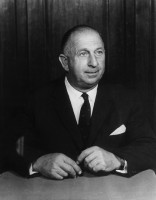
Sir Henry Edward Bolte GCMG (/ˈbɒlti/ BOL-tee; 20 May 1908 – 4 January 1990) was an Australian politician who served as the 38th premier of Victoria from 1955 to 1972. He held office as the leader of the Victorian division of the Liberal Party of Australia (LPA) and was a member of the Victorian Legislative Assembly (MLA) for the division of Hampden from 1947 to 1972. He is the longest-serving premier in Victorian state history, having been in office for over 17 consecutive years.

Early years

[edit]

Bolte was born on 20 May 1908 in Ballarat East, Victoria. He was the son of Anna Jane (née Martin) and James Henry Bolte. His father, a miner, was the son of German immigrants and his mother was also half-German.[1]

Shortly after his birth, Bolte's parents moved the family to Skipton in the Western District where they ran a local pub, the Ripon Hotel. His mother's stepfather William Warren was also a hotel proprietor, running the Skipton Hotel until 1921 when he sold it to the Boltes. During World War I the family faced anti-German sentiment.[1]

Bolte began his education at Skipton State School. He entered Ballarat Grammar School as a boarder in 1922 on a technical scholarship, attending alongside his future parliamentary colleagues Tom Hollway and Edward Montgomery. He left school in 1924 and returned to Skipton, where he had land dealings and ran a haberdashery shop established by his father. He was also active in community organisations, playing cricket and football for local teams, qualifying as a swimming instructor and serving as secretary of the local racing club. His store failed in 1929 and during the Great Depression he worked as a shearer to support himself.[1]

In 1934, with money from his grandmother, Bolte purchased Kialla, a sheep farming property of 900 acres (360 ha) at Bamganie near Meredith. In his early years on the land he faced rabbit plague and supplemented his income by trapping and hunting rabbits. In August 1940, Bolte enlisted in the Militia as a gunner. He was stationed at Puckapunyal for periods as an artillery instructor and pay clerk, but was rejected for overseas service and discharged in January 1943.[1]

Parliamentary career

[edit]

Bolte was founding president of the Liberal Party's Meredith branch in 1945 and was a delegate to its inaugural state council. He first stood for parliament at the 1945 state election, running unsuccessfully in the seat of Hampden, but reprised his candidacy in 1947 and defeated the incumbent Australian Labor Party (ALP) member Raymond Hyatt.[1]

Victorian politics was volatile at this time, with a succession of weak short-term governments. The electoral system was malapportioned in favour of rural areas, which gave the Liberals' junior partner, the Country Party disproportionate power. As a rural Liberal, Bolte despised the Country Party nearly as much as the Labor Party.[2] In April 1935, Country Party leader and Deputy Premier Albert Dunstan unexpectedly withdrew support for the Premier, Stanley Argyle, breaking the coalition agreement and forming a minority Country government, which Labor supported in return for some policy concessions.

When Bolte was elected to Parliament in 1947 the Liberal leader was Thomas Hollway, who also came from Ballarat but was somewhat less conservative than Bolte. In 1951 Hollway tried to reform the electoral system, which caused a split in the Liberal Party and his replacement by Les Norman, with Bolte as Deputy Leader. Norman would lose his seat to Hollway in 1952, and be replaced as leader by Trevor Oldham. When Oldham was killed on BOAC Flight 783 in May 1953, Bolte succeeded him.

The Labor Party under John Cain Sr. had come to power at the 1952 elections, but in 1955 the party suffered a split over the issue of communist influence in the trade unions. With Cain's government reeling, Bolte tabled a no-confidence motion on 19 April. The anti-communist Catholic MPs, who had organised as the Australian Labor Party (Anti-Communist), crossed the floor to support the no-confidence motion, bringing Cain down.

Due in large part to Labor (A-C) directing its second preferences to the Liberals, Bolte won the ensuing election with a huge majority, routing both Labor and the Country Party. There was little hint at the time that he would reverse the pattern of unstable government in Victoria; he headed the state's 11th government in 12 years. However, he was able to form the first stable non-Labor government in Victoria for many years.

Bolte was a rough-hewn politician who liked to be seen as a simple farmer, but he had a shrewd political mind. With the help of the expelled faction of the Labor Party, which became the Democratic Labor Party, Bolte was able to consolidate his position. Due in part to the DLP continuing to direct its preferences to the Liberals at elections, Bolte was reelected six times. His populist attacks on the trade unions, intellectuals, protesters and the press won him a large following. It peaked at the 1967 election, which saw the opposition reduced to just 28 seats (16 Labor and 12 Country) in total.

Infrastructure building

[edit]

Bolte used state debt to provide a wide range of state infrastructure and he was very successful at winning overseas investment for the state. Some of the large projects undertaken during his time in government were increased coal production and power generation in the Latrobe Valley, new offshore oil and gas fields in Gippsland, the West Gate Bridge over the lower Yarra River, a new international airport for Melbourne at Tullamarine and two new universities (Monash University and La Trobe University). The majority of these projects were facilitated, rather than funded, by the State government. Bolte was easily re-elected at the 1958, 1961 and 1964 state elections.

Capital punishment controversy

[edit]

Bolte was a proponent of using capital punishment as a deterrent against violent crime. Many believed he was foiled when Robert Peter Tait who had murdered Ada Hall, an elderly widow, at the Hawthorn vicarage where she lived with her son, and who subsequently had been sentenced to hang for the crime, was granted an eleventh-hour reprieve in 1962 after the High Court had found him insane.[3][4]

Justice Starke subscribed to the substitute Tait theory, Starke had defended Tait but later on was the sentencing judge in the R v Ryan & Walker 1966. Starke said "After Bolte was denied with Tait he simply waited for the next cab off the ranks, and poor Ryan happened to be the next cab!"[3]

In 1965, two prisoners, Ronald Ryan and Peter Walker, had escaped from Melbourne's Pentridge Prison, allegedly killing a prison guard in the process. They were recaptured, and Ryan was sentenced to death for murder. Bolte had the power to recommend clemency, but declined to exercise it, arguing that the death penalty was a necessary deterrent for crime against government officials and law enforcement officers.

All calls for clemency, petitions and protests were to no avail.[5] Bolte was determined that the law be upheld. Ryan was hanged in February 1967. Bolte had said "If I thought the law was wrong I would change it".[6]

A reporter at his daily press conference on the day of the hanging asked what he was doing at the time it took place. Bolte, replied: "One of the three Ss, I suppose." The reporter asked him what he meant. Bolte responded: "A shit, a shave or a shower."[7] Peter Blazey later wrote 'For a man practically devoid of political or social idealism, the hanging had proved a way of tightening his control over cabinet, the party and the press.' Blazey also adds, however, that the Ryan hanging meant Bolte 'had become brutalized politically, even if he didn't know it...'[8]

Bolte's insistence on having Ryan hanged earned him the opposition of the Melbourne press, particularly The Age, the churches, the universities and most of the legal profession. It also alienated sections of the Liberal Party and some members of his own Cabinet, including his eventual successor, Dick Hamer. But Bolte had correctly interpreted the populist appeal of his putative law-and-order stand, and at the 1967 elections the Liberals went from 38 of 66 seats in 1964 to 44 of 73 in 1967.

Later career

[edit]
Bolte with Prime Minister John Gorton in February 1970.

After 1968, when Bolte turned 60, his appeal to younger urban voters declined, and he showed little sympathy with new issues such as the environment and civil liberties. His standing was also reduced by a crisis in the state education system, with teacher shortages and overcrowded schools as the children of the baby boom passed through the education system. The government recruited large numbers of American schoolteachers to deal with the shortage. At the same time the Labor Party began to revive under a new leader, Clyde Holding.

At the 1970 state elections the Liberals seemed in serious danger of losing office, or at least being forced into a coalition with the Country Party, but Bolte was saved by Holding's left-wing enemies in the Labor Party, who sabotaged his campaign by publicly opposing government funding for non-government schools (which Holding and Gough Whitlam had made Labor policy). Nevertheless, the Liberals lost six seats.

Bolte was promoted to Knight Grand Cross of the Order of St Michael and St George (GCMG) in the 1972 New Year Honours.[9] Bolte on various occasions asked the prime minister, William McMahon, to approach the British authorities to have Bolte made a life peer of the UK Parliament. McMahon needed Bolte's political support, so he wrote to 10 Downing Street with a proposal, but it was declined.[10]

As 1972 dawned, the Liberals lost further ground among younger voters in Melbourne. Bolte was shrewd enough to see that the Liberals had a year at most to broaden their appeal before a statutory general election, and concluded that they needed a new leader and a new image for the 1970s. In August 1972, he resigned, apparently with no regrets. He arranged for Deputy Premier Dick Hamer, a somewhat more progressive Melbourne-based Liberal, to succeed him. Despite misgivings from the more conservative wing of the party, Hamer became Liberal leader and premier. This proved a sound judgement, since Hamer went on to win three more elections for the Liberals.

Retirement and death

[edit]

After his resignation and retirement from Parliament, Bolte retired to his farm, 'Kialla', at Bamganie, near Meredith.[1] When the Liberals lost government in Victoria to John Cain, Jr. Liberals in the Opposition would visit Bolte at his farm, "whisky bottle in hand, seeking consolation and advice."[1] Bolte was deeply affected by the sudden death of his wife, Dame Edith, in 1986.[1]

On 24 March 1984, Bolte was involved in a serious head-on accident when he was driving home after an evening in the local hotel near his property at Bamganie. Bolte and the occupants of the other car were taken to the Ballarat Base Hospital, where blood samples were taken to test for alcohol levels. Whilst there was no evidence of alcohol in the blood of the other driver involved, there were indications of an alcohol content in excess of 0.05%, the legal limit in Victoria, in Bolte's blood. Further samples were subsequently collected from the hospital by the police, but these were found to have been substituted, and the sample box containing them had been unlocked by an unknown person. An enquiry found that it would have been unfair to proceed with prosecution because of interference with the evidence.[11][12] Bolte later told author Tom Prior "Of course I know nothing, I was unconscious".[2]

Bolte died at his home on 4 January 1990.[1]

Honours and memorials

[edit]

Bolte was appointed a Knight Commander of the Order of St. Michael and St. George (KCMG) in the New Year's Day honours list of 1966.[13] In the 1972 New Year Honours he was advanced to the rank of Knight Grand Cross (GCMG).[14] Despite "his intense lobbying", Bolte failed to secure a peerage.[1]

His wife, Lady Edith Lilian Bolte, known as Jill Bolte, was appointed a Dame Commander of the Order of the British Empire in the 1973 New Year Honours for "outstanding public service to Victoria".[15]

A portrait of Bolte by William Dargie hangs in Queens Hall at Parliament House Victoria.[16]

Bridge

[edit]

The Bolte Bridge that spans Melbourne's Docklands is named after him.

Further reading

[edit]

References

[edit]

Further reading

[edit]
Revisions and contributorsEdit on WikipediaRead on Wikipedia
from Grokipedia

Sir Henry Edward Bolte GCMG (20 May 1908 – 4 January 1990) was an Australian politician who served as the 38th Premier of Victoria from 28 May 1955 to 23 August 1972, achieving the longest premiership in the state's 20th-century history at 17 years.
As leader of the Liberal and Country Party, Bolte entered parliament in 1947 representing the electorate of Hampden and rose to become Leader of the Opposition in 1953 before assuming the premiership upon his party's election victory.
His tenure emphasized pragmatic economic development, including the completion of the Melbourne-Albury standard-gauge railway in 1962, initiation of Melbourne's underground rail system, construction of freeways, and securing natural gas supplies from the Gippsland Basin to fuel industrial growth and attract investment.
Bolte also expanded education by establishing Monash University in 1961 and La Trobe University in 1967, contributing to Victoria's post-war prosperity amid a focus on rural interests and infrastructure.
However, his direct and assertive leadership style drew controversy, notably in refusing to commute the death sentence of Ronald Ryan, leading to Australia's last execution by hanging on 3 February 1967 despite widespread public, legal, and ecclesiastical opposition—a decision his cabinet upheld to signal firmness on law and order ahead of the 1967 election, which Bolte won with an increased majority.
Other defining tensions included resistance to high-rise public housing projects and a partial retreat from the controversial Little Desert land clearance proposal in 1969, reflecting his prioritization of development over certain environmental or urban planning concerns.
Bolte's legacy endures in Victoria's infrastructural foundations and the Bolte Bridge in Melbourne, named in his honor, though his approach has been critiqued for emphasizing material progress at the expense of broader social reforms.

Early Life

Family Background and Upbringing

Henry Bolte was born on 20 May 1908 in East, Victoria, as the elder son of James Henry (Harry) Bolte, a , , , and prospector, and Anna Jane Bolte (née Martin). Both parental lines traced origins to German immigrants; his paternal grandparents had fled political unrest in for in 1847 before migrating to Victoria in 1852, while his maternal grandparents also held German roots, with Anna's mother remarrying William Warren in 1892. He had at least one younger brother, William David Bolte. The family relocated soon after his birth to in Victoria's western district, where Bolte was raised amid a rural environment centered on his father's publican ventures, including ownership of the Hotel until 1921 and subsequent acquisition of the Hotel. Of stocky build, he earned the childhood nickname "Pud" or "Pudden" and engaged in typical country pursuits such as , , , and , fostering a practical, outdoors-oriented character suited to farming life. This upbringing in a working-class, German-descended of modest means instilled in Bolte a no-nonsense resilience, influenced by his father's varied manual occupations and the demands of regional Victorian life during the early .

Education and Pre-Political Career

Bolte attended State School, where he topped the seventh grade in 1920. In 1922, he secured a junior technical scholarship and became a boarder at , attending until 1924; there he earned the nickname "Pot" due to his stocky build. He did not pursue , making him the last Victorian without a university degree. After leaving school in 1924, Bolte considered careers in politics, the clergy, auctioneering, or banking but instead remained in the district, working various manual jobs, including in shearing sheds during the ; he joined the Australian Workers' Union. In 1934, using funds from his grandmother, he purchased Kialla, a 900-acre (360 ha) sheep farm stocking around 600 sheep at Bamganie near Meredith, Victoria. On 24 November that year, he married Edith Lilian "Jill" Elder, with whom he managed the property, focusing on rabbit control and pastoral operations. During , Bolte enlisted in the Citizens Military Force (Militia) on 20 August 1940 and served until his discharge on 19 January 1943. He continued farming at Kialla until entering politics in 1947, establishing himself as a primary producer in Victoria's western districts.

Rise to Political Prominence

Entry into Parliament

Bolte became involved in politics following his return to civilian life after serving in the Australian Imperial Force during . He agreed to stand as the Liberal candidate for the rural seat of Hampden in the at the 1945 state election, prompted by local party members who struggled to find a nominee, but he was defeated by the incumbent Labor member. At the subsequent 1947 Victorian state election on 8 November, Bolte secured victory in Hampden for the Liberal and Country Party, entering as a at age 39. The electorate encompassed farming districts in western Victoria near his Meredith property, aligning with his background as a local grazier. He held the seat continuously until his retirement in 1972, defeating Labor challengers in multiple elections amid the state's volatile political landscape.

Early Parliamentary Roles and Party Involvement

Bolte was elected to the on 8 November 1947 as the member for Hampden, defeating Labor candidate Raymond Hyett by nearly 2,000 votes. He had previously contested the same seat unsuccessfully in November 1945, losing by approximately 600 votes. The he entered featured volatile alignments among the Liberal, Labor, and parties, with no stable majority. Bolte's engagement with the Liberal Party predated his parliamentary entry; in 1945, he attended the party's inaugural State council as president of the small Meredith branch. On 3 December 1948, under Premier Thomas Hollway's minority Liberal government, Bolte was appointed Minister for Water Supply and Mines, expanding to include Conservation from December 1949; he retained these roles until the government's collapse in June 1950. This brief ministerial tenure positioned him advantageously amid internal party rivalries. Bolte participated in efforts to remove Hollway as leader in 1951, objecting to the proposed "2 for 1" scheme that would have granted additional seats to the Country Party. In December 1951, he was elected deputy leader of the Liberal and Country Party (LCP) under L. G. Norman. Following the death of LCP leader Trevor Oldham in an air crash en route to the in May 1953, Bolte won the leadership ballot, assuming the role of .

Premiership (1955–1972)

Economic Policies and Fiscal Management

Bolte's economic policies emphasized minimal government intervention and promotion of private enterprise, aligning with his declaration upon taking office that his administration would prove "fewer controls will mean greater advancement." He prioritized attracting foreign investment through overseas promotional missions, such as those by the Victoria Promotion Committee established in 1956, which successfully drew multinational firms including Ford and to establish operations in the state. This approach fostered industrial expansion amid the post-war boom, contributing to Victoria's rising from $12,194 in 1955 to $18,584 by 1972, alongside low rates of 1.5% in 1955 increasing modestly to 2.3% by the end of his tenure. Fiscal management under Bolte involved initial deficits in his first four budgets from 1955 to 1959, attributed to rapid growth and demands for expanded public services, followed by efforts to achieve balance as revenues grew. By 1971, the state budget was balanced, incorporating proceeds from payroll taxes, while state debt was leveraged for productive investments, reaching approximately 55% of gross state product by 1962 without leading to fiscal instability. Bolte advocated for home ownership to build a "population of little capitalists," selling Housing Commission properties to encourage involvement, which helped elevate Victoria's home ownership to among the highest globally by 1972. On taxation, Bolte pursued greater state revenue autonomy, seeking devolution of powers in the 1950s and proposing a in 1964, though the latter was abandoned due to opposition in the . He clashed with federal governments over financial arrangements, criticizing the 1959 formula as disadvantaging Victoria and protesting John Gorton's 1968 rejection of the state's stamps duty as an illicit , as well as a 1970 veto of $35 million in funding that was later resolved under in 1971. These policies reflected a commitment to fiscal prudence amid growth, avoiding excessive reliance on high taxes while funding development through rather than expansive welfare spending.

Infrastructure Development and Major Projects

Bolte's government prioritized infrastructure investment as a driver of , funding extensive capital works through increased state borrowing, with public debt rising from approximately 20% to 40% of gross state product over his premiership. This approach enabled the construction of roads, schools, hospitals, and housing on a scale unmatched by previous Victorian leaders, reflecting a focus on physical development to support and industrialization. Key expenditures targeted transport networks, power generation, and urban expansion, with the administration acting as both premier and treasurer to direct funds toward projects like highway upgrades and public facilities. A cornerstone was the 1969 Melbourne Transportation Plan, commissioned under Bolte, which outlined 494 kilometers of new freeways integrated with 520 kilometers of supporting highways, alongside rail and bus enhancements to accommodate projected urban growth to four million residents by 2000. The plan expanded bus routes from 205 (1,813 km total) to 238 (2,977 km), emphasizing car-oriented infrastructure with wide, eight-lane freeways as its "crown jewel," though many proposals faced later community opposition and partial implementation. Complementing this, the government advanced freeway development, adopting the term "freeways" for high-speed routes modeled on international standards, including early segments of the Tullamarine Freeway linking the city to the airport. The Melbourne Underground Rail Loop, a flagship element estimated at $80 million, was planned as a central rail circuit to improve connectivity, with legislative foundations laid during Bolte's tenure despite construction delays post-1972. Beyond transport, major projects included the , initiated in 1965 to span the and ease freight movement, and completion of the power scheme to bolster energy supply for industry. Highway upgrades, such as the 9.24 km Gordon section of the Western Highway opened on 5 May 1972 at a cost of A$4.3 million, exemplified road network expansions to regional areas. These initiatives, coupled with Bass Strait oil and gas field developments, underscored Bolte's strategy of leveraging resource extraction and to decentralize economic activity and reduce Melbourne's dominance.

Social Reforms and Legislative Initiatives

During Bolte's premiership, the Victorian government expanded higher education infrastructure to accommodate post-war population growth and industrialization needs. Legislation establishing was enacted in 1962, with the institution opening in 1961, followed by in 1967; the La Trobe University Library was completed in 1965. In 1965, the Victoria Institute of Colleges was created to coordinate and elevate senior technical colleges to degree-awarding status, aligning with a 1964 policy commitment to advanced technical education. Under pressure from the Democratic Labor Party, grants of $20 were introduced in the late 1960s for secondary students in non-government schools, marking a shift toward state aid for independent education. Public housing initiatives focused on and modernization amid acute shortages, with the Housing Commission reorganized in 1956, emergency settlements like Camp Pell in Royal Park cleared, and rents raised to fund operations. This led to aggressive high-rise developments in inner suburbs, described by contemporaries as a "brutal program" to address demand, though it provoked protests over forced relocations and urban disruption. Legislative measures in health and safety emphasized public welfare through regulation. In 1965, a 0.05 percent blood-alcohol limit was set for motorists to reduce road fatalities. Seatbelt use became mandatory for drivers and front-seat passengers in 1970. Aboriginal welfare policies under the 1957 Aborigines Welfare Board, continued into the 1960s, included targeted provisions for housing loans, educational assistance, medical care, and employment training as part of assimilation efforts. Other social legislation reflected pragmatic adjustments to public habits rather than ideological overhaul. The Racing (Totalizators Extension) Act of 1960 legalized off-course betting to generate revenue for hospitals and welfare. trading hours were extended to 10 p.m. from February 1, 1966, easing prior restrictions. Bolte's government maintained a socially conservative stance, resisting progressive changes such as or homosexual , prioritizing stability over expansive welfare expansions.

Law and Order Policies

Bolte's government emphasized a stringent approach to , prioritizing deterrence and punishment for serious offenses, particularly those involving violence against authority figures. He advocated for stiffer penalties on violent crimes and maintained support for as a measure to uphold public order. This stance reflected a broader conservative that viewed leniency toward such crimes as risking societal . A defining element of Bolte's law and order policies was the enforcement of the death penalty, culminating in the execution of on 3 February 1967 at Pentridge Prison—the last legal hanging in . Ryan had been convicted in 1966 of murdering prison warder George Hodson during an escape attempt from the same facility on 19 December 1965, under Victoria's mandatory death sentence for such capital offenses. Despite widespread protests, petitions with over 36,000 signatures, and appeals from figures including , Bolte's Liberal government declined to commute the sentence on 12 December 1966, citing the murder's direct challenge to state authority. Bolte framed the decision as essential to law and order principles, especially amid an election campaign where he highlighted it as a stand against crime. Bolte's administration resisted efforts to abolish or soften , aligning with his opposition to liberalizing laws on related social issues like and sexual offenses. While specific expansions in police resources or infrastructure under his tenure are less documented, his policies reinforced a punitive framework that prioritized execution for murders of personnel over rehabilitation or reprieve. This approach drew criticism for inflexibility but was credited by supporters with maintaining stability during a period of social upheaval.

Federal-State Relations and Interstate Dynamics

Bolte advocated vigorously for Victoria's financial interests within Australia's federal structure, emphasizing state autonomy and criticizing perceived encroachments by the on taxation and revenue-sharing powers. Throughout his premiership, he ran state deficits in years including 1964, 1966, and 1968–1970, attributing these partly to insufficient federal grants and using budget speeches to press for greater state fiscal independence. In 1959, Bolte demanded the restoration of powers to the states, which the federal government had seized in 1942; the request was denied, and his subsequent challenge failed. The responded by adopting a revised formula for financial assistance to states, but Bolte maintained it shortchanged Victoria relative to its economic contributions. He consistently opposed tied grants, viewing them as undermining state sovereignty, and in 1968 clashed with Prime Minister over Victoria's levy, which Gorton classified as an illicit . Tensions peaked at the February 1970 premiers' conference, where reportedly vetoed an additional $35 million in funding for the states during Bolte's absence, provoking Bolte's public fury and highlighting his combative stance in intergovernmental forums. Relief came in 1971 under , when states secured rights to levy payroll taxes, enabling Bolte to stabilize Victoria's finances. Earlier, Bolte negotiated a favorable supply deal from the Gippsland Basin with Robert Menzies, securing long-term energy resources on advantageous terms. Interstate relations under Bolte centered on defending Victorian primacy, exemplified by his 1972 intervention to thwart a Sydney-headquartered firm's of Melbourne-based , preserving local control over key assets. While personal alliances were limited, Bolte collaborated with fellow premiers like New South Wales' in resisting federal overreach, particularly during Gorton's tenure, fostering ad hoc unity on financial and resource disputes amid underlying state rivalries.

Key Controversies

Capital Punishment Enforcement

During Henry Bolte's premiership from 1955 to 1972, remained on the statute books in Victoria, with Bolte personally advocating its use as a deterrent against and favoring stiffer penalties for such offenses. He enforced the penalty in the case of Ronald Ryan, convicted of murdering prison officer George Henry Hodson during an escape attempt from Pentridge Prison on 28 December 1965; Ryan was hanged at the same facility on 3 February 1967, marking the sole execution in Victoria—and the last in —during Bolte's tenure. No hangings had occurred in the state since Jean Lee and her accomplices in 1951, prior to Bolte assuming office. Bolte refused repeated pleas for clemency, including petitions signed by thousands, appeals from , lawyers, and media outlets, and even internal cabinet reservations about the penalty, insisting the execution proceed as a matter of upholding against deliberate . He publicly affirmed Cabinet's final decision on 16 December 1966, rejecting any reprieve despite Ryan's claims of innocence and doubts raised over evidence linking him to the fatal shot. Bolte framed the as an assault on state , justifying the death sentence under existing law, which required executive review but not mandatory commutation. The Ryan execution drew national protests, strikes by prison officers, and a moment of silence observed across , yet it reinforced Bolte's law-and-order stance without electoral cost; the Liberal government secured an increased majority in the Victorian state election held on 8 March 1967, less than two months later. Bolte's unyielding position contrasted with growing abolitionist sentiments elsewhere, as other Australian jurisdictions had ceased executions earlier, but Victoria retained the practice until formal abolition in 1975, after his retirement.

West Gate Bridge Collapse and Safety Oversight

On October 15, 1970, during the construction of the spanning the in , a 112-meter span (spans 10–11) collapsed at approximately 11:50 a.m., plunging into the river and killing 35 workers while injuring 18 others, marking Australia's deadliest industrial accident. The incident occurred amid efforts to close an 11-centimeter gap between box-girder sections using kentledge weights, which caused under the stress of the innovative but unproven design for the cable-stayed structure. The collapse exposed systemic deficiencies in , including the absence of harnesses for riggers working at heights and reliance on rudimentary shields for welders, reflecting broader lax standards in Victoria's projects during the era. As , Henry Bolte responded swiftly the following day, October 16, by announcing the immediate establishment of a to investigate the causes, halting all construction and expressing shock at the tragedy. This inquiry, led by a under Bolte's Liberal-Country government, attributed the failure primarily to errors in , inadequate by contractors, and omissions by engineers, rather than direct governmental regulatory lapses, though it underscored the risks of rushed major projects without robust independent oversight. The Royal Commission's findings prompted legislative reforms in workplace health and safety across Victoria and nationally, including stricter regulations on high-risk and improved fall protection measures, though critics noted that pre-collapse under Bolte's administration had been minimal, prioritizing rapid delivery over precautionary inspections. Bolte's government facilitated compensation payments to victims' families, totaling significant sums from project insurers and state funds, but the event fueled debates on balancing with worker protections in an era of aggressive state-led building programs. No criminal charges resulted from , which focused on technical and managerial accountability among private firms like the main contractor World Services and General Steel, rather than public officials.

Retirement and Post-Premiership

Transition from Office

Bolte informed his cabinet of his intention to resign as on 10 July 1972, following 17 years in office. He publicly announced his retirement the following day, 11 July 1972, stating he would step down effective 23 August 1972. At age 63, Bolte cited the need for the Liberal Party to adopt a fresher image to appeal to younger voters in the , recognizing that his conservative style had served its purpose but required evolution. In selecting a successor, Bolte endorsed his deputy, , a Melbourne-based progressive Liberal, to lead the party forward despite resistance from its conservative faction. Bolte's influence ensured Hamer's ascension, with the transition occurring seamlessly; Hamer assumed the premiership on 23 August 1972, marking the end of the Bolte ministry. This handover maintained Liberal continuity in Victoria, where Bolte's governments had secured five consecutive election victories since 1955. The retirement was viewed as pragmatic rather than compelled by health or scandal, allowing Bolte to exit on his terms after overseeing significant state growth. He retired fully from politics, returning to his farm 'Kialla' near Bamganie, without immediate involvement in party affairs.

Later Public Engagements

Following his retirement from the premiership on 23 August 1972, Bolte assumed several prominent roles in Victoria's sporting institutions, including serving as a committeeman of the Victoria Racing Club and as a trustee of the Melbourne Cricket Ground. He also joined the boards of directors for various Australian companies, leveraging his extensive political experience in corporate governance. These positions reflected his longstanding interest in racing and cricket, activities he had pursued personally throughout his life. Bolte maintained informal involvement in politics, particularly within Liberal Party circles, where he offered advice to opposition members at his Bamganie farm, often during private discussions accompanied by whisky. After , he provided guidance to Victorian Liberal figures on and endorsed select candidates, though he eschewed formal offices. Publicly, he voiced opposition to policies of the federal Whitlam Labor government (1972–1975), criticizing its centralizing tendencies and economic approaches in media statements and private correspondences that influenced state Liberal discourse. On 24 March 1984, Bolte sustained serious injuries in a head-on car accident near his Kialla , an incident that involved a switched blood sample and no subsequent charges; he recovered sufficiently to resume limited engagements thereafter. His public activities tapered in later years, particularly after the death of his wife, Dame Edith Bolte, in 1986, though he continued selective advisory roles until his own death on 4 January 1990.

Death, Honours, and Legacy

Death and Immediate Aftermath

Sir Henry Bolte died of lung cancer on 4 January 1990 at his farm home in Bamganie, Victoria, aged 81. He continued smoking until the end, reportedly joking that his final cigarette would be in the crematorium. Bolte's death prompted widespread recognition of his transformative influence on Victorian governance, with media outlets framing it as the close of a defining era in the state's political history. He was cremated following a state memorial service held at St Paul's Cathedral in Melbourne, attended by political figures from across party lines, including tributes from Labor Premier John Cain acknowledging Bolte's enduring legacy in state development. The service underscored his status as Victoria's longest-serving premier, with public and official condolences highlighting his role in post-war infrastructure expansion and fiscal prudence.

Awards and Recognitions

Bolte was appointed Knight Commander of the Order of St Michael and St George (KCMG) in the New Year's Honours List of 1 January 1966, in recognition of his political service as Premier of Victoria. This honour elevated him to the style of "Sir Henry Bolte". Following his retirement from the premiership on 23 August 1972, Bolte's knighthood was advanced to Knight Grand Cross of the Order of St Michael and St George (GCMG) in the New Year Honours announced on 1 January 1972, acknowledging his 17-year tenure and contributions to state governance. These were the principal formal honours conferred upon him during his public career, reflecting imperial recognition of his leadership in fostering economic growth and infrastructure development in Victoria.

Memorials and Commemorations

The Bolte Bridge, a cable-stayed structure spanning the in central , was named after Henry Bolte when it opened on 16 1999. Completed as part of the city's and Docklands development, the bridge features two 140-meter-high towers and carries four lanes of traffic in each direction across its twin spans, symbolizing Bolte's contributions to Victorian infrastructure during his premiership. The naming decision by then-Premier honored Bolte's record as Victoria's longest-serving premier from 1955 to 1972. A life-sized bronze of Bolte, sculpted by Peter Corlett, stands in Treasury Gardens adjacent to the Old Treasury Building in Melbourne's Treasury Place. Erected as part of a series commemorating former Victorian premiers, the statue depicts Bolte in a relaxed pose with hands in pockets, reflecting his informal public persona. In , a honors Bolte for his services to Victoria and the region, where he maintained farming interests. Additionally, a bust commemorates him in Meredith, his longtime rural base, unveiled during the town's 175th anniversary celebrations in 1983. The Sir Henry Bolte Institute, founded to preserve his legacy, operates as an educational body focused on his political and economic principles, hosting lectures and publications. These tributes underscore Bolte's enduring recognition for advancing Victoria's post-war development, though they have drawn occasional debate over his controversial stances on issues like .

Enduring Historical Impact and Assessments

Bolte's 17-year premiership from 1955 to 1972 underpinned Victoria's economic transformation, with the state's growing from 2.4 million to 3.4 million and expanding to establish it as Australia's industrial hub. His government invested heavily in , including the completion of the -Albury in 1962, the establishment of in 1961 and in 1967, and the securing of from the Gippsland Basin, which fueled industrial and residential expansion. These developments, financed through state debt and overseas investment, laid the groundwork for 's and Victoria's long-term competitiveness. Politically, Bolte's tenure introduced stability after a pre-1955 era of eight premiers in twelve years, enabling six consecutive election victories and solidifying Liberal Party dominance through a pro-business, low-intervention approach that prioritized private enterprise and home ownership—achieving the world's highest per capita rate by 1972. This model emphasized fiscal restraint alongside targeted public spending on essentials like schools, hospitals, and freeways, fostering small business prosperity and regional pride. Historical assessments portray Bolte as Victoria's most effective 20th-century premier, credited by contemporaries like for strategic economic focus and by as the state's greatest leader for his decisiveness and media savvy in attracting investment from firms like Ford and . Biographers note his evolution from an "accidental leader" into a tactical master who refined the of the rural-rooted, business-aligned state executive, though without a deep commitment to . While his conservative governance resisted progressive shifts on issues like state aid for non-government schools until later concessions, his legacy endures in Victoria's endowment and as a benchmark for authoritative, growth-oriented .

References

Add your contribution
Related Hubs
User Avatar
No comments yet.