Hubbry Logo
HeresiarchHeresiarchMain
Open search
Heresiarch
Community hub
Heresiarch
logo
8 pages, 0 posts
0 subscribers
Be the first to start a discussion here.
Heresiarch
Heresiarch
from Wikipedia
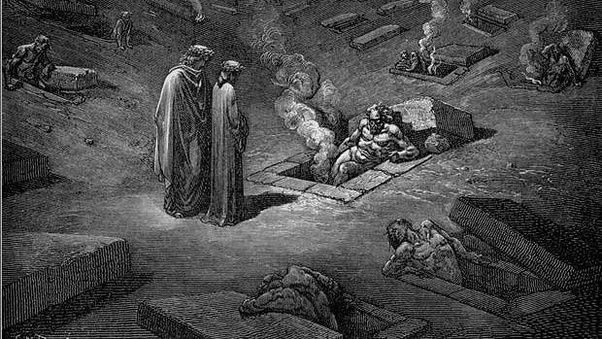
In this Gustave Dore engraving, Dante and Virgil speak to a Heresiarch trapped within a burning tomb. Dante placed arch-heretics in the Sixth Circle of Hell.

In Christian theology, a heresiarch (also hæresiarch, according to the Oxford English Dictionary; from Greek: αἱρεσιάρχης, hairesiárkhēs via the late Latin haeresiarcha[1]) or arch-heretic is an originator of heretical doctrine or the founder of a sect that sustains such a doctrine.[1]

List of heresiarchs

[edit]

Dante's Inferno

[edit]

In his Divine Comedy, Dante Alighieri represents the heresiarchs as being immured in tombs of fire in the Sixth Circle of Hell. In Cantos IX and X of the Inferno, Virgil describes the suffering these souls experience, saying "Here are the Arch-Heretics, surrounded by every sect their followers... / Like with like is buried, and the monuments are different in degrees of heat."[4] Among the historical figures that Dante specifically lists as arch-heretics are Epicurus, Farinata Degli Uberti, Frederick II of Sicily, and Pope Anastasius II.

See also

[edit]

References

[edit]
Revisions and contributorsEdit on WikipediaRead on Wikipedia
from Grokipedia
A heresiarch is the originator or chief proponent of a heresy, typically referring to a leader who establishes or advances doctrines deemed contrary to orthodox Christian teachings. The term, entering English in the 1620s, derives from Late Latin haeresiarcha, borrowed from Late Greek hairesiarkhēs, a compound of hairesis ("choice, faction, or sect") and archēs ("leader" or "ruler"), originally connoting a head of a philosophical or doctrinal school. In ecclesiastical history, heresiarchs have been identified with key figures propagating divergent views, such as Arius, whose subordinationist Christology sparked Arianism and prompted ecumenical councils to affirm Trinitarian orthodoxy. The label carries a pejorative weight, emphasizing not mere dissent but systematic leadership in error as viewed by prevailing doctrinal authorities, influencing theological polemics and canon law across centuries.

Definition and Etymology

Core Meaning and Usage

A heresiarch denotes the originator, founder, or chief proponent of a , particularly one who leads or establishes a movement propagating doctrines opposed to orthodox religious standards. In religious discourse, especially , it refers to a figure who initiates or heads a sustaining heterodox beliefs, such as (c. 256–336 CE), originator of denying Christ's full divinity, or (1483–1546), founder of viewed by Catholics as schismatic. The term's usage underscores agency in doctrinal , distinguishing the heresiarch from mere adherents by their in and organization. Historically, it appears in writings from the early onward, applied to arch-heretics challenging creedal authority, as in Joseph Hall's 1625 polemics against nonconformists. Beyond , analogous applications occur in other traditions to denote leaders, though primary connotations remain tied to monotheistic debates.

Linguistic Origins

The term heresiarch derives from Late Greek hairesiarkhēs (αἱρεσιάρχης), combining hairesis (αἵρεσις), meaning "choice," "school of thought," or "faction," with arkhēs (ἄρχης), denoting a "leader" or "ruler." The root hairesis stems from the verb hairein (αἱρεῖν), "to choose" or "to take," reflecting an original connotation of selecting beliefs or doctrines, which later evolved in Christian contexts to imply deviation from orthodoxy. This Greek compound passed into as haeresiarcha, where it retained the sense of a "leader of a " or "arch-heretic," often applied to founders of doctrinal schisms. The Latin form influenced French hérésiarque before entering English directly via ecclesiastical texts in the early , with the recording its earliest attested use in 1625 by Bishop Joseph Hall, who employed it to denote a chief proponent of . In linguistic evolution, the word's adoption mirrors the patristic tradition of labeling influential dissenters, such as or , as heads of erroneous schools, emphasizing leadership in heterodox movements rather than mere adherence. Its rarity in secular English underscores its specialized theological provenance, persisting primarily in discussions of ecclesiastical history without significant semantic shifts.

Theological Context in Christianity

Heresy as Deviation from Orthodoxy

In , heresy denotes a deliberate and obstinate divergence from the orthodox doctrines derived from , Scripture, and the interpretive authority of the Church, often manifesting as the promotion of novel teachings that contradict foundational truths such as the nature of , , or . This conception emerged prominently in the patristic era, where was viewed as the unbroken paradosis (handing down) of faith from the apostles, preserved against innovations through episcopal succession and communal discernment. Early writers like of Lyons (c. 130–202 AD) framed heretics as fabricators of speculative systems—such as Gnostic cosmologies—that fragmented the unity of Scripture and tradition, substituting private interpretations for the Church's "." The provides scriptural precedents for this understanding, warning against "destructive heresies" introduced by false teachers who deny the Lord who bought them (2 Peter 2:1) or preach a different gospel, warranting (Galatians 1:8–9). By the second century, such deviations were systematically opposed, as heretics were seen not merely as erring individuals but as schismatics who chose (hairesis, from Greek for "choice" or "") factional opinions over consensual truth, thereby endangering the of believers. This framework crystallized in responses to specific challenges: for instance, (c. 144 AD) rejected the as inferior, prompting orthodox affirmations of scriptural continuity, while Valentinian posited a flawed , countered by insistence on creation's goodness. Ecclesiastical definitions reinforce heresy as culpable deviation post-initiation into the . The , in its (promulgated 1992), specifies heresy as "the obstinate post-baptismal of some truth which must be believed with divine and catholic , or likewise an obstinate doubt concerning the same." aligns closely, defining heresy as an erroneous teaching that turns away from the and the dogmatic decisions of the seven ecumenical councils (325–787 AD), resulting in separation and loss of sacramental communion. In both traditions, functions as a bulwark, delineated through synods like (325 AD), which condemned Arianism's subordination of the to the , affirming homoousios () to preserve Trinitarian coherence against subordinationist deviations. This paradigm of heresy as deviation underscores causal mechanisms in doctrinal disputes: innovations often arise from philosophical accretions (e.g., influencing dualism) or interpretive liberties, prompting orthodox clarification to maintain logical and empirical fidelity to Christ's historical , as evidenced by the rapid proliferation and subsequent refutation of proto-heretical groups within decades of apostolic witness. While some modern scholars question the anachronistic application of "" to pre-conciliar diversity, patristic sources consistently portray it as emergent consensus against verifiable falsehoods, prioritizing fidelity to over pluralistic tolerance.

Role and Identification of Heresiarchs

In Christian theology, particularly within patristic and conciliar traditions, a heresiarch denotes the founder or chief proponent of a heresy, actively disseminating doctrines deemed contrary to apostolic teaching and ecclesiastical consensus. This role entails not merely personal error but the organization and propagation of heterodox views, often attracting adherents and fracturing communal unity, as evidenced by figures like Arius, whose subordinationist Christology prompted widespread debate in the early fourth century. The heresiarch's influence is viewed as corrosive to the deposit of faith, prioritizing novel interpretations over scriptural and traditional norms, thereby assuming responsibility for the spiritual peril of followers. Identification of heresiarchs historically occurred through deliberative processes by church authorities, including local synods and ecumenical councils, which evaluated teachings against criteria such as fidelity to the canon of Scripture, the (regula fidei), and prior conciliar definitions. For instance, the Council of Nicaea in 325 AD explicitly condemned and his associates after scrutinizing their writings and public statements, affirming the of the Son with the Father to counter Arian denials of divine equality. Subsequent councils, such as in 431 AD against , followed similar protocols: summoning the accused, debating scriptural , and issuing anathemas upon finding deviation from , with decisions binding on the universal church. This method emphasized collective episcopal discernment over individual judgment, ensuring that heresiarchs were not merely dissenters but leaders whose errors warranted formal exclusion to preserve doctrinal integrity. Theological assessments underscore that heresiarchs differ from ordinary heretics by their authoritative or charismatic leadership, which amplifies the threat to ; early writers like of Lyons (c. 130–202 AD) highlighted this in critiquing Gnostic originators for fabricating secret knowledge systems alien to public . Such identification served a preservative function, clarifying boundaries of acceptable belief and prompting creedal formulations, though critics from heterodox perspectives have occasionally reframed heresiarchs as innovative reformers challenging institutional rigidity. Empirical patterns from conciliar records reveal that most condemnations targeted alterations to core soteriological or Trinitarian tenets, with over 90% of early heresies involving Christological disputes by the fifth century, as cataloged in patristic polemics.

Historical Development and Examples

Early Church Period (1st-5th Centuries)

In the Early Church period, heresiarchs were prominent figures who formulated and disseminated teachings deemed deviations from apostolic doctrine, often prompting responses from church leaders and councils to delineate orthodoxy. These individuals typically drew followers by emphasizing philosophical speculations or scriptural reinterpretations that conflicted with emerging consensus on Christ's nature, the , and salvation. Church fathers like of Lyons (c. 130–202 AD) and (c. 155–220 AD) identified such leaders as sources of error, tracing many heresies back to figures like in the 1st century, who blended magic and proto-Gnostic ideas, as described in Acts 8:9–24 and elaborated in later patristic critiques. Marcion of Sinope (c. 85–160 AD) exemplifies an early heresiarch, rejecting the Hebrew Scriptures' God as a flawed Demiurge distinct from Christ's Father and compiling a truncated canon excluding the Old Testament and much of the New. Excommunicated around 144 AD by the Roman church under Bishop Pius I for these views, Marcion established parallel communities that persisted for centuries, influencing debates on scripture's unity. His dualistic theology, portraying the Old Testament deity as inferior, was refuted by Tertullian in Adversus Marcionem (c. 207–212 AD), which argued for scriptural continuity. Gnostic heresiarchs proliferated in the , with Valentinus (c. 100–160 AD) developing a complex cosmology of emanations (aeons) and secret knowledge () for salvation, nearly becoming bishop of in 143 AD before his teachings—positing Christ as a spiritual being untainted by flesh—were rejected. (fl. c. 120–140 AD) similarly taught 365 heavens and a doctrine minimizing ' suffering, influencing esoteric sects critiqued by in Adversus Haereses (c. 180 AD). These systems, blending and , were condemned for undermining the incarnation's materiality and the creator God's goodness. By the 3rd century, Mani (c. 216–274 AD) founded , syncretizing Christian, Zoroastrian, and Buddhist elements into a radical dualism of light versus darkness, with Christ as a prophet among others; persecuted and executed under , his followers spread widely until Augustinian conversion highlighted its appeal and errors. The 4th century saw (c. 256–336 AD), an Alexandrian , assert the Son's creation "before time" and subordination to the Father, sparking empire-wide controversy resolved at the Council of Nicaea (325 AD), where 318 bishops anathematized and affirmed homoousios (same substance). Arius' death in 336 AD amid imperial recall underscored the heresy’s volatility, though variants lingered. In the 5th century, (c. 360–418 AD), a British ascetic, denied original sin's transmission and human depravity, advocating free will's sufficiency for righteousness; condemned at the Council of Carthage (418 AD) and (431 AD), his views clashed with Augustine's emphasis on grace, as detailed in Augustine's De Peccato Originali (418 AD). (c. 386–451 AD), of from 428 AD, distinguished two separate persons (divine and human) in Christ, rejecting for Christotokos; deposed at the (431 AD) by 200 bishops, his was reframed in orthodox Chalcedonian terms (451 AD). These figures' influence necessitated ecumenical councils, solidifying creeds against doctrinal fragmentation.

Medieval and Reformation Era

In the late medieval period, the intensified efforts to suppress dissenting movements that deviated from orthodox doctrine, often identifying charismatic leaders as heresiarchs responsible for propagating . (c. 1320–1384), an English theologian and scholar, emerged as a prominent figure whose critiques of , papal authority, , and the veneration of saints positioned him as a heresiarch in ecclesiastical eyes. His advocacy for translating the into English and emphasizing scripture over tradition inspired the Lollard movement, which persisted despite suppression. The posthumously condemned Wycliffe as a heretic in 1415, ordering his exhumation and burning of remains in 1428 to symbolically eradicate his influence. Similarly, (c. 1369–1415), a Bohemian priest influenced by Wycliffe's writings, preached against indulgences, , and the moral corruption of the clergy, attracting followers who formed the Hussite movement. Convicted of heresy at the for denying the full authority of the Church over scripture and asserting the right of lay communion in both kinds, Hus was burned at the stake on July 6, 1415. His execution sparked the (1419–1434), a series of conflicts in that challenged papal and imperial authority, highlighting the volatile tensions between reformist impulses and orthodoxy. During the Reformation era, the term heresiarch was frequently applied by Catholic authorities to Protestant leaders who rejected core doctrines such as the sacramental system and . (1483–1546), a German monk and theologian, was declared a heretic in Pope Leo X's 1520 bull for teachings on justification by faith alone and the bondage of the will, culminating in his excommunication the following year after refusing to recant at the Diet of Worms. Figures like Ulrich Zwingli (1484–1531) in and (1509–1564) in faced analogous condemnations for iconoclasm, predestination doctrines, and denial of transubstantiation, fueling schisms that fragmented Western Christendom. These leaders' emphasis on and was viewed by opponents as reviving ancient heresies, though their movements gained traction amid widespread dissatisfaction with clerical abuses and the sale of indulgences.

Cultural and Literary Depictions

In Dante's Works

![Gustave Doré's depiction of the heresiarchs in the sixth circle of Hell][float-right] In Dante Alighieri's Inferno, the first part of the Divine Comedy composed around 1308–1320, heresiarchs are consigned to the sixth circle of Hell, a vast cemetery-like plain where heretics who denied the immortality of the soul lie eternally in flaming tombs. This punishment symbolically mirrors their Epicurean belief that the soul perishes with the body, confining them to sepulchers that burn without consuming, emphasizing a perpetual material torment. Dante encounters two prominent Florentine heresiarchs in Canto 10: (d. 1264), a Ghibelline leader, and Cavalcante de' Cavalcanti, both adherents of . rises nobly from his fiery tomb, engaging Dante in discourse on Florentine politics and the heretics' foresighted vision limited to past and future events but blind to the present, underscoring their disconnection from divine eternity. Cavalcante briefly interrupts, mistaking Dante's silence for disdain toward his son , revealing the heresiarchs' persistent earthly attachments amid their torment. Dante's portrayal draws on medieval theology equating Epicurean denial of with , positioning these leaders as exemplars of intellectual pride that rejects orthodox . The episode also alludes to historical figures like , whose tomb is inscribed with accusations of monophysite , broadening the circle to include deviants. No explicit heresiarchs appear in or Paradiso, where focus shifts to penitents and the blessed aligned with Catholic doctrine.

Broader Literary and Symbolic Uses

In , the term heresiarch has been employed metaphorically to denote innovators who disrupt established artistic or intellectual orthodoxies, akin to religious sect founders. For instance, sociologist analogized painter as a "heresiarch" of the , paralleling Gustave Flaubert's role in , to illustrate how such figures challenge field-specific dominants through autonomous assertion against academic conventions. This usage underscores the symbolic role of the heresiarch as an agent of rupture, fostering new by defying consecrated norms, as analyzed in Bourdieu's The Rules of Art (1992), where Manet's Impressionist innovations are framed as heretical breaks from Salon traditions. In interpretations of ancient , the heresiarch motif emerges in scholarly exegeses of 's Li sao (circa 3rd century BCE), where it symbolizes the poet's alienated dissent from courtly , intertwined with shamanistic visions of otherworldly exile. Academic works, such as David Hawkes' The Songs of the South (1985) and subsequent analyses, portray as a proto-heresiarch whose lyrical defiance evokes heretical leadership against ritualistic conformity, blending mythic rebellion with political critique. This symbolic extension highlights the heresiarch as an of visionary isolation, where personal catalyzes cultural introspection, distinct from strictly theological connotations. Broader symbolic appropriations appear in , extending the heresiarch to secular or interstellar schisms; in the Star Wars franchise's expanded lore, heresiarchs lead doctrinal cults deviating from imperial or Force-based orthodoxies, representing engineered in galactic power structures. Such depictions, drawn from licensed novels and media post-1990s, recast the term as a narrative device for exploring ideological fractures beyond Abrahamic traditions, emphasizing causal chains of in fictional empires.

Significance and Controversies

Defense of Orthodoxy Against Heresiarchs

The defense of Christian orthodoxy against heresiarchs primarily involved systematic theological refutations, ecumenical councils, and ecclesiastical disciplines aimed at preserving apostolic doctrines such as the Trinity and the Incarnation, which heresies threatened to undermine by introducing speculative innovations unsupported by Scripture and tradition. Church Fathers emphasized that heresies originated recently and deviated from the unified teaching handed down from the apostles, contrasting with the antiquity and consensus of orthodox belief. This approach relied on scriptural exegesis, appeals to historical succession, and communal discernment to expose logical inconsistencies and spiritual dangers in heretical systems, such as Gnostic dualism or Arian subordinationism. Irenaeus of Lyons, in his work Adversus Haereses composed around 180 AD, provided an early comprehensive critique of Gnostic heresiarchs like Valentinus, arguing that their secret knowledge (gnosis) contradicted the public revelation of Christ and the apostles, while affirming the unity of God and creation against docetic denials of the Incarnation's materiality. Similarly, Athanasius of Alexandria vigorously opposed Arius, the heresiarch whose teachings portrayed Christ as a created being inferior to the Father, through treatises like Orations Against the Arians and his leadership at the Council of Nicaea in 325 AD, where Arius was anathematized for subverting the Son's eternal divinity and consubstantiality (homoousios) with the Father as essential to salvation. These efforts underscored that heresies not only erred doctrinally but eroded the Church's soteriological foundation, as only a fully divine Savior could redeem humanity. Ecumenical councils formalized these defenses by convening bishops to deliberate and condemn specific heresiarchs, issuing creeds and canons to clarify . The in 431 AD deposed and excommunicated , whose Christological separation of divine and human natures into two persons undermined the , affirming instead Mary's title as (God-bearer) to safeguard the single person of Christ. Subsequent councils, such as in 451 AD, extended this by rejecting ' , which absorbed Christ's humanity into divinity, thus reinforcing dyophysite against extremes that either divided or confused the natures. These gatherings, attended by hundreds of bishops, demonstrated the Church's conciliar mechanism for resolving disputes through majority consensus rooted in prior tradition, often resulting in imperial enforcement to prevent schisms. Disciplinary measures, including and imperial edicts, complemented intellectual defenses by isolating heresiarchs and their followers, as seen in the exile of and the suppression of Nestorian communities, which preserved unity amid threats of fragmentation. Critics of this approach, such as modern scholars questioning early orthodoxy's dominance, overlook the empirical continuity of credal formulas across patristic writings and the rapid marginalization of condemned views, evidencing as rather than primitive diversity. Ultimately, these defenses prioritized causal to Christ's revealed identity over tolerant pluralism, viewing unchecked as a vector for doctrinal corruption and communal dissolution.

Alternative Views on Heresiarchs as Reformers

Some scholars contend that heresiarchs, rather than merely deviating from , often sought to perceived doctrinal corruptions or inconsistencies with scriptural or philosophical foundations. In this perspective, figures condemned as heretics functioned as catalysts for theological clarification, challenging institutional dogmas that had accreted over time. For example, Protestant historiography portrays (c. 1328–1384), posthumously declared a heretic at the in 1415 for views on papal authority and , as the "Morning Star of the " due to his advocacy for translation into English vernacular and critiques of clerical wealth accumulation, which anticipated sixteenth-century Protestant emphases on . Similarly, (c. 1370–1415), executed as a heretic for preaching against indulgences and , is reevaluated by Reformation-influenced scholars as a reformer who prioritized and scriptural fidelity over , influencing later figures like . Hus's burning at the stake in 1415 underscored tensions between reformist impulses and conciliar condemnations, yet his ideas persisted, contributing to Bohemian religious movements. In , theologian argues in Arius: Heresy and Tradition (1987) that (c. 256–336), originator of , was not an aberrant innovator but represented a strand of Alexandrian tradition concerned with preserving God's absolute unity and transcendence against formulations risking or modalism. Williams posits that Arian debates, culminating at the Council of Nicaea in 325, refined by exposing logical tensions in Christological language, framing Arius's subordination of the Son as an attempt to uphold monotheistic rigor rather than deny Christ's significance. Pelagius (c. 360–418), condemned for denying original sin's , is interpreted by certain analysts as a moral reformer reacting to ethical laxity in fifth-century , emphasizing and personal accountability as aligned with divine justice and human dignity, countering what he viewed as deterministic excesses in Augustine's grace theology. This view attributes to Pelagius a corrective intent, fostering accountability amid societal decay, though his ideas were anathematized at the in 431. These reformist interpretations, often from Protestant or revisionist scholarly traditions, contrast with orthodox condemnations by highlighting how heresiarchs' challenges prompted doctrinal consolidation, albeit at the cost of their marginalization; however, such views risk retrojecting later priorities onto ancient contexts, where heresy designation typically reflected consensus on apostolic fidelity.

References

Add your contribution
Related Hubs
User Avatar
No comments yet.