


Community hub
Recent from talks
Contribute something
Nothing was collected or created yet.
Ermanaric
View on Wikipedia

Key Information


Ermanaric[a] (died 376) was a Greuthungian king who before the Hunnic invasion evidently ruled a sizable portion of Oium, the part of Scythia inhabited by the Goths at the time. He is mentioned in two Roman sources: the contemporary writings of Ammianus Marcellinus, and in Getica by the sixth-century historian Jordanes. He also appears in a fictionalized form in later Germanic heroic legends.
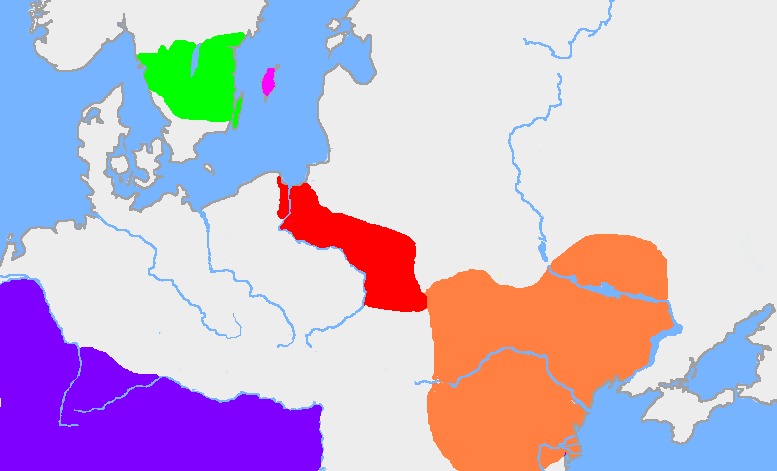
Modern historians disagree on the size of Ermanaric's realm. Herwig Wolfram postulates that he at one point ruled a realm stretching from the Baltic Sea to the Black Sea as far eastwards as the Ural Mountains.[1] Peter Heather is skeptical of the claim that Ermanaric ruled all Goths except the Tervingi, and furthermore points to the fact that such an enormous empire would have been larger than any known Gothic political unit, that it would have left bigger traces in the sources and that the sources on which the claim is based are not nearly reliable enough to be taken at face value.[2]
Etymology
[edit]The first element of the name Ermanaric appears to be based on the Proto-Germanic root *ermena-, meaning 'universal'.[3] The second element is from the element *-rīks, Gothic reiks, meaning 'ruler'; this is found frequently in Gothic royal names.[4]
In Roman sources
[edit]According to Ammianus, Ermanaric was "a most warlike king" who eventually committed suicide, faced with the aggression of the Alani and of the Huns, who invaded his territories in the 370s. Ammianus says he "ruled over extensively wide and fertile regions".[5][6] Ammianus also says that after Ermanaric's death, a certain Vithimiris was elected as the new king.
According to Jordanes' Getica, Ermanaric ruled the realm of Oium. Jordanes describes him as a "Gothic Alexander" who "ruled all the nations of Scythia and Germania as they were his own". Jordanes also states that the king put to death a young woman named Sunilda (Svanhildr) with the use of horses, as punishment for her husband's treason. Thereupon her two brothers, Sarus and Ammius, severely wounded Ermanaric, leaving him unfit to defend his kingdom from Hunnic incursions. Variations of this legend had a profound effect on medieval Germanic literature, including that of England and Scandinavia (see Jonakr's sons). Jordanes claims that he successfully ruled the Goths until his death aged 110.
Edward Gibbon gives the version of Ammianus and Jordanes as historical, reporting that Ermanaric successively conquered, during a reign of about 30 years from AD 337 to 367, the west-goths, the Heruli, the Venedi and the Aestii, establishing a kingdom which ranged from the Baltic to the Black Sea;[7] and died aged 110 of a wound inflicted by the brothers of a woman whom he had cruelly executed for her husband's revolt, being succeeded by his brother Vithimiris.[8]
In Germanic sources and legends
[edit]Ermanaric appears in a variety of different Germanic heroic legends.
Jǫrmunrekkr is the Old Norse form of the name.[9] Ermanaric appears in Anglo-Saxon and Scandinavian legend. In the former, the poem Beowulf focused on the image of "Eormenric's wiles and hatred".[10] He is described in the tenth century poem Deor as a powerful but treacherous king: "We have heard of the wolfish mind of Eormanric: far and wide he ruled the people of the realm of the Goths: he was a cruel king".[9]
The death of Svanhildr (Svanhildr Sigurðardóttir) and Ermanaric's (Jörmunrek) subsequent death at the hands of Jonakr's sons occupies an important place in the world of Germanic legend. The tale is retold in many northern European stories, including the Norse poems Ragnarsdrápa, Hamðismál and Guðrúnarhvöt, the Prose Edda and the Volsunga Saga; the Norwegian Ragnarsdrápa; the Danish Gesta Danorum; and the German Nibelungenlied[11] and Annals of Quedlinburg.
In the Norse Thidreks Saga, translated from Low German sources, Ermanaric is ill-advised by his treacherous counsellor Bicke, Bikka, Sifka, or Seveke (who wants revenge for the rape of his wife by Ermanaric),[12] with the result that the king puts his own wife to death for supposed adultery with his son;[13] he is thereafter crippled by his brothers-in-law in revenge.[14]
In the Middle High German poems Dietrichs Flucht, the Rabenschlacht, and Alpharts Tod about Dietrich of Bern, Ermanaric is Dietrich's uncle who has driven his nephew into exile.[15] The early modern Low German poem Ermenrichs Tod recounts a garbled version of Ermanaric's death reminiscent of the scene told in Jordanes and Scandinavian legend.[16]
Name
[edit]Ermanaric's Gothic name is reconstructed as *Airmanareiks. It is recorded in the various Latinized forms:
- in Jordanes' Getica, he is called Ermanaricus or Hermanaricus, but some of the manuscripts even have Armanaricus, Hermericus, Hermanericus etc.
- in Ammianus' Res gestae, he is Ermenrichus (his name occurs only once).
In medieval Germanic heroic legend, the name appears as:
- Old English Eormenric in Beowulf; the alternative spelling Eormanric occurs in the poems Deor and Widsith,
- Old Norse Jǫrmunrekkr
- (or, borrowed from Low German) Ermenrekur, Old Swedish Ermenrik or Ermentrik in the Swedish Didrik Saga,
- Middle High German Ermenrîch.
Since the name Heiðrekr may have been confused with Ermanaric[citation needed] through folk etymology, Ermanaric is possibly identifiable with Heiðrekr Ulfhamr of the Hervarar saga.
See also
[edit]Notes
[edit]- ^ Gothic: *Aírmanareiks; Latin: Ermanaricus or Hermanaricus; Old English: Eormanrīc [ˈeorˠmɑnriːtʃ]; Old Norse: Jǫrmunrekkr [ˈjɔrmunrekr], Middle High German: Ermenrîch
References
[edit]- ^ Wolfram, Herwig (1997). The Roman Empire and Its Germanic Peoples. University of California Press. p. 27. ISBN 0-520-08511-6. Retrieved 2 November 2013.
- ^ Heather, Peter (1991). Goths and Romans 332-489. Oxford University Press. pp. 86–89. ISBN 0-19-820234-2.
- ^ Gillespie 1973, p. 39.
- ^ Gillespie 1973, p. 30.
- ^ Michael Kulikowski (2007), Rome's Gothic Wars, pp. 111, 112, ISBN 9780521846332
- ^ Ammianus Marcellinus, Thayer (ed.), Res Gestae XXXI 3
- ^ Edward Gibbon, The Decline And Fall Of The Roman Empire, (The Modern Library, 1932), chap. XXV., pp. 890, 891
- ^ Gibbon, Ibid. chap. XXVI., pp. 920, 921
- ^ a b Deor, quoted in J R R Tolkien, The Legend of Sigurd and Gudrun (London 2009) p. 322-323.
- ^ Seamus Heaney trans., Beowulf (London 2000) p. 40
- ^ Lettsom, William Nanson; Carpenter, William H. (1901), The Nibelungenlied, Colonial Press, retrieved 7 May 2011
- ^ Gillespie 1973, 117
- ^ J. R. Tanner ed., The Cambridge Medieval History Vol VI (Cambridge 1929) p. 839
- ^ Tom Shippey, The Road to Middle-Earth (London 1992) p. 16
- ^ Heinzle 1999, pp. 4-7
- ^ Millet 2008, p. 475
Works cited
[edit]- Gillespie, George T. (1973). Catalogue of Persons Named in German Heroic Literature, 700-1600: Including Named Animals and Objects and Ethnic Names. Oxford: Oxford University. ISBN 9780198157182.
- Heinzle, Joachim (1999). Einführung in die mittelhochdeutsche Dietrichepik. Berlin, New York: De Gruyter. pp. 58–82. ISBN 3-11-015094-8.
- Millet, Victor (2008). Germanische Heldendichtung im Mittelalter. Berlin, New York: de Gruyter. pp. 332–370. ISBN 978-3-11-020102-4.
| International | |
|---|---|
| National | |
| People | |
| Other | |

Ermanaric
View on GrokipediaHistorical Context
Gothic Tribes and Pre-Reign Developments
The Goths, an East Germanic tribal group, had by the 3rd century AD established control over the Pontic-Caspian steppe north of the Black Sea, as indicated by the Chernyakhov archaeological culture (ca. 200–400 AD). This culture encompassed regions in modern Ukraine and Moldova, featuring fortified hilltop settlements, extensive iron production for weapons and tools, and a synthesis of Germanic, Sarmatian, Dacian, and early Slavic elements, reflecting Gothic overlordship in a diverse population.[4] Within this framework, the Goths differentiated into the western Tervingi, positioned west of the Dnieper River, and the eastern Greuthungi, dwelling between the Dniester and Don rivers. The Greuthungi, who would later be identified as Ostrogoths, maintained a distinct identity and territorial focus eastward, interacting with steppe nomads such as Alans and remaining less entangled in early Roman frontier conflicts compared to their Tervingian kin.[5] Prior to Ermanaric's rise circa 350 AD, Greuthungian leadership operated through elected kings rather than strict hereditary succession, with the Amali clan providing notable rulers like Ostrogotha in the mid-3rd century. Gothic polities benefited from Roman subsidies for border defense, fostering stability amid raids and alliances, while internal consolidation prepared the ground for Amali resurgence under Ermanaric, son of Achiulf, amid growing threats from eastern nomads.[6][7]Ascension to Power
Ermanaric, a member of the Amal dynasty, ascended as king of the Greuthungian (eastern) Goths circa 350 AD, succeeding Geberic, who had previously led campaigns against the Vandals.[8][7] This transition occurred amid the Goths' consolidation in the region known as Oium, encompassing parts of modern Ukraine and southern Russia, following earlier tribal migrations and conflicts with neighboring peoples.[7] Prior Gothic kingships were typically determined by election among tribal leaders rather than strict heredity, but Ermanaric's rule initiated a pattern of Amal familial succession that later Ostrogothic rulers invoked for legitimacy.[6] Primary accounts, such as those in Jordanes' Getica (mid-6th century), derived from Cassiodorus' lost Gothic history, omit specifics of the ascension process, focusing instead on Ermanaric's subsequent conquests; this omission likely stems from the sources' emphasis on glorifying Amal achievements to support contemporary Gothic identity under figures like Theodoric the Great.[8] Ammianus Marcellinus, a near-contemporary Roman historian writing in the late 4th century, references Ermanaric only as an established ruler during the Hunnic incursions of the 370s, confirming a lengthy reign of approximately 30 years but providing no insight into his rise.[7] The scarcity of detail reflects the oral and fragmentary nature of Gothic records, filtered through Roman and later Gothic lenses prone to heroic embellishment over procedural accuracy.Reign and Empire
Conquests and Subjugated Peoples
Ermanaric, king of the Greuthungian Goths (often identified with the early Ostrogoths), expanded his authority eastward from the core Gothic territories around the Dnieper River during his reign circa 350–375 CE. Primary evidence for his conquests derives from the 6th-century historian Jordanes in his Getica, which portrays Ermanaric as subjugating a series of warlike tribes through military campaigns, allowing many to retain their customs under Gothic overlordship.[9] These included the Heruli, Vistula Veneti, Aesti, and various Sarmatian groups, among at least 13 peoples listed, though the account draws parallels to Alexander the Great that suggest rhetorical embellishment.[10] Archaeological correlations, such as the Chernyakhov culture's distribution east of the Carpathians, align with a sphere of Gothic influence incorporating sedentary and nomadic elements, but do not confirm direct conquests beyond regional hegemony.[7] The subjugated peoples encompassed both Germanic and non-Germanic groups inhabiting the Pontic-Caspian steppe and adjacent northern woodlands, extending influence from the Baltic fringes to the Black Sea coast. Jordanes specifies tribes such as the Goldingi, Rugii, and Harii alongside eastern nomads, implying a loose imperial structure rather than centralized annexation, with tribute and military service as key mechanisms of control.[9] Contemporary Roman historian Ammianus Marcellinus corroborates Ermanaric's preeminence among the eastern Goths but omits detailed conquests, focusing instead on his advanced age and wounding during later Hunnic pressures, which underscores a kingdom vulnerable to steppe incursions despite prior expansions.[11] Modern assessments limit the kingdom's verifiable extent to the area between the Dniester and Don rivers south of the Pripet Marshes, rejecting Jordanes' broader Scythian dominion as legendary inflation derived from Gothic oral traditions.Governance and Military Structure
Ermanaric's governance centered on a loose hegemony over diverse tribes in the region of Oium (modern Ukraine and southern Russia), where he imposed authority through conquest rather than formalized institutions. Primary accounts indicate he ruled the Greuthungi Goths as king, extending control over subject peoples via tributary systems and enforced submission, treating their territories "as if they were his own possessions."[12] This structure lacked the bureaucratic apparatus of Roman administration, relying instead on personal loyalty from tribal leaders and the threat of military reprisal, as evidenced by his harsh punishment of disloyal elements, such as the tearing apart of a woman accused of adultery with wild horses.[13] The military framework under Ermanaric comprised tribal warrior bands mobilized for expansionist campaigns, with the core forces drawn from the Ostrogothic (Greuthungian) population known for their martial prowess.[13] Conquests incorporated levies from subjugated groups, including the Heruli, Aestii, and Sarmatian tribes, enabling a flexible army capable of subduing resistant nations through coordinated assaults.[10] Ammianus Marcellinus describes the Greuthungi as "a nation very powerful in arms," underscoring Ermanaric's role as a war leader who directed these forces without detailed records of hierarchical ranks or standing units.[14] Surviving evidence suggests no permanent professional army, but rather ad hoc assemblies emphasizing cavalry for steppe mobility and infantry for close combat, reflective of broader Germanic practices.[7]Primary Sources
Accounts in Roman Historiography
The principal account of Ermanaric in Roman historiography derives from Ammianus Marcellinus' Res Gestae, composed in the late 4th century by a Roman army veteran and historian who documented events up to 378 AD.[15] Ammianus portrays Ermanaric (rendered as Ermenrichus in Latin) as a formidable Gothic ruler who commanded a broad expanse of territory east of the Danube, encompassing numerous tribes and rich cantons, evoking comparisons to figures of martial prowess in Roman tradition.[16] He describes Ermanaric explicitly as "Ermenrichus, a most warlike monarch, dreaded by the neighbouring nations because of his many and varied deeds of valour," emphasizing a long reign marked by subjugation of diverse peoples between the Dniester and Don rivers.[16] This depiction underscores Ermanaric's dominance over a confederation that included Greuthungic Goths and subjected groups like the Heruli, Venethi, and others, though Ammianus provides no detailed chronology of conquests or internal governance.[17] Ammianus' narrative pivots to Ermanaric's downfall amid the Hunnic incursions of the 370s AD, framing it as a pivotal moment in the destabilization of Gothic power structures.[18] He recounts that the Huns, in alliance with the Alans, launched a sudden invasion into Ermanaric's domains; unable to withstand the onslaught, the king chose suicide to evade capture, an act Ammianus attributes to the overwhelming ferocity of the attackers rather than personal failing.[18] This event, dated circa 375 AD, precipitated leadership vacuums among the Goths, with succession falling to Vithimiris, who briefly resisted before perishing, leading to regency under Alatheus and Saphrax.[19] Ammianus' brevity on Ermanaric reflects his broader focus on Roman imperial crises, yet his firsthand military perspective lends credibility to the portrayal of Gothic resilience fracturing under nomadic pressure, corroborated by archaeological evidence of disrupted settlements in the region.[15] No other surviving Roman historians from the 4th or early 5th centuries, such as Orosius or Eunapius in extant fragments, provide independent accounts of Ermanaric, rendering Ammianus the sole contemporaneous Roman authority.[5] His work, preserved partially through medieval manuscripts, prioritizes causal sequences of barbarian migrations impacting Roman frontiers, portraying Ermanaric's realm as a buffer state whose collapse facilitated Hunnic advances toward the empire.[17] Later Roman compilations, like those drawing on lost sources, echo Ammianus without adding substantive details on Ermanaric's pre-invasion rule.[20]Evidence from Gothic and Later Chronicles
Jordanes' Getica, completed in 551 CE, provides the primary account of Ermanaric drawn from Gothic traditions, abridging the lost Gothic history of Cassiodorus Senator (c. 533 CE) and possibly earlier sources like the Gothic historian Ablavius.[21] In chapter XXIV, Jordanes depicts Ermanaric as king of the Ostrogoths and "a most warlike man" of the Amal lineage, who "by his wisdom and might ruled over many warlike nations of the northern world."[22] This portrayal emphasizes his extensive dominion in Scythia, extending influence over regions comparable in scope to Alexander the Great's conquests, though Jordanes' narrative serves the ideological purpose of glorifying Gothic royal genealogy under Ostrogothic patronage.[22] Jordanes details Ermanaric's conquests as commencing after the reign of Geberic, with the subjugation of the Heruli kingdom, followed by victories over the Venethi (early Slavs) and punitive campaigns against the Antes (an East Slavic group).[22] He enumerates a broad array of subjected peoples, including the Aesti, and portrays Ermanaric's empire as encompassing diverse northern tribes through military prowess rather than alliance alone.[22] These accounts, while rooted in Gothic oral or archival traditions preserved by Cassiodorus, reflect a retrospective amplification to legitimize Amal descent, as Ermanaric's rule predated the Ostrogothic kingdom in Italy by over a century.[12] Regarding Ermanaric's demise, Jordanes recounts that in old age, following Hunnic incursions led by Balamber, Ermanaric sustained a wound—possibly from an arrow during combat—and, unable to endure the physical pain and humiliation of defeat, "slew himself" in despair.[22] This suicide motif diverges from contemporary Roman reports and may incorporate heroic or tragic elements from Germanic lore, though Jordanes presents it as historical fact derived from his sources.[23] Later medieval chronicles, such as those synthesizing Gothic history, largely echo or omit these details without independent attestation, underscoring Jordanes' centrality as the conduit for Gothic evidentiary traditions on Ermanaric.[24]Defeat and Demise
Hunnic Incursions and Conflicts
The Hunnic incursions into the territories of the Greuthungian Goths, ruled by Ermanaric, began in the early 370s AD as nomadic warriors from the eastern steppes advanced westward, initially subduing the neighboring Alans before targeting Gothic settlements east of the Dniester River.[25] These raids escalated into full-scale conflicts, with Hunnic forces employing superior mobility and archery tactics that overwhelmed the more settled Gothic warriors.[26] According to the 6th-century Gothic historian Jordanes in his Getica, the Huns under their king Balamber launched direct assaults on Ermanaric's realm, defeating Gothic armies and leaving the king himself grievously wounded in battle. The contemporary Roman historian Ammianus Marcellinus corroborates the timing of Hunnic pressures around 375 AD but attributes Ermanaric's death to advanced age and disease rather than explicit suicide, suggesting Jordanes may have interpreted the collapse through a lens of heroic defeat.[23] Facing unrelenting Hunnic advances and internal strains from subjugated peoples, Ermanaric, estimated to be over 100 years old, died in 375 AD, an event Jordanes frames as voluntary self-inflicted death to avoid capture or dishonor.[27] This demise fragmented Gothic resistance; Ermanaric's successor, Vinitharius (possibly a relative), mounted further opposition but was slain by Balamber in subsequent clashes, prompting partial Gothic submission under leaders like Gesimund.[28] The conflicts resulted in the rapid subjugation of Ermanaric's multi-ethnic empire, with many Goths incorporated into Hunnic tributary systems, foreshadowing broader migrations and the Huns' dominance over eastern European steppes until the late 5th century.[25] Archaeological evidence from the period, including disrupted Chernyakhov culture sites, supports the narrative of violent upheaval coinciding with these incursions.[29]Death and Immediate Consequences
Ermanaric perished circa 376 AD during the onset of Hunnic invasions into the territories of the Greuthungian Goths east of the Dnieper River. The contemporary Roman historian Ammianus Marcellinus recounts that Ermanaric, dreading capture by the advancing Huns, elected to end his life rather than face subjugation. In a later account, Jordanes in his Getica asserts that the Hunnic chieftain Balamber defeated Ermanaric in battle, inflicting severe wounds that caused his death at the reputed age of 110 years. The two narratives diverge notably on the precise circumstances, with Ammianus emphasizing voluntary suicide amid strategic collapse and Jordanes detailing physical trauma from combat; the advanced age cited by Jordanes likely incorporates legendary embellishment, as Ermanaric's reign is estimated to have begun around 350 AD based on archaeological correlations with the Chernyakhov culture's peak.[24] Ermanaric's death precipitated the swift fragmentation of his dominion over diverse peoples in Oium (the Gothic-held steppe regions). The Greuthungian Goths suffered heavy defeats, with large segments compelled to submit to Hunnic overlordship under Balamber, marking the onset of nearly a century of Hunnic hegemony over the eastern Goths until the mid-5th century. Surviving factions under his great-nephew Vithimiris mounted resistance, allying temporarily with Huns against Alan tribes but ultimately perishing in ensuing conflicts, further eroding Gothic autonomy and driving remnants toward the Roman frontier for asylum. This collapse facilitated Hunnic expansion westward, intensifying pressures on both Gothic groups and Roman border defenses.Depiction in Germanic Traditions
Legendary Narratives and Motifs
In Old Norse heroic legend, Ermanaric is rendered as Jörmunrekkr, depicted as a powerful but tyrannical Gothic king whose rule ends in familial retribution for the brutal slaying of his wife Swanhildr. According to the Hamðismál in the Poetic Edda, Jörmunrekkr, influenced by his counselor Bikki, falsely accuses Swanhildr of adultery with the king's son Randverr; he then orders her execution by trampling under horses, portraying her as innocent and emphasizing the king's unchecked cruelty.[30] Swanhildr's half-brothers, the sons of Guðrún (including Hamðir and Sǫrli), undertake a doomed quest for vengeance, mutilating Jörmunrekkr but failing due to divine prophecy and their own handicaps, underscoring motifs of inexorable fate (wyrd) and the perils of kin-slaying.[30] This narrative expands historical kernels from Jordanes' Getica, where Ermanaric executes a woman named Sunilda for her husband's rebellion by similar means, into a tale of moral decay and hubris; the legendary version shifts blame from treason to personal malice, amplifying the motif of the tyrannical ruler betrayed by evil counsel.[31] In the Völsunga saga, the story integrates with the broader Sigurðar cycle, linking Swanhildr as daughter of Sigurðr and Guðrún, with Jörmunrekkr's downfall serving as a cautionary arc of overreach, where the king's vast domain crumbles under vengeful kin, echoing themes of generational curse and the fragility of power in Germanic oral traditions. Continental Germanic variants, preserved in medieval epics and annals, reinforce Ermanaric's image as a archetypal despot, with crimes against kin—such as the perfidy involving advisors like Sifka or Bicke—motivating heroic opposition, as analyzed in comparative studies of heroic legend evolution from late antique facts to mythic tyrant tropes.[31] Common motifs include the "torn woman" (Sunilda/Swanhildr drawn by horses, symbolizing unjust punishment), treacherous counsel leading to royal isolation, and avenging kin who succeed partially but at great cost, contrasting earlier positive portrayals in sources like the Old English Widsith where Eormanric dispenses gold liberally to retainers. These elements collectively frame Ermanaric's legend as a meditation on the corruption of absolute rule, diverging from historical conquests to emphasize ethical downfall.[32]Discrepancies with Historical Records
The depiction of Ermanaric in Germanic heroic legends, as preserved in Old Norse texts such as the Poetic Edda's Guðrúnarkviða III and Hamðismál, introduces narrative elements of familial betrayal and ritualistic punishment absent from Roman historical accounts. In these traditions, Ermanaric—rendered as Jörmunrekkr—suspects his wife Swanhild of adultery with his son Randver, ordering her execution by trampling beneath horses; Randver subsequently hangs himself, and Swanhild's half-brothers Hamðir and Sörli exact revenge by ambushing and mutilating Jörmunrekkr, severing his hands and feet in a doomed assault foretold to fail.[31] This sequence culminates in themes of inexorable fate and tyrannical cruelty, with no corresponding events in sources like Ammianus Marcellinus, who describes Ermanaric's realm as expansive but silent on any such intrigue or kin-slaying.[31] Historical records emphasize Ermanaric's advanced age and strategic defeats rather than personal vendettas. Ammianus Marcellinus recounts that the Greuthungian king, aged and enfeebled, faced relentless assaults from Huns and Alans around 375 AD, leading to his suicide amid collapsing dominion, a pragmatic end tied to military reversal rather than domestic revenge.[33] Jordanes, drawing on Cassiodorus, similarly attributes his death to grief or illness post-Hunnic wars, portraying him as a long-reigning conqueror of diverse peoples without legendary embellishments.[31] In contrast, Germanic lore reframes his demise as a direct consequence of moral hubris, with the avengers' attack echoing broader Indo-European motifs of hubristic kings felled by kin, unmoored from the 4th-century geopolitical context.[33] These variances stem from the accretion of mythic layers onto sparse historical kernels, as analyzed in studies of heroic legend formation. Ermanaric's documented conquests and suicide provided archetypes for both noble expansion and tyrannical overreach, but the Swanhild episode—lacking archaeological or textual corroboration in Gothic records—represents folkloric invention, possibly displacing tales from unrelated figures like the Burgundian Gundaharius into his orbit.[31][34] Chronologically, legends synchronize him with the Nibelung cycle's protagonists, such as Sigurd, anchoring him in a mythic 5th-century framework centuries removed from his attested floruit circa 350–376 AD, thus blurring historical specificity into timeless heroic typology.[31] Early attestations, like the Anglo-Saxon Deor's lament praising Eormanric as a "gold-giver," preserve a positive valence closer to Roman views of his patronage, underscoring how later Norse redactions amplified adversarial traits amid oral transmission.[35]Name and Linguistic Analysis
Etymological Origins
The name Ermanaric is a Latinized form of the Gothic Aírmanareiks, the personal name borne by the 4th-century Ostrogothic king, as reconstructed from historical attestations and linguistic analysis.[36] This East Germanic compound follows a standard dithematic structure prevalent in royal and noble nomenclature, reflecting Proto-Germanic roots adapted into Gothic phonology. The initial element, airmana- (Gothic form of Proto-Germanic *ermunaz or *airmaz), denotes "great," "immense," "whole," or "universal," evoking totality or supreme magnitude in early Germanic semantics.[37][38] The second element, reiks, derives from Proto-Germanic *rīks, signifying "ruler," "king," or "power," a common suffix in Germanic kingly names such as Theodoric (Þiudareiks).[37] Together, these yield an interpretation of "great ruler" or "universal king," underscoring attributes of expansive authority suited to a monarch of Ermanaric's reputed dominion over diverse tribes east of the Danube circa 350–376 CE.[37] Cognates appear in other Germanic traditions, including Old Norse Jǫrmunrekr and Old High German Ermenrîh, demonstrating continuity in the name's transmission across dialects despite orthographic variations in Latin sources like Jordanes' Getica.Variants Across Languages and Texts
The name of the Gothic king Ermanaric manifests in diverse forms reflecting phonetic adaptations across Germanic languages and the orthographic conventions of Latin texts. In the Latin account of Ammianus Marcellinus's Res Gestae (composed circa 390 CE), the name appears as Ermenrichus, emphasizing a Latinized rendering of the Germanic elements.[11] Jordanes's Getica (circa 551 CE), drawing on earlier Gothic oral traditions, records it as Ermanaricus, a form closer to the hypothesized Proto-Germanic Aírmanareiks, where airma- or erman- denotes "whole" or "universal," compounded with reiks meaning "ruler." In Old Norse eddic poetry, such as Guðrúnarhvǫt and Hamðismál from the Poetic Edda (codified in the 13th century but preserving older material), the figure is named Jörmunrekr or Jǫrmunrekkr, with the initial element Jörmun- evolving from Erman- through umlaut and Norse-specific sound shifts, linking the historical king to legendary motifs of a vast-ruling monarch.[39] This identification as the same individual is supported by shared narrative elements, including his defeat and associations with figures like the Huns, though Norse texts embellish with mythic avengers like the sons of Guðrún.[31] Anglo-Saxon literature, including the 10th-century Exeter Book poem Widsith, employs Eormanric or Eormenric, aligning with West Germanic phonology while retaining the core etymon. In Middle High German traditions, such as Dietrich von Bern epics (circa 13th century), it surfaces as Ermenrich, adapting to High German vowel shifts and consonant softening. These variants underscore the name's transmission through oral epic cycles before textual fixation, with consistency in the "universal ruler" semantics across branches of Germanic.[40]Historical Evaluation
Extent and Achievements of the Empire
Ermanaric ruled over the Greuthungi Goths, whose core territory was centered on the Dnieper River basin in present-day Ukraine, extending eastward toward the Don River and southward to the northern shores of the Black Sea.[6] [41] His kingdom incorporated diverse peoples across Eastern Europe, with influence reaching northward to the Gulf of Bothnia, where Estonian tribes resided, and westward into regions inhabited by other Germanic and Baltic groups.[6] Ermanaric's primary achievements involved extensive military conquests that subjugated neighboring tribes, thereby consolidating a multi-ethnic empire under Gothic hegemony.[6] He defeated the Heruli, led by their king Alaric, and the Aesti (Estonians), among others; Jordanes lists additional subdued "northern peoples" (arctoi gentes) such as the Golthescytha, Thiudos, Inaunxis, and roughly ten more tribes, though their locations and identities are subject to scholarly debate.[6] [10] These campaigns, likened by Jordanes to the exploits of Alexander the Great, enabled Ermanaric to rule "all the nations of Scythia and Germany" through his own efforts.[10] [31] Under Ermanaric's leadership, the Gothic kingdom achieved internal stability and hereditary succession within the Amaling dynasty, marking a shift toward more structured royal authority.[6] His military prowess was further evidenced by dispatching 30,000 Greuthungi troops to aid the Roman usurper Procopius in 365 CE, highlighting the realm's capacity to project power beyond its borders without direct invasion of Roman provinces.[3] This period of expansion and consolidation positioned the Greuthungi as a dominant force in the steppes until disrupted by Hunnic pressures around 375 CE.[6]Assessments of Rule and Criticisms
Ancient sources portray Ermanaric's rule as marked by extensive military conquests and effective dominance over diverse tribes, establishing a Gothic hegemony in eastern Europe without challenging Roman territories directly. Ammianus Marcellinus, writing in the late 4th century, characterized him as "a most warlike king" who controlled broad and prosperous domains until overwhelmed by Hunnic incursions around 376, leading to his death by suicide amid despair.[33] Jordanes, in his mid-6th-century Getica, elaborated on these achievements, crediting Ermanaric with subjugating groups including the Heruli, Aestii, and Venedi through forceful campaigns, depicting him as a noble and sagacious leader whose advanced age contributed to vulnerability rather than any inherent flaw in governance.[33] These accounts, drawn from Roman and Gothic oral traditions, highlight a reign of consolidation—spanning roughly 350 to 376—focused on internal expansion rather than external aggression, with no recorded revolts or administrative failures prior to the Hunnic crisis. Later Germanic legends, however, criticize Ermanaric as a despotic figure whose rule involved gratuitous cruelty toward subjects. In the Völsunga Saga and related Norse texts, he orders the execution of Sunilda (identified with Swanhild) by binding her to horses and allowing them to tear her apart for alleged infidelity, an act that incites retaliation from her kin and symbolizes tyrannical excess.[31] Similar motifs appear in Anglo-Saxon and Old High German traditions, framing Ermanaric (Eormenric) as embodying harsh retribution against perceived betrayals. Historians view these narratives as amalgamations of folkloric elements and dim memories of conquest-era violence, rather than reliable biography, given chronological inconsistencies—such as Ermanaric's reputed old age at death—and their emergence centuries later in non-contemporary sources influenced by heroic saga conventions.[31] The discrepancy underscores how subjugated peoples may have retroactively amplified tales of oppression to moralize the empire's fall. Contemporary evaluations question the durability of Ermanaric's dominion, attributing its rapid disintegration to structural weaknesses like decentralized control over a heterogeneous realm lacking unified loyalty or defensive depth. The empire's expanse, purportedly from the Vistula to the Don, fostered short-term tribute extraction but proved brittle against nomadic assaults, as evidenced by the Huns' breakthrough in 375–376 fracturing alliances without prolonged resistance.[6] This fragility implies overreliance on personal charisma and ad hoc coalitions, rather than institutionalized authority or fortifications, rendering the regime susceptible to succession crises and external predation even absent the Huns. While ancient writers emphasize triumphs, the absence of enduring Gothic polities in the region post-376 suggests his rule prioritized conquest over sustainable integration, a critique echoed in analyses of early Germanic kingships as ephemeral power networks.[13] No archaeological or epigraphic evidence corroborates tales of systemic abuse, aligning historical assessments more with pragmatic warlordship than outright condemnation.References
- https://en.wiktionary.org/wiki/Reconstruction:Proto-Germanic/ermunaz