Recent from talks
Nothing was collected or created yet.

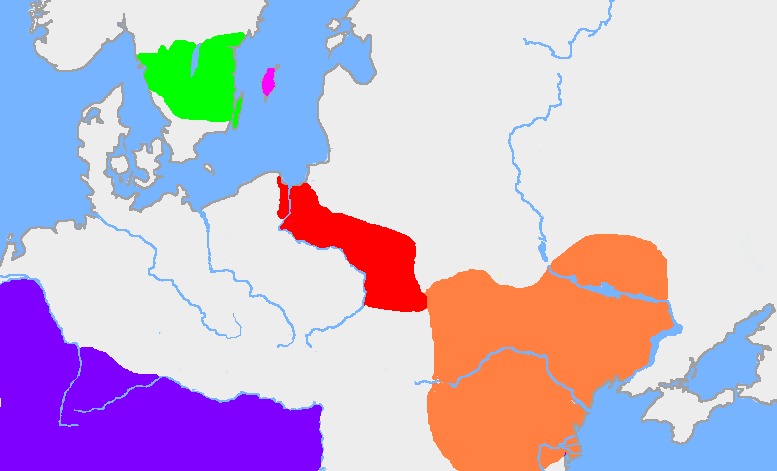
Oium was a name for Scythia, or a fertile part of it, roughly in modern Ukraine, where the Goths, under a legendary King Filimer, settled after leaving Gothiscandza, according to the Getica by Jordanes, written around 551.[1][2][3]
It is generally assumed that the story reproduced by Jordanes contains a historical core, although several scholars have suggested that parts of it are fictional.[4]
Name etymology
[edit]Jordanes does not give an etymology, but many scholars interpret this word as a dative plural to a noun, widespread in the Germanic languages, whose Proto-Germanic reconstruction is *awjō and which means 'well-watered meadow' or 'island'.[2] (The same noun is also found in Scatinauia, the Latinised name of an island in Northern Europe mentioned in Pliny the Elder's Naturalis historia, from which the names of Scandinavia and Scania originate.) This noun is generally derived from the Proto-Germanic word *ahwō 'water; stream, river' (whence Gothic aƕa 'river'), which is cognate with Latin aqua 'water'.[4] This is seen as consistent with the description Jordanes gave of the Goths delight in this region's fertility.
As mentioned for example by Dennis H. Green[2] Jordanes describes another place with a similar name — the place where the Goths' relatives the Gepids lived:
- XVII (96) These Gepidae were then smitten by envy while they dwelt in the province of Spesis on an island surrounded by the shallow waters of the Vistula. This island they called, in the speech of their fathers, Gepedoios [emphasis added]; but it is now [in the 6th century] inhabited by the race of the Vividarii, since the Gepidae themselves have moved to better lands. The Vividarii are gathered from various races into this one asylum, if I may call it so, and thus they form a nation. (97) So then, as we were saying, Fastida, king of the Gepidae, stirred up his quiet people to enlarge their boundaries by war. He overwhelmed the Burgundians, almost annihilating them, and conquered a number of other races also.
Chronology
[edit]A problem with Jordanes' account is that he dates the arrival of the Goths in Oium well before 1000 BCE (approximately 5 generations after 1490).[5] Historians who accept Jordanes' account as partially reflecting real events do not accept this aspect.
Jordanes
[edit]Mierow's translation of the one short passage in Getica IV, which mentions Oium is as follows:
- [...] But when the number of the people increased greatly and Filimer, son of Gadaric, reigned as king — about the fifth since Berig — he decided that the army of the Goths with their families should move from that region.
- (27) In search of suitable homes and pleasant places they came to the land of Scythia, called Oium in that tongue. Here they were delighted with the great richness of the country, and it is said that when half the army had been brought over, the bridge whereby they had crossed the river fell in utter ruin, nor could anyone thereafter pass to or fro.
- For the place is said to be surrounded by quaking bogs and an encircling abyss, so that by this double obstacle nature has made it inaccessible. And even to-day one may hear in that neighborhood the lowing of cattle and may find traces of men, if we are to believe the stories of travellers, although we must grant that they hear these things from afar.
- (28) This part of the Goths, which is said to have crossed the river and entered with Filimer into the country of Oium, came into possession of the desired land, and there they soon came upon the race [gens] of the Spali, joined battle with them and won the victory. Thence the victors hastened to the farthest part of Scythia, which is near the sea of Pontus; for so the story is generally told in their early songs, in almost historic fashion. Ablabius also, a famous chronicler of the Gothic race, confirms this in his most trustworthy account.
- (29) Some of the ancient writers also agree with the tale. [...][6]
The place where they first arrived is thus described not as the whole of Scythia, which Jordanes describes in the subsequent chapter (V), but a remote and isolated part of it, where the Spali lived. The Goths coming from the Baltic crossed a bridge to get there, but when it broke, it became impossible to cross back and forth anymore.[7] Returning to his narrative, Jordanes described the area where Filimer subsequently moved his people and settled as being near the Sea of Azov, noting that there are verbal legends around about Gothic origins, but that he prefers to trust what he reads:
- (38) We read that on their first migration the Goths dwelt in the land of Scythia near Lake Maeotis [the Sea of Azov; the Latin calls it a marsh, not a sea or lake: paludem Meotidem]. On the second migration they went to Moesia, Thrace and Dacia, and after their third they dwelt again in Scythia, above the Sea of Pontus.
- [...]
- Of course if anyone in our city says that the Goths had an origin different from that I have related, let him object. For myself, I prefer to believe what I have read, rather than put trust in old wives' tales.
- (39) To return, then, to my subject. The aforesaid race of which I speak is known to have had Filimer as king while they remained in their first home in Scythia near Maeotis. In their second home, that is in the countries of Dacia, Thrace and Moesia, Zalmoxes reigned, whom many writers of annals mention as a man of remarkable learning in philosophy.
According to Jordanes, the Goths left Oium in a second migration to Moesia, Dacia and Thrace, but they eventually returned, settling north of the Black Sea. Upon their return, they were divided under two ruling dynasties. The Visigoths were ruled by the Balþi and the Ostrogoths by the Amali.
The identified places
[edit]Jordanes himself understands Oium to be near the Sea of Azov, which was understood to be a marshy area in this period. Wolfram (p. 42) for example interprets Jordanes in a straightforward way to be referring to a place on the shore of the Sea of Azov.
The Reallexikon der germanischen Altertumskunde (RGA) article on Oium, for example, proposes, based upon a proposal by Herwig Wolfram, that the uncrossable river with a broken bridge might be the Dnieper. The bridge story itself can not be taken literally as bridges crossing major rivers were not known in this area more than 1000 years BCE. It can therefore only refer to events in a much later period.[8] Both Herwig Wolfram and Walter Goffart see the bridge story as likely to be symbolic.
Based upon a proposal by Norbert Wagner, the RGA suggests that the marshes surrounding Oium could be the Pripyat or Rokitno marshes in the area of the modern border of Belarus and Ukraine.[4] This is to the west of the Dnieper, and not near Southern Russia where Wagner believed Oium was, and so Wagner saw this area, which contains the Pripyat River, as representing the "river" which needed to be crossed en route to Oium.
Jordanes' sources
[edit]As explained above, Jordanes represented his story as being consistent with history-like Gothic songs, and the lost work of Ablabius. He also specifically expressed his preference for written sources in defending this Oium account against legends he had encountered in Constantinople. Concerning the larger work where this story appears, the Getica, Jordanes also explained in his prefaces to it and his other surviving work, the Romana, that he had started the work with the aim of summarizing a far larger work written by Cassiodorus, which has not survived.
According to some historians, Jordanes' account of the Goths' history in Oium was constructed from his reading of earlier classical accounts and from oral tradition.[9][10] According to other historians, Jordanes' narrative has little relation to Cassiodorus's,[11][12] no relation to oral traditions[13] and little relation to actual history.[14]
Archaeology
[edit]Historians such as Peter Heather, Walter Goffart, Patrick Geary, A. S. Christensen and Michael Kulikowski have criticized the use of the Getica as a source for details about real Gothic origins.[14]
Archaeologically, the Chernyakhov culture, which is also called the Sântana de Mureș culture, contained parts of Ukraine, Moldova and Romania and corresponds with the extent of Gothic-influenced Scythia as known from 3rd and 4th century contemporaries.[15]
For archaeologists who subscribe to the proposal that Jordanes' account of migration from the Vistula can be seen in archaeological evidence, the Vistula archaeological culture which is proposed to represent the earlier Goths is the Wielbark culture. The account of Jordanes fits with the interpretation of the Wielbark and Chernyakhov cultures, in which Germanic peoples from the Vistula Basin, moved towards, influenced, and began to culturally dominate, peoples in Ukraine. Some of the historians who agree with this scenario, such as Herwig Wolfram, propose that this did not require significant amounts of people to move.[16]
Norse mythology
[edit]In The origin of Rus', Omeljan Pritsak connects the Hervarar saga with its account of Gothic legendary history and of battles with the Huns, with historical place names in Ukraine from 150 to 450 AD,[17] This places the Goths' capital Árheimar, on the river Dniepr (Danpar). The connection to Oium was made by both Heinzel and Schütte.[18] However the attribution of places, people, and events in the saga is confused and uncertain, with multiple scholarly views on who, where, and what real things the legend refers to.
See also
[edit]References
[edit]- ^ Mierow 1908, chapter IV (25)
- ^ a b c Green 1998, p. 167.
- ^ Merrills 2005, p.120: "The term may, of course, have been a simple invention of Jordanes or Cassiodorus, intended to lend a witty verisimilitude to a knowingly derivative origin myth."
- ^ a b c Günnewig 2003.
- ^ Christensen 2002.
- ^ Jordanes, Getica IV (27), translated by Mierow
- ^ Merrills 2005
- ^ Christensen 2002, p. 305.
- ^ Merrills 2005, p.120: "The influence of oral tradition in this passage [the passage introducing Oium] is palpable. Classical and scriptural parallels for the over-population motif, the Arcadian description of the Scythian Canaan and the broken bridge image do suggest that Gothic migration stories had not survived uncontaminated by contact with the Mediterranean world, but they remain recognizably the tropes of oral tradition", and p. 121: "Jerome and Orosius had identified the relatively unfamiliar Goths with the Scythian Getae of ancient historiography.... In the wake of this authority, the identification of Oium could be made with little comment".
- ^ Wolfram, Herwig (2006). "Gothic history as historical ethnography" and Origo et religio: ethnic traditions and literature in early medieval texts". In From Roman Provinces to Medieval Kingdoms. Ed. Thomas F. X. Noble, Routledge, ISBN 0-415-32741-5, pp. 43-90.
- ^ Amory 1997, pp. 36 & 292.
- ^ Kulikowski 2006, pp. 50–51.
- ^ Amory 1997, p. 295"It is a mistake to think that any of the material in the Getica comes from oral tradition."
- ^ a b Kulikowski 2006, p. 66.
- ^ On the identification of Oium with the Sintana de Mures/Chernyakhov culture-area see Green (1998, pp. 167–168), Heather & Matthews (1991, pp. 50–52, 88–92), Kulikowski (2006, pp. 62–63)
- ^ Heather 1999, p. 16.
- ^ Pritsak 1981, p. 214.
- ^ Pritsak 1981, p. 209.
Sources
[edit]- Amory, Patrick (1997), People and Identity in Ostrogothic Italy 489-554
- Christensen, Arne Søby (2002). Cassiodorus, Jordanes and the History of the Goths. Museum Tusculanum Press. ISBN 9788772897103.
- Green, Dennis Howard (1998). Language and history in the early Germanic world. Cambridge, UK: Cambridge University Press. ISBN 0-521-79423-4.
- Günnewig (2003), "Oium", Reallexikon der germanischen Altertumskunde, vol. 22 (2 ed.), Walter de Gruyter, pp. 38–39, ISBN 9783110173512
- Jordanes (1882), Mommsen (ed.), Getica, Monumenta Germaniae Historica, Scriptores, Auctores antiquissimi 5 (in Latin)
- Heather, Peter; Matthews, John (1991), Goths in the Fourth Century
- Heather, Peter J (1999), The Visigoths from the Migration Period to the Seventh Century, Boydell & Brewer, ISBN 0-85115-762-9
- Kulikowski, Michael (2006), Rome's Gothic Wars
- Merrills, Andrew H. (2005), History and Geography in Late Antiquity, Cambridge University, ISBN 0-521-84601-3
- Mierow, Charles C., ed. (1908), Jordanes. The Origin and Deeds of the Goths, Princeton University , translation, e-text
- Mierow, Charles Christopher, ed. (1915), The Gothic History of Jordanes, Princeton, Univ. Press
- Pritsak, Omeljan (1981), The origin of Rus, Cambridge, Massachusetts: Distributed by Harvard University Press for the Harvard Ukrainian Research Institute, ISBN 0-674-64465-4
- Wagner, Norbert (1967), Getica: Untersuchungen zum Leben des Jordanes und zur frühen Geschichte des Jordanes und zur Sprach- und Kulturgeschichte der germanischen Völker, Walter de Gruyter GmbH & Co KG, ISBN 9783111381671
- Wolfram, Herwig (1988). History of the Goths. Berkeley and Los Angeles: University of California Press. ISBN 0-520-05259-5.
External links
[edit]Etymology and Terminology
Linguistic Origins
The term "Oium" is derived from the Proto-Germanic noun *awjō, denoting a "well-watered meadow" or "island," which itself stems from an earlier form *agwjō, a substantive adjective related to *ahwō meaning "water; stream, river."[5] This root traces back to the Proto-Indo-European *h₂ekʷeh₂ ("water"), reflecting a semantic field tied to fertile, aquatic landscapes.[5] In the Gothic language, an East Germanic dialect, the term appears as a Latinized form of *aujōm or *aujam, evoking watery, productive terrains consistent with ancient descriptions of abundant regions. This etymology aligns with Gothic vocabulary for watery lands, such as aƕa ("river"), directly from *ahwō, underscoring the term's emphasis on hydrological fertility and agricultural potential in historical accounts. The descriptive connotation highlights Oium as a locus of prosperity, where rivers and meadows supported settlement and cultivation. Cognates appear across Germanic languages, illustrating the term's broad application to insular or floodplain features. In Old Norse, ey signifies "island," preserving the core sense of land amid water.[6] Similarly, Old High German ouwa refers to an "island" or "meadow," often denoting low-lying, inundated areas suitable for grazing.[7] Jordanes employed "Oium" as a Gothic designation for a region in Scythia.[8]Scholarly Interpretations
In the 19th century, philologists such as those contributing to early editions and commentaries on Jordanes' Getica interpreted "Oium" as a Germanic term denoting a "watery place" or marshland, drawing on emerging comparative linguistics to link it to Proto-Germanic roots associated with fens and floodplains. This view positioned the name as descriptive of the fertile yet boggy terrains encountered by the Goths during their migrations, emphasizing environmental adaptation over symbolic connotations. By the 20th century, scholars refined this understanding, associating "Oium" with swampy or island-like landscapes in Eastern Europe, particularly the Pontic-Caspian steppe regions. Post-2000 analyses have increasingly viewed "Oium" as a descriptive toponym rather than a fixed proper name, highlighting its role in Jordanes' narrative as a generic label for "the watery places" derived from Gothic aujan (dative plural of aujō, meaning "water-meadow" or "island in marsh").[9]Jordanes' Account
Description in Getica
In his Getica, completed in 551 CE, Jordanes describes Oium as a fertile region in Scythia, situated near the shore of the Sea of Pontus and above an arm of that sea, where the Goths first established their settlement after migrating from the island of Scandza.[10] Under the leadership of King Filimer, son of Gadaric, the Goths advanced into this land, which Jordanes portrays as abundant and welcoming, delighting the migrants with its great richness suitable for their growing population.[10] Jordanes emphasizes the prosperity of Oium through its "fertile fields," a term he provides as a translation of the Gothic word for the area, highlighting soils rich enough to support the Goths' expansion.[10] Upon arrival, the Goths encountered the Spali, a local tribe, and promptly engaged them in battle, emerging victorious and further securing their hold on the territory.[10] A notable event in Jordanes' account involves a miraculous crossing into Oium: as half the Gothic army passed over a bridge spanning a river, the structure collapsed entirely behind them, rendering the path impassable and symbolizing an irreversible commitment to the new homeland.[10] This occurrence, set near the Sea of Azov (referred to as Lake Maeotis), underscores the region's role as a pivotal gateway for the Goths in Scythia.[10]Narrative Elements and Symbolism
In Jordanes' Getica, Oium emerges as a central "promised land" motif within the Gothic migration narrative, depicting the region as a bountiful destination in Scythia where the Goths, under King Filimer's leadership, finally settled after departing Scandza in search of suitable homes and pleasant places. The text describes Oium as a land of great fertility, rich in meadows and extending across rivers and mountains, where the migrants were delighted by its abundance, marking it as their first enduring abode and a symbol of renewal following generations of wandering. This portrayal underscores divine guidance in their journey, with the Goths possessing the territory after crossing a now-collapsed bridge, evoking themes of providential arrival at a destined homeland. Symbolic elements in the depiction of Oium further enrich the narrative, particularly through the Haliurunnae and the surrounding wilderness that represent the perils of settlement. Filimer, upon reaching Oium, expelled the Haliurunnae—a band of suspected witches—driven by divine fury into the surrounding wilderness, where they consorted with unclean spirits and begat the Huns, who later invaded the Goths. The region's quaking bogs, vast swamps, and mystical forests, enchanted by these outcasts, serve as metaphors for the supernatural challenges and moral trials inherent in claiming and taming the new territory, blending Gothic folklore with cautionary motifs of purification and retribution. Scholarly analysis views this episode as a constructed mythological layer, drawing on oral traditions and Christian influences to symbolize the obstacles overcome in establishing Gothic dominance.[11] Oium's role integrates seamlessly into the broader Gothic origin myth, emphasizing fertility and divine favor as foundational to their identity and heroic legacy. As the cradle of Gothic settlement in Scythia, Oium—named in the Gothic tongue to denote its inherent richness—symbolizes not only material prosperity but also the gods' endorsement of the Amali lineage's rule, from which subsequent kings and conquests emanate. This motif reinforces the Getica's overarching narrative of the Goths as a chosen people, their arrival in Oium heralding an era of expansion and cultural flourishing amid the Eurasian steppes.[12]Sources and Historical Reliability
Jordanes' Influences
Jordanes' account of Oium in his Getica primarily relies on the now-lost Gothic History of Cassiodorus, a twelve-volume work commissioned by King Theoderic the Great, which Jordanes abridged from memory after a brief access to the text.[1] This source provided the foundational migration narrative, framing Oium as the fertile Scythian homeland where the Goths settled under King Berig after departing Scandza.[13] Complementing Cassiodorus, Jordanes drew upon the works of Ablabius, a prominent Gothic chronicler of the fourth century, who is explicitly cited for corroborating the Goths' arrival in Oium and their subsequent victory over the Spali tribe in the region.[1] In addition to these written histories, Jordanes incorporated elements from Gothic oral traditions, including ancestral songs and legends that preserved memories of early settlements and migrations.[14] He describes these songs as quasi-historical accounts of the Goths' deeds, such as their journey to Oium, which he preferred over unsubstantiated fables circulating in Constantinople.[15] This blend of oral material likely stemmed from Cassiodorus' own integration of Gothic lore, adding vivid, legendary color to the narrative of Oium as an isolated, bountiful land encircled by bogs and abysses.[14] For the geographical context of Oium within Scythia, Jordanes was influenced by classical authors, notably Orosius' Seven Books of History Against the Pagans for broader historical and topographical details on Scythian territories, and Ptolemy's Geography for specifics on northern landscapes like Scandza.[1] These sources helped situate Oium amid the vast, resource-rich plains east of the Vistula, aligning the Gothic migration with established Greco-Roman understandings of the barbarian world.[13]Chronology and Criticisms
Jordanes presents the Gothic arrival in Oium as occurring in remote antiquity, portraying it as the ancient homeland where the Goths, having migrated from the northern island of Scandza under their leader Berig, settled and from which their royal lines and expansions originated. This timeline extends the Gothic narrative back to a legendary past, integrating it with accounts of ancient kings and conquests that span over a millennium before the Common Era, though without precise dates. The chronicle then advances through centuries of Gothic dominance in Oium until the mid-4th century CE, when the Huns invaded around 375 CE, defeating the Ostrogoths and compelling the Visigoths to seek refuge across the Danube River, marking a turning point in their migrations. Jordanes' chronology has faced significant scholarly criticism for its anachronistic framework, which conflates mythical origins with historical events and relies heavily on a lost Gothic history by Cassiodorus, potentially introducing 6th-century biases to glorify Gothic heritage. Critics argue that the early timeline, linking Goths to the ancient Getae of Thracian lore from the 5th century BCE or earlier, serves rhetorical purposes rather than factual accuracy, and the absence of corroborating contemporary records undermines its reliability. Furthermore, the blending of oral traditions, classical ethnography, and invented genealogies raises doubts about the historicity of the Oium settlement as depicted. In response to these critiques, modern historians reconstruct the chronology of events associated with Oium based on archaeological patterns and Roman accounts, placing the initial Gothic movements into the region during the 2nd to 4th centuries CE, consistent with the expansion of East Germanic groups from the Baltic during the Roman Iron Age. This adjusted timeline emphasizes gradual migrations rather than a singular ancient arrival, while affirming the Hunnic incursions of circa 375 CE as a verifiable catalyst for subsequent Gothic displacements, supported by evidence from the Chernyakhov cultural horizon.[16]Geographical Proposals
Primary Identifications
Scholars primarily identify Oium with the fertile region near the Sea of Azov and the lower Dnieper River in southern Ukraine, aligning with Jordanes' portrayal of it as a prosperous area in Scythia where the Goths settled under King Filimer after migrating from Scandinavia. This location represents the scholarly consensus, corresponding to the Pontic-Caspian steppe and associated with the Chernyakhov culture.[4] It is endorsed by Herwig Wolfram, who situates the Goths' early expansion in the Black Sea steppes, emphasizing the area's role as a base for their interactions with neighboring peoples.[17] Similarly, Peter Heather associates Oium with this zone, viewing it as the heartland for Gothic consolidation before further southward movements.[16] While Jordanes describes the Goths crossing extensive marshes (Polesia) to reach Oium, alternative theories proposing the marshes themselves (such as the Pripyat or Rokitno Polissia in modern Ukraine and Belarus) as Oium are not supported by mainstream scholarship, which places Oium south of these wetlands in the open steppes.Supporting Arguments
Scholars supporting the identification of Oium with the region around the Sea of Azov and the lower Dnieper River emphasize its alignment with Jordanes' portrayal of the site as a fertile expanse in Scythia, a classical term for the northern Black Sea steppes inhabited by nomadic Scythian tribes such as the Spali, whom the Goths are said to have defeated upon arrival.[18] This location facilitates the narrative progression in the Getica, where the Goths migrate westward from Oium toward the Ister (Danube River), placing the settlement in proximity to both Scythian heartlands and the eventual path of Gothic expansion into Roman territories. Herwig Wolfram, in his seminal analysis, locates Oium specifically along the Azov shores, interpreting it as the "rich meadows" (aujom) that provided an ideal base for early Gothic consolidation amid diverse steppe populations.[17] Counterarguments to southern placements sometimes highlight the challenges of a rapid 2nd-century migration from the Vistula basin, potentially conflating later Ostrogothic strongholds with earlier settlements and noting Germanic presence in northern regions during the late Roman period. However, archaeological evidence ties Oium more firmly to the Chernyakhov culture in the Ukrainian steppes.[4] Methodological challenges in pinpointing Oium arise from Jordanes' composition in the mid-6th century, which relies on abbreviated excerpts from Cassiodorus' lost Gothic history, potentially incorporating anachronistic 5th-century geography or legendary embellishments to legitimize Gothic origins in a biblical-Scythian framework.[19] This temporal disconnect between the described events (circa 200 CE) and the source material invites scrutiny, as environmental changes, such as shifting river courses in the Pontic steppes, may have altered recognizable landmarks by Jordanes' era.[20] Contemporary scholars advocate interdisciplinary methods, integrating linguistic analysis of Germanic toponyms, paleoenvironmental reconstructions of marsh extents, and comparative ethnography of Scythian-Gothic interactions, to bridge textual ambiguities with material evidence and avoid overreliance on classical topoi.[18]Archaeological Evidence
Associated Material Cultures
The Wielbark culture, flourishing from the 1st to 3rd centuries CE primarily in Pomerania and extending into eastern Poland and western Ukraine, is widely regarded as a key precursor to the Gothic migrations associated with Oium, representing an early phase of settlement and expansion before southward movements into the proposed Oium region.[21] This culture's emergence is linked to Germanic groups, including proto-Goths, who established cemeteries and settlements characterized by inhumation burials and distinctive pottery, facilitating the transition from Scandinavian origins to continental bases.[22] The Chernyakhov culture, active from the 3rd to 5th centuries CE across Ukraine and adjacent areas, exhibits strong ties to the Goths in the context of Oium, interpreted as their kingdom or power center during this period, with evidence of Gothic-influenced pottery, iron weapons, and fortified settlements reflecting a multi-ethnic but Germanic-dominated society.[23] Emerging partly from Wielbark influences amid Gothic invasions, it incorporated elements like wheel-turned ceramics and Roman imports, underscoring the Goths' role in its formation and dominance in the Dnieper region.[23] Influences from the Przeworsk culture, spanning the 2nd century BCE to 5th century CE in southern and eastern Poland, indicate multi-ethnic interactions in the proposed Oium area, as elements of Przeworsk populations integrated with migrating Gothic groups, contributing to hybrid material assemblages during the transition to Chernyakhov dominance.[24] This interplay is evident in shared artifact styles, such as fibulae and tools, highlighting cultural exchanges that enriched Gothic material expressions without overshadowing their core identity.[25]Key Findings and Interpretations
Excavations at the Komariv settlement in western Ukraine, conducted between the 1950s and 2021, have uncovered extensive remains of a Chernyakhov culture site dating to the 3rd–5th centuries CE, including pottery, Roman imports, and a unique glass-production workshop, highlighting the site's role as a productive center in the middle Dniester region.[26] While specific grain storage structures were not detailed in these digs, broader evidence from Chernyakhov settlements across Ukraine reveals storage pits containing remains of wheat, rye, millet, and barley, underscoring the culture's emphasis on cereal cultivation and soil fertility in fertile forest-steppe zones.[27] These agricultural features align with descriptions of abundant lands, suggesting Oium's portrayal as a prosperous Gothic homeland may reflect real environmental advantages exploited by settlers. Archaeological surveys in Ukraine, including near Chernihiv, and in adjacent regions have yielded weapon hoards and burial complexes indicative of organized warrior groups within the Chernyakhov culture, such as iron swords, spears, and fibulae found in male graves at cemeteries like Kompaniytsy in Ukraine, where a warrior's interment included combat-related artifacts alongside pottery and jewelry from the 3rd–4th centuries CE.[28] Similar finds, including armament in cremation and inhumation burials at sites like Dal'niy Vydrin in Russia's Kursk Region, evoke Jordanes' accounts of Spali encounters, implying a militarized society with Germanic leadership amid local interactions.[29] These discoveries, concentrated in the Dnieper basin and nearby areas, demonstrate elite martial traditions rather than mass weaponry, consistent with a semi-nomadic warrior ethos. Recent archaeogenetic studies, including analyses from 2023, have identified Germanic genetic components in Chernyakhov culture burials, supporting the association with Gothic migrations and multi-ethnic interactions in the Oium region.[30] Interpretations of these findings position the Chernyakhov culture as tangible evidence of Germanic (particularly Gothic) expansion and influence across Scythia from approximately 200–400 CE, with settlements and burials reflecting migration patterns described in Jordanes' narrative of Oium as a key territorial base.[4] However, scholars debate whether such material correlates precisely to Oium's location, as the culture's multi-ethnic composition—blending Germanic, Sarmatian, and local elements—complicates direct attribution to a singular Gothic enclave, with some arguing for a more diffuse "island" of power rather than a fixed site.[31] The Chernyakhov overview, spanning Ukraine's forest-steppe, supports regional fertility and martial prowess but leaves Oium's exact coordinates unresolved amid varying chronological and cultural overlays.Cultural and Mythological Connections
Links to Norse Sagas
In the Hervarar saga ok Heiðreks, a 13th-century Icelandic legendary saga, the realm of Árheimar serves as the capital of the Goths in Reidgotaland, situated at Danparstaðir along the Dnieper River (referred to as Danpar), where King Heiðrekr rules tyrannically before his son Angantýr inherits the domain amid conflicts with invading Huns.[32] This depiction parallels Oium as described in Jordanes' Getica, positioning both as key Gothic strongholds in eastern Scythia near the Dnieper. Shared motifs between the saga and Getica include the portrayal of fertile eastern territories as desirable homelands for the Goths, echoing Jordanes' account of Oium's abundant soil and rivers that delighted the migrating tribes. Additionally, the saga's narratives of Gothic migrations and epic battles against eastern foes, such as the Huns under Hlǫðr, reflect the migratory patterns and conflicts outlined in Jordanes' history of the Goths' expansion from Scandinavia to the Black Sea region.[32]Modern Scholarly Perspectives
These debates, evident in regional historiographical works from the decade, often prioritized ethnic narratives over multidisciplinary evidence, leading to polarized interpretations of Jordanes' description as either a Vistula-region settlement or a Dnieper basin polity. Modern researchers advocate disentangling such biases by emphasizing empirical data from archaeology and genomics, which consistently point to Oium as a fertile expanse in the northern Black Sea steppes, corresponding to modern Ukraine.[33] Integration of ancient DNA studies in the 2020s has revolutionized understandings of Oium by illuminating Germanic migrations into the region, providing genetic corroboration for the Goths' establishment of a kingdom there during the 3rd–4th centuries CE. For instance, a 2025 genomic analysis of 91 individuals from Ukraine spanning the Migration Period identified significant influxes of northern European ancestry associated with Gothic groups, aligning with the Chernyakhov material culture and supporting Oium's identification as a multiethnic hub rather than a monolithic ethnic domain. Similarly, high-resolution sequencing from early medieval East-Central Europe revealed Scandinavian-related Germanic ancestry in the region, underscoring large-scale mobility that reshaped the demographic landscape without the distortions of prior nationalistic lenses. These findings highlight how ancient genomics challenges static territorial claims, revealing Oium as a dynamic zone of interaction among Goths, Sarmatians, and later Huns.[34][35][22] Emerging post-2020 perspectives increasingly view Oium as a composite mytho-historical construct in Jordanes' Getica, weaving legendary motifs—such as the fertile "egg-shaped" land under King Filimer—with kernels of historical migration to create an origin narrative for Gothic identity. Scholars call for expanded interdisciplinary approaches, combining textual criticism, paleogenomics, and landscape archaeology, to address lingering gaps in understanding Oium's socio-political formation and its dissolution amid Hunnic incursions. This shift not only reframes Oium beyond outdated chronologies but also parallels faint echoes in Norse sagas, where similar migratory motifs appear in accounts of eastern realms. Such research directions promise to clarify Oium's role in the broader tapestry of late antique Eurasia.[18]References
- https://en.wiktionary.org/wiki/ey#Old_Norse
- https://en.wikisource.org/wiki/An_Etymological_Dictionary_of_the_German_Language/Annotated/Au