Hubbry Logo
Holy ChaliceHoly ChaliceMain
Open search
Holy Chalice
Community hub
Holy Chalice
logo
8 pages, 0 posts
0 subscribers
Be the first to start a discussion here.
Contribute something
Holy Chalice
Holy Chalice
from Wikipedia

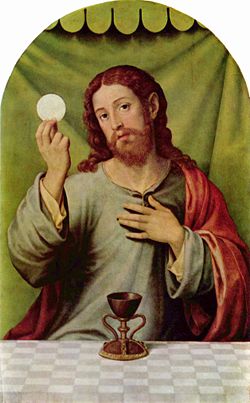
Oil painting showing Jesus at the Last Supper. He is shown seated behind a table, looking directly at the viewer while raising a communion wafer in his right hand, and laying his left hand on his heart. The cup of Communion is on the table, placed centrally in the picture.
Christ of the Eucharist by Juan de Juanes. This 16th-century painting depicts the Valencia Chalice

The Holy Chalice, also known as the Holy Grail, is in some Christian traditions the vessel that Jesus used at the Last Supper to share his blood. The Synoptic Gospels refer to Jesus sharing a cup of wine with the Apostles, saying it was the covenant in his blood. The use of wine and chalice in the Eucharist in Christian churches is based on the Last Supper event. In the late 12th century, the author Robert de Boron associated the pre-existing story of the Holy Grail, a magical item from Arthurian literature, with the Holy Chalice. This association was continued in many subsequent Arthurian works, including the Lancelot-Grail (Vulgate) cycle, the Post-Vulgate Cycle, and Sir Thomas Malory's Le Morte d'Arthur. A cup kept in the Spanish Cathedral of Valencia has been identified since medieval times as the purported Holy Chalice used at the Last Supper.[1]

Last Supper

[edit]

The Gospel of Matthew (26:27–29) says:[2]

And He took a cup and when He had given thanks He gave it to them saying "Drink this, all of you; for this is My blood of the covenant, which is poured out for many for the forgiveness of sins. I tell you, I shall not drink again of the fruit of the vine until I drink it new with you in My Father's kingdom."

This incident, traditionally known as the Last Supper, is also described by the gospel writers, Mark and Luke, and by the Apostle Paul in I Corinthians. With the preceding description of the breaking of bread, it is the foundation for the Eucharist or Holy Communion, celebrated regularly in many Christian churches. Except within the context of the Last Supper, the Bible makes no mention of the cup, and ascribes no significance whatsoever to the object itself.[citation needed]

St. John Chrysostom (347–407 AD) in his homily on Matthew asserted:

The table was not of silver, the chalice was not of gold in which Christ gave His blood to His disciples to drink, and yet everything there was precious and truly fit to inspire awe.

The pilgrim Antoninus of Piacenza (570 AD) in his descriptions of the holy places of Jerusalem, said that he saw "the cup of onyx, which our Lord blessed at the last supper" among many relics displayed at the Basilica erected by Constantine near to Golgotha and the Tomb of Christ.[3]

Herbert Thurston in the Catholic Encyclopedia (1908) concluded that:

No reliable tradition has been preserved to us regarding the vessel used by Christ at the Last Supper. In the sixth and seventh centuries pilgrims to Jerusalem were led to believe that the actual chalice was still venerated in the church of the Holy Sepulchre, having within it the sponge which was presented to Our Saviour on Calvary.[4]

Medieval tradition

[edit]

Iconography

[edit]
Medieval mural showing two scenes. One scene shows Jesus praying in the garden, with details as described in the text. The second scene illustrates the capture of Christ by soldiers.
Two episodes from the Passion-cycle murals of Öja Church, Gotland.

The iconic significance of the Chalice grew during the Early Middle Ages. Depictions of Jesus praying in the Garden of Gethsemane, such as that in the fourteenth-century frescoes of the church at Öja, Gotland (illustration, right), show a prefigured apparition of the Holy Chalice that stands at the top of the mountain, illustrating the words "Let this cup be taken from me". Together with the halo-enveloped Hand of God and the haloed figure of Jesus, the halo image atop the chalice, as if of a consecrated Host, completes the Trinity by embodying the Holy Spirit.

Holy Grail

[edit]

The Holy Grail appears as a miraculous artifact in Arthurian legend in the 12th century, and is soon associated with the Holy Chalice.

The "Grail" became interwoven with the legend of the Holy Chalice. The connection of the Holy Chalice with Joseph of Arimathea dates from Robert de Boron's Joseph d'Arimathie [fr] (late 12th century). The fully developed "Grail legend" of the 13th century identifies the Holy Grail with the Holy Chalice used in the Last Supper and later used to collect Christ's blood, brought to Hispania by Joseph of Arimathea.

Medieval relics

[edit]

In the account of Arculf, a 7th-century Anglo-Saxon pilgrim, mention is made of a chalice venerated as the one used in the Last Supper in a chapel near Jerusalem.

It is also mentioned in the account of The Anonymous pilgrim of Piacenza, when traveling through Jerusalem in the 570s.[5]

Two artifacts were claimed as the Holy Chalice in Western Christianity in the later medieval period. The first is the Sant Calze, an agate cup in the Cathedral of Valencia, purportedly from around the 1st century AD, and celebrated by Pope Benedict XVI in 2006 as "this most famous chalice" (hunc praeclarum Calicem); Valencia's Holy Chalice is the object most commonly identified as a claimant to being the Holy Grail.[6] The second is the Sacro Catino in Genoa Cathedral, a flat dish made of green glass; recovered from Caesarea in 1101, it was not identified as the Holy Chalice until much later, towards the end of the 13th century.

Valencia Chalice

[edit]
The Valencia Chalice in its chapel in Valencia Cathedral

The Holy Chalice (Spanish: Santo Cáliz) is an agate cup preserved in the Cathedral of Valencia. The chalice is commonly credited as being the actual Holy Grail used by Jesus during the Last Supper[6] and is preserved in a chapel consecrated to it, where it still attracts the faithful on pilgrimage. The artifact has seemingly never been accredited with supernatural powers.

The cup is made of dark red agate which is mounted by means of a knobbed stem and two curved handles onto a base made from an inverted cup of chalcedony. The agate cup is about 9 centimeters (3.5 inches) in diameter and the total height, including base, is about 17 centimetres (7 inches) high. The base, stems and handles are later additions purportedly medieval, with the lower part added 'Arabic looking' inscription. The red agate cup itself (the chalice) was most likely produced in a Levantine or Egyptian workshop between the 2nd century BC and the 1st century AD.[7]

It is kept together with an inventory list on vellum, said to have accompanied a lost letter which detailed state-sponsored Roman persecution of Christians that forced the church to split up its treasury and hide it with members, specifically the deacon Saint Lawrence.[citation needed]

The first explicit inventory reference to the present Chalice of Valencia is found in an inventory of the treasury of the monastery of San Juan de la Peña drawn up by Don Carreras Ramírez, Canon of Zaragoza, on 14 December 1134. The Chalice is described as the vessel in which "Christ Our Lord consecrated his blood" (En un arca de marfil está el Cáliz en que Cristo N. Señor consagró su sangre, el cual envió S. Lorenzo a su patria, Huesca).[citation needed]

Reference to the chalice is made again in 1399, when it was given by the monastery of San Juan de la Peña to king Martin I of Aragon in exchange for a gold cup.[citation needed]

Pope John Paul II celebrated Mass with the Holy Chalice in Valencia in November 1982, and in that occasion the Pope referred to it as "a witness to Christ's passage on Earth". In July 2006, at the closing Mass of the 5th World Meeting of Families in Valencia, Pope Benedict XVI also celebrated Mass with the Holy Chalice, on this occasion calling it "this most famous chalice" (hunc praeclarum Calicem), words in the Roman Canon said to have been used for the first popes to refer to the Holy Grail until the 4th century in Rome.[citation needed]

Genoa Dish

[edit]

The Genoa Chalice

The Sacro Catino ("Sacred Basin"), kept in Genoa Cathedral, is a hexagonal dish made of green Egyptian glass, some 9 cm high and 33 cm across. It was taken to Genoa by Guglielmo Embriaco as part of the spoils from the conquest of Caesarea in 1101. William of Tyre (10.16) describes it as a "vessel of the most green colour, in the shape of a serving dish" (vas coloris viridissimi, in modum parapsidis formatum) which the Genoese thought to be made of emerald, and accepted as their share of the spoils. William states that the Genoese were still exhibiting the bowl, insisting on its miraculous properties due to its being made of emerald, in his own day (Unde et usque hodie transeuntibus per eos magnatibus, vas idem quasi pro miraculo solent ostendere, persuadentes quod vere sit, id quod color esse indicat, smaragdus), the implication being that emerald was thought to have miraculous properties of its own in medieval lore, and not that the bowl was thought of as a holy relic. The Sacro Catino would later become identified as the Holy Grail. The first explicit claim to this effect is found in the Chronicon by Jacobus de Voragine, written in the 1290s.[8] Pedro Tafur, who visited Genoa in 1436, reported that the Holy Grail, "made of a single emerald" is kept in Genoa Cathedral.[9]

The bowl was seized and taken to Paris by Napoleon in 1805, and it was damaged when it was returned to Genoa in 1816, on which occasion it was confirmed it is made of glass rather than emerald. It was the subject of various restorations, in 1908, 1951, and 2017.[citation needed]

The study of the object made during the period of presence in France by the Académie des sciences of the Institut de France established that it was a Byzantine crystal,[clarification needed] and not emerald. Modern studies consider it to be an Islamic artifact of the 9th–10th century.[citation needed]

Modern candidates

[edit]

Aside from the Holy Chalice of the Cathedral of Valencia, which some have believed to be the Holy Grail since the time of the first few centuries AD, and which has been used by popes to celebrate Mass through to the present, a number of other artifacts of greater or lesser notability have come to be identified with the "Holy Grail" or "Holy Chalice", beginning with the rising popularity of the Grail legend in 19th-century Romanticism.[10]

Chalice of Doña Urraca

[edit]
A replica of the Chalice of Doña Urraca.

The Chalice of Doña Urraca is an artifact kept in St. Isidore's Basilica in León, Spain.[11] The connection of this artifact to the Holy Grail was made in the 2014 book Los Reyes del Grial, which develops the hypothesis that this artifact had been taken by Egyptian troops following the invasion of Jerusalem and the looting of the Church of the Holy Sepulchre, then given by the Emir of Egypt to the Emir of Denia, who in the 11th century gave it to the Kings of Leon for them to spare his city in the Reconquista.[12]

Antioch Chalice

[edit]
A photo of a large ovoid vessel standing on a short knobbed stem. The cup comprises a silver body enclosed in an openwork layer of gold. The gold ornamentation represents vine scrolls enclosing small seated and praying figures.
Antioch Chalice, first half of the 6th century, Metropolitan Museum of Art

This silver-gilt object is in the collection of the Metropolitan Museum of Art in New York City. It was apparently made at Antioch in the early 6th century, and is of double-cup construction, with an outer shell of cast-metal open work, enclosing a plain silver inner cup. When it was first recovered in Antioch in 1910, it was touted as the Holy Chalice, an identification the Metropolitan Museum characterizes as "ambitious". It is no longer identified as a chalice, having been identified by experts at Walters Art Museum in Baltimore, Maryland as likely a standing lamp, in a style of the 6th century.[13]

Nanteos Cup

[edit]
The Nanteos cup fragment

The Nanteos Cup is a medieval wood mazer bowl, held for many years at Nanteos Mansion, Rhydyfelin, near Aberystwyth in Wales.[14] It is recorded as having been attributed miraculous powers of healing in the late 19th century, and tradition apparently held it had been made from a piece of the True Cross at the time, but it came to be identified as the Holy Chalice in the early 20th century.[15]

See also

[edit]

References

[edit]

Bibliography

[edit]
Revisions and contributorsEdit on WikipediaRead on Wikipedia
from Grokipedia
The Holy Chalice, also known as the Santo Cáliz, is a revered Christian relic believed to be the cup used by at the to institute the . In broader Christian traditions and legends, the is also associated with collecting his blood during the . Housed in in since 1437, it consists of an oriental bowl dated by archaeological analysis to between the and the AD, mounted on a later stem and gemstone base added in the medieval period. The relic's legendary history traces its origins to , where it was purportedly brought to by and safeguarded by early popes until the , when sent it to , , via to protect it from Roman persecution under Emperor Valerian. During the Muslim invasion of the in 713 AD, the chalice was hidden in the and later preserved at the of San Juan de la for approximately 300 years, with its presence documented there as early as 1071. Reliable historical records begin in 1399, when the monks of San Juan de la presented it to King Martin I of as part of his royal ; it subsequently passed to King Alfonso V, who transported it to around 1424 and formally donated it to the cathedral in 1437, where it has remained ever since. Scientifically, Spanish archaeologist Antonio Beltrán's 1960 study (revised in later analyses) confirmed the cup's antiquity and Middle Eastern provenance, aligning it temporally with the era of , though its direct connection to the remains unprovable and subject to scholarly debate. Among over 200 claimed Holy Grails across —such as chalices in , León, and —the Valencia artifact stands out as the most accessible and prominently venerated, having been used in papal Masses by John Paul II in 1982 and Benedict XVI in 2006. Religiously, the Holy Chalice symbolizes the institution of the and Christ's sacrificial love, serving as a focal point for and devotion; the Vatican recognized it in 2014 by establishing Years every five years (beginning in 2015), during which plenary indulgences are granted to visitors, including during the ongoing 2025–2026 Year, drawing hundreds of thousands annually to . While medieval legends of , popularized in 12th-century literature like ' works, portray it as a mystical object of divine power, the Valencia Chalice's significance lies in its tangible role as a Eucharistic relic rather than a fantastical artifact.

Origins in Scripture and Early Tradition

The Last Supper Account

The , as described in the , serves as the foundational narrative for the Holy Chalice, depicting using a cup during a meal to institute the Eucharistic rite. According to the Gospel of Matthew, took a cup after supper, gave thanks, and gave it to his disciples, saying, "Drink from it, all of you. This is my blood of the covenant, which is poured out for many for the forgiveness of sins" (Matthew 26:27–29). The Gospel of Mark similarly recounts taking the cup, giving thanks, and distributing it with the words, "This is my blood of the covenant, which is poured out for many," while declaring he would not drink again of the fruit of the vine until that day when he drinks it new in the kingdom of (Mark 14:23–25). In Luke's account, takes the cup, gives thanks, and says, "Take this and divide it among you," interpreting it as "the in my blood, which is poured out for you" (Luke 22:17–20). The Apostle Paul, in his earliest written account, reports receiving the tradition that took the cup after supper, stating, "This cup is the in my blood; do this, as often as you drink it, in remembrance of me," linking it directly to the proclamation of the Lord's death until his return (1 Corinthians 11:23–26). This event occurred within the context of a 1st-century Jewish Passover meal (Seder), a ritual commemorating the Exodus from Egypt, typically involving the consumption of wine from multiple cups symbolizing redemption and divine promises. Archaeological evidence from sites like Jerusalem and Qumran indicates that such meals utilized simple, ritually pure vessels, often made of stone or clay to avoid impurity under Jewish law, rather than elaborate metal or glassware. Stone cups, in particular, were prevalent in Jewish households during the Second Temple period for their non-porous nature, which preserved ritual cleanliness during sacred observances like the Passover. Theologically, the cup's use in the establishes the as Christianity's central sacrament, symbolizing the through ' sacrificial blood and transforming the into a memorial of redemption from . This institution marks the origin of the Eucharistic rite, where the cup represents participation in Christ's atoning death and anticipates eschatological fulfillment. These accounts laid the groundwork for the cup's enduring symbolic role in early Christian Eucharistic practices.

Early Christian References

In the patristic era, began to emphasize the symbolic role of the cup in the Eucharistic , drawing from the narrative. St. (c. 347–407 AD), in his Homily 50 on the Gospel of Matthew, described the chalice used by Christ as neither silver nor gold, yet profoundly precious and venerable due to its infusion with the : "That table at that time was not of silver nor that cup of gold, out of which Christ gave His disciples His own blood; but precious was everything there, and awful, for that they were full of the Spirit." This reflection highlights the cup's emerging theological significance as a vessel of in late 4th-century worship, prioritizing spiritual essence over material luxury. Early Christian Eucharistic vessels, including chalices, were characteristically simple and functional, crafted from accessible materials like , wood, clay, or to suit the clandestine and humble settings of 1st- to 3rd-century gatherings. Archaeological from sites such as those in and confirms the prevalence of cups, which were inexpensive and symbolically pure, often undecorated to avoid drawing attention during periods of . By the , with Christianity's legalization under Emperor Constantine, these plain forms gradually evolved toward more ornate designs, incorporating metals like silver and , as churches gained resources and liturgical practices formalized, reflecting increased reverence for the . The first documented reference to a relic purportedly linked to the Holy Chalice dates to the mid-6th century, in the pilgrimage account of Antoninus of Piacenza (c. 570 AD). Visiting , he reported seeing "the cup which [Christ] blessed at the [Last] Supper" preserved among sacred items in the Basilica of Constantine adjacent to , alongside relics like the and the crown of thorns. This description marks the initial shift toward venerating a specific physical object as the Last Supper chalice, though such claims remained localized to pilgrimage sites. Before the , no widespread tradition of relic veneration for the Holy Chalice existed, with early Christian writings and practices centering on its metaphorical and liturgical symbolism as a conduit for Christ's blood rather than a tangible artifact worthy of cultic devotion. This restraint aligned with broader patristic caution against , emphasizing the Eucharist's transformative mystery over material relics, a focus that persisted amid the era's theological developments.

Medieval Development and Legends

Connection to the Holy Grail

The concept of the Holy Grail emerged in through ' Perceval, or the Story of the Grail (late ), where it is depicted as a mysterious, life-sustaining vessel paraded in a spectral procession at the Grail Castle, without explicit ties to Christian sacraments. This enigmatic object, carried by a maiden during a banquet, symbolizes otherworldly abundance but remains undefined, blending Celtic motifs with courtly romance. Robert de Boron, writing around 1200 in Joseph d'Arimathie (part of his Grail trilogy), transformed the Grail into a distinctly Christian relic by identifying it as the chalice used by Jesus at the Last Supper, which Joseph of Arimathea employed to collect Christ's blood at the Crucifixion. In this narrative, Joseph safeguards the vessel, which sustains his imprisoned followers with divine nourishment, establishing its role as a Eucharistic symbol and catalyst for the Arthurian quest. Legends in this tradition attribute the chalice's journey to Britain via Joseph of Arimathea. A separate 3rd-century tradition, associated with the Valencia Chalice, recounts that it was sent from Rome to Hispania (Spain) amid persecutions under Emperor Valerian in 258 AD, entrusted by Pope Sixtus II to Saint Lawrence for safekeeping. The Grail motif evolved in subsequent works, integrating the chalice's sacred origins with chivalric quests for spiritual perfection. In Wolfram von Eschenbach's (early 13th century), the Grail shifts to a stone guarded by a templar-like order on Munsalvaesche, yet retains echoes of the blood-collecting vessel, emphasizing themes of redemption and hidden wisdom accessible only to the pure-hearted. By the 15th century, Thomas Malory's synthesizes these strands into a cohesive quest narrative, where the Grail appears as the Last Supper chalice, challenging King Arthur's knights—particularly , Percival, and —to a perilous spiritual trial that tests and ultimately fractures the Round Table's unity. This literary fusion profoundly shaped chivalric ideals, while fostering esoteric traditions that interpreted the quest as an for inner enlightenment and alchemical transformation. The Grail's enduring allure in these contexts elevated the chalice from a mere relic to a of divine pursuit, influencing codes and mystical philosophies across centuries.

Iconography in Art and Literature

In , early depictions of the Holy Chalice often appeared in scenes within church frescoes, where it served as a central symbol of the and Christ's impending sacrifice. These 14th-century representations underscored the chalice's transformation from a simple vessel to a sacred object embodying divine blood, reflecting the growing devotional focus on during the . The evolved significantly in illuminated manuscripts associated with Grail romances, where the was reimagined as a radiant, miraculous container linked to Christ's Passion. In the 13th-century Didot Perceval, a prose continuation of ' Perceval, the is explicitly identified as the used at the and to collect Christ's blood, described as a luminous vessel that sustains the faithful and heals the wounded king. Later manuscripts of the Lancelot-Grail cycle, such as the 15th-century Bonn (University and State Library , MS 526), feature detailed illustrations of the emitting divine light during the vision, portraying it as a jeweled, glowing cup borne by angels or knights, symbolizing spiritual enlightenment and the quest for purity. Symbolic motifs involving the chalice proliferated in Gothic art, particularly in altarpieces and devotional images, where it was paired with elements of the Passion to evoke Eucharistic themes. In Jan van Eyck's Ghent Altarpiece (1432), the Mystic Lamb bleeds directly into a chalice on the altar, representing the perpetual sacrifice and the blood of the New Covenant, a motif that reinforced the doctrine of transubstantiation amid 15th-century religious debates. Similarly, in late medieval representations of the Man of Sorrows, such as the pre-1405 fresco in Malâncrav, Romania, the chalice catches blood from Christ's side wound, often alongside a bleeding lance from the Arma Christi, transforming the vessel into a multifaceted emblem of redemption, suffering, and the Real Presence in the host. These visuals, common in Central European works like the 1390 stained glass from Slivenec, Czech Republic, heightened the chalice's aura of sanctity, blending liturgical symbolism with narrative intensity. In literature, 12th-century descriptions outside strict Grail narratives, including those evoking pilgrim-like journeys, portrayed the with an enveloping sacred aura of divine provision and mystery. Robert de Boron's Joseph d'Arimathie (c. 1191–1202) depicts the -chalice as a holy carried by on a missionary voyage akin to , sustaining believers with miraculous nourishment and evoking an otherworldly glow that signifies eternal life. Such accounts emphasized the chalice's role not merely as an object but as a beacon of , inspiring quests that mirrored medieval pilgrims' pursuits of relics and spiritual renewal.

Claimed Relics from the Middle Ages

Valencia Chalice

The Valencia Chalice is composed of a semispherical cup carved from dark red , measuring approximately 9 cm in diameter and 5.5 cm in depth, mounted on a stem and base of engraved adorned with pearls, rubies, and emeralds; the total height reaches 17 cm, with the lower elements added during the to enhance its form as a liturgical vessel. The agate portion, of oriental origin and polished to a fine sheen, forms the upper vessel, while the medieval additions include curved handles and an elliptical foot measuring 14.5 by 9.7 cm, reflecting Islamic artistic influences in its design. The relic's documented history begins with its first explicit reference in a 1134 inventory of the treasury at the Monastery of San Juan de la Peña in , where it was described as "the chalice in which Christ Our Lord consecrated his blood," indicating its veneration as a sacred object since at least the early . Tradition traces its earlier path to during the Muslim of 712 AD, when it was hidden in the ; by 1399, the monks of San Juan de la Peña presented it to King Martin I of in exchange for protection, after which it moved through royal holdings in and . In 1437, King transferred the chalice to as a pledge for a substantial from the chapter, where it has remained enshrined in a dedicated . According to longstanding tradition, the chalice was brought from to by St. Peter and later conveyed to by St. Lawrence in 258 AD, who entrusted it to the church in before his martyrdom; this narrative underscores its apostolic origins and role in early . Its veneration intensified over centuries, including use in Holy Thursday processions until the 18th century, and it has been employed in papal es, notably by John Paul II during his 1982 visit to and by Benedict XVI at the closing Mass of the Fifth World Meeting of Families on July 9, 2006. The chalice is associated with spiritual graces through s, such as the plenary granted by for its annual feast on the last Thursday of October, and the current Jubilee Year from October 30, 2025, to October 29, 2026, during which pilgrims may obtain a plenary by visiting the cathedral and fulfilling customary conditions.

Genoa Sacra Catino

The Sacra Catino, or Sacred Basin, is a hexagonal dish crafted from green glass, measuring approximately 33 cm in diameter and 9 cm in height. It serves as an imitation of rock crystal, likely produced in the Islamic world during the 9th or as a luxurious serving vessel. The artifact's translucent quality and elegant form contributed to its longstanding misidentification as an emerald platter. The relic arrived in Genoa in 1101, acquired as war booty by the Genoese crusader Embriaco during the conquest of in the . It was initially stored in the Palazzo Ducale before being transferred to the treasury of the Cathedral of San Lorenzo, where it has remained a central element of the cathedral's collection. In the late , its prestige grew within Genoese civic and religious life, symbolizing the city's crusading heritage. Veneration of the Sacra Catino intensified in the medieval period, with legends attributing profound biblical significance to it. In the 1290s, Archbishop described it in his Chronicle of Genoa as the dish from Paradise in which served food to , later used to collect in the desert and as the platter for the Paschal Lamb at the . The object featured prominently in religious processions, such as the annual rite, and was employed in solemn oath-taking ceremonies by doges and officials, underscoring its role in affirming authority and . During the , the Sacra Catino was seized in 1805 and transported to , where scientific examination by the French Institute revealed it to be glass rather than emerald, shattering the of its precious material. Returned to in 1816 in a damaged state, it underwent initial restorations in 1806, 1908, and 1951 to repair fractures from transit. In 2017, a comprehensive restoration at the Opificio delle Pietre Dure in confirmed its medieval Islamic craftsmanship through detailed analysis, restoring its original transparency and structural integrity while preserving its historical patina.

Modern-Day Candidates

Chalice of Doña Urraca

The is a jewel-encrusted vessel housed in the museum of the of San Isidoro in . It consists of two antique cups—one oriented upward and the other downward—joined together and mounted with gold bands and precious stones, with the upper portion featuring a small missing fragment. Scientific analysis dates the cups to between 200 BCE and 100 CE, consistent with Roman-era craftsmanship. The chalice bears an inscription in beaded gold letters indicating it was a gift from , daughter of King and Castile (r. 1037–1065), to the basilica around 1060. In 2014, medieval historian Margarita Torres and art historian José Miguel Ortega del Río proposed in their book Los Reyes del Grial that this chalice is the , the cup used by at the . Their research traces the vessel's path from , where it was safeguarded by early , to under Fatimid caliphs after the 1009 destruction of the . By the , it was reportedly gifted as a peace offering by a Cairene to Ferdinand I amid conflicts with Muslim rulers in . Urraca then adorned the ancient cups with her personal jewelry to form the chalice and donated it to the basilica, where it has remained since. The authors argue that the chalice aligns with descriptions in medieval Grail romances, such as its Eastern origins and material, and cite two 11th-century Egyptian parchments discovered in 2011 at Cairo's as key evidence of its provenance. These documents detail the relic's transfer from to and its veneration by Muslim guardians who viewed it as a Christian holy object. Torres and Ortega del Río further connect it to broader traditions, including brief references to legends associating the chalice with early medieval European royalty. The claim garnered significant public interest, drawing crowds of pilgrims and tourists to the shortly after the book's release, which necessitated moving the to a larger display area. However, it has faced widespread from medievalists, who note the absence of historical records for the first four centuries after Christ and emphasize that the is primarily a 12th-century literary motif without verifiable relic status. The Vatican has not endorsed the assertion, and it competes with the longer-venerated Valencia Chalice as Spain's primary candidate.

Antioch Chalice

The Antioch Chalice is a liturgical vessel dating to approximately 500–550 AD, consisting of a plain silver interior bowl encased within an elaborate footed outer shell adorned with a grapevine rinceau pattern, birds, animals, and twelve sculpted human figures representing early Christian scenes. Measuring 7 11/16 x 7 1/16 x 6 inches overall, with a foot diameter of 2 15/16 inches, it was crafted in the Byzantine style, likely in Antioch or the nearby village of Kaper Koraon in present-day . The artifact was discovered around 1910 during excavations near Antioch on the , possibly as part of a hoard from the Church of Saint Sergios unearthed in 1908. In the early , Swedish-American Gustavus A. Eisen promoted it as the chalice used by at the , citing stylistic similarities to first-century Roman cups for the inner vessel and suggesting its figures depicted apostles and biblical motifs. This claim gained attention through Eisen's 1923 multi-volume publication, which speculated on its journey from to Antioch via early Christian traditions. By the mid-20th century, scholarly analysis reclassified the object not as a but as a standing , based on its bell-shaped form and decorative elements that align with sixth-century Byzantine lamp designs rather than vessels. The inner bowl, once dated by some to the first century, is now understood as integral to the later structure, with no evidence linking it to blood-relic or Eucharistic use beyond general liturgical purposes. Despite its dismissal as the Holy Chalice, the Antioch Chalice has appeared in major exhibitions, including at the Metropolitan Museum of Art's collection since 1950, where it highlights early Christian silverwork and symbolic themes like , as in John 8:12. Scholars regard it as a significant but non-relic artifact of Byzantine , valued for its over any Grail association.

Nanteos Cup

The Nanteos Cup is a small medieval mazer bowl crafted from wych elm wood, measuring approximately 10 cm by 8.5 cm, with a capacity that originally held about half a but has since been reduced due to damage. It dates to the 14th or and was likely used as a domestic drinking vessel in a religious house before acquiring legendary status. According to folklore, the cup originated with , who purportedly brought it to in the AD as the containing a fragment of the ; it was later safeguarded by Cistercian monks who carried it from Glastonbury to during the under in 1539, and then to Nanteos Mansion near , , in the early 19th century via the Powell family. The relic first gained public attention in when exhibited by George Everett Powell at a Cambrian Archaeological Association meeting, where it was documented as a wooden vessel tied to Grail legends. From the mid-19th century onward, the cup became renowned in Welsh folk tradition for its supposed miraculous healing properties, with believers drinking from it or even nibbling fragments in rituals to cure ailments such as and cancer; records include testimonial slips from attesting to successful cures after its use. It was typically lent to the ill in exchange for a valuable deposit, like a gold watch, to ensure its return, fostering a local of devotion centered on Nanteos Mansion. In modern times, the fragmented cup—now reduced to about half its original form from years of ritual wear—remains in the private possession of Powell family descendants but has been housed at the for safekeeping and display since the 2010s. It was stolen in July 2014 from its custodians' home in during a but recovered intact by police in June 2015 following a public appeal. Despite its role in promoting Arthurian tourism and Grail quests in , scholars view it as a medieval artifact embellished by pious rather than an authentic ancient relic.

Scientific Examination and Scholarly Perspectives

Material Analysis and Dating

Scientific analyses of claimed Holy Chalice relics have utilized techniques such as for organic components, for fired materials like ceramics, and spectrometry for elemental composition, enabling non-destructive or minimally invasive assessments since the mid-20th century. These methods provide empirical on age and , complementing historical records without relying on legend. The Valencia Chalice's agate cup, composed of banded with reddish-brown tones and a polished surface approximately 4 mm thick, has been examined through gemological and archaeological methods. Typological comparisons with Hellenistic-Roman stone vessels, combined with metrological analysis via , date the cup to between the and the AD, compatible with 1st-century origins. A 2023 study further confirmed this range through mineralogical characterization, emphasizing its pre-Christian craftsmanship in a Palestinian or Egyptian workshop. In 2025, the Universitat Politècnica de València conducted the largest study to date using 3D blue-laser scanning and to create a detailed digital model for non-invasive analysis of the cup's engravings, wear, and craftsmanship. For the Genoa Sacra Catino, a simple scratching test in 1806 by Napoleon's troops revealed its green material to be glass rather than emerald, as the surface scratched easily without the hardness expected of a gemstone. During a 2017 restoration, X-ray fluorescence spectrometry identified its composition as consistent with 9th–10th century Islamic glass production, featuring high levels of soda-lime silica typical of Fatimid-era vessels from the Middle East. Other candidates have undergone limited testing due to preservation concerns. The Nanteos Cup, constructed from wych elm wood in a mazer bowl style, is stylistically dated to the medieval period, around the 14th–15th century. The Antioch Chalice, a silver-gilt vessel, was stylistically and metallurgically dated to the 6th century AD through analysis of its repoussé decoration and form, which matches Early Byzantine lamps rather than Eucharistic chalices, with silver alloy composition aligning with Syrian workshops of the period.

Historical Authenticity Debates

The debate over the historical authenticity of the Holy Chalice centers on the absence of verifiable linking any surviving artifact to the 1st-century , with scholars emphasizing that no contemporary records describe the preservation or veneration of such a relic from ' time. The accounts in the Gospels of Mark and 1 Corinthians mention a cup used in the Eucharistic ritual, but these texts focus on its symbolic role rather than any physical object's ongoing history. The earliest references to a potential physical chalice appear in late antique pilgrim accounts, such as the 570 AD travelogue by the , who described an onyx vessel in venerated as the cup from which Christ drank during the ; however, these mentions suggest a localized, symbolic piety rather than widespread recognition of a authenticated relic. Physical claims did not proliferate until the medieval era, coinciding with a broader "relic boom" in Europe following the and the rise of Arthurian , where the Grail evolved from a Eucharistic symbol into a quest motif. Scholars widely regard the Holy Grail as a 12th-century literary invention by in his romance Perceval, functioning as a for spiritual enlightenment and rather than a tangible historical object, with later medieval texts amplifying its mystical allure without grounding it in empirical history. Historian Joanne Pierce of the reinforces this view, arguing that the Grail's significance lies in its cultural and theological symbolism, not in proving a physical relic's , as in Christ does not depend on such artifacts. Proponents of specific claims, such as the Valencia Chalice, counter with documented chains of custody; an 1134 inventory from the Monastery of San Juan de la Peña explicitly lists it as "the chalice in which Christ Our Lord consecrated his blood," tracing its path from early Christian through royal and hands. The multiplicity of competing claims—over 200 chalices purported to be the across alone—underscores challenges to authenticity, as medieval relic markets often involved pious forgeries to attract pilgrims and prestige, with little early Church to distinguish genuine traditions from inventions. This proliferation, peaking in the 12th–15th centuries, reflects devotional fervor more than historical rigor, as noted in analyses of patterns. In modern scholarship and media, discussions as of 2025 highlight the tension between faith-driven veneration and historical skepticism, with outlets like examining how believers prioritize spiritual meaning over empirical proof amid rival claims from sites like , , and León. The Vatican maintains official neutrality on the Grail's authenticity, avoiding dogmatic endorsement of any single relic, but has demonstrated implicit favor toward the Valencia Chalice through papal actions, including its use in Masses by Popes John Paul II (1982) and Benedict XVI (2006), and granting Years every five years for the Holy Chalice, beginning in 2015.

References

Add your contribution
Related Hubs
Contribute something
User Avatar
No comments yet.