Hubbry Logo
HomotopyHomotopyMain
Open search
Homotopy
Community hub
Homotopy
logo
8 pages, 0 posts
0 subscribers
Be the first to start a discussion here.
Homotopy
Homotopy
from Wikipedia
The two dashed paths shown above are homotopic relative to their endpoints. The animation represents one possible homotopy.

In topology, two continuous functions from one topological space to another are called homotopic (from Ancient Greek: ὁμός homós 'same, similar' and τόπος tópos 'place') if one can be "continuously deformed" into the other, such a deformation being called a homotopy (/həˈmɒtəp/[1] hə-MOT-ə-pee; /ˈhmˌtp/[2] HOH-moh-toh-pee) between the two functions. A notable use of homotopy is the definition of homotopy groups and cohomotopy groups, important invariants in algebraic topology.[3]

In practice, there are technical difficulties in using homotopies with certain spaces. Algebraic topologists work with compactly generated spaces, CW complexes, or spectra.

Formal definition

[edit]
A homotopy and its inverse, between two embeddings of the torus into : as "the surface of a doughnut" and as "the surface of a coffee mug". This is also an example of an isotopy.

Formally, a homotopy between two continuous functions f and g from a topological space X to a topological space Y is defined to be a continuous function from the product of the space X with the unit interval [0, 1] to Y such that and for all .

If we think of the second parameter of H as time then H describes a continuous deformation of f into g: at time 0 we have the function f and at time 1 we have the function g. We can also think of the second parameter as a "slider control" that allows us to smoothly transition from f to g as the slider moves from 0 to 1, and vice versa.

An alternative notation is to say that a homotopy between two continuous functions is a family of continuous functions for such that and , and the map is continuous from to . The two versions coincide by setting . It is not sufficient to require each map to be continuous.[4]

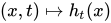
The animation that is looped above right provides an example of a homotopy between two embeddings, f and g, of the torus into R3. X is the torus, Y is R3, f is some continuous function from the torus to R3 that takes the torus to the embedded surface-of-a-doughnut shape with which the animation starts; g is some continuous function that takes the torus to the embedded surface-of-a-coffee-mug shape. The animation shows the image of ht(X) as a function of the parameter t, where t varies with time from 0 to 1 over each cycle of the animation loop. It pauses, then shows the image as t varies back from 1 to 0, pauses, and repeats this cycle.

Properties

[edit]

Continuous functions f and g are said to be homotopic if and only if there is a homotopy H taking f to g as described above. Being homotopic is an equivalence relation on the set of all continuous functions from X to Y. This homotopy relation is compatible with function composition in the following sense: if f1, g1 : XY are homotopic, and f2, g2 : YZ are homotopic, then their compositions f2 ∘ f1 and g2 ∘ g1 : XZ are also homotopic.

Examples

[edit]
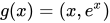
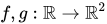
  • If are given by and , then the map given by is a homotopy between them.
  • More generally, if is a convex subset of Euclidean space and are paths with the same endpoints, then there is a linear homotopy[5] (or straight-line homotopy) given by
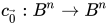
  • Let be the identity function on the unit n-disk; i.e. the set . Let be the constant function which sends every point to the origin. Then the following is a homotopy between them:
Homotopy equivalence

[edit]

Given two topological spaces X and Y, a homotopy equivalence between X and Y is a pair of continuous maps f : XY and g : YX, such that g ∘ f is homotopic to the identity map idX and f ∘ g is homotopic to idY. If such a pair exists, then X and Y are said to be homotopy equivalent, or of the same homotopy type. This relation of homotopy equivalence is often denoted .[6] Intuitively, two spaces X and Y are homotopy equivalent if they can be transformed into one another by bending, shrinking and expanding operations. Spaces that are homotopy-equivalent to a point are called contractible.

Homotopy equivalence vs. homeomorphism

[edit]

A homeomorphism is a special case of a homotopy equivalence, in which g ∘ f is equal to the identity map idX (not only homotopic to it), and f ∘ g is equal to idY.[7]: 0:53:00  Therefore, if X and Y are homeomorphic then they are homotopy-equivalent, but the opposite is not true. Some examples:

  • A solid disk is homotopy-equivalent to a single point, since you can deform the disk along radial lines continuously to a single point. However, they are not homeomorphic, since there is no bijection between them (since one is an infinite set, while the other is finite).
  • The Möbius strip and an untwisted (closed) strip are homotopy equivalent, since you can deform both strips continuously to a circle. But they are not homeomorphic.

Examples

[edit]
  • The first example of a homotopy equivalence is with a point, denoted . The part that needs to be checked is the existence of a homotopy between and , the projection of onto the origin. This can be described as .
  • There is a homotopy equivalence between (the 1-sphere) and .
    • More generally, .
  • Any fiber bundle with fibers homotopy equivalent to a point has homotopy equivalent total and base spaces. This generalizes the previous two examples since is a fiber bundle with fiber .
  • Every vector bundle is a fiber bundle with a fiber homotopy equivalent to a point.
  • for any , by writing as the total space of the fiber bundle , then applying the homotopy equivalences above.
  • If a subcomplex of a CW complex is contractible, then the quotient space is homotopy equivalent to .[8]
  • A deformation retraction is a homotopy equivalence.

Null-homotopy

[edit]

A function is said to be null-homotopic if it is homotopic to a constant function. (The homotopy from to a constant function is then sometimes called a null-homotopy.) For example, a map from the unit circle to any space is null-homotopic precisely when it can be continuously extended to a map from the unit disk to that agrees with on the boundary.

It follows from these definitions that a space is contractible if and only if the identity map from to itself—which is always a homotopy equivalence—is null-homotopic.

Invariance

[edit]

Homotopy equivalence is important because in algebraic topology many concepts are homotopy invariant, that is, they respect the relation of homotopy equivalence. For example, if X and Y are homotopy equivalent spaces, then:

An example of an algebraic invariant of topological spaces which is not homotopy-invariant is compactly supported homology (which is, roughly speaking, the homology of the compactification, and compactification is not homotopy-invariant).

Variants

[edit]

Relative homotopy

[edit]

In order to define the fundamental group, one needs the notion of homotopy relative to a subspace. These are homotopies which keep the elements of the subspace fixed. Formally: if f and g are continuous maps from X to Y and K is a subset of X, then we say that f and g are homotopic relative to K if there exists a homotopy H : X × [0, 1] → Y between f and g such that H(k, t) = f(k) = g(k) for all kK and t ∈ [0, 1]. Also, if g is a retraction from X to K and f is the identity map, this is known as a strong deformation retract of X to K. When K is a point, the term pointed homotopy is used.

Isotopy

[edit]
The unknot is not equivalent to the trefoil knot since one cannot be deformed into the other through a continuous path of homeomorphisms of the ambient space. Thus they are not ambient-isotopic.

When two given continuous functions f and g from the topological space X to the topological space Y are embeddings, one can ask whether they can be connected 'through embeddings'. This gives rise to the concept of isotopy, which is a homotopy, H, in the notation used before, such that for each fixed t, H(x, t) gives an embedding.[9]

A related, but different, concept is that of ambient isotopy.

Requiring that two embeddings be isotopic is a stronger requirement than that they be homotopic. For example, the map from the interval [−1, 1] into the real numbers defined by f(x) = −x is not isotopic to the identity g(x) = x. Any homotopy from f to the identity would have to exchange the endpoints, which would mean that they would have to 'pass through' each other. Moreover, f has changed the orientation of the interval and g has not, which is impossible under an isotopy. However, the maps are homotopic; one homotopy from f to the identity is H: [−1, 1] × [0, 1] → [−1, 1] given by H(x, y) = 2yx − x.

Two homeomorphisms (which are special cases of embeddings) of the unit ball which agree on the boundary can be shown to be isotopic using Alexander's trick. For this reason, the map of the unit disc in defined by f(x, y) = (−x, −y) is isotopic to a 180-degree rotation around the origin, and so the identity map and f are isotopic because they can be connected by rotations.

In geometric topology—for example in knot theory—the idea of isotopy is used to construct equivalence relations. For example, when should two knots be considered the same? We take two knots, K1 and K2, in three-dimensional space. A knot is an embedding of a one-dimensional space, the "loop of string" (or the circle), into this space, and this embedding gives a homeomorphism between the circle and its image in the embedding space. One may try to define knot equivalence based on isotopy instead of the more restricted property of ambient isotopy. That is, two knots are isotopic when there exists a continuous function starting at t = 0 giving the K1 embedding, ending at t = 1 giving the K2 embedding, with all intermediate values corresponding to embeddings. However, this definition would make every knot equivalent to the unknot, as the knotted portions can be "contracted" down to a straight line. The problem is that, while continuous, this is not an injective function of the euclidean space that the knot is embedded in. An ambient isotopy, studied in this context, is an isotopy of the larger space, considered in light of its action on the embedded submanifold. Knots K1 and K2 are considered equivalent when there is a continuous which moves K1 to K2 via homeomorphisms of the euclidean space.

Similar language is used for the equivalent concept in contexts where one has a stronger notion of equivalence. For example, a path between two smooth embeddings is a smooth isotopy.

Timelike homotopy

[edit]

On a Lorentzian manifold, certain curves are distinguished as timelike (representing something that only goes forwards, not backwards, in time, in every local frame). A timelike homotopy between two timelike curves is a homotopy such that the curve remains timelike during the continuous transformation from one curve to another. No closed timelike curve (CTC) on a Lorentzian manifold is timelike homotopic to a point (that is, null timelike homotopic); such a manifold is therefore said to be multiply connected by timelike curves. A manifold such as the 3-sphere can be simply connected (by any type of curve), and yet be timelike multiply connected.[10]

Properties

[edit]

Lifting and extension properties

[edit]

If we have a homotopy and a cover and we are given a map such that ( is called a lift of ), then we can lift all to a map such that . The homotopy lifting property is used to characterize fibrations.

Another useful property involving homotopy is the homotopy extension property, which characterizes the extension of a homotopy between two functions from a subset of some set to the set itself. It is useful when dealing with cofibrations.

Groups

[edit]

Since the relation of two functions being homotopic relative to a subspace is an equivalence relation, we can look at the equivalence classes of maps between a fixed X and Y. If we fix , the unit interval [0, 1] crossed with itself n times, and we take its boundary as a subspace, then the equivalence classes form a group, denoted , where is in the image of the subspace .

We can define the action of one equivalence class on another, and so we get a group. These groups are called the homotopy groups. In the case , it is also called the fundamental group.

Homotopy category

[edit]

The idea of homotopy can be turned into a formal category of category theory. The homotopy category is the category whose objects are topological spaces, and whose morphisms are homotopy equivalence classes of continuous maps. Two topological spaces X and Y are isomorphic in this category if and only if they are homotopy-equivalent. Then a functor on the category of topological spaces is homotopy invariant if it can be expressed as a functor on the homotopy category.

For example, homology groups are a functorial homotopy invariant: this means that if f and g from X to Y are homotopic, then the group homomorphisms induced by f and g on the level of homology groups are the same: Hn(f) = Hn(g) : Hn(X) → Hn(Y) for all n. Likewise, if X and Y are in addition path connected, and the homotopy between f and g is pointed, then the group homomorphisms induced by f and g on the level of homotopy groups are also the same: πn(f) = πn(g) : πn(X) → πn(Y).

Applications

[edit]

Based on the concept of the homotopy, computation methods for algebraic and differential equations have been developed. The methods for algebraic equations include the homotopy continuation method[11] and the continuation method (see numerical continuation). The methods for differential equations include the homotopy analysis method.

Homotopy theory can be used as a foundation for homology theory: one can represent a cohomology functor on a space X by mappings of X into an appropriate fixed space, up to homotopy equivalence. For example, for any abelian group G, and any based CW-complex X, the set of based homotopy classes of based maps from X to the Eilenberg–MacLane space is in natural bijection with the n-th singular cohomology group  of the space X. One says that the omega-spectrum of Eilenberg-MacLane spaces are representing spaces for singular cohomology with coefficients in G. Using this fact, homotopy classes between a CW complex and a multiply connected space can be calculated using cohomology as described by the Hopf–Whitney theorem.

Recently, homotopy theory is used to develop deep learning based generative models like diffusion models and flow-based generative models. Perturbing the complex non-Gaussian states is a tough task. Using deep learning and homotopy, such complex states can be transformed to Gaussian state and mildly perturbed to get transformed back to perturbed complex states.[12]

See also

[edit]

References

[edit]

Sources

[edit]
Revisions and contributorsEdit on WikipediaRead on Wikipedia
from Grokipedia
In , a homotopy between two continuous maps f,g:XYf, g: X \to Y between topological spaces XX and YY is a continuous map H:X×[0,1]YH: X \times [0, 1] \to Y such that H(x,0)=f(x)H(x, 0) = f(x) and H(x,1)=g(x)H(x, 1) = g(x) for all xXx \in X, representing a continuous deformation of ff into gg. This relation is an on the set of continuous maps, partitioning them into homotopy classes that capture essential topological similarities invariant under such deformations. The concept was introduced by in his 1895 paper Analysis Situs, where it formed the basis for early by enabling the classification of spaces via deformation-invariant properties like the . Homotopy extends naturally to spaces themselves through homotopy equivalence: two spaces XX and YY are homotopy equivalent if there exist continuous maps f:XYf: X \to Y and g:YXg: Y \to X that are homotopy inverses, meaning fgidYf \circ g \simeq \mathrm{id}_Y and gfidXg \circ f \simeq \mathrm{id}_X. This equivalence preserves key topological invariants, such as homology groups, which remain unchanged under homotopy and thus detect obstructions to such deformations. In particular, contractible spaces—those homotopy equivalent to a point, like Rn\mathbb{R}^n—exhibit trivial homology in positive degrees, highlighting homotopy's role in distinguishing deformable versus rigid structures. Beyond basic definitions, homotopy theory encompasses higher-dimensional generalizations through homotopy groups πn(X,x0)\pi_n(X, x_0), which classify maps from nn-spheres into a pointed space XX up to homotopy and form groups for n1n \geq 1. These groups, starting with the fundamental group π1\pi_1 for loops, provide a hierarchy of invariants that grow increasingly complex, with computations often relying on fibrations and spectral sequences in modern applications. Homotopy has profoundly influenced fields like , via étale homotopy, and physics, through modeling configuration spaces in , underscoring its enduring impact on understanding spatial continuity and deformation.

Definition and Fundamentals

Formal Definition

In , a homotopy between two f,g:XYf, g: X \to Y, where XX and YY are topological spaces, is defined as a H:X×IYH: X \times I \to Y, with I=[0,1]I = [0, 1] denoting the unit interval, such that H(x,0)=f(x)H(x, 0) = f(x) and H(x,1)=g(x)H(x, 1) = g(x) for all xXx \in X. This HH provides a continuous family of maps ft:XYf_t: X \to Y for each tIt \in I, given by ft(x)=H(x,t)f_t(x) = H(x, t), interpolating between f=f0f = f_0 and g=f1g = f_1. The relation of being homotopic, denoted fgf \simeq g, is an equivalence relation on the set of all continuous maps from XX to YY. Specifically, reflexivity holds via the constant homotopy H(x,t)=f(x)H(x, t) = f(x); symmetry via the reparametrization H(x,t)=H(x,1t)H'(x, t) = H(x, 1 - t); and transitivity by concatenating homotopies along the interval. This equivalence partitions the set of continuous maps into homotopy classes, often denoted $$ for the class containing ff, or collectively as [X,Y][X, Y]. These homotopy classes correspond to the path-connected components in the of continuous maps from XX to YY, equipped with the , where paths in this space are precisely the homotopies. Thus, homotopy serves as a fundamental that captures continuous deformations between maps, motivating the study of topological invariants preserved under such deformations.

Basic Properties

The homotopy relation \simeq between continuous maps f,g:XYf, g: X \to Y between topological spaces XX and YY is an on the set of such maps. Reflexivity holds because each map ff is homotopic to itself via the constant homotopy H(x,t)=f(x)H(x, t) = f(x) for all t[0,1]t \in [0, 1]. Symmetry follows from the fact that if fgf \simeq g via a homotopy HH, then gfg \simeq f via the reversed homotopy H(x,t)=H(x,1t)H'(x, t) = H(x, 1 - t). Transitivity is established by concatenating homotopies: if fgf \simeq g via H1H_1 and ghg \simeq h via H2H_2, then fhf \simeq h via the homotopy that applies H1H_1 on [0,1/2][0, 1/2] and H2H_2 on [1/2,1][1/2, 1], suitably reparametrized to ensure continuity. A key feature of homotopy is its independence from the choice of parametrization of the interval [0,1][0, 1]. Specifically, if H:X×[0,1]YH: X \times [0, 1] \to Y is a homotopy from ff to gg, and ϕ:[0,1][0,1]\phi: [0, 1] \to [0, 1] is a continuous reparametrization with ϕ(0)=0\phi(0) = 0 and ϕ(1)=1\phi(1) = 1, then the composed map H(idX×ϕ)H \circ (\mathrm{id}_X \times \phi) defines an equivalent homotopy from ff to gg. This reparametrization invariance ensures that homotopy classes are well-defined without dependence on the specific timing of the deformation. Homotopies compose naturally in a manner that respects the structure of continuous maps. If fg:XYf \simeq g: X \to Y and gh:YZg \simeq h: Y \to Z, then fh:XZf \simeq h: X \to Z via the concatenated homotopy described above, confirming the transitivity property algebraically. Moreover, the relation is functorial with respect to composition: if f0f1:XYf_0 \simeq f_1: X \to Y and g0g1:YZg_0 \simeq g_1: Y \to Z, then g0f0g1f1:XZg_0 \circ f_0 \simeq g_1 \circ f_1: X \to Z, via the homotopy H(x,t)=gt(ft(x))H(x, t) = g_t(f_t(x)), where ftf_t and gtg_t are the interpolating maps from the respective homotopies. This property underscores the compatibility of homotopy with the and continuous maps.

Examples and Illustrations

Continuous Deformations

Homotopy provides an intuitive notion of continuous deformation between maps, allowing one to "stretch" or "shrink" paths or embeddings within a without tearing or passing through singularities. This concept is fundamental to understanding how shapes can be transformed while preserving topological features, such as connectivity or the presence of holes. A classic example of such a deformation occurs in the closed unit disk D2={(x,y)R2x2+y21}D^2 = \{(x,y) \in \mathbb{R}^2 \mid x^2 + y^2 \leq 1\}, which is contractible. Here, the identity map id:D2D2\mathrm{id}: D^2 \to D^2 is homotopic to a constant map sending every point to (0,0)(0,0). The homotopy can be explicitly constructed by radially shrinking the disk toward over time, with H(x,t)=(1t)xH(x,t) = (1-t)x for t[0,1]t \in [0,1], demonstrating how the entire disk continuously collapses to a point while remaining within itself. This contractibility highlights the disk's trivial homotopy type, equivalent to that of a single point. In simply connected spaces, such as the R2\mathbb{R}^2, any closed loop—say, a circle centered at the origin—can be continuously deformed to a point. The deformation proceeds by filling the interior of the loop with a disk and then contracting that disk radially to the base point, ensuring the path remains embedded in the space throughout the process. This null-homotopy illustrates why simply connected spaces have no "non-trivial holes" that prevent such contractions. On the 2-sphere S2S^2, two paths connecting the same endpoints are homotopic if the closed loop they form bounds a disk on the sphere. For instance, consider the and as endpoints; a arc from north to south can be deformed to a meridian by "sweeping" across the spherical disk it encloses, leveraging the sphere's simply connectedness to fill and shrink the bounding region continuously. These deformations are often visualized using the "rubber-sheet" analogy, where maps are imagined as drawings on an elastic sheet that can be stretched, twisted, or shrunk continuously without ripping or gluing, preserving the relative positions of points up to homotopy.

Null-Homotopy

A continuous f:XYf: X \to Y between topological spaces is null-homotopic if it is homotopic to a constant , meaning there exists a continuous homotopy H:X×[0,1]YH: X \times [0,1] \to Y such that H(x,0)=f(x)H(x,0) = f(x) for all xXx \in X and H(x,1)H(x,1) is constant for all xXx \in X. This property captures maps that can be continuously deformed to a point in the , reflecting a form of topological triviality. One key characterization of null-homotopy is that ff extends continuously to the CX=(X×[0,1])/(X×{1})CX = (X \times [0,1]) / (X \times \{1\}), where the extension sends the apex (the collapsed end) to a fixed point in YY; since the CXCX is contractible, this extension implies the original map deforms to a constant. These characterizations highlight null-homotopy as a foundational tool for identifying deformable structures in . Prominent examples include all continuous maps from (for any n0n \geq 0) to an arbitrary space YY, as Rn\mathbb{R}^n is contractible and thus every such map deforms to a constant via a straight-line homotopy to the origin. Similarly, projections or any maps originating from contractible spaces, such as disks DnD^n or simplices, are null-homotopic, as the domain's contractibility forces the homotopy class to be trivial. In contrast, the identity map on the circle S1S^1 is not null-homotopic, as it cannot be continuously deformed to a point without "tearing," reflecting the non-trivial generator in its π1(S1)Z\pi_1(S^1) \cong \mathbb{Z}. In the context of homotopy classes, a map ff is null-homotopic precisely when its class $$ equals the basepoint class [][*] in the pointed homotopy set [X,Y][X, Y]_*, marking it as the trivial element that detects the absence of non-trivial topological obstructions. This role underscores null-homotopy's importance in classifying maps up to deformation, distinguishing contractible features from more complex homotopy structures.

Homotopy Equivalence

Definition and Criteria

In algebraic topology, two topological spaces XX and YY are homotopy equivalent, denoted XYX \simeq Y, if there exist continuous maps f:XYf: X \to Y and g:YXg: Y \to X such that the compositions fgf \circ g is homotopic to the identity map idY\mathrm{id}_Y and gfg \circ f is homotopic to idX\mathrm{id}_X. This relation is an on the class of topological spaces, partitioning them into equivalence classes known as homotopy types, which capture the essential "shape" of spaces up to continuous deformation. A key criterion for homotopy equivalence is the existence of homotopy inverses, as embodied in the maps ff and gg above; such maps are called homotopy inverses to each other. Another important criterion involves deformation retracts: a subspace AXA \subset X is a deformation retract of XX if the inclusion map i:AXi: A \to X admits a retraction r:XAr: X \to A (satisfying ri=idAr \circ i = \mathrm{id}_A) such that iridXi \circ r \simeq \mathrm{id}_X via a homotopy H:X×IXH: X \times I \to X with H(x,0)=xH(x, 0) = x for all xXx \in X, H(x,1)AH(x, 1) \in A for all xXx \in X, and H(a,t)=aH(a, t) = a for all aAa \in A and tIt \in I. In this case, XX and AA are homotopy equivalent, with ii and rr serving as homotopy inverses. Weak homotopy equivalence provides a related but potentially stricter criterion in certain contexts: a continuous map f:XYf: X \to Y is a weak homotopy equivalence if it induces isomorphisms on the sets of path components π0\pi_0 and on all homotopy groups πn\pi_n for n1n \geq 1 at every basepoint. For CW-complexes, weak homotopy equivalences coincide with homotopy equivalences by Whitehead's theorem, but in general they may differ. Representative examples of homotopy equivalent pairs include a point space and any , such as the closed unit disk in R2\mathbb{R}^2, which deformation retracts to its center point via radial contraction. Similarly, the on any is contractible and thus homotopy equivalent to a point.

Relation to Homeomorphism

A between topological s XX and YY is a bijective continuous f:XYf: X \to Y whose inverse f1:YXf^{-1}: Y \to X is also continuous, establishing an that preserves all topological properties, including local , , and . This relation is strictly stronger than homotopy equivalence: every homeomorphism induces a homotopy equivalence, since the identity maps serve as the required homotopies, but the reverse implication fails in general. Homotopy equivalence captures large-scale or "global" topological features, such as connectivity and the existence of holes, while disregarding finer details like exact shape or dimensionality that homeomorphisms preserve. For instance, the Euclidean spaces Rn\mathbb{R}^n and Rm\mathbb{R}^m for nmn \neq m are both contractible—meaning each is homotopy equivalent to a point via a straight-line contraction to the origin—but they are not homeomorphic, as their topological dimensions differ. Similarly, the closed nn- BnB^n in Rn\mathbb{R}^n is homotopy equivalent to a point through radial contraction, yet it cannot be homeomorphic to a point, which has 0 while BnB^n has n>0n > 0. In infinite-dimensional settings, this distinction becomes even more pronounced. The Hilbert cube Q=i=1[0,1]Q = \prod_{i=1}^\infty [0,1], equipped with the , is a compact, contractible absolute neighborhood retract, hence homotopy equivalent to a point via coordinate-wise contraction to 0. However, QQ is not homeomorphic to any finite-dimensional or a point, as it is infinite-dimensional and contains uncountably many points, violating the bijectivity and local Euclidean properties required for such homeomorphisms. These examples illustrate how homotopy equivalence ignores local and dimensional intricacies, focusing instead on deformable connectivity that homeomorphisms must match exactly.

Invariants and Classification

Homotopy Invariants

In , the relation of homotopy equivalence partitions continuous between topological spaces into equivalence classes, denoted [X,Y][X, Y], where XX and YY are pointed topological spaces. A continuous map ϕ:YZ\phi: Y \to Z induces a well-defined function on these homotopy classes, [ϕ]:[X,Y][X,Z][\phi]_*: [X, Y] \to [X, Z], given by post-composition [ϕf] \mapsto [\phi \circ f]; this is well-defined because if two maps fgf \sim g are homotopic, then ϕfϕg\phi \circ f \sim \phi \circ g. Among the basic homotopy invariants, the zeroth homotopy set π0(X)\pi_0(X) consists of the path-connected components of XX, classifying the path-connectedness of the space: XX is path-connected if and only if π0(X)\pi_0(X) has a single element. The χ(X)=k0(1)k\rankHk(X;Z)\chi(X) = \sum_{k \geq 0} (-1)^k \rank H_k(X; \mathbb{Z}), defined via the alternating sum of ranks of groups, is a coarser homotopy invariant that detects certain structural features but is not exclusively homotopy-theoretic, as it also remains unchanged under homeomorphisms. For continuous maps f:SnSnf: S^n \to S^n between nn-spheres, the topological degree deg(f)Z\deg(f) \in \mathbb{Z} provides a precise homotopy invariant; homotopic maps share the same degree, and for oriented spheres, this completely classifies the homotopy classes. Whitehead's theorem asserts that if XX and YY are CW-complexes and f:XYf: X \to Y induces isomorphisms πn(f):πn(X,x0)πn(Y,f(x0))\pi_n(f): \pi_n(X, x_0) \to \pi_n(Y, f(x_0)) on all homotopy groups for n0n \geq 0, then ff is a homotopy equivalence.

Homotopy Groups

The nth homotopy group of a pointed (X, x_0), denoted πn(X,x0)\pi_n(X, x_0), is defined as the set of homotopy classes of basepoint-preserving continuous maps f:(Sn,)(X,x0)f: (S^n, *) \to (X, x_0), where SnS^n is the nn- with basepoint * at the , and two such maps are equivalent if they are connected by a basepoint-preserving homotopy. This construction, introduced by Hurewicz, endows πn(X,x0)\pi_n(X, x_0) with an structure for n2n \geq 2 via the pinch map on the equator of SnS^n, which induces a well-defined of classes; the corresponds to the class of constant maps, which are precisely the null-homotopic ones. For n=1n=1, π1(X,x0)\pi_1(X, x_0) recovers the , which need not be abelian in general. These groups serve as powerful invariants for classifying spaces up to , as a homotopy equivalence induces isomorphisms on all . A example arises with spheres: πn(Sk)Z\pi_n(S^k) \cong \mathbb{Z} for n=k1n=k \geq 1, generated by the degree map, while πn(Sk)\pi_n(S^k) is trivial for n<kn < k; however, exceptions occur in higher dimensions, such as π3(S2)Z\pi_3(S^2) \cong \mathbb{Z}, generated by the attaching map of the S3S2S^3 \to S^2. The provides the first non-trivial example of a higher , demonstrating that spheres do not classify simply by their dimension alone. The Freudenthal suspension theorem states that if X is an (n-1)-connected CW-complex for some n ≥ 2, then the suspension homomorphism πk(X)πk+1(ΣX)\pi_k(X) \to \pi_{k+1}(\Sigma X) is an isomorphism for k < 2n - 1 and a surjection for k = 2n - 1. This result, proved by Freudenthal, establishes a stability pattern in homotopy groups: for a simply connected space, suspensions yield isomorphisms in a range of low dimensions, allowing computations of unstable groups to inform stable ones via iterated suspensions. Despite their utility, computing homotopy groups remains highly challenging, with no general available; for instance, the fundamental groups of compact orientable surfaces of g1g \geq 1 are presented as a1,b1,,ag,bgi=1g[ai,bi]=1\langle a_1, b_1, \dots, a_g, b_g \mid \prod_{i=1}^g [a_i, b_i] = 1 \rangle, which is free abelian of rank $2gforthe[torus](/page/Torus)( for the [torus](/page/Torus) (g=1$), but higher groups like those of spheres require spectral sequences and are known explicitly only up to dimension around 100 through computational efforts building on seminal work by Serre and Toda.

Variants and Extensions

Relative Homotopy

In algebraic topology, relative homotopy refers to a homotopy between two continuous maps f,g:XYf, g: X \to Y that remains fixed on a subspace AXA \subset X. Specifically, a homotopy H:X×IYH: X \times I \to Y, where I=[0,1]I = [0,1] is the unit interval, is relative to AA if H(x,t)=f(x)H(x, t) = f(x) for all xAx \in A and tIt \in I, ensuring that the deformation does not move points in AA. This concept extends the notion of homotopy to pairs of spaces (X,A)(X, A), where maps preserve the subspace structure, and is fundamental for analyzing how deformations behave when constrained by a fixed subset. Relative homotopy groups generalize absolute homotopy groups to pairs (X,A,x0)(X, A, x_0) with basepoint x0Ax_0 \in A. The nnth relative homotopy group πn(X,A,x0)\pi_n(X, A, x_0) consists of homotopy classes of continuous maps (Dn,Sn1,s0)(X,A,x0)(D^n, S^{n-1}, s_0) \to (X, A, x_0), where DnD^n is the nn-dimensional disk, Sn1S^{n-1} its boundary sphere, and s0Sn1s_0 \in S^{n-1}. These classes form a group under concatenation of maps, abelian for n2n \geq 2, capturing "spheres" attached to AA within XX. When AA is a single point, πn(X,A,x0)\pi_n(X, A, x_0) reduces to the standard homotopy group πn(X,x0)\pi_n(X, x_0). For a pair (X,A)(X, A) with AXA \subset X, there exists a long in homotopy groups: πn(A,x0)πn(X,x0)πn(X,A,x0)πn1(A,x0)π0(X,A,x0)0,\cdots \to \pi_n(A, x_0) \to \pi_n(X, x_0) \to \pi_n(X, A, x_0) \to \pi_{n-1}(A, x_0) \to \cdots \to \pi_0(X, A, x_0) \to 0, where the maps are induced by inclusions and boundary operators, with exactness meaning the image of each map equals the kernel of the next. This sequence arises from viewing the pair as a fibration and provides a tool to relate the topology of XX and AA through their relative structure. Applications of relative homotopy are prominent in the study of cell complexes, such as CW-complexes, where cellular approximation simplifies computations. The cellular approximation theorem states that any map (X,A)(Y,B)(X, A) \to (Y, B) between CW-pairs is homotopic, relative to AA, to a cellular map, allowing homotopy groups to be calculated using skeletal filtrations and chain complexes of cells. Additionally, the excision theorem ensures that if UintAU \subset \operatorname{int} A with UA\overline{U} \subset A, then the inclusion (XU,AU)(X,A)(X - U, A - U) \to (X, A) induces an isomorphism πn(XU,AU)πn(X,A)\pi_n(X - U, A - U) \cong \pi_n(X, A) for all nn, facilitating local-to-global analysis by removing small open sets without altering homotopy types.

Isotopy

In topology, an isotopy is a homotopy between two maps that remains invertible at every stage of the deformation. Specifically, for two homeomorphisms f0,f1:XYf_0, f_1: X \to Y between topological spaces, an isotopy is a continuous family of homeomorphisms Ht:XYH_t: X \to Y for t[0,1]t \in [0,1] such that H0=f0H_0 = f_0 and H1=f1H_1 = f_1. Similarly, for embeddings of a manifold MM into another manifold NN, an isotopy is a homotopy between two embeddings f,g:MNf, g: M \to N such that each intermediate map Ht:MNH_t: M \to N is also an embedding. This levelwise invertibility distinguishes isotopy from general homotopy, ensuring the deformation preserves the topological structure without self-intersections or collapses. Ambient isotopy refines this concept by considering deformations within a fixed . Given two embeddings f,g:MNf, g: M \to N, they are ambient isotopic if there exists an isotopy of self-homeomorphisms of NN (starting from the identity) that carries the image f(M)f(M) to g(M)g(M) while fixing the complement Nf(M)N \setminus f(M) setwise at each stage. This extends the deformation to the entire ambient manifold, providing a global perspective on equivalence under continuous distortions that respect the surrounding . Ambient isotopy is particularly useful for studying embedded objects, as it models "ambient-preserving" reconfigurations without altering the of the exterior. A classic example arises in , where two embeddings of the S1S^1 into R3\mathbb{R}^3 () are equivalent if they are ambient isotopic; in particular, any unknotted is ambient isotopic to the standard round via a deformation that avoids intersections. Reidemeister moves provide a combinatorial realization of this equivalence: two knot diagrams represent ambient isotopic if and only if one can be transformed into the other through a finite sequence of these local moves (type I: twist/untwist; type II: create/annihilate crossing pair; type III: slide over crossing), as established by Reidemeister's theorem. For higher-dimensional spheres, the Schönflies theorem implies that every locally flat embedding of the 2-sphere S2S^2 into R3\mathbb{R}^3 is ambient isotopic to the standard equatorial sphere, confirming the uniqueness of such embeddings up to deformation. In the smooth category, the topological notion of isotopy generalizes to diffeotopy, where each stage of the homotopy consists of diffeomorphisms rather than mere homeomorphisms. This smooth variant is essential for studying manifolds with differentiable structure, ensuring the deformation preserves not only topology but also local differentiability, though the two concepts coincide in low dimensions due to the of smooth approximations.

Advanced Structures

Lifting and Extension

In , the (HLP) is a key characteristic of , enabling the extension of lifts from to homotopies. Specifically, for a p:EBp: E \to B defined as a , given any space XX, a homotopy G:X×IBG: X \times I \to B, and a lift f:XEf: X \to E of the initial G0:XBG_0: X \to B (satisfying pf=G0p \circ f = G_0), there exists a homotopy G~:X×IE\tilde{G}: X \times I \to E such that pG~=Gp \circ \tilde{G} = G and G~0=f\tilde{G}_0 = f. This property ensures that behave well under homotopy, preserving structural information from the base space BB to the total space EE. A classic example of a fibration exhibiting the HLP is the path-loop fibration p:PBBp: P B \to B, where PBP B denotes the space of paths in BB starting at a fixed basepoint, and the fiber over the basepoint is the based loop space ΩB\Omega B. This fibration lifts homotopies of based loops in BB to paths in PBP B, which is essential for computing homotopy groups. Dually, the homotopy extension property (HEP) applies to cofibrations, facilitating the extension of homotopies from subspaces. For a i:AXi: A \hookrightarrow X, given a f:XYf: X \to Y and any homotopy H:A×IYH: A \times I \to Y such that H(a,0)=f(a)H(a, 0) = f(a) for all aAa \in A, there exists a homotopy H~:X×IY\tilde{H}: X \times I \to Y such that H~A×I=H\tilde{H}|_{A \times I} = H and H~(x,0)=f(x)\tilde{H}(x, 0) = f(x) for all xXx \in X. This property is crucial for constructions involving cell attachments, as it allows homotopies defined on subcomplexes to propagate to the full space without obstruction. Cell inclusions in CW complexes provide a concrete illustration of the HEP; for instance, the inclusion of the boundary sphere Sn1DnS^{n-1} \hookrightarrow D^n (or skeleta inclusions Xk1XkX^{k-1} \hookrightarrow X^k) admits extensions of homotopies from the boundary or lower skeleton to the disk or full complex. These examples underpin the deformation properties of CW pairs, enabling approximations and retractions in . The HLP and HEP play foundational roles in model category theory, where fibrations are defined via the right lifting property against acyclic cofibrations (incorporating HLP), and cofibrations via the left lifting property against acyclic fibrations (incorporating HEP). In the category of simplicial sets, these properties manifest in the Kan fibrations (which satisfy HLP) and cofibrations (which satisfy HEP), providing a combinatorial framework for that mirrors topological constructions.

Homotopy Category

The homotopy category of topological spaces, denoted Ho(Top)\mathrm{Ho}(\mathrm{Top}), is a category whose objects are topological spaces and whose morphisms are homotopy classes of continuous maps between them, denoted $$ for a continuous map f:XYf: X \to Y. This construction formalizes by treating homotopies as isomorphisms, allowing the study of spaces up to homotopy equivalence. Specifically, the composition of morphisms \circ is induced by the usual composition of representatives, modulo homotopy. Ho(Top)\mathrm{Ho}(\mathrm{Top}) arises as the localization of the category Top\mathrm{Top} of topological spaces and continuous maps at the class of weak homotopy equivalences (or homotopy equivalences for well-behaved spaces like CW-complexes), inverting these maps to make them isomorphisms in the localized category. This localization process, in the sense of model categories, yields a category where the homotopy type of a space determines its essential properties, enabling the application of categorical tools to . The resulting structure is equivalent to the homotopy category of simplicial sets under the structure. A key adjunction underpinning this equivalence is between the singular simplicial set functor Sing:TopsSet\mathrm{Sing}: \mathrm{Top} \to \mathrm{sSet}, which assigns to each space XX the simplicial set of its singular simplices, and the geometric realization functor :sSetTop|-|: \mathrm{sSet} \to \mathrm{Top}, which constructs a topological space from a simplicial set. The functor Sing\mathrm{Sing} preserves homotopies, mapping continuous homotopies in Top\mathrm{Top} to simplicial homotopies in sSet\mathrm{sSet}, and thus induces a functor on the homotopy categories Ho(Top)Ho(sSet)\mathrm{Ho}(\mathrm{Top}) \to \mathrm{Ho}(\mathrm{sSet}). Conversely, geometric realization preserves weak equivalences and fibrations, ensuring the adjunction descends to an equivalence of homotopy categories. The stable homotopy category extends this framework by considering the homotopy category of spectra, which stabilizes Ho(Top)\mathrm{Ho}(\mathrm{Top}_*) (the pointed version) under infinite suspension; it captures the stable homotopy groups of spaces and serves as the foundation for . The suspension spectrum functor Σ:Ho(Top)Ho(Sp)\Sigma^\infty: \mathrm{Ho}(\mathrm{Top}_*) \to \mathrm{Ho}(\mathrm{Sp}) embeds unstable homotopy into this stable setting, where homotopy groups become independent of dimension after sufficient suspension.

Applications

In Algebraic Topology

In algebraic topology, homotopy theory plays a central role in classifying topological spaces, particularly through the use of homotopy groups to distinguish non-homeomorphic manifolds with the same homotopy type. A prominent example is the family of lens spaces, which are 3-dimensional manifolds constructed as quotients of the by actions. All lens spaces L(p,q)L(p,q) with coprime integers pp and qq share the same π1(L(p,q))Z/pZ\pi_1(L(p,q)) \cong \mathbb{Z}/p\mathbb{Z}, making π1\pi_1 insufficient for full classification. The topological classification requires additional invariants, such as the Reidemeister torsion, to determine when two lens spaces are homeomorphic: L(p,q)L(p,q)L(p,q) \cong L(p,q') if and only if qq(modp)q \equiv q' \pmod{p} or qq1(modp)q \equiv -q'^{-1} \pmod{p}, up to orientation. This demonstrates how homotopy invariants like π1\pi_1 provide initial distinctions but necessitate complementary tools for precise classification. The exemplifies the power of homotopy in manifold classification, positing that every closed, simply connected is to the S3S^3. Simply connectedness means π1=0\pi_1 = 0, and the asserts that this, combined with the homotopy type of S3S^3, implies homeomorphism. resolved this in 2002–2003 using with surgery, showing that any such manifold evolves under the flow to a metric of constant , thereby confirming it is diffeomorphic to S3S^3 and establishing the . This resolution not only verified the topological invariance of homotopy type in dimension 3 but also advanced the broader , highlighting homotopy's role in bridging and . CW-complexes further enable homotopy-based classification by providing combinatorial models for spaces. These structures, built by attaching cells of increasing dimension, approximate arbitrary topological spaces up to weak homotopy equivalence. The cellular approximation theorem states that for CW-complexes XX and YY, any continuous map f:XYf: X \to Y is homotopic to a cellular map, which sends the nn-skeleton of XX into the nn-skeleton of YY. This theorem simplifies the study of homotopy classes [X,Y][X,Y], as cellular maps reduce computations to algebraic data on cells, facilitating the classification of maps and spaces via chain complexes and attachment maps. Spectral sequences provide a systematic method to compute homotopy groups from fibration structures. For a Serre FEBF \to E \to B, the associated converges to the homology groups H(E)H_*(E), with E2p,q=Hp(B;Hq(F))E_2^{p,q} = H_p(B; H_q(F)), allowing indirect computation of homotopy groups via the Hurewicz homomorphism, which relates πn\pi_n to HnH_n in simply connected spaces. In more general settings, such as towers of principal fibrations from Postnikov truncations, a arises from the exact couple of long exact homotopy sequences, converging to π(E)\pi_*(E) and enabling inductive calculations of higher homotopy groups from lower ones and kk-invariants. These tools are essential for classifying spaces by unraveling their decompositions. Surgery theory extends homotopy classification to manifolds by addressing when homotopy equivalences can be realized as or . Developed in the , it involves excising embedded spheres and attaching handles to modify manifolds while preserving homotopy type. For a homotopy equivalence f:MNf: M \to N between closed nn-manifolds (n5n \geq 5), the surgery obstruction groups Ln(π1(N))L_n(\pi_1(N)) measure whether ff is homotopic to a ; vanishing obstructions imply the existence of such a surgery sequence leading to in the smooth case under stable range conditions. This framework classifies manifolds up to homotopy equivalence, particularly in high dimensions, by relating geometric structures to algebraic LL-theory.

In Other Fields

In differential geometry, Morse theory provides a powerful connection between the critical points of smooth functions on manifolds and the homotopy type of those manifolds. Specifically, for a Morse function on a compact manifold, the homotopy type changes at critical points through the attachment of s, where the dimension of each handle corresponds to the index of the critical point, allowing the manifold to be reconstructed up to homotopy equivalence via a handlebody decomposition. This framework, developed by and refined by , enables the computation of homotopy invariants from the Morse data, such as the number and indices of critical points, which determine the Betti numbers via the Morse inequalities. In algebraic geometry, the étale homotopy type offers an analogue of singular homotopy theory adapted to schemes, replacing continuous maps with étale morphisms to capture the "topological" structure over fields of arbitrary characteristic. Introduced by Michael Artin and Barry Mazur, this construction assigns to a scheme a pro-object in the homotopy category of spaces, computed via étale hypercovers, which approximates the classical homotopy type when the scheme is over the complex numbers by profinite completion. For varieties over algebraically closed fields, the étale homotopy groups provide obstructions to lifting properties from characteristic zero to positive characteristic, and they are particularly useful in studying moduli spaces of algebraic curves where the étale fundamental group detects non-trivial coverings. In physics, homotopy theory plays a crucial role in string theory through the moduli spaces of Riemann surfaces, which parametrize the worldsheets of propagating and carry homotopy-invariant structures that govern scattering amplitudes. The compactification of these moduli spaces reveals structures, leading to homotopy Lie algebras on the string state space, as shown by Getzler, where the homotopy operations arise from gluing surfaces and encode the algebraic relations in open . Similarly, in (TQFT), homotopy enters via the hypothesis, which equates fully extended (n+1)-dimensional TQFTs with fully dualizable objects in a symmetric monoidal (∞,n)-category, with bordisms modeled as homotopy equivalences preserving the topological invariants of manifolds. This perspective, formalized by John Baez and James Dolan, unifies the axiomatic framework of with , enabling computations of partition functions from the homotopy type of the of the structure group. In and mathematical foundations, (HoTT) reinterprets identity types in Martin-Löf dependent type theory as paths in a , providing a foundation for where proofs of equality are higher-dimensional homotopies, thus bridging logic with . Developed by the Univalent Foundations Program, HoTT incorporates the , which states that equivalences of types induce equalities in the type of types, allowing synthetic reasoning about homotopy-theoretic constructions like the fundamental groupoid directly in the . This approach facilitates of mathematical proofs in proof assistants like Coq, with applications to where types model homotopy types, and identity proofs correspond to paths, enabling the definition of higher inductive types that capture colimits and free constructions up to homotopy.

References

Add your contribution
Related Hubs
User Avatar
No comments yet.