


Community hub
Recent from talks
Contribute something
Nothing was collected or created yet.
Newcastle International Sports Centre
View on Wikipedia
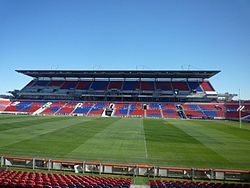
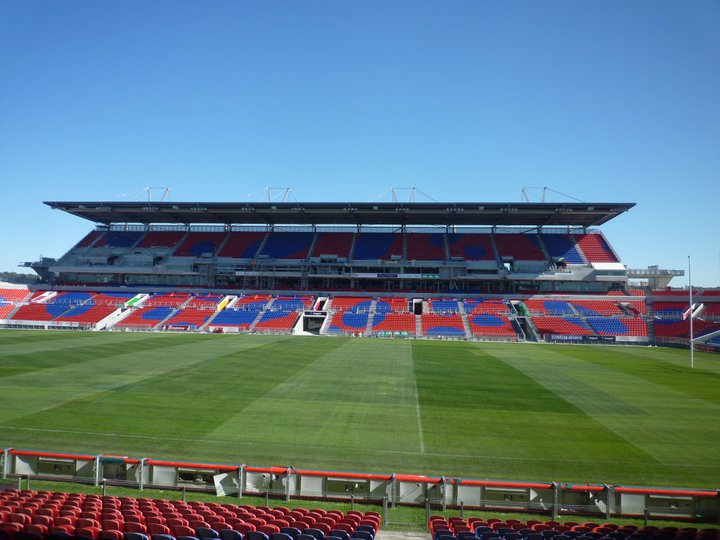
Newcastle International Sports Centre, currently known as McDonald Jones Stadium for sponsorship reasons, is a multi-purpose sports stadium located in Newcastle, Australia. The ground is home to the Newcastle Knights (National Rugby League) and Newcastle Jets FC (A-League). It is owned by the Government of New South Wales and is administered by Venues NSW. Due to past sponsorship deals, the ground has been previously known as Marathon Stadium, EnergyAustralia Stadium, Ausgrid Stadium and Hunter Stadium. Newcastle International Sports Centre is also known as Newcastle Stadium when in use during AFC competitions due to conflicting sponsorship reasons.
Key Information


History
[edit]Work began on the stadium on 1 December 1967, and was officially opened by Queen Elizabeth II on 10 April 1970. It was originally known as the International Sports Centre, and is still part of the ISC complex to this day. The playing surface back then was originally oval shaped to allow both codes of rugby, soccer and cricket to be able to make use of it.
The Newcastle Knights secured a lease on the stadium in 1986, and converted it from an oval to a rectangle layout. During the 1988 Great Britain Lions tour, the Newcastle Knights, in their first season, hosted a match at the ground. On that occasion the Lions, captained by Ellery Hanley, defeated the Knights 28–12.
In 1992, local tyre outlet Marathon Tyres became the naming rights sponsor for the stadium, and it was renamed Marathon Stadium. That year the Knights played Great Britain for a second time as part of the Lions Tour of Australasia. The Ellery Hanley captained Lions took the Knights apart winning 22–0. Later in the 1992 NSWRL season, the Knights qualified for their first ever Finals series.
Towards the end of 2001, energy supplier EnergyAustralia took over naming rights, and thus the stadium became EnergyAustralia Stadium. In February 2011 it was announced that the stadium would be renamed Ausgrid Stadium after EnergyAustralia was renamed Ausgrid.[4]
Before redevelopment, the stadium had a capacity of 28,000, including 5,000 in the main grandstand. The ground attendance record for a sporting event at the venue prior to the redevelopments is 32,642, which was set when the Knights took on the Manly-Warringah Sea Eagles in July 1995.[5]
Following the retirement of former Knights captain Andrew Johns, the new eastern grandstand was renamed The Andrew Johns Stand in honour of Johns in front of a packed crowd before the Knights vs Brisbane Broncos NRL match on 22 April 2007.
The name (Newcastle International Sports Centre) is used primarily by those who wish to mention stadiums by original names, such as non-commercial organisations like the Australian Broadcasting Corporation, and those with other corporate interests such as FIFA or the Asian Football Confederation.
On 16 October 2011, the venue's all-time record sporting attendance was set with 32,890 attending the Australia vs New Zealand Rugby League test match.
In October 2016, McDonald Jones Homes, a local Newcastle company, was named as the new naming rights sponsor of the stadium. This new deal left behind a five year gap between naming rights sponsors at the ground.[6]
Redevelopments
[edit]2003–05
[edit]The stadium underwent redevelopment during the years 2003–05, funded mostly by local and state government grants.
Factors that brought on the redevelopment included:
- non-compliance of National Rugby League (NRL) stadium criteria, especially the dressing rooms;
- failure to attract major sporting events to the area, specifically the 2003 Rugby World Cup;
- inadequate and ageing spectator and corporate facilities;
- covered seating capacity well below best practice and NRL standards;
- minimal areas within the grandstand to increase members' patronage both during a sporting event and on non-match-days;
- poor facilities for media officials;
- unsatisfactory temporary spectator facilities to the north and south of the western stand;
- the perceived need for the incumbent State Labor government to contribute to the public infrastructure in a region of safe seats.[7][8]
The first stage of the redevelopment was completed in early 2004. This consisted of;
- The construction of the lower level of the Eastern Stand (brought into operation for the 2004 NRL season and Anzac Test between Australia and New Zealand). This level holds 7,700 people.
- The relocation of corporate boxes and seating to the North and South stands.
The second stage of construction began in 2004 and was completed in 2005. This consisted of:
- The construction of the Eastern Stand's second level of seating and corporate boxes;
- a new video screen; and
- remedial work for the Western Grandstand, including updating the media facilities.
2008–11
[edit]During the 2007 NSW Election campaign, the Premier Morris Iemma promised $30 million towards an upgrade of the stadium, conditional on the Federal Government matching the funds.[9]
On 1 April 2008 the federal government confirmed $10m towards the development of the Western Grandstand. This was in addition to the $30m commitment from the state government. This was a critical step for the stadium's development for the upgrade to be in by 2011.[10] The A$40 million contributed to an expansion of the stadium's capacity to eventually hold over 40,000 as well as general improvements in the stadiums facilities.[11][12]
From 2008 to 2010 the stadium was upgraded again[13] to around 33 000 seats, with a hope for the stadium to be involved in the 2015 Asian Cup and 2018 World Cup were Australia be the host of those tournaments (Australia did host the Asian Cup, but not the World Cup). As part of the announcement, Morris Iemma stated that the capacity of 33,000 could be increased to the 40,000 necessary for World Cup Hosting, through temporary seating.[14] The total cost of the upgrade was estimated as $60 million, with $50 million from the state government and $10 million from the Federal Government. Although construction was slated to take place during both the Newcastle Knights and Newcastle Jets seasons, developers stated that there would be minimal effect on attendances due to the staged approach.[13]

The stadium development was planned to be carried out over four stages.
- Stage 1 (now completed) included dressing, warm up and medical rooms, with showers, toilets, ice baths and 855-seats of the spectator concourse in the stadium's south-west.[15]
- Stage 2 (now completed) replicates Stage 1 on the northern side of the Western Grandstand and also included the main western stand's lower concourse.
- Stage 3 (now completed) demolished the old western Grandstand and is replacing it with one similar to the eastern stand.
- Stage 4 (undertaking preparation) will involve building the northern and southern ends of the ground, replacing the grass hills with seated areas.
Newcastle Knights Centre of Excellence
[edit]In June 2018, plans were announced for a Centre of Excellence for the Newcastle Knights located at the southern end of the ground at a cost of $20 million with $10 million provided by the NSW government with the other $10 million funded by the Knights' owners The Wests Group.[16]
2024 upgrades
[edit]Prior to the start of the 2024 NRL season, the two video screens at the ground were replaced with two 160sqm screens along with a series of minor upgrades to spectator facilities.[17][18]
Transport
[edit]The nearest railway station is Broadmeadow. Newcastle Transport operate a shuttle service from Queens Wharf on match days.[19]
Uses
[edit]
Rugby league
[edit]The Newcastle Knights of the National Rugby League team have been tenants of the ground since their formation in 1988.
In October 2011 the ground hosted a rugby league one-off test match between Australia and New Zealand. This event set a new ground attendance record for a sporting event of 32,890.
Soccer
[edit]During the National Soccer League competition, three clubs have played their home ground games at this stadium. They are Newcastle KB United (1978–84); Newcastle Rosebud United (1984–86) and Newcastle United (2000–04). The NSL competition folded in 2004.
In 2005, the newly formed national competition (A-League) began to operate. Newcastle United Jets was part of the newly formed competition, and have played at this ground ever since.
The stadium also hosted two 2015 AFC Asian Cup group stage matches, and also a semi final between Australia and the United Arab Emirates and a third place playoff between United Arab Emirates and Iraq.
In February 2017 it was announced that the National Premier Leagues Northern NSW Grand Final would be taking place at the ground in September that year. In the Grand Final between the Edgeworth Eagles and Lambton Jaffas a crowd of 4174 was on hand to see the Jaffas clinch the title beating the Eagles 2–0 deep into Extra Time.
The 2018 A-League Grand Final was held at the venue, contested by the Newcastle Jets and Melbourne Victory, on 5 May 2018.
Baseball
[edit]The Hunter Eagles were formed for the 1994–95 Australian Baseball League season after purchasing the Sydney Wave's licence. The Eagles played in the Australian Baseball League until the end of the 1997–98 season.[20]
Rugby union
[edit]In 2012, it was used for the first match of the 2012 Scotland rugby union tour of Oceania. Scotland won the match, beating Australia 9–6.[21]
The New South Wales Waratahs played a home fixture of their Super Rugby season from 2019 in Newcastle whilst the Sydney Football Stadium was rebuilt.[22]
Notable games
[edit]Rugby league test matches
[edit]The venue has hosted three Australia internationals and one Rugby League World Cup game. The results were as follows;[23] Hunter Stadium was also chosen as the host venue for the 2016 Anzac Test between Australia and New Zealand on 6 May.[24]
| Date | Opponents | Result | Attendance | Part of |
|---|---|---|---|---|
| June 1996 |  Fiji (NRL) Fiji (NRL)
|
84–14 | 19,234 | |
| 23 April 2004 |  New Zealand New Zealand
|
37–10 | 21,537 | 2004 Anzac Test |
| 16 October 2011 | 42–6 | 32,890 | ||
| 6 May 2016 | 16–0 | 27,724 | 2016 Anzac Test |
Rugby League World Cup
[edit]| Game No. | Date | Result | Attendance | Part of |
|---|---|---|---|---|
| 1 | 6 November 2008 | New Zealand def.  England 36–24 England 36–24
|
15,145 | 2008 World Cup |
Rugby league tour matches
[edit]The Newcastle Knights twice hosted the Great Britain Lions at the stadium.
| Game No. | Date | Result | Attendance | Notes |
|---|---|---|---|---|
| 1 | 31 May 1988 |  Great Britain def. Great Britain def.  Newcastle Knights 28–12 Newcastle Knights 28–12
|
8,970 | 1988 Great Britain Lions tour |
| 2 | 23 June 1992 | Great Britain def. Newcastle Knights 22–0
|
9,758 | 1992 Great Britain Lions tour |
2015 AFC Asian Cup matches
[edit]| Game No. | Date | Stage | "Home" team | Score | "Away" team | Attendance |
|---|---|---|---|---|---|---|
| 1 | 12 January 2015 | Group |  Japan Japan
|
4–0 |  Palestine Palestine
|
17,147 |
| 2 | 17 January 2015 | Group |  Oman Oman
|
1–0 |  Kuwait Kuwait
|
7,499 |
| 3 | 27 January 2015 | Semi-final |  Australia Australia
|
2–0 |  United Arab Emirates United Arab Emirates
|
21,079 |
| 4 | 30 January 2015 | 3rd place | United Arab Emirates
|
3–2 |  Iraq Iraq
|
12,829 |
References
[edit]- ^ "Aurecon - Redevelopment of Newcastle's iconic sports entertainment stadium". Austadiums. Retrieved 30 June 2025.
- ^ a b Bossi, Dominic (19 January 2015). "Socceroos Asian Cup semi-final won't be moved to Sydney despite Hunter Stadium limitations". Sydney Morning Herald. Fairfax Media. Retrieved 19 January 2015.
- ^ Tarala, Kate (17 January 2013). "VIDEOS, GALLERY: Golden gig that rocked Newcastle". Newcastle Herald. Archived from the original on 3 March 2016. Retrieved 19 August 2016.
- ^ Goffet, Neil (18 February 2011). "EnergyAustralia stadium to change name". Newcastle Herald. Archived from the original on 17 February 2011. Retrieved 4 March 2011.
- ^ Ferguson, Shawn Dollin and Andrew. "ARL 1995 – Round 17 – Rugby League Project". www.rugbyleagueproject.org. Archived from the original on 4 March 2016. Retrieved 17 December 2015.
- ^ Green, Penelope (7 October 2016). "McDonald Jones Homes is the new naming rights sponsor of Hunter Stadium". Newcastle Herald. Archived from the original on 18 April 2019. Retrieved 9 October 2016.
- ^ "Newcastle Stadium, NSW Legislative Assembly Hansard extract". New South Wales Government Publisher. 27 June 2002. Archived from the original on 29 September 2007. Retrieved 23 May 2007.
- ^ "Newcastle Stadium, NSW Legislative Assembly Hansard extract". New South Wales Government Publisher. 28 May 2002. Archived from the original on 29 September 2007. Retrieved 23 May 2007.
- ^ "Protester crash-tackled by Iemma minder". Sydney Morning Herald. 20 March 2007.
- ^ 'Funding powers development of stadium' – Department of Health and Ageing Archived 25 August 2008 at the Wayback Machine
- ^ "Group's goal for growing stadium – Local News – News – General – The Herald". yourguide.com.au. Archived from the original on 12 February 2008. Retrieved 5 May 2008.
- ^ Davutovic, David (5 April 2008). "Sydney fights Melbourne for the right to host World Cup". The Daily Telegraph.
- ^ a b "State's $20m grand stand – Local News – News – General – Newcastle He…". theherald.com.au. 18 July 2012. Archived from the original on 18 July 2012.
- ^ "$20m to create a field of dreams – Local News – News – General – The Herald". yourguide.com.au. Archived from the original on 11 August 2008. Retrieved 15 June 2008.
- ^ "Images of Stage 1 of 2008 Energy Australia Stadium redevelopment". Archived from the original on 4 March 2016. Retrieved 9 April 2013.
- ^ "Newcastle Knights Centre of Excellence concept designs unveiled". Austadiums. Retrieved 15 February 2019.
- ^ "Screen upgrade for McDonald Jones Stadium". Austadiums. Retrieved 18 October 2024.
- ^ "Gema Group to deliver food and beverage offerings at Newcastle's McDonald Jones Stadium". Australasian Leisure Management. Retrieved 18 October 2020.
- ^ Stadium shuttle Newcastle Transport
- ^ "The Clubs". pflintoff.com. Archived from the original on 7 March 2008. Retrieved 9 October 2012.
- ^ "Australia 6–9 Scotland". BBC Sport. 5 June 2012.
- ^ "Waratahs announce Newcastle Super Rugby game".
- ^ Ferguson, Shawn Dollin and Andrew. "Newcastle International Sports Centre – Results – Rugby League Project". www.rugbyleagueproject.org.
- ^ "Representative Round: Newcastle to host Test". NRL.com. 25 January 2016.
External links
[edit]- Official site
- Newcastle International Sports Centre at Austadiums
- EnergyAustralia Stadium page at newcastleknights.com.au
| Teams | |
|---|---|
| History | |
| Home stadiums |
|
| Honours | |
| Players | |
| Rivalries | |


Newcastle International Sports Centre
View on GrokipediaHistory
Initial Construction and Opening
The Newcastle International Sports Centre was commissioned in 1967 under the Newcastle International Sports Centre Act 1967 by the New South Wales government to provide a dedicated venue for regional sports amid post-war expansion in the Hunter Valley area.[3] The site, located in the suburb of Broadmeadow, repurposed the disused Newcastle Aerodrome, a former aviation facility, to accommodate growing demands for organized sporting events and community gatherings.[4] Construction began in December 1967, focusing on an oval-shaped design to support multiple codes including rugby league, Australian rules football, cricket, and association football, reflecting Australia's diverse sporting culture at the time.[5] The project represented a key state-funded infrastructure initiative aimed at bolstering local sports infrastructure without reliance on private sponsorship in its early stages. The venue officially opened on 10 April 1970, with Queen Elizabeth II performing the ceremony during her royal tour of Australia.[6] Initial facilities emphasized functional seating and field access for rugby league and public events, establishing the centre as a hub for Newcastle's sporting community while stimulating short-term employment through construction activities.[5]Early Operations and Expansions
The Newcastle International Sports Centre began operations as a multi-purpose rectangular stadium following its official opening by Queen Elizabeth II on 10 April 1970, with an initial capacity accommodating up to 30,000 spectators.[7][5] In its early years, the venue hosted a range of local sporting events, primarily focused on rugby league and athletics, reflecting the Hunter Region's strong affinity for community-based competitions in these disciplines. A pivotal development occurred in 1988 with the entry of the Newcastle Knights into the top-tier rugby league competition, establishing the stadium as their primary home ground. The Knights' debut match on 5 March 1988 against Parramatta Eels attracted over 26,000 attendees, underscoring immediate operational viability and local enthusiasm for professional rugby league.[8] The club assumed management responsibilities for the venue from that year, enabling targeted operational adjustments such as enhanced event scheduling and basic facility tuning to support weekly fixtures and rising spectator numbers.[7] Attendance trends in the late 1980s and early 1990s evidenced sustained growth, with regular home games drawing crowds exceeding 20,000 and peaks such as 30,251 for a match during Andrew Johns' 1993 rookie season, indicative of deepening community ties to rugby league amid the region's industrial heritage.[9] These patterns prompted incremental enhancements to seating arrangements and ancillary services to better handle demand, prior to sponsorship-driven renaming as Marathon Stadium in 1992 and subsequent larger-scale modifications.[5]Major Redevelopments and Upgrades
The first major redevelopment phase commenced in 2003 with the construction of the Andrew Johns Grandstand on the eastern side, completed by 2005, which incorporated corporate facilities and a new video screen to support increased attendance for rugby league and football matches.[7][2] This upgrade addressed practical capacity constraints at the time, raising the total seating from prior levels of around 16,000 to approximately 25,000 by providing additional tiered seating and improved sightlines for spectators.[2] Subsequent work focused on the western grandstand, which was fully demolished and rebuilt between 2007 and April 2011 as a five-level structure seating 13,500, including 21 corporate suites, five function rooms, eight food and beverage outlets, dedicated media centers, and enhanced player change rooms with plunge pools.[7][10] The project, valued over A$20 million and funded primarily by the New South Wales state government, elevated the overall capacity to 33,000 while integrating stormwater harvesting for field maintenance and toilet flushing to ensure operational efficiency and sustainability for high-usage events.[7][10] These enhancements prioritized structural durability and revenue-generating amenities to bolster the venue's viability for professional sports amid growing regional demand.[10] In 2014, the playing surface underwent a targeted upgrade, replacing the turf to withstand intensive match schedules, timed ahead of hosting four fixtures in the AFC Asian Cup the following January.[7][2] Adjacent to the main stadium, the Newcastle Knights developed the Centre of Excellence training facility, operational from 2022, featuring three full-sized fields designed with reinforced turf to accommodate repeated high-impact rugby league drills and pathways programs.[11] This addition extended the site's infrastructure for athlete preparation without altering the primary arena's core structure.[11]Facilities and Design
Architectural Features and Layout
The Newcastle International Sports Centre features a rectangular playing field measuring 100 metres in length by 68 metres in width, designed to support both rugby league and association football with minimal adjustments to goal lines and markings. This layout aligns with standard dimensions for National Rugby League (NRL) matches, ensuring compatibility for multiple codes through versatile line configurations. The field is surrounded by grandstands along the sidelines and earthen embankments at the northern and southern ends, optimizing sightlines and airflow in the open-air configuration.[12] Key architectural elements include the five-storey western grandstand, which incorporates 21 corporate suites, function rooms, food and beverage outlets, and dedicated player change rooms with media facilities, emphasizing functionality for elite-level events. The Andrew Johns Grandstand on the eastern side complements this, providing covered seating along the field length. Floodlighting supports evening fixtures, while a giant video scoreboard, installed in 2018 and supplied by Daktronics, enhances spectator engagement with real-time replays and statistics.[2][10][13] The playing surface consists of natural turf, upgraded in recent years including a $1.4 million overhaul to improve durability and performance under heavy usage, prioritizing resilience for consecutive high-impact events over synthetic alternatives. Situated in the Broadmeadow suburb at a modest elevation, the stadium's orientation facilitates natural ventilation, reducing reliance on artificial climate control and reflecting practical engineering focused on cost-effective, weather-resilient design rather than elaborate sustainability features.[14][2]Capacity, Seating, and Amenities
The Newcastle International Sports Centre, commercially known as McDonald Jones Stadium, has a total capacity of 33,000 spectators in its current configuration, including approximately 23,000 permanent seats and 10,000 standing positions primarily on terraced hills at either end.[2] The Western Grandstand provides 13,500 permanent seats, featuring tiered seating with improved sightlines following its 2011 redevelopment.[2] The venue's record attendance stands at 32,890, recorded during a rugby league international match between Australia and New Zealand on October 16, 2011.[2] Amenities include 21 corporate suites, five function rooms, and eight food and beverage outlets distributed across the grandstands to serve patrons efficiently.[2] Accessibility features encompass reserved wheelchair seating in designated bays—such as Bays 2, 4, 8, 10, 13, 15, and 21 in the Eastern Grandstand, and Bays 23, 54–57, 62, and 70 in the Western Grandstand—along with companion seating, disability-accessible toilets on each level, lifts with tactile controls, and ramps at key entry points.[15] A sensory room is available at Bay 55 on the Western Level 1 concourse for patrons requiring a quieter space.[15] Mobility parking is provided near accessible entrances, bookable through event ticketing channels.[15] For association football events, the stadium maintains a full capacity of 33,000, though pitch protection protocols may limit hill usage during periods of heavy wear from concurrent rugby league fixtures, contributing to observed lower average crowds compared to rugby matches.[16][2] Post-redevelopment audits confirm compliance with these configurations to preserve playing surfaces while accommodating demand.[10]Primary Uses
Rugby League
The Newcastle International Sports Centre, also known as McDonald Jones Stadium, has served as the primary home venue for the Newcastle Knights rugby league club since its entry into the National Rugby League (NRL) in 1988.[17] The stadium's oval configuration and capacity of up to 33,000 spectators align with the demands of rugby league, fostering a regional stronghold in the sport amid Newcastle's industrial heritage and working-class demographics.[7] Knights matches have consistently drawn strong local support, contributing to the club's role in bolstering community identity through weekly fixtures that emphasize physicality and territorial play characteristic of the code.[18] Key achievements at the venue include multiple playoff qualifiers, with the Knights securing home wins en route to their NRL premierships in 1997 and 2001, though grand finals were held elsewhere.[19] Record home attendances underscore this legacy, peaking at 32,642 for a 1995 round-17 victory over Manly-Warringah Sea Eagles (34-18).[9] The club has also hosted State of Origin trial matches and is scheduled for the women's State of Origin series decider on May 29, 2025, highlighting the venue's adaptability for representative rugby league.[20] Venue upgrades, such as the 2011 Western Grandstand addition, have enhanced sightlines and amenities tailored to rugby league's high-contact format, enabling sustained home advantages with win rates historically above 55% in regular-season games through 2020.[7][21] Fan culture at Knights games reflects deep-rooted community ties, with matchdays generating economic activity through attendance-driven revenue and reinforcing loyalty in a sport tied to local pride.[22] Average home crowds have exceeded 20,000 in peak seasons like 1990, outpacing other stadium uses and linking directly to regional participation rates in junior leagues.[19] While occasional reports note rowdy behavior during intense rivalries, data indicate rugby league fixtures yield the venue's highest consistent turnouts, such as 29,423 for a 2023 NRL clash against Cronulla Sharks, surpassing non-league events.[23] The Knights' community programs, including player-led initiatives, further causal ties between stadium events and grassroots development, sustaining the code's dominance in Newcastle's sporting landscape.[18]Association Football
The Newcastle International Sports Centre, commercially known as McDonald Jones Stadium, has been the primary home venue for Newcastle Jets FC since the club's entry into the A-League Men during the 2005–06 season.[24] The Jets secured their first and only A-League championship in the 2007–08 season, defeating Melbourne Victory 1–0 in extra time during the grand final, following a strong regular-season performance that included a third-place finish.[25] Additional successes include a runners-up finish in the 2017–18 grand final and multiple playoff qualifications, such as semi-final appearances in 2007–08 and 2017–18, though the club has faced inconsistent results in recent years, including relegation threats and promotion battles after a brief stint in the second tier.[25] Average attendances for Jets home matches have typically ranged from 5,000 to 7,000 spectators per game, as evidenced by the 2023–24 season's home average of 5,673 across 13 fixtures.[26] Peak crowds have occurred during high-stakes playoff games, with a recorded 29,410 attendees for a 2018 A-League semi-final against Melbourne Victory, marking one of the venue's highest football-specific turnouts.[23] These figures reflect association football's secondary popularity in the Hunter Region, where rugby league predominates, resulting in Jets matches drawing significantly fewer fans than comparable rugby events at the same stadium.[23] Shared usage with rugby league has necessitated specialized pitch management, including a 2019 upgrade to an Evergreen Matrix Instant Play Turf system—a reinforced natural grass surface designed for durability under multi-code demands, funded by a $1.4 million state government investment to align with elite venues like Sydney's Accor Stadium.[27] This hybrid-like reinforcement helps mitigate wear from rugby's higher-impact play, allowing more frequent soccer fixtures without excessive deterioration, though ongoing maintenance remains critical to preserve playability for the Jets' style, which emphasizes ball control and lower surface abrasion. Key Jets scoring records at the venue include Joel Griffiths' club-high 61 career goals, many netted during home games that contributed to the 2007–08 title run.[25]Other Sports and Events
The Newcastle International Sports Centre has hosted occasional rugby union fixtures, including Super Rugby trial matches, reflecting its multi-purpose design but with limited frequency due to the oval field's optimization for rugby league rather than union-specific requirements.[28] Baseball exhibitions have also taken place sporadically, though the turf and layout—lacking a dedicated diamond—have precluded regular adoption for the sport.[24] Concerts and entertainment events form a key ancillary use, with the venue accommodating performances that leverage its capacity for large crowds and acoustics suited to outdoor amplification.[29] These gatherings, alongside community-oriented activities, generate supplementary revenue for operators, though data indicate sports fixtures yield higher per-event economic contributions in the Hunter region compared to non-sporting spectacles.[30] In niche international contexts, the stadium supported the 2015 AFC Asian Cup by hosting four group and knockout matches, including logistical handling of diverse fan bases and broadcasting needs, with the semi-final between Australia and the United Arab Emirates on 27 January 2015 attracting 21,079 attendees without reported capacity or operational shortfalls.[7][31]Notable Events and Records
International and Tour Matches
The Newcastle International Sports Centre has hosted key international rugby league test matches, demonstrating its capacity to attract large crowds for high-profile fixtures. On 16 October 2011, Australia defeated New Zealand 42–6 in a Trans-Tasman Test, drawing a record attendance of 32,890 spectators and surpassing the previous ground high of 32,642.[2][32] The 2016 Anzac Test followed on 6 May, with Australia securing a 16–0 shutout victory over New Zealand at the then-Hunter Stadium.[33] In association football, the stadium served as a venue for the 2015 AFC Asian Cup, hosting four matches across group and knockout stages. Group C fixtures on 15 January included Japan’s 4–0 win over Palestine and Oman’s 1–0 victory against Kuwait.[34] The semi-final on 27 January saw hosts Australia beat the United Arab Emirates 2–0, advancing to the final.[35] The tournament concluded at the venue with the third-place playoff on 31 January, where the UAE defeated Iraq 2–2 (2–1 on penalties).[34] These events underscored the stadium's role in accommodating international competitions, with robust security and logistics supporting diverse fan bases from Asia and beyond.| Date | Sport | Match | Result | Notes |
|---|---|---|---|---|
| 15 January 2015 | Football | Japan vs Palestine | 4–0 | Group C, AFC Asian Cup |
| 15 January 2015 | Football | Oman vs Kuwait | 1–0 | Group C, AFC Asian Cup |
| 27 January 2015 | Football | Australia vs UAE | 2–0 | Semi-final, AFC Asian Cup |
| 31 January 2015 | Football | UAE vs Iraq | 2–2 (2–1 pens) | Third-place, AFC Asian Cup |
| 16 October 2011 | Rugby league | Australia vs New Zealand | 42–6 | Trans-Tasman Test, record attendance 32,890 |
| 6 May 2016 | Rugby league | Australia vs New Zealand | 16–0 | Anzac Test |