Hubbry Logo
search
logo
1805727

Hunting oscillation

logo
Community Hub0 Subscribers
Read side by side
from Wikipedia
Hunting oscillation on railway wheelsets

Hunting oscillation is a self-oscillation, usually unwanted, about an equilibrium.[1] The expression came into use in the 19th century and describes how a system "hunts" for equilibrium.[1] The expression is used to describe phenomena in such diverse fields as electronics, aviation, biology, and railway engineering.[1]

Railway wheelsets

[edit]

A classical hunting oscillation is a swaying motion of a railway vehicle (often called truck hunting or bogie hunting) caused by the coning action on which the directional stability of an adhesion railway depends. It arises from the interaction of adhesion forces and inertial forces. At low speed, adhesion dominates but, as the speed increases, the adhesion forces and inertial forces become comparable in magnitude and the oscillation begins at a critical speed. Above this speed, the motion can be violent, damaging track and wheels and potentially causing derailment. The problem does not occur on systems with a differential because the action depends on both wheels of a wheelset rotating at the same angular rate, although differentials tend to be rare, and conventional trains have their wheels fixed to the axles in pairs instead. Some trains, like the Talgo 350, have no differential, yet they are mostly not affected by hunting oscillation, as most of their wheels rotate independently from one another. The wheels of the power car, however, can be affected by hunting oscillation, because the wheels of the power car are fixed to the axles in pairs like in conventional bogies. Less conical wheels and bogies equipped with independent wheels that turn independently from each other and are not fixed to an axle in pairs are cheaper than a suitable differential for the bogies of a train.[2]

The problem was first noticed towards the end of the 19th century, when train speeds became high enough to encounter it. Serious efforts to counteract it got underway in the 1930s, giving rise to lengthened trucks and the side-damping swing hanger truck. In the development of the Japanese Shinkansen, less-conical wheels and other design changes were used to extend truck design speeds above 225 km/h (140 mph). Advances in wheel and truck design based on research and development efforts in Europe and Japan have extended the speeds of steel wheel systems well beyond those attained by the original Shinkansen, while the advantage of backwards compatibility keeps such technology dominant over alternatives such as the hovertrain and maglev systems. The speed record for steel-wheeled trains is held by the French TGV, at 574.9 km/h (357 mph).

Kinematic analysis

[edit]
Diagram, from the front, of a laterally displaced wheelset on rails (modelled as circles). Labels: on a line of circumference of the wheel, "Position of point of contact for straight running"; on the radius of that circumference, "Nominal radius"; on the distance between that circumference and the top of the rail, "Lateral displacement"; overall: "Centre of curvature is the intersection of the line of contact and the wheelset centreline".
Kinematics of railway wheel coning action

A kinematic description deals with the geometry of motion, without reference to the forces causing it, so the analysis begins with a description of the geometry of a wheel set running on a straight track. Since Newton's second law relates forces to the acceleration of bodies, the forces acting may then be derived from the kinematics by calculating the accelerations of the components. However, if these forces change the kinematic description (as they do in this case) then the results may only be approximately correct.

Assumptions and non-mathematical description

[edit]

This kinematic description makes a number of simplifying assumptions since it neglects forces. For one, it assumes that the rolling resistance is zero. A wheelset (not attached to a train or truck), is given a push forward on a straight and level track. The wheelset starts coasting and never slows down since there are no forces (except downward forces on the wheelset to make it adhere to the track and not slip). If initially the wheelset is centered on the railroad track then the effective diameters of each wheel are the same and the wheelset rolls down the track in a perfectly straight line forever. But if the wheelset is a little off-center so that the effective diameters (or radii) are different, then the wheelset starts to move in a curve of radius R (depending on these wheelset radii, etc.; to be derived later on). The problem is to use kinematic reasoning to find the trajectory of the wheelset, or more precisely, the trajectory of the center of the wheelset projected vertically on the roadbed in the center of the track. This is a trajectory on the plane of the level earth's surface and plotted on an x-y graphical plot where x is the distance along the railroad and y is the "tracking error", the deviation of the center of the wheelset from the straight line of the railway running down the center of the track (midway between the two rails).

To illustrate that a wheelset trajectory follows a curved path, one may place a nail or screw on a flat table top and give it a push. It will roll in a circular curve because the nail or screw is like a wheelset with extremely different diameter wheels. The head is analogous to a large diameter wheel and the pointed end is like a small diameter wheel. While the nail or screw will turn around in a full circle (and more) the railroad wheelset behaves differently because as soon at it starts to turn in a curve, the effective diameters change in such a way as to decrease the curvature of the path. Note that "radius" and "curvature" refer to the curvature of the trajectory of the wheelset and not the curvature of the railway since this is perfectly straight track. As the wheelset rolls on, the curvature decreases until the wheels reach the point where their effective diameters are equal and the path is no longer curving. But the trajectory has a slope at this point (it is a straight line which crosses diagonally over the centerline of the track) so that it overshoots the centerline of the track and the effective diameters reverse (the formerly smaller diameter wheel becomes the larger diameter and conversely). This results in the wheelset moving in a curve in the opposite direction. Again it overshoots the centerline and this phenomenon continues indefinitely with the wheelset oscillating from side to side. Note that the wheel flange never makes contact with the rail. In this model, the rails are assumed to always contact the wheel tread along the same line on the rail head which assumes that the rails are knife-edge and only make contact with the wheel tread along a line (of zero width).

Mathematical analysis

[edit]

The train stays on the track by virtue of the conical shape of the wheel treads. If a wheelset is displaced to one side by an amount y (the tracking error), the radius of the tread in contact with the rail on one side is reduced, while on the other side it is increased. The angular velocity is the same for both wheels (they are coupled via a rigid axle), so the larger diameter tread speeds up, while the smaller slows down. The wheel set steers around a centre of curvature defined by the intersection of the generator of a cone passing through the points of contact with the wheels on the rails and the axis of the wheel set. Applying similar triangles, we have for the turn radius:

Calculation of radius of turn

where d is the track gauge, r the wheel radius when running straight and k is the tread taper (which is the slope of tread in the horizontal direction perpendicular to the track).

The path of the wheel set relative to the straight track is defined by a function y(x), where x is the progress along the track. This is sometimes called the tracking error.[3] Provided the direction of motion remains more or less parallel to the rails, the curvature of the path may be related to the second derivative of y with respect to distance along the track as approximately[4]

It follows that the trajectory along the track is governed by the equation:[5]
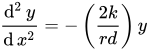
This is a simple harmonic motion having wavelength:
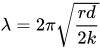
 known as Klingel's formula (derived in 1883)[6]

This kinematic analysis implies that trains sway from side to side all the time. In fact, this oscillation is damped out below a critical speed and the ride is correspondingly more comfortable. The kinematic result ignores the forces causing the motion. These may be analyzed using the concept of creep (non-linear) but are somewhat difficult to quantify simply, as they arise from the elastic distortion of the wheel and rail at the regions of contact. These are the subject of frictional contact mechanics; an early presentation that includes these effects in hunting motion analysis was presented by Carter.[7] See Knothe[8] for a historical overview.

If the motion is substantially parallel with the rails, the angular displacement of the wheel set is given by:

Hence:
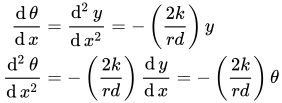
The angular deflection also follows a simple harmonic motion, which lags behind the side to side motion by a quarter of a cycle. In many systems which are characterised by harmonic motion involving two different states (in this case the axle yaw deflection and the lateral displacement), the quarter cycle lag between the two motions endows the system with the ability to extract energy from the forward motion. This effect is observed in "flutter" of aircraft wings and "shimmy" of road vehicles, as well as hunting of railway vehicles. The kinematic solution derived above describes the motion at the critical speed.

In practice, below the critical speed, the lag between the two motions is less than a quarter cycle so that the motion is damped out but, above the critical speed, the lag is greater than a quarter cycle so that the motion is amplified.

In order to estimate the inertial forces, it is necessary to express the distance derivatives as time derivatives. This is done using the speed of the vehicle U, which is assumed constant:

The angular acceleration of the axle in yaw is:
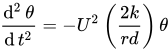
The inertial moment (ignoring gyroscopic effects) is:
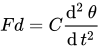
where F is the force acting along the rails and C is the moment of inertia of the wheel set.
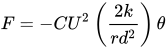
the maximum frictional force between the wheel and rail is given by:

where W is the axle load and is the coefficient of friction. Gross slipping will occur at a combination of speed and axle deflection given by:

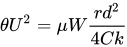
this expression yields a significant overestimate of the critical speed, but it does illustrate the physical reason why hunting occurs, i.e. the inertial forces become comparable with the adhesion forces above a certain speed. Limiting friction is a poor representation of the adhesion force in this case.

The actual adhesion forces arise from the distortion of the tread and rail in the region of contact. There is no gross slippage, just elastic distortion and some local slipping (creep slippage). During normal operation these forces are well within the limiting friction constraint. A complete analysis takes these forces into account, using rolling contact mechanics theories.

However, the kinematic analysis assumed that there was no slippage at all at the wheel-rail contact. Now it is clear that there is some creep slippage which makes the calculated sinusoidal trajectory of the wheelset (per Klingel's formula) not exactly correct.

Energy balance

[edit]

In order to get an estimate of the critical speed, we use the fact that the condition for which this kinematic solution is valid corresponds to the case where there is no net energy exchange with the surroundings, so by considering the kinetic and potential energy of the system, we should be able to derive the critical speed.

Let:

Using the operator:

the angular acceleration equation may be expressed in terms of the angular velocity in yaw, :

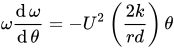
integrating:
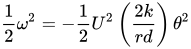
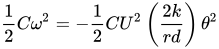
so the kinetic energy due to rotation is:
Diagram, from above, of an angled wheelset withrespect to the rails. The angle of the wheel set with respect to the rails is labelled theta; the rail gauge is labelled d; the spacing of the points of contact is labelled d over cos theta.
Outward displacement of points of contact with axle yaw

When the axle yaws, the points of contact move outwards on the treads so that the height of the axle is lowered. The distance between the support points increases to:
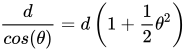
(to second order of small quantities). the displacement of the support point out from the centres of the treads is:
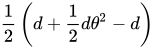
the axle load falls by

The work done by lowering the axle load is therefore:
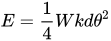
This is energy lost from the system, so in order for the motion to continue, an equal amount of energy must be extracted from the forward motion of the wheelset.

The outer wheel velocity is given by:
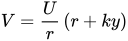
The kinetic energy is:
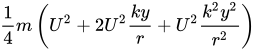
for the inner wheel it is
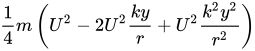
where m is the mass of both wheels.

The increase in kinetic energy is:
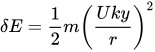
The motion will continue at constant amplitude as long as the energy extracted from the forward motion, and manifesting itself as increased kinetic energy of the wheel set at zero yaw, is equal to the potential energy lost by the lowering of the axle load at maximum yaw.

Now, from the kinematics:

but
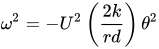
The translational kinetic energy is
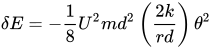
The total kinetic energy is:

The critical speed is found from the energy balance:
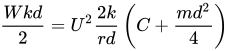
Hence the critical speed is given by
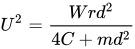
This is independent of the wheel taper, but depends on the ratio of the axle load to wheel set mass. If the treads were truly conical in shape, the critical speed would be independent of the taper. In practice, wear on the wheel causes the taper to vary across the tread width, so that the value of taper used to determine the potential energy is different from that used to calculate the kinetic energy. Denoting the former as a, the critical speed becomes:
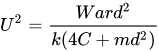
where a is now a shape factor determined by the wheel wear. This result is derived in Wickens (1965)[9] from an analysis of the system dynamics using standard control engineering methods.

Limitation of simplified analysis

[edit]

The motion of a wheel set is much more complicated than this analysis would indicate. There are additional restraining forces applied by the vehicle suspension[10] and, at high speed, the wheel set will generate additional gyroscopic torques, which will modify the estimate of the critical speed. Conventionally a railway vehicle has stable motion in low speeds, when it reaches to high speeds stability changes to unstable form. The main purpose of nonlinear analysis of rail vehicle system dynamics is to show the view of analytical investigation of bifurcation, nonlinear lateral stability and hunting behavior of rail vehicles in a tangent track. This study describes the Bogoliubov method for the analysis.[11]

Two main matters, namely assuming the body as a fixed support and influence of the nonlinear elements in calculation of the hunting speed, are mostly focused in studies.[12] A real railway vehicle has many more degrees of freedom and, consequently, may have more than one critical speed; it is by no means certain that the lowest is dictated by the wheelset motion. However, the analysis is instructive because it shows why hunting occurs. As the speed increases, the inertial forces become comparable with the adhesion forces. That is why the critical speed depends on the ratio of the axle load (which determines the adhesion force) to the wheelset mass (which determines the inertial forces).

Alternatively, below a certain speed, the energy which is extracted from the forward motion is insufficient to replace the energy lost by lowering the axles and the motion damps out; above this speed, the energy extracted is greater than the loss in potential energy and the amplitude builds up.

The potential energy at maximum axle yaw may be increased by including an elastic constraint on the yaw motion of the axle, so that there is a contribution arising from spring tension. Arranging wheels in bogies to increase the constraint on the yaw motion of wheelsets and applying elastic constraints to the bogie also raises the critical speed. Introducing elastic forces into the equation permits suspension designs which are limited only by the onset of gross slippage, rather than classical hunting. The penalty to be paid for the virtual elimination of hunting is a straight track, with an attendant right-of-way problem and incompatibility with legacy infrastructure.

Hunting is a dynamic problem which can be solved, in principle at least, by active feedback control, which may be adapted to the quality of track. However, the introduction of active control raises reliability and safety issues.

Shortly after the onset of hunting, gross slippage occurs and the wheel flanges impact on the rails, potentially causing damage to both.

Road–rail vehicles

[edit]
Independent rail wheel axles are common on road–rail vehicles

Many road–rail vehicles feature independent axles and suspension systems on each rail wheel. When this is combined with the presence of road wheels on the rail it becomes difficult to use the formulae above. Historically, road–rail vehicles have their front wheels set slightly toe-in, which has been found to minimise hunting whilst the vehicle is being driven on-rail.

Aviation

[edit]

Two common "hunting" oscillations in aviation are the phugoid oscillation, in which the plane's natural trim mechanism "hunts" for the trimmed angle of attack[13], and the Dutch roll mode where yaw-and-roll oscillations "hunt" for straight-and-level flight.

See also

[edit]

References

[edit]
Revisions and contributorsEdit on WikipediaRead on Wikipedia
from Grokipedia
Hunting oscillation, also known simply as hunting, is a self-sustained, undesired oscillatory phenomenon in dynamic systems where a component or mechanism repeatedly swings back and forth around an equilibrium position due to insufficient damping and feedback delays, often leading to instability if unchecked. The term originated in the late 18th century to describe the erratic speed fluctuations in steam engine governors, such as James Watt's centrifugal device, which "hunted" for stable rotational speed by alternately opening and closing the steam throttle in an oscillatory manner. This behavior arises from the interaction between the system's inertia, nonlinearities in the control mechanism, and external disturbances, as analyzed in early stability studies like James Clerk Maxwell's 1868 work on governors. In modern engineering contexts, hunting oscillation manifests prominently in railway vehicles (known in Spanish as movimiento de lazo), where it refers to the high-frequency lateral and yaw motions of wheelsets or bogies on coned wheels interacting with curved track profiles, becoming divergent above a critical speed determined by factors like wheel conicity, suspension stiffness, and track conditions.[1] For instance, the phenomenon is defined by the Association of American Railroads as six or more consecutive oscillations having a peak acceleration in excess of 0.8 g peak-to-peak at frequencies of 1–10 Hz, posing risks to high-speed rail safety through derailment potential and accelerated wear.[1] Mitigation strategies include optimized wheel profiles, active dampers, and real-time monitoring systems to raise the critical speed and maintain stability.[1] The concept extends to electrical engineering, particularly synchronous machines, where hunting describes rotor oscillations around the synchronous position following load changes, caused by sudden torque variations and the machine's inertia, potentially leading to loss of synchronism if damping from amortisseur windings or exciters is inadequate. Overall, understanding and suppressing hunting oscillations remains crucial in control theory for ensuring stability across mechanical, electrical, and vehicular systems, with ongoing research focusing on advanced modeling and predictive controls to prevent failures.

Fundamentals

Definition and causes

In the context of railway vehicles, hunting oscillation, also known as wheelset hunting or truck hunting, or movimiento de lazo (in Spanish),[2] is a self-excited sinusoidal lateral swaying or snaking motion of railway wheelsets relative to the track, typically occurring at speeds exceeding a critical threshold where the motion becomes unstable and can lead to derailment risks.[3] This phenomenon manifests as the wheelset repeatedly shifting its position across the track gauge, with the leading wheel alternately contacting the outer rail and the trailing wheel contacting the inner rail, creating a zigzag pattern.[4] The primary cause stems from the geometric coning of wheel treads, which feature a slight inward taper typically ranging from 1:20 to 1:40, designed to enable self-centering on straight track and differential rotation during curves without excessive slipping.[5] This coning results in periodic misalignment between the wheelset's rolling radius and the track's curvature, particularly on tangent (straight) sections, where a lateral displacement alters the effective wheel diameters and induces a restoring yaw motion that, at sufficient speeds, sustains oscillation.[3] Track irregularities, such as geometric variations or surface defects, further amplify this kinematic effect by providing initial disturbances that excite the inherent instability.[4] The phenomenon was first observed by George Stephenson in 1821.[6] During the nineteenth century, railway engineers faced severe hunting problems as steam locomotives achieved higher speeds, often limiting operations to avoid violent shaking and potential accidents.[7] The foundational kinematic analysis was established by Johann Klingel in 1883, with systematic investigations accelerating in the early 20th century.[8][9] An intuitive analogy illustrates this: consider two cones joined at their bases rolling along parallel lines on a flat surface; any sideways nudge causes the contact points to shift, generating a sinusoidal path as the cones alternately steer left and right.[9]

Physical principles involved

Hunting oscillation in railway wheelsets arises from the interplay of geometric and contact mechanics principles at the wheel-rail interface. A fundamental prerequisite is the conical profile of railway wheels, typically featuring a coning angle of 1/20 (a slope of 1:20), which ensures self-centering by varying the rolling radius with lateral displacement relative to the track. When the wheelset shifts laterally, the wheel on the outer side contacts the rail at a larger radius, causing it to rotate faster than the inner wheel under gravitational load, thereby generating a restoring torque that steers the wheelset back toward the track center.[10] The wheel-rail contact operates under Hertzian contact theory, which models the interaction between the curved wheel tread and rail head as elastic bodies forming a small elliptical contact patch. This theory assumes frictionless, non-conforming surfaces with quadratic profiles and isotropic materials, predicting the patch dimensions as semiaxes aa and bb proportional to the cube root of the normal load PP, with maximum pressure p0=3P2πabp_0 = \frac{3P}{2\pi ab}. The elliptical shape accommodates the relative curvatures, enabling the distribution of normal forces that support the wheelset's weight while influencing subsequent tangential interactions.[11] Tangential forces emerge from relative motions or "creepages" at the contact patch, as described by Kalker's linear theory of rolling contact. Longitudinal creepage ξx\xi_x represents forward slipping, lateral creepage ξy\xi_y denotes sideways sliding, and spin creepage ϕ\phi accounts for yaw-induced rotation differences, defined respectively as ξx=(VxΩR)/V\xi_x = (V_x - \Omega R)/V, ξy=Vy/V\xi_y = V_y / V, and ϕ=(γα/R)/V\phi = (\gamma - \alpha / R) / V, where VV is the forward speed, Ω\Omega the angular velocity, RR the rolling radius, γ\gamma the coning angle, and α\alpha the wheelset yaw angle. These creepages generate frictional forces and moments through Kalker's creep coefficients (C11C_{11}, C22C_{22}, C23C_{23}, C33C_{33}), which relate tangential tractions to creepages via a compliance matrix, with the normal contact force modulating the friction limit.[12] Gravitational effects on the coned geometry interact with these contact forces to drive the dynamics. The vertical load distribution creates differential rolling radii during displacement, amplifying creepages and invoking tangential forces that provide lateral guidance. The self-excitation mechanism manifests as positive feedback: creep forces initially restore the wheelset toward the center by countering displacement-induced slip, but the wheelset's inertia causes overshooting, perpetuating oscillatory motion through repeated cycles of misalignment and correction.[13]

Analysis in railway wheelsets

Kinematic modeling

Kinematic modeling of hunting oscillation focuses on the geometric constraints governing the motion of a rigid railway wheelset on straight track under ideal conditions. This approach assumes a rigid wheelset with perfectly coned wheels rolling without slip on cylindrical rails, a straight and frictionless track, small-amplitude oscillations, and no yaw restraint from any bogie or suspension elements.[9] These assumptions simplify the problem to pure kinematic behavior, neglecting dynamic forces such as creep or damping.[9] In this framework, hunting oscillation arises from the wheelset's conical profile, which causes a lateral shift to induce differential rotation between the wheels. As the wheelset displaces laterally by a small amount $ y $, the contact points move inward on one rail and outward on the other, resulting in different rolling radii for the left and right wheels. This differential rotation generates a yaw torque that turns the wheelset, steering it back toward the track center but overshooting due to the geometry, thereby perpetuating a sinusoidal lateral and yaw oscillation along the track.[9] The motion forms a steady sinusoidal pattern in the wheelset's position relative to the track centerline, with the amplitude remaining constant under these ideal kinematic conditions.[9] The mathematical analysis derives from the geometric coupling between the wheelset's roll (lateral displacement) and yaw motions under pure rolling constraints. For small angles, the rolling condition equates the longitudinal displacements at the contact points, leading to a second-order differential equation for the lateral displacement $ y $ as a function of the along-track distance $ s = v t $, where $ v $ is the forward speed. Solving this yields the natural frequency of oscillation given by Klingel's formula:
f=v2π2λr(2a) f = \frac{v}{2\pi} \sqrt{\frac{2\lambda}{r (2a)}}
Here, $ \lambda $ is the wheel conicity (the rate of change of wheel radius with lateral displacement), $ r $ is the nominal wheel radius, and $ 2a $ is the full track gauge (with a the semi-gauge).[9][14] This frequency increases linearly with speed, reflecting the kinematic nature where faster motion amplifies the geometric steering effect.[9] The corresponding wavelength of the oscillation, defined as the distance along the track for one full cycle, is independent of speed and given by:
λosc=2πr(2a)2λ \lambda_{\text{osc}} = 2\pi \sqrt{\frac{r (2a)}{2\lambda}}
This arises directly from $ \lambda_{\text{osc}} = v / f $, highlighting the purely geometric origin of the motion scale.[9][14] In practice, this wavelength typically ranges from 10 to 30 meters for standard railway parameters, providing a baseline for understanding oscillation periodicity before incorporating dynamic effects like creep forces.[9]

Energy-based dynamics

In the energy-based analysis of hunting oscillation in railway wheelsets, stability is assessed by examining the balance between kinetic energy from lateral and yaw motions, potential energy arising from the coning geometry of the wheels, and the net energy input or dissipation through creep forces at the wheel-rail interface.[15] The coning effect generates a restoring potential energy that tends to center the wheelset, while forward motion couples with small displacements to produce oscillatory kinetic energy; however, creep forces introduce self-excitation by transferring energy from the vehicle's longitudinal motion into the transverse plane, potentially sustaining or amplifying oscillations. This framework reveals that hunting emerges as a self-sustained phenomenon when energy input exceeds dissipation, leading to growing amplitudes until limited by nonlinear effects like flange contact.[15] A simplified model captures this dynamics using a two-degree-of-freedom representation, focusing on lateral displacement $ y $ and yaw angle $ \psi $. The total mechanical energy $ E $ of the wheelset is given by
E=12my˙2+12Iψ˙2+mgλy22a, E = \frac{1}{2} m \dot{y}^2 + \frac{1}{2} I \dot{\psi}^2 + \frac{mg \lambda y^2}{2a},
where $ m $ is the wheelset mass, $ I $ is the yaw moment of inertia about the wheelset center, $ g $ is gravitational acceleration, $ \lambda $ is the wheel conicity (the taper angle of the wheel profile), and $ 2a $ is the track gauge. The first two terms represent kinetic energy from lateral velocity $ \dot{y} $ and yaw rate $ \dot{\psi} $, while the potential energy term $ \frac{mg \lambda y^2}{2a} $ approximates the gravitational restoring effect due to differential rolling radii on the coned wheels, acting like a harmonic oscillator potential for small displacements.[15] This model neglects higher-order nonlinearities but effectively illustrates the coupling between translation and rotation in the hunting mode. Sustained oscillation occurs at the critical speed where the energy input from creep forces precisely balances the energy dissipated through damping and other losses, resulting in neutral stability. The rate of change of total energy $ \frac{dE}{dt} $ can be derived from the equations of motion, showing that below the critical speed, $ \frac{dE}{dt} < 0 $ as dissipation dominates, causing oscillations to decay; at the critical speed, $ \frac{dE}{dt} = 0 $ for neutral equilibrium; and above it, $ \frac{dE}{dt} > 0 $, leading to exponential growth in amplitude until nonlinearities intervene.[15] This speed-dependent behavior arises because creep input scales with the square of the forward speed $ V^2 $, as the lateral and yaw creepages increase proportionally with $ V $, overpowering the fixed potential well at higher velocities. Friction at the wheel-rail contact plays a dual role through longitudinal and lateral creep components. Below the critical speed, longitudinal creep forces primarily dissipate energy by resisting small slips in the forward direction, stabilizing the motion akin to viscous damping.[15] Above the critical speed, however, lateral creep forces dominate and inject energy into the system, as the phase relationship between displacement and creepage aligns to produce positive work, sustaining the oscillation; this reversal is governed by the friction coefficient and contact geometry, with higher friction enhancing the self-excitation potential.

Critical speed and stability limits

The stability of a railway wheelset against hunting oscillation is assessed through eigenvalue analysis of its linearized equations of motion, focusing on the lateral displacement $ y $, yaw angle $ \psi $, and roll angle $ \phi $. These equations incorporate the kinematic effects of wheel conicity and the dissipative creep forces at the wheel-rail interfaces. For a simplified wheelset model without suspension (using semi-gauge a), the lateral equation is $ m \ddot{y} = 2 f_{22} \left( \psi - \frac{\dot{y}}{V} \right) $; the yaw equation is $ I_z \ddot{\psi} + \frac{2 f_{11} a^2}{V} \dot{\psi} = -\frac{2 f_{11} \lambda a}{r} y $; roll dynamics add terms involving gravitational restoring moments and creep-spin coupling $ f_{23} $. Roll dynamics add terms involving gravitational restoring moments and creep-spin coupling $ f_{23} $, which can increase $ v_{cr} $ by 10-20% in full models.[16] To determine stability, solutions of the form $ e^{st} $ are assumed, yielding a characteristic equation typically of fourth order for the yaw-lateral subsystem: $ s^4 + a_3 s^3 + a_2 s^2 + a_1 s + a_0 = 0 $, where coefficients $ a_i $ depend on $ V $, geometry, and creep parameters. Stability requires all roots to have negative real parts; the critical speed $ v_{cr} $ marks the onset of neutral stability, where a pair of complex conjugate roots crosses the imaginary axis, indicating oscillatory instability for $ V > v_{cr} $. Using Routh-Hurwitz criteria or root locus methods, the threshold is found when the damping term vanishes, leading to pure imaginary roots $ s = \pm i \omega $, with oscillation frequency $ \omega \approx V \sqrt{\lambda / (a r)} $. This analysis, originating from Carter's linear creep theory, reveals that creep forces stabilize the kinematic self-steering below $ v_{cr} $ by dissipating energy, but above it, the coupling amplifies lateral-yaw modes.[16][17] The resulting critical speed formula in the simple model is $ v_{cr} = \sqrt{ \frac{ f_{11} a^2 r^2 }{ \lambda I_z } } \cdot f(\gamma) $, where the creep-modified factor $ f(\gamma) = \sqrt{1 + \gamma} $ accounts for the ratio $ \gamma = \frac{f_{11}}{f_{22}} \left( \frac{a}{r} \right)^2 $, which typically increases $ v_{cr} $ by 10-30% over the basic limit depending on creep linearity and contact conditions. For instance, with standard geometry ($ a = 0.75 $ m, $ r = 0.46 $ m, $ \lambda = 0.02 $) and typical creep coefficients, $ v_{cr} \approx 25-35 $ m/s. Energy balance at the threshold confirms neutral stability, where creep dissipation equals kinematic excitation.[16][9] Simplified models like this neglect track flexibility, which introduces additional compliant modes reducing effective stiffness; suspension stiffness in full bogie systems, often providing lateral constraints of 1-5 MN/m; and nonlinear effects such as flange contact, which limits amplitude but triggers earlier onset via impact loading. Consequently, predicted $ v_{cr} $ overestimates real values, often by 20-50% in operational contexts due to these omissions, as validated in multibody simulations incorporating nonlinear Hertzian contact and track irregularities.[16][18] Key influencing factors include wheel conicity $ \lambda $, which inversely scales $ v_{cr} $ (e.g., reducing $ \lambda $ from 0.03 to 0.01 raises $ v_{cr} $ by ~73%); track gauge $ 2a $, where wider gauges (e.g., 1435 mm standard vs. 1520 mm) boost stability; and axle load, which enhances creep coefficients proportionally to normal force $ N $ (via $ f_{ij} \propto N $), increasing $ v_{cr} $ by up to 20% for loads from 10 to 20 tons. Standards such as UIC 519 limit equivalent conicity to ensure $ v_{cr} > 1.2 \times $ operational speed, with hunting frequencies constrained below 10 Hz at 300 km/h to maintain ride comfort per UIC 518 filtering criteria.[16][19]

Practical considerations and extensions

Mitigation strategies

Design modifications to railway wheelsets and bogies represent a primary approach to suppressing hunting oscillations by altering the critical speed, the threshold at which instability occurs. Reduced wheel-rail conicity, such as through wheel reprofiling, decreases the equivalent conicity that amplifies self-steering effects, thereby raising the critical speed and stabilizing high-speed operations.[20] Yaw dampers in bogies, hydraulic devices linking the carbody and bogie frame, introduce rotational damping to counteract yaw motions, significantly increasing critical speed.[21] Lateral stops limit excessive bogie displacement, preventing amplitude growth during incipient oscillations.[22] Active control systems enhance mitigation through real-time intervention, particularly in high-speed trains operational since the 1990s. Electronic stability systems, including wheel slide protection adapted for lateral dynamics, use sensors to monitor accelerations and apply braking or torque adjustments to quell oscillations.[1] Active suspension employs actuators in secondary lateral systems with adaptive nonlinear damping, based on 17-degree-of-freedom models, to suppress limit-cycle amplitudes and convert subcritical bifurcations to supercritical ones, narrowing unstable speed ranges.[23] Recent developments include AI-based detection algorithms using accelerometers for early identification of hunting, improving safety in high-speed operations as of 2024.[24] Track improvements focus on minimizing excitations that trigger or amplify hunting. Superelevation in curves balances centrifugal forces, reducing lateral wheel-rail interactions that can initiate oscillations on straight sections post-curve.[25] Rail grinding restores profiles to standard conicities (e.g., 1/40), eliminates corrugations and irregularities, and alleviates hunting by improving contact geometry. The European standard EN 14363 mandates acceptance testing for running characteristics, including bandpass-filtered assessments of bogie accelerations (threshold ~6-12 m/s² RMS over 100 m) and guiding forces to verify hunting stability below critical speeds.[6] Historical evolution traces from early theoretical foundations to modern computational aids. In the 1920s, F.W. Carter's analyses of creep forces and stability laid groundwork for understanding hunting thresholds, influencing initial designs to incorporate damping elements.[26] Subsequent fixes evolved to include wear-resistant interfaces, though practical suppressions relied on profile optimizations. Today, multibody dynamics software like SIMPACK enables predictive simulations of full-vehicle models (up to 42 degrees of freedom), optimizing damper parameters and profiles to raise critical speeds pre-deployment.[4]

Applications beyond standard railways

In high-speed and magnetically levitated (maglev) train systems, hunting oscillation concepts are adapted to account for non-wheeled guidance mechanisms, where lateral instabilities manifest as interactions between the vehicle and guideway. For maglev trains, these oscillations arise from electromagnetic suspension dynamics and aerodynamic forces, differing from conventional rail hunting by lacking physical wheel-rail coning but involving similar self-excited lateral and yaw modes. Critical speeds exceeding 500 km/h are achievable through active electromagnetic control systems that adjust levitation and guidance forces in real-time to suppress instabilities.[27] Analogous self-excited oscillations occur in non-rail vehicles, such as shimmy in aircraft landing gear, where lateral and torsional vibrations during ground contact resemble the kinematic hunting in rail wheelsets but are driven by tire-ground interactions rather than coned profiles. In rail hybrids like trams operating on grooved tracks, hunting is particularly pronounced due to the constrained rail geometry, which amplifies yawing motions. Shorter wheelbases in four-wheeled trams increase the likelihood and violence of side-to-side hunting, while bogie designs with longer effective wheelbases (e.g., 12 feet in historical Brill Radiax trucks) provide damping through relative movement, isolating the car body from track irregularities. Modern low-floor trams with axle-less suspensions exhibit marked hunting at elevated speeds on grooved rails, necessitating profile optimizations for stability.[28][29] The adoption of lightweight materials in modern freight vehicles since the 2010s has heightened susceptibility to hunting oscillation by reducing overall mass and damping, thereby lowering critical speeds and amplifying lateral responses to track perturbations. This trend, coupled with higher operating speeds, exacerbates wear and instability risks in freight operations. Case studies from European incidents in the 2000s highlight the role of rolling stock faults in derailments, contributing to around 37% of freight derailments and prompting enhanced monitoring standards like UIC 519.[30]

References

User Avatar
No comments yet.