Hubbry Logo
Fossil trackFossil trackMain
Open search
Fossil track
Community hub
Fossil track
logo
8 pages, 0 posts
0 subscribers
Be the first to start a discussion here.
Contribute something
Fossil track
Fossil track
from Wikipedia
A reverse ichnite of the impression of Jialingpus yuechiensis, on display at the Paleozoological Museum of China

A fossil track or ichnite (Greek "ιχνιον" (ichnion) – a track, trace or footstep) is a fossilized footprint. This is a type of trace fossil. A fossil trackway is a sequence of fossil tracks left by a single organism. Over the years, many ichnites have been found, around the world, giving important clues about the behaviour (and foot structure and stride) of the animals that made them. For instance, multiple ichnites of a single species, close together, suggest 'herd' or 'pack' behaviour of that species.

Combinations of footprints of different species provide clues about the interactions of those species. Even a set of footprints of a single animal gives important clues, as to whether it was bipedal or quadrupedal. In this way, it has been suggested that some pterosaurs, when on the ground, used their forelimbs in an unexpected quadrupedal action.

Special conditions are required, in order to preserve a footprint made in soft ground (such as an alluvial plain or a formative sedimentary deposit). A possible scenario is a sea or lake shore that became dried out to a firm mud in hot, dry conditions, received the footprints (because it would only have been partially hardened and the animal would have been heavy) and then became silted over in a flash storm.

The first ichnite found was in 1800 in Massachusetts, US, by a farmer named Pliny Moody, who found 1-foot (31 cm) long fossilized footprints. They were thought by Harvard and Yale scholars to be from "Noah's Raven".[1]

A famous group of ichnites was found in a limestone quarry at Ardley, 20 km Northeast of Oxford, England, in 1997. They were thought to have been made by Megalosaurus and possibly Cetiosaurus. There are replicas of some of these footprints, set across the lawn of Oxford University Museum of Natural History (OUMNH).

A creature named Cheirotherium was, for a long time and still may be, only known from its fossilized trail. Its footprints were first found in 1834, in Thuringia, Germany, dating from the Late Triassic Period.

The largest known dinosaur footprints, belonging to sauropods and dating from the early Cretaceous were found to the north of Broome on the Dampier Peninsula, Western Australia, with some footprints measuring 1.7 m.[2][3] The 3D digital documentation of tracks has the benefit of being able to examine ichnite in detail remotely and distribute the data to colleagues and other interested personnel.[4]

Fossil trackway Protichnites in sedimentary stone

Fossil trackways

[edit]

Many fossil trackways were made by dinosaurs, early tetrapods, and other quadrupeds and bipeds on land. Marine organisms also made many ancient trackways (such as the trails of trilobites and eurypterids like Hibbertopterus).

Some basic fossil trackway types:

  1. footprints
  2. tail drags
  3. belly drag marks – (e.g., tetrapods)[5]
  4. chain of trace platforms – (example: Yorgia)
  5. body imprint – (Monuron trackway, insect)
Specialized marine trace trackway, Yorgia, from the Ediacaran of northern Russia

The majority of fossil trackways are foot impressions on land, or subsurface water, but other types of creatures will leave distinctive impressions. Examples of creatures supported, or partially supported, in a water environment are known. The fossil "millipede-type" genus Arthropleura left its multi-legged/feet trackways on land.

Hominid trackways

[edit]

Africa

[edit]
Tanzania
[edit]
Laetoli Site, February 2006

Some of the earliest trackways for human ancestors have been discovered in Tanzania.[6] The Laetoli trackway is famous for the hominin footprints preserved in volcanic ash. After the footprints were made in powdery ash, soft rain cemented the ash layer into tuff, preserving the prints.[6] The hominid prints were produced by three individuals, one walking in the footprints of the other, making the original tracks difficult to discover. As the tracks lead in the same direction, they might have been produced by a group – but there is nothing else to support the common reconstruction of a nuclear family visiting the waterhole together.

South Africa
[edit]

In South Africa, two ancient trackways have been found containing footprints, one at Langebaan and one at Nahoon. Both trackways occur in calcareous eolianites or hardened sand dunes. At Nahoon, trackways of at least five species of vertebrates, including three hominid footprints, are preserved as casts.[7] The prints at Langebaan are the oldest human footprints, dated to approximately 117,000 years old.[8]

Australia

[edit]
New South Wales
[edit]

Twenty six human fossil trackways have been found in the Willandra Lakes area adjacent to Lake Garnpung, consisting of 563 human footprints from 19,000 to 20,000 years ago.[9]

Early Tetrapod

[edit]

The earliest land creatures (actually land-marine coastal-riverine-marshland) left some of the first terrestrial trackways. They range from tetrapods to proto-reptilians and others.

A possible first connection of a trackway with the vertebrate that left it was published by Drs. Sebastian Voigt and David Berman and Amy Henrici in the 12 September 2007 issue of Journal of Vertebrate Paleontology. The paleontologists who made the connection were aided by unusually detailed trackways left in fine-grained Lower Permian mud of the Tambach Formation in central Germany, together with exceptionally complete fossilised skeletons in the same 290-million-year-old strata. They matched the two most common trackways with the two most common fossils, two reptile-like herbivores known as Diadectes absitus (with the trackway pseudonym Ichniotherium cottae) and Orobates pabsti (with the trackway pseudonym of Orobates pabsti).[10]

The Permo-Carboniferous of Prince Edward Island, Canada contains trackways of tetrapods and stem-reptiles.[11] Macrofloral and palynological information help date them.

Ireland hosts late Middle Devonian tetrapod trackways at three sites on Valentia Island within the Valentia Slate Formation.[12][13]

The earliest fossil trackway of primitive tetrapods in Australia occurs in the Genoa River Gorge, Victoria, dating from the Devonian 350 million years ago.[14]

Dinosaur trackways

[edit]
Arabian Peninsula dinosaur trackway

Dinosaurs lived on the continents before grasses evolved (the "Age of the Grasses" evolved with the "Age of the Mammals"); the dinosaurs lived in the Triassic, Jurassic, and Cretaceous and left many trackways, both from plant-eaters and the meat-eaters, in various layers of mud and sand.

With scientific analysis, dinosaur specialists are now analyzing tracks for the walking-speeds, or sprint-running speeds for all categories of dinosaurs, even to the large plant eaters, but especially the faster 3-toed meat hunters. Evidence of herding, as well as pack hunting are also being investigated.

Bolivia

[edit]

Brazil

[edit]

Africa

[edit]
Namibia
[edit]
Dinosaur trace fossil of Otjihaenamparero

In north-central Namibia there is a dinosaur trackway in sandstone on what is now the private farm Otjihaenamparero. Larger footprints are of a ceratosauria and smaller ones of syntarsus. The prints are believed to be around 190 million years old.[15][16]

Zimbabwe
[edit]

In the Lower Zimbabwe Rift Valley there is a trackway in 140 Ma rose-coloured sandstone of Chewore Area. The small footprint size, with both manus and pes, implies that it is a trackway of a juvenile, a probable carnosaur.[17]

North America

[edit]
Probable Dilophosaurus footprint from Red Fleet State Park, northeastern Utah

The western regions of North America, especially the western border of the Western Interior Seaway, are common for dinosaur trackways. Wyoming has dinosaur trackways from the Late Cretaceous, 65 ma.[18] (A model example of this 3-toed Wyoming trackway was made for presentation.)[19]

Theropod and sauropod tracks under water in the Paluxy River

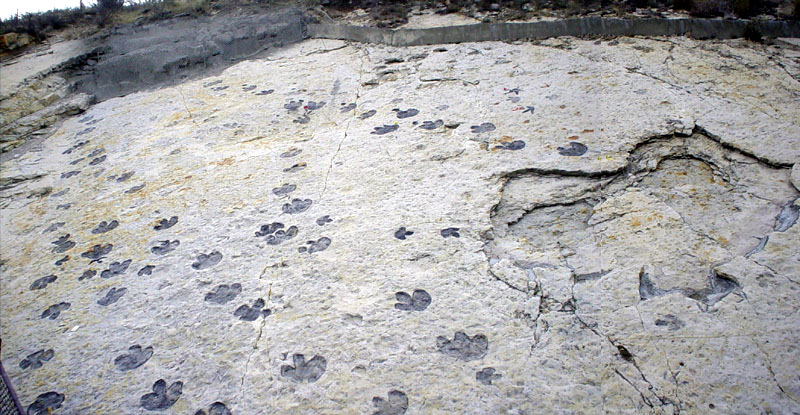
In the United States, dinosaur footprints and trackways are found in the Glen Rose Formation, the most famous of these being the Paluxy River site in Dinosaur Valley State Park. These were the first sauropoda footprints scientifically documented, and were designated a US National Natural Landmark in 1969. Some are as large as about 3 feet across. The prints are thought to have been preserved originally in a tidal flat or a lagoon.[20] There are tracks from two types of dinosaur. The first type of tracks are from a sauropod and were made by an animal of 30 to 50 feet in length, perhaps a brachiosaurid such as Pleurocoelus,[20] and the second tracks by a theropoda, an animal of 20 to 30 feet in length, perhaps an Acrocanthosaurus. A variety of scenarios was proposed to explain the tracks, but most likely represent twelve sauropods "probably as a herd, followed somewhat later by three theropods that may or may not have been stalking – but that certainly were not attacking."[20]

Other examples include:

Asia

[edit]
China
[edit]

The Gansu dinosaur trackway located in the Liujiazia National Dinosaur Geopark in Yanguoxia, China contains hundreds of tracks including 245 dinosaur, 350 theropod, 364 sauropod and 628 ornithopod tracks among others.[22]

Thailand
[edit]

The Phu Pha Man National Park in Thailand contains one of the oldest dinosaur tracks to have been discovered in Asia.[23] Discovered in January 2024, paleontologists from the Department of Mineral Resources have dated the tracks to around 225–220 million years old (the late Triassic period).[24] The track contains traces of a variety of dinosaurs including theropods, sauropods, and archosaurs.[25]

Australia

[edit]

The Lark Quarry Trackway in Queensland contains three-toed tracks made by a herd of ornithopod dinosaurs crossing a river. It was once believed they respresented a large predator chasing a mixed flock of small ornithopods and theropods, but this was contested in 2011.[26]

Europe

[edit]
Portugal
[edit]
England
[edit]

In a Bathonian limestone quarry site at Ardley, Oxfordshire more than 40 sets of footprints, with some trackways reaching up to 180 metres in length, were discovered in 1997. These prints are largely only preserved in replicas and photographic records due to quarrying and subsequent restoration. Theropod tracks have been tentatively assigned to the ichnogenus Megalosauripus, possibly from Megalosaurus. The sauropod tracks could be grouped into wide-gauge trackways, associated with early titanosauria or brachiosauridae, and narrow-gauge ones, possibly from Cetiosaurus or a basal diplodocoid.[27] In 2024 at nearby Dewars Farm Quarry,[28] five new extensive Middle Jurassic trackways dating back about 166 Ma were discovered, with evidence of more in the neighbourhood. The longest continuous trackway measured more than 150 metres. Four of the trackways were made by large sauropods, most likely again Cetiosaurus. The fifth one was identified as made by the carnivorous theropod Megalosaurus, based on its distinctive three-toed feet with claws. One area of the site shows the carnivore and herbivore tracks crossing over, suggesting the predator followed up on the steps of the sauropod.[29][30]

Mammal trackways

[edit]

Mammal trackways are among the least common trackways. Mammals were not often in mud, or riverine environments; they were more often in forestlands or grasslands. Thus the earlier tetrapods or proto-tetrapods would yield the most fossil trackways. The Walchia forest of Brule, Nova Scotia has an example of an in situ Walchia forest, and tetrapod trackways that extended over some period of time through the forest area.

United States

[edit]

A 1.5km-long Late Pleistocene Age trackway of human (child and adult) fossilized footprints, as well as mammoth and giant ground sloth tracks have been found at White Sands National Park near Alamogordo, New Mexico.[31][32]

Australia

[edit]

A recent marsupial trackway site in the Colac district of Australia (west of Colac) contains marsupial trackways as well as kangaroo and wallaby tracks.[33]

Pterosaur trackways

[edit]

France

[edit]

Pterosaur Beach was, at the end of the Jurassic era, a mudflat, flooded at high tide, on a marine lagoon in a gulf that opened on the Atlantic Ocean between Bordeaux and the island of Oléron. On it, animals foraged for food.[34] The site has hundreds of fossilized trackways.[35]

[edit]

See also

[edit]

References

[edit]
[edit]
Revisions and contributorsEdit on WikipediaRead on Wikipedia
from Grokipedia
A fossil track, also known as an ichnofossil or , is the preserved impression or indentation left by the foot or other body part of an ancient organism interacting with a soft substrate, such as , , or , which later lithifies into . These structures record the locomotion, posture, and sometimes social behaviors of prehistoric animals, including vertebrates like dinosaurs, mammals, and early hominins, without preserving the organism's body itself. Fossil tracks form through a combination of the trackmaker's foot morphology, the animal's and loading , and environmental conditions like sediment moisture and , often creating undertracks that penetrate subsurface layers. They are most commonly preserved in fluvial (riverine), lacustrine (lake), marginal marine, or eolian () deposits, where rapid protects them from , and have been documented across all continents, from synapsids in to Miocene hominins in . Unlike body , tracks offer of behavior in specific paleoenvironments, such as speed calculations via formulas like 1976 equation (u = 0.25 × g^{0.5} λ^{1.67} h^{-1.17}), , and predator-prey interactions, complementing skeletal remains to reconstruct ancient ecosystems. Notable examples include the 3.66-million-year-old hominin footprints at , , preserved in and indicating bipedal walking; the site in , , with parallel sauropod and theropod tracks suggesting possible pursuit; and the Lark Quarry in , featuring over 3,000 prints interpreted as a stampede event. These discoveries, spanning over 540 million years of history, underscore the value of ichnology—the study of trace fossils—in for inferring unpreserved aspects of life, such as gait patterns and habitat use.

Fundamentals

Definition and Types

Fossil tracks, also known as ichnites, are a subset of trace fossils consisting of impressions, deformations, or casts formed by the interaction of an organism's appendages or body with a soft substrate, which are subsequently preserved through as the sediment hardens into rock. These traces record locomotive behaviors and provide indirect evidence of an organism's presence, size, speed, and gait, without preserving the actual body. Unlike body s, which are the mineralized remains of hard parts such as bones or shells, fossil tracks capture dynamic activities and are classified under ichnotaxonomy based on morphology rather than biological . Common types of fossil tracks include single footprints, which are isolated impressions of a foot or ; trackways, comprising sequences of consecutive prints made by the same individual during movement; undertracks, which are deeper impressions transmitted into underlying substrate layers without direct surface contact; and slab tracks, where multiple impressions are preserved across a single bedding plane or rock slab, often in concave epirelief on the upper surface or convex hyporelief on the underside. These types differ from other trace fossils, such as burrows (excavations for dwelling or feeding) or coprolites (fossilized feces), which document non-locomotory behaviors like sheltering or rather than progression across a surface. Key terminology in describing fossil tracks includes stride length, the linear distance between successive impressions of the same foot; pace, the distance between left and right contralateral foot impressions; trackway width, measured as the perpendicular distance between the outer edges of parallel track series or across the midline; and digit impressions, which are the preserved outlines of toes or claws, often numbered from medial (I) to lateral (V) to denote the number and arrangement. These metrics allow for quantitative analysis of an organism's locomotion patterns, such as bipedal or quadrupedal .

Formation and Preservation

Fossil tracks form through the physical interaction between an organism's locomotion and unconsolidated substrates, such as mudflats, sandy shores, or snow-covered ground, where the foot or penetrates and displaces the . The resulting impression's depth, shape, and detail are governed by the trackmaker's body mass, which determines penetration force; locomotion speed, which influences deformation extent in fluid-like substrates; and , which affects load distribution across the foot. Softer, more cohesive substrates yield clearer morphological fidelity by resisting immediate collapse, while overly liquid conditions can lead to blurred or collapsed prints due to during foot withdrawal. Preservation hinges on environmental factors that minimize post-formation degradation. High substrate moisture content facilitates initial imprinting by reducing , allowing deformation without excessive resistance, while fine grain sizes—such as silts or clays—enhance detail retention by providing cohesive support. Coarser sands may produce shallower, less defined tracks but can still preserve if rapidly stabilized. Crucially, swift burial by overlying sediments, transported via fluvial flooding, tidal action, or , shields impressions from , bioturbation, or subaerial , thereby transitioning the track from a transient feature to a permanent record. Taphonomic pathways determine how tracks endure through geological time, encompassing biostratinomic and diagenetic alterations. Primary mechanisms include passive infilling with fine-grained sediments during episodic deposition, forming concave epireliefs on upper planes as the cast fills the void. Casting occurs when the impression molds the undersurface of subsequent layers, producing convex hyporeliefs that highlight the track's outline upon exposure. of the substrate can generate polygonal cracking that accentuates track boundaries, while microbial mats promote biostabilization through extracellular polymeric substances, fostering early cementation and preventing slumping. In rarer instances, diagenetic —via silica or infiltration—or mineral replacement during reinforces the structure against compaction. These processes predominantly occur in subaerial terrestrial or marginal marine settings, where episodic in low-energy environments like floodplains, lake shores, or intertidal zones provides ideal conditions for track registration and burial. From the onward, such contexts have yielded the bulk of preserved track assemblages, as the advent of terrestrial ecosystems increased opportunities for subaerial imprinting in fine-grained, water-saturated sediments.

Scientific Study

Ichnology and Classification

Ichnology is a branch of dedicated to the study of trace fossils, including fossil tracks, burrows, and other preserved evidence of ancient organism behavior. This discipline emerged in the early 19th century, with the Reverend (1784–1856) playing a pioneering role through his examinations of footprints and other traces, such as his involvement through correspondence in the early examination of tracks from Corncockle Quarry, , discovered in 1824 (formally described in 1828). Buckland's work established foundational methods for interpreting traces as records of locomotion and rather than mere curiosities. Ichnotaxonomy provides the systematic framework for naming and classifying trace fossils, emphasizing morphological features over the identity of the tracemaker. Names are assigned based on recurrent morphological traits, such as , digit impressions, and trackway patterns, following principles adapted from the (ICZN, 1999), which treats traces as independent from biological . For instance, the ichnogenus Chirotherium, common in deposits, describes hand-like footprints of early tetrapods with five digits and a distinctive claw pattern, regardless of whether they were produced by archosauromorphs or other groups. This approach ensures stability in nomenclature, with ichnotaxa like ichnogenera and ichnospecies defined by holotypes of well-preserved specimens to avoid conflating undertracks or composites. Classification schemes for fossil tracks organize traces by multiple criteria to reflect their formation and implications. By substrate, tracks are distinguished as surface traces (e.g., true prints on exposed ) versus undertraces (deeper impressions transmitted through layers). Morphological schemes categorize based on features like pentadactyl (five-toed, e.g., some early tracks) versus tridactyl (three-toed, e.g., theropod-like prints) configurations, highlighting anatomical inferences. Ethological classifications, pioneered by Seilacher, group traces by inferred behavior, such as repichnia for walking trackways (e.g., Diplichnites) or natichnia for swimming traces (e.g., Undichna undertracks). A key challenge in ichnotaxonomy is , where a single may encompass tracks from multiple, unrelated tracemakers due to convergent morphologies influenced by substrate or preservation. This issue arises from extramorphological variations, such as sediment consistency affecting digit impressions, leading to oversplitting or overlumping of taxa and complicating phylogenetic interpretations. To mitigate this, modern practices prioritize 3D documentation and standardized ichnotaxobases, ensuring names reflect behavioral morphology rather than assumed .

Analytical Methods and Interpretations

Modern analytical methods for studying fossil tracks emphasize non-destructive documentation and quantitative analysis to preserve specimens while extracting detailed morphological data. , which generates high-resolution 3D models from overlapping photographs using structure-from-motion algorithms, has become a standard technique for capturing track surfaces and trackways with sub-millimeter accuracy, enabling virtual preservation and remote analysis. Similarly, 3D employs to produce precise topographic maps of tracks, revealing subtle features like undertracks and substrate deformation that inform on formation dynamics. For physical replication, silicone molding involves applying room-temperature vulcanizing ( rubber to create durable casts that replicate fine details without damaging the original, facilitating study and comparison in museum settings. Morphometric analysis quantifies track dimensions such as foot , width, stride , and pace to derive biomechanical insights. A key application is estimating the speed of trackmakers using Alexander's formula, derived from observations of extant animals: v=0.25g0.5SL1.67HF1.17v = 0.25 g^{0.5} SL^{1.67} HF^{-1.17}, where vv is speed in meters per second, gg is (approximately 9.81 m/s²), SLSL is stride , and HFHF is (often estimated as 4 times foot for bipedal forms). This dimensionless relative stride approach assumes dynamic similarity in locomotion, yielding speeds typically between 1 and 40 km/h for trackways, though validations with modern analogs highlight potential overestimations by up to twofold due to substrate effects. Interpretations from these analyses provide biological and ecological context. Body size is inferred by scaling track measurements to skeletal proportions; for instance, hip height from foot length allows estimation of via volumetric models, with theropod tracks suggesting animals from 1 to 10 tons. is determined from trackway patterns: bipedal locomotion is indicated by alternating hindfoot impressions with narrow gauge, while quadrupedal gaits show paired manus-pes prints in lateral sequence, revealing transitions from walking to trotting based on pace angle and stride relative to leg length. Social behavior emerges from multi-individual trackways; parallel alignments of similar-sized prints suggest , as seen in sauropod sites where synchronized paths imply group coordination for migration or predator avoidance. Paleoenvironmental cues arise from substrate interactions: concave-up tracks in fine-grained mudstones indicate soft, water-saturated conditions implying coastal or lacustrine settings, while collapse margins suggest firmground on tidal flats, linking to wetter climates. Dating fossil tracks relies on the enclosing sediments, as tracks themselves lack datable organic material. via positions track horizons within sedimentary sequences using superposition and index fossils, establishing chronological order across sites. Absolute ages are obtained through radiometric methods on interbedded , such as uranium-lead dating of zircons yielding Permian to ages (e.g., 252–66 Ma for major track-bearing formations), or argon-argon on sanidines for precise millennial-scale resolution in contexts. These techniques calibrate biostratigraphic correlations, ensuring track interpretations align with global timelines.

Examples by Organism Group

Invertebrate Tracks

Invertebrate tracks, or ichnofossils, represent the preserved traces of movement, feeding, and resting behaviors by ancient arthropods, annelids, and other soft-bodied organisms, providing key insights into early metazoan locomotion and ecological interactions. These traces are predominantly found in marine and marginal marine sediments, where invertebrates interacted with soft substrates through crawling, burrowing, or grazing. Unlike body fossils, tracks reveal behavioral patterns, such as substrate probing or trail formation, often predating direct evidence of the organisms themselves. Among the most common types are Cruziana, elongated bilobate furrows with medial ridges formed by trilobites grazing on microbial mats or sediment surfaces during the era. These traces, preserved as concave epireliefs, exhibit repeated transverse scratches from the trilobite's appendages, indicating deliberate sediment disturbance for food extraction. Rusophycus complements this as short, bilobed resting impressions, typically convex and three times longer than wide, created when trilobites paused to feed or burrow briefly into the seafloor. Arthropod trackways like Diplichnites feature parallel rows of fine, closely spaced ridges, suggestive of multi-legged crawling by euthycarcinoids or millipede-like forms across marine to continental environments. Invertebrate tracks dominate Paleozoic ichnoassemblages, particularly from to strata, where they record early benthic lifestyles in shallow seas and tidal flats. For instance, the Tonto Group in the Grand Canyon preserves diverse traces like Cruziana and Rusophycus, reflecting arthropod colonization of seafloors following the . Helminthopsis, a sinuous, unbranched trail attributed to worm-like deposit feeders, appears frequently in these deposits, evidencing meandering exploration of organic-rich sediments. By the , coal measure environments yield tracks, such as those of the enigmatic arthropod Camptophyllia, with branched or leaf-like impressions from ambulatory or resting behaviors in swampy terrains. These traces illuminate substrate interactions, from grazing disruptions to burrowing refuges, and highlight evolutionary transitions in mobility. The oldest potential tracks date to the late (ca. 551–541 million years ago), including bilaterian trackways with paired impressions from the Shibantan Member in , predating body fossils and suggesting pre-trilobite locomotor capabilities. Such findings underscore the role of ichnofossils in tracing the advent of animal movement on .

Early Tetrapod Tracks

Early tracks represent some of the earliest evidence of transition from aquatic to terrestrial environments, spanning from the to the Permian periods. These ichnofossils document the initial stages of limb evolution and locomotion in stem , often predating corresponding body fossils by millions of years. For instance, the oldest known trackways, dated to approximately 395 million years ago in the early , occur in marine tidal flat deposits and indicate that achieved basic terrestrial competence far earlier than previously thought based on skeletal remains. This temporal range highlights a gradual progression in limb morphology, from polydactyl configurations in forms—reflecting ancestral fin-like structures with up to eight digits—to more standardized pentadactyl patterns by the and Permian, as seen in the diversification of track morphologies. Such tracks provide critical biochronological markers, resolving geological time intervals 20-50% as effectively as body fossils in some cases. Key ichnotaxa illustrate the morphological diversity of these early trackmakers. In the Devonian, unnamed trackways from sites like Zachełmie in feature manus and pes impressions with multiple short digits, suggestive of fish-like fin drags transitioning to limb prints, preserved in tidal flat sediments where trackmakers likely waded or briefly ventured onto land. By the , ichnotaxa such as Limnopus, attributed to temnospondyl amphibians, dominate assemblages with broad, splay-toed footprints up to 20 cm long, indicating larger-bodied forms navigating environments. Dromopus, another prominent Carboniferous-Permian ichnotaxon, shows pentadactyl, prints with slender, inwardly curving digits (e.g., digit IV up to 43 mm), often linked to early or basal reptilian trackmakers exhibiting more efficient terrestrial gaits. These forms appear in late Moscovian to Kasimovian strata, reflecting adaptations to increasingly arid conditions during the . Notable features of early tracks include their preservation in marginal marine or fluvial settings like tidal flats, where fine-grained sediments captured impressions of awkward, asymmetrical gaits—such as hindlimb-propelled lateral-sequence walking or crutching—supporting predominantly aquatic origins with limited terrestrial forays. Trackway patterns reveal shifts in , with deeper pes impressions suggesting initial reliance on hindlimbs for while s provided stability, a configuration consistent with semi-aquatic lifestyles akin to modern mudskippers. Evolutionarily, these ichnofossils offer insights into locomotor experimentation predating body fossils like , demonstrating how early tetrapods balanced buoyancy loss and gravitational demands, ultimately paving the way for fully terrestrial vertebrate radiations.

Reptile and Dinosaur Tracks

Reptile tracks from the era provide evidence of diverse locomotor patterns among non-dinosaurian forms, such as those attributed to crocodylomorphs and other archosaurs, often preserved in fluvial and lacustrine sediments alongside early dinosaurian ichnofossils. tracks, however, dominate the record due to their abundance and variety, reflecting the group's from the onward. These ichnofossils reveal adaptations in bipedal and quadrupedal gaits, with global occurrences spanning continents and highlighting the widespread dominance of dinosaurs in terrestrial ecosystems. Among the major types of dinosaur tracks, represents small, three-toed prints typically made by bipedal theropod s, characterized by slender digits and a total length of 5 to 15 cm, indicating agile predators or omnivores. Anomoepus ichnogenus encompasses tracks from ornithischian dinosaurs, featuring tetradactyl manus and tridactyl pes impressions that suggest facultative quadrupedality in forms. Sauropod pes tracks, in contrast, display wide, rounded outlines with minimal digit impressions due to their columnar feet, often paired with smaller manus prints in trackways of massive, herbivorous quadrupeds. Dinosaur tracks are distributed globally from the to the , with notable concentrations in , , , and , preserved in sedimentary layers that capture a range of environments from coastal plains to inland basins. Trackways frequently indicate social behaviors, such as in sauropods, exemplified by parallel sequences of prints suggesting coordinated movement, and rare "stampede" events where multiple individuals appear to have fled en masse. Key insights from these tracks include speed estimates for small theropods reaching up to 40 km/h, derived from stride length and foot length ratios in well-preserved trackways, providing evidence of rapid locomotion capabilities. Additionally, buoyancy traces in some trackways, where only digit tips or partial impressions occur due to flotation in shallow water, offer direct evidence of behaviors among theropods and possibly sauropods. The ichnogenus Atreipus, featuring bird-like tridactyl pes tracks from strata, underscores the early evolution of in dinosaurs, bridging proto-dinosaurian forms to more derived lineages.

Mammal and Hominin Tracks

Fossil tracks attributed to mammals and their ancestors provide key evidence of locomotor evolution, social behaviors, and environmental adaptations primarily from the Cenozoic era onward. These tracks often exhibit pentadactyl (five-toed) morphologies with reduced or retracted claws, reflecting adaptations for diverse terrestrial lifestyles among warm-blooded vertebrates. Unlike the sprawling gait of earlier reptiles, mammalian trackways typically show more upright postures, with digit impressions that emphasize padded soles and arched feet for efficient weight distribution. Early examples include tracks possibly from eucynodont synapsids from the Moenave Formation at the St. George Dinosaur Discovery Site in southwestern , resembling the ichnogenus Brasilichnium. These pentadactyl prints, with varying digit orientations and occasional claw marks, suggest semi-aquatic or terrestrial locomotion by eucynodonts, highlighting the transition toward mammalian posture around 200 million years ago. In the John Day Formation of , tracks linked to Mesohippus, an early horse , reveal three-toed (tridactyl) patterns with central dominance, illustrating the progressive digit reduction in equid evolution from multi-toed browsing forms to specialized grazers. These footprints, preserved in , demonstrate strides indicative of (running) gaits adapted to open grasslands. Hominin tracks offer direct insights into early human ancestry and . The footprints in , dated to approximately 3.66 million years ago, consist of bipedal trackways attributed to , showing a well-developed arch, divergent big toe, and heel-to-toe progression consistent with upright walking. These 70+ impressions, spanning nearly 27 meters, preserve evidence of at least three individuals traveling together, with stride lengths suggesting efficient terrestrial locomotion without habitual climbing adaptations. Similarly, footprints from Ileret at , , around 1.5 million years old, are assigned to and feature modern human-like morphology, including non-divergent toes and longer strides that imply group coordination during travel. Trackway analyses indicate social walking patterns, with inferences of tool-carrying behaviors drawn from extended stride variability and foot placement efficiency. Mammalian trackways, particularly from proboscideans, illuminate migration and herd dynamics in the . A site in the ' Baynunah Formation preserves over 250 Stegotetrabelodon tracks from at least 13 individuals moving in parallel, evidencing matriarchal herd structures and sex-segregated groups traversing seasonal routes between water sources. These elongated, five-toed prints with minimal claw impressions underscore proboscidean adaptations for long-distance migration across arid landscapes, predating modern behaviors by about 7 million years.

Pterosaur and Avian Tracks

Pterosaur tracks, primarily attributed to the ichnogenus Pteraichnus, reveal the of these flying reptiles, characterized by quadrupedal trackways with manus (hand) impressions showing an elongated fourth finger that supported the wing membrane. These tracks indicate a , semi-erect posture where the manus prints are positioned lateral to the pes (foot) prints, with the body weight distributed primarily on the hind limbs during walking. The manus impressions often display three functional digits and a prominent fourth digit trace, reflecting adaptations for both flight and ground support, as seen in specimens from and formations worldwide. Avian fossil tracks, in contrast, typically exhibit anisodactyl foot morphology, featuring three forward-pointing toes and a single hallux (rear ), which facilitated perching, walking, and behaviors. Due to the lightweight bodies of early birds, complete trackways are relatively rare in the record, often preserved only as isolated prints in fine-grained sediments like mudflats or shorelines. Notable examples include Koreanaornis, small tridactyl tracks from deposits in and , interpreted as traces of shorebird-like avians based on their narrow digit impressions and slight webbing indications. Wading bird tracks, such as those from the Early Jindong Formation in Korea, show semi-palmate features suited to soft substrates, with elongated digits for probing mud. These tracks provide key insights into and avian behaviors, particularly takeoff and dynamics. A exceptional trackway from the Crayssac in captures a pterosaur's landing sequence, beginning with initial wing-assisted contact via manus prints, followed by pes impacts and a forward leap into quadrupedal stance, demonstrating coordinated aerial-to-terrestrial transitions. Such manus-dominated prints underscore the quadrupedal nature of pterosaur ground locomotion, with the elongated finger IV anchoring the body during maneuvers. For avians, rare track assemblages suggest similar lightweight adaptations, with sparse prints indicating brief ground contacts during foraging or brief rests.

Notable Discoveries and Sites

Africa

Africa's fossil track record spans a vast geological timeline, preserved primarily in the sedimentary deposits of the valleys and the Basin. The , formed during the and continuing into the Pleistocene, features volcanic ash layers and lacustrine sediments that have captured tracks from early hominins and other s, providing insights into behavioral evolution in dynamic rift environments. In contrast, the Basin in holds Permian to strata, including sandstones and mudstones from fluvial and aeolian settings, which document the transition from early tetrapods to dinosaurs during the late and eras. These settings highlight Africa's role as a cradle for locomotion studies, with track assemblages reflecting tectonic shifts and climatic changes over hundreds of millions of years. One of the most significant sites is in , located within the East African Rift's volcanic landscape. Discovered in 1978, this site preserves bipedal hominin footprints dated to approximately 3.66 million years ago, embedded in a layer from a volcanic eruption, representing the oldest direct evidence of habitual in . The trails, spanning nearly 27 meters and comprising about 70 prints, show a striding with divergent big toes, informing timelines of human ancestry. These tracks underscore the rift's preservation potential for hominin activity. In , the Karoo Basin yields diverse trackways from multiple organism groups, illustrating early vertebrate diversification. Permian shorelines in the basin preserve footprints alongside fish trails in Ecca Group sediments, evidencing coastal ecosystems during the late . These include synapsid tracks attributable to therapsids, precursors to mammals, highlighting the basin's importance for understanding the Permian mass extinction's aftermath. By the , the basin's hosts tridactyl and tetradactyl tracks from theropods and ornithischians, reflecting dominance in semi-arid floodplains. Namibia's Omingonde Formation adds to the record with early tetrapod-like tracks from the . Sites here feature large theropod trackways, estimated for animals over 8 meters long, preserved in sandstone interbeds of the Supergroup's extension, indicating predatory behaviors in rift-adjacent basins. These footprints, including those resembling Otozoum ichnogenus, suggest prosauropod activity and connect to broader Gondwanan faunas. Zimbabwe's mid-Jurassic deposits provide key track examples, with over 88 theropod prints forming at least five parallel trackways in Karoo-equivalent strata. These Eubrontes-like impressions, found in the upper Basin, depict gregarious behavior among large carnivores, dated to around 170 million years ago via stratigraphic correlation. Associated sauropod tracks nearby indicate mixed-herd interactions in fluvial environments. The in , a UNESCO-listed site in Province with ancient cave systems within rift extensions, contributes early tracks from Pleistocene sediments, though dominated by body fossils. Separately, track sites in aeolianites on the Cape South Coast, dated to 0.1-0.15 million years ago, preserve hominin prints alongside traces, revealing coexistence in coastal dunes. This area's high density of hominin tracks, including bipedal forms from layers, refines evolutionary timelines for Homo sapiens emergence. In 2025, the first tracks from the Western Cape Province were reported from (~140 Ma) coastal deposits, including sauropod and possible ornithopod prints, extending the known distribution of in . Overall, African sites like these emphasize the continent's unparalleled contribution to tracing locomotor evolution, particularly in hominin lineages.

North America

North America hosts some of the world's most renowned fossil track sites, particularly those preserving dinosaur footprints and mammal traces, which illuminate ancient behaviors and ecosystems across diverse geological settings. One of the most iconic locations is in , where well-preserved sauropod and theropod tracks from the Lower , dating to approximately 113 million years ago, are exposed along the bed. These tracks, including large sauropod prints up to 3 feet long and theropod impressions attributed to carnivores like , demonstrate interactions between herbivores and predators in a environment dominated by a shallow sea. The site's main track layer contains multiple trackways, some showing apparent pursuit sequences, as first documented by paleontologist Roland T. Bird in the 1940s. The , spanning western states like , , and , provides critical context for understanding dinosaur diversity through extensive track assemblages preserved in fluvial and lacustrine sediments. Known as the "Dinosaur Freeway," this formation features over 80 tracksites revealing parallel trackways of sauropods, theropods, and ornithopods migrating along ancient coastal plains, indicating coordinated group movements over vast distances. A prominent example is the Picket Wire Canyonlands in Colorado, the largest known dinosaur tracksite in North America, with over 1,500 individual tracks in more than 100 trackways from the Late Jurassic (approximately 150 million years ago), including those of sauropods like Brontopodus and theropods, offering evidence of social behaviors and paleoecology in floodplain environments. In the of and adjacent areas, dinosaur tracks are rarer but significant, with the first documented trackway site on the Holsti Ranch preserving theropod and ornithopod prints in floodplain deposits, offering insights into the final dinosaur communities before the end-Cretaceous extinction. Shifting to the Cenozoic, the Pleistocene deposits at in preserve a unique record of and tracks in gypsiferous lakebed sediments, dating from about 23,000 to 21,000 years ago. These include footprints of extinct such as , mammoths, and giant bison alongside tracks, some showing interactions like a following a sloth, which provide the earliest direct evidence of human-megafauna coexistence in . The site's linear traces and over 1.5 kilometers of trackways highlight mobility and environmental use during the . North American sites also capture multi-group diversity, including early tracks from the Mississippian Mauch Chunk Formation in eastern Pennsylvania's measures, where Carboniferous-age tracks such as those of the ichnogenera Hylopus and Palaeosauropus, attributed to early tetrapods including stem-amphibians, in and sandstones reveal the transition from aquatic to terrestrial locomotion around 330 million years ago. In , tracks from the Morrison and Dakota formations, such as those in the Ten Mile Range and eastern plains, include high-density assemblages of manus and pes prints suggesting flocking behavior in marginal marine settings. These tracksites underscore behavioral significance, such as evidence of mass migrations, exemplified by over 100 theropod trackways at the Parowan Gap site in Utah's Iron Springs Formation, where dense concentrations of tridactyl prints indicate herd-like movements across arid floodplains. Similarly, the Mill Canyon Dinosaur Tracksite in eastern Utah's Lower Cedar Mountain Formation preserves hundreds of theropod tracks, pointing to seasonal group traversals in riverine environments. Such assemblages highlight the scale of dinosaur and paleoenvironmental dynamics in North America's landscapes.

Other Regions

In , the Holy Cross Mountains in central preserve significant Early and Middle footprint assemblages that include some of the oldest known tracks of dinosauromorphs, dating to approximately 250 million years ago, providing key evidence for the early diversification of dinosauromorphs. These tracks, found in sedimentary layers of the Wióry and Stryczowice formations, feature small, tridactyl prints indicative of basal archosaurs and early dinosauromorphs, with assemblages containing over 100 individual footprints across multiple sites. Complementing these, the region in hosts Triassic vertebrate ichnofaunas, including archosauriform tracks such as Isochirotherium delicatum from the Anisian-Ladinian stages, preserved in coastal and fluvial deposits that reveal diverse reptilian locomotion patterns. Another notable site is the Isle of Skye in Scotland, where Middle Jurassic (approximately 167 million years ago) deposits have yielded over 130 theropod footprints at Prince Charles's Point, representing a diverse assemblage of small to large carnivorous dinosaurs and providing rare insights into dinosaur communities during this poorly understood period. Turning to Asia, the in yields an extensive record of Upper dinosaur trackways, with at least 18 localities documenting over 20 trackways attributed to theropods, ornithopods, and sauropods from formations like the Nemegt and Djadochta. These footprints, often preserved in aeolian sandstones, include large hadrosaurid prints up to 50 cm long, offering insights into herd behaviors and migration in a semi-arid paleoenvironment. In Liaoning Province, , Early sites such as those in the preserve bird-like tracks alongside the renowned body fossils, with avian ichnites like Charadriipodidae suggesting transitional forms between non-avian theropods and modern birds, though direct prints remain elusive. South America's fossil track record is exemplified by Cal Orck'o in , a (Maastrichtian) site in the El Molino Formation featuring over 12,000 dinosaur prints across a 1.5 km wall, including extensive sauropod trackways of titanosaurs and theropod sequences up to 100 m long. This quarry preserves parallel trackways that indicate social grouping and wide-gauge gaits typical of titanosaurids. A more extensive site is Carreras Pampa in Torotoro National Park, Bolivia, which records over 16,000 dinosaur tracks from the Upper Cretaceous (approximately 70 million years ago), primarily theropod prints along with tail traces and swim tracks, representing the largest known dinosaur tracksite and revealing diverse behaviors such as walking, running, and aquatic interactions in a coastal environment. Nearby, in Brazil's Serrote do Letreiro (also known as Serrote do Favelão) in state, (Berriasian-Valanginian) outcrops reveal theropod, sauropod, and ornithopod tracks from the Sousa Formation, with over 50 prints clustered on three slabs, highlighting localized dinosaur activity in a fluvial setting. Australia's contributions include the Broome Sandstone in , where (Valanginian-Barremian) coastal exposures at sites like Gantheaume Point and Walmadany preserve hundreds of dinosaur tracks, including theropod tridactyl prints up to 60 cm and rare sauropod pes-manus impressions, evidencing a diverse coastal . Further inland, the Riversleigh World Heritage Area in documents (15-25 million years ago) mammal ichnofossils, such as burrow traces and rare quadrupedal prints from marsupials like diprotodontids, preserved in karstic caves that complement the site's rich body fossil record of ancient . Cross-continental comparisons reveal striking similarities in sauropod trackway morphologies, such as the wide-gauge, pes-dominant patterns at Cal Orck'o in and the Winton Formation in eastern , both from the , suggesting convergent locomotor adaptations among titanosaurs despite geographic separation following Gondwanan fragmentation. These parallels underscore the utility of ichnological data in reconstructing global .

References

Add your contribution
Related Hubs
Contribute something
User Avatar
No comments yet.