Hubbry Logo
House crowHouse crowMain
Open search
House crow
Community hub
House crow
logo
8 pages, 0 posts
0 subscribers
Be the first to start a discussion here.
House crow
House crow
from Wikipedia

House crow
Corvus splendens ssp. zugmayeri at Desert National Park
Scientific classification Edit this classification
Kingdom: Animalia
Phylum: Chordata
Class: Aves
Order: Passeriformes
Family: Corvidae
Genus: Corvus
Species:
C. splendens
Binomial name
Corvus splendens
Vieillot, 1817

Songs and calls

House Crow calling:

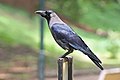
The house crow (Corvus splendens), also known as the Indian, greynecked, Ceylon or Colombo crow,[2] is a common bird of the crow family that is of Asian origin but now found in many parts of the world, where they arrived assisted by shipping. It is between the jackdaw and the carrion crow in size (40 cm (16 in) in length) but is slimmer than either. The forehead, crown, throat and upper breast are a richly glossed black, whilst the neck and breast are a lighter grey-brown in colour. The wings, tail and legs are black. There are regional variations in the thickness of the bill and the depth of colour in areas of the plumage.

Taxonomy

[edit]

The nominate race C. s. splendens is found in Pakistan, India, Nepal and Bangladesh and has a grey neck collar. The subspecies C. s. zugmayeri is found in the dry parts of South Asia and Iran and has a very pale neck collar. The subspecies C. s. protegatus is found in southern India, the Maldives (sometimes separated as maledivicus) and Sri Lanka and is darker grey. C. s. insolens, found in Myanmar, is the darkest form and lacks the grey collar.[3]

Distribution and habitat

[edit]

It has a widespread distribution in southern Asia, being native to Nepal, Bangladesh, India, Pakistan, Sri Lanka, Maldives and Laccadive Islands, southern Myanmar, south Thailand, and coastal southern Iran. It was introduced to East Africa around Zanzibar (about 1897)[4] and Port Sudan. It arrived in Australia via ship but has up to now been exterminated. Recently, it has made its arrival in Europe and has been breeding in the Dutch harbour town Hook of Holland since 1998.

A population between 200 and 400 birds has been present in Sham Shui Po, New Kowloon, Hong Kong, in particular Lai Kok Estate and Sham Shui Po Park, as well as Kowloon Tsai Park in Kowloon Tsai.[5] An individual has been present in Cork Harbour on the south coast of Ireland since early September 2010.[6]

In the New World, a small population of house crows is established in the area around St. Petersburg, Florida.[7] As of April 2009, the introduced population of house crows in Socotra Island, Yemen, has been eradicated to avoid negative ecological effects to endemic species of Socotra.[8]

It is associated with human settlements throughout its range, from small villages to large cities. In Singapore, there was a density of 190 birds/km2 in 2001 with efforts to suppress the population in planning.[9][10]

Due to a human population explosion in the areas it inhabits, this species has also proportionately multiplied. Being an omnivorous scavenger has enabled it to thrive in such circumstances.

Invasive species

[edit]

The invasive potential for the species is great all over the tropics. This species can make use of resources with great flexibility and appears to be associated with humans, and no populations are known to exist independently of humans. Based on niche-modelling it is estimated that it can also persist in some coastal areas in southern and northwestern Europe.[11] In 2016, house crow was added to the List of Invasive Alien Species of Union concern. The breeding population of this species is reported from Netherlands (Hoek van Holland), while individuals were seen in Belgium, Hungary, Poland and Spain.[12]

Behaviour

[edit]
Parents feeding nestlings
Nest with eggs

Diet

[edit]

House crows feed largely on refuse around human habitations, small reptiles and mammals,[13] and other animals such as insects and other small invertebrates, eggs, nestlings, grain and fruits. House crows have also been observed swooping down from the air and snatching baby squirrels. Most food is taken from the ground, but also from trees as opportunity arises. They are highly opportunistic birds and given their omnivorous diet, they can survive on nearly anything that is edible. These birds can be seen near marketplaces and garbage dumps, foraging for scraps. They have also been observed to eat sand after feeding on carcasses.[14]

Nesting

[edit]
Eudynamys scolopaceus in a clutch of Corvus splendens - MHNT

At least some trees in the local environment seem to be necessary for successful breeding although house crows occasionally nest on telephone towers.[15] It lays 3–5 eggs in a typical stick nest, and occasionally there are several nests in the same tree. In South Asia they are parasitized by the Asian koel. Peak breeding in India as well as Peninsular Malaysia is from April to July. Large trees with big crowns are preferred for nesting.[16]

Roosting

[edit]

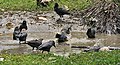
House crows roost communally near human habitations and often over busy streets. A study in Singapore found that the preferred roost sites were in well-lit areas with a lot of human activity, close to food sources and in tall trees with dense crowns that were separated from other trees. The roost sites were often enclosed by tall buildings.[17] Before flying into roost trees, crows make pre-roosting aggregations perched on TV antennas, roof tops, wayside trees, open fields, and feed or preen during this time.[18]

Voice

[edit]

The voice is a harsh kaaw-kaaw.[3]

Relationship to humans

[edit]
House crow near Chandigarh.

It is suspected that paramyxoviruses, such as PMV 1 that causes of Newcastle disease[19] may be spread by Corvus splendens. Outbreaks of Newcastle disease in India were often preceded by mortality in crows.[20] They have also been found to carry Cryptococcus neoformans, which can cause cryptococcosis in humans.[21]

House crows in Tanzania curiously showed an absence of blood parasites, although some species such as Trypanosoma corvi have been first described from this species.[22] Pathologist T.R. Lewis expressed surprise at the numbers of haematozoa present in the blood of house crows from Calcutta.[23]

[edit]

References

[edit]
[edit]
Revisions and contributorsEdit on WikipediaRead on Wikipedia
from Grokipedia
The house crow (Corvus splendens) is a medium-sized, slender bird in the family , measuring 40–43 cm in length and weighing 245–371 g, with glossy black on the head, wings, and body contrasted by a distinctive pale grey collar on the nape, neck, and upper breast. Its long, graduated tail and relatively large bill contribute to a leggy appearance, and both sexes are similar, though juveniles show duller coloration. Native to , including countries such as , , , , , and parts of , , , and , the species thrives in close association with human populations. The house crow has a broad native distribution across the and adjacent regions, spanning an extent of occurrence of approximately 8,510,000 km², but it is non-migratory and typically remains within localized areas. It has been widely introduced by humans through shipping and trade, establishing feral populations in at least 25 countries, including (e.g., , , ), the (e.g., , ), (e.g., , ), the islands (e.g., , ), (e.g., ), the (), and . In these non-native ranges, it often spreads rapidly along coastal and urban corridors, posing ecological challenges; it was added to the European Union's List of Invasive Alien Species of Union Concern in 2016. There are five recognized , differentiated by subtle variations in shade and size, such as C. s. splendens in peninsular and C. s. maledivicus in the . Primarily inhabiting lowland tropical and subtropical zones up to 2,100 m elevation, the house crow is highly synanthropic, favoring urban and rural human settlements, including cities, villages, agricultural fields, garbage dumps, and coastal areas, but avoiding dense forests or remote . As an opportunistic , its diet encompasses a diverse array of foods scavenged or foraged within 20 km of roosts, including insects, small vertebrates (such as eggs, chicks, reptiles, and mammals), fruits, seeds, grains, crop produce (e.g., , ), and like leftovers and refuse. This adaptability, combined with its intelligence and problem-solving abilities, enables it to exploit anthropogenic resources effectively. House crows are diurnal, highly social, and form large, noisy flocks for roosting and , often numbering hundreds or thousands in urban settings, with individuals exhibiting strong and limited dispersal. Breeding is colonial and monogamous, typically occurring from to June in native ranges or September to January in introduced areas, with nests constructed 4–20 m high in trees, palms, or even buildings using twigs, wire, and cloth; clutches consist of 3–5 pale bluish-green eggs incubated for 17–19 days, with fledging after 20–30 days. The global population is estimated in the tens of millions (e.g., around 34 million in alone), with a stable trend overall, leading to its classification as Least Concern on the . However, in introduced regions, it is regarded as invasive due to predation on native birds and their eggs, crop raiding, and potential transmission of pathogens like Salmonella to humans and , prompting management efforts such as trapping, shooting, and nest removal in places like and .

Description

Physical characteristics

The house crow (Corvus splendens) measures 40–43 cm in length, with a of 76–85 cm and a body weight of 245–371 g. It possesses a slender build accentuated by a long neck and a graduated , contributing to its leggy . The bill is prominent, long, and slightly decurved, ranging from dark gray to in color. The legs and feet are robust and , facilitating perching and . features glossy feathers with iridescent greenish-blue to purple highlights on the forehead, , throat, back, wings, and . A contrasting gray collar spans the , ear-coverts, sides of the , and , with variations in shade across . Sexual dimorphism is limited, as males and females exhibit similar plumage, though males are slightly larger. Juveniles closely resemble adults but display duller, browner tones without the characteristic gloss.

Plumage and identification

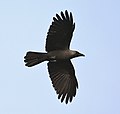
The adult house crow possesses glossy black plumage overall, with a metallic purple-blue or greenish sheen most prominent on the forehead, crown, throat, back, wings, and tail. The nape, neck, and sides of the breast form a contrasting pale gray collar, often described as smoky-gray, which lacks gloss and extends from the hindcrown to the mantle. This distinctive collar is the primary visual identifier, setting the species apart in urban and rural settings across its range. Regional variations affect the saturation of the plumage, with subspecies differing in the depth of color in the gray collar and the intensity of the black gloss; for instance, populations in southern and tend to show duller tones compared to brighter sheens in northern Indian forms. The sexes are similar in plumage, though males may exhibit slightly more vibrant gloss. Bill thickness also varies regionally, being thicker in some eastern populations. In the field, the house crow is recognized by its slim, somewhat leggy build, long and slightly decurved bill, and the prominent gray collar. During flight, it shows shallow wingbeats with relatively long, narrow wings and a rounded , contributing to its agile appearance. The basic "caw" call provides auditory confirmation but is not unique. It is differentiated from the large-billed crow (Corvus macrorhynchos) by its slimmer physique and the diagnostic gray collar, as the large-billed crow features entirely glossy black plumage without such markings. Relative to the jungle crow (Corvus culminatus), the house crow is smaller, with a finer bill and the key gray nape and neck contrasting against the jungle crow's uniform black head and neck. Juveniles closely resemble adults but display duller, less glossy black areas and a somewhat browner tone to the gray collar, with brownish legs and toes. They undergo an annual complete molt in summer, achieving full adult by the first winter.

Taxonomy and systematics

Etymology and naming

The scientific name of the house crow is Corvus splendens, first described and named by French ornithologist Louis Jean Pierre Vieillot in 1817 in his work Nouvelle Dictionnaire d'Histoire Naturelle. The genus name derives from the Latin word for "crow" or "raven," a term used since ancient times to denote birds in this group. The specific epithet splendens is also Latin, meaning "shining" or "splendid," alluding to the bird's glossy black feathers that exhibit a subtle iridescent sheen. Common names for the house crow reflect its close association with human settlements and its distinctive appearance. In English, it is primarily known as the house crow, with additional names including Indian crow, grey-necked crow, crow, and Ceylon crow, the latter two referencing its prevalence in . In , where it is native, regional vernacular names include "kauwa" in , emphasizing its everyday presence around homes. The type locality for the species, as designated in Vieillot's original description, is Bengal (modern-day Bangladesh and parts of India).

Subspecies and genetics

The house crow (Corvus splendens) is classified into five recognized subspecies, primarily distinguished by subtle variations in body size and the shade of gray on the nape, neck, and breast plumage. C. s. zugmayeri inhabits regions from southeastern Iran through eastern Afghanistan, Pakistan, and into northwestern India, where individuals are slightly larger with darker gray tones compared to other subspecies. C. s. splendens is distributed across central and northeastern India, Nepal, Bhutan, and Bangladesh, exhibiting intermediate gray plumage shades. C. s. protegatus occupies southern India and Sri Lanka, featuring paler gray tones on the neck and breast. C. s. maledivicus is endemic to the Maldives, with similar plumage but adapted to insular conditions. C. s. insolens occurs in southeastern Myanmar, Thailand, and southern China, with darker gray tones. Genetic analyses of reveal low divergence among these , suggesting a relatively recent and ongoing across their ranges. Mitogenomic sequencing indicates shallow genetic differentiation in native populations, with diversity levels consistent with historical range expansions rather than deep phylogenetic splits. A 2025 study sequencing the subunit I (cox1) gene in Pakistani populations identified nine distinct haplotypes, underscoring regional genetic variability that supports adaptive responses to urban habitats. Within the genus Corvus, the house crow occupies a phylogenetic position closely allied with the jungle crow (C. macrorhynchos), from which it diverged approximately 3–5 million years ago during the mid-Pliocene Zanclean stage. This sister-group relationship is supported by comparative mitogenomic data, highlighting shared ancestral traits in the Asian corvid . The house crow's genetic profile contributes to its invasiveness, with high adaptability enabling swift colonization of new areas despite founder effects. Introduced populations exhibit bottleneck signatures, including reduced heterozygosity and allelic richness relative to native ones, yet retain sufficient standing variation for rapid local . This resilience is evident in genes linked to environmental tolerance, facilitating establishment beyond native ranges.

Distribution and habitat

Native distribution

The house crow (Corvus splendens) is native to the , encompassing countries such as , , , , , , as well as southern , southeastern , southwestern , and parts of southern including and . Within this range, the species occupies elevations from sea level up to approximately 2,100 m, particularly in the Himalayan foothills. In its native areas, the house crow inhabits a variety of modified landscapes, including urban and rural settlements, open woodlands, agricultural fields, and riverine forests. It shows a strong preference for proximity to activity, often nesting in trees within villages, towns, and cities where resources from waste are abundant. Population densities vary across habitats, with the being abundant in urban centers such as , where densities are around 15 birds per km², while numbers are lower and declining in remote forested regions due to with other corvids. Historically, urban populations have expanded significantly since the , driven by post-colonial and increased settlements that provided expanded foraging and nesting opportunities.

Introduced and invasive ranges

The house crow (Corvus splendens) was first introduced outside its native Asian range in the late , primarily via ship transport to port cities around the . Initial deliberate introductions occurred in (now ), Klang in , and in around 1897, often for or purposes. In , the species was brought to Klang, , in the to combat caterpillars on plantations, and to in the 1940s. From these entry points, it spread to the , including Persian Gulf countries such as the and , and to , encompassing , , and . By the early 20th century, the house crow had reached , establishing populations in coastal areas like . Dispersal has been facilitated mainly by ship-assisted human transport, with rapid colonization enabled by large communal roosting flocks that allow quick expansion along coastal and urban corridors. The is now established as invasive in over 25 countries, predominantly around the basin, including additional sites in the (e.g., ), (e.g., , ), and (e.g., parts of beyond Klang). Brief introductions have occurred in , such as in the , where a small population was successfully targeted for eradication through interventions. Recent unestablished sightings in , including a confirmed detection in , in July 2025, are under active monitoring to prevent establishment. Eradication efforts have had mixed success: programs in the in the 1990s using trapping and shooting reduced the population significantly, though isolated sightings occurred afterward, while ongoing initiatives in and , , employ similar methods including traps and poisoning to reduce numbers.

Ecology and behavior

Diet and foraging

The house crow (Corvus splendens) exhibits an omnivorous diet, incorporating both animal and plant matter along with scavenged human waste. Animal components include , mollusks, small vertebrates such as and frogs, eggs, chicks, and carrion, while plant items consist of grains like and , fruits such as mulberries, and seeds. In urban settings, the heavily exploits anthropogenic sources, including garbage, leftovers, , and kitchen waste, which provide reliable nutrition and contribute to its adaptability in human-modified landscapes. Foraging strategies are diverse and opportunistic, encompassing ground probing with the bill to uncover buried or debris, scavenging at carcasses often alongside other animals like feral dogs, and preying on live items such as parasites on . House crows also engage in aerial hawking to capture flying like during swarms and , aggressively stealing food from other birds by them in coordinated efforts. These techniques allow the species to exploit a broad range of microhabitats, from agricultural fields to urban dumps. Dietary preferences show seasonal variations, with higher overall feeding activity observed from to in urban areas, where daytime reliance shifts toward miscellaneous refuse and carcasses, while early mornings favor more natural and sources. In agricultural contexts, food availability fluctuates with environmental conditions, such as increased and aquatic prey during flooded fields, prompting shifts toward urban scavenging when natural resources dwindle. Urban populations demonstrate strong dependence on anthropogenic foods for consistency across seasons, reducing vulnerability to natural scarcities. Group foraging is a prominent behavior, with house crows typically hunting or scavenging in flocks of 2 to 20 individuals, facilitating cooperative tactics like mobbing to kleptoparasitize larger birds or access shared resources such as slaughter waste. This social dynamic enhances foraging efficiency, particularly for challenging prey, and aligns with their preference for congregated feeding over solitary efforts in most habitats.

Reproduction and breeding

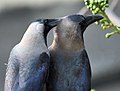
The house crow (Corvus splendens) typically breeds during the dry season in its native South Asian range, with the season spanning April to June, though it can extend from February to May in some regions and occur year-round in tropical latitudes. In introduced tropical areas, such as , breeding peaks from September to January. Breeding pairs are monogamous, often maintaining long-term bonds and reusing nests from prior seasons. House crows are monogamous, and involves pairs snuggling on branches while producing tuneful croaks. Nests are bulky structures constructed from twigs, wires, and other materials, lined with softer substances like grass or hair, and typically placed 4–20 m above ground in tall trees, buildings, or utility structures. Clutch sizes range from 3–5 eggs on average, though 2–6 have been recorded, with eggs being pale blue-green and speckled brown; females may lay a second in favorable conditions. Incubation lasts 15–19 days, primarily handled by the female, while the male provides food. Both parents share parental duties, feeding altricial nestlings a diet rich in and scraps until fledging at 20–32 days. Fledglings remain dependent on adults for 4–6 weeks post-fledging, with full independence around 2 months; urban populations exhibit high fledging success rates of about 70%. House crows reach and first breed at 2–3 years of age, with an average wild lifespan of 7–10 years influencing reproductive output over multiple seasons.

Vocalization and communication

The house crow (Corvus splendens) produces a primary vocalization described as a harsh, nasal "kaan-kaan" or repeated "caw-caw," often rendered as a flat, toneless "aahh-aahh." This call varies in intensity and pitch by context, with louder, more abrupt versions signaling alarm or territorial defense, while softer iterations facilitate contact between individuals in social groups. The species exhibits a diverse vocal encompassing over a dozen distinct calls, including flight calls such as "eh-aw" and responses to heterospecific vocalizations. Additional types include higher-frequency incubation calls reaching up to 10.5 kHz, used during breeding to maintain pair coordination, and recruitment calls that draw conspecifics to sources or threats during group and defense. Alarm calls specifically function to recruit against predators, enhancing collective vigilance in communal settings. Vocalizations convey information on individual identity, , and age, aiding in recognition and social cohesion. Females produce higher-pitched, harsher calls with slower modulations, while males emit lower-pitched sounds with greater frequency variation; adults display higher fundamental frequencies and faster modulations compared to juveniles. Regional dialects manifest as pitch and tempo differences across , such as between C. s. splendens in and C. s. protegatus in , potentially reflecting adaptations to local environments including urban areas.

Social structure and roosting

House crows (Corvus splendens) are highly gregarious, forming daytime flocks that typically range from 10 to 1,000 individuals, with larger aggregations observed in resource-rich urban environments. These flocks facilitate social foraging, where birds share information about food sources through coordinated movements. Within groups, loose dominance hierarchies emerge, primarily determined by age and body size, influencing access to preferred feeding spots and reducing intra-group conflicts. Communal roosting is a key aspect of their , with birds gathering in large night roosts often exceeding 2,000 individuals and occasionally reaching several thousand in urban settings. These roosts are typically located in tall trees, utility wires, or man-made structures in cities, where flocks arrive progressively at —first birds about 98 minutes , half the flock around 26 minutes before, and stragglers up to 17 minutes after—accompanied by vocal choruses signaling assembly. In their native tropical ranges, roosting occurs year-round, while introduced populations in more temperate areas may exhibit seasonal shifts in roost size and location. Roosting confers several advantages, including enhanced predator detection through vigilance and the exchange of among group members, which boosts overall survival in dynamic urban habitats. However, for prime roost sites can lead to intra-specific , particularly in invasive populations where rapid intensifies disputes.

Interactions with humans

Cultural and historical significance

In , the house crow (Corvus splendens) holds a sacred association with ancestors, particularly during Shraddha rituals and the period, when food offerings are made to crows as they are believed to embody the spirits of the deceased, serving as messengers between the living and the afterlife. This practice underscores the bird's role in honoring pitrs (forefathers), with acceptance of the offering by the crow interpreted as satisfaction of the ancestors' souls. Additionally, like other corvids, the house crow symbolizes intelligence and resourcefulness in , often celebrated in folk tales for its adaptability and wisdom. In South Asian folklore, the house crow frequently appears as a clever , embodying wit and strategic thinking in ancient narratives such as the tales, where it outsmarts adversaries like serpents or to protect its family or secure resources. Rural beliefs across the region also attribute omens to the bird's behavior, drawing from texts like the Brihat Samhita (6th century CE), which interprets crow cries, nesting sites, and flights as portents of prosperity, rain, famine, or danger—for instance, a crow nesting in a dead tree signals abundance, while specific cries may foretell joy or obstacles. These portrayals highlight the house crow's dual role as both a harbinger and a symbol of cunning survival. During the colonial era, British naturalists in the extensively documented the house crow in , with detailed descriptions in works like William Thomas Blanford's The Fauna of British India, Including Ceylon and Burma (Birds, Vol. 1, 1895), which cataloged its , distribution, and behaviors as a common urban species. These accounts also noted early human-assisted introductions, such as to and in the late 1800s for , marking initial studies of its invasive potential beyond native ranges. In modern Indian media, the house crow appears in cinema as a representation of urban life, often as or a pest-like figure in Bollywood films; for example, the 1998 comedy features crows in its title and narrative, drawing on for humorous effect, while song sequences in other productions highlight their mischievous traits.

Pest status and economic impacts

The house crow (Corvus splendens) is widely regarded as an agricultural pest due to its opportunistic feeding on crops, particularly grains and fruits, leading to significant yield reductions in native and introduced ranges. In , house crows cause damage ranging from 9% to 18% on crops such as , , and sunflower, with higher losses observed in the afternoon foraging periods. This crop raiding behavior, facilitated by the bird's omnivorous diet, exacerbates food security challenges in regions like . Additionally, house crows prey on , particularly eggs and chicks; in , , invasive populations result in substantial economic losses for farmers, with predation rates highest on young chicks and eggs compared to adult birds. In urban environments, house crows act as commensal pests by scavenging garbage, which contributes to the spread of diseases through their droppings and the strewing of waste. They are known vectors for pathogens such as spp., transmitted via fecal contamination of surfaces and food sources. Large roosts generate excessive noise from vocalizations and cause fouling of buildings and public spaces with acidic droppings that damage . These behaviors diminish in cities across their introduced ranges, including parts of and the . House crows pose notable health risks as carriers of zoonotic and avian diseases. The birds also harbor virus (AIV), including highly pathogenic strains like H5N1, with detection rates up to 88.6% in sampled populations. While direct attacks on humans are rare, aggressive incidents have been reported in , where flocks target individuals perceived as threats to their young. The economic impacts of invasive house crows are substantial, encompassing direct losses from agricultural and livestock damage as well as management expenditures. In , , an unsuccessful eradication effort targeting over one million birds exceeded US$1.5 million, highlighting the high costs of controlling established populations in . Globally, alien birds like the house crow contribute to billions in invasion-related expenses, with perching species driving much of the agricultural burden.

Conservation and management

The house crow (Corvus splendens) is classified as Least Concern on the , reflecting its large global population that has not been quantified but is described as very abundant, with a stable trend across its native range in South and . While no major threats imperil the species overall, local declines have been observed in areas such as rural , where habitat loss from , , and agricultural intensification has reduced nesting and roosting sites. These localized pressures highlight the need for protection in urbanizing native regions, though the species' adaptability to human-modified environments buffers broader risks. In invasive ranges, management emphasizes through targeted methods to limit ecological disruption. remains a primary non-chemical approach, with efficacy enhanced by monitoring food availability and deploying multiple traps to capture flocks in high-density areas like coastal . Avicides such as DRC-1339 (Starlicide), a slow-acting selective for corvids, have been deployed in poisoning campaigns, including Kenya's 2025 revival of the method after a prior import ban, aiming to reduce numbers by up to 80% in treated sites. As of late 2024, over 5,500 birds had been culled in initial efforts, with plans to target 100,000 by the end of 2025 along the coast. in Kenya combines these tactics with habitat modifications, public reporting of sightings, and egg/chick removal to sustain long-term suppression without over-reliance on any single tool. Recent conservation initiatives incorporate advanced monitoring to anticipate expansions. In 2025, genomic studies analyzed house crow populations to trace invasion pathways and predict suitable habitats, revealing standing that enables rapid and informing early-detection protocols. Eradication successes in island ecosystems demonstrate feasibility; on , , a 15-year program culminated in the removal of the final 13 individuals in 2009 using international expertise, , and avicides, preventing establishment and protecting endemic . Looking ahead, poses challenges by potentially expanding habitable ranges, with models projecting increased suitability in eastern under warming scenarios, thereby accelerating invasions. Global management relies on international regulations to prevent unintentional introductions via shipping, including port inspections and measures outlined in frameworks like the EU's Invasive Alien Species Regulation, which designates the house crow for mandatory prevention and control.

References

Add your contribution
Related Hubs
User Avatar
No comments yet.