Hubbry Logo
Italic LeagueItalic LeagueMain
Open search
Italic League
Community hub
Italic League
logo
8 pages, 0 posts
0 subscribers
Be the first to start a discussion here.
Italic League
Italic League
from Wikipedia
Italic League
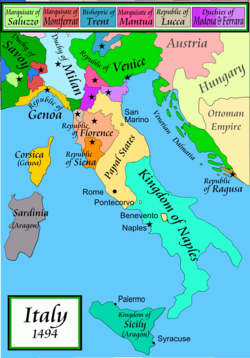
Map of Italy in the late 15th century, in Italian, showing the major powers of Florence, Milan, Naples, the Papal States and Venice, plus the more-minor powers such a Genoa, Modena–Ferrara, Mantua, Sienna and Lucca.
Italy in 1494, showing the borders that were broadly stabilised by the treaty 40 years earlier
ContextTreaty of Lodi, after the Wars in Lombardy
SignedAugust 30, 1454 (1454-08-30)
LocationVenice, Republic of Venice
Expiry1494 (1494)
Signatories

The Italic League or Most Holy League was an international agreement concluded in Venice on 30 August 1454, between the Papal States, the Republic of Venice, the Duchy of Milan, the Republic of Florence, and the Kingdom of Naples, following the Treaty of Lodi a few months previously.[1][2] The next forty years were marked by peace and economic expansion based on a balance of power within Italy. The decline of the League brought about the Italian Wars.

Background

[edit]

In the first half of the 15th century, the larger Italian powers had been consolidating their territories, with Savoy expanding towards the Ligurian Coast, Venice focusing on Terraferma while the Stato da Màr was threatened by Turkish expansion, Milan expanding southwards (and, even after the dismembering of the empire after Gian Galeazzo Visconti's death, retaining the bulk of Lombardy), the Florentines having gained most of Tuscany and the Papal States having begun an expansion in central Italy that would continue into the next century, while King Alfonso V of Aragon expanded from Sicily into the Kingdom of Naples.[2]

Solemnly proclaimed on 2 March 1455 with the accession of Pope Nicholas V (1447–1455), King Alfonso, and other small states to the League (excluding Malatestine Rimini, at Alfonso's insistence),[3] it established a mutual defense agreement and a 25-year truce between the Italian powers, forbidding separate alliances and treaties while committing to maintenance of the established boundaries.[1] The other Italian states acknowledged the condottiero Francesco Sforza as successor to the last of the Visconti of Milan, after having married the only daughter of Filippo Maria Visconti. The relative peace and stability resulting from Lodi and the League, promoted by Sforza, allowed him to consolidate his rule over Milan.[4] It was Cosimo de' Medici's most important foreign policy decision to end the traditional rivalry between his Florence and Sforza's Milan.[5]

Consequences

[edit]

The League was the coherent development of the Peace of Lodi, born from the realisation that none of the regional Italian states, despite the long and bloody wars in the preceding hundred years, was in a position to assume hegemony in the north, let alone in the peninsula. The League therefore provided a détente, founded on mutual suspicion and fear of France rather than on collaboration, which might have led to the formation of a broader, unified state.

The Italic League played an essential part in the balance of power subsequently pursued by the Florentine ruler Lorenzo de' Medici (1449–1492); its only cracks[citation needed] were the Pazzi conspiracy, the Barons' conspiracy, and the Salt War. The League provided enough stability to allow the peninsular economy to recover from the population loss and economic depression caused by the Black Death and its aftermath, leading to an economic expansion that endured until the first part of the 17th century.[6] The League also enabled the creation of the first permanent embassies amongst the states of the Italian peninsula,[7] in order to monitor compliance with the terms prohibiting supporting exiled dissidents,[8] with De Officio Legati — what seems to be the first treatise on ambassadorship — written by Ermolao Barbaro in Venice in 1490, after he had served the Serenìsima in Burgundy and Milan.[7]

The death of Lorenzo de' Medici in 1492 marked the decline of the League. He had been one of its greatest supporters[9] and prime maintainer,[10] recognising the advantage of maintaining a balance among the five powers as opposed to trying to eliminate his enemies.[10] Whilst the League failed to prevent the French invasion in 1494 that began the Italian Wars,[clarification needed] it did enable (as the League of Venice) the creation of the army that repelled Charles VIII's army after its sack of Naples.[1] The League army engaged the French at Fornovo and retained control of the battlefield but failed to prevent an orderly French retreat.[1] The Venetian alliance with France and Spain against Milan and Naples in the Italian Wars of 1499–1504, however, sounded the death knell for the League.[11]

As a result of the détente,[citation needed] unlike France, Spain, and England, Italy did not coalesce into a single monarchy in the Middle Ages, and was consequently left vulnerable to invasion from more powerful neighbours. Several factors have been considered causes of this; Francesco Guicciardini blamed particularism,[citation needed] for example, while Niccolò Machiavelli believed it resulted from the moral and civil decay of institutions and morals and in papal policy,[citation needed] for centuries aimed at avoiding the formation of a unified Italy. It should be borne in mind, however, that Machiavelli's great work The Prince was a reflection of the political equilibrium resulting from the League's existence.[12]

See also

[edit]

References

[edit]
Revisions and contributorsEdit on WikipediaRead on Wikipedia
from Grokipedia
The Italic League, also known as the Italian League or Lega Italica, was a multilateral defensive alliance established in 1454 among 's principal states to secure mutual defense, recognize existing boundaries, and prevent foreign intervention on the peninsula. Formed as a direct outgrowth of the Peace of Lodi—signed on 9 April 1454 between the under Francesco Sforza and the , which ended a protracted war of Milanese succession—the league initially comprised , , the , the Kingdom of Naples under Alfonso V, and the . This pact, formalized in on 30 August 1454 and extended into a broader framework by 1455, instituted a 25-year commitment to non-aggression and , marking an early instance of balance-of-power that fostered relative stability in for approximately four decades until its collapse amid escalating external pressures in 1494. The league's defining achievement lay in its role as a stabilizing mechanism amid chronic inter-state rivalries, enabling a period of cultural and economic flourishing in Renaissance Italy while deterring ambitions from powers like under Charles VII; it also laid groundwork for innovations such as permanent diplomatic embassies to manage ongoing negotiations and curb expansionist tendencies. Though not without internal frictions—such as occasional border disputes or papal maneuvers—the alliance's emphasis on juridical equilibrium and shared contingents for defense represented a pragmatic response to the fragmented political landscape, ultimately succumbing to the French invasion that ignited the .

Origins

Preceding Conflicts and Instability

The major Italian powers—, , , , and the —were embroiled in recurrent warfare from the 1420s to the 1450s, driven by territorial rivalries and dynastic ambitions that destabilized the . The Wars in (1423–1454) formed the core of this instability, beginning with 's offensive against Venetian-aligned territories in 1423 under Duke , escalating into full-scale conflict by 1425 over control of Lombard cities like and . countered with alliances, including from 1426, leading to battles such as Maclodio in 1427, where Venetian forces under Francesco Bussone da Carmagnola defeated Milanese troops. Subsequent phases involved 's direct wars against in the 1430s and 1440s, marked by campaigns under like Niccolò Piccinino, and culminated in the 1449–1454 contest following Visconti's death, when mercenary leader Francesco Sforza seized amid Venetian incursions. Mercenary warfare, reliant on condottieri and their companies, intensified these rivalries by prioritizing profit over resolution; captains like Carmagnola and later Sforza orchestrated maneuvers that avoided pitched battles, favoring sieges, raids, and negotiated surrenders to extend engagements and secure ongoing contracts. This , embedded in contracts (condotte) that rewarded longevity of service, led to tactical caution—evident in the rare decisive engagements—and frequent betrayals, as mercenaries switched sides for better terms, exacerbating distrust among principals. By the 1440s, such dynamics had fragmented alliances, with the under Eugenius IV intervening against in 1431 and under Alfonso V allying variably, turning local disputes into broader coalitions that strained resources across the region. Prolonged conflicts imposed severe economic pressures, reallocating wealth toward military outlays that consumed 70–80% of communal budgets in states like and , while ravaging through , pillage, and abandoned fields. Trade routes in the and Adriatic were intermittently severed, as Venetian galleys clashed with Milanese blockades and Florentine merchants faced disrupted and exchanges; farmland depopulation from war refugees and outbreaks reduced taxable yields, forcing reliance on forced loans and taxes that fueled internal unrest. Bilateral truces repeatedly collapsed under the weight of opportunistic , as seen in the Peace of Ferrara (1430), which halted the initial Milan-Venice phase but crumbled amid Florentine-Milanese skirmishes by 1438, and the Peace of Cremona (1441), intended to stabilize borders yet undermined by Sforza's ambitions and Venetian expansions post-1447. These failures exposed the limitations of dyadic pacts, where a weakened party often sought external allies—such as Venice's overtures to the Habsburgs or Milan's to France—risking escalation and preventing any single state from achieving lasting dominance without provoking counter-coalitions.

The Peace of Lodi

The Peace of Lodi, signed on April 9, 1454, at Lodi in the , concluded the latest phase of the Wars in between the , led by Francesco Sforza who had recently secured control as duke, and the . The agreement ended hostilities that had persisted since the 1447 resumption of conflict following the breakdown of earlier truces, with both parties exhausted by prolonged military engagements and shifting alliances. Under the treaty's terms, Francesco Sforza received formal recognition as the legitimate Duke of Milan, stabilizing his rule after the contested succession from the Visconti dynasty. Venice conceded certain territories in the Lombard plain, including areas around the Adda River, while retaining control over eastern Lombard districts such as Bergamo and Brescia, thus acknowledging Milan's restored influence without fully reversing Venetian gains from prior campaigns. Demilitarization provisions mandated the disbandment of mercenary forces beyond peacetime levels and prohibited fortifications along mutual borders, aiming to reduce immediate threats of renewed aggression. The treaty included clauses extending invitations for adherence to other Italian powers, notably the and the Kingdom of Naples, alongside the , to foster a broader framework of non-aggression and mutual defense. This multilateral outreach marked a transition from bilateral reconciliation to arrangements, directly paving the way for the formation of the Italic League formalized later that year. By establishing principles of balance among northern Italian states, the Peace of Lodi temporarily halted expansionist rivalries and promoted diplomatic consultation over unilateral conquest.

Negotiation and Signing of the Treaty

The negotiations for the Italic League unfolded during a diplomatic congress in in the summer of 1454, building directly on the fragile truce established by the Peace of Lodi earlier that year. Envoys from the , represented by Pope Nicholas V's legates, the , the under Francesco Sforza, the influenced by , and the Kingdom of under , gathered to hammer out terms amid lingering distrust from decades of intermittent warfare. These discussions prioritized pragmatic mutual restraint over ideological unity, as each power recognized that unchecked rivalry invited exploitation by external actors like the or French monarchs, yet none was willing to subordinate its sovereignty to a central authority. The congress emphasized , with delegates reluctantly conceding non-aggression pacts among members while stipulating collective defense only against unambiguous foreign invaders, explicitly avoiding mechanisms for internal that might erode . Smaller Italian entities, such as or , were sidelined from participation to ensure the great powers retained dominance in any equilibrium, reflecting a calculated exclusion rather than inclusive . This self-interested calculus drove the compact's formation, as historical animosities—evident in Venice's recent conflict with —necessitated binding assurances without idealistic overreach. The treaty, known as the Most Holy League, was formally signed on 30 August 1454 in , committing the signatories to a 25-year defensive devoid of supranational . The document's provisions underscored causal priorities of territorial preservation, mandating notification of threats and proportional military aid, but omitted punitive measures for intra-league breaches, underscoring the alliance's dependence on balanced deterrence rather than coercive unity.

Composition and Terms

Member States and Their Motivations

The Italic League united five major Italian powers: the under Francesco Sforza, the , the led by , the Kingdom of Naples ruled by , and the headed by . These states, despite prior conflicts such as the Milanese Wars of Succession (1447–1454), allied to preserve territorial balances forged by the preceding Peace of Lodi on April 9, 1454, which had ended hostilities between Milan and Venice. The agreement, formalized on August 30, 1454, in Venice, reflected a pragmatic recognition that unchecked expansion by any single power risked inviting external intervention, particularly from , which held dynastic claims to Milan via the branch of the Valois. For , the league served as a critical defensive mechanism; Sforza, having seized the duchy in 1450 after his marriage to , faced vulnerabilities from Venetian territorial ambitions in and persistent French pressures under Charles VII, who viewed as a gateway for influence in . Sforza's emphasized to deter aggression, allowing him to consolidate internal control over a state encompassing approximately 200,000 square kilometers and reliant on condottieri forces numbering up to 20,000 men. , recovering from losses like the Brescian territories ceded in the Peace of Lodi, prioritized safeguarding its Adriatic dominance and overland trade routes to the , fearing Milanese overreach into the would disrupt commerce valued at millions of ducats annually. The republic's and fleet of over 100 galleys underscored its stake in stability to counter both Ottoman naval threats post-Constantinople's fall in 1453 and Italian rivals. Florence's participation stemmed from Cosimo de' Medici's strategy to shield the republic's republican institutions and banking empire—handling papal finances and European loans exceeding 100,000 florins yearly—from Holy Roman Imperial encroachments under Frederick III and residual hostilities with , despite earlier alliances against . Naples, under Alfonso V, who had conquered the kingdom from by 1442, joined to legitimize Aragonese rule over a of 30,000 square kilometers and neutralize papal-Angevin alliances that challenged his sovereignty. The , fragmented by baronial unrest in the and , benefited from the league's mutual defense to enforce spanning 44,000 square kilometers, enabling Nicholas V to redirect resources toward anti-Ottoman preparations amid fears of Islamic expansion after 1453. These motivations converged on a shared interest in equilibrium, yet revealed tensions: Venice's Adriatic primacy clashed with Milan's continental ambitions, while the papacy's universal claims occasionally strained relations with secular rulers. Smaller entities like the , weakened by internal strife and French alliances, and the were excluded, highlighting the league's focus on dominant actors capable of enforcing commitments rather than inclusive . This selective composition prioritized deterrence through counterbalanced power over comprehensive unity, a causal dynamic rooted in the fragmented of the , where alpine passes and coastal access amplified vulnerabilities to both internal and transalpine incursions.

Core Provisions and Mutual Obligations

The Italic League treaty, signed on August 30, 1454, and ratified in March 1455, established a defensive alliance binding the , , , , and for 25 years. Members pledged mutual assistance against invasions or attacks from non-signatory powers, with each state obligated to furnish armed contingents to support collective defense efforts. This pact emphasized preservation of the territorial status quo established by the preceding Peace of Lodi, implicitly barring aggressive expansion or conquest directed at fellow members without collective consent. Military obligations were decentralized, requiring ad hoc coalitions rather than a standing league army or shared treasury, thereby safeguarding individual sovereignty while depending on voluntary compliance for enforcement. Contributions were to be proportional to each state's resources and strategic strengths—for instance, Venice's commitments prioritized naval forces to counter maritime threats, complementing the land-based troops of inland powers like and . Disputes among members were to be resolved through by designated mediators from within the league, preventing escalation into open conflict and reinforcing the non-aggression framework. These provisions reflected a pragmatic balance of and , devoid of supranational institutions, which hinged on diplomatic goodwill and the mutual interest in deterring foreign intervention. The absence of punitive mechanisms for internal breaches underscored the treaty's reliance on reputational costs and iterative negotiations over coercive structures.

Governance and Decision-Making Mechanisms

The Italic League lacked a formal central institution or executive body, embodying a loose where member states retained full and coordinated through diplomatic channels rather than hierarchical command. This structure emphasized mutual consultation via networks of resident ambassadors exchanged among the principal courts of , , , , and the , enabling ongoing information sharing and preemptive negotiation to avert conflicts. These envoys, often permanent fixtures by the mid-1450s, reported directly to their rulers and facilitated discussions, but possessed no independent authority to bind their principals, rendering the system reactive and prone to delays. Decision-making hinged on for collective actions, such as mobilizing joint forces against external threats or arbitrating internal disputes, a requirement rooted in the league's defensive provisions that guaranteed territorial status quo only through voluntary adherence. This consensus model, while preserving autonomy, inherently favored inertia, as any single member's —driven by parochial interests—could stall responses, underscoring the alliance's causal fragility amid divergent priorities like 's maritime expansion or 's northern defenses. Periodic congresses of ambassadors or plenipotentiaries, convened in rotating venues such as or either annually or amid crises (e.g., Ottoman advances), served as forums for policy alignment, though attendance and outcomes depended on rulers' goodwill rather than obligation. The ' participation positioned the as a nominal moral guarantor, leveraging spiritual prestige to exhort compliance and frame the league as a "most holy" pact under divine auspices, with 's 1455 bull providing ecclesiastical endorsement. In practice, however, papal influence yielded to secular exigencies; pontiffs like Calixtus III prioritized curial politics over enforcement, allowing temporal rulers to sidestep obligations when convenient, which eroded the league's cohesion over time. This interplay highlighted the tension between ideological unity and pragmatic fragmentation, with no mechanisms for sanctions against defection beyond reputational costs or bilateral reprisals.

Functioning and Diplomatic Practice

Early Implementation and Congresses

The Italic League's early implementation began with its formal proclamation by on March 2, 1455, which extended the defensive alliance to include the and , committing all members to mutual non-aggression and collective defense through contingents of 400 men-at-arms and 200 light horse per major power. This structure immediately reinforced Francesco Sforza's precarious rule in Milan, established after Filippo Maria Visconti's death in 1447 and the ensuing , by legitimizing his duchy within a balanced system that deterred challenges from or other rivals. Initial congresses and diplomatic coordination proved effective in quelling minor conflicts. In 1455–1456, the league mobilized against condottiero Jacopo Piccinino's destabilizing activities in , where he sought to expand influence amid local factionalism; member states, including and , enforced compliance through joint pressure and , averting broader escalation without invoking full military obligations. Similar mechanisms diffused latent Venetian-Florentine border tensions arising from prior alliances, as routine ambassadorial exchanges and assemblies upheld the treaty's arbitration clauses, preventing skirmishes that had plagued the region pre-1454. By the 1460s and early 1470s, the league's framework sustained relative stability, evidenced by the absence of major inter-Italian wars and the containment of disputes like those over territories. Economically, this deterrence enabled trade resumption, with Florentine banking records indicating heightened transaction volumes and extensions to northern partners post-1454, reflecting normalized routes unhindered by hostilities. The period's efficacy stemmed from the league's emphasis on balanced contributions and rapid dispute resolution, fostering a deterrent equilibrium among equals.

Role in Resolving Disputes

The Italic League's treaty stipulated that disputes among members be submitted to by the or collective congresses of representatives, prioritizing diplomatic over military escalation to preserve the balance of power. This mechanism drew on the Peace of Lodi's emphasis on mutual guarantees, extending it to require members to renounce unilateral aggression and seek mediated settlements. In practice, the league mediated tensions arising from the Ferrara succession in the 1450s, where papal arbitration under Nicholas V confirmed Borso d'Este's investiture as in 1452, facilitating the league's informal extension of protections to as a Milanese ally and deterring Venetian expansionism without provoking open conflict. Similarly, lingering papal-Neapolitan frictions over feudal rights in the Abruzzi and were channeled through league diplomacy, with envoys negotiating truces that integrated Alfonso I of into the alliance, averting renewed warfare post-1454. Papal legates served as primary mediators, leveraging the Pope's nominal presidency of the league for impartial oversight, though their decisions often favored curial prerogatives, such as reinforcing in disputed fiefs. These interventions emphasized procedural equity, with congresses at sites like convening to deliberate claims and impose binding compromises. The league's arbitration yielded tangible results, maintaining internal peace with no major wars among core members until Venice's 1482 incursion against , which prompted allied responses but highlighted prior successes amid pre-1454 volatility marked by near-constant conflicts. This quarter-century of restraint underscored the efficacy of institutionalized in curbing opportunistic disputes.

Military and Economic Commitments

The Italic League imposed mutual defense obligations on its member states, mandating collective military action against external aggressors or violations of the peace. Each signatory pledged to furnish troops and resources to aid any attacked ally, with contributions scaled to the state's size and wealth; for instance, major powers such as and , which routinely fielded armies of over 20,000 infantry and cavalry, were expected to lead these efforts primarily against Ottoman incursions following the fall of in 1453 or potential interventions by transalpine powers like . These commitments aimed to deter invasions by pooling fiscal-military capacities, though enforcement hinged on ad hoc mobilization rather than a permanent league army, reflecting the fragmented sovereignty of Italian polities. Economic aspects of the league were secondary but intertwined with military stability, as the pact implicitly encouraged non-interference in commerce to sustain the resources needed for defense. By curbing endemic warfare, it enabled recovery from prior depredations like the Black Death's aftermath, fostering intra-Italian trade in goods such as , , and without formalized tariff reductions, though de facto reductions in blockades and tolls occurred during periods of adherence. This stability supported fiscal bases strained by high mercenary wages, yet the absence of dedicated economic mechanisms—such as shared treasuries—limited robustness, as states prioritized domestic revenues over league-wide levies. A core constraint arose from dependence on condottieri, professional mercenary captains who commanded the bulk of pledged forces; contracts emphasized pay over loyalty, creating principal-agent dilemmas where commanders could defect or prolong conflicts for profit, undermining rapid collective response. This system, while cost-effective for peacetime, exposed fiscal limits: Italian states lacked the taxation depth for conscript armies, rendering commitments vulnerable to budgetary shortfalls and opportunistic bargaining by captains like Francesco Sforza, who navigated allegiances fluidly before and after the league's formation.

Decline

Internal Divisions and Betrayals

The of April 26, 1478, exposed deep fissures within the Italic League, as covertly supported the Pazzi family's assassination attempt on and his brother Giuliano during High Mass in Florence's , aiming to dismantle Medici dominance and install a more pliable regime. Despite Lorenzo's survival—Giuliano was killed—the Pope excommunicated Lorenzo, placed Florence under , and formed a with King , both League signatories, to invade Florentine territory, directly contravening the League's pledges of mutual non-aggression and collective defense. This conflict, lasting until a fragile peace in November 1480 achieved through Lorenzo's diplomatic concessions like ceding strategic castles such as Castellina and Poggio Imperiale, underscored how papal ambitions to curb Florentine influence superseded alliance obligations, eroding interstate trust. Subsequent strains arose from Venetian territorial ambitions clashing with Milanese security concerns along their shared northern borders, where Venice's aggressive mainland expansions—rooted in pre-League rivalries resolved only nominally by the 1454 Peace of Lodi—fostered persistent suspicion despite the League's framework. These tensions culminated in the War of Ferrara (1482–1484), triggered by a dispute over salt trade monopolies; allied with to seize the papal fief of , prompting defensive intervention by under Ludovico Sforza's predecessor and under Lorenzo, who shifted from mediation to opposition against Venetian incursions, fracturing the League's unity as members prioritized bilateral gains over multilateral fidelity. The war ended with the Treaty of Baghdad (June 1484), imposing Venetian withdrawals but leaving residual animosities that highlighted elite self-interest in exploiting papal disputes for local advantage. By the 1490s, these endogenous fractures manifested in waning commitment to the League's governance structures, with congresses—intended for routine dispute resolution—experiencing diminished participation and efficacy as rulers like expended energies on personal diplomacy rather than institutionalized cooperation. Lorenzo's death on April 8, 1492, deprived the League of its principal balancer, accelerating apathy amid diverging priorities, such as Venice's Ottoman distractions and Milan's internal Sforza successions, which collectively undermined the alliance's capacity to enforce mutual obligations without invoking external threats.

External Pressures from Foreign Powers

The French invasion of Italy in 1494, spearheaded by King Charles VIII, represented a pivotal external shock that underscored the Italic League's inability to deter non-Italian aggressors despite its mutual defense clauses. Charles VIII, claiming the throne of Naples through the Angevin line, crossed the Alps on September 3, 1494, with an army of approximately 25,000 men, advancing rapidly through Lombardy and Tuscany with minimal resistance due to fragmented Italian responses. Ludovico Sforza, regent of Milan and a League member, actively invited the French intervention to counter Neapolitan influence and secure his own position, thereby betraying the League's core prohibition against foreign entanglements and fracturing its unity from within. This event exposed the League's parochial orientation, as member states' opportunistic alliances with outsiders prioritized short-term gains over collective security against transalpine threats. Ottoman incursions further strained the League's cohesion, diverting resources without eliciting a coordinated defense mechanism. In July 1480, Ottoman forces under captured in the Kingdom of after a 15-day siege, establishing a that alarmed the and prompted to call for a crusade. Although the town was recaptured in 1481 following II's death, the raid involved the slaughter of up to 12,000 inhabitants and highlighted Italy's southern vulnerabilities, yet League members provided only ad hoc support—primarily from and the Papacy—rather than mobilizing the promised joint contingents of 400 and 8,000 per major power. This piecemeal response reflected the League's design limitations, as northern states like and focused on their own eastern trade interests over unified anti-Ottoman action, allowing external ambitions to exploit regional disparities. Spanish Aragonese influence in Naples introduced divided loyalties that undermined the League's autonomy. The Kingdom of Naples, ruled by Alfonso I (d. 1458) and his successors from the House of Aragon, maintained dynastic ties to , who viewed the realm as a strategic foothold for Mediterranean dominance. These connections facilitated Spanish naval and diplomatic interventions, such as support against Ottoman raids, but also sowed seeds for later conflicts, as Aragonese priorities often aligned with Iberian expansion rather than exclusive Italian equilibrium. By the 1490s, Ferdinand's ambitions contributed to the anti-French coalition post-invasion, yet earlier they fostered perceptions of Naples as a proxy for foreign powers, eroding trust among League partners and amplifying the alliance's exposure to exogenous geopolitical maneuvering.

Key Events Leading to Breakdown

, regent of , undermined the Italic League by encouraging to invade and claim the Kingdom of , motivated by his rivalry with King Ferrante I and seeking to weaken a southern rival. This complicity included granting safe passage through Milanese territory, directly contravening the league's mutual defense obligations. In early September 1494, Charles VIII's army, numbering around 30,000 troops including Swiss and Gascon mercenaries, crossed the and advanced southward through and with minimal resistance, as submitted without battle and revolted against its overlords to aid the French. The rapid progress—reaching by December 1494 and by February 1495—exposed the league's deterrence failure, as fragmented responses from and the prioritized local interests over unified action. Revival efforts culminated in the League of Venice, formed on March 31, 1495, by Pope Alexander VI, Venice, Milan (with Sforza switching allegiances), Spain, and the Holy Roman Empire to expel the French, but internal distrust and delayed mobilization hampered effectiveness. The coalition's confrontation at the Battle of Fornovo on July 6, 1495, resulted in tactical French victory amid heavy losses on both sides, yet failed to prevent Charles VIII's temporary retention of southern gains, highlighting persistent divisions. The invasion's chaos manifested in empirical terms through disease epidemics; a typhus outbreak in occupied killed an estimated several thousand French troops by mid-1495, exacerbating logistical collapse and underscoring the league's inability to prevent widespread disorder. These events collectively eroded the league's systemic cohesion, as betrayals enabled external penetration and revival attempts revealed irreparable fractures.

Dissolution and Immediate Aftermath

Formal Collapse and Wars

The Italic League's de facto collapse occurred by 1495, precipitated by the French invasion of launched on September 3, 1494, when King Charles VIII crossed the with 25,000 troops, initially supported by Milan's regent who sought to counter Neapolitan influence. This betrayal violated the league's core mutual defense provisions, as Milan prioritized dynastic ambitions over collective Italian security, enabling French forces to advance unopposed through the peninsula and occupy by 1495. The league's inability to mount a unified response—despite initial papal and Venetian opposition—exposed its structural frailties, including reliance on ad hoc diplomacy without binding military enforcement. The Concordat of Bologna, signed on August 18, 1516, between and King following the French victory at Marignano in 1515, marked the league's formal irrelevance by subordinating key papal prerogatives to French influence, including the right to nominate bishops in and annulling revenues from vacant benefices. This agreement, while primarily regulating Franco-papal church relations, effectively neutralized the Pope's role as the league's guarantor of Italian equilibrium, as it aligned papal policy with French expansionism amid ongoing Habsburg-Valois rivalry over . The league's demise directly ignited the (1494–1559), transforming Italy into a proxy battlefield where former allies repeatedly defected to foreign patrons; for instance, in 1508, orchestrated the against , enlisting , the , and , only for to later join anti-French coalitions. Such opportunistic realignments eroded any remnant of Italian autonomy, culminating in extensive territorial concessions: temporarily held and , while secured permanent dominion over , , and by the Peace of Cateau-Cambrésis on April 3, 1559. The wars exacted a profound human toll, with chronic mercenary warfare, sieges, and atrocities like the Sack of Rome in 1527—where imperial-Spanish forces killed up to 12,000 civilians and clergy—compounded by famine and plague, depopulating regions and bankrupting cities, thus underscoring the catastrophic failure of the league's collective security framework to avert foreign subjugation.

Territorial and Political Realignments

Following the breakdown of the Italic League's balance-of-power system in the early 1490s, the experienced rapid subjugation when of invaded in September 1499, exploiting claims derived from the Visconti lineage and capturing Duke by April 1500, thereby reducing Milan's independent agency as it served as a strategic base for French campaigns until its expulsion of French forces in 1512. In the south, the Kingdom of faced partition between and in November 1500 after joint occupation, but escalating conflict led to Spanish victory under , who decisively defeated French armies at Cerignola on April 28, 1503, and the on December 29, 1503, securing full Spanish control by summer 1504 and transforming Naples into a viceregal province under Habsburg influence after 1516. These conquests fragmented Italy into spheres dominated by foreign monarchies, with and functioning as client territories beholden to French or Spanish overlords, curtailing local rulers' diplomatic maneuverability and exposing the peninsula to repeated invasions. exhibited relative endurance by reclaiming most terraferma losses—such as and —through opportunistic alliances post the League of Cambrai's collapse, including the 1511 against , though its mainland pivots yielded to sustained maritime focus amid ongoing Habsburg-French rivalries. Efforts at realignment via ad hoc coalitions, such as the anti-Venetian League of Cambrai in 1508 or the subsequent anti-French , underscored adaptive Italian diplomacy but proved structurally ineffective, as shifting great-power interventions perpetuated client-state dependencies without restoring pre-1494 autonomy.

Historical Impact and Evaluation

Contributions to Balance-of-Power Diplomacy

The Italic League formalized a multilateral among 's principal states—, , , the , and —committing them to respect existing territorial boundaries and provide collective defense against external aggression. Established on 30 August 1455 following the Peace of Lodi, this agreement marked Europe's first comprehensive interstate system for preserving the through diplomatic equilibrium rather than conquest, thereby innovating by prioritizing power balances over dominance by any single entity. The league's charter emphasized mutual guarantees of , prohibiting members from altering frontiers without consensus, which fostered a framework of reciprocal restraint verifiable in the reduced incidence of inter-Italian conflicts during its tenure. This diplomatic construct enabled regular congresses for , where envoys negotiated settlements to avert escalation, prefiguring structured multilateral consultations in European statecraft without imposing supranational oversight. By institutionalizing such mechanisms, the league demonstrated causal efficacy in sustaining stability, as states calibrated actions to avoid tipping the balance, a principle evidenced in the arbitration of border frictions and alliances against non-members. , as Florence's ruler from 1469, exemplified this approach by maneuvering within the league to counterbalance Venetian and Milanese ambitions, ensuring no power achieved . The league's most tangible contribution lay in engineering 40 years of relative from 1454 to 1494, a duration free from major wars among signatories that allowed economic consolidation and deterred foreign incursions through unified deterrence. This empirical outcome—corroborated by the absence of large-scale campaigns in contemporary chronicles—highlighted Italian agency in self-regulating multipolar dynamics, countering views of peninsula disunity by showcasing proactive equilibrium management. Such precedents informed later balance-of-power doctrines, underscoring the league's role in evolving toward pragmatic, interest-based coalitions.

Criticisms and Limitations

The Italic League's structure, predicated on mutual non-aggression pledges without binding enforcement mechanisms such as mandatory sanctions or a collective military force, rendered it susceptible to opportunistic defections by member states pursuing individual interests. Decisions required consensus among equals, effectively granting veto-like powers to any participant, which stalled responses to violations and prioritized short-term gains over . For instance, during the War of Ferrara (1482–1484), and breached the league's status quo by invading the Papal of over salt trade disputes, yet the failed to impose repercussions, highlighting the absence of coercive tools to deter aggression among signatories. This enforceability deficit enabled figures like , Duke of , to betray the pact in 1494 by covertly inviting King Charles VIII of to intervene against Aragonese , calculating that foreign disruption would bolster Milan's regional dominance despite the league's explicit aim to bar external powers. Sforza's maneuver, driven by dynastic rivalries rather than ideological commitment, exposed the alliance's reliance on personal —epitomized by Lorenzo de' Medici's balancing act—which crumbled upon key actors' deaths or ambition shifts, as no institutional framework compelled adherence. Furthermore, the league's exclusionary design, confined to the oligarchic major powers of , , , the , and , marginalized smaller entities like , , and , whose vulnerabilities to predation were unaddressed, breeding resentment and incentives for separate alignments that eroded pan-Italian stability. This elite-centric approach overlooked diffuse societal burdens, including fiscal strains from condottieri contracts and localized warfare's human costs, with historical records showing no substantive evidence of broader reforms or egalitarian ideals; instead, it facilitated by leaders amid persistent interstate skirmishes.

Long-Term Influence on Italian Statecraft

The Italic League's framework of multilateral alliances among rival Italian powers established a template for pragmatic, interest-based that shaped subsequent statecraft, emphasizing equilibrium over to deter internal and foreign interference. This approach, formalized in the 1454 and extended by the League, fostered innovations such as permanent resident embassies to monitor compliance, influencing the evolution of interstate relations within the peninsula. However, by prioritizing short-term balances without institutional unification, it reinforced a competitive mindset among , , , , and the , perpetuating fragmentation as each pursued autonomous aggrandizement under the guise of . Niccolò Machiavelli, reflecting on the League's equilibrium in the decades following its formation, critiqued its underlying moral and structural weaknesses as symptomatic of broader Italian decay, advocating instead for realist statecraft centered on decisive princely virtù to forge unity and repel external threats. In (composed 1513), he analyzed how transient pacts like the League failed due to unreliable condottieri and opportunistic betrayals, urging rulers to cultivate domestic military strength and opportunistic alliances rather than dependence on fragile coalitions. This perspective, drawn from diplomatic experience amid post-League instability, elevated pragmatic power calculations—balancing force, fortune, and —into a foundational for Italian leaders navigating chronic disunity. Causally, the League delayed but did not resolve the peninsula's vulnerability to conquest, as its dissolution in 1494 amid escalating rivalries invited French incursions under VIII, validating the principle that decentralized systems invite domination by cohesive outsiders. Absent the League's temporary deterrent, earlier foreign interventions might have accelerated fragmentation or prompted premature unification attempts; yet its illusory stability entrenched barriers to integration, sustaining a patchwork of sovereign entities whose mutual distrust outlasted and contributed to the preconditions for 19th-century Risorgimento upheavals. The League thus exemplified how equilibrium , while tactically astute, yielded to the inexorable logic of scale in state survival, a realism echoed in later Italian efforts to consolidate amid persistent regionalist legacies.

References

Add your contribution
Related Hubs
User Avatar
No comments yet.