Hubbry Logo
Jack WebbJack WebbMain
Open search
Jack Webb
Community hub
Jack Webb
logo
8 pages, 0 posts
0 subscribers
Be the first to start a discussion here.
Jack Webb
Jack Webb
from Wikipedia

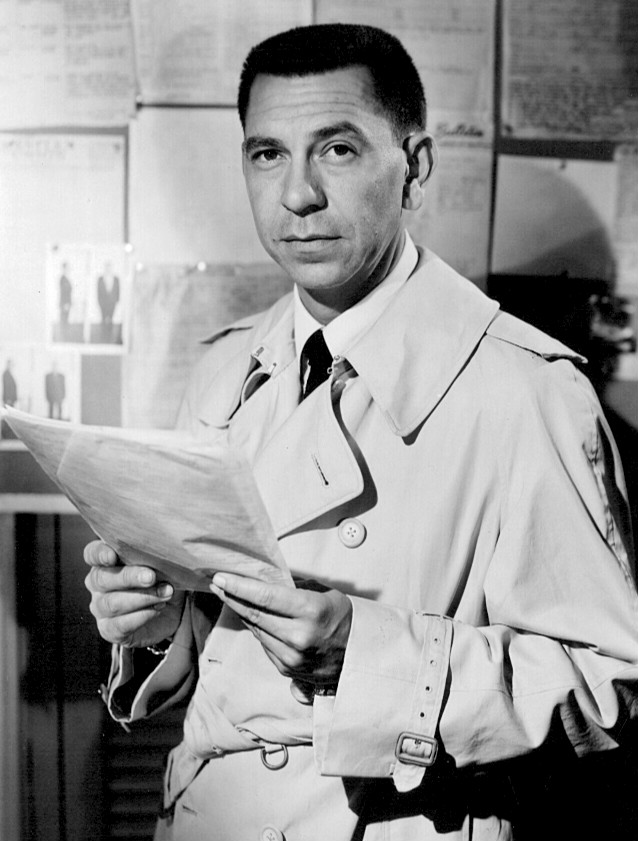
John Randolph Webb (April 2, 1920 – December 23, 1982) was an American actor, television producer, director, and screenwriter, most famous for his role as Joe Friday in the Dragnet franchise, which he created. He was also the founder of his own production company, Mark VII Limited.[1][2]

Key Information

Webb started his career in the 1940s as a radio personality, starring in several radio shows and dramas—including Dragnet, which he created in 1949—before entering television in the 1950s, creating the television adaptation of Dragnet for NBC as well as other series. Throughout the 1960s, Webb worked in both acting and television production, creating Adam-12 in 1968, and in 1970, Webb retired from acting to focus on producing, creating Emergency! in 1972. Webb continued to make television series, and although many of them were less successful and short-lived, he wished to rekindle his prior successes, and had plans to return to acting in a Dragnet revival before he died.

Webb's production style aimed for significant levels of detail and accuracy. Many of his works focused on law enforcement and emergency services in the Los Angeles area, most prominently the Los Angeles Police Department (LAPD), which directly supported the production of Dragnet and Adam-12.

Early life

[edit]

Webb was born in Santa Monica, California, on April 2, 1920, son of Samuel Chester Webb and Margaret (née Smith) Webb.[3][4] He grew up in the Bunker Hill section of Los Angeles. His father left home before Webb was born, and Webb never knew him.[5][failed verification]

In the late 1920s and early 1930s, Webb lived in the parish of Our Lady of Loretto Catholic Church and attended Our Lady of Loretto Elementary School in Echo Park, where he served as an altar boy.[6] He then attended Belmont High School, near downtown Los Angeles, where he was elected student body president. He wrote to Belmont's student body in the 1938 edition of its yearbook, Campanile, "You who showed me the magnificent warmth of friendship which I know, and you know, I will carry with me forever."[7] Webb attended St. John's University, Minnesota, where he studied art.

During World War II, Webb enlisted in the United States Army Air Corps, but he "washed out" of flight training.[3] He later received a hardship discharge because he was the primary financial support for both his mother and grandmother.[8]

Career

[edit]

Acting

[edit]

Following his discharge, Webb moved to San Francisco, where a wartime shortage of announcers led to a temporary appointment to his own radio show on ABC's KGO Radio.[9] The Jack Webb Show was a half-hour comedy that had a limited run on ABC radio in 1946. Prior to that, he had a one-man program, One Out of Seven, on KGO in which he dramatized a news story from the previous week.[3]

By 1949, Webb had abandoned comedy for drama, and starred in Pat Novak, for Hire, a radio show originating from KFRC about a man who worked as an unlicensed private detective. The program co-starred Raymond Burr. Pat Novak was notable for writing that imitated the hardboiled style of such writers as Raymond Chandler, with lines such as: "She drifted into the room like 98 pounds of warm smoke. Her voice was hot and sticky — like a furnace full of marshmallows." Early in 1949, Webb served as the main antagonist of Alan Ladd's protagonist character Dan Holliday in "The Better Man" episode of the radio series Box 13, which aired on January 2, 1949.

Webb's radio shows included Johnny Madero, Pier 23; Jeff Regan, Investigator; Murder and Mr. Malone; Pete Kelly's Blues; and One Out of Seven. Webb provided all of the voices on One Out of Seven, often vigorously attacking racial prejudice.

In 1950, Webb appeared in three films that would become cult classics. In Sunset Boulevard, he is the fiancé of William Holden's love interest Nancy Olson (his performance is very animated and jovial, unlike his later deadpan style). He played a war veteran in Marlon Brando's first feature, The Men, and in the film noir Dark City, he co-starred with Harry Morgan, his future partner on the second Dragnet series.

Webb's most famous motion-picture role was as the combat-hardened Marine Corps drill instructor at Parris Island in the 1957 film The D.I., with Don Dubbins as a callow Marine private. Webb's hard-nosed approach to this role, that of Drill Instructor Technical Sergeant James Moore, would be reflected in much of his later acting, but The D.I. was a box office failure.

Webb was approached to play the role of Vernon Wormer, dean of Faber College, in National Lampoon's Animal House, but he refused, saying "the movie didn't make any damn sense"; John Vernon ultimately played the role.[10]

Dragnet and stardom

[edit]

Webb had a featured role as a crime-lab technician in the 1948 film He Walked by Night, based on the real-life murder of California Highway Patrolman Loren Cornwell Roosevelt, by Erwin Walker.[11] The film was produced in semidocumentary style with technical assistance provided by Detective Sergeant Marty Wynn of the Los Angeles Police Department. He Walked By Night's thinly veiled fictionalized recounting of the 1946 Walker crime spree gave Webb the idea for Dragnet: a recurring series based on real cases from LAPD police files, featuring authentic depictions of the modern police detective, including methods, mannerisms, and technical language.[12]

With much assistance from Wynn and legendary LAPD chief William H. Parker, Dragnet premiered on NBC Radio in 1949 and ran until 1957. It was also picked up as a television series by NBC, which aired episodes each season from 1952 to 1959. Webb played Sgt. Joe Friday and Barton Yarborough co-starred as Sgt. Ben Romero. After Yarborough's death, Ben Alexander joined the cast.[13]

Webb with Harry Morgan in Dragnet 1968

Webb was a stickler for attention to detail. He believed viewers wanted "realism" and tried to give it to them. Webb had tremendous respect for those in law enforcement. He often said, in interviews, that he was angry about the "ridiculous amount" of abuse to which police were subjected by the press and the public. Webb was also impressed by the long hours, the low pay, and the high injury rate among police investigators of the day, particularly in the LAPD, which had by then acquired a notorious reputation for jettisoning officers who had become ill or injured in the line of duty; in Webb's book, The Badge, one of Erwin Walker's victims, LAPD detective Lt. Colin Forbes, was among those whose experiences were so noted.[14]

In announcing his vision of Dragnet, Webb said he intended to perform a service for the police by showing them as low-key working-class heroes. Dragnet moved away from earlier portrayals of the police in shows such as Jeff Regan and Pat Novak, which had often shown them as brutal and even corrupt. Dragnet became a successful television show in 1952. Barton Yarborough died of a heart attack in 1951, after filming only two episodes, and Barney Phillips (Sgt. Ed Jacobs) and Herbert Ellis (Officer Frank Smith) temporarily stepped in as partners. Veteran radio and film actor Ben Alexander took over the role of jovial, burly Officer Frank Smith. Alexander was popular and remained a cast member until the show's cancellation in 1959. In 1954, a full-length feature-film adaptation of the series was released, starring Webb, Alexander, and Richard Boone.

The television version of Dragnet began with this narration by George Fenneman: "Ladies and gentlemen, the story you are about to see is true. The names have been changed to protect the innocent." Webb would intone, "This is the city: Los Angeles, California." He would then make a historical or topical point, describe his duties, his partner, and superior on the episode. The radio series had a similar opening, though Webb, as Friday, did not give a unique Los Angeles-themed opening. Webb then set the plot by describing a typical day and then led into the story. "It was Wednesday, March 19th. It was cool in Los Angeles. I was at headquarters, working narcotics ..." At the end of each show, Fenneman repeated his opening narration, revised to read: "The story you have just seen is true. The names were changed to protect the innocent."

A second announcer, Hal Gibney, usually gave dates when and specific courtrooms where trials were held for the suspects, announcing the trial verdicts after commercial breaks. Many suspects shown to have been found guilty at the end were also shown as having been confined at San Quentin State Prison. Webb frequently recreated entire floors of buildings on sound stages, such as the police headquarters at Los Angeles City Hall and a floor of the Los Angeles Herald Examiner.

During Dragnet's early days, Webb continued to appear in movies, notably as Artie Green, the best friend of William Holden's character in the 1950 Billy Wilder film Sunset Boulevard. The character Green was an assistant director and fiancé to script reader Betty Schaefer (played by Nancy Olson).

In Dark City, Webb played a vicious card sharp and Harry Morgan a punch-drunk ex-fighter, in contrast to the pair's straight-arrow image in the later Dragnet. Also in 1950, Webb appeared in The Men, Marlon Brando's debut film. Both actors played paraplegics undergoing rehabilitation at a veterans' hospital. In a subplot, Webb's character, a cynical intellectual, is fleeced of his life savings by a woman who feigns romantic interest.

In 1951, Webb introduced a short-lived radio series, Pete Kelly's Blues, in an attempt to bring the music he loved to a broader audience. That show became the basis for a 1955 film of the same name. In 1959, a television version was made. Neither was very successful. The character of Pete Kelly was a cornet player who supplemented his income from playing in a nightclub band by working as a private investigator.

1960s

[edit]

From September 1962 through May 1963, Webb was the executive producer of GE True, an anthology series that ran for 33 episodes, each of which Webb acted as host-narrator for while also directing and acting in some episodes.[15][16] At the beginning of June 1963, it was reported that GE True would not continue.[17]

In February 1963, Webb succeeded William T. Orr as executive in charge of Warner Bros. Television, with Orr moving to the motion picture part of Warner Bros.[18] Webb brought about wholesale changes to the ABC/Warner Bros. detective series 77 Sunset Strip retaining only Efrem Zimbalist Jr., in the role of private detective Stuart Bailey.[19] The result was a disaster, and critics accused Webb of being out of touch with the younger generation of viewers.[citation needed]

That same year, Webb sold Temple Houston to NBC. The show, starring Jeffrey Hunter, followed the exploits of Temple Lea Houston, a circuit-riding lawyer and the youngest son of Sam Houston. Despite Webb and Hunter's high profiles, however, it ended after its 26-week run. In a 1965 interview with The Milwaukee Journal, Hunter described the situation:

In the first place, we had no time to prepare for [the series]. I was notified on July 17 to be ready to start August 7 for an October air date. When we reached the screen we did not have a single segment ready. It was done so fast the writers never got a chance to know what it was all about. We all wanted to follow the line indicated by the pilot film, which we thought would make a charming series. NBC, however, favored making it serious.[20]

Webb's role with Warner ended in December 1963.[21]

1967: Dragnet returns

[edit]
Jack Webb and Walter Strenge on the set of Dragnet, 1966

Shortly after leaving his position at Warner Bros., he first attempted to produce an adaptation of the Selena Mead books by Patricia McGerr for CBS,[22] then Webb teamed with Universal Television to begin work on a new Dragnet series.[23] A pilot television film, based on the Harvey Glatman serial killings, was produced in 1966 for NBC, with Webb's Sgt. Joe Friday joined by Harry Morgan as Officer Bill Gannon. Webb had tried to get Ben Alexander to reprise his role as Frank Smith, but Alexander would not leave the ABC series Felony Squad.

The new Dragnet premiered as a midseason replacement series on January 12, 1967, and aired until April 16, 1970. To distinguish it from the original series, the year of production was added to the title (Dragnet 1967, Dragnet 1968, etc.). The revival emphasized crime prevention and outreach to the public. Its attempts to address the contemporary youth-drug culture (such as the revival's first episode, "The LSD Story", guest-starring Michael Burns as Benjamin John "Blue Boy" Carver, voted 85th-best TV episode of all time by TV Guide and TV Land) have led certain episodes on the topic to achieve cult status due to their strained attempts to be "with-it", such as Joe Friday grilling "Blue Boy" by asking him, "You're pretty high and far out, aren't you? What kind of kick are you on, son?" Don Dubbins, who had acted alongside Webb in The D.I. in 1957, was featured in the second Dragnet 1967 episode, "The Big Explosion," and was another featured actor in Mark VII Limited programs beginning in the 1960s. Other Webb-affiliated actors featured in the revived series many times in different roles were Virginia Gregg, Peggy Webber, Clark Howat, Olan Soule, Bobby Troup, Tim Donnelly, and Marco Lopez.

In 1968, Webb and his production partner R.A. Cinader launched Adam-12 on NBC. A spinoff of Dragnet, Adam-12 starred Martin Milner and Kent McCord as a pair of LAPD officers, and followed their escapades while on patrol. Running until 1975 for a total of seven seasons, Adam-12 was Webb's second-longest running television series, with the eight seasons recorded by the original Dragnet being the longest.

Also in 1968, Webb and Johnny Carson performed a sketch on The Tonight Show that has since become known as the "Copper Clapper Caper" sketch. Webb, in character as Joe Friday, was working on the case of a robbery at a school-bell factory. Carson played the owner of the factory and victim of the theft, which consisted of each bell being relieved of its clapper (the device that makes the bell ring). The sketch's dialogue consisted of Webb and Carson discussing the situation in deadpan style and using alliteration and tongue twisters to describe the incident, each word having either a "c" or "cl" sound at the beginning. Both Webb and Carson tried desperately not to lose composure, but both did, near the end of the sketch.[24]

1970s and 1980s

[edit]
Jack Webb with first wife Julie London and daughters Stacy and Lisa, 1953

In 1970, Webb decided to bring an end to Dragnet and cease acting to focus on expanding Mark VII Limited's production profile.[citation needed] In 1971, Webb entered the world of district attorneys and federal government work with two series. The first, The D.A., starred Robert Conrad and Harry Morgan as a pair of Los Angeles County ADAs, with Conrad playing a junior ADA and Morgan his superior. The second, O'Hara, United States Treasury, was a co-production of Webb and David Janssen, the former star of The Fugitive and future star of Harry O, for CBS (a rare non-NBC Mark VII effort) and featured Janssen as a Nebraska county sheriff-turned-United States Treasury Department agent. Neither series lasted very long, as The D.A., Webb's last 30-minute series, was cancelled after 15 episodes and O'Hara ended after 22.[citation needed]

Later in the 1971–72 season, Webb and Cinader launched Emergency!, which focused on the fictional Station 51 Rescue Squad of the L.A. County Fire Department, and its work in coordination with the emergency department staff of the fictional Rampart General Hospital. LACoFD's paramedic program was among the first paramedic services in the United States.[25] Webb cast his ex-wife, Julie London, as well as her second husband and Dragnet ensemble player Bobby Troup, as Rampart's Chief Nurse of The Emergency Room, Dixie McCall and Dr. Joe Early, respectively, with Randolph Mantooth and Kevin Tighe playing paramedics, John Gage and Roy DeSoto and Robert Fuller playing Dr. Kelly Brackett, Rampart's Chief of Emergency Medicine.

Emergency! ran as part of NBC's Saturday-night lineup for six entire seasons, and it was a hugely popular series, sometimes winning its time slot against CBS's popular Saturday-night comedy block, which included All in the Family.[citation needed] The series came to an end in 1977, but it spawned a series of telefilms that ran until 1979.[citation needed] Webb's company and Universal also contracted with animator Fred Calvert to produce a spin-off Saturday-morning cartoon show for NBC titled Emergency +4, which ran for three seasons (the last in reruns) and featured the paramedics Gage and DeSoto assisted by four youngsters and their three pets.[26] The franchise was also credited in performing a social good in easing acceptance of the emergency medical service and encouraging communities to establish the service locally.[27]

Emergency! was Webb's last sustained success. Of the remaining series his company produced, the only two that lasted longer than one season were Hec Ramsey, a two-season component of the NBC Mystery Movie wheel series that featured former Have Gun – Will Travel star Richard Boone as a pioneering forensic scientist in the Old West,[citation needed] and Project UFO, an anthology based on the investigations into UFOs as compiled by Project Bluebook that also ran for two seasons beginning in 1978. In 1977, he quit Universal Studios, and set up Mark VII Limited independently, signing a distribution deal with Worldvision Enterprises, and set up offices in the Samuel Goldwyn Studios.[28]

Despite his string of short-lived series in the late 1970s, Webb still kept trying to recapture his previous success and decided to bring Dragnet back to television for a third series in 1982. Departing from the original format (with Harry Morgan tied up with his commitments to M*A*S*H, and its already greenlit followup AfterMASH), Webb decided he would not appear in the series as Sgt. Joe Friday (other than in voice over), and approached former Adam-12 stars Martin Milner and Kent McCord (who had several guest appearances early in the 1967 revival series) to reprise their roles as now-detectives Malloy and Reed in the updated Dragnet series.[29] Days after speaking with McCord about the project, on December 23, 1982, Webb died unexpectedly from a heart attack and the Dragnet revival was scrapped.

In 1987, Dan Aykroyd and Tom Hanks starred in a movie parody (and homage) to Webb, titled Dragnet, along with Harry Morgan, who reprised his role from the television series as Bill Gannon, who had by now become a captain of detectives. The comedy film was written and directed by Tom Mankiewicz, in his directorial debut. Aykroyd played the role of Joe Friday, described as the namesake nephew of the original series lead, while Hanks co-starred as Detective Officer Pep Streebeck, Friday's new smart-alecky and streetwise partner.[citation needed]

Personal life

[edit]

Webb's personal life was better defined by his love of jazz than his interest in police work. He had a collection of more than 6,000 jazz recordings.[3] Webb's own recordings reached cult status, including his deadpan delivery of "Try A Little Tenderness".[30] His lifelong interest in the cornet allowed him to move easily in the jazz culture, where he met singer and actress Julie London. They married in 1947 and had daughters Stacy and Lisa. They divorced in 1954.[31] He was married three more times after that, to Dorothy Towne for two years beginning in 1955, to former Miss USA Jackie Loughery for six years beginning in 1958, and to his longtime associate, Opal Wright, for the last two years of his life.[citation needed]

The grave of Jack Webb at Forest Lawn Memorial Park Cemetery, in the Hollywood Hills

Stacy Webb authorized and collaborated on a book, Just the Facts, Ma'am: The Authorized Biography of Jack Webb, Creator of Dragnet, Adam-12, and Emergency!, of which Daniel Moyer and Eugene Alvarez were the primary authors. It was published in 1999. Stacy did not live to see the publication of the book, having been killed in a collision with a California Highway Patrol vehicle three years earlier.[32]

Death

[edit]

Webb died of an apparent heart attack in the early morning hours of December 23, 1982, at age 62.[5] He is interred at Sheltering Hills Plot 1999, Forest Lawn, Hollywood Hills Cemetery in Los Angeles, and was given a funeral with full Los Angeles police honors.[33] On Webb's death, Chief Daryl Gates announced that badge number 714, which was used by Joe Friday in Dragnet, would be retired.[34] Los Angeles Mayor Tom Bradley ordered all flags lowered to half staff in Webb's honor for a day, and Webb was buried with a replica LAPD badge bearing the rank of sergeant and the number 714.[citation needed]

Legacy

[edit]

Webb has two stars on the Hollywood Walk of Fame, one for radio (at 7040 Hollywood Boulevard) and the other for television (at 6728 Hollywood Boulevard). In 1992, Webb was posthumously inducted into the Television Hall of Fame.[35]

Filmography

[edit]

Film

[edit]
Year Title Role Notes
1932 Three on a Match Boy in schoolyard Uncredited
1948 Hollow Triumph Bullseye Uncredited
He Walked by Night Lee
1949 Sword in the Desert Hoffman Uncredited
1950 Appointment with Danger Joe Regas
The Men Norm Alternative title: Battle Stripe; Marlon Brando's film debut
Sunset Boulevard Artie Green
Dark City Augie
1951 Halls of Montezuma Correspondent Dickerman
You're in the Navy Now Ens. Anthony "Tony" Barbo Alternative title: U.S.S. Teakettle
1954 Dragnet Sgt. Joe Friday Also director
1955 Pete Kelly's Blues Pete Kelly Also director and producer
1957 The D.I. Technical Sgt. Jim Moore Also director and producer
1957 Red Nightmare Narrator Also producer. Educational short film made for the United States Armed Forces.
1959 -30- Sam Gatlin Also director and producer
1961 The Last Time I Saw Archie William "Bill" Bowers Also director and producer
1967 Greyhounds of the Sea Narrator United States Navy (final role)

Television

[edit]
Year Title Role Notes
1951–1959 Dragnet Sergeant Joe Friday 276 episodes
1956–1957 Noah's Ark Creator of the series starring Paul Burke 24 episodes
1962–1963 GE True Host-narrator† 33 episodes; Executive Producer, Director (4 episodes)
1967–1970 Dragnet 1967 Sergeant Joe Friday 98 episodes
1968–1975 Adam-12
174 episodes; Co-Creator, Executive Producer, Writer
1971 O'Hara, U.S. Treasury Narrator 1 episode
The Partners The Commissioner 1 episode
1972–1976 Emergency!
Creator, Executive Producer, Director (5 episodes)
1972–1974 Hec Ramsey
Producer, 10 episodes
1978 Project UFO Announcer 1 episode, (final appearance)

† Webb also starred in the GE True two-part episode "Code Name: Christopher"

Discography

[edit]
  • Songs from Pete Kelly's Blues (1955)
  • You're My Girl: Romantic Reflections by Jack Webb (1958)
  • Pete Kelly Lets His Hair Down (1958)[36]
  • Golden Throats volume 1 (1988)
  • Just the Tracks, Ma'am: The Warner Brothers Recordings (2000)[37]

References

[edit]

Further reading

[edit]
[edit]
Revisions and contributorsEdit on WikipediaRead on Wikipedia
from Grokipedia
John Randolph Webb (April 2, 1920 – December 23, 1982), professionally known as Jack Webb, was an American actor, producer, director, and screenwriter renowned for creating and portraying the stoic sergeant in the groundbreaking series Dragnet. Born in , Webb rose from radio announcing and bit film roles to pioneer realistic depictions of law enforcement, emphasizing factual accuracy derived from consultations with actual police officers. His signature catchphrase, "Just the facts, ma'am," encapsulated the show's commitment to procedural detail over sensationalism, influencing generations of crime dramas. Webb's Dragnet originated on radio in 1949 before transitioning to television from 1951 to 1959, and revived under his production from 1967 to 1970, achieving massive popularity and critical acclaim for its documentary-style narrative and innovative use of . Beyond Dragnet, he produced and directed other influential series such as and Emergency!, which similarly prioritized authentic portrayals of public safety professionals and contributed to public respect for police and emergency services. A staunch supporter of , Webb's works often reflected a pro-police perspective, drawing from real LAPD cases to underscore the challenges faced by officers, though critics later viewed them as overly sympathetic to institutional authority. His rigorous production methods, including meticulous scripting and on-location shooting, set standards for television realism. Webb's personal life included marriages to singer and actress , and a deep passion for jazz music, amassing a collection of over 6,000 records. Despite health warnings, his intense —fueled by chili dogs, cigarettes, and long hours—led to a fatal heart attack at age 62, just as he planned a Dragnet revival. Posthumously honored with dual stars on the for radio and , Webb's legacy endures as a shaper of the modern police genre, blending entertainment with empirical fidelity to real-world policing.

Early Life

Childhood and Family Background

John Randolph Webb was born on April 2, 1920, in , to Samuel Chester Webb and Margaret Smith Webb. His father, who was Jewish and reportedly a veteran, abandoned the family prior to his birth, leaving Webb with no personal knowledge or relationship with him. Margaret Smith, of Irish and Native American descent, raised Webb as a single mother in the Roman Catholic faith, supporting the household through various means including operating a in the impoverished Bunker Hill neighborhood of . Webb's early years were marked by financial hardship in the working-class Bunker Hill area, a once-affluent district that had declined into by the and , where his family resided in modest conditions amid economic instability. His mother's remarriage provided limited stability, but the household remained strained, with Webb later recalling a childhood shaped by maternal resilience and the absence of paternal influence. This environment instilled in him an early appreciation for self-reliance, though specific details of siblings or dynamics remain sparsely documented in primary accounts. The family's Roman Catholic upbringing exposed Webb to parochial education and community ties, contrasting with the secular pursuits he would later embrace, but no verified records indicate early familial involvement in or media.

Initial Interests in Entertainment and Radio

Webb's fascination with emerged during his adolescence in , where he developed a strong interest in music after exposure to an ex- who boarded at his mother's rooming house in the Bunker Hill neighborhood. This passion for , which he pursued lifelong and later incorporated into projects like the radio series Pete Kelly's Blues, aligned with his growing intrigue in as a burgeoning medium. As a student at Belmont High School in the late , Webb joined the school's radio club, honing basic skills in announcement and production while also contributing cartoons to the student newspaper, reflecting an early creative bent toward performance and media. Following a hardship discharge from the U.S. Army Air Forces in early 1945 after wartime service that included staging for troops via the , Webb relocated to to capitalize on postwar demand for radio talent. He secured his first professional role as a radio and at ABC affiliate KGO, where he hosted The Coffee Club, a program featuring records and introductions of emerging artists, leveraging his personal enthusiasm for the genre. This marked his entry into as a performer, blending music commentary with on-air presence, before expanding into scripted formats. By , Webb's radio work proliferated on the ABC network, including a short-lived half-hour series titled The Jack Webb Show, which showcased his versatility in humor and ad-libbing amid the network's expansion. These early broadcasts, often freelance and voice-heavy, built his reputation in the medium, transitioning from musical interests to dramatic acting in shows like Pat Novak for Hire by late 1946, though his foundational draw remained radio's potential for authentic storytelling rooted in real-life inspirations.

Career

Radio Career and Early Productions

Webb entered radio in the mid-1940s as a part-time and on West Coast stations before securing his first full-time role at San Francisco's KGO, where he hosted , a morning program that highlighted emerging musical acts reflective of his personal interest in the genre. During this period, he also produced early news dramatizations such as One Out of Seven on KGO, experimenting with realistic audio techniques that foreshadowed his later procedural style. In 1946, Webb transitioned to scripted drama with The Jack Webb Show, a short-lived series, and starred as the titular hard-boiled in Pat Novak for Hire, a local ABC West Coast Network production running from 1946 to 1947, co-written by Webb and known for its fast-paced, witty banter and San Francisco dockside setting. The series aired weekly episodes emphasizing Novak's reluctant involvement in s while operating a pier rental business, establishing Webb's signature terse narration and sound-effect-driven storytelling. Building on this, Webb led Johnny Madero, Pier 23 on Mutual from April 24, 1947, to September 4, 1947, portraying a waterfront informant entangled in mysteries, in a 30-minute format that aired Thursdays at 8 p.m. and concluded after roughly 20 episodes due to limited sponsorship. He followed with Jeff Regan, Investigator on CBS starting July 1948, voicing a Los Angeles-based operative for the fictional International Detective Bureau earning $10 daily plus expenses, in one of his earliest national broadcasts that ran through 1950 and featured 26 initial episodes under his tenure. These productions, often self-contained and noir-influenced, honed Webb's directorial approach, including on-air effects and minimalistic plots, while he concurrently contributed to Armed Forces Radio programming.

Creation and Success of Dragnet on Radio

Jack Webb developed Dragnet as a groundbreaking radio series, drawing directly from authentic (LAPD) case files to ensure realism amid a landscape of melodramatic . His collaboration with LAPD Marty provided access to these records, allowing Webb—who wrote, directed, and starred as the no-nonsense —to craft episodes focused on methodical investigation rather than heroics or glamour. The show's signature elements included terse, documentary-style narration, the recurring directive "Just the facts," and Walter Schumann's ominous four-note theme, all reinforcing a commitment to procedural authenticity. Dragnet debuted on Radio on June 3, 1949, initially as an unsponsored production funded by Webb himself, which allowed creative control but limited initial promotion. Early episodes featured Friday partnered with Officer Ben Romero (), whose death in 1951 led to successors like as Officer Frank Smith. Original scripts aired weekly through September 1955, followed by reruns until the series concluded on July 26, 1957, totaling hundreds of episodes that chronicled routine crimes from narcotics trafficking to homicides. The program built a loyal audience through its unvarnished depiction of police work, contrasting with escapist radio fare and appealing to listeners valuing empirical detail over narrative embellishment. By 1952, it held a solid 8.7 rating, ranking 14th overall despite television's rise, and remained NBC's highest-rated dramatic series into 1955. This endurance—spanning eight years and paralleling the 1951 television launch—demonstrated its resonance, as Webb's insistence on LAPD-vetted accuracy fostered public trust in law enforcement portrayals, though initial ratings reflected modest rather than explosive growth. The radio success solidified Dragnet's formula, influencing subsequent media and establishing Webb's reputation for procedural rigor.

Transition to Film and Acting Roles

Webb's entry into film acting occurred in 1948 with a supporting role as crime laboratory technician Lee Rawlings in the semi-documentary He Walked by Night, directed by Alfred L. Werker and an uncredited Robert Florey. The film, based on the real-life 1946 murder spree of Erwin Walker, featured consultations with (LAPD) experts, exposing Webb to authentic forensic procedures and law enforcement operations that directly influenced his development of the radio series Dragnet. This role marked his shift from radio exclusivity, where he had gained prominence through programs like Pat Novak for Hire (1946–1949), to on-screen performances, leveraging his distinctive delivery and interest in procedural realism. Building on this debut, Webb secured several film roles in 1950 amid continued radio commitments. He portrayed a in Billy Wilder's noir classic Sunset Boulevard, appearing alongside and in scenes emphasizing Hollywood's underbelly. In the same year, he played Norm, a paraplegic war veteran and friend to the lead character portrayed by , in Fred Zinnemann's drama The Men, which drew from real rehabilitation experiences at Birmingham Army Hospital. Additionally, Webb co-starred as a gambling house operator opposite and future Dragnet colleague in the film noir Dark City. These parts, often in , noir, or veteran-themed narratives, honed his acting range while aligning with his affinity for gritty, fact-based stories, facilitating a smoother integration of radio-honed skills into visual media. By 1951, as Dragnet transitioned from radio success to television preparation, Webb's film work expanded with roles such as a Treasury agent in , a Paramount production starring , and a Marine in the war epic Halls of Montezuma. These appearances, totaling over a dozen credits by mid-decade, provided financial stability and visibility, allowing Webb to produce and star in Dragnet's TV adaptation premiering December 16, 1951, on . His film experience underscored a preference for authentic portrayals over dramatic flair, as evidenced by consultations with LAPD —the namesake character—reinforcing his commitment to procedural accuracy over sensationalism. This phase solidified Webb's dual identity as and , bridging radio's audio realism with film's visual demands.

Dragnet on Television and Peak Stardom

Dragnet transitioned to television on , 1951, with its premiere episode "The Human Bomb" on , adapting the radio format into a visual starring Jack Webb as Sergeant . The series emphasized documentary-style realism, drawing from actual (LAPD) case files provided through Webb's collaboration with Chief of Police William H. Parker, which included on-location filming and authentic procedures to differentiate it from sensationalized crime dramas. Over eight seasons, it produced 276 episodes, maintaining a top-10 Nielsen rating position through 1956 and establishing Webb as a pioneering figure in the genre. Webb served as , director for many episodes, and , exerting tight control over production to ensure factual accuracy, such as using verbatim police jargon and minimal dramatic embellishment. This approach resonated with audiences seeking grounded depictions of , contributing to the show's cultural impact, including the iconic "Just the facts, ma'am," though often misquoted from actual dialogue variations. By the mid-1950s, Dragnet's success elevated Webb to peak stardom, with the series syndicating as Badge 714 and influencing subsequent police shows through its procedural template. Webb voluntarily ended the original run in 1959 after 276 episodes, citing creative fatigue, before reviving it in color as Dragnet 1967, premiering January 12, 1967, on with as Officer Bill Gannon. The revival spanned four seasons and 96 episodes, adapting to social changes like and civil unrest while retaining the core emphasis on methodical investigation and law-and-order themes. This period solidified Webb's status as television's preeminent police , though ratings declined compared to the original, leading to cancellation in 1970. His multifaceted role in both iterations underscored a commitment to over spectacle, earning Emmy nominations for acting in 1954 and 1955.

Other Television Productions and Mark VII Ventures

, originally incorporated as Mark VII Productions in 1951, served as Jack Webb's independent production entity, focusing on scripted television content that emphasized factual procedural elements drawn from real-life consultations with professionals in , , and . The company's distinctive closing logo, featuring animated smoke rings forming the Roman numeral VII, became synonymous with Webb's output and appeared on numerous series through the . While Dragnet anchored its early success, Mark VII diversified into anthology formats, character-driven dramas, and public-information vehicles, often co-produced with networks like and or studios such as , reflecting Webb's commitment to authentic depictions over . The company remained active until Webb's death in 1982, after which rights to its library passed to his estate, with distribution handled by entities like . Among Mark VII's early non-Dragnet efforts was (1956–1957), a 30-minute anthology series hosted by Webb that dramatized true animal rescue stories in collaboration with the Los Angeles Humane Society, blending narrative segments with live pet adoptions to promote compassion for strays. This was followed by The D.A.'s Man (1959), a short-lived ABC crime drama starring Webb as a Los Angeles investigator, which drew on actual case files for its episodic structure but struggled with low ratings and ended after 26 episodes. Also in 1959, Mark VII adapted Webb's own jazz-era property into Pete Kelly's Blues, a 13-episode series set in Kansas City speakeasies, featuring Webb voicing the lead role posthumously after the character's film iteration, though it prioritized atmospheric music over plot innovation and failed to gain traction. The 1960s saw Mark VII pivot to anthology and pilot formats, including contributions to G.E. True (1961–1962), a dramatization of General Electric-sponsored real events, and the short-run Temple Houston (1963–1964), a Western legal on starring as a historical attorney, which incorporated realism but was canceled mid-season due to network shifts. By the late , the company achieved broader hits with police procedurals like (1968–1975), an series co-created with R.A. Cinader and starring and as LAPD officers, which aired 174 episodes by emphasizing routine patrol duties informed by department advisors and topped ratings in its demographic. Similarly, O'Hara, U.S. Treasury (1971–1972) on followed a Treasury agent played by in hunts, running for 22 episodes with a focus on federal investigative techniques. Mark VII's most enduring successes came in the 1970s with emergency services themes, exemplified by Emergency! (1972–1977, extended to 1979 in specials), an drama co-produced with Universal that depicted County paramedics and firefighters, starring and , and consulted medical experts for accuracy, amassing 122 episodes plus pilots and influencing real-world EMS protocols through its public education segments. Other notable entries included The D.A. (1971–1972), a Robert Conrad-led prosecutor series canceled after 15 episodes amid scheduling woes; (1972–1974), a Western spin-off from featuring as a 1900s forensics pioneer; and Chase (1973–1974), an ABC fugitive-hunt drama with that lasted one season of 23 episodes. These productions collectively underscored Webb's formula of consulting authorities for verisimilitude, though some critics noted formulaic repetition across the slate; Mark VII's output totaled over a dozen series, prioritizing instructional value in civic roles over entertainment novelty.

Later Career Challenges and Projects

In the 1970s, following the end of the Dragnet revival in 1970, Webb shifted his focus exclusively to production under , retiring from on-screen acting to oversee an expanding slate of procedural dramas. This period saw the launch of Emergency!, a medical rescue series co-developed with , which premiered on in January 1972 and ran for six seasons until 1977, achieving high ratings and cultural impact by depicting operations with input from personnel. The show's success, averaging over 20 million viewers per episode in its early years, demonstrated Webb's continued ability to blend documentary-style realism with dramatic tension, though it marked a departure from his police-focused narratives. Subsequent projects faced greater hurdles, reflecting broader industry shifts toward more sensational formats amid declining interest in Webb's austere, fact-driven style. In 1978, Mark VII produced , a 13-episode series dramatizing declassified U.S. investigations from , with Webb providing uncredited narration to maintain a tone of investigative sobriety akin to Dragnet. Despite drawing from authentic witness reports and government files, the program struggled with low ratings and was canceled after one season, highlighting challenges in adapting Webb's procedural rigor to speculative topics like unidentified flying objects without alien . Other late efforts, including pilots and short-lived ventures, similarly underperformed, as Mark VII grappled with a television landscape favoring faster-paced, less meticulous storytelling. Webb's personal health deterioration compounded professional strains, exacerbated by his lifelong heavy —up to three packs daily—and a history of from childhood. These factors contributed to cardiovascular strain, culminating in his death from a heart attack on December 23, 1982, at age 62 in his home, just as he sought to sustain Mark VII's output. Despite these setbacks, Webb's insistence on empirical accuracy in productions preserved Mark VII's solvency until his passing, influencing later procedural genres even as his formula waned in popularity.

Political Views and Public Stance

Alignment with Law Enforcement

Jack Webb forged a deep alignment with through meticulous collaboration with the (LAPD) to ensure procedural authenticity in his productions. For Dragnet, he invested countless hours riding with officers and observing operations, while attending classes at the LAPD to grasp investigative techniques and terminology. This stemmed from his early work on the 1948 film He Walked by Night, where he partnered with LAPD Sergeant Marty Wynn, whose real-case insights directly inspired the radio series' format. The LAPD formally endorsed Dragnet upon its 1949 radio debut, marking the start of a sustained partnership that extended to television adaptations and subsequent shows like . Webb routinely consulted active-duty officers for script accuracy, replicating details such as station layouts and designs, which garnered departmental appreciation over nearly two decades. In recognition, LAPD Chief Thomas Reddin gifted Webb the original number 714 in 1968—a number synonymous with Sgt. —declaring it a symbol of gratitude for contributions dating to Dragnet's inception, with the badge reserved exclusively for him thereafter. Webb's advocacy extended to public defenses of police integrity amid growing scrutiny. In the 1967 Dragnet episode "The Big Interrogation," he delivered the monologue "What is a Cop?", portraying officers as selfless guardians enduring thankless risks to uphold community safety, countering narratives of cynicism or abuse. This reflected his broader ethos, as his portrayals influenced global perceptions and recruitment, evidenced by the LAPD Museum's annual Jack Webb Awards, which honor exemplars in reserve service and historical preservation in his name.

Anti-Communist Activities and Conservatism

Webb participated in anti-communist efforts through documentary-style films and television content during the . In 1962, he narrated Red Nightmare (originally titled Freedom and You), a produced for the U.S. Department of Defense under the Kennedy administration, which portrayed a suburban American awakening to a communist-controlled town where freedoms were systematically eroded through , , and . The production, directed by at , was distributed to schools, military bases, and civic groups to illustrate the mechanics of communist infiltration, including of youth and suppression of . In the , Webb narrated additional anti-communist shorts, such as one depicting an American waking in a Soviet-dominated society to underscore the loss of individual liberties and the infiltration of unions by communist agents. His radio and early television series Dragnet (airing from 1949 on radio and 1951–1959 on TV) incorporated episodes based on real cases involving communist subversives, portraying them as threats to through and ideological recruitment. Webb's emphasized law-and-order values, , and resistance to cultural shifts. He revived Dragnet for television in 1967 amid rising social unrest, using the series—alongside spin-offs like (1968–1975)—to depict police proceduralism and moral discipline as bulwarks against , drugs, and countercultural influences, which he regarded as destructive to societal stability. This alignment resonated with audiences favoring traditional authority, contributing to the shows' popularity during an era of conservative backlash against . A close friend of , Webb proposed in 1982 a Dragnet-style television series focused on the , offering agency collaboration including content veto rights to highlight its "patriotic role" and "high moral standards" against prevailing media criticisms. The initiative, pitched via Reagan administration channels, aimed to counter anti-intelligence narratives but ended with Webb's death in December 1982.

Responses to Social Unrest

In the wake of the 1965 , which exposed tensions between the (LAPD) and minority communities, Jack Webb revived the Dragnet television series in January 1967 with the LAPD's endorsement, positioning it as a counter to negative perceptions of amid escalating civil disturbances. The production emphasized procedural realism drawn from actual LAPD cases, aiming to depict officers as professional guardians of order rather than aggressors, even as critics later contended that this approach downplayed documented instances of during unrest. The revived Dragnet (1967–1970) directly engaged with 1960s countercultural unrest through episodes targeting youth rebellion, drug experimentation, and anti-authority sentiments, portraying these as precursors to crime and societal decay. For example, the November 2, 1967, episode "The Big High" illustrated the dangers of marijuana use by showing neglectful users causing a child's accidental death, aligning with Webb's view of counterculture as a transient threat to be depicted unflatteringly to deter emulation. Episodes frequently cast hippies and protesters as misguided or criminal, contrasting sharply with the era's rising crime rates and protests, which Webb attributed to moral laxity rather than systemic inequities. Following 's assassination on April 4, 1968, which sparked riots in over 100 U.S. cities, a Dragnet episode focused on the LAPD's proactive measures to maintain calm in , crediting disciplined policing for averting widespread violence despite national turmoil. Similarly, the September 19, 1968, episode featured Sergeant rebutting charges of LAPD and brutality on a fictional debate program, arguing that officer shootings followed strict protocols and that hiring reflected merit over quotas, thereby defending institutional integrity against activist critiques rooted in events like Watts. Webb's productions, informed by his longstanding LAPD consultations, prioritized narratives of restraint and accountability—such as episodes where mediated racial disputes during traffic stops—over explorations of underlying grievances, reflecting his conviction that factual depictions of police work would foster public trust amid unrest. This stance, while praised by law enforcement supporters for countering sensationalized media portrayals, drew retrospective accusations of sanitizing reality, as the series rarely interrogated command failures or community alienation documented in official commissions.

Controversies

Criticisms of LAPD Collaboration

Jack Webb's collaboration with the (LAPD) for Dragnet involved extensive consultation with officers, use of real but sanitized case files, and script approval by the LAPD's Public Information Division to ensure procedural accuracy and avoid negative depictions of the department. This partnership, initiated in the late 1940s under Chief William H. Parker, allowed Webb access to authentic details but drew accusations of producing material that obscured departmental flaws. Critics contended that the show's emphasis on meticulous, apolitical detective work ignored LAPD's history of racial bias and excessive force, particularly against minorities in Los Angeles' Black and Latino communities. For instance, during the 1943 and subsequent decades of discriminatory practices, Dragnet portrayed an integrated force handling cases impartially, without addressing enforcement disparities documented in contemporary reports. This idealized narrative persisted into the , even as events like the 1965 —sparked by LAPD arrests and resulting in 34 deaths and over 1,000 injuries—highlighted tensions the series omitted. Journalists and media analysts later described Dragnet as contributing to a "PR coup" for law enforcement by fostering public trust in police efficiency while downplaying corruption scandals, such as those under Parker's tenure involving unchecked authority and informant abuses. In the 1968–1969 season, following Martin Luther King Jr.'s assassination and amid rising scrutiny, Webb introduced minor storylines with Black officers and victims, but detractors viewed these as superficial efforts to counter perceptions of whitewashing rather than substantive critique. By the 1990s, reflections on events like the 1991 Rodney King beating contrasted Dragnet's "just the facts" ethos with LAPD's real-world accountability failures, amplifying claims that Webb's work had entrenched a mythic, uncritical view of policing.

Accusations of Bias in Portrayals

Critics of Webb's work, particularly Dragnet, have accused the series of embedding a pro-police that portrayed as uniformly competent and moral, while minimizing documented LAPD misconduct, including excessive force against minorities during the 1950s and 1960s. This perspective gained traction retrospectively, with analysts arguing that Webb's close collaboration with LAPD Chief William H. Parker—who himself faced allegations of racial insensitivity and —transformed the show into a tool that obscured brutality and reinforced an idealized, depoliticized image of policing amid rising civil rights tensions. Portrayals of suspects and social deviants in Dragnet episodes drew specific charges of conservative ideological slant, often depicting criminals as isolated moral failures rather than products of systemic issues, and framing countercultural elements like hippies or protesters as threats to order without nuance. For instance, the 1960s revival addressed urban unrest and from a law-and-order viewpoint, which some viewed as dismissive of underlying grievances, contributing to accusations that the series whitewashed LAPD's handling of racial dynamics in a department criticized for discriminatory practices. Later critiques have termed this "copaganda," claiming distorted depictions of and minority communities by emphasizing procedural triumphs over critiques of institutional bias or disproportionate policing. These accusations intensified in the 2020s amid national debates on policing, with commentators linking Dragnet's formula—insisting on "just the facts" without exploring officer accountability—to a legacy of public misperception about crime causation and flaws. Such views, often from progressive media outlets, contrast with contemporaneous reception, where the show's realism was praised for grounding viewers in empirical casework over .

Defenses Based on Procedural Realism

Jack Webb defended Dragnet's portrayals against accusations of pro-police bias by emphasizing the series' strict adherence to authentic Los Angeles Police Department (LAPD) procedures, derived directly from real case files and consultations with officers. To ensure accuracy, Webb compensated LAPD personnel $100 per episode idea drawn from actual investigations, incorporating details such as forensic evidence evaluation, witness interviews, and chain-of-custody protocols for building prosecutable cases. This approach extended to set design, where police stations and official documents like rap sheets were replicated faithfully, and scripts were reviewed by the LAPD's Office of Public Information to align with departmental practices. Technical advisors, including LAPD Sergeant Dan Cook, were on set to verify procedural fidelity, resulting in episodes that highlighted routine investigative challenges, such as inconsistent eyewitness accounts and the limitations of confessions without corroboration, as depicted in the 1954 episode "The Big False Make." The LAPD itself endorsed Dragnet as an accurate reflection of its methods, estimating the show's execution as 99% truthful in concept and operations, countering claims of undue favoritism by showcasing the bureaucratic constraints and evidence-based rigor required in real policing. Webb's methodology, influenced by his consultations with LAPD Sergeant Marty Wynn during the 1948 film He Walked by Night, prioritized linear, procedure-driven narratives over dramatic embellishments, portraying officers as methodical technicians reliant on scientific crime lab analysis—often featuring real LAPD experts like Ray Pinker—rather than intuitive heroes. This realism underscored that resolutions stemmed from adherence to protocol, not arbitrary authority, thereby defending the series against bias allegations by illustrating the system's self-imposed limitations and the infrequency of firearm use in actual police careers (estimated at under 25% of officers ever discharging weapons). In response to contemporary criticisms, particularly during the social unrest, later Dragnet episodes (1968–1969) incorporated defenses of procedural integrity, such as addressing LAPD of minorities and refuting charges of systemic bigotry through fact-based narratives grounded in departmental . Critics who labeled the show as LAPD often overlooked this commitment to verifiable procedures, which Webb maintained elevated public understanding of 's operational realities over . The approach not only withstood scrutiny from insiders but also established a benchmark for the police procedural genre, influencing subsequent series by demonstrating that fidelity to process inherently balanced portrayals without requiring narrative concessions to external viewpoints.

Personal Life

Marriages and Relationships

Jack Webb was married four times. His first marriage was to singer and actress Julie London on July 21, 1947; the couple had two daughters, Stacey and Lisa, before divorcing in 1954. Despite the divorce, Webb and London maintained a close professional relationship, with Webb casting her in roles on his television series Emergency! alongside her second husband, Bobby Troup. Webb's second marriage was to actress Dorothy Towne in January 1955, which ended in divorce in 1957. His third marriage, to actress in June 1958, lasted until 1964 and produced no children. Webb's final marriage was to Opal Wright on December 30, 1980, shortly after he suffered a heart attack; Wright remained his wife until his death in 1982. No additional significant relationships beyond these marriages are documented in primary biographical accounts.

Family and Children

Jack Webb had two daughters from his first marriage to actress and singer , whom he wed on December 27, 1947, and divorced on November 24, 1954: Stacy Webb, born January 19, 1950, and Lisa Webb, born circa 1952. The daughters remained close to their father following the divorce, with Lisa Breen (née Webb) later describing Webb as a "good dad" who maintained a strong relationship with her despite the early separation when she was three months old. Stacy Webb worked in the entertainment industry, serving as a producer on seasons 6 and 7 of the television series , a show created by her father, and collaborated on the authorized biography Just the Facts, Ma'am: The Authorized Biography of Jack Webb published in 1997. She died on September 28, 1996, at age 46 in a involving a vehicle near Morongo Valley, . Webb had no other children from his subsequent marriages to Dorothy Towne (1955–1957) and (1958–1964).

Health Struggles and Lifestyle

Webb suffered from acute beginning at age six, which persisted into adulthood and necessitated a restrictive childhood diet excluding , cheese, eggs, and . This condition, combined with a exacerbated by unfiltered cigarettes, shaped his respiratory challenges throughout life. As an adult, Webb maintained a high-stress, indulgent lifestyle marked by heavy —up to three packs of cigarettes daily—frequent , and late-night card games with colleagues, often extending into the early morning hours while sustaining early work starts. He favored simple, unhealthy foods like chili dogs, contributing to poor dietary habits amid his production schedule. In the 1960s, Webb developed a severe ulcer potentially indicating cancer, prompting medical advice to quit smoking and adopt a specialized diet; he disregarded these recommendations, prioritizing his habits over health warnings. This pattern of overwork, nicotine dependence, alcohol consumption, and nutritional neglect accelerated his cardiovascular strain, evident in arteriosclerosis documented later. Despite these risks, he rarely sought preventive care, reflecting a stoic disregard for personal well-being in favor of professional output.

Death and Immediate Aftermath

Final Years and Medical Decline

In the late 1970s, Webb shifted emphasis to production oversight at after retiring from on-screen roles around 1970. His key success was Emergency!, a series he created and produced from 1972 to 1979, which realistically portrayed County paramedics and firefighters based on consultations with medical and emergency personnel. The show's popularity stemmed from its procedural accuracy and ran for six seasons on , concluding in May 1979. Post-Emergency!, Webb sustained his company through ongoing management and development efforts, navigating television industry shifts while avoiding major new commitments in the immediate pre-1982 period. He upheld a workaholic routine, often prioritizing projects over personal well-being, as evidenced by his insistence on rigorous schedules during prior productions like the 1967 Dragnet revival. Webb's medical decline stemmed primarily from lifelong acute asthma, contracted at age six, compounded by chronic heavy smoking—reaching three packs daily—and neglect of health directives. In the 1960s, physicians recommended quitting cigarettes and adopting a strict diet for a suspected cancerous ulcer, advice he rejected, continuing his habits amid elevated cardiovascular strain. By the early 1980s, arteriosclerosis had advanced due to these factors, alongside reported high cholesterol, hypertension, excess weight, alcohol consumption, and a meat-heavy diet, progressively impairing his condition despite his relative youth at 62.

Circumstances of Death

Jack Webb died from a heart attack at his home in West Hollywood, California, on December 23, 1982, at the age of 62. He was pronounced dead at 3:23 a.m. Pacific Standard Time. An autopsy conducted by the Los Angeles County coroner's office confirmed the cause as acute myocardial infarction due to arteriosclerosis, with no evidence of foul play or other contributing factors. Webb had been found unresponsive by associates after failing to respond to calls, prompting emergency services to respond to his residence. At the time, he was actively planning a revival of the Dragnet television series alongside collaborator Kent McCord, but collapsed suddenly without prior immediate medical intervention reported at the scene.

Legacy

Innovations in Police Procedural Genre

Jack Webb's Dragnet, debuting on radio in 1949 and television in 1951, established the genre by prioritizing authentic depictions of law enforcement routines over sensationalized action. Webb collaborated closely with the (LAPD), gaining access to case files and technical advisors to script episodes drawn from real investigations, ensuring procedural accuracy in elements like evidence handling, interrogations, and report filing. This semi-documentary approach contrasted with prior crime dramas that emphasized heroics or moral ambiguity, instead portraying detectives as methodical civil servants navigating bureaucratic and evidentiary hurdles. Central to Dragnet's innovation was its narrative structure, featuring terse narration by Webb as , dispassionate dialogue, and the iconic insistence on "just the facts," which underscored empirical investigation devoid of speculation. Episodes typically opened with a announcement, progressed through step-by-step procedural work, and concluded with arrests grounded in verifiable , minimizing chases or shootouts to reflect the 80-90% of police cases resolved without violence, as per LAPD data available to Webb. This format trained audiences on police methodologies, influencing public understanding of as a systematic rather than individualistic . Webb's innovations extended to production techniques, including on-location filming at LAPD facilities and use of authentic jargon, which set a benchmark for in the genre. By directing every episode and enforcing script approvals from LAPD's Public Information Division, Webb ensured fidelity to operational realities, such as the emphasis on victim impacts and community effects post-crime. This realism not only elevated Dragnet's ratings—peaking at 50 million weekly viewers by 1954—but also inspired successors like (1968), which Webb produced, further embedding procedural detail into television standards.

Cultural and Societal Influence

Dragnet, under Jack Webb's creation and portrayal of Sergeant , established a template for police procedurals by prioritizing documentary realism, drawing from authentic cases and consulting officers for script accuracy. This approach, featuring stark narration, location filming, and focus on routine investigative work, influenced generations of television series, setting standards for factual depiction over in portrayals. The show's emphasis on procedural contributed to elevating public perception of police as methodical public servants during the post-World War II era. Webb's collaboration with LAPD Chief William H. Parker amplified the series' role as informal for policing, promoting a narrative of order and professionalism amid urban challenges. By 1967, the revived Dragnet explicitly countered countercultural movements, with episodes addressing youth rebellion and social disorder, reinforcing traditional authority structures in a period of national unrest. Such content resonated with audiences favoring law-and-order themes, evidenced by high ratings and cultural staying power. Critics, however, contend that Dragnet's unyielding focus on protocol marginalized accounts of , fostering a sanitized view that impeded broader discussions. Iconic motifs like the "Dum da Dum Dum" theme and "Just the facts" mantra—though the latter was often misquoted as "Just the facts, ma'am"—embedded into American lexicon, symbolizing empirical rigor while inspiring parodies in and . Webb's broader output, including anti-communist like Red Nightmare (1962), extended this influence to ideological defenses of American institutions.

Modern Assessments and Debates

In contemporary analyses, Jack Webb's Dragnet is credited with establishing the police procedural genre's emphasis on factual accuracy and procedural detail, influencing subsequent series like and by prioritizing authentic depictions drawn from LAPD consultations. Critics, however, argue that this realism was selective, presenting an idealized view of that downplayed systemic issues such as brutality or prevalent in mid-20th-century policing. For instance, Webb's scripts, vetted by LAPD's Public Information Division, reinforced a of infallible officers focused on routine crimes, which some scholars contend obscured broader departmental flaws documented in historical records like the 1950s LAPD scandals involving officer misconduct. Debates intensified post-2010s, particularly amid discussions of "copaganda" in media, where Dragnet's portrayal of stoic, apolitical detectives like is viewed by detractors as contributing to in police institutions, potentially hindering of real-world abuses. Conservative commentators, conversely, praise Webb's work for countering 1960s countercultural narratives by upholding traditional values of order and authority, as seen in episodes addressing youth rebellion and , aligning with his documented anti-communist stance evidenced in productions like the 1962 short film Red Nightmare. Empirical studies of television's societal impact suggest Dragnet's formula—reaching peak viewership of over 20 million weekly in the 1950s—helped normalize procedural storytelling, though its conservative undertones, rooted in Webb's LAPD advocacy, are critiqued in academic works for reflecting postwar anxieties rather than unvarnished causality in policing dynamics. Recent reassessments, including those from 2020 onward, highlight tensions between Dragnet's archival value and its perceived role in valorizing law enforcement amid movements questioning police accountability; for example, analyses note how Friday's "just the facts" ethos, while innovative for evidence-based narratives, often omitted contextual factors like socioeconomic drivers of crime, leading to debates on whether Webb's approach fostered causal realism or institutional apologetics. Supporters counter that Webb's fidelity to LAPD-sourced cases—over 500 episodes grounded in actual files—provided a counterweight to sensationalized crime media, with data from viewer surveys of the era indicating high perceived authenticity among audiences. These discussions persist in media studies, weighing Dragnet's genre-defining procedural innovations against its alignment with establishment views, often citing mainstream outlets' left-leaning critiques as potentially overemphasizing bias while undervaluing the empirical basis of Webb's collaborations.

Comprehensive Works

Film Roles and Productions

Webb began his film career with supporting roles in late 1940s noir productions. In He Walked by Night (1948), he portrayed crime laboratory technician Lee, a character involved in forensic analysis during a manhunt for a killer modeled on real LAPD cases; the film's semi-documentary style and elements directly inspired Webb's later Dragnet series. His performance, though brief, highlighted his interest in authentic depictions, gained from on-set consultations with LAPD technical advisor Baxter Ward. Webb's breakthrough in feature films came with Dragnet (1954), where he starred as LAPD Sergeant , directed the production, and adapted material from his radio series. The plot centers on Friday and partner Frank Smith (Ben Alexander) investigating a syndicate member's shotgun murder amid a , emphasizing procedural realism with LAPD cooperation and authentic locations. Released by on December 27, 1954, the film grossed modestly but reinforced Webb's signature "just the facts" approach, drawing from real cases while fictionalizing details for narrative. In Pete Kelly's Blues (1955), Webb starred as Pete Kelly, a 1920s cornetist entangled with gangsters, while also directing and producing under his independent banner. The release, shot in color with a score featuring and , shifted from police themes to period drama but retained Webb's commitment to historical accuracy, including consultations with musicians for instrumentation. Premiering August 31, 1955, it earned mixed reviews for its pacing but praise for musical authenticity. Webb directed and starred in The D.I. (1957) as Marine Corps Sergeant Jim Moore, a disciplinarian training recruits at Parris Island amid personal turmoil. Produced by Webb's company and released by Warner Bros. on February 20, 1957, the film drew from real Marine experiences, with Webb shadowing instructors for realism; it received acclaim for its stark portrayal of boot camp rigors, scoring a 7.3/10 average on user aggregates. His final major directorial effort, -30- (1959), cast Webb as newspaper editor Sam Houston managing a chaotic Los Angeles newsroom during a crisis. Self-produced and released by Warner Bros. on September 16, 1959, it incorporated journalistic details from Webb's research, though critics noted its formulaic structure compared to his police works. Earlier bit parts included a police officer in Sunset Boulevard (1950) and Navy ensign Tony Barbo in You're in the Navy Now (1951), roles that honed his authoritative screen presence without production involvement.

Television Series and Episodes

Jack Webb starred as LAPD Sergeant in the original television series Dragnet, which aired on from December 16, 1951, to August 23, 1959, spanning eight seasons and 276 episodes. The program pioneered the police procedural genre by depicting routine investigative work with a documentary-style , drawing from actual cases and consulting directly with LAPD officers for authenticity. Webb also served as creator, producer, director, and writer for many episodes, emphasizing factual accuracy over sensationalism, as exemplified by Friday's recurring line, "Just the facts, ma'am." In 1967, Webb revived Dragnet for , retitled Dragnet 1967, running from January 12, 1967, to April 16, 1970, across four seasons and 98 episodes. Co-starring as Officer Bill Gannon, the series updated the format with color production and addressed contemporary issues like drug abuse, while maintaining the original's procedural focus; episodes often opened with Friday's narration stating, "My name's Friday," followed by the date. Webb directed and produced through his company , incorporating technical advisors from to ensure realistic portrayals. Beyond Dragnet, Webb created and produced Pete Kelly's Blues, a short-lived series in 1959 starring William Reynolds as a 1920s jazz cornetist entangled in mob activities, adapting his earlier radio show. He hosted and narrated the anthology GE True on from 1962 to 1963, dramatizing real criminal cases with a focus on perspectives. Through , Webb executive produced (NBC, 1968–1975), following two LAPD patrol officers in routine duties, and Emergency! (, 1972–1979), highlighting and operations in collaboration with the . These series extended Webb's commitment to procedural realism, influencing public perceptions of public safety professions by prioritizing empirical depictions over dramatized heroics.

Radio Shows and Narrations

Webb's radio career commenced in the mid-1940s with appearances in noir-style programs, where he honed a rapid-fire, hard-boiled delivery that influenced his later work. In Pat Novak for Hire, he starred as the titular wisecracking boat rental operator and unlicensed investigator, with the series originating locally on KGO in in 1946 before a national run on ABC in 1949. The show featured scripts by Richard Breen and emphasized cynical narration interspersed with plot exposition, airing approximately 40 episodes across its runs. Prior to Dragnet's debut, Webb led Johnny Madero, Pier 23, a short-lived 1949 series portraying a pier-based fixer entangled in waterfront crimes, which showcased his emerging style of terse, factual storytelling. He also guest-starred in episodes of Jeff Regan, Investigator, applying similar verbal techniques in supporting roles. Dragnet, Webb's breakthrough, premiered on Radio on June 3, 1949, and ran for 314 original episodes until its final broadcast on September 20, 1955, with occasional reruns extending to 1957. As creator, producer, director, and star, he portrayed LAPD Sergeant , emphasizing procedural realism drawn from consultations with police, including authentic case files and terminology. Webb's signature narration opened each episode with the line, "The story you are about to hear is true; the names were changed to protect the innocent," followed by a dispassionate recounting of facts, underscoring the program's commitment to documentary-like accuracy over dramatization. In 1951, Webb fronted Pete Kelly's Blues as a summer replacement series from July 4 to September 19, starring as Pete Kelly, a cornet-playing in a Prohibition-era Kansas City drawn into mob conflicts. The 13-episode run, scripted by Breen and others, integrated live performances—often featuring Webb on —with crime drama, reflecting his personal affinity for the genre. Though brief, it demonstrated his versatility beyond pure police procedurals. Webb's narrations extended beyond leads, including voice work in anthology series like The Whistler and guest spots, but Dragnet epitomized his influence on radio narration through its clipped, evidence-based monologues that prioritized causal sequences of events over embellishment.

Discography and Music Contributions

Jack Webb maintained a profound interest in throughout his life, owning a collection exceeding 6,000 records and commencing his professional broadcasting career as a at San Francisco's KGO radio station in the 1940s, where he programmed selections and introduced emerging artists. His affinity for directly shaped creative endeavors, particularly the Pete Kelly's Blues (1951–1953), which he co-created and in which he portrayed a cornet-playing immersed in the 1920s underworld, incorporating live performances as integral to the narrative. This enthusiasm culminated in the 1955 feature film Pete Kelly's Blues, produced, directed, and starring Webb as the protagonist, a fictional cornetist entangled with bootleggers and mobsters; the production featured authentic renditions by notable performers including , , and The Orchestra, with original score composed by Ray Heindorf and . Complementing the film, Webb issued a mono vinyl LP titled Pete Kelly's Blues that same year, credited to Jack Webb with Pete Kelly and His Big Seven, comprising tracks drawn from the movie's and emphasizing ensemble playing on standards evoking the era's ambiance. Webb's direct musical discography remained sparse, with no evidence of personal instrumental recordings despite his character's cornet proficiency; subsequent releases under his name largely comprised spoken-word compilations, such as the 2000 collection Just the Tracks, Ma'am: The Warner Bros. Recordings, aggregating audio excerpts from Dragnet episodes rather than original compositions or performances. His influence extended indirectly to music through marital ties to singer (1947–1954), whose post-divorce recording career at benefited from Webb's industry contacts, though he did not produce her albums.

References

Add your contribution
Related Hubs
User Avatar
No comments yet.