Hubbry Logo
Jamuna River (Bangladesh)Jamuna River (Bangladesh)Main
Open search
Jamuna River (Bangladesh)
Community hub
Jamuna River (Bangladesh)
logo
8 pages, 0 posts
0 subscribers
Be the first to start a discussion here.
Jamuna River (Bangladesh)
from Wikipedia

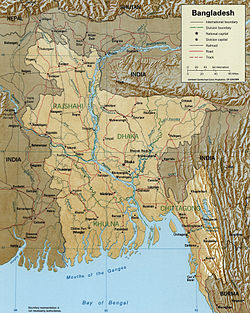
A Map showing major rivers in Bangladesh including Jamuna.
Fishing boats on the Jamuna River

The Jamuna River (Bengali: যমুনা, romanizedyamunā Jomuna) is one of the three main rivers of Bangladesh. The two other major rivers in Bangladesh are the Padma and the Meghna. The Jamuna is the lower stream of the Brahmaputra River, which originates in Tibet as Yarlung Tsangpo, before flowing through India and then southwest into Bangladesh. The Jamuna flows south and joins the Padma River, near Goalundo Ghat, before meeting the Meghna River near Chandpur. The Meghna then flows into the Bay of Bengal.

The Brahmaputra-Jamuna is a classic example of a braided river and is highly susceptible to channel migration and avulsion.[1] It is characterised by a network of interlacing channels with numerous sandbars enclosed between them. The sandbars, known in Bengali as chars, do not occupy a permanent position. The river deposits them in one year, very often to be destroyed later, and redeposits them in the next rainy season. The process of bank and deposit erosion together with redeposition has been going on continuously,[2] making it difficult to precisely demarcate the boundary between the districts of Sirajganj and Pabna on one side and the districts of Mymensingh, Tangail and Dhaka on the other. The breaking of a char or the emergence of a new one is also a cause of much violence and litigation. The confluence of the Jamuna and the Padma rivers is unusually unstable and has been shown to have migrated southeast by over fourteen kilometres between 1972 and 2014.[3]

Jamuna River

Course

[edit]
A view of Jamuna River from Jamuna Bridge

In Bangladesh, the Brahmaputra is joined by the Teesta River (or Tista), which is one of its largest tributaries.

James Rennell made a survey between 1764 and 1777 and his maps are one of the earliest authentic maps of Bengal in existence. In these maps, Teesta is shown as flowing through North Bengal in several branches — Punarbhaba, Atrai, Karatoya, etc. All these streams combined lower down with the Mahananda river, now the westernmost river in North Bengal, and taking the name of Hoorsagar finally discharged into the Ganges at Jafarganj, near modern Goalundo. The Hoorsagar river is still in existence, being the combined outfall of the Baral, a spill channel of the Ganges, the Atrai, the Jamuna or Jamuneswari (not the main Jamuna through which the Brahmaputra now flows), and the Karatoya, but instead of falling into the Ganges, it falls into the main Jamuna, a few kilometres above its confluence with the Padma at Goalundo.[4]

James Rennell's 1776 map shows the Brahmaputra's main flow through Jamalpur and Mymensingh and a much narrower Jamuna or Jamuneswari before an earthquake in 1762, and the Teesta R. flowing in 3 channels to the Ganges before a flood in 1787.

Below the Teesta, the Brahmaputra splits into two distributary branches. The western branch, which contains the majority of the river's flow, continues due south as the Jamuna to merge with the lower Ganges, called the Padma River. The eastern branch, formerly the larger but now much smaller, is called the lower or Old Brahmaputra. It curves southeast to join the Meghna River near Dhaka. The Padma and Meghna converge near Chandpur and flow out into the Bay of Bengal. This final part of the river is called Meghna.

In the past the course of the lower Brahmaputra was different and passed through the Jamalpur and Mymensingh districts. The river flowed east of Dhaka and the old course is now called Old Brahmaputra River.[5][6] The huge earthquake on 2 April 1762 of estimated magnitude 8 on the moment magnitude scale caused tectonic uplift of the Madhupur tract.[7] The main channel of the Brahmaputra at Bhahadurabad point was switched southwards and opened as Jamuna due to the result of caused tectonic uplift of the Madhupur tract. The earthquake caused both uplift and subsidence that resulted in change in course of the Brahmaputra River to from east of Dhaka (Old Brahmaputra River) to 150 kilometres (93 mi) to the west via the Jamuna River. The old course can be seen on https://ars.els-cdn.com/content/image/1-s2.0-S0169555X21001045-ga1_lrg.jpg.

The Jamuna is a very wide river. During the rainy season it stretches about 8–13 km (5–8 mi) from bank to bank. Even during the dry season when the waters subside, the breadth is seldom less than 3–5 km (2–3 mi).

The Jamuna was a barrier in establishing a direct road link between the capital Dhaka and northern part of Bangladesh, better known as Rajshahi Division, until 1996. This was mitigated by the completion of the Jamuna Multi-purpose Bridge.[8] The Jamuna is also a very important waterway. It is navigable all year round by large cargo and passenger steamers. Before the Partition of Bengal in 1947, passenger steamers used to ply up to Dibrugarh in the state of Assam in the Indian Union. At present two steamer ferry services link the district of Pabna with the districts of Mymensingh, Tangail and Dhaka. The Bangladesh Railway maintains a ferry service between Sirajganj and Jagannathganj in Mymensingh. The other ferry service between Nagarbari in Pabna and Aricha in Dhaka is run by the C & B Department.

See also

[edit]

References

[edit]
[edit]
Revisions and contributorsEdit on WikipediaRead on Wikipedia
from Grokipedia
The Jamuna River is the principal channel of the within , extending approximately 240 kilometres southward from its entry at the India- border near Chilmari to its confluence with the at Goalundo Ghat. As a highly dynamic, multi-channel , it maintains an average width of 8 to 12 kilometres and carries an average annual discharge of about 20,000 cubic metres per second, with peaks exceeding 100,000 cubic metres per second during the monsoon season. This river system is central to the Bengal Delta's hydrology, depositing vast quantities of nutrient-rich sediment that sustains across a vast , while also fostering rich biodiversity including the critically endangered (Platanista gangetica gangetica) and numerous fish species. Economically, it facilitates vital inland water transport and irrigation, with the 4.8-kilometre Bangabandhu Jamuna Multi-purpose Bridge—opened in 1998—serving as a key infrastructure link that integrates eastern and western , boosting trade and connectivity for approximately 30 million residents in the surrounding regions. However, the Jamuna's intense sediment load and seasonal variability lead to severe challenges, including annual averaging over 2,000 hectares and widespread flooding that displaces up to one million people each year, exacerbating and land loss in vulnerable char (mid-river island) communities. Ongoing efforts, such as riverbank protection and development programs, aim to mitigate these risks while enhancing of this critical .

Geography

Course

The Jamuna River enters Bangladesh as the continuation of the from , crossing the border near at the junction of Kurigram Sadar and Ulipur upazilas, approximately at coordinates 25°50′N 89°40′E. From this entry point, it flows southward for about 205 km through northern and central before its final . The river's path traverses districts including , Gaibandha, Bogura, Jamalpur, , , and , characterized by a dynamic, braided channel morphology with multiple active threads and seasonal sandbars known as chars. These chars, formed by deposition, number over 280 in the system, with larger ones exceeding 3.5 km in length, and shift with seasonal flows. A key feature along its course is the confluence with the , one of its largest tributaries, located near Phulchhari Upazila in . Downstream of this junction, at in Dewanganj Upazila of , the river bifurcates into two branches: the main western Jamuna, which carries approximately 90-95% of the total flow, and the smaller eastern Old Brahmaputra branch. The Jamuna continues its southward progression, widening significantly during the monsoon season from 3-5 km in the to 8-13 km or more, reflecting its high sediment load and variable discharge. The river's braided pattern features interwoven channels that migrate laterally, supported by extensive development, and it maintains an average width of about 10 km over much of its length. It culminates at Goalundo Ghat in (approximately 23°49′N 89°45′E), where it merges with the (the continuation of the ), forming the Lower Meghna downstream that empties into the . This confluence point is a critical navigational and hydrological node, marking the transition to the vast deltaic system of the Ganges-Brahmaputra-Meghna basin.

River Basin

The Jamuna River basin within encompasses approximately 47,000 km², representing the local drainage area of this segment of the Brahmaputra system. This forms part of the much larger Brahmaputra basin, which originates in the of and covers about 580,000 km² across , , , and , with the majority of the catchment lying upstream in the and Indian states. The basin is fed by several major tributaries entering from the north, notably the Dharla and Teesta rivers, which originate in the Himalayan foothills and deliver significant volumes of and during seasonal flows. Smaller tributaries, such as the Karatoya and Bangali, also contribute from the surrounding lowlands, enhancing the river's braided channel morphology and overall discharge variability. Physiographically, the Jamuna basin occupies the expansive alluvial plains of the Bengal Basin, characterized by low-lying floodplains formed by repeated sediment deposition over millennia. To the west, the elevated Barind Tract—a Pleistocene upland rising 10–50 m above the plains—constrains and diverts flow, while the Madhupur Tract to the east similarly influences channel alignment and limits eastward expansion, creating a north-south corridor for the river's course. Key catchment characteristics include a substantial sediment load sourced from intense Himalayan , driven by tectonic uplift and heavy rainfall, which the Jamuna transports southward in massive quantities. Inflow is predominantly monsoon-driven, with peak contributions occurring from to , when up to 80% of annual in the upstream areas intensifies runoff and mobilization. The basin boundaries traverse multiple districts in northern and north-central Bangladesh, including Kurigram, Gaibandha, Bogura, , and , where the river forms natural divides between eastern and western floodplains. Internationally, the upstream catchment is shared with , particularly through transboundary tributaries like the Teesta, leading to ongoing negotiations on water sharing to address seasonal shortages and flood risks in both nations.

Hydrology

Discharge and Flooding

The Jamuna River displays pronounced seasonal fluctuations in discharge, characteristic of its position as the lower course of the Brahmaputra in a monsoon-dominated basin. The average annual discharge, measured at the Bahadurabad gauging station, is approximately 20,000 m³/s, reflecting the combined contributions from upstream Himalayan snowmelt and regional rainfall. During the monsoon season (June to September), discharges can surge dramatically, reaching peaks of up to 100,000 m³/s due to intense precipitation and meltwater inflows. In contrast, low-flow periods from January to March see discharges ranging between 5,000 and 10,000 m³/s, sustained primarily by residual Himalayan snowmelt and baseflow from the Indian monsoon cycle. These discharge variations contribute to frequent and severe flooding in the Jamuna , with annual inundation affecting 20-30% of Bangladesh's land area during typical events. Major floods have occurred in 1988, 1998, 2004, 2020, and 2024, each impacting 30-40 million people through widespread displacement, crop losses, and damage. For instance, the 1998 flood inundated over 70% of the country at its peak, while the 2004 event submerged about 38% of the area, exacerbating vulnerabilities in densely populated riparian zones. Flooding in the Jamuna is driven by multiple interconnected factors, including heavy rainfall of up to 2,000 mm across the basin, which overwhelms local drainage systems. Additional triggers include sudden releases from upstream in , such as those on Brahmaputra tributaries, and the influence of tropical cyclones that amplify runoff through surges and intensified . Discharge and flood data for the Jamuna are systematically monitored by the (BWDB) through a network of gauging stations, including key sites at , , and Goalundo. These stations provide real-time measurements of water levels and flows using acoustic Doppler current profilers and stage-discharge rating curves, enabling early warning and hydrological modeling.

Sediment Dynamics

The Jamuna River, the lower reach of the Brahmaputra in , transports an enormous annual load estimated at 500–600 million tons, predominantly consisting of and fine sand derived from Himalayan processes. This high flux, which constitutes a significant portion of the Ganges-Brahmaputra-Meghna system's total output, originates from rapid tectonic uplift and monsoon-driven weathering in the upstream Himalayan catchment, delivering materials through glacial melt, landslides, and overland flow. Sediment transport in the Jamuna occurs primarily via two mechanisms: bedload, involving coarse particles moved by rolling, sliding, and saltation along the riverbed, and , where finer is carried in within the . Bedload typically accounts for about 10% of the total load but plays a crucial role in shaping the river's braided morphology, while dominates during high flows, facilitated by generated at velocities reaching up to 3 m/s in conditions. These processes are intensified during the monsoon season, when peak discharges enhance and particle entrainment. A key geomorphic feature resulting from this sediment dynamics is the formation of chars—ephemeral and islands that emerge, erode, and reform annually within the braided channels, covering an estimated 1,000 km² across the Jamuna . These dynamic landforms arise from differential deposition during falling stages, where suspended sediments settle in low-velocity zones, creating habitable but unstable surfaces that support approximately 2–3 million people engaged in and . The constant reconfiguration of chars, driven by the river's high energy, leads to significant bankline retreat, with rates of 100–300 m per year observed in vulnerable areas such as , resulting in the displacement of thousands of communities and loss of agricultural land each year. Recent post-2020 studies indicate a trend toward increased sediment deposition in the Jamuna, attributed to climate variability enhancing monsoon intensity and upstream erosion, potentially raising sediment loads by 34–60% under future scenarios. Quantifying this flux often involves adaptations of the Einstein-Brown bedload equation for braided river systems, which estimates transport rates as a function of shear stress and grain size: ϕ=40F1(τF2)3/2\phi = \frac{40}{F_1} \left( \frac{\tau^*}{F_2} \right)^{3/2} where ϕ\phi is the dimensionless bedload transport rate, τ\tau^* is the dimensionless shear stress, and F1F_1, F2F_2 are correction factors incorporating flow viscosity and particle fall velocity; this formulation has been calibrated for high-sediment rivers like the Jamuna to account for variable channel geometry and flood . Such models underscore the river's sensitivity to climatic shifts, with implications for long-term stability.

Geological and Historical Development

Tectonic and Seismic Influences

The Bengal Basin, in which the Jamuna River flows, is a influenced by tectonic driven by isostatic loading from Himalayan accumulation. Long-term rates in the eastern and southern parts of the basin average 1–2 mm/year, balanced by high influx from the . This is locally counteracted by uplifts in Pleistocene tracts such as Madhupur and Barind, which stand 3–15 m above surrounding , reflecting a complex interplay of regional downwarping and localized tectonic elevation. A pivotal seismic event contributing to the shaping of the Jamuna's course was the , estimated at magnitude ~M 8.5 along the Indo-Burman zone. This event caused coseismic uplift of 2–3 m in the Madhupur Tract, which facilitated the diversion of the westward and the subsequent establishment of the Jamuna as its primary channel in during the late . The uplift blocked the river's previous eastern path near , contributing to a southward switch that persists today. Ongoing in the Indo-Burman zone continues to influence the Jamuna's , with the megathrust locked and converging at ~12 mm/year, capable of generating large events. Minor earthquakes of M 5–6, along with occasional M 7–8 events, periodically induce channel alterations through and differential subsidence in the Bengal Basin. Such seismic activity has historically triggered abrupt river avulsions, as evidenced by paleochannel shifts over millennia. Geomorphic evidence of these tectonic influences includes fault scarps along the Madhupur Tract's western margin, such as linear features up to 4 m high indicating blind thrust or right-lateral slip faulting, and tilted strata in areas like Madarganj Upazila. Subsurface 2D seismic profiling reveals NE-SW trending faults with associated anticlinal folds uplifting central regions, while GNSS (GPS) data confirm active convergence and deformation rates. These features, combined with resistivity surveys showing sharp block transitions, underscore neotectonic control on the Jamuna's alignment and stability.

Channel Migration and Avulsions

Prior to the , the primarily followed an eastward course through the Old Brahmaputra channel, meandering around the eastern margins of the Madhupur Tract before joining the system. This stable path persisted until a major avulsion initiated in the late , facilitated by vertical displacement of the Madhupur Terrace from the and triggered by high monsoon discharges and the 1787 break-in, which enabled westward diversion. The process began with the capture of Brahmaputra flow by a distributary of the known as the Jenai or Konaie, marking the birth of the Jamuna channel as the river's dominant southward route. During the 19th and early 20th centuries, the Jamuna experienced significant westward migration following the Teesta's offtake integration, with the channel widening and braiding as it adjusted to increased sediment loads. Avulsions in the completed the primary shift, as maps from that period show the Jenai expanding and diverting substantial flow from the Old Brahmaputra, fully abandoning the eastern course by the 1860s. A further avulsion in the involved channel rerouting near the upper reaches, creating new braided paths that accelerated the river's lateral expansion. These changes transformed the Jamuna into a highly dynamic braided system, with the braidplain width increasing from approximately 5.5 km in 1914 to 9 km by 1952. Early mapping efforts, such as James Rennell's surveys from 1764 to 1777, documented the pre-avulsion eastward course, depicting the Brahmaputra recurved about 80 km east of the modern Jamuna near Jamalpur. Subsequent historical maps through the tracked the progressive westward migration, while from the 1970s onward has revealed shifts of 10-15 km in channel position over decades, enabling precise quantification of planform dynamics. In the , a notable avulsion occurred near Jamalpur, where the river shifted westward by several kilometers, eroding banks and altering local channels through progressive capture of distributaries. More recently, the Jamuna-Padma migrated 14 km southeastward between 1972 and 2014, driven by differential and deposition at the junction. Predictive models utilizing data, such as Landsat imagery and GIS , forecast ongoing migration rates of 100-200 m per year, aiding in risk assessment and channel evolution projections.

Ecology and Environment

Floodplain Ecosystems

The floodplain ecosystems of the Jamuna River encompass a diverse array of wetlands, including haors and beels, which are bowl-shaped depressions and shallow lakes in the lowlands that undergo seasonal inundation. This flooding creates interconnected , where receding waters allow for rice cultivation while residual pools serve as , supporting ecological productivity through and habitat provision. These wetlands are integral to the Brahmaputra-Jamuna , where hydrological connectivity fosters resilience against dry-season . Vegetation in these ecosystems varies by landform stability. On stable riverbanks, riparian forests dominated by simul (Bombax ceiba) and koroch (Pongamia pinnata) trees form dense canopies that bind soil and mitigate erosion, while their root systems create microhabitats for understory species. In contrast, chars—temporary sandbars formed by sediment accretion—support aquatic grasses such as Vallisneria species and floating vegetation like water hyacinth (Eichhornia crassipes), which thrive in shallow, shifting waters and aid in sediment stabilization. These plant communities adapt to the river's braiding dynamics, with pioneer species rapidly colonizing exposed deposits to initiate ecological succession. Seasonal dynamics drive profound changes across the . During the (November to May), water levels recede, confining the active to a narrow riverine corridor of about 5,000 km², where beels shrink and chars emerge as dry land. In the period (June to October), peak discharges inundate 25–30% of the , expanding the wetted area to roughly 10,000–12,000 km² and reconnecting isolated wetlands, which promotes nutrient redistribution and pulses. This cyclical expansion and contraction underscores the 's role as a pulse-driven system. Annual silt deposition from floodwaters is a key process enhancing soil fertility, as fine sediments rich in nutrients accumulate on the floodplain, creating fertile alluvial soils that sustain intensive cropping. This deposition supports agriculture across the region, contributing significantly to Bangladesh's rice production, with the Jamuna floodplain alone accounting for a substantial share through high-yield aman and boro varieties. Char ecosystems exemplify this renewal, where floating vegetation mats trap sediments and pioneer grasses establish on fresh deposits, transitioning barren bars into vegetated islands over time.

Biodiversity and Conservation

The Jamuna River harbors significant aquatic biodiversity, notably serving as a critical for the endangered (Platanista gangetica), with Bangladesh's overall population estimated at around 1,352 to 2,307 individuals as of 2025, a substantial portion of which occupy the Jamuna and associated channels. This blind, freshwater cetacean relies on the river's turbid waters for echolocation-based foraging on fish and invertebrates. The river also supports the anadromous hilsa shad (Tenualosa ilisha), which migrates upstream through the Jamuna from the and system during the season for spawning, traversing routes that extend from the Padma and Jamuna to inland waterways. Terrestrial and avifaunal diversity in the Jamuna's floodplains includes migratory waterbirds arriving in winter that use the wetlands for staging. These species contribute to the region's ecological balance. Biodiversity in the Jamuna faces acute threats from overfishing, which depletes stocks of migratory species like hilsa, industrial pollution from upstream sources in India and Bangladesh, and habitat fragmentation due to riverbank erosion. Surveys indicate that 40% of fish species in the Jamuna are threatened, reflecting broader declines in abundance linked to these pressures since the early 2020s. Conservation initiatives include the Bangladesh Forest Department's Conservation Action Plan for and (2021-2030), which outlines restoration and monitoring, building on IUCN's 2010 Conservation Action Plan that emphasizes protected areas and . The (BWDB), in collaboration with IUCN, has supported dolphin monitoring and sanctuary proposals along the Jamuna since 2010, including efforts to designate key river stretches as protected zones. Recent 2025 surveys highlight a increase but note a nearly 30% shrinkage in suitable due to river dynamics, underscoring the need for enhanced adaptive measures. Additionally, broader proposals aim to safeguard habitats integral to avifauna and fish migration. Climate change exacerbates these challenges, with rising temperatures and altered disrupting migration patterns of dolphins, hilsa, and birds; studies from 2022 onward identify the Jamuna basin as a requiring adaptive measures to sustain resilience.

Human Uses and Impacts

Economic Role

The Jamuna River serves as a critical for in , functioning as a year-round spanning over 200 kilometers and forming part of the country's extensive 8,000-kilometer navigable inland network managed by the Bangladesh Inland Water Transport Authority (BIWTA). This route facilitates the movement of passengers and , including essential goods like , fertilizers, and grains, contributing to efficient domestic and cross-border trade with via protocol routes. Overall, 's inland water transport system, with the Jamuna as a key corridor, handles approximately 194 million tons of annually (as of ), accounting for approximately 17-20% of inland freight traffic and reducing reliance on costlier and rail options. Key trade hubs along the river, such as the ports at and Aricha, enhance connectivity to and northern districts, supporting the flow of commercial goods and bolstering regional . These facilities handle substantial volumes of inter-district , with BIWTA-operated terminals like those in the Chittagong-Dhaka corridor—linked via the Jamuna—processing millions of tons yearly to sustain supply chains for industries and exports. In agriculture, the Jamuna provides vital irrigation water through canals and floodplain inundation, enabling cultivation across extensive areas in its basin, which covers millions of hectares of fertile land. This supports major crops such as and , as well as capture and fisheries, with development projects enhancing and drainage for at least 44,000 hectares in the Jamuna-Meghna region to boost and resilience. The river's sediment-rich waters nourish the , allowing for seasons and contributing to Bangladesh's , where alone dominates over 70% of agricultural output in these zones. The economic contributions extend to livelihoods for 10-15 million people in the Jamuna basin, including vulnerable char dwellers who depend on the river for seasonal farming on emerging sandbars, , and related activities. Approximately 6.5 million individuals reside on char lands nationwide (as of ), with the Jamuna system hosting around 3 million of them, engaging in riverine economies that blend , , and small-scale transport. These communities generate income from catches valued at millions annually and crop yields from char farming, though they face challenges from river dynamics. Since 2020, the Jamuna's role in has grown amid road network disruptions from pandemics and events, with increased use of river routes for cargo, including parcels, to maintain supply chains in northern and central . BIWTA reports heightened reliance on waterways for cost-effective delivery, aligning with national efforts to integrate inland transport into broader digital commerce growth.

Infrastructure and River Management

The Jamuna Multipurpose Bridge, completed in 1998 and spanning 4.8 kilometers, connects the (east bank, linking to ) with (west bank), significantly reducing road travel distances to northern by approximately 100 kilometers compared to previous ferry-dependent routes. This infrastructure has facilitated year-round connectivity for road and across the river's braided channels. Bank protection efforts along the Jamuna River, led by the (BWDB) since the 1960s, have employed structures such as groynes and revetments to combat severe . These interventions, intensified in the and , have stabilized approximately 50 kilometers of vulnerable riverbanks, particularly along priority reaches south of the Jamuna Bridge and in areas like . Permeable groynes, tested under BWDB projects, promote deposition to reinforce bank lines without fully disrupting flow dynamics. Upstream developments, including India's Teesta Barrage project operational since the 1990s, have reduced dry-season flows into the Brahmaputra system, indirectly affecting the Jamuna's sediment and water regime in Bangladesh by exacerbating erosion and altering navigation conditions downstream. In response, Bangladesh has proposed a Jamuna (Brahmaputra) barrage, potentially at sites like Fulchhari in Gaibandha or , to regulate flows for irrigation expansion in northwestern regions, alongside flood moderation and improved water diversion. Management policies for the Jamuna emphasize integrated flood and erosion control, with the Flood Action Plan (FAP) of the 1990s initiating comprehensive studies and pilot works to address bank instability and enhance inland navigation through dredging and channel training. Building on this, the Bangladesh Delta Plan 2100, approved in 2018, outlines long-term strategies for river management, prioritizing erosion mitigation, navigability restoration via systematic dredging, and adaptive infrastructure to sustain the Jamuna's role in regional transport. Recent initiatives under the Jamuna River Economic Corridor Development Program, launched with Phase 1 (2023-2028) supported by $102 million from the World Bank, as part of a multi-phase program extending to 2037, focus on sustainable bank stabilization using nature-based solutions like vegetated groynes and climate-resilient designs to protect riparian communities while boosting navigation capacity for year-round cargo movement. This program aligns with Delta Plan 2100 objectives, aiming to safeguard 2,500 hectares from erosion and integrate community insurance mechanisms for enhanced resilience against variable flows. As of 2024, the program has advanced with embankment strengthening at sites like Kalihati to combat erosion ahead of the monsoon season.

References

Add your contribution
Related Hubs
User Avatar
No comments yet.