Hubbry Logo
search
logo
2073012

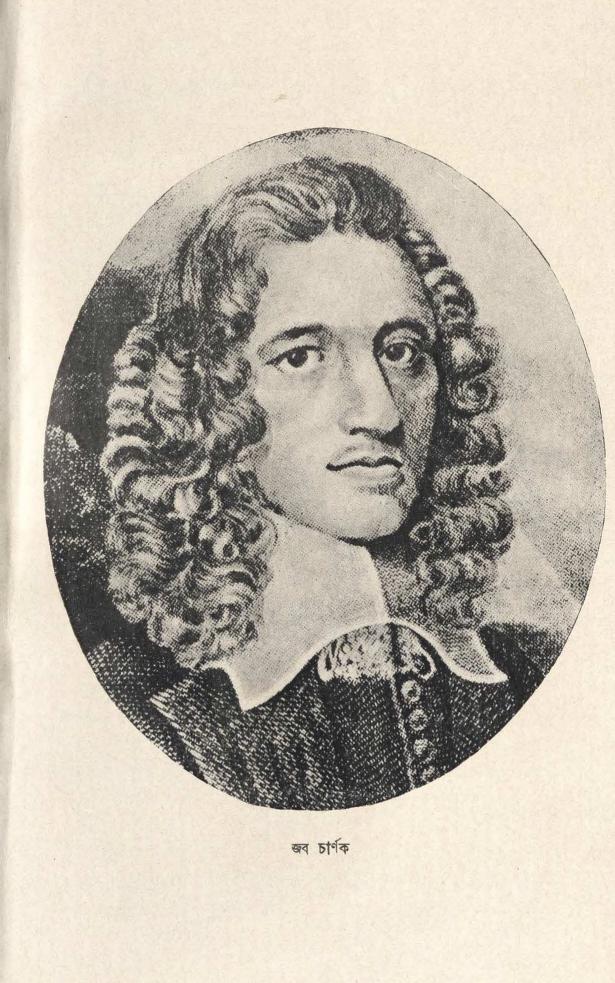
Job Charnock

logo
Community Hub0 Subscribers
Read side by side
from Wikipedia

Job Charnock (/b/; c. 1630–1692/1693) was an English administrator with the East India Company. He is widely regarded by historians as the founder of the city of Calcutta (Kolkata); however, this view was challenged in court, and in 2003 the Calcutta High Court ruled that he ought not to be regarded as the sole founder.[1][2]

Key Information

Early life and career

[edit]

Charnock came from a Lancashire family and was the second son of Richard Charnock of London. Stephen Charnock (1628–1680) was probably his elder brother. He was part of a private trading enterprise in the employ of the merchant Maurice Thomson between 1650 and 1653, but in January 1658 he joined the East India Company's service in Bengal, where he was stationed at Hoogly.[3]

Charnock was described as a silent, morose man, not popular among his contemporaries, but as "always a faithful man to the Company",[3] which rated his services very highly.[4] In addition to his business acumen, he won the Company's esteem by stamping out smuggling among his less scrupulous colleagues. His zeal in this regard made him enemies who throughout his life spread malicious gossip to discredit him.[5]

Patna factory

[edit]

Charnock was entrusted with procuring the Company's saltpetre and appointed to the centre of the trade, Patna in Bihar, on 2 February 1659.[citation needed] After four years at the factory he contemplated returning to England, but the Company persuaded him to stay on by promoting him to the position of chief factor in 1664.[6]

Charnock took a Hindu common-law wife.[7] Historian P. Thankappan Nair places the event in 1678 or a little earlier.[8] A Company servant, Alexander Hamilton, later wrote that she had been a sati and that Charnock, smitten by her beauty, had rescued her from her husband's funeral pyre by the Ganges in Bihar,[9] but Nair dismisses Hamilton's statement as fiction.[10] She was said to be a fifteen-year-old Rajput princess.[11] Charnock named her Maria, and soon after he was accused of secretly converting to Hinduism.[citation needed] Though he remained a devout Christian,[5] the story of his conversion and moral laxity was so widely believed that it became a cautionary tale in a later more puritanical age.[12]

Charnock was promoted to the rank of senior merchant by 1666, and became third in the Bengal hierarchy in 1676. He was now the Company's longest-serving servant in Bengal, and applied for a transfer to a more senior post. After some haggling due to difficulties with resentful colleagues who hoped to see him sent away to Madras, on 3 January 1679 the directors promoted him to the position of head at Cossimbazar, second in charge of the Company's operations in Bengal.

Rivalry with William Hedges

[edit]

Cossimbazar was notorious as a smugglers' den, and when Charnock assumed his new post on Christmas Day 1680 it was over the objections of Streynsham Master, president at Madras, who oversaw the Company's operations in the whole Bay of Bengal. The directors reprimanded Master for his interference, but although they agreed to free Bengal from oversight by the Madras presidency, Charnock's hopes of promotion to the top Bengal post at Hooghly were dashed when in 1681 the directors sent out one of their own, William Hedges, as agent of the bay and governor of Bengal.[13]

On Hedges' arrival at Hooghly, Charnock found him to be an officious neophyte. The rivalry between the Company's two most senior servants in Bengal was aggravated by the intrigues of Company servants and interlopers keen to undermine Charnock's authority and resume their smuggling operations on the side. Charnock was further irritated by the fact that members of Hedges' staff from Hooghly were regularly sabotaging their colleagues' work in Cossimbazar by poaching the local commodities. In 1684 the exasperated directors restored supervisory control over Bengal to the new president at Madras, William Gyfford, and replaced Hedges in Bengal with John Beard, the elder.

Chief agent in Bengal

[edit]
Plaque with details of Baptism of Charnock's daughters, on Baptismal Font at St. Mary's Church, Fort St. George, Madras

When Beard died on 28 August 1685, Charnock finally assumed the position of agent and chief in the Bay of Bengal.[14] By this time a crisis had arisen over restrictions on trade, and in particular the Mughal nawab's imposition of a customs duty of 3½ per cent, which the English refused to pay on the grounds that it was in breach of the original firman which exempted them from customs.[15] Relations with the nawab deteriorated into violent conflict. When Charnock received word of his promotion, Cossimbazar was under siege, and he could not leave to take up his responsibilities at Hooghly until April 1686. On his arrival he continued to resist what he saw as extortion, by force or persuasion, and when these did not serve, by taking the Company's business elsewhere.

Finding himself again besieged at Hooghly, Charnock put the Company's goods and servants on board his light vessels. Pursued by the nawab's troops, on 20 December 1686 he dropped down the river 27 miles (43 km) to Sutanuti, then "a low swampy village of scattered huts",[16] but a place well chosen for the purpose of defence.[3][17] From Sutanuti he moved on to Hijili in February 1687, where he was again besieged from March to June 1687. After negotiating a truce and safe passage, he transferred the factory back to Sutanuti in November 1687.

It was probably during this interlude at Sutanuti that Charnock suffered a personal loss in the death of his wife Maria. They had been together for some twenty-five years. They had one son (who would predecease his father), and three surviving daughters who were later baptised in Madras. Although Maria was buried like a Christian, and not cremated as a Hindu,[18] Charnock was said to sacrifice a cock over her grave each year on the anniversary of her death, "after the Pagan Manner".[9] University librarian Prabodh Biswas writes that the ritual resembles the Sufi worship of the panch peer or "five saints", a custom which Charnock "is said to have adopted".[19] He was also said to have built his garden house at Barrackpore so as to be near her grave.[18]

Even though Charnock had married a native woman, he had a certain animosity towards the natives due to his sufferings at the hands of the native rulers. Captain Hamilton had said, "the Governor (Charnock) at the hour of dinner and near his dining room had delinquents (native) punished that he might satiate himself with their cries."[20]

Chittagong expedition

[edit]
Sketch of Job Charnock's Cemetery, made before 1742 (p.196), March 1824[21]
Job Charnock's mausoleum

By 1686 the secret committee of the court of directors in London had decided the Company should establish a fortified settlement in Bengal, to resist what they regarded as arbitrary exactions and violent harassment by Mughal officials:

we have no remedy left, But either to desert our Trade or we must draw that sord his Majesty hath intrusted us with to vindicate the Rights and Honour of the English Nation in India.[15]

Accordingly, in September 1688 the largest naval force the Company had ever assembled swept into the bay, with orders to blockade the ports and arrest the ships of the Grand Mughal, and, if this did not bring satisfaction, to take the town of Chittagong. Beard being dead, authority devolved to a reluctant Charnock as commander-in-chief. As he anticipated, Chittagong proved remote and unviable. Sutanuti had in the meantime been razed by the nawab's troops, therefore the squadron sailed for Madras, arriving on 7 March 1689.

Calcutta

[edit]
Job Charnock founding Calcutta, 1690

In Madras Charnock persuaded the reluctant council, over the objections of its president, his old opponent William Hedges, that Sutanuti was the best place to establish the headquarters in Bengal, because of its defensible position and its deep-water anchorage for the fleet. The selection of the future capital of India was entirely due to his stubborn resolution.[3]

In March 1690, the Company received permission from Aurangzeb in Delhi to re-establish a factory in Bengal, and on 24 August 1690 Charnock returned to set up headquarters in the place he called Calcutta; the appointment of a new nawab ensured this agreement was honoured, and on 10 February 1691 an imperial grant was issued for the English to "contentedly continue their trade".[5][22]

The directors showed their approval of Charnock's initiative by making his agency independent of Madras on 22 January 1692. Thereafter "Calcutta grew steadily till it became India's 'city of cities' and capital".[16]

Mausoleum

[edit]
Job Charnock's Tomb and epitaph

Charnock died in Calcutta on 10 January 1692 (or 1693 according to an exhibition at the Victoria Memorial which points out that the 1692 date on his gravestone refers to an old calendar system by which the new year began in March), shortly after the death of his son. His three surviving daughters all remained in Calcutta: Mary (d. 19 February 1697), Elizabeth (d. August 1753), and Katherine (d. 21 January 1701); all found wealthy English husbands.[11] Mary married the President and Governor of Fort William, Sir Charles Eyre.[23]

A mausoleum was erected in 1695 over Charnock's simple grave by Eyre, his son-in-law and successor. It can still be seen in the graveyard of St. John's Church, the second oldest Protestant church in Calcutta after John Zacharias Kiernander's Old Mission Church (1770), and is now regarded as a national monument.[24][25] The stone for the mausoleum was brought from the St. Thomas Mount, Madras. Later in 1893 geogologist T. H. Holland found it to be a different form of granite and named it Charnockite after Job Charnock.[26][27]
It is inscribed with the Latin epitaph:

The marble slab in the mausoleum

D.O.M. Jobus Charnock, Armiger Anglus et nup. in hoc regno. Bengalensi dignissimum Anglorum Agens Mortalitatis suae exuvias sub hoc marmore deposuit, ut in spe beatae resurrectionis ad Christi judicis adventum obdormirent. Qui postquam in solo non-suo peregrinatus esset diu reversus est domum suae aeternitatis decimo die 10th Januarii 1692. Pariter Jacet Maria, Iobi Primogenita, Carole Eyre Anglorum hicci Praefecti. Conjux charissima. Quae Obiit 19 die Februarii A.D. 1696–97.[28]

Translation:

In the hands of God Almighty, Job Charnock, English knight and recently the most worthy agent of the English in this Kingdom of Bengal, left his mortal remains under this marble so that he might sleep in the hope of a blessed resurrection at the coming of Christ the Judge. After he had journeyed onto foreign soil he returned after a little while to his eternal home on the 10th day of January 1692. By his side lies Mary, first-born daughter of Job, and dearest wife of Charles Eyre, the English prefect in these parts. She died on 19 February AD 1696–97.[29]

The inscription omits any mention of Charnock's Hindu wife Maria. Eyre may have hoped to make the public image of his predecessors and in-laws seem more respectable to the growing Anglican community in Calcutta.[30] Even so, the monument was built by Bengali craftsmen, and its incorporation of Indo-Islamic design reflects the intersection of two cultures which their union personified.[31]

Assessment

[edit]

In the verdict of Scottish historian Sir Henry Yule:

We cannot claim a high character for Charnock. The charge of cruelty is based, we presume, on the tales of Alexander Hamilton; it is impossible to view this as more than gossip. The charges of vacillation and timidity are based, we again presume, on the fault found by the Court with his conduct of the first exodus from the Upper Hugly. We can see that Job mistrusted (though we apprehend justly) the wisdom of the orders given, especially as to the seizure of Chittagong; and his own notion of occupying Hijili as a fortified settlement showed what may doubtless seem strange ignorance of the sanitary condition of such a position. But setting aside this as a serious mistake he showed no lack of spirit in his action since February, 1687, when he saw that the Nabob and his people by their negotiations were only trying to gain time, and certainly none in the defence of the miserable position in Hijili, and no lack of resource in the notable stratagem by which he imposed upon the enemy! . . . My view of him, pieced together from the fragmentary impressions which are alone available, would be that of an imperfectly educated and coarse and wilful but strong man who had spent his life in almost isolated positions among natives and had been deeply tinged with native habits of thought and action, but who maintained a general loyalty to the Company whom he served, though he was by no means as scrupulous as they gave him credit for being.[32]

Ruling of Calcutta High Court

[edit]

A Calcutta High Court ruling on 16 May 2003,[1][33] based on a report from a committee found that a "highly civilised society" and "an important trading centre" had existed on the site of Calcutta long before Charnock established his settlement. They also found the place then called Kalikatah was an important religious centre due to the existence of the Kali temple in the adjacent village of Kalighat. The first literary reference to the site is found in Bipradas Pipilai's magnum opus Manasa Mangala which dates back to 1495. Abul Fazl's Ain-I-Akbari dating 1596 also mentions the place. The Sabarna Roy Choudhury family was granted the Jagirdari of Kalikatah by Emperor Jehangir in 1608. The report added that there are multiple founders: Charnock, Eyre and Goldsborough, Lakshmikanta Majumdar, the Sett Bysack families, Gobindapur and Sabarna Choudhuries (who sold land to the English).[34] The court argued that Charnock ought not to be regarded as the sole founder of Calcutta,[1] and ordered government authorities to purge his name from all textbooks and official documents containing the history of the founding story of the city.[1][35][page needed]

Other historical authorities reject such revisionism:

It is mostly due to Charnock's imagination, his vision, and his commitment to what he considered was right that the English transformed three small villages on an inhospitable tract of riverbank into what was to become the premier city in India ... Of all the great cities of modern India, Calcutta it is that owes its existence to the vision and commitment of one man.[5]

See also

[edit]

Notes

[edit]

References

[edit]
[edit]
Revisions and contributorsEdit on WikipediaRead on Wikipedia
from Grokipedia
Job Charnock (died 10 January 1692) was an English merchant and administrator employed by the British East India Company in Bengal, renowned for selecting the site of Calcutta and establishing a fortified trading factory there in 1690, which served as the foundation for the British settlement that evolved into the city of Kolkata. Arriving in India around 1655 or 1656 initially as a private trader before formally joining the Company as a junior merchant at its Kasimbazar factory in 1658, Charnock advanced through the ranks to become chief agent at Patna circa 1676–1679 and later at Hugli from 1686 to 1689. His tenure involved leading a failed military expedition to establish a factory at Chittagong in 1686 amid deteriorating relations with Mughal authorities, prompting a temporary retreat before the successful relocation to Calcutta with imperial permission. Charnock's career was fraught with conflicts, including repeated accusations from Company superiors of mismanagement, corruption, and excessive severity toward Indian prisoners and locals—charges he often rebutted successfully through appeals to London—yet his strategic acumen in fortifying Calcutta against raids ensured its viability as a secure commercial outpost.[1] While traditionally hailed as the city's founder, later historical assessments, including a 2003 Calcutta High Court ruling, emphasize that urban development there resulted from gradual migration and agglomeration rather than a singular event, underscoring Charnock's role as initiator rather than sole originator of the modern metropolis.[2][3]

Early Life and East India Company Entry

Origins and Education

Job Charnock was born around 1630 or 1631 in London, England, as the son of Richard Charnock, a prosperous solicitor and landowner whose family originated from Lancashire.[4][5] Little is documented about his immediate family beyond his father, though branches of the Charnock lineage had settled in London and Bedfordshire by the 16th century.[5] Details of Charnock's education remain obscure in surviving records, with no evidence of attendance at university or specific institutions. His later correspondence, however, reflects a well-educated individual proficient in literacy, administrative reasoning, and mercantile practices, qualities that facilitated his recruitment by the East India Company as a junior writer at approximately age 24 or 25 in 1655 or 1656.[4][5]

Recruitment and Voyage to India

Charnock, born around 1631 to a family with roots in Lancashire, entered the Indian trade through private employment rather than direct enlistment with the East India Company. He joined a trading venture organized by the merchant Maurice Thomson, a key figure in England's colonial commerce who held interests in Virginia tobacco and Asian ventures, departing England likely in late 1654 or early 1655.[6] The voyage followed standard East India routes, sailing from English ports such as London or Portsmouth, rounding the Cape of Good Hope, and navigating the Indian Ocean to reach the subcontinent's eastern coast, a journey typically lasting five to eight months depending on monsoon winds and ship conditions. Charnock arrived in India in 1655 or 1656, initially stationed at coastal factories before moving inland.[7] Upon arrival, Charnock transitioned to East India Company service, joining as a junior merchant at the Kasimbazar factory in Bengal by 1658, where he began his apprenticeship in the Company's council under senior factors. This posting involved overseeing saltpeter and textile procurement amid competition from Dutch and Portuguese traders, marking his entry into the structured hierarchy of Company operations in Mughal territories.

Initial Postings in India

Arrival in Madras

Job Charnock reached India in 1655, disembarking at Madras (Fort St. George), the East India Company's principal settlement on the [Coromandel Coast](/page/Coromandel Coast), after stowing away on a vessel without formal company authorization or listing on the ship's manifest.[8] This unofficial entry reflected his determination to pursue opportunities in the burgeoning Anglo-Indian trade network, bypassing standard recruitment channels amid the company's expanding operations in the mid-17th century. Upon arrival at the fortified enclave of Fort St. George, established in 1639 as a secure base for commerce in textiles, spices, and indigo, Charnock leveraged his initiative to secure employment with the East India Company as a junior merchant by early 1657. The settlement, governed by company agents under charter from the English Crown, served as a vital hub for new recruits destined for inland factories, providing administrative oversight, warehousing, and armed protection against local rivalries with Dutch and Portuguese traders. From Madras, Charnock transitioned to the Bengal subagency, initially assigned to the Kasimbazar factory, where he engaged in procuring silks and other goods for export to Europe.[9] His rapid integration into company ranks underscored the pragmatic needs of the era, as the East India Company prioritized capable individuals to counter competitive pressures from European rivals and Mughal authorities, despite occasional lapses in formal vetting.[10] This Madras entry point facilitated his early exposure to the logistical and diplomatic challenges of sustaining EIC presence in southern and eastern India.

Service at Patna Factory

Job Charnock was appointed chief of the East India Company's factory at Patna in early 1664, securing his first major administrative role after initial postings in India.[7] The Patna factory, situated in Bihar amid abundant natural deposits, functioned primarily as a procurement hub for saltpetre, which the Company refined into gunpowder for the European market; other goods like opium and indigo were also traded, but saltpetre dominated exports from the region.[11] [12] Under Charnock's oversight from 1664 to 1680, the factory's operations expanded significantly, with organized fleets of Patna boats shipping saltpetre down the Ganges to Hugli for onward transport; his vigorous management enhanced procurement efficiency and trade volume, capitalizing on Patna's lower costs compared to coastal factories.[11] [13] He navigated dealings with Mughal provincial governors (nabobs) and local intermediaries, leveraging acquired proficiency in regional languages and customs to resolve disputes and secure favorable terms, though such immersion later drew unsubstantiated accusations of cultural assimilation from Company rivals.[7] This prolonged inland tenure honed Charnock's practical expertise in Indian governance and commerce, distinguishing him among Company servants and earning directors' confidence for future Bengal assignments; by 1666, his contributions warranted promotion to senior merchant status.[7] [14] Toward the end of his Patna service, escalating pressures from local authorities prompted his relocation southward, but the period solidified the factory's role in sustaining the Company's munitions supply chain.[7]

Internal Company Conflicts

Rivalry with William Hedges

William Hedges was appointed by the East India Company's Court of Directors in 1681 as the first Agent and Governor of its Bengal factories, with explicit instructions to eradicate private trade by Company servants, centralize authority, and negotiate firmer commercial privileges from Mughal officials.[15] His arrival at Hugli on 7 December 1682 exposed deep divisions within the local establishment, where senior factors had long profited from unauthorized trading that competed with Company consignments.[15] Charnock, serving as chief factor at the Patna factory since 1679, became a primary target of Hedges' reforms due to documented involvement in private saltpeter exports, a lucrative sideline evading Company oversight.[16] Hedges promptly suspended Charnock from duty in early 1683, citing violations of Company monopoly rules, and reassigned him to subordinate roles amid investigations revealing similar infractions by other council members like John Beard.[15] Charnock contested the suspension by petitioning the London directors, who initially endorsed Hedges' crackdown, affirming that private trade undermined fiscal discipline and exposed the Company to Mughal reprisals over unpaid duties.[17] The conflict escalated into open council discord at Hooghly, where Charnock and allies resisted Hedges' directives, delaying fortification plans and intelligence-sharing critical for Mughal negotiations.[15] Hedges recorded these obstructions as deliberate sabotage, attributing them to entrenched interests prioritizing personal gain over collective security, though his own inflexible style exacerbated tensions.[15] By mid-1683, amid faltering talks with Bengal's subahdar Shaista Khan—who demanded higher customs and barred factory expansions—Hedges' authority eroded, culminating in his voluntary departure from Bengal on 20 August 1683 and formal recall to London.[15] Hedges' deposition by the directors in 1684, following reports of operational paralysis, underscored the rivalry's toll, as internal factionalism had neutralized his mandate without yielding concessions.[17] Charnock, reinstated after Hedges' exit, navigated the vacuum by aligning with shifting directorate preferences toward pragmatic expansion over strict monopolies, eventually securing the chief agent role in 1686—evidence of how opposition to Hedges preserved networks enabling Bengal's later resurgence under Charnock's tenure.[16] This episode highlighted causal tensions between London's reformist impulses and on-ground realities of dependency on local initiative amid Mughal dominance.[15]

Clashes with London Directors

During the Anglo-Mughal War (1686–1690), the Court of Directors in London instructed Charnock, as chief agent in Bengal, to seize the port of Chittagong to assert Company dominance, but he delayed execution, judging the operation impracticable given the Mughal military superiority and logistical challenges. This hesitation led to expressions of disappointment from the directors, who viewed it as a missed opportunity to expand territorial control amid their broader aggressive policy under Josiah Child. In response to the war's setbacks, the directors temporarily superseded Charnock in 1690 by appointing Captain John Heath to command a relief fleet, which carried Charnock to Madras against his preference to remain in Bengal; Heath's mission ultimately failed to relieve the Company's positions, underscoring the directors' frustration with field-level execution. Despite this, the directors retained underlying confidence in Charnock's loyalty, citing his 34 years of service and fidelity, and did not pursue formal charges, allowing his eventual return to Bengal leadership. Following the 1686 treaty negotiated at Sutanuti amid Mughal pressure, the directors further criticized Charnock for insufficient firmness in enforcing terms with the nawab's agent, attributing it partly to internal council enmities against him, though they acknowledged the difficulties of operating under duress. These rebukes reflected broader tensions between London's strategic directives for expansion and confrontation versus Charnock's pragmatic assessments on the ground, yet the Court continued to praise his overall "good and faithful service" in correspondence, balancing censure with reliance on his experience.

Ascension to Leadership in Bengal

Appointment as Chief Agent

Job Charnock assumed the role of Chief Agent for the East India Company's Bengal operations upon the death of the incumbent agent, Vincent Beard, on 28 August 1685. Beard, who had held the position since around 1680, succumbed while Charnock was stationed at Balasore, prompting an urgent summons for Charnock to relocate to Hugli and take command of the Company's factories across the region. This succession marked Charnock's elevation from deputy or senior councilor status, leveraging his over two decades of service in Bengal, including oversight of saltpetre procurement at Patna.[18][19] Charnock's appointment occurred against a backdrop of internal Company frictions, particularly his prior defiance of William Hedges, the London-appointed commissioner who arrived in 1682 to audit and reform Bengal operations. Hedges had criticized Charnock's management practices and alliances with local intermediaries, but the Court of Directors in London, prioritizing operational continuity and Charnock's proven trade results, overrode such objections and confirmed his leadership. By early 1686, Charnock arrived at Hugli to formally exercise authority, inheriting a council that included figures like Francis Ellis, who had briefly acted as interim head.[20] This transition coincided with mounting external pressures from Mughal officials under Subahdar Shaista Khan, who viewed the Company's growing militarization—bolstered under Charnock's advocacy for armed defenses—as a security threat. Charnock's tenure as Chief Agent thus initiated a phase of assertive policies, including fortification proposals and naval reinforcements, setting the stage for the Anglo-Mughal confrontations of 1686–1690.[21]

Administrative and Commercial Strategies

Upon his appointment as Chief Agent of the Bengal Presidency in August 1686, Job Charnock prioritized relocating the East India Company's operations from the vulnerable Hugli factory to more defensible sites with direct sea access, evacuating Hugli on December 15, 1686, and temporarily occupying Sutanuti before shifting to Hijili. He selected Sutanuti as the permanent headquarters in 1690 due to its strategic position on the Hooghly River, clearing the site and initiating fortifications to safeguard against local hostilities and Mughal interference.[7] Administratively, Charnock centralized control over subordinate factories at Patna and Kasimbazar, emphasizing oversight of saltpetre procurement from Bihar and silk production in Murshidabad to streamline supply chains amid disruptions from nawab exactions. He negotiated treaties with Mughal officials, including a 1690 agreement allowing resumption of trade at Bengal factories and establishment of docks at Ulubaria, though ratification was pending; this was supplemented by an imperial farman on February 10, 1691, granting trade privileges for an annual payment of 3,000 rupees.[7] Commercially, Charnock advocated aggressive bargaining for customs exemptions, a mint, and fort construction, as demanded from Shaista Khan in 1684, leveraging Company naval power—such as the 1686 sacking of Hugli—to compel concessions after Dutch-mediated peace talks restored access.[7] These efforts aimed to reduce dependency on local intermediaries and Mughal revenue demands, focusing exports on high-value goods like saltpetre and textiles while mitigating risks from interlopers and rival European traders. Despite London directors' occasional opposition to his bold tactics, Charnock's approach yielded short-term trade stability, though it heightened tensions leading to further military engagements.[7]

Military and Expansion Efforts

Chittagong Expedition

In the context of the East India Company's aggressive expansion policy during the Anglo-Mughal War of 1686–1690, Chittagong emerged as a strategic target due to its position as a major Mughal-controlled port facilitating trade in Bengal and access to the Bay of Bengal.[22] The Company's directors, led by [Josiah Child](/page/Josiah Child), sought to capture it to establish a fortified base superior to the vulnerable Hugli settlement, which had faced repeated Mughal interference.[23] Job Charnock, as the senior civilian agent in Bengal, was designated to serve as governor of the prospective Chittagong territory if seized, reflecting his accumulated experience in regional operations and the Company's intent to leverage his administrative expertise.[23] The expedition materialized in late 1688 when Captain William Heath arrived in Bengal with a fleet of approximately 15–16 vessels, including reinforcements from Madras, carrying around 400 European troops and additional Bengali mercenaries under Charnock's contingent.[24] Heath's force, initially anchored at Balasore, proceeded toward Chittagong in alliance with the Kingdom of Arakan, aiming to exploit local rivalries against Mughal authority under Shaista Khan.[22] However, upon reaching Chittagong in early January 1689, the English found the port heavily fortified with Mughal defenses and insufficient local support from Arakanese forces, who proved unreliable.[21] The operation aborted without a major engagement; internal discord, including mutinies among the crew and Heath's reluctance to commit to a land assault without clear superiority, compounded the failure.[23] Charnock, assuming temporary authority after the death of another official, advocated caution but could not overcome logistical constraints and the expedition's overextension.[24] By March 1689, the fleet withdrew to Madras, marking a significant setback that exposed the limits of the Company's naval and military capabilities against Mughal resources.[21] This abortive venture shifted Company priorities in Bengal, prompting Charnock's return and third occupation of Sutanuti (later Calcutta) in July–August 1690 as a fallback settlement, while contributing to the broader war's resolution through English capitulation and renewed Mughal dominance over coastal trade.[23] The failure underscored the risks of detached adventurism without sustained ground forces, influencing subsequent defensive strategies over offensive conquests.[22]

Campaigns Against Mughal Authorities

In the context of the Anglo-Mughal War (1686–1690), initiated by the East India Company's aggressive expansion under Governor Josiah Child, Job Charnock served as the chief agent at the Hughli factory in Bengal, directing operations against Mughal forces led by Subahdar Shaista Khan. The Company's strategy aimed to secure dominance over trade routes and ports, prompting retaliatory Mughal assaults on English settlements, including the plundering of factories at Balasore, Cossimbazar, Patna, and Malda, where personnel were imprisoned. Upon arriving at Hughli on 16 or 17 April 1686, Charnock immediately engaged in hostilities with the local faujdar, achieving a decisive victory supported by Company troops dispatched from England, though a truce was soon mediated by Dutch intermediaries. By December 1686, facing escalating threats from the nawab of Bengal, Charnock defended Hughli with a limited force but was compelled to retreat downriver, burning Company magazines and granaries to deny resources to pursuers; he then fortified positions at the island of Ingelle (near Hijli). In early 1687, Charnock advanced to Hijli, where English forces under his leadership captured the island's forts, including those at Tanna, defeating combined Hindu and Mughal defenders with approximately 400 soldiers and naval support.[25][26] However, Mughal reinforcements besieged Hijli from March to June 1687, exacerbated by disease that reduced Charnock's effective strength by two-thirds; despite initial holds, the position was lost by late May, with Mughals recapturing the forts on 20 May and driving out the English by 28 May amid heavy casualties from fever and combat.[25][27] Following the Hijli setback, Charnock negotiated a temporary truce permitting safe passage and relocated to Madras for reinforcements. In 1689, he returned to Bengal with a strengthened expeditionary force, reoccupying Hughli and resuming operations amid ongoing hostilities, though the broader war concluded unfavorably for the Company, compelling concessions to Mughal demands. These engagements highlighted the limits of English naval superiority against Mughal land power and logistical challenges in Bengal's terrain and climate.

Founding and Development of Calcutta

Site Selection and Initial Settlement

Following the Anglo-Mughal War (1686–1690), Job Charnock negotiated with Bengal Subahdar Ibrahim Khan for a new English settlement after the East India Company's prior base at Hooghly became untenable. He selected the site encompassing the villages of Sutanuti, Govindapur, and Kalikata on the east bank of the Hooghly River, landing at Muhonto's Ghat near Sutanuti on 24 August 1690 and hoisting the English flag to mark the establishment.[10] The choice of this location provided strategic advantages, including independence from Mughal and European settlements on the west bank, proximity to the sea enabling access for larger ships and naval defense, deep waters in the Hooghly, elevated ground with natural barriers such as forests and swamps for protection, and an existing community of entrepreneurial traders supporting commerce.[10] [28] The site's marshy terrain was undervalued by Mughal authorities, offering plentiful provisions, secure naval positioning, easy land communications, and export potential through its ghat suitable for docking.[28] Initial settlement efforts began amid monsoon conditions, with settlers relying on boats for shelter before a meeting on 28 August 1690 to plan construction of thatched structures including a warehouse, dining room, and residences.[10] The Company acquired the local zamindar's cutcherry (office) for records, which later evolved into Dalhousie Square, and established a pucca factory building for factors to conduct trade.[10] [28] This laid the groundwork for a fortified trading post, securing duty-free trade privileges through a farman negotiated with an annual tribute of 3,000 rupees.

Fort William Construction and Defenses

Following Job Charnock's establishment of the East India Company's factory at Sutanuti on August 24, 1690, the initial defenses relied on the site's natural advantages, including the Hooghly River for fluvial protection and surrounding marshes that deterred land-based assaults, supplemented by a flotilla of armed boats moored in the river.[28] These measures provided rudimentary security for the trading post amid tensions with local Mughal authorities, but no permanent fortifications were erected under Charnock's direct oversight before his death in January 1693.[29] Substantial construction of what became known as the original Fort William commenced in 1696, directed by Company agents under the orders of Sir John Goldsborough, utilizing the nucleus of Charnock's settlement along the eastern bank of the Hooghly River.[30] The structure evolved from basic factory buildings into a two-storied brick edifice with projecting wings, completed progressively between 1696 and 1702 to serve as the Company's Bengal headquarters.[31] Officially designated Fort William in 1700 to honor King William III, it featured earthen ramparts initially reinforced with wooden palisades for defense against potential raids.[32] Early enhancements to the fort's defenses included the addition of bastions and curtain walls, with the southeast bastion constructed under Sir Charles Eyre around 1700 and the northeast under John Beard shortly thereafter, aiming to mount artillery for riverine and terrestrial threats.[30] These developments transformed the outpost into a more robust stronghold, though vulnerabilities persisted, as evidenced by later Mughal pressures that prompted further palisade extensions and gun emplacements by the 1710s.[32] The fort's strategic orientation prioritized river access for trade while providing overwatch against upstream incursions from Hugli.

Negotiations for Imperial Grants

Following the Anglo-Mughal War of 1686–1690, in which the English East India Company suffered significant defeats against Mughal forces under Emperor Aurangzeb, the Company petitioned for reinstatement of trading privileges. In February 1690, Aurangzeb issued a firman readmitting the Company to trade within his dominions on terms prevailing before the conflict, effectively restoring prior customs exemptions and factory operations in Bengal without granting new sovereignty-like concessions.[33] This imperial decree marked a pragmatic reversal from the Company's earlier aggressive demands for a farman conferring territorial autonomy, which had provoked the war under the direction of London officials like Sir Josiah Child. As chief agent of the Company in Bengal, Job Charnock capitalized on this firman by negotiating directly with the newly appointed subahdar (governor) of Bengal, Ibrahim Khan, who succeeded Shaista Khan in 1689. Charnock proposed relocating the English factory from Hooghly to the less contested site of Sutanuti (along with adjacent villages Govindapur and Kalikata) to avoid ongoing hostilities, and sought a provincial farman authorizing duty-free trade in exchange for a fixed annual tribute of 3,000 rupees.[9] Ibrahim Khan, despite initial imperial instructions to expel the English, advocated leniency and provisionally approved these terms pending a confirmatory imperial farman, providing immediate protections to facilitate the move.[34] On 24 August 1690, Charnock hoisted the English flag at Sutanuti, establishing the initial settlement that evolved into Calcutta, under the subahdar's interim farman. This local agreement, backed by the February imperial decree, enabled fortification and trade resumption, though full imperial validation for the site's zamindari (land revenue) rights was not secured until 1698, after Charnock's death.[9] Charnock's negotiations emphasized defensive positioning over expansion, reflecting a shift from confrontation to cautious legitimacy-seeking within Mughal administrative hierarchies.[21]

Personal Affairs and Later Years

Marriages and Family Dynamics

Charnock entered into a single known marriage with a local Indian woman of Hindu origin around 1663, during his tenure as chief agent at the Patna factory.[12] This union, likely following Hindu rites, produced three daughters—Mary, Elizabeth, and Katherine—who were baptized as Christians on August 19, 1689, at St. Mary's Church in Fort St. George, Madras.[35] The marriage strengthened Charnock's ties to regional authorities, notably fostering a protective alliance with the local governor Bal Chand Rai, who safeguarded British commercial interests amid Mughal oversight.[21] A persistent legend, first recorded in 18th-century accounts such as Alexander Hamilton's A New Account of the East Indies (1727), claims Charnock rescued his bride—a young widow—from sati (widow immolation) on her husband's funeral pyre, prompting their union; however, no contemporary East India Company records substantiate this romanticized narrative, which historians regard as apocryphal folklore rather than verifiable fact.[36] The couple's household reflected intercultural dynamics typical of early Company settlements, with Charnock maintaining European administrative roles while leveraging local kinship networks for operational security. His wife, sometimes retrospectively named Maria in later sources, predeceased him, dying on February 19, 1694.[37] The daughters integrated into Anglo-Indian colonial society through marriages to East India Company officials: Mary wed Sir Charles Eyre, the first President of Fort William; Katherine married John White; and Elizabeth's union similarly tied the family to Company elites.[38] All three remained in Calcutta, where they outlived their parents—Mary dying in 1697, Katherine in 1701, and Elizabeth in 1753—and were interred in the family mausoleum alongside Charnock. This arrangement underscores a strategic family orientation toward perpetuating British influence, with the daughters' Christian baptisms and English marriages signaling Charnock's prioritization of Company loyalty over full assimilation into Indian customs, despite the maternal heritage.[39]

Death, Burial, and Mausoleum

![Job Charnock's mausoleum][float-right] Job Charnock died on 10 January 1693 in Calcutta, shortly after the death of his son, which reportedly contributed to his declining health.[4][40] His passing occurred amid ongoing efforts to secure the Company's position in Bengal, leaving a power vacuum filled by successors like John Beard.[41] Charnock was initially buried in a cemetery on the site that later formed part of the grounds of St. John's Church in Calcutta, one of the earliest European burial areas in the settlement.[42] His mausoleum, constructed around 1695 by his son-in-law and successor Charles Eyre, stands as one of the oldest surviving English monuments in Kolkata.[43][44] The structure also contains the remains of his second wife, Maria, who died on 19 February 1694.[37] The mausoleum features an octagonal design in Moroccan or Moorish style, built using charnockite stones sourced from South India, reflecting the era's architectural influences and resource availability.[45][46] Located within the compound of St. John's Church, consecrated in 1787, it predates the church itself and serves as a memorial to Charnock's role in establishing the British presence in the region.[41][44]

Historical Evaluation

Contributions to British Trade and Presence

Job Charnock's tenure as chief agent of the East India Company (EIC) in Bengal, beginning in 1686 at Hooghly, marked a pivotal shift in British commercial strategy amid escalating Anglo-Mughal tensions.[9] As leader of the entire English mercantile and non-corporate presence in the region, he directed efforts to assert EIC autonomy against Mughal restrictions on inland trade and fortification, initiating military actions during the Anglo-Mughal War of 1686–1690 that included raids on Mughal shipping and alliances with local dissidents.[21] These maneuvers, though resulting in temporary expulsion from Hooghly, compelled Mughal authorities to renegotiate terms, underscoring Charnock's role in leveraging force to secure expanded trading rights in Bengal's high-value commodities, such as textiles and saltpetre essential for European markets and munitions.[21] Following the war's resolution, Charnock orchestrated the relocation to Sutanuti in August 1690, establishing a fortified factory that transitioned the EIC from vulnerable riverine outposts to a defensible base on the Hooghly River, facilitating direct access to Bengal's agrarian hinterlands and reducing dependence on Mughal intermediaries.[9] This initiative not only protected EIC shipments from piracy and local extortion but also positioned the company to provide auxiliary military and financial support to the Mughal nawab against internal rebellions, thereby earning de facto privileges that enhanced British extraterritoriality and trade exclusivity.[21] By his death in 1693, the Calcutta settlement had begun consolidating EIC influence, transforming Bengal into the company's most profitable Asian presidency and laying groundwork for imperial expansion through cooperative clientage with Mughal elites rather than outright conquest.[21] Charnock's prior experience, rising from a junior merchant at Kasimbazar in 1658 to overseeing factories at Patna and Balasore, had already built extensive inland networks for procuring goods, but his Bengal agency integrated military capacity with commerce, enabling the EIC to export Bengal's staples on a scale that rivaled European competitors like the Dutch and French.[9] This strategic presence curtailed Mughal divide-and-rule tactics among European traders, fostering a unified British commercial enclave that by the early 18th century supported annual trade volumes exceeding those of prior decades, with Calcutta serving as a hub for re-export to Europe and intra-Asian voyages.[21]

Criticisms of Methods and Character

Charnock's methods in establishing British settlements involved aggressive military policies against Mughal authorities, including the fortification of trading posts and direct confrontations that escalated into open conflict during the late 1680s, a strategy later disapproved by the East India Company's Court of Directors in England, who viewed it as overly provocative and unsupported by adequate resources.[47] This approach, part of the broader "Child's War" initiated under Company President Josiah Child, prioritized armed expansion over diplomatic negotiation, leading to sieges and retaliatory actions by Mughal forces that temporarily disrupted British trade in Bengal.[33] Contemporaries and historians have criticized these tactics for their vindictiveness toward local populations, with accounts portraying Charnock as exercising authority more absolute than a local raja and treating native inhabitants with great severity to enforce compliance.[48] On a personal level, Charnock's character drew rebuke from fellow Company servants for his dour, unsmiling disposition and zealous campaigns against corruption among British employees, which alienated peers and contributed to his unpopularity despite his effectiveness.[4] His interracial marriage to a Bengali woman—legendarily rescued from sati, though the details remain unverified—and the subsequent birth of three daughters faced criticism from contemporaries, who questioned the legitimacy of the children and viewed the union as a breach of social norms among Europeans in India.[49] These aspects of his private life, combined with reports of a morose and savage temper, underscored perceptions of Charnock as a resolute but harsh figure whose personal conduct mirrored the uncompromising methods he employed in his official duties.[48]

Debate Over Calcutta's Founding

The attribution of Calcutta's founding to Job Charnock stems from his decision on August 24, 1690, to establish an English East India Company factory at the site of the existing villages of Sutanuti, Govindapur, and Kalikata along the Hooghly River, following the evacuation of earlier British positions upstream due to conflicts with Mughal authorities.[50] This act is credited in traditional British accounts with initiating permanent European settlement and trade infrastructure that evolved into the city's core, including subsequent land acquisitions and the construction of Fort William in 1696.[10] Historians challenging this narrative highlight evidence of pre-existing habitation and commerce, including Hindu villages documented in Mughal records from the 16th century and Armenian trading communities active in the area by the 1630s, arguing that Charnock merely relocated to an inhabited, commercially viable site rather than creating a new settlement from uninhabited land.[2] Archaeological excavations, such as those in Dum Dum yielding artifacts from the first century CE, further substantiate continuous human activity predating European involvement, underscoring that the region's development was incremental rather than a singular foundational event.[51] The debate gained legal prominence in 2001 when the Sabarna Roy Chowdhury family, claiming descent from the original zamindars of the villages, petitioned the Calcutta High Court to reject August 24, 1690, as the city's official founding date and to affirm ancestral land rights, asserting that formal grants to the English occurred later in 1698 and that no individual founder existed.[50] In response, the court appointed a five-member expert committee of Indian historians, which reported in January 2003 that pinpointing a specific founding was untenable given the site's evolved urban markers from indigenous trade and that Charnock could not be deemed the sole founder.[52] Upholding the committee's findings in May 2003, the High Court ruled that Job Charnock was not Kolkata's founder and that the city possessed no determinable "birthday," directing state authorities to cease official commemorations tied to 1690.[53][54] This judgment, influenced by post-independence historiography emphasizing indigenous continuity over colonial agency, has prompted ongoing scholarly contention: while affirming prior settlements, it arguably understates Charnock's causal role in unifying the villages under fortified British administration, which catalyzed demographic growth from scattered hamlets to a presidency capital by the early 18th century.[55][56]

Calcutta High Court Ruling and Subsequent Historiography

In 2001, the Sabarna Roychowdhury family, claiming historical ties to the land comprising modern Kolkata, petitioned the Calcutta High Court to challenge the West Bengal government's recognition of August 24, 1690— the date of Job Charnock's arrival and establishment of a British trading post—as the official founding date of the city, arguing that pre-existing indigenous settlements invalidated such attribution.[50] The court appointed a five-member expert committee of historians to examine archaeological, documentary, and cartographic evidence regarding the site's origins.[52] The committee's January 2003 report concluded that the area, encompassing the villages of Sutanuti, Kalikata, and Govindapur, featured established habitation and economic activity predating Charnock's involvement, with records of Portuguese and Mughal-era presence and local zamindari control as early as the 16th century; it deemed it "difficult to regard any individual as the founder" of what became Calcutta.[52] On May 16, 2003, Justice Bivas Chaudhuri of the Calcutta High Court upheld these findings in his judgment, ruling that Charnock did not found the city, as the site was neither uninhabited nor undeveloped prior to British intervention, and directing the state government to cease official celebrations tied to the 1690 date while acknowledging the site's pre-colonial urban markers such as temples, markets, and riverine trade.[53][54] Post-ruling historiography has reinforced the committee's emphasis on continuity over abrupt foundation, with scholars highlighting archaeological evidence of settlements dating to the 15th century or earlier, including pottery shards and structural remains indicating a thriving pre-British economy linked to the Hooghly River.[50] While acknowledging Charnock's role in fortifying the site and securing imperial grants that enabled its rapid colonial expansion—transforming it into a fortified British enclave by 1696—historians such as those cited in subsequent analyses argue that portraying him as the singular founder reflects an outdated Eurocentric narrative that marginalizes indigenous agency and incremental urban development under Mughal oversight.[57] This perspective aligns with broader postcolonial revisions, prioritizing empirical records of local governance and trade over hagiographic accounts from early East India Company chroniclers, though some maintain that Charnock's strategic selection and defense of the location constituted a de facto refounding in practical terms for British imperial history.[50][55]

References

User Avatar
No comments yet.