Hubbry Logo
JunghansJunghansMain
Open search
Junghans
Community hub
Junghans
logo
8 pages, 0 posts
0 subscribers
Be the first to start a discussion here.
Junghans
Junghans
from Wikipedia

48°13′21″N 8°22′44″E / 48.22250°N 8.37889°E / 48.22250; 8.37889

Junghans Uhren GmbH is a German watch and clock manufacturer. The company is located in the district of Rottweil, in the town of Schramberg, Baden-Württemberg, southwest Germany.

Key Information

In 1903, Junghans was the largest watch factory in the world and in 1956 it was the third largest chronometer manufacturer right behind Rolex and Omega.[1]

The company is owned by local businessman and politician Hans-Jochem Stein (CDU).

History

[edit]
Junghans factory, in 1925.
A Junghans wrist watch, designed by Max Bill in the early 1960s.

On 15 April 1861 Erhard Junghans created the company Junghans und Tobler together with his brother-in-law Jakob Zeller-Tobler in Schramberg.[2] In 1866, shortly before Erland Junghans died and his wife took over the company, the first Junghans watches appeared. She was succeeded by her sons, Erhard Jr. and Arthur, the latter of whom spent much time in the United States, where he learned innovative American production techniques that enabled the company to market affordable and popular timepieces to the German public.[3] The USA was also the inspiration for the five-pointed star as the Junghans logo, shortly to be replaced by an eight-pointed star, intended to symbolize a gear wheel, which is still in use.[4] By the year 1903, Junghans had the largest watch and clock factory, with over 3000 employees.[5]

The company began to produce wristwatches in 1927, and over the following decades created clocks and watches for the civilian market and the German air force.[6] Beginning in the 1950s, the Bauhaus-trained designer Max Bill created products for the firm, notably the teardrop-shaped "Kitchen Clock with Timer", which can be found in the collection of The Museum of Modern Art, and followed by a series of watches, the first of which launched in 1961. The relationship between Junghans and Bill lasted many years, and the company has continued to release new models based on his work. Many of the firm's best-selling watches today are based on those designed by Bill.[7]

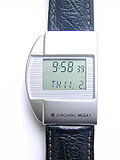
The company served as the official timekeeper for the 1972 Summer Olympics in Munich.[8][9] In the late 1980s, Junghans introduced the first radio-controlled table clock on the world market. In 1990 the first radio-controlled wristwatch, called the MEGA 1, followed, designed by Hartmut Esslinger and his firm Frog Design. In 1995 Junghans presented a solar-powered watch with ceramic housing. Together with the Japanese firm Seiko, Junghans developed a globally-oriented wristwatch that automatically sets the local time in respective time zones.[citation needed]

Junghans had been owned by Egana Goldpfeil from Hong Kong since the 1990s. In 2008, Egana Goldpfeil and Junghans went bankrupt. The Schramberg business man and politician Hans-Jochem Stein acquired the company with the 85 employees.[10]

Junghans defence industry

[edit]

The Junghans Microtec GmbH was a division of Junghans Uhren GmbH founded in the mid-1980s, which was formally spun out into a separate legal entity in 1999, and produces fuze-technology for artillery, mortar, medium-calibre, tanks, anti-tank and cruise missiles. Junghans Microtec is located in the small town of Dunningen-Seedorf, close to Schramberg. The company produces fuses for 76 mm to 203 mm artillery. The small German tank Wiesel AWC uses the Junghans fuse MFZ/M as a standard performance.[11]

According to a leaked diplomatic cable, the production facilities of Junghans Microtec GmbH would be endangered by terrorist attacks.[12]

Junghans timepieces (gallery)

[edit]

See also

[edit]

References

[edit]
[edit]
Revisions and contributorsEdit on WikipediaRead on Wikipedia
from Grokipedia
Junghans Uhren is a German manufacturer of precision watches and clocks, founded in 1861 by Erhard Junghans in , a town in the Black Forest region of . Initially focused on producing components for clockmakers, the company rapidly expanded under Erhard's leadership and his brother-in-law's involvement, transitioning to full timepiece assembly and achieving industrial-scale output. By 1903, Junghans employed 3,000 workers and had become the world's largest watch and clock factory, producing over three million units annually, a milestone driven by mechanized production techniques in the era's burgeoning horological industry. The firm maintained its prominence through the , ranking as the third-largest producer by 1956, behind only and , while introducing luminous dials in 1912 and advancing into wristwatches amid shifting market demands. Innovations continued with the development of Germany's first quartz watch in 1970 and the world's first radio-controlled analog wristwatch, the MEGA, in 1990, synchronizing with atomic time signals for unprecedented accuracy. Design collaborations, notably with starting in the 1950s, yielded minimalist Bauhaus-inspired models that blended functional precision with aesthetic simplicity, influencing modern horology. Today, Junghans continues at its original site, emphasizing in-house movements, integration, and radio-control technologies, while preserving its legacy of engineering excellence amid competition from Swiss and Asian producers. Its timepieces, from military-issued chronographs to high-end collections, reflect a commitment to reliability and innovation rooted in over 160 years of empirical refinement measurement.

History

Founding and Early Expansion (1861–1900)

Junghans was founded on 15 April 1861 in , in Germany's region, by Erhard Junghans and his brother-in-law Jakob Zeller-Tobler under the name Junghans und Tobler. The partners established a focused on producing components for clocks and watches, including dials, cases, pendulums, and other accessories, capitalizing on Erhard Junghans's prior experience in and the region's established clockmaking tradition. This industrialized approach marked a shift from the decentralized, artisanal methods typical of clockmakers, enabling higher volume production through mechanization. Following Zeller-Tobler's departure from the around , Erhard Junghans reorganized the firm, incorporating family members and transitioning toward complete timepieces by the early . The company produced wall clocks, regulators, and mantle clocks, emphasizing precision and reliability to meet growing domestic and export demand. Exports to markets across and beyond began in the late , supported by steam-powered machinery that boosted efficiency and output. By the 1880s, Junghans introduced its iconic star emblem—initially a five-pointed version in 1888, evolving to eight points by 1890—as a mark of quality on its products. The period saw steady workforce expansion, from a small initial team to hundreds of employees by century's end, driven by investments in factory infrastructure and specialization in standardized components. This growth positioned Junghans as Germany's preeminent clock producer by 1900, with annual production scaling toward millions of units and laying foundations for global leadership in horology.

Rise to Global Leadership (1901–1939)

By 1903, Junghans had established itself as the world's largest clock and watch manufacturer, employing over 3,000 workers in Schramberg and producing more than 3 million timepieces annually. This milestone followed the company's showcase of clocks at the 1900 Paris World's Fair, which boosted its international reputation and export capabilities. To support growing demand, Junghans expanded production facilities, establishing subsidiaries and factories in locations including Rottenburg, Schwenningen in Germany, Ebensee in Austria, Venice in Italy, and Paris in France. In 1906, the company diversified into by beginning production of ammunition fuses, leveraging its expertise in fine mechanics. Innovations in horology included the 1912 introduction of radium-based for and hands, enhancing visibility and functionality. The 1918 construction of a nine-story terrace building in symbolized industrial scale, accommodating expanded operations amid demands. Following the death of Arthur Junghans in 1920, his sons Erwin and Oscar assumed leadership, steering the firm toward wristwatch production starting in 1926–1928, initially sourcing movements externally before achieving full in-house capability by 1930. The 1930s marked further advancements, with Junghans launching the premium line in 1936 featuring the J80/2 movement and collaborating on early electric watches with the French firm ATO. These developments, combined with sustained high-volume output and global distribution networks, solidified Junghans' preeminence in the industry by 1939, positioning it as a leader in both consumer timepieces and precision components.

Wartime Production and Post-War Reconstruction (1939–1960)

During the Second World War, Junghans redirected substantial resources toward military production, capitalizing on its established expertise in precision timing mechanisms to fabricate fuses, detonators, and related devices for German armaments. Under director Erwin Junghans, the firm received direct orders for these components, expanding operations to support the with an estimated workforce exceeding 9,000 employees dedicated to such output. In addition to munitions components, Junghans manufactured specialized horological instruments for the branches, including cockpit clocks installed in aircraft and torpedo stopwatches for the . The company initiated development of the J88 wrist caliber as early as 1943, reflecting adaptations of civilian watchmaking for combat timing needs. After Germany's defeat in May 1945, Junghans' facilities faced severe disruption, with Allied occupation authorities dismantling and shipping key machinery to France for reparations, severely hampering operations. Civilian watch and clock production recommenced in 1946, amid broader economic reconstruction in the Western zones, though initial output was constrained by material shortages and processes. Building on wartime chronograph prototypes, Junghans introduced its in-house j88 wristwatch movement in 1946, marking an early innovation in mechanical timepieces. The firm gradually rebuilt its civilian portfolio, focusing on alarm clocks, wall models, and pocket watches to meet recovering domestic and export demand. In 1956, acquisition by the Diehl Group provided capital for modernization, enabling collaborations such as the minimalist designs by architect and the development of timepieces for the newly formed , including pilot watches issued from the late . By the end of the decade, Junghans had reasserted its position as a leading European producer, with annual output scaling toward pre-war levels.

Technological Revival and Challenges (1961–2000)

Following post-war reconstruction, Junghans pursued technological advancements in the and early , culminating in the development of technology. In 1970, the company presented a series of the Astro-Quartz, recognized as the first German wristwatch, which was commercially launched in 1971. This innovation positioned Junghans at the forefront of the emerging electronic horology trend, enabling precise timekeeping through a crystal oscillator vibrating at 32,768 Hz, a standard that became widespread in the industry. The shift to quartz represented an adaptive revival amid the global quartz revolution, which disrupted traditional mechanical watchmaking. Junghans embraced this by ceasing production of mechanical watches in 1976 to concentrate on and subsequent electronic developments, including early solar-powered quartz mechanisms. However, this pivot contributed to long-term challenges, as the company underestimated the enduring appeal of mechanical horology, leading to financial strains and a diminished market presence by the late and . The , originating from Japanese dominance in low-cost electronic watches, eroded profitability across European manufacturers, with Junghans facing intensified competition despite its pioneering efforts. In the 1980s, Junghans advanced further with radio-controlled timekeeping, introducing the world's first radio-controlled table clock in 1985, which synchronized via signals from atomic clocks such as the . This technology extended to wristwatches with the Mega 1 in 1990, the first radio-controlled analog wristwatch, featuring an antenna in the strap to receive long-wave time signals for automatic accuracy. Despite these breakthroughs, persistent economic pressures from market saturation and the failure to maintain mechanical expertise culminated in ownership changes and near-collapse by the , underscoring the risks of over-reliance on electronic innovations without diversified production.

Modern Era and Recent Innovations (2001–Present)

In 2008, Junghans faced alongside its Hong Kong-based owner Egana Goldpfeil, which had acquired the company in 2000. The following year, in , entrepreneur Dr. Hans-Jochem Steim and his son Hannes Steim purchased the brand, initiating a revival centered on returning full production to the original facility in and emphasizing in-house of movements and cases. This shift restored operational independence and prioritized traditional German craftsmanship combined with precision engineering. Under the Steim family's stewardship, Junghans advanced its radio-controlled technology, building on earlier MEGA models with updates like the 2005 Mega 1000, which integrated contemporary aesthetics with multi-band signal reception for enhanced accuracy. Solar power integration progressed in lines such as the Force Mega Solar and max bill MEGA Solar, featuring dials with embedded solar cells that charge a power reserve via calibre J615.84, enabling perpetual calendars and automatic time zone adjustments without battery replacements. By the 2020s, a dedicated mobile app extended global functionality for MEGA watches, allowing synchronization beyond European transmitters through smartphone-assisted signal processing. Collections like and saw iterative refinements, including the 2011 Meister Chronoscope with complications and Bauhaus-inspired updates in 2023, such as new Chronoscope variants and titanium-cased solar models. In 2018, the company renovated its historic terrace building to support expanded production capacity. Financially, Uhrenfabrik Junghans reported revenues exceeding 19 million euros in 2022, reflecting sustained demand for its precision timepieces amid a focus on sustainable, light-powered innovations. The brand marked its 160th anniversary in 2021 with limited-edition releases underscoring enduring commitments to minimalist design and technological reliability.

Defense Sector

Origins in Precision Engineering for Munitions

Junghans' entry into for munitions originated from its established expertise in watchmaking, founded in , , on April 14, 1861, by Erhard Junghans as a producing clock components and later full timepieces. The company's proficiency in crafting intricate mechanical movements with high accuracy—essential for reliable timekeeping—provided the foundational skills for developing timing mechanisms applicable to military ordnance. By the early 1900s, under the leadership of Arthur Junghans, these capabilities were adapted to create safety-critical devices for , marking the birth of a parallel defense-oriented production line distinct from horology. In 1905, Junghans developed its first mechanical time , a pioneering device that utilized miniaturized mechanisms to initiate at predetermined intervals after launch. This stemmed directly from the of small movements honed in watch production, enabling reliable performance under the extreme conditions of and mortar shells, such as high acceleration and vibration. The fuze's design prioritized soldier safety through robust arming sequences and resistance to premature activation, establishing Junghans as an early innovator in munitions timing technology ahead of widespread demands. This initial foray into production laid the groundwork for Junghans' defense sector, transforming watchmaking precision into a strategic asset for munitions reliability. By integrating mechanical tolerances measured in fractions of seconds, the company addressed the causal need for exact timing to maximize effectiveness while minimizing risks like duds or unintended explosions. Subsequent expansions in the , including adaptations for mortar systems, built on this 1905 milestone, with production scaling during wartime to meet military specifications for and applications.

Key Developments in Fuses and Ignition Systems

Junghans initiated its involvement in fuze technology in 1905, when Arthur Junghans adapted precision watchmaking movements to develop the company's first mechanical time , enabling delayed ignition for projectiles. This innovation leveraged the firm's expertise in and timing mechanisms, marking the start of a dual focus on horology and munitions components. By , production expanded to include timing devices, detonators, and fuzes, establishing a foundation for applications. During , Junghans extended operations to France in 1914, supplying fuzes for the Brandt mortar system, which required reliable mechanical impact and time functions to ensure precise amid variable conditions. Post-war, the company refined mechanical designs, incorporating safety features like wind wheel mechanisms for arming only after launch acceleration, as seen in later mortar fuzes such as the DM111S impact fuze with optional delay. These developments prioritized mechanical reliability over electronic dependency, achieving high in-flight stability for calibers from 60 mm to 120 mm. The 1950s introduced electronic elements through collaborations with TRT-Philips and , transitioning from purely mechanical systems to hybrid designs that enhanced timing accuracy and adaptability. The 1957 acquisition by the Diehl Group accelerated this shift, bolstering resources for advanced and mechanisms. By the , following the 1984 separation of operations from watchmaking, Junghans focused on electronic and devices (ESAD), integrating low-energy exploding foil initiators (LEEFI) for slapper detonators that provide precise, low-voltage ignition with reduced electromagnetic vulnerability. Modern advancements emphasize multi-option combining mechanical and electronic functions, such as the FBM21 tail-cockpit programmable bomb , which uses ESAD-LEEFI technology for STANAG 4187-compliant , enabling impact, proximity, or time modes with over 98% reliability. Innovations like open wind wheel concepts in mortar improve environmental resilience, while LEEFI-based firesets minimize size and cost constraints in systems from 76 mm to 203 mm. Recent contracts, including a 2024 framework for 180,000 programmable time fuzes for German 155 mm and a 2025 agreement for Swedish Archer munitions, underscore ongoing refinements in electronic ignition for high-precision, .

Current Capabilities, Partnerships, and Strategic Role

JUNGHANS Defence, formed as a between Germany's Diehl Group and France's , maintains advanced capabilities in designing and manufacturing fuzes integrating precision mechanics, electronics, and sensor technologies for enhanced safety and performance. These encompass multi-option fuzes such as the series, which autonomously select modes like impact, proximity, or time based on target detection; electronic time fuzes like the DM52 for 155mm illuminating and smoke shells; and fully electronic bomb fuzes including the FBM21 with EFI/LEEFI detonators for bombs, rockets, missiles, and torpedoes. The company also produces impact, proximity, and time fuzes for mortars featuring wind-wheel safety mechanisms, as well as magnetic-inductive programmed fuzes for direct-fire and munitions. Products adhere to standards including AOP, STANAG, and MIL-STD, enabling reliable operation across army, naval, and air domains. Key partnerships extend beyond the Diehl-Thales structure, including a January 2025 strategic collaboration with AS to develop integrated 30mm medium-caliber and systems, leveraging Nammo's propulsion expertise with JUNGHANS' innovations. Government contracts underscore operational ties, such as a seven-year signed in May 2025 with Sweden's FMV for fuzes compatible with the Archer system; an October 2024 German procurement of 180,000 time fuzes for 155mm ; and multiple deals with MSM Group in 2024 for hundreds of thousands of fuzes. Internationally, a 2022 distribution agreement with Australia's supports 155mm fuze supply for army munitions, while NATO's NSPA awarded €1.1 billion in contracts in January 2024 involving JUNGHANS for 220,000 155mm rounds, aiding stock replenishment. Strategically, JUNGHANS Defence holds a leading position as Europe's primary supplier of fuzing systems and safety-arming devices, critical for munitions reliability in modern conflicts where precise enhances effectiveness and reduces collateral risks. Its role supports interoperability and rapid scaling of ammunition production, as evidenced by contributions to post-2022 Ukraine invasion stockpile restorations across European allies, ensuring armed forces maintain deterrence amid escalating threats from state actors like .

Horological Products and Innovations

Clocks and Mantle Pieces

Junghans expanded from clock components to complete timepieces in the , producing around 100 clocks daily by 1870, encompassing wall, shelf, and mantle varieties. Mantle clocks, designed for placement on fireplaces or shelves, typically incorporated spring-driven movements offering 8-day power reserves, with options for timekeeping, striking hours, and Westminster chimes. These models often featured or cases, sometimes with influences in the and , and beveled glass panels for dial visibility. The model, documented in the 1915 Junghans catalogue, exemplifies early 20th-century mantle clocks with a 14-day runtime variant, silvered dial, and time-and-strike functionality, measuring approximately 28.5 cm in height. Production date codes, introduced in 1901, aid in authenticating these pieces, such as those stamped "B13" indicating manufacture in the second half of 1913. Additionally, 1912 catalogues highlighted 400-day clocks suitable for mantle display, featuring shades, metal stands, and garland dials in carved fumed cases. By the mid-20th century, Junghans continued mantle clock production, including models like No. 3452 with mechanical movements, though emphasis shifted toward watches post-World War II. The company's archive catalogues, such as the 1979 Kleinuhren (small clocks) edition, reflect ongoing output of compact table and mantle designs amid broader horological diversification. Overall, Junghans mantle clocks contributed to their peak as the world's largest clock producer in 1903, outputting over 3 million units annually with 3,000 employees.

Mechanical and Automatic Watches

Junghans produces mechanical and automatic watches primarily within its and collections, drawing on the company's heritage established since the late . Mechanical movements in these timepieces rely on traditional mechanisms powered either by manual winding or self-winding rotors, offering power reserves typically ranging from 38 to 42 hours. The line, originally designed by Swiss architect in collaboration with Junghans starting in 1951, features minimalist Bauhaus-inspired aesthetics with automatic variants equipped with the self-winding calibre J800.1, assembled in Germany with meticulous finishing. This ETA 2824-2 derivative includes 25 jewels, hacking seconds, and a 38-hour power reserve, encased in 38 mm cases with 10 mm thickness and 5 bar water resistance. Date complications are standard, displayed via a window at 3 o'clock, while sapphire crystals provide anti-reflective protection. Limited to puristic dials with slim indices and luminescent hands, these models emphasize legibility and form-follows-function design principles. In the Meister collection, automatic watches incorporate self-winding movements such as the J810.5 calibre in models like the Calendar, delivering a 42-hour power reserve and additional functions including day-date displays. Chronoscope variants feature mechanical chronographs with flyback capabilities, often powered by calibre J880.2, supporting 30-minute and 12-hour counters alongside small seconds sub-dials. Case diameters range from 38 mm for classic pieces to 44 mm for sportier iterations, with options for bracelets or leather straps and water resistance up to 10 bar in select models. Hand-winding options, like the Erhard Junghans 1 with calibre J325, highlight intricate finishing and traditional drive trains. These movements undergo rigorous in-house testing at Junghans' facility, ensuring accuracy within standards where applicable, though the brand prioritizes reliable everyday performance over certification in most production models. Revival of mechanical production post-quartz crisis in the underscores Junghans' commitment to horological traditions amid competition from electronic alternatives. Junghans watches, particularly in the max bill and Meister lines, hold appeal among collectors due to their historical significance in German horology, enduring Bauhaus-influenced designs, and the scarcity of certain limited editions and vintage models. These factors contribute to appreciation in the secondary market, where pre-owned pieces often retain strong demand and can command prices starting from around $300 for accessible models, reflecting their heritage without positioning them as ultra-luxury investment watches comparable to brands like Rolex or Patek Philippe.

Quartz, Radio-Controlled, and Solar Technologies

Junghans entered the quartz era by introducing Germany's first wristwatch in 1971, featuring an innovative movement with an indirect central seconds hand. This development marked a shift toward electronic timekeeping, enabling greater accuracy than mechanical movements while maintaining the company's heritage. The watches served as official timepieces for the 1972 Olympics, underscoring Junghans' reliability in high-stakes applications. In radio-controlled technology, Junghans pioneered the world's first analog radio-controlled wristwatch with the Mega model in 1991, synchronizing time via long-wave signals from transmitters like DCF-77 in . The Mega 1, introduced around 1990, featured an antenna in the strap for digital reception, evolving into multi-frequency capabilities that receive signals from global sources including and . Subsequent innovations include intelligent radio-controlled movements in lines like and Mega, offering automatic adjustments and perpetual calendars for enhanced precision without manual intervention. Solar technology integrates with radio-controlled systems in models such as the Mega Solar and Milano Mega Solar, where solar cells embedded in the dial harvest light to power the movement indefinitely. These eco-efficient designs, introduced in recent collections, combine photovoltaic energy with multi-band radio , achieving accuracies measured to micrometers during production. By 2023, Junghans expanded solar offerings with titanium-cased variants supporting app-based adjustments, emphasizing and self-sufficiency in modern horology.

References

Add your contribution
Related Hubs
User Avatar
No comments yet.