Hubbry Logo
Kahan CommissionKahan CommissionMain
Open search
Kahan Commission
Community hub
Kahan Commission
logo
8 pages, 0 posts
0 subscribers
Be the first to start a discussion here.
Kahan Commission
Kahan Commission
from Wikipedia
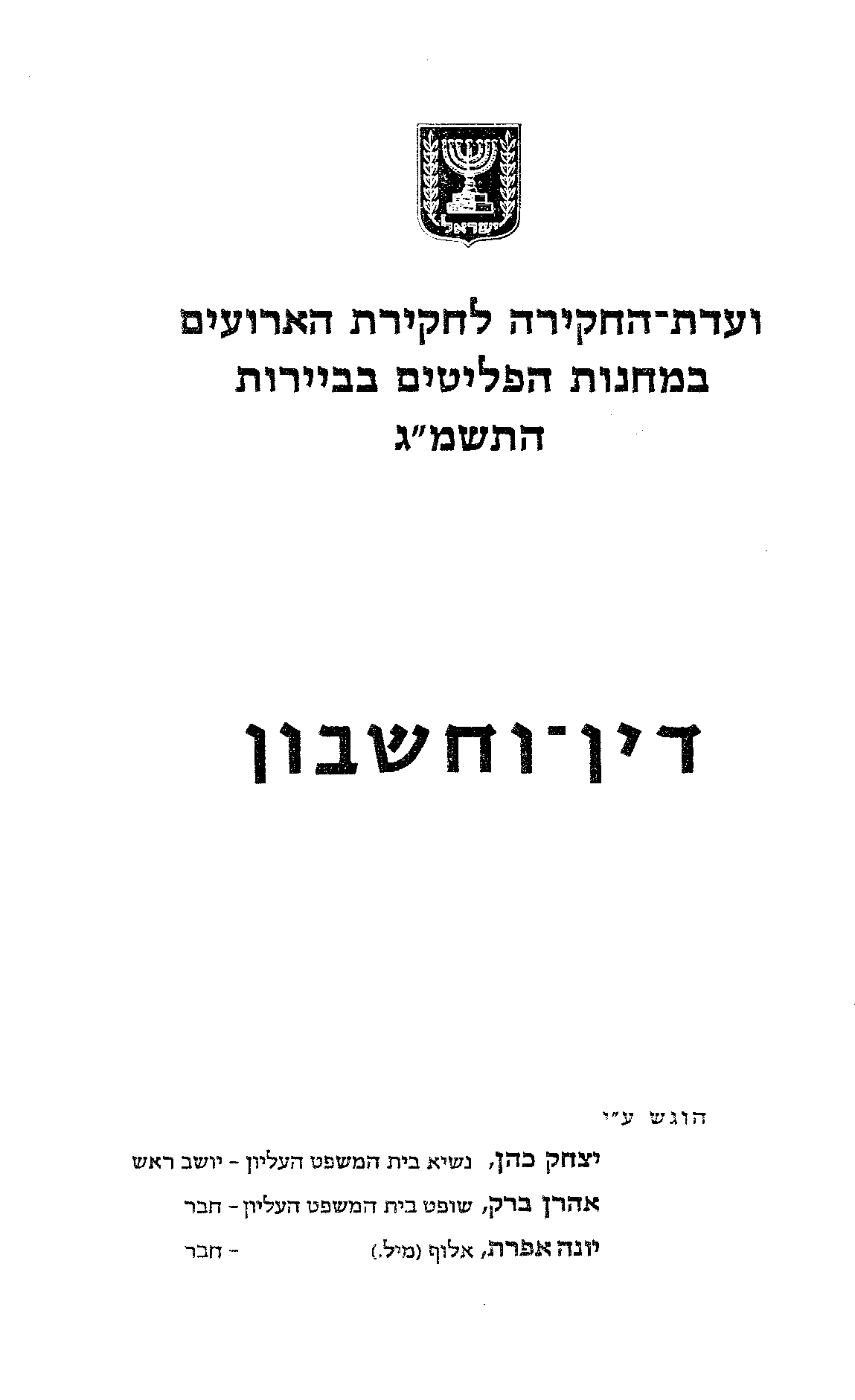
Front page of Kahan Commission report

The Kahan Commission (ועדת כהן), formally known as the Commission of Inquiry into the Events at the Refugee Camps in Beirut, was established by the Israeli government on 28 September 1982, to investigate the Sabra and Shatila massacre (16–18 September 1982). The Kahan Commission was chaired by the president of the Supreme Court, Yitzhak Kahan. Its other two members were Supreme Court Judge Aharon Barak, and Major general (res.) Yona Efrat. The Commission was to make recommendations on Israeli involvement in the massacre through an investigation of:

[A]ll the facts and factors connected with the atrocity carried out by a unit of the Lebanese Forces against the civilian population in the Shatilla and Sabra camps.

Following a four-month investigation, on 8 February 1983, the Kahan Commission submitted its report, which was released to the public by spokesman Bezalel Gordon simultaneously in Hebrew and English. It concluded that "direct responsibility" rested with the Gemayel Phalangists led by Fadi Frem, and that no Israelis were deemed "directly responsible", although Israel was held to be "indirectly responsible".

The decision on the entry of the Phalangists into the refugee camps was taken without consideration of the danger - which the makers and executors of the decision were obligated to foresee as probable - the Phalangists would commit massacres and pogroms against the inhabitants of the camps, and without an examination of the means for preventing this danger. Similarly, it is clear from the course of events that when the reports began to arrive about the actions of the Phalangists in the camps, no proper heed was taken of these reports, the correct conclusions were not drawn from them, and no energetic and immediate action were taken to restrain the Phalangists and put a stop to their actions.

The Defence minister Ariel Sharon was found to bear "personal responsibility"[1] for "ignoring the danger of bloodshed and revenge" and "not taking appropriate measures to prevent bloodshed". Sharon's negligence in protecting the civilian population of Beirut, which had come under Israeli control, amounted to a "non-fulfillment of a duty with which the Defence Minister was charged", and it was recommended that Sharon be dismissed as Defence Minister.

Initially, Sharon refused to resign, and Prime Minister Menachem Begin refused to fire him. However, following a peace march against the government, as the marchers were dispersing, a grenade was thrown into the crowd, killing Emil Grunzweig, a reserve combat officer and peace activist, and wounding half a dozen others, including the son of the Interior Minister.[2] Although Sharon resigned as Defence Minister, he remained in the Cabinet as a Minister without Portfolio. Years later, Sharon would be elected Israel's Prime Minister.

The Commission arrived to similar conclusions with respect to Chief of Staff, Lt. Gen. Rafael Eitan ("tantamount to a breach of duty that was incumbent upon the Chief of Staff"), as well as Director of Military Intelligence, Major general Yehoshua Saguy, and other Intelligence officials — though the Mossad was not reprimanded and parts of the report commenting on its role remain under military censorship.

Critics of the Commission point to its limited scope, some of whom argue it amounted to a whitewash.[3] The final paragraph of the report anticipated such reaction: "We do not deceive ourselves that the results of this inquiry will convince or satisfy those who have prejudices or selective consciences, but this inquiry was not intended for such people. We have striven and have spared no effort to arrive at the truth, and we hope that all persons of good will who will examine the issue without prejudice will be convinced that the inquiry was conducted without any bias."

Israel's standing in the international community, which had sunk to an all-time low in the wake of the massacre, rebounded following the publication of the report. Israel was praised from many quarters for having investigated itself and punishing senior members of its government.[4] Richard Falk noted that the "sincere and careful" report was "much more devastating in its impact on the evaluation of state leadership during the Lebanon War than any self-scrutiny that the American government allowed during the Vietnam War."[5]

See also

[edit]

References

[edit]
[edit]
Revisions and contributorsEdit on WikipediaRead on Wikipedia
from Grokipedia
The Kahan Commission, formally known as the Commission of Inquiry into the Events at the Camps in , was an independent Israeli judicial body established on 28 September 1982 by the Israeli government to investigate the circumstances of the , in which Lebanese Phalangist militias killed hundreds to thousands of and Lebanese civilians in Beirut's refugee camps from 16 to 18 September 1982, shortly after the assassination of Phalangist leader Bashir Gemayel. Chaired by former Israeli Supreme Court President Yitzhak Kahan, with Supreme Court Justice and Major General (ret.) Yona Efrat as members, the commission conducted a four-month inquiry involving witness testimonies and document reviews, culminating in a report released on 8 February 1983. The report determined that the massacres were perpetrated solely by Phalangist forces, with no direct participation by Israeli Defense Forces (IDF) personnel, but attributed indirect responsibility to Israeli military and political leaders for allowing the Phalangists entry into the camps despite awareness of their potential for revenge killings, given the IDF's effective control over the surrounding area. It specifically held Defense Minister personally responsible for disregarding warnings of possible bloodshed and for decisions that facilitated the Phalangists' actions, recommending his removal from office and barring him from future security-related governmental roles; Sharon resigned as defense minister on 14 February 1983 but retained a cabinet position without portfolio. Other officials, including and intelligence chief Yehoshua Saguy, received lesser reprimands, underscoring the commission's emphasis on command accountability amid Israel's involvement in the . The inquiry represented a rare instance of high-level self-scrutiny in Israeli , prompted by massive domestic protests and international condemnation, though critics contended it minimized broader strategic culpability in the war's context.

Background

Historical Context of the 1982 Lebanon War

The (PLO), expelled from Jordan following the events of 1970, established extensive military bases in , amassing an estimated 15,000–18,000 fighters equipped with Katyusha rockets, artillery, tanks, and anti-aircraft systems. From these positions, the PLO conducted cross-border attacks on northern Israeli communities, including 270 terrorist actions between July 1981 and June 1982 that killed 29 Israelis and injured over 300 others. Lebanon's ongoing civil war, which erupted in 1975 between Maronite Christian factions and a coalition of Muslim militias allied with Palestinian groups, allowed the PLO to exert de facto control over much of , exacerbating regional instability amid Syrian military intervention since 1976. Israel had previously responded with limited operations, such as the March 1978 Litani campaign to dismantle PLO infrastructure near the border, followed by a U.S.-brokered in July 1981 that the PLO repeatedly violated through shelling and raids. The immediate trigger for escalation occurred on June 3, 1982, when Shlomo Argov was critically wounded in an assassination attempt in by militants from the , a PLO splinter group. retaliated on June 4 with airstrikes on PLO targets in , prompting PLO artillery barrages on northern ; the next day, June 5, the IDF launched Operation Peace for Galilee, deploying approximately 60,000 troops to push PLO forces beyond a 40-kilometer and neutralize their threat to Israeli civilians. The operation's objectives included destroying PLO military infrastructure and addressing Syrian deployments in the Bekaa Valley, which supported anti- forces. Israeli forces rapidly advanced, capturing key southern cities like Tyre and by June 8, and on June 9 conducted , destroying 15 Syrian surface-to-air missile batteries and downing 29 Syrian aircraft to achieve air superiority. By mid-June, IDF units encircled , initiating a that tightened control over the city's southern districts and airport while pressuring PLO and Syrian elements. The siege persisted until late August, culminating in the supervised evacuation of over 14,000 PLO fighters from to and other Arab states by August 31, 1982, under international guarantees for the safety of remaining Palestinian civilians in camps. Israeli troops maintained positions in and around West to secure the area amid ongoing Lebanese factional violence, setting the stage for subsequent events involving allied Phalange militias.

Assassination of Bashir Gemayel and Immediate Aftermath

On September 14, 1982, Bashir Gemayel, the president-elect of Lebanon and commander of the Lebanese Forces militia aligned with Israel, was killed in a bomb explosion at the Phalangist Party headquarters in the Achrafieh district of East Beirut. The detonation occurred during a party meeting, destroying the building and killing Gemayel along with approximately 26 to 32 other individuals. Responsibility was attributed to Habib Shartouni, a Lebanese member of the pro-Syrian Syrian Social Nationalist Party, who planted roughly 65 kilograms of explosives and later confessed to the act, claiming it aimed to thwart Gemayel's perceived subservience to Israeli interests. A Lebanese military court issued a death sentence in absentia against Shartouni in 2017 for the bombing. The assassination, occurring just nine days before Gemayel's scheduled inauguration following his election on August 23, 1982, created a amid Lebanon's ongoing and recent Israeli military operations against Palestinian Liberation Organization (PLO) forces. Syrian-backed factions were widely suspected due to Gemayel's opposition to Syrian influence in Lebanon and his alliance with during the . In the immediate hours following the blast, Phalangist militiamen and supporters mourned publicly while clashing sporadically with rival groups, heightening sectarian tensions in . Israel, which had supported Gemayel's as a bulwark against Syrian and PLO dominance, viewed the killing as a direct threat to its strategic objectives in . On September 15, Israeli Defense Forces (IDF), under orders from Defense Minister , advanced into West —previously a designated neutral zone under the evacuation agreement for PLO fighters—surrounding including Sabra and Shatila to preempt retaliatory attacks and the area. This incursion, justified by Israeli officials as necessary to prevent anarchy, facilitated the entry of Phalangist forces into the camps under IDF oversight, setting the stage for subsequent events. Gemayel's brother, Amine Gemayel, was elected president by parliament on September 21, 1982, in a session amid heavy , signaling a continuation of Phalangist leadership but with diminished Israeli leverage.

The Sabra and Shatila Massacre

The Sabra and Shatila massacre took place from September 16 to 18, 1982, in the adjacent Palestinian refugee camps of Sabra and Shatila located in West Beirut, Lebanon. The perpetrators were units of the Lebanese Phalange militia, a Christian Lebanese force allied with Israel during the 1982 Lebanon War, numbering approximately 150 fighters who entered the camps on the evening of September 16. This followed the September 14 assassination of Phalange leader Bashir Gemayel, the president-elect of Lebanon, which the militia attributed to Palestinian elements despite the PLO's evacuation from Beirut in late August under an international agreement supervised by multinational forces. The Phalangists proceeded to kill camp residents indiscriminately, targeting civilians including children, women, and the elderly, in acts of revenge; estimates of the death toll range from 700 to 800 according to the subsequent Israeli inquiry, though other accounts cite figures up to 3,500. Israeli Defense Forces (IDF) had advanced into West Beirut on September 15, surrounding the camps amid concerns over remaining armed Palestinian fighters after the PLO's withdrawal. Phalange entry into the camps was coordinated with IDF approval to conduct operations against suspected terrorists, with Israeli forces providing illumination via flares during nighttime hours and positioned at entry points. Throughout September 17, IDF personnel reported hearing bursts of gunfire and observing unusual activity, including militiamen exiting with civilians, but initial assessments attributed this to anti-terrorist actions rather than systematic killings. The scale of the violence became clearer by September 18 morning, when IDF commanders demanded the Phalangists withdraw, halting their presence in the camps by midday. The massacre's victims were primarily and poor Shiite Lebanese residents of the overcrowded camps, with reports documenting executions, rapes, and mutilations amid widespread destruction of homes and infrastructure. International observers, including journalists and Red Cross workers, accessed the sites post-withdrawal on September 18, documenting mass graves and unburied bodies, which prompted global outrage and UN Security Council resolutions condemning the events. In , public protests erupted upon confirmation of the killings, leading to the government's appointment of an inquiry commission on September 28. The Phalange leadership, under , directed the operation, though internal Lebanese investigations into perpetrator accountability yielded no prosecutions.

Establishment and Mandate

Israeli Government Decision

On September 28, 1982, the Israeli Cabinet met and resolved to establish a commission of inquiry into the atrocities committed by Phalangist militias at the Sabra and Shatila refugee camps in between September 16 and 18, 1982. The decision invoked Israel's Commissions of Inquiry Law of 1968, which authorizes independent panels to investigate matters of public importance, and specified examination of all facts, factors, and responsibilities connected to the events, including Israeli political and oversight of the Phalangists' operations. This step responded to intense domestic and international pressure following media disclosures of the massacre, which killed hundreds to thousands of Palestinian civilians under the watch of surrounding Israel Defense Forces units that provided illumination flares and coordination. In Israel, widespread protests drew hundreds of thousands to the streets, with demonstrators holding the government accountable for indirect facilitation of the killings despite the Phalangists' independent execution. Internationally, the events drew condemnation and scrutiny of Israel's role in the 1982 Lebanon War, prompting the inquiry as a means to affirm democratic self-scrutiny and clarify potential oversights by officials such as the defense minister and chief of staff in authorizing Phalangist entry to the camps. The resolution tasked the commission with determining degrees of direct and indirect responsibility to guide any subsequent accountability measures. The Kahan Commission, formally the Commission of Inquiry into the Events at the Refugee Camps in , derived its authority from Israel's Commissions of Inquiry Law, 5729-1968, which authorizes the government to establish panels for investigating issues of substantial public and national significance, granting them quasi-judicial powers to summon witnesses, compel testimony, and assess evidence under oath. This law stipulates that commissions typically comprise three members, appointed after consultation with the President of the , and empowers them to recommend actions based on findings without direct prosecutorial authority. The , enacted on December 30, 1968, aims to provide transparent, independent scrutiny of government actions amid public outcry, as occurred following the September 16–18, 1982, in the Sabra and Shatila camps. On September 28, 1982, the Israeli Cabinet invoked this law to formally establish the commission, responding to domestic protests and international criticism over the events in West Beirut, where Israeli Defense Forces (IDF) units encircled the area while militias entered the camps. The decision appointed former President Yitzhak Kahan as chairman, alongside Justice and (Reserve) Yona Efrat, aligning with the law's requirement for expertise in law, administration, or relevant fields. The commission's mandate was narrowly defined to encompass "all the facts and factors connected with the atrocity carried out by a unit of the Lebanese Forces against the civilian population in the Shatila and Sabra camps," with particular emphasis on Israeli decision-making, knowledge of risks, and preventive measures during the IDF's operational control of West Beirut from September 15 onward. This included scrutiny of the authorization for Phalangist entry into the camps, IDF illumination and perimeter activities, communications between military and political echelons, and any indirect facilitation or failure to halt the killings, but explicitly excluded broader review of the Lebanese Forces' internal operations or the overall Lebanon War strategy. The terms of reference prioritized determining degrees of responsibility—direct, indirect, or personal—among Israeli officials, focusing on ethical and operational lapses rather than criminal liability, as the law permits recommendations for dismissal or reprimand but not formal charges.

Composition and Proceedings

Commission Members

The Kahan Commission was composed of three members selected for their expertise in and military affairs, in accordance with Israel's Commissions of of 1968, which authorizes the government to appoint panels for independent investigations. The chairman was Kahan, who had been appointed President of the in 1982, shortly before the commission's establishment on September 28, 1982; Kahan's judicial background included service as a Supreme Court justice since 1969 and prior roles in legal advisory positions during Israel's early statehood. The other judicial member was , a sitting Justice of the at the time of his appointment; Barak had previously served as Israel's from 1978 to 1981 and as deputy before that, bringing experience in constitutional and to the panel. To provide military perspective on operational decisions during the , the commission included Yona Efrat, a Major General in the reserves who had retired after commanding roles, including as head of the IDF's Northern Command planning branch. This trio was tasked with examining testimonies from 58 witnesses over 60 sessions, reflecting a deliberate effort to combine civilian judicial oversight with operational military insight, though critics later noted the members' establishment ties potentially influenced the inquiry's framing of Israeli responsibility.
MemberRole in CommissionKey Background Qualifications
Yitzhak KahanChairmanPresident of the (1982–1983); former Justice (1969–1983)
Aharon BarakMember Justice; former (1978–1981)
Yona EfratMemberMajor General (Res.); retired IDF officer with command experience

Investigative Methods and Testimonies

The employed staff investigators to collect preliminary evidence, obtaining 180 statements from 163 witnesses, including Israeli military personnel, Phalangist representatives, and foreign observers. The commission itself convened 60 sessions between late September and early February 1983, directly examining 58 witnesses under mostly in-camera proceedings to address security and diplomatic sensitivities. Investigative methods included reviewing extensive documentation from Israeli and archives, such as operational logs and reports designated as exhibits (e.g., Exhibit 1240), alongside analysis of television footage depicting events in the refugee camps. A planned site visit to occurred, though access to the Sabra and Shatila camps was denied, limiting direct on-site verification. Public submissions were solicited but yielded minimal responses, prompting reliance on official channels for additional materials. Key testimonies featured senior Israeli officials, including Defense Minister , who appeared on October 26, 1982, and addressed the decision to deploy Phalangist forces; ; Northern Command head Rafael Drori; and 96th Division commander Amos Yaron, who detailed on-the-ground reports of Phalangist activities. Military intelligence director Yehoshua Saguy and journalist Ron Ben-Yishai also testified regarding prior knowledge and real-time communications about civilian casualties. Phalangist liaison officer "G." provided accounts of casualty estimates, while foreign witnesses, such as doctors Ang and Morris and nurse Siegel, offered medical perspectives on the aftermath. Lower-ranking personnel, including Lieutenant Elul, reported specific interactions with Phalangist commanders implying intent toward civilians. These accounts focused on timelines of events from September 16-18, 1982, illumination flares provided by IDF units, and interpretations of incoming intelligence.

Key Findings

Attribution of Direct Responsibility

The Kahan Commission placed direct responsibility for in the Sabra and Shatila camps squarely on the Phalangist militias affiliated with the . These forces, comprising approximately 150 fighters mainly from an intelligence unit, entered the camps on September 16, 1982, and conducted killings over the following two days, resulting in an estimated 700–800 victims among civilians and combatants. The commission identified , head of the Phalangist intelligence division, as a key commander overseeing the operation from a forward post near the camps. from an Israeli liaison officer recounted Hobeika's response to a query about sparing 50 women and children: "This is the last time you're going to ask me a question like that, you know exactly what to do," followed by laughter, signaling deliberate endorsement of indiscriminate killings. No Israeli Defense Forces personnel entered the camps or participated in the atrocities, which the commission described as acts perpetrated by the Phalangists acting on their own initiative, driven by revenge for the assassination of Bashir Gemayel and prior conflicts with Palestinian factions. The report emphasized that the direct perpetrators bore accountability for failing to distinguish between combatants and non-combatants, amid a pattern of Phalangist reprisals during Lebanon's .

Assessment of Indirect Israeli Involvement

The Kahan Commission determined that while no Israeli personnel bore direct responsibility for the atrocities committed in the Sabra and Shatila camps between and 18, 1982, the State of held indirect responsibility due to systemic failures in oversight and anticipation of risks. The Commission emphasized that Israeli Defense Forces (IDF) commanders, aware of the Phalangist militias' vengeful disposition following the assassination of Bashir Gemayel—attributed to Palestinian elements—nonetheless facilitated their entry into the camps under the pretext of rooting out remaining () fighters. This decision, coordinated with Phalangist leaders on September 15, aimed to minimize IDF casualties after the IDF had already secured the perimeter of the camps, with approximately 100-150 Phalangist fighters entering Sabra camp that evening supported by IDF illumination flares and logistical coordination. The Commission's assessment hinged on the foreseeability of civilian harm, given historical precedents of Phalangist brutality, including massacres in Tel al-Zaatar in 1976 and the in 1976, which Israeli intelligence had documented. Despite these indicators, senior IDF and intelligence officials dismissed the likelihood of mass killings, prioritizing alliance with the Phalangists as proxies in post-PLO . Once the massacres commenced, reports of indiscriminate killings—relayed via IDF observers embedded with Phalangist units and eyewitness accounts from camp perimeters—were not acted upon decisively; for instance, on , notifications to IDF divisional command about executions of civilians prompted only partial interventions, such as halting bulldozers used to bury bodies, but failed to expel the militias or deploy IDF forces to halt operations until September 18. The Commission faulted this inaction as a dereliction, noting that IDF presence could have deterred or terminated the events, thereby attributing indirect complicity to the permissive environment created by Israeli military control. Further, the inquiry highlighted lapses in intelligence dissemination and command accountability, where and assessments of Phalangist reliability were overridden by operational imperatives, leading to inadequate precautions like explicit orders against harm. The Commission rejected claims of deliberate indifference, instead framing the indirect responsibility as rooted in erroneous judgments and insufficient preventive measures, which enabled the Phalangists—responsible for an estimated 700-3,500 deaths, predominantly non-combatants—to operate unchecked within IDF-secured zones. This conclusion underscored a broader institutional to uphold Israel's against targeting, as articulated in pre-invasion directives, without implicating any premeditated Israeli intent.

Evaluations of Specific Officials

The Kahan Commission assigned degrees of indirect responsibility to several Israeli officials for acts of omission or that contributed to the failure to anticipate or halt the Phalangist killings in the Sabra and Shatila camps between September 16 and 18, 1982. While emphasizing that no Israeli forces directly perpetrated the atrocities, the report criticized systemic insensitivity and inadequate oversight, particularly in light of the Phalangists' known animus toward following the of Bashir Gemayel on , 1982. Defense Minister bore the heaviest personal responsibility among civilian leaders, as he decided—without prior consultation with —to authorize Phalangist entry into the camps on September 15, 1982, in concurrence with Chief of Staff , while disregarding foreseeable risks of killings. The Commission concluded that Sharon "made a grave mistake when he ignored the danger of acts of and bloodshed" by the Phalangists against noncombatants and failed to implement protective measures or ensure timely withdrawal upon initial reports of atrocities. It recommended his , noting that he should be removed from office under Section 21-A(a) of the if he did not step down voluntarily; Sharon resigned as Defense Minister on November 14, 1982, but retained a cabinet seat without portfolio. Chief of Staff Lt. Gen. shared significant personal responsibility for concurring in the decision to deploy the Phalangists, underestimating risk despite intelligence on their vengeful mindset, and delaying orders to stop their operations after early reports of killings surfaced. The report drew "grave conclusions" regarding Eitan's acts and omissions, including his failure to escalate concerns or demand illumination of the camps, which might have deterred or exposed the atrocities; however, no practical sanctions were recommended, as his term was set to expire in April 1983. Prime Minister Menachem Begin was faulted for indirect responsibility due to indifference after learning of the Phalangist entry during a cabinet session on September 16, 1982—approximately 36 hours after the decision—and for not inquiring into their progress or mitigating evident dangers, though he was not deemed directly involved. The Commission attributed this to defects in his oversight duties rather than personal fault, recommending consideration of his removal under legal provisions but stopping short of demanding it. Foreign Minister incurred indirect responsibility for erring in not pursuing a September 17, 1982, report from Minister of Energy Yitzhak Modai (via Aharon Naftali Zipori) of Phalangist "unruliness," dismissing it due to skepticism toward the source rather than verifying amid rising concerns. Director of Maj. Gen. Yehoshua Saguy was held accountable for serious omissions in failing to issue explicit warnings about Phalangist revenge risks post-Gemayel assassination, recommending he not continue in his role. Brig. Gen. Amos Yaron, commanding the forces encircling the camps, was found to have significant responsibility for inadequate reporting of initial killings and insensitivity to the situation, barring him from field command for three years. The head faced no substantial blame, as his post-decision awareness on September 16 did not constitute a serious breach.

Recommendations and Consequences

The Kahan Commission recommended the removal of Defense Minister from his post, attributing to him personal responsibility for disregarding intelligence warnings about the risk of massacres in the Sabra and Shatila camps and for failing to adopt measures that could have prevented or halted the bloodshed. The report specified that Sharon had been informed on September 16, 1982, of potential dangers posed by Phalangist forces entering the camps, yet proceeded with the decision without sufficient safeguards, exacerbating the indirect Israeli involvement. It further stipulated that Sharon should not hold any public office bearing responsibility for state security matters unless approved by a three-fifths majority in the , emphasizing the gravity of his oversights in decision-making processes during the operation. For IDF Chief of Staff Lt. Gen. , the Commission advised against reappointment following the end of his term in early 1983, holding him accountable for not preventing the Phalangists' entry into the camps despite his authority and for ignoring initial reports of killings on , 1982. Eitan was criticized for downplaying the Phalangists' potential for revenge-driven violence and for inadequate supervision of forces illuminating the camps, which facilitated the atrocities. The report also called for the immediate dismissal of Director of Maj. Gen. Yehoshua Saguy, faulting him for failing to deliver a comprehensive and accurate assessment of the Phalangists' intentions and capacities to Israeli leadership prior to their deployment. Saguy's lapses included underestimating sectarian animosities and not emphasizing the risks in briefings, which contributed to the flawed decision-making chain. Lower-level military personnel faced targeted sanctions, including the removal from command positions of Brig. Gen. Amos Yaron, the divisional commander in , for not intervening forcefully enough upon receiving reports of around 8:00 p.m. on September 17, 1982, despite his proximity and operational control. The head of the branch in was recommended for transfer out of sensitive roles due to delays in relaying critical on-site updates about the killings. Several other officers, such as those in the operations branch, received formal reprimands for procedural failures in monitoring and responding to the events unfolding between September 16 and 18, 1982. These actions were framed as necessary to restore accountability within the IDF command structure without implicating direct perpetration by Israeli forces.

Implementation and Resignations

The Israeli cabinet convened multiple sessions following the Kahan Commission's report on February 8, 1983, debating its recommendations for personnel changes stemming from indirect responsibility in the Sabra and Shatila events. On February 11, 1983, the cabinet voted 16-2 to accept the report's validity while rejecting full dismissal of Defense Minister , instead requiring his resignation from that post; Sharon submitted his resignation the same day, with Prime Minister assuming temporary duties as defense minister. Sharon retained a cabinet seat without portfolio initially, later shifting to agriculture minister in 1984, reflecting partial adherence to the commission's call for his removal from defense responsibilities due to failure to anticipate risks of bloodshed. Military personnel faced stricter implementation of the recommendations. The commission urged dismissal of Yehoshua Saguy, head of , for inadequate warnings about Phalangist vengeful acts despite prior assessments of their brutality; Saguy was removed from his position shortly after the report's release. For Rafael Eitan, the panel deemed his inaction a breach of duty in not preventing or halting the massacres, recommending against his reappointment to a comparable role post-term; Eitan completed his tenure on April 16, 1983, without extension and retired from active service, succeeded by Moshe Levi. Amos Yaron, commander of forces near the camps, received a recommendation barring senior command for several years due to oversight failures; he faced transfer and reprimand but remained in service initially. Prime Minister Begin rejected personal resignation despite the commission's attribution of oversight lapses to him, citing broader war context, and no immediate cabinet collapse ensued; Begin stepped down in September 1983 amid unrelated health and political pressures. The Mossad director escaped sanctions, as the commission found he lacked foreknowledge of the Phalangist entry decision. Overall, while key dismissals and the Sharon resignation marked compliance, critics noted incomplete accountability, as affected officials like Sharon sustained political viability without criminal proceedings.

Reactions

Domestic Israeli Responses

The Israeli government formally accepted the Kahan Commission's report upon its release on February 8, 1983, with Menachem Begin stating that it would be implemented, though he rejected opposition calls for early elections and instructed cabinet ministers to refrain from individual public reactions. Defense Minister , whom the report held personally responsible for ignoring risks of violence, publicly contested the findings and refused to resign immediately, arguing they overlooked broader strategic necessities during the operation. Public responses were polarized, reflecting deep divisions over accountability for the Sabra and Shatila events. On February 10, 1983, the movement organized a demonstration in to demand full adoption of the commission's recommendations, including Sharon's removal from office to uphold democratic and legal standards; the march drew a large crowd of supporters emphasizing government responsibility. Counter-protesters, including right-wing activists, , and Orthodox groups backing Sharon, clashed violently with demonstrators, culminating in a attack by Yona Avrushmi that killed activist Emil Grunzweig and injured nine others, shocking the nation and highlighting escalating domestic tensions. Broader sentiment included widespread criticism from the public and Israel Defense Forces personnel, who expressed dissatisfaction with leadership decisions that enabled the massacres, viewing the commission's self-scrutiny as a democratic strength despite its limitations. Supporters of the government, however, decried the report as unduly harsh self-criticism amid wartime exigencies, with some factions rallying to defend Sharon against what they saw as politically motivated attacks. These reactions underscored Israel's internal reckoning, with the process praised by some as evidence of institutional vitality in addressing moral failures without external compulsion.

International and Palestinian Perspectives

The Kahan Commission's findings elicited mixed international responses, with some Western governments and analysts commending Israel's establishment of an independent inquiry as a rare instance of state self-accountability amid allegations of war crimes. The , Israel's primary ally, implicitly endorsed the process by not challenging its conclusions, viewing the recommended resignation of Defense Minister on February 14, 1983, as fulfilling demands for internal reckoning following the September 16–18, 1982, massacres. In contrast, the had condemned as bearing responsibility for the Sabra and Shatila events in Resolution 37/123 on December 16, 1982—before the commission's February 8, 1983, report—and persisted in equating Israeli facilitation with direct culpability in subsequent resolutions, dismissing the distinction between Phalangist perpetrators and Israeli indirect involvement. European reactions were divided, with outlets like of acknowledging the report's candor in implicating high officials but critiquing its narrow scope for excluding broader policy failures in the invasion. International legal scholars, such as Richard Falk, described the inquiry as "sincere and careful" yet noted its limited impact on global evaluations of Israeli leadership during the war, as it did not lead to prosecutions under . Palestinian authorities and advocacy groups uniformly rejected the Kahan Report as inadequate and self-serving, labeling it a mechanism to deflect accountability for enabling the Phalangists' entry into the undefended camps housing approximately 3,000–3,500 civilians. The (PLO), exiled from after the Israeli siege, demanded an international to try Israeli officials, arguing the commission—composed entirely of Israelis—ignored eyewitness accounts of Israeli forces illuminating the camps with flares and blocking exits during the killings, which claimed 700–3,500 lives per varying estimates from survivor testimonies and Red Cross records. Arab states, echoing Palestinian critiques, viewed the report's attribution of "personal responsibility" to Sharon and others as tokenistic, with Jordan's King Hussein and Egypt's leadership (post-Camp David) decrying it for exonerating Israel's strategic alliance with the Phalange militia amid the . This perspective framed the inquiry as perpetuating impunity, influencing later efforts like the 2001–2003 Belgian lawsuit by survivors against Sharon under , though dismissed on procedural grounds.

Criticisms and Debates

Accusations of Insufficient

Critics, including organizations and journalists, have accused the Kahan Commission of insufficient accountability by attributing only "personal responsibility" to for failing to prevent the massacre, rather than recommending criminal prosecution for complicity or negligence. The commission's report, released on February 8, 1983, concluded that Sharon bore indirect responsibility for ignoring the risk of Phalangist reprisals against civilians but deemed this warranted his dismissal from the Defense Ministry, not judicial action, a threshold critics argued was too low given Israel's control over the camps and illumination of the area during the killings. , in a 2001 statement, urged a into Sharon's role, asserting that the Kahan findings provided grounds for probing under , yet no such proceedings followed in . Israeli journalist Amnon Kapeliouk, in his book Sabra et Chatila: Enquête sur un massacre published in and updated post-report, contended that the commission underestimated Israel's direct facilitation of the Phalangists' entry into the camps, where between and 3,500 civilians were killed from September 16 to 18, , thereby shielding higher echelons from fuller blame. Palestinian and international observers, often citing the report's reliance on Israeli military testimonies without independent verification of massacre-scale intelligence, viewed as structurally lenient, prioritizing administrative reprimands over mechanisms for victim redress or international referral. Legal analyses have echoed this, noting the absence of sanctions beyond resignations for figures like Chief of Staff and intelligence director Yehoshua Saguy, despite their roles in overlooking revenge motives post-Bashir Gemayel's assassination on September 14, , as of the commission's failure to enforce causal for enabling the atrocities. These critiques, while acknowledging the report's unprecedented self-scrutiny in Israeli history, highlight its non-binding nature and domestic political constraints as barriers to deeper culpability attribution.

Claims of Excessive Self-Criticism

Some defenders of the Israeli leadership, particularly supporters of Defense Minister , contended that the Kahan Commission's attribution of "personal responsibility" to Sharon for failing to anticipate the Phalangists' atrocities constituted an overreach, as no Israeli personnel participated directly in the killings and the Phalangists acted independently to avenge the of their leader Bashir Gemayel. Sharon himself rejected the commission's characterization, arguing in responses to and subsequent public statements that allowing Phalangist forces into the camps was a necessary measure to neutralize remaining Palestinian fighters and prevent attacks on Israeli positions, and that did not indicate an imminent . He further asserted that the findings unfairly penalized proactive in a chaotic war zone, potentially discouraging bold actions in future operations. Public opinion in Israel reflected similar reservations about the commission's severity. A poll conducted shortly after the report's release on February 8, 1983, found that 51.7 percent of respondents viewed the conclusions as too harsh toward Israeli officials, with only 2.17 percent deeming them too lenient, indicating widespread sentiment that the inquiry amplified indirect oversights into disproportionate blame amid external atrocities committed by allied Lebanese militias. Critics from within right-leaning political circles, including elements of the coalition, echoed this by warning that such self-scrutiny risked fostering a "guilt complex" that undermined national morale and emboldened adversaries, prioritizing internal recrimination over recognition of 's restraint in not exacting despite prior losses to Palestinian factions. These arguments framed the commission's recommendations—such as Sharon's removal from the Defense Ministry—as emblematic of excessive introspection, contrasting with the direct culpability of the Phalangist perpetrators, who faced no equivalent , and emphasizing that Israeli forces had illuminated the camps and intervened to halt the killings once aware, on September 18, 1982. Proponents of this view maintained that the , while demonstrating democratic transparency, veered into undue by equating vigilance lapses with moral complicity in allied vengeance, potentially setting a precedent for paralyzing self-doubt in asymmetric conflicts.

Methodological and Evidentiary Disputes

The Kahan Commission's mandate, established under Israel's 1968 Commissions of Inquiry Law, restricted its inquiry to the indirect responsibility of Israeli and for the events in the Sabra and Shatila refugee camps from September 16 to 18, 1982, explicitly excluding direct culpability of the Phalangist forces or broader aspects of the . This narrow scope drew criticism for precluding a comprehensive evidentiary examination, as the commission neither visited the massacre sites nor conducted on-site investigations, relying instead on 58 witness testimonies—predominantly from Israeli officials—and documentary reviews over 60 sessions. Critics, including legal analysts, argued that this approach omitted critical perspectives, such as those from Palestinian survivors or Lebanese , whose inclusion might have altered assessments of Israeli foreknowledge and oversight failures, though the commission attributed limited Arab testimony to fears of retribution. Evidentiary disputes centered on the commission's handling of conflicting accounts and selective fact-finding. For instance, discrepancies in testimonies regarding Menachem Begin's awareness of the massacres—reported by some witnesses as early as September 16—were dismissed by the commission as "unimportant" without full reconciliation, potentially understating command-level negligence. The report's conclusion that IDF forward positions could not observe activities inside the camps due to terrain and lighting was contested by journalists present at the time, who documented flares illuminating the area and sounds of gunfire audible to Israeli troops, raising questions about the commission's reliance on military assessments over independent verification. Methodological critiques highlighted the commission's departure from strict judicial evidentiary standards, allowing unverified claims—such as inflated estimates of 2,000 armed terrorists in the camps—to go unchallenged while excluding partially proven or circumstantial evidence of premeditated risks. Analyst , in a review of the report, contended that this framework favored "fully proven facts" at the expense of logical inferences, leading to improbable conclusions like "dulled sensitivity" among leaders such as Defense Minister and Chief of Staff , rather than deliberate allowance of Phalangist reprisals despite documented warnings of their vengeful history. The commission's composition—two justices and a retired IDF general—was also faulted for embedding establishment preconceptions, predisposing it toward lenient interpretations that prioritized direct orders over indirect enablement. These disputes underscored broader tensions in the inquiry's causal reasoning, where the report applied principles akin to the and to attribute "personal responsibility" but stopped short of recommending prosecutions, citing insufficient proof of intent beyond negligence—a threshold some scholars viewed as artificially elevated to shield higher officials. While the flexible procedures enabled rapid fact-finding amid constraints, including the withholding of classified Appendix B on Phalangist orders, detractors argued this facilitated a partial truth, resonant with Israeli domestic pressures but evading fuller for evidentiary gaps.

Legacy

Precedent for Israeli Inquiries

The Kahan Commission, through its investigation into the 1982 Sabra and Shatila events, established a for attributing indirect personal responsibility to senior Israeli political and military leaders in state commissions of inquiry, as evidenced by its February 8, 1983, recommendation that Defense Minister resign due to failures in oversight and decision-making. This marked a notable application of the 1968 Commissions of Inquiry Law, which empowers the government to appoint independent panels for public matters, by emphasizing accountability across echelons without shielding high officials from scrutiny. Subsequent inquiries adopted the Kahan model's rigorous methodology, including extensive witness testimonies—over 180 statements from 163 witnesses in 60 sessions—and public reporting to promote transparency and systemic corrections. The 2006 Winograd Commission, probing failures in the Second Lebanon War, mirrored this by conducting detailed fact-finding, assigning personal responsibility, and issuing recommendations for military and political reforms, thereby reinforcing Israel's commitment to internal self-examination in security operations. This framework underscored preventive oversight and ethical conduct in warfare, influencing later bodies like the Turkel Commission on effective investigation mechanisms, which referenced Kahan in evaluating complaints against security services. While the approach fostered democratic , it also highlighted tensions between thorough inquiry and operational secrecy, shaping debates on the balance in future commissions. The Kahan Commission's determination of personal responsibility for in failing to anticipate the risks of Phalangist entry into the Sabra and Shatila camps prompted his resignation as Defense Minister on February 14, 1983, marking a rare instance of high-level political accountability in for military oversight failures. However, this did not terminate Sharon's career; he was reappointed Foreign Minister in 1984 under a and later served as from 2001 to 2006, demonstrating the political system's capacity for rehabilitation amid public scrutiny. The episode weakened the Begin government's standing, contributing to electoral shifts in 1984 where lost its absolute majority, though direct causation remains debated among analysts. In the broader political sphere, the commission reinforced Israel's norm of establishing independent inquiries into controversial operations, serving as a model for subsequent probes like the 1993 Turkel Commission on the Beaufort incident and the 2006 Winograd Commission on the Second Lebanon War, which similarly emphasized indirect governmental liabilities. This practice has institutionalized as a tool for maintaining democratic legitimacy, distinguishing from regional peers, though critics argue it often substitutes for criminal proceedings. The findings also fueled ongoing debates within Israeli politics about military restraint in asymmetric conflicts, influencing policies on alliances with non-state actors like the Phalangists. Legally, the commission's recommendations lacked binding force under Israel's 1968 Commissions of Inquiry Law, which empowers panels to investigate public matters but defers enforcement to political bodies, resulting in no criminal indictments despite options for referral to the attorney general. This underscored the law's emphasis on moral-political sanctions over judicial ones, with Chief of Staff Rafael Eitan and intelligence chief Yehoshua Saguy also dismissed per the report's advice. Internationally, the inquiry's attribution of indirect responsibility has been invoked in jurisprudence on command accountability, such as in analyses of superior responsibility under the Geneva Conventions, though it did not yield precedents for extraterritorial prosecutions of Israeli officials. Over time, it has informed Israeli military doctrine on oversight of allied forces, reducing tolerance for unchecked proxy operations in urban settings.

References

Add your contribution
Related Hubs
User Avatar
No comments yet.