Hubbry Logo
Kaj MunkKaj MunkMain
Open search
Kaj Munk
Community hub
Kaj Munk
logo
8 pages, 0 posts
0 subscribers
Be the first to start a discussion here.
Kaj Munk
Kaj Munk
from Wikipedia

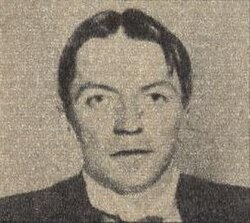
Kaj Harald Leininger Munk (commonly called Kaj Munk; 13 January 1898 – 4 January 1944) was a Danish playwright and Lutheran pastor, known for his cultural engagement and his martyrdom during the Occupation of Denmark of World War II. He is commemorated as a martyr in the Calendar of Saints of the Lutheran Church on 14 August, alongside Maximilian Kolbe.[1]

Key Information

Biography

[edit]

He was born Kaj Harald Leininger Petersen on the island of Lolland, Denmark, and raised by a family named Munk after the death of his parents. From 1924 until his death, Munk was the vicar of Vedersø in Western Jutland.[2] Munk's plays were mostly performed and made public during the 1930s, although many were written in the 1920s. Much of his other work concerns the "philosophy-on-life debate" (religion—Marxism—Darwinism) which marked much of Danish cultural life during this period.[citation needed]

On one occasion, in the early 1930s, in a comment that came back to haunt him in later years, Munk expressed admiration for Hitler (for uniting Germans) and wished a similar unifying figure for Danes.[3] However, Munk's attitude towards Hitler (and Mussolini) turned to outspoken criticism as he witnessed Hitler's persecution of the German Jewish community, and Mussolini's conduct of the war in Ethiopia. In 1938, the Danish newspaper Jyllands-Posten published on its front page an open letter to Benito Mussolini written by Kaj Munk criticising the persecutions against Jews.[2]

Early on, Munk was a strong opponent of the German Occupation of Denmark (1940–1945), although he continually opposed the idea of democracy as such, preferring the idea of a "Nordic dictator" who should unite the Nordic countries and keep them neutral during periods of international crisis. His plays Han sidder ved Smeltediglen ("He sits by the melting pot") and Niels Ebbesen were direct attacks on Nazism. The latter, centering on the figure of Niels Ebbesen, a medieval Danish squire considered a national hero for having assassinated an earlier German occupier of Denmark, Count Gerhard III, was a contemporary analogue to World War II-era Denmark. Despite his friends urging Munk to go underground, he continued to preach against Danes who collaborated with the Nazis.[citation needed]

The Gestapo arrested Munk on the night of 4 January 1944, a month after he had defied a Nazi ban and preached the first Advent sermon at the national cathedral in Copenhagen. Munk's body was found in a roadside ditch in rural Hørbylunde near Silkeborg the next morning with a note stating, "Swine, you worked for Germany just the same."[4]

Munk's body was returned to his parish church, Vedersø, where it is buried outside the choir.[5] A simple stone cross was also erected on a small hill overlooking the site where Munk's body was dumped.[6]

Half of the January 1944 issue of the resistance newspaper De frie Danske was dedicated to Munk with his portrait filling the front page. The obituary Danmarks store Søn—Kaj Munk (The great son of Denmark—Kaj Munk) filled the next page, followed by excerpts from a new year's sermon he had given. Next came a description of his murder and a photo reportage from his funeral. Lastly the paper featured condemning reactions from influential Scandinavians, namely Prince Wilhelm, Duke of Södermanland, Jarl Hemmer, Johannes Jørgensen, Sigrid Undset, Erling Eidem and Harald Bohr.[7]

The Danish government allowed his widow, Lise, to live at the parish house until she died in 1998. The church and parish house were restored as a memorial and opened to the public in 2010.[8]

Playwright

[edit]

Munk often used a historical background for his plays—among his influences were William Shakespeare, Adam Oehlenschläger, Henrik Ibsen, and George Bernard Shaw.[9] As a playwright, Munk became known for "strong characters"—integrated people who fight wholeheartedly for their ideals (whether good or bad). In his play En Idealist, for example, the "hero" is King Herod whose fight to maintain power is the motive behind all of his acts until he is at last defeated by a show of kindness to the Christ child in a weak moment.[10]

His 1925 play Ordet (The Word) is generally considered to be his best work; it is an investigation of miracles from the unique (at least, to theatre) viewpoint of one who was not prepared to dismiss them. A family of farmers—of differing degrees of faith—find themselves reconciled to their neighbours through a miracle. A 1943 film adaptation titled The Word was directed by Gustaf Molander. A 1955 film version of Ordet was directed by Carl Theodor Dreyer, and won numerous awards, including the Golden Lion at the 16th Venice International Film Festival and the 1956 Golden Globe Award for Best Foreign Language Film.[11][citation needed]

Munk's plays, many of which have been performed at the Royal Theatre, Copenhagen, and elsewhere, include:

His play Niels Ebbesen has been translated into English (2006) by his granddaughter Arense Lund and Canadian playwright Dave Carley.[12]

See also

[edit]

References

[edit]
[edit]
Revisions and contributorsEdit on WikipediaRead on Wikipedia
from Grokipedia
Kaj Harald Leininger Munk (13 January 1898 – 4 January 1944) was a Danish Lutheran pastor and whose works infused modern Danish with Christian existential themes and whose vocal opposition to Nazi occupation marked him as a resistance symbol, culminating in his execution by Danish collaborators under direction. Born in to working-class parents and orphaned by age five, Munk was adopted by relatives who gave him their surname; after theological studies at the , he was ordained in 1924 and assigned to the rural Vedersø parish in western , where he ministered for two decades while pursuing literary endeavors. His dramatic output, exceeding a dozen plays, peaked in the 1930s with successes like Cant (1931), a historical piece on , and (The Word, written 1925, staged 1932), a miracle play set among peasants that explored faith's redemptive potential and was twice adapted into films by . Though early writings reflected admiration for authoritarian figures like Mussolini as bulwarks against and moral decay, Munk's orthodox compelled rejection of Nazism's pagan racialism and anti-Semitism, especially post-1940 occupation; he channeled critiques through sermons, , and allegorical dramas such as Niels Ebbesen, a tale of circulated underground, and veiled Hitler satires that provoked surveillance. On 4 January 1944, en route from , Munk was abducted near by members of the Schalburg Corps—a Danish Nazi unit—and shot; his body, discovered the next day with a note declaring "Swine, you worked for ," galvanized Danish defiance against .

Early Life and Formation

Orphanhood and Upbringing

Kaj Harald Leininger Petersen was born on January 13, 1898, in on the island of Lolland, , to Carl Petersen, a tanner of modest rural means, and his wife Mathilde. His father died in 1899 when Kaj was one year old, and his mother followed in 1903, orphaning him at age five and thrusting him into early instability amid a working-class context. Following the loss of his biological parents, young Kaj was placed in the care of his mother's childless cousin, Marie Munk, and her husband Peter Munk, who lived in the rural village of Opager, approximately 16 kilometers south of Maribo. This adoptive household provided a stable, pietistic Lutheran environment characterized by rigorous moral discipline, fervent religious devotion, and encouragement of intellectual curiosity, which shaped his emerging character through immersion in church life and the rhythms of agrarian Denmark. Formally adopted by the Munks in 1916, he took their surname, marking a legal and symbolic integration into their family and faith tradition. The combination of early bereavement and subsequent nurturing in a devout, insular rural setting fostered personal resilience and a profound sense of Danish cultural rootedness, laying causal groundwork for his lifelong engagement with Lutheran and without mitigating the enduring psychological imprint of orphanhood.

Education and Path to Ministry

Munk completed his at State School and , institutions that provided a classical grounding in and . During his studies at , he displayed precocious literary aptitude by authoring the Pilatus in 1917, a work reflecting his interest in moral and historical themes, though it remained unpublished until 1937. In 1917, at age nineteen, Munk matriculated at the University of Copenhagen to pursue theological studies, a decision aligned with his deepening commitment to Lutheran Christianity amid competing literary aspirations. He graduated with a cand.theol. degree in 1924 after seven years of rigorous examination in biblical exegesis, church history, and systematic theology, culminating in ordination as a pastor in the Church of Denmark. Munk's theological training emphasized a personal, existential confrontation with faith, drawing heavily from Søren Kierkegaard's critique of institutionalized religion and insistence on subjective truth, which fostered a rooted in individual accountability to divine absolutes rather than cultural accommodation. Complementing this was the influence of N.F.S. Grundtvig's traditions, particularly through exposure to ideals that prioritized living Christian experience and national spiritual renewal over abstract dogma or secular rationalism prevalent in early 20th-century academia. This synthesis equipped Munk to view ministry not as rote clerical duty but as a prophetic call demanding unflinching adherence to scriptural principles against modern dilutions.

Pastoral Career

Service in Rural Denmark

In 1924, following his , Kaj Munk accepted the position of at Vedersø Church, a small rural parish in western near the coast, where he remained until his murder in 1944. This remote location, characterized by sparse population and harsh coastal conditions, presented challenges for work, yet Munk committed to serving its farming and fishing families through routine duties such as conducting services, baptisms, confirmations, and funerals. His tenure marked a period of personal embedding in local Danish life, as he and his wife raised five children amid the everyday rhythms of vicarage existence, fostering a noted for its vitality with children, dogs, and communal gatherings. Munk's approach emphasized direct community integration, rejecting urban detachment in favor of hands-on immersion in Jutland's agrarian culture; he participated in local customs, including hunting expeditions that informed his writings and strengthened ties with parishioners. This self-reliant ethos was evident in his establishment of a functional home base at the vicarage, which, though rebuilt decades earlier after an 1881 fire, became a hub for family and parish life under his stewardship starting in 1924. By prioritizing moral guidance rooted in Lutheran tradition alongside practical support for rural hardships—such as aiding families during economic strains—Munk cultivated loyalty among locals, who regarded him as an approachable figure amid Denmark's interwar rural decline. The empirical impact of Munk's service included heightened engagement, as his pastoral presence correlated with increased local participation in church activities, reflecting his ability to connect evangelical imperatives with the concrete realities of existence. Attendance at services grew beyond routine obligations, attributable to his reputation for addressing , redemption, and personal accountability in ways resonant with community values, though quantitative records from the era remain limited. This revitalization underscored Munk's success in merging faith with everyday Danish ruralism, positioning the as a microcosm of resilient, independent communal life rather than state-dependent welfare.

Theological Influences and Preaching Style

Munk's theology was firmly anchored in Lutheran confessionalism, emphasizing the sovereignty of Christ and the church as ecclesia militans—the militant, actively engaged body of believers confronting worldly powers through obedience to divine truth—rather than a triumphant or complacent institution. This doctrinal core drew from Søren Kierkegaard's existential insistence on personal faith and the leap beyond rationalism, as evident in Munk's portrayal of orthodox belief triumphing over skepticism in works like , where a Kierkegaard-obsessed character embodies living faith in miracles against modern doubt. He explicitly rejected liberal theology's accommodations to cultural and , denouncing its tendency to dilute scriptural authority in favor of human-centered ethics or material progress, positioning instead as a radical call to self-sacrificial alignment with God's kingdom. Pietistic elements from his upbringing reinforced a focus on inner conviction, but Munk critiqued overly introspective or bibliocentric for insufficiently engaging broader . His preaching style employed dramatic, prophetic , leveraging his background as a to infuse sermons with theatrical intensity and vivid biblical imagery that pierced parishioner complacency. Rather than abstract exposition, Munk confronted listeners directly with scriptural narratives—such as judgments in Matthew 8:11-12—to expose contemporary moral decay, framing ethical lapses as betrayals of covenant fidelity akin to ancient Israel's failures. Sermons often built to climactic appeals for truth-telling and spiritual vigilance, eschewing gentle persuasion for bold pronouncements that demanded immediate response, as in his insistence on proclaiming unvarnished reality where others faltered. Central to Munk's doctrinal vision was a robust form of stressing personal and communal as the essence of discipleship, countering individualistic or pacifist dilutions with calls for national spiritual renewal through costly obedience. He articulated this as " is onto death," prioritizing the kingdom's advance over self-preservation and viewing complacency as a gateway to decay. This emphasis on renewal rejected secularism's materialist , insisting that true vitality stemmed from rediscovering anchors amid cultural erosion.

Literary Contributions

Major Plays and Writings

Kaj Munk's debut play, En idealist (An Idealist), was written between 1923 and 1924 and premiered in 1928 at the Royal Theatre in . The work, published that year by H. Aschehoug & Company, examined the figure of in 128 pages. Munk achieved his theatrical breakthrough with Cant, a drama centered on and , published in 1931 by Nyt Nordisk Forlag. The play premiered on October 10, 1931, at Stærekassen Theatre in under the direction of Svend Methling, with Johannes Poulsen portraying . Ordet (The Word), written in 1925, was first produced in 1932 as a modern miracle play set among peasants in West Jutland. The drama, which ran in traditional form, contributed to Munk's recognition as a leading Danish during revival. In 1938, Munk released Han sidder ved smeltediglen (He Sits by the Melting Pot), a play amid rising European tensions. This work, like others, employed verse elements and was performed in Danish theaters. Munk's oeuvre encompassed over a dozen plays alongside essays, sermons, speeches, and poems, with total sales exceeding 100,000 copies in . His dramas, often in verse, were staged widely in , and , incorporating accessible modern production methods while adhering to ethical and historical structures.

Themes of Faith, History, and Human Struggle

Munk's dramas recurrently depict the interplay between divine providence and human vulnerability, framing historical personages as symbolic tests of ethical resolve amid authoritarian pressures. In works such as The Word, this manifests through the transformative potency of authentic Christian belief amid personal and communal failings, underscoring faith's capacity to transcend mortal limitations. Such portrayals root in a Lutheran emphasis on grace countering innate frailty, where characters confront existential perils not as isolated absurdities but as arenas for divine intervention and moral agency. Blending parochial Danish heritage with transcendent Christian precepts, Munk's oeuvre elevates personal before over class-based antagonisms, as evident in his advocacy for resolute against materialist collectivisms. This spiritual particularism rejects secular utopias, positing ethical fidelity to eternal truths as the antidote to ideological subsumption. Historical motifs serve didactic ends, illuminating perennial clashes between temporal powers and immutable , thereby instructing readers on principled defiance rooted in covenantal obligation rather than pragmatic expediency. Munk assailed contemporary secularization's dissolution of venerable customs and authoritative hierarchies, deeming modern democratic processes deficient in furnishing unequivocal moral direction and prone to dilatory deliberation devoid of transcendent anchoring. He championed audacious —mirroring biblical and legendary martyrs—as superior to ameliorative bargaining or prosperity pursuits, viewing such sacrifices as restorations of heroic vitality against enervating . This valorization of sacrificial , informed by his conviction in truth's uncompromising demands, distinguishes his dramatic vision from relativistic modernisms by affirming objective Christian verities over subjective accommodations.

Political and Ideological Evolution

Initial Sympathies Toward Strong Leadership

In the early 1930s, Kaj Munk articulated sympathies for strong authoritarian leadership as a corrective to the perceived frailties of , particularly its tendencies toward political fragmentation and cultural stagnation in . He praised Benito Mussolini's consolidation of power in , describing him in 1935 as a "genius" who served as the "saviour of Italy" by imposing order and reviving national purpose after years of division. This admiration extended to Mussolini's fascist model as a potential bulwark against and ineffective parliamentary systems, which Munk critiqued in Danish contexts as yielding little beyond inertia. Munk similarly expressed approbation for Adolf Hitler's early achievements in restoring German discipline and unity, viewing them as a vigorous response to the Weimar Republic's economic and social disarray. In his 1934 travelogue Gennem Hitlers Tyskland (Through Hitler's Germany), he declared, "No Dane can honour Hitler’s deed more than I," highlighting the chancellor's energy in mobilizing the nation toward renewal and contrasting it with Denmark's "weak" democratic processes, which Munk likened to a mere "gramophone record" in a 1933 article. These views reflected Munk's broader disdain for majority-rule governance, termed a "majority dictatorship" in 1936, and his hope that resolute figures could enact a Christian-infused national revival amid interwar chaos. While drawn to concepts of Nordic cultural and racial cohesion to strengthen regional solidarity against broader European decline—Munk advocated in his 1938 essay "Saml dig, Nord! Til eet Rige" ("Unite, North! Into One Realm") for a unified Nordic entity under singular leadership—he delimited his endorsements by rejecting Nazi excesses. As early as 1933, he decried German anti-Semitism in writings such as "Guds grønne Enge og det Tyske Jødehad" ("God's Green Meadows and German Jew-Hatred"), and in 1935 he issued an open letter condemning Mussolini's invasion of as imperial overreach incompatible with ethical governance. These critiques underscored Munk's , grounded in Danish heritage and Christian liberty, which began fostering reservations about totalitarianism's potential to erode individual freedoms even before the late 1930s.

Shift to Anti-Totalitarian Critique

By the late , Munk's direct engagement with fascism's empirical manifestations—such as its promotion of pagan revivalism and erosion of ecclesiastical independence—led him to repudiate its core idolatrous tendencies in favor of uncompromised Christian orthodoxy. Having initially viewed authoritarian figures like Mussolini as bulwarks against Bolshevik chaos, he increasingly observed how fascist regimes subordinated spiritual authority to state absolutism, a dynamic he deemed incompatible with biblical . In his journalistic pieces and dramatic works, Munk articulated this rejection, portraying political power as derivative from divine order rather than an end in itself, thereby critiquing the elevation of the collective state over personal . Munk's opposition extended to the era's strategies, which he lambasted in articles as morally bankrupt concessions that emboldened aggressors, invoking prophets like and Nathan who confronted kings without regard for temporal consequences. Writing amid rising tensions, such as Germany's annexation of and subsequent pogroms, he contended that Danish and broader European neutrality not only failed to deter evil but actively facilitated its entrenchment by abdicating ethical duty. This stance reflected a causal realism: passivity, he argued, yields causal chains of unchecked tyranny, demanding instead principled defiance rooted in scriptural imperatives for justice. Underpinning this evolution was Munk's insistence on the inviolability of individual against totalitarian encroachments, which he viewed as systematically dismantling the human capacity for transcendent . Totalitarian systems, in his , coerced through and force, suppressing the prophetic voice essential to Christian —a theme he explored without veering into endorsements of egalitarian collectivism, which he equally distrusted for diluting personal responsibility. This focus prefigured an ethos of active ethical resistance, grounded in the belief that , informed by , must override state mandates when they conflict with higher truths.

Resistance Against Nazi Occupation

Public Denunciations and Writings

Following the German invasion of Denmark on April 9, 1940, Kaj Munk utilized his position as a regular contributor to and his pulpit to voice opposition to the occupation, framing it as a profound moral and spiritual threat that demanded resistance rooted in Christian principles. His articles and essays in the newspaper, while navigating , emphasized the incompatibility of Nazi ideology with Danish values and urged intellectual and ethical defiance rather than passive acceptance. Munk's sermons during this period escalated in directness, portraying the occupation as an affront to and invoking biblical mandates for confronting ; a collection of 25 such wartime addresses documents his progressive sharpening of critique against the German authorities and their local enablers. These homilies, delivered in his at despite , stressed spiritual resilience and the duty of believers to reject , with thousands attending in acts of that underscored their role in sustaining morale. In one notable instance in November 1943, defying Nazi prohibitions, Munk preached an Advent at Copenhagen's national cathedral, explicitly challenging the occupiers' legitimacy. Complementing his prose, Munk's dramatic works served as veiled yet potent indictments of collaboration and tyranny. His 1942 play Niels Ebbesen, depicting a 14th-century Jutland hero's slaying of an oppressive German count, functioned allegorically to equate Nazi rule with historical foreign domination, implicitly condemning Danes who accommodated the regime. Staged amid tightening controls, it drew capacity crowds whose enthusiastic reception signaled widespread interpretive alignment with anti-occupation sentiments, amplifying Munk's influence through cultural channels.

Advocacy for Active Opposition

By 1943, following the Danish government's resignation on amid widespread strikes and , Kaj Munk shifted toward endorsing against the Nazi occupation, publicly supporting disruptive actions such as in his sermons and writings as necessary to counter escalating brutality. He argued that mere verbal opposition or passive endurance failed to deter aggression, favoring strategies rooted in national honor and the causal reality that unresisted tyranny expanded, over the government's prior accommodationist approach which prioritized temporary stability. Munk criticized this policy as a capitulation that undermined Danish and enabled , viewing with occupiers as a betrayal of core ethical traditions. In a delivered in Copenhagen's , Munk called for insurrection, invoking the on the Danish to lead into "that Nordic struggle," thereby framing resistance as a collective imperative transcending pacifist ideals. Theologically, he justified defensive violence by asserting that Christian love demanded protection of the vulnerable against unrepentant evil, declaring, "Christians MUST NEVER BE PACIFISTS in the face of evil," as inaction equated to in . This stance prioritized empirical with Nazi over abstract non-violence, aligning with a realist assessment that only tangible opposition could preserve human dignity and heritage. Munk's engagement extended to practical coordination, as through his leadership in the Danish Unity resistance network, he facilitated contacts with British Special Operations Executive agents, aiding intelligence flows and bolstering underground efforts. He particularly urged youth involvement, portraying active defiance as a duty to safeguard Judeo-Christian values and national independence against totalitarian erosion, rather than yielding to pragmatic concessions that eroded resolve.

Assassination and Martyrdom

Events Leading to Death

Following the premiere of his play Niels Ebbesen in September 1943, which drew parallels between medieval Danish resistance to foreign tyranny and the contemporary Nazi occupation, Kaj Munk faced heightened monitoring and censorship efforts. The production, attended by over 100,000 viewers before its prohibition, amplified his reputation as a moral adversary to German rule, prompting authorities to track his movements and sermons more closely. Munk declined suggestions from associates to seek safety abroad or curtail his activities, resuming preaching in defiance of explicit prohibitions, including a banned address at Copenhagen's national cathedral in that decried and passivity under occupation. This persistence, coupled with his writings' role in bolstering public resolve, marked him as an intolerable influence on Danish morale. Warnings of imminent danger reached him via intermediaries, yet he returned to his rural parish in Vedelshave, prioritizing his congregational responsibilities. On the evening of January 4, 1944, a squad from the Peter Group—a Danish-German unit affiliated with the Schalburg Corps—arrived at Munk's home, where his wife and mother-in-law were present. The assailants, numbering around 10-12 men in civilian attire, forcibly removed him without resistance after a brief exchange, driving him toward for interrogation regarding his subversive activities. En route, they halted at a roadside ditch, where Munk was shot multiple times in the back following questioning that confirmed his unyielding opposition; the perpetrators affixed a sign reading "Swine, you worked for " to his body before fleeing. Post-war interrogations of , including leader Flemming Helweg-Larsen, revealed the operation's authorization stemmed from directives to neutralize high-profile figures whose rhetoric undermined Nazi authority and encouraged sabotage, independent of specific retaliatory "clearing" pretexts.

Discovery and Immediate Impact

Kaj Munk's body was discovered on January 5, 1944, in a roadside ditch near , , following his abduction the previous evening. Attached to his clothing was a note reading "Swine, you worked for Germany just the same," intended to falsely implicate elements of the Danish resistance in the . Historical evidence, including perpetrator confessions and operational records, confirms the assassination was carried out by a unit of the German under direction. The revelation ignited immediate public fury throughout , with news spreading rapidly despite . German authorities prohibited a public funeral, yet approximately 4,000 attended the service on , , at Munk's in Vedersø, braving risks of to demonstrate . This gathering evolved into a de facto , underscoring Munk's status as a of defiance. Danish church leaders issued vehement protests, portraying Munk's as a Christ-like martyrdom against totalitarian tyranny and prophetic to the moral of resistance. These ecclesiastical responses, coupled with broader intellectual outrage, intensified national resolve, correlating with a surge in acts and labor unrest in the ensuing months, alongside escalated German reprisals and covert Allied coordination.

Legacy and Controversies

Post-War Recognition in Denmark and Abroad

Following , Kaj Munk's vicarage in Vedersø was established as Kaj Munks Præstegård, a preserving his life, writings, and role in the Danish resistance, attracting visitors to exhibitions on his multifaceted career as pastor and . Annual commemorations, including services and wreath-layings at his grave in Vedersø Church cemetery, have honored his martyrdom since 1945, underscoring his contributions to 's liberation and its postwar status as an allied partner. Internationally, Munk emerged as a symbol of Christian resistance to , with his plays achieving acclaim through translations, including English versions of Niels Ebbesen (2006) and collections of five major works published by the American-Scandinavian Foundation. Scholarly comparisons to highlight parallels in their Lutheran opposition to Nazi ideology, as explored in volumes framing both as exemplars of faith-driven defiance. Munk's legacy retains particular resonance in conservative Christian communities, where his integration of theological conviction with active anti-totalitarian action—prioritizing spiritual authority over secular compromise—serves as a model distinct from ideological alternatives prevalent in postwar . The Lutheran Church's designation of him as a , with commemoration on alongside figures like , reinforces this enduring influence.

Debates Over Nationalism and Initial Fascist Leanings

Supporters of Munk emphasize his resolute opposition to Nazi occupation during as evidence of principled , positioning his ideology as a bulwark against totalitarian extremes on both the political left and right. This perspective frames his early interest in strong leadership not as endorsement of but as a reaction to perceived democratic weaknesses in interwar , ultimately redeemed by his public denunciations of German atrocities and advocacy for active resistance. Critics, particularly post-war leftist intellectuals in Denmark, have pointed to Munk's expressed admiration for Benito Mussolini in the 1930s—whom he described in 1935 as Italy's savior and a genius—as indicative of proto-fascist sympathies that undermine claims of ideological consistency. They argue this enthusiasm for authoritarian vigor, coupled with brief positive remarks on Adolf Hitler's unification of Germans, reflects an affinity for dictatorial models despite Munk's later anti-racist actions, such as protesting Jewish persecution, which some dismiss as insufficient to negate earlier leanings. Such views contributed to Munk being labeled a Nazi sympathizer in the late 1950s, resulting in decades of neglect for his works until renewed interest in the 1990s. More balanced scholarly assessments characterize Munk's Danish as a defensive focused on cultural and spiritual renewal rather than imperial expansion or , distinguishing it from fascist variants. Recent Danish analyses, including examinations of his vitalist influences and "strong man" , reject over-politicized interpretations by highlighting his causal rejection of totalitarianism's dehumanizing core—evident in his shift against Hitler upon observing anti-Semitic policies—while acknowledging context of widespread European fascination with decisive leadership amid economic turmoil. These studies, often from university-affiliated projects, prioritize archival evidence of Munk's writings over retrospective ideological projections, countering earlier partisan critiques with emphasis on his consistent prioritization of individual over state absolutism.

References

Add your contribution
Related Hubs
User Avatar
No comments yet.